Introduction
Hi, I'm cardene, a software engineer and technical writer focused on blockchain and AI.
I've also authored Japanese technical books on specification-driven development with LLMs and decentralized application (DApp) development.

I also build and publish a variety of tools, libraries, and open-source projects.
When AI agents search for capabilities or rewarded tasks, descriptions alone cannot establish the current owner, payment recipient, or deposited reward. ERC8444 attaches on-chain evidence to ordinary search results so these facts can be rechecked before use.
As of October 17, 2026, the proposal was in Draft status.
This article covers the underlying discovery mechanism, all APIs, the official reference implementation, tests, and security considerations.
The official specification is available below.

Overview
Consider a travel-planning AI agent looking for a flight-search capability and someone offering a reward for preparing an itinerary. Even if the search results mention a booking API or 100 USDC reward, the descriptions alone cannot establish whether the current owner approves those terms or whether the reward is actually deposited. If an old owner's payment address remains listed, an agent might find the correct capability but pay the wrong recipient.
Agentic Resource Discovery (ARD) is a common mechanism for collecting publicly available Web information and discovering AI capabilities or endpoints through natural-language queries.
ERC8444 does not replace ARD.
It connects ARD results to on-chain information about tokens, task rewards, agent identities, and discovery-service operators.
A provider publishes a descriptor and records a hash derived from its contents on-chain. A discovery service retrieves the descriptor and checks it against the recorded hash, current owner, value backing, and relationship with the publishing domain. A consuming agent evaluates search relevance separately from on-chain evidence when choosing a candidate.
Discovering capabilities and rewarded tasks
With ARD, a consuming agent can submit a natural-language query such as image generation on Base payable in USDC.
The discovery service returns entries representing capabilities, APIs, agents, or other resources.
An entry is a JSON search result describing a resource and its publisher.
ERC8444 supports discovering not only providers of capabilities but also parties requesting work. A rewarded task can specify the required deliverable format, reward, deadline, and acceptance criteria. An agent offering a service can discover tasks compatible with its capabilities and requirements.
Connecting search results with on-chain information
An anchor is the on-chain object connecting a search description to verifiable information.
Examples include an NFT representing a capability, an NFT representing an escrow-backed task, or an address representing an agent.
A record is an on-chain entry storing a descriptor hash and proposed public name for an anchor.
The ARD entry containing the resource description is called a descriptor.
The current controller hashes the members describing the offered terms and registers that hash in the record.
If the retrieved descriptor's committed contents are modified, the resolver detects a hash mismatch.
Different anchor types require different ways of reading existing contracts.
An adapter provides a common interface for reading whether an anchor exists, who currently controls it, whether it is backed, and what value should be compared against the descriptor.
The adapter does not duplicate the underlying state; it reads the target contract's current values when called.
A resolver retrieves documents, verifies them against on-chain information, and enriches search results.
A resolver that also exposes an ARD search API is called a gateway.
From discovery to a usage decision
Discovery and selection proceed as follows.
- The provider publishes a descriptor, and the current controller commits its content hash to the record.
- The gateway reads the record and adapter and retrieves the descriptor and public domain documents.
- The resolver checks the hash, current controller, domain relationship, and backing.
- The gateway includes eligible, consistent entries in ordinary ARD search results.
- The consumer separately evaluates relevance, status, controller adoption, and backing.
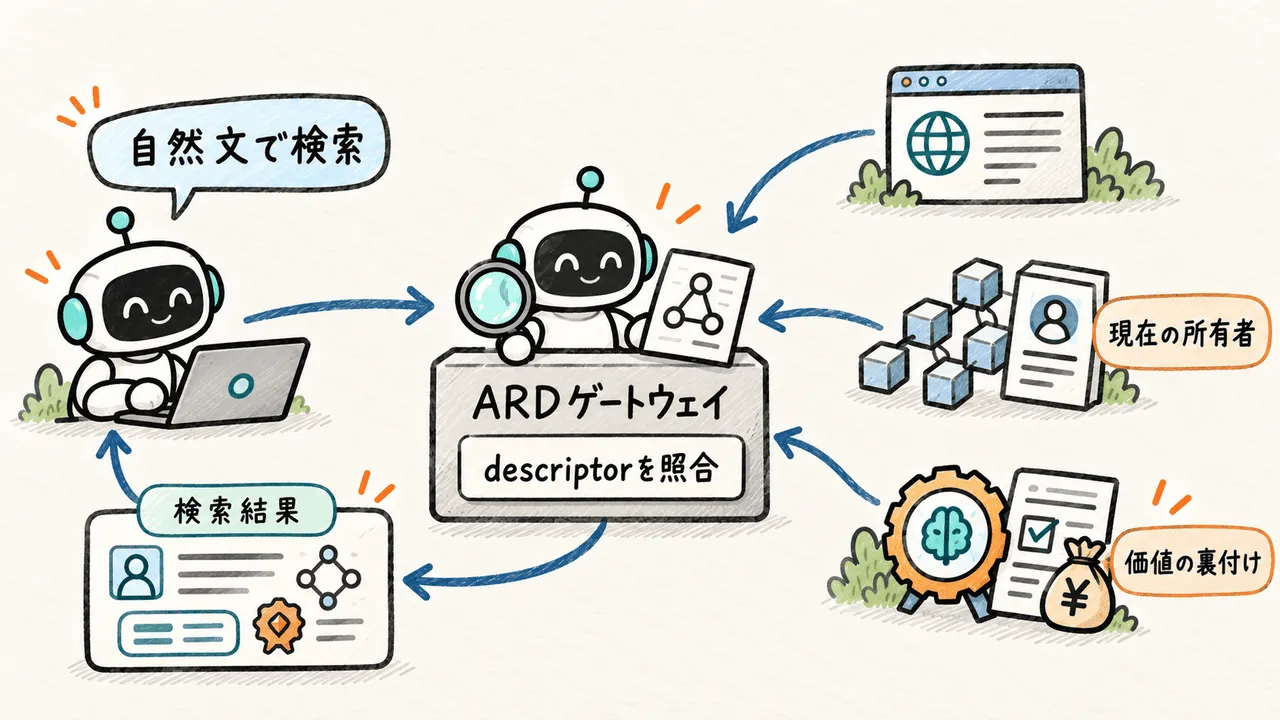
A relevance score measures how well a result matches a query; it is not a trust score. Records not adopted by the new controller after transfer, and retired records, are excluded from search results.
The specification version discussed here does not unambiguously establish whether suspended records appear in search results or which level applies to them.
The reference gateway treats suspension as numerical level 0, but this should not be interpreted as a normative requirement.
Consumers should inspect status and adoption separately and avoid treating suspended offers as active candidates.
Motivation
ARD provides discovery of capabilities advertised by publishers. It does not itself define prices, payments, deposited rewards, or credit information. ERC8444 preserves ordinary ARD entries while allowing value-related facts to be read from existing contracts.
Value information not established by discovery alone
A description of image-generation capabilities does not establish the price of a call or the payment recipient. Similarly, a task advertising a reward of 100 USDC does not establish whether the reward remains escrowed or the task remains open.
Duplicating financial information into a discovery registry could introduce discrepancies with the underlying contract's balance or state. ERC8444 stores a descriptor commitment in the record and reads balances and ownership live from the underlying contract through an adapter. The discovery registry is not a second authoritative source of financial state.
Separating domains from payment addresses
The entity controlling a Web domain need not be the entity controlling the address receiving funds. Giving both identical authority could let a domain publish prices not approved by the address controller, or let an address claim a domain name without permission.
ERC8444 uses the address controlling the funds or anchor as the starting point for value-related information. A domain adds evidence of its relationship with that address by acknowledging it in a public document. A domain publisher without a private key can still publish ordinary ARD entries, which remain discoverable without on-chain backing.
Discovering demand through rewarded tasks
Ordinary ARD discovery focuses on finding capabilities a consumer wants to use.
An ERC8444 task entry describes requested work and a reward for satisfying its acceptance criteria.
Requesters can publish the required deliverable format, reward, deadline, review mechanism, and eligibility requirements. A service-providing agent can discover who needs its capabilities. Deliverable submission, evaluation, and reward release are outside ERC8444's scope.
Preventing stale descriptions after transfers
Selling a capability NFT does not automatically change the descriptor hash in its record. Continuing to serve that descriptor could incorrectly imply that the buyer endorses the previous owner's endpoint, terms, or payment recipient. The same issue arises if an NFT is transferred to an address that did not request it.
ERC8444 compares the address that last committed the descriptor with the current controller. Exclude the record from search while these addresses differ. It can reappear when the new controller commits the same or a new descriptor hash.
Specification
Four kinds
The kind categorizes the role a resource plays in the discovery and transaction ecosystem.
It is distinct from ARD's type, which identifies the data format.
kind |
Role | Anchor | Current controller | Backing condition |
|---|---|---|---|---|
skill |
Capability provider | Token representing an executable capability | Token owner | Package hash exists |
task |
Rewarded request | Token representing a rewarded task | Token owner | Not canceled, reward available, within deadline |
agent |
Transaction participant | Address | The address itself | Active in an identity registry |
registry |
Discovery service | Operator address and discriminator | The address itself | Never backed |
Every registry instance supports the four kinds: skill, task, agent, and registry.
New JSON formats do not require adding new kinds.
The names assertion, policy, and market are reserved for future use.
Derive kind IDs using the following formula.
bytes32 kindId = keccak256("ard-onchain.kind.<name>");Anchors and records
An anchor is a tuple (chainId, target, id).
Token anchors are represented using CAIP-19, identifying the chain, token contract, and token ID. Address anchors use CAIP-10 to identify the chain and address.
These formats identify the chain and contract or address that consumers need to verify.
Derive the record ID from the anchor using the following formula.
recordId = keccak256(abi.encode(block.chainid, target, id));Only one record may be registered for an anchor. A second record cannot be registered by supplying a different kind. The same token contract address and ID on another chain represent a different anchor.
An ARD public name has the form urn:air:<publisher>:<namespace>:<name>.
The URN is an alias; record identity is determined by the anchor.
It can be used as a canonical name only while the current controller's relationship with the publisher domain is verified and that domain's manifest includes the same URN.
Gateways can create aliases resolvable under their own domains.
Even if gateways return different aliases, consumers compare value:anchor to determine whether they refer to the same record.
Descriptor verification
A descriptor is an ARD entry containing a display name, endpoint, description, and offered terms. The current controller canonicalizes the content-related members, calculates their SHA-256 hash, and stores it in the record.
Information included in the hash
Descriptor members fall into three categories.
| Category | Principal members | Included in hash | Reason |
|---|---|---|---|
| Publisher metadata | identifier, trustManifest, @context, @id |
No | Allows gateway-specific aliases and publication metadata |
| Content | displayName, type, url or data, description, terms |
Yes | Commits to what the controller offers or requests |
| Resolver-computed values | value:anchor, binding, level, status, adopted, and related values |
No | Recomputed using current chain and domain information |
Content members are canonicalized using RFC 8785, JSON Canonicalization Scheme (JCS).
JCS produces deterministic bytes for the same JSON data independently of whitespace and object-member order.
Apply SHA-256 to the resulting UTF-8 bytes to obtain descriptorHash.
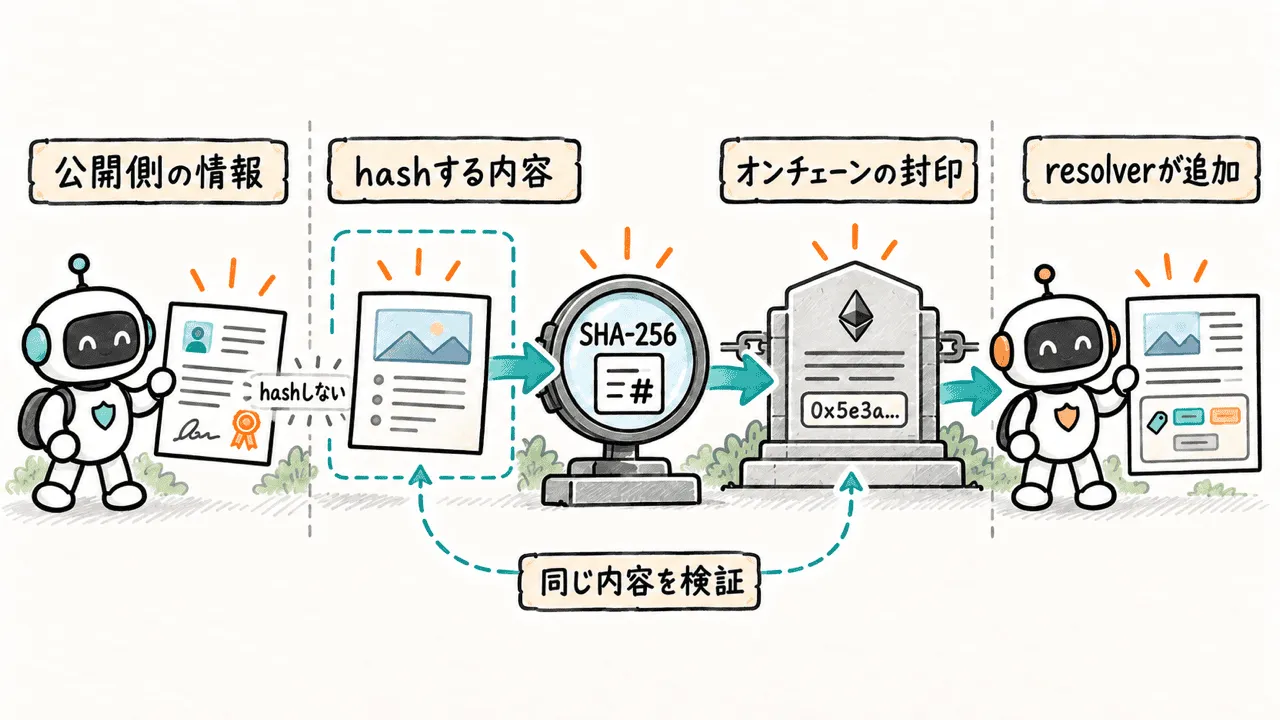
descriptorURI is a retrieval hint, not a trust guarantee.
If the document cannot be retrieved or its hash does not match, the resolver cannot serve it as a consistent record.
JSON for offered terms and rewarded tasks
The controller may publish the following additional members.
| Member | Information for consumers |
|---|---|
value:kind |
Whether the entry represents a capability, rewarded task, participant, or discovery service |
value:controller |
Publisher-declared controller; not used as the authoritative authorization check |
value:terms |
Capability units, price, currency, and supply |
value:settlement |
On-chain, x402, or declared payment rail and recipient |
value:provenance |
Package and published card digests |
value:credit |
External credit registry and level |
value:dispute |
Dispute-resolution policy and registry |
value:eligibility |
Eligibility requirements for task applicants |
value:registration |
Agent registration file |
value:indexes |
Registry instances indexed by the discovery service |
A task payload uses application/ai-task+json.
The wants member identifying the deliverable format and bounty specifying the reward amount and currency are required.
Deadlines, quantity, review mechanism, and eligibility requirements may be added.
Such an entry can be valid ARD content without an on-chain record, allowing publication of domain-only rewarded tasks.
Domain Binding
A binding indicates the relationship between a domain and an address.
The resolver compares the address's on-chain claim with the domain's Web acknowledgment.
Onchain claim
An address stores a declaration in the registry claiming an association with the specified domain. The address may submit the transaction directly or authorize another party to submit a signature.
Use a normalized domain of 1–253 bytes containing lowercase ASCII letters, digits, hyphens, and periods. Leading and trailing periods and empty labels are invalid. Convert internationalized domains to punycode before submitting them.
Multiple addresses may claim the same domain. The registry stores each address's claim without adjudicating actual domain ownership.
Domain acknowledgment
A domain acknowledges an address by listing it in /.well-known/ard.json.
It may appear in the top-level manifest's value:controllers or an entry's value:controller.
The chain cannot directly read an HTTPS manifest. Instead of storing a verified judgment in the registry contract, the resolver combines the on-chain claim and manifest.
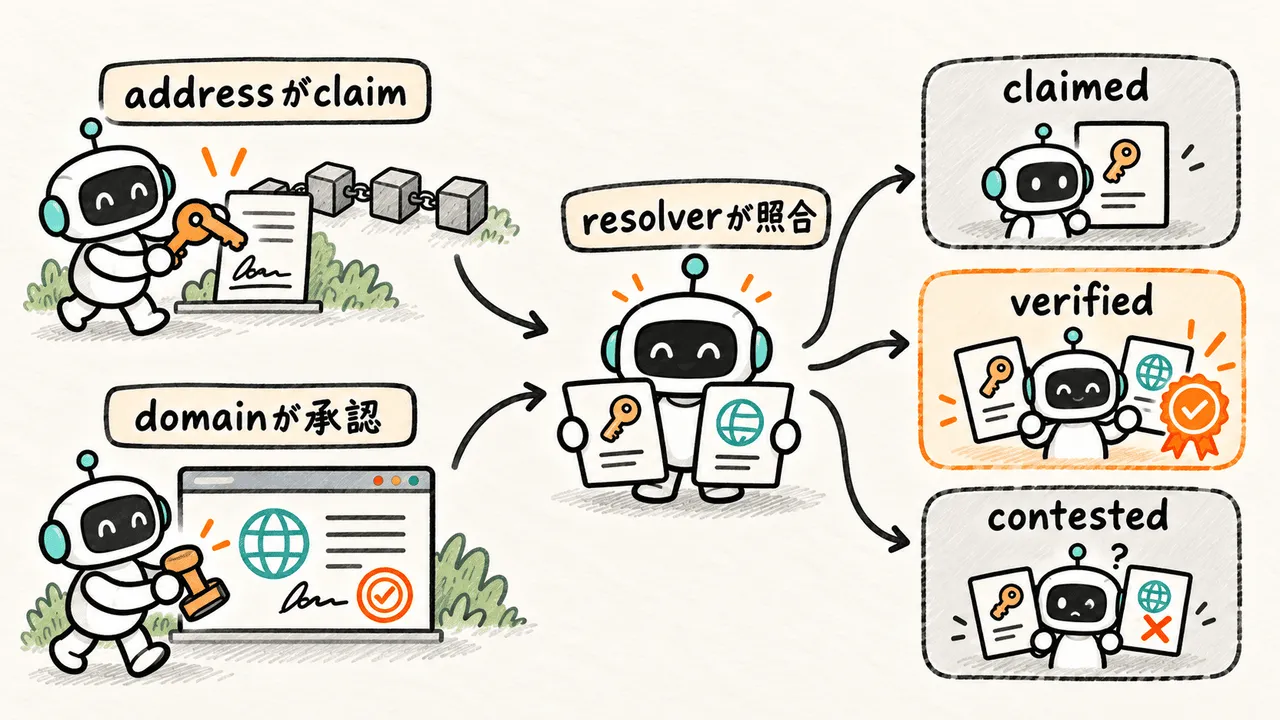
Four binding states
The binding indicates which declarations exist between the domain and address. Consumers use it to determine whether a domain name can be displayed as verified.
| State | Stored or published conditions | Consumer interpretation |
|---|---|---|
unbound |
No address claim | No established relationship |
claimed |
Only one address claims the domain, without acknowledgment | Unilateral address claim |
verified |
Address claims the domain and the domain acknowledges it | Mutually confirmed relationship |
contested |
Multiple addresses claim the domain, and the relevant address is not acknowledged | Contested relationship |
If a record has no URN, display none; if the current controller has not claimed the URN's publisher domain, display third-party.
A canonical URN becomes stale when its acknowledgment is removed.
Restoring acknowledgment later does not retroactively establish the validity of content served during the intervening period.
Level and adoption
From dormant to backed
The level indicates what on-chain evidence supports a resource. It is independent of domain binding and credit information.
| Level | Condition | What consumers can establish |
|---|---|---|
L0 |
No record | Only the domain publisher's declaration |
L1 |
Record with Active status | Anchor and current controller are readable on-chain |
L2 |
L1 plus adapter backing and matching required provenance | Kind-specific backing such as a reward, package, or identity |
L2 does not guarantee a fair price or service quality.
Consumers evaluate (level, binding, credit) separately.
Suspension and retirement
A record stores an active, suspended, or retired status. The current controller may reverse suspension, but retirement cannot be reversed even by a subsequent owner.
| Stored status | Permitted next states | Discovery behavior |
|---|---|---|
Active |
Suspended or Retired |
Candidate for L1 or L2 |
Suspended |
Active or Retired |
Explicitly inspect status; the specification leaves search inclusion and level ambiguous |
Retired |
No changes | Excluded from search results |
Check status before making a purchase. Use suspension, rather than retirement, for a temporary pause.
Adoption after transfer
The address that last committed the descriptor is called the attestor.
A record is adopted when the attestor matches the current controller, and unadopted otherwise.
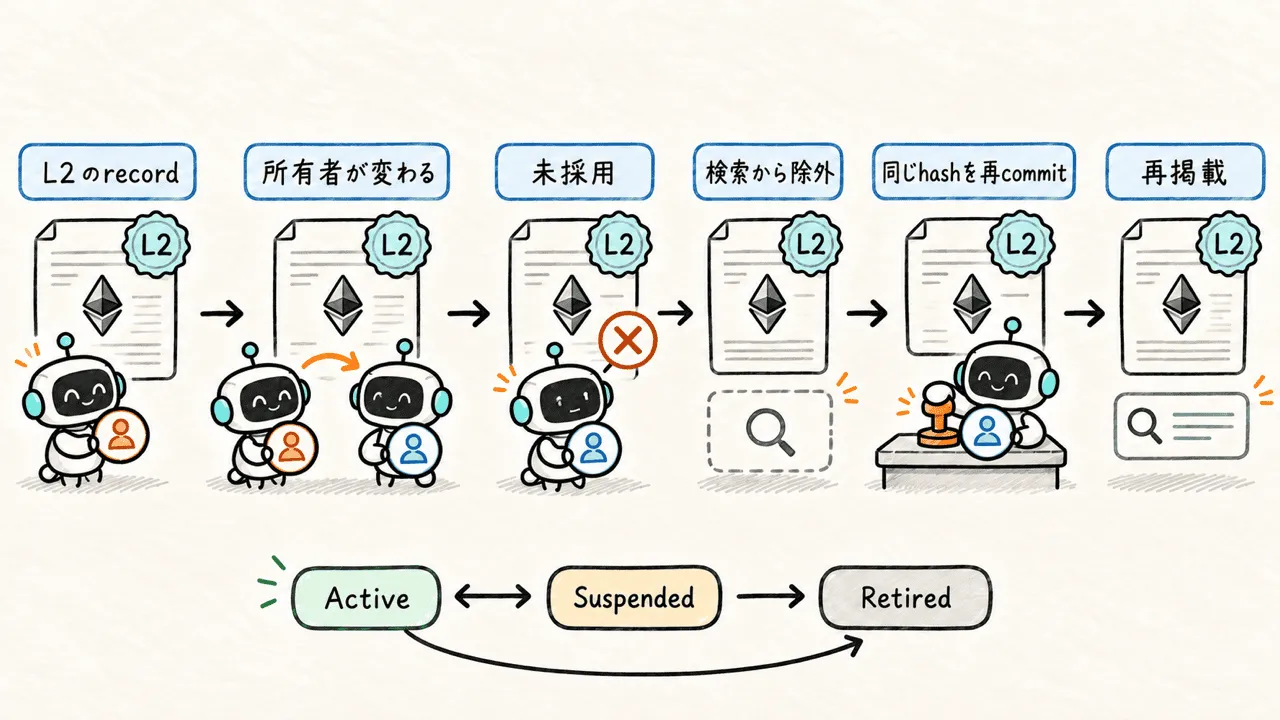
An unadopted record retains its record data, level, and status.
The resolver nevertheless excludes it from discovery results and listings.
When the new controller recommits the same descriptor hash through updateDescriptor, that controller becomes the attestor and the record can be listed again.
IARDOnchainRegistry
IARDOnchainRegistry defines the interface for anchor commitments, domain claims, and kind-to-adapter associations.
Status
enum Status { None, Active, Suspended, Retired }The Status enum describes whether a record is absent, active, suspended, or retired.
| Value | Stored status | Treatment |
|---|---|---|
None |
Record not registered | Reject updates and status changes |
Active |
Active | Evaluate L1 or L2 |
Suspended |
Suspended by controller | Indicates that the record should not be treated as an active offer |
Retired |
Permanently retired | Reject updates and exclude from search |
Record
struct Record {
    bytes32 kind;
    address target;
    uint256 id;
    bytes32 descriptorHash;
    string descriptorURI;
    string urn;
    Status status;
    address attestor;
    uint64 updatedAt;
}
The Record struct stores the descriptor commitment and anchor registered by the controller.
- Fields
| Field | Stored value |
|---|---|
kind |
Which of the four kinds applies |
target |
Token contract or participant address |
id |
Token ID, zero for an agent, or nonzero discriminator for a registry |
descriptorHash |
SHA-256 of committed content members |
descriptorURI |
Descriptor retrieval hint |
urn |
Canonical-name candidate supplied by the controller |
status |
Active, suspended, or retired |
attestor |
Controller that last committed the descriptor |
updatedAt |
Last update timestamp |
The current controller, backing, and anchor hint are not stored; read them live through the adapter.
Registered
event Registered(bytes32 indexed recordId, bytes32 indexed kind, address indexed target, uint256 id, address attestor, bytes32 descriptorHash, string descriptorURI, string urn);Emitted when the initial record for an anchor is registered. Indexers can enumerate candidate records from these logs.
- Fields
| Field | Description |
|---|---|
recordId |
Record identifier derived from the anchor |
kind |
Kind ID selecting the adapter |
target |
Anchor contract or address |
id |
Token ID or address-anchor discriminator |
attestor |
Controller at registration |
descriptorHash |
Committed content hash |
descriptorURI |
Descriptor retrieval hint |
urn |
Canonical-name candidate |
DescriptorUpdated
event DescriptorUpdated(bytes32 indexed recordId, bytes32 descriptorHash, string descriptorURI, string urn);Emitted when the current controller updates the descriptor commitment. Recommitting the same hash is also recorded; retrieve the record again to obtain the updated attestor.
- Fields
| Field | Description |
|---|---|
recordId |
Updated record |
descriptorHash |
Updated content hash |
descriptorURI |
Updated retrieval hint |
urn |
Updated canonical-name candidate |
StatusChanged
event StatusChanged(bytes32 indexed recordId, Status status);Emitted when the record's status changes.
- Fields
| Field | Description |
|---|---|
recordId |
Record whose status changed |
status |
Updated status |
DomainClaimed
event DomainClaimed(bytes32 indexed domainHash, address indexed controller, string domain);Emitted when an address's domain claim is stored.
- Fields
| Field | Description |
|---|---|
domainHash |
Keccak-256 hash of the normalized domain |
controller |
Address making the claim |
domain |
Normalized domain string |
DomainReleased
event DomainReleased(bytes32 indexed domainHash, address indexed controller);Emitted when an address releases its domain claim.
- Fields
| Field | Description |
|---|---|
domainHash |
Hash of the relevant domain |
controller |
Address releasing the claim |
KindRegistered
event KindRegistered(bytes32 indexed kind, address adapter, string uri);Emitted when the instance owner registers a kind-to-adapter association for the first time.
- Fields
| Field | Description |
|---|---|
kind |
Registered kind ID |
adapter |
Adapter address providing live reads |
uri |
Reference to adapter information |
OwnershipTransferred
event OwnershipTransferred(address indexed previousOwner, address indexed newOwner);Emitted when ownership of a registry instance changes.
- Fields
| Field | Description |
|---|---|
previousOwner |
Previous instance owner |
newOwner |
New instance owner |
register
function register(bytes32 kind, address target, uint256 id, bytes32 descriptorHash, string calldata descriptorURI, string calldata urn) external returns (bytes32 recordId);Registers the initial record for an anchor.
- Check that the kind has an adapter, the anchor exists, and the caller is its current controller.
- Derive the record ID and reject duplicate registration or a zero descriptor hash.
- Store an Active record with the caller as attestor and emit
Registered.
- Parameters
| Parameter | Description |
|---|---|
kind |
Kind ID selecting the adapter |
target |
Token contract or participant address |
id |
Token ID or address-anchor discriminator |
descriptorHash |
SHA-256 of committed content members |
descriptorURI |
Descriptor retrieval hint |
urn |
Canonical-name candidate; may be empty |
- Return value
| Return value | Description |
|---|---|
recordId |
Identifier derived from chain ID, target, and id |
-
Execution requirements
-
The kind must be registered.
-
The anchor must exist and the caller must be its current controller.
-
The descriptor hash must be nonzero and the anchor must not already have a record.
updateDescriptor
function updateDescriptor(bytes32 recordId, bytes32 descriptorHash, string calldata descriptorURI, string calldata urn) external;Updates an existing record's descriptor commitment.
- Check that the record exists and has not been retired.
- Compare the current controller returned by the adapter with the caller.
- Store the hash, URI, URN, attestor, and timestamp, then emit
DescriptorUpdated.
- Parameters
| Parameter | Description |
|---|---|
recordId |
Record to update |
descriptorHash |
New content hash; the same hash can be recommitted |
descriptorURI |
New retrieval hint |
urn |
New canonical-name candidate |
-
Execution requirements
-
The record must exist and its status must not be Retired.
-
The caller must be the current controller.
-
The descriptor hash must be nonzero.
Allowing the same hash enables a new controller to adopt the existing content after transfer without modifying it.
setStatus
function setStatus(bytes32 recordId, Status status) external;Suspends, resumes, or retires a record.
- Check the record and current controller.
- Permit only transitions between Active and Suspended, or from either of those states to Retired.
- Store the status and emit
StatusChanged.
- Parameters
| Parameter | Description |
|---|---|
recordId |
Record whose status will change |
status |
Updated status |
-
Execution requirements
-
The caller must be the current controller.
-
The record must not be Retired.
-
The requested transition must be permitted.
This function does not change the attestor.
claimDomain
function claimDomain(string calldata domain) external;Allows the caller to claim a relationship with a domain.
- Validate domain characters, length, and label boundaries.
- Check for an existing claim by the caller and the implementation's claim-count limit.
- Store the claim and emit
DomainClaimed.
- Parameters
| Parameter | Description |
|---|---|
domain |
Normalized domain string |
-
Execution requirements
-
The domain must be normalized and 1–253 bytes long.
-
The caller must not already claim the domain.
claimDomainBySig
function claimDomainBySig(string calldata domain, address controller, uint256 nonce, uint256 deadline, bytes calldata signature) external;Allows a third party to submit a domain claim using the controller's signature.
- Check the domain, deadline, and current nonce.
- Recompute the typed signing digest binding the domain claim to the chain ID, registry address, controller, nonce, and deadline.
- Verify the signature, store the claim, and increment the nonce.
- Parameters
| Parameter | Description |
|---|---|
domain |
Normalized domain to claim |
controller |
Address making the claim |
nonce |
Current nonce for one-time use of the signature |
deadline |
Deadline for accepting the signature |
signature |
Signature created by the controller |
-
Execution requirements
-
The deadline must not have passed.
-
The nonce must match
nonces(controller). -
EOA or contract-account signature verification must succeed.
EIP712 binds the signed data to the chain and registry, preventing reuse across deployments.
Consumers can recompute the digest using DOMAIN_SEPARATOR, the claim data, nonce, and deadline.
For more about EIP712, see the following article.
[EIP712] Understanding Typed Structured Data Hashing and Signing
For a contract controller, pass the digest and signature to the contract and check for the required approval value. ERC1271 defines this approach to signature authorization for contract accounts such as multisignature or policy contracts.
For more about ERC1271, see the following article.
[ERC1271] Verifying Signatures through Smart Contracts
releaseDomain
function releaseDomain(string calldata domain) external;Allows the caller to release its domain claim.
- Validate the domain and compute its hash.
- Check that the caller has a claim.
- Remove the claim and emit
DomainReleased.
- Parameters
| Parameter | Description |
|---|---|
domain |
Domain whose claim will be released |
-
Execution requirements
-
The domain must be normalized.
-
The caller's claim must exist.
registerKind
function registerKind(bytes32 kind, address adapter, string calldata uri) external;Registers a kind-to-adapter association once.
- Check that the caller is the instance owner and that the adapter address is nonzero.
- Check that the kind is unregistered and matches the kind reported by the adapter.
- Store the association and emit
KindRegistered.
- Parameters
| Parameter | Description |
|---|---|
kind |
Kind ID to register |
adapter |
Contract responsible for live reads |
uri |
Reference to adapter information |
-
Execution requirements
-
Only the instance owner may call the function.
-
The kind must not already be registered.
-
The adapter must report the matching kind.
The kind table is write-once. An incorrectly registered adapter cannot be replaced in that instance.
transferOwnership
function transferOwnership(address newOwner) external;Transfers ownership of the registry instance to another address.
- Check that the caller is the current owner.
- Set the owner to
newOwner. - Emit
OwnershipTransferred.
- Parameters
| Parameter | Description |
|---|---|
newOwner |
New instance owner; the zero address renounces ownership |
-
Execution requirements
-
Only the current owner may call the function.
Transferring ownership to the zero address permanently disables further kind registration.
owner
function owner() external view returns (address);Returns the instance owner authorized to register kinds and transfer ownership.
- Read and return the stored owner address.
- Return value
| Return value | Description |
|---|---|
address |
Current owner; zero address if ownership has been renounced |
-
Execution requirements
-
Anyone may call the function.
recordIdOf
function recordIdOf(address target, uint256 id) external view returns (bytes32);Computes a record ID from the current chain ID, target, and id.
- ABI-encode the chain ID, target, and id, and return their Keccak-256 hash.
- Parameters
| Parameter | Description |
|---|---|
target |
Anchor contract or address |
id |
Token ID or address-anchor discriminator |
- Return value
| Return value | Description |
|---|---|
bytes32 |
Computed record ID |
-
Execution requirements
-
Anyone may specify any target and id.
recordOf
function recordOf(bytes32 recordId) external view returns (Record memory);Returns the stored Record corresponding to a record ID.
- Look up the record ID and return the stored
Recordstruct.
- Parameters
| Parameter | Description |
|---|---|
recordId |
Record to read |
- Return value
| Return value | Description |
|---|---|
Record |
Commitment, anchor, status, attestor, and update timestamp |
An unregistered ID returns a value with status equal to None.
-
Execution requirements
-
Anyone may call the function.
controllerOf
function controllerOf(bytes32 recordId) external view returns (address);Queries the adapter for the address currently controlling the anchor.
- Read the record's kind and anchor and forward the query to the corresponding adapter's
controllerOf.
- Parameters
| Parameter | Description |
|---|---|
recordId |
Record whose controller is queried |
- Return value
| Return value | Description |
|---|---|
address |
Current controller; zero address when the anchor no longer exists |
-
Execution requirements
-
The record must exist.
Because the controller is read live, token transfers are reflected in the returned owner.
backed
function backed(bytes32 recordId) external view returns (bool);Queries the adapter to determine whether the anchor currently satisfies the kind-specific backing condition.
- Read the record's kind and anchor and forward the query to the corresponding adapter's
backed.
- Parameters
| Parameter | Description |
|---|---|
recordId |
Record whose backing is queried |
- Return value
| Return value | Description |
|---|---|
bool |
True if backed |
-
Execution requirements
-
The record must exist.
anchorHintOf
function anchorHintOf(bytes32 recordId) external view returns (bytes32);Returns the kind-specific value used to compare against descriptor provenance.
- Read the record's kind and anchor and forward the query to the corresponding adapter's
anchorHint.
- Parameters
| Parameter | Description |
|---|---|
recordId |
Record whose hint is queried |
- Return value
| Return value | Description |
|---|---|
bytes32 |
Package hash, task hash, identity digest, or zero |
-
Execution requirements
-
The record must exist.
claimsOf
function claimsOf(bytes32 domainHash) external view returns (address[] memory);Returns all addresses claiming a particular domain.
- Look up the claimant list by domain hash and return its array.
- Parameters
| Parameter | Description |
|---|---|
domainHash |
Hash of the normalized domain |
- Return value
| Return value | Description |
|---|---|
addresses |
Array of addresses claiming the domain |
-
Execution requirements
-
Anyone may specify any domain hash.
The resolver compares the claimants with the domain manifest to determine whether a binding is contested.
hasClaim
function hasClaim(bytes32 domainHash, address controller) external view returns (bool);Returns whether a particular address has a stored domain claim.
- Look up the domain hash and controller pair in the claim index and return whether it exists.
- Parameters
| Parameter | Description |
|---|---|
domainHash |
Hash of the relevant domain |
controller |
Address to check |
- Return value
| Return value | Description |
|---|---|
bool |
True if the claim exists |
-
Execution requirements
-
Anyone may specify any domain hash and controller.
domainHashOf
function domainHashOf(string calldata domain) external pure returns (bytes32);Computes Keccak-256 over the bytes of the supplied string.
- Convert the domain string to bytes and return its Keccak-256 hash.
- Parameters
| Parameter | Description |
|---|---|
domain |
Domain string to hash |
- Return value
| Return value | Description |
|---|---|
bytes32 |
Result of keccak256(bytes(domain)) |
This view function does not itself validate domain normalization. Supply the same normalized string used for a valid claim.
-
Execution requirements
-
Anyone may supply any string.
kindAdapter
function kindAdapter(bytes32 kind) external view returns (address);Returns the adapter address assigned to a kind.
- Read the adapter table using the kind as key and return its address.
- Parameters
| Parameter | Description |
|---|---|
kind |
Kind ID to query |
- Return value
| Return value | Description |
|---|---|
address |
Registered adapter; zero address if unregistered |
-
Execution requirements
-
Anyone may supply any kind ID.
nonces
function nonces(address controller) external view returns (uint256);Returns the nonce used for a controller's signed domain claims.
- Look up the controller's nonce and return its current value.
- Parameters
| Parameter | Description |
|---|---|
controller |
Address whose nonce is queried |
- Return value
| Return value | Description |
|---|---|
uint256 |
Next acceptable nonce |
It increases by one for each successful signed claim, preventing reuse of the same authorization.
-
Execution requirements
-
Anyone may specify any controller.
DOMAIN_SEPARATOR
function DOMAIN_SEPARATOR() external view returns (bytes32);Returns the EIP712 domain separator binding signed data to a particular chain and registry instance.
- Read and return the domain separator fixed at deployment in the reference implementation.
- Return value
| Return value | Description |
|---|---|
bytes32 |
Value derived from name, version, chain ID, and verifying contract |
-
Execution requirements
-
Anyone may call the function.
supportsInterface
function supportsInterface(bytes4 interfaceId) external view returns (bool);Returns whether the contract declares support for a particular interface.
- Compare the interface ID against the registry and ERC165 interface IDs and return whether it is supported.
- Parameters
| Parameter | Description |
|---|---|
interfaceId |
Four-byte ID to check |
- Return value
| Return value | Description |
|---|---|
bool |
True if supported |
ERC165 provides standardized interface detection.
The ERC8444 registry returns true for 0x881908a5 in the version described here.
-
Execution requirements
-
Anyone may specify any interface ID.
For more about ERC165, see the following article.
[ERC165] Detecting Supported Smart Contract Interfaces
Custom errors
Custom errors identify the input or state that caused an operation to be rejected.
error NotOwner();
error ZeroAddress();
error KindExists(bytes32 kind);
error UnknownKind(bytes32 kind);
error AdapterKindMismatch(bytes32 expected, bytes32 reported);
error AnchorMissing();
error NotController();
error EmptyDescriptor();
error AlreadyRegistered(bytes32 recordId);
error UnknownRecord(bytes32 recordId);
error RecordRetired(bytes32 recordId);
error InvalidTransition(Status from, Status to);
error InvalidDomain();
error AlreadyClaimed();
error NotClaimed();
error TooManyClaims();
error SignatureExpired(uint256 deadline);
error BadNonce(uint256 expected, uint256 given);
error InvalidSignature();| Error | Rejected condition | Corrective action |
|---|---|---|
NotOwner |
Administrative operation by a non-owner | Execute from the instance owner account |
ZeroAddress |
Zero address supplied for an adapter or other required address | Supply a valid address |
KindExists |
Attempted registration of an existing kind | Use the registered adapter |
UnknownKind |
Record operation for an unregistered kind | Register the kind first |
AdapterKindMismatch |
Adapter reports a different kind | Supply the correct adapter |
AnchorMissing |
Adapter reports a missing anchor | Check target, id, and burn status |
NotController |
Change attempted by a non-controller | Check the adapter's live controller |
EmptyDescriptor |
Zero descriptor hash | Derive a valid content hash |
AlreadyRegistered |
Anchor already has a record | Update the existing record |
UnknownRecord |
Record is unregistered | Use the correct record ID |
RecordRetired |
Attempted change to a retired record | Stop the update |
InvalidTransition |
Disallowed status transition | Use a permitted transition between Active and Suspended or to Retired |
InvalidDomain |
Invalid domain format | Normalize to the required lowercase ASCII format |
AlreadyClaimed |
Duplicate claim by the same address | Use the existing claim |
NotClaimed |
Release of a nonexistent claim | Check the claim status |
TooManyClaims |
Implementation's claim-count limit exceeded | Retry only once capacity is available |
SignatureExpired |
Deadline exceeded | Obtain a new signature with a valid deadline |
BadNonce |
Stored nonce differs from supplied nonce | Sign with the current nonce |
InvalidSignature |
EOA or ERC1271 verification failed | Check signer, digest, and signature format |
IARDKindAdapter
IARDKindAdapter defines a common interface for reading five kinds of information from different anchor contracts.
Adapter view functions represent failures with false or zero values rather than reverting.
kind
function kind() external view returns (bytes32);Returns the kind ID implemented by the adapter.
- Read and return the adapter's fixed kind ID.
- Return value
| Return value | Description |
|---|---|
bytes32 |
Value of keccak256("ard-onchain.kind.<name>") |
The registry compares it with the expected value when registering the kind.
-
Execution requirements
-
Anyone may call the function.
exists
function exists(address target, uint256 id) external view returns (bool);Returns whether the specified anchor currently exists and can be interpreted as the adapter's kind.
- Check the target interface and identifier; return false on failure.
- Parameters
| Parameter | Description |
|---|---|
target |
Target contract or address |
id |
Token ID or address-anchor discriminator |
- Return value
| Return value | Description |
|---|---|
bool |
True if the anchor exists; false if the external call fails |
-
Execution requirements
-
Anyone may specify any target and id.
controllerOf
function controllerOf(address target, uint256 id) external view returns (address);Returns the address currently controlling an anchor.
- Read the kind-specific owner or participant address; return the zero address on failure.
- Parameters
| Parameter | Description |
|---|---|
target |
Target contract or address |
id |
Target identifier |
- Return value
| Return value | Description |
|---|---|
address |
Token owner or participant address; zero address on read failure |
-
Execution requirements
-
Anyone may specify any target and id.
backed
function backed(address target, uint256 id) external view returns (bool);Returns whether the anchor currently meets its kind-specific backing requirements.
- Read the relevant package, escrow, deadline, or identity information and return the result as a Boolean.
- Parameters
| Parameter | Description |
|---|---|
target |
Target contract or address |
id |
Target identifier |
- Return value
| Return value | Description |
|---|---|
bool |
True if the applicable package, escrow, or identity requirements are satisfied |
-
Execution requirements
-
Anyone may specify any target and id.
anchorHint
function anchorHint(address target, uint256 id) external view returns (bytes32);Returns the value from the target contract used to compare descriptor provenance.
- Read the kind-specific package hash, task hash, or identity digest; return zero on failure.
- Parameters
| Parameter | Description |
|---|---|
target |
Target contract or address |
id |
Target identifier |
- Return value
| Return value | Description |
|---|---|
bytes32 |
Package hash, task hash, identity digest, or zero |
-
Execution requirements
-
Anyone may specify any target and id.
Resolver and gateway
The resolver constructs a discovery entry as follows.
- Read the record and the adapter's live views.
- Retrieve the descriptor using
descriptorURIand verify its content hash. - Compute the anchor, gateway alias, binding, canonical URN, level, and status.
- Compare the attestor and current controller to compute adoption.
- Serve the entry by combining committed content members with publisher metadata and computed members.
Exclude records with unavailable descriptors, mismatched hashes, unadopted descriptors, or Retired status from discovery results.
An inspection endpoint accepting an anchor or record ID may display an unadopted record with value:adopted: false.
A gateway implements ARD search federation modes auto, referrals, and none.
auto searches additional registries when appropriate, referrals returns referral destinations, and none uses only the gateway's own index.
The gateway also publishes an application/ai-registry+json entry describing itself in /.well-known/ard.json.
Additional considerations
Search relevance and trust
The search score ranks how closely an entry's contents match the consumer's query. A high score does not establish descriptor adoption by the current controller, verified domain binding, or backed rewards.
Consumers should expose at least value:anchor, value:descriptorHash, value:level, value:binding, value:status, and value:adopted separately.
Credit is also an external registry reference and must not be folded into the level.
Naming and identity
The same record may appear under the controller's canonical URN, gateway A's alias, or gateway B's alias.
Compare value:anchor, rather than names, to determine whether they represent the same record.
A canonical URN remains valid while the publisher domain binding is verified and the manifest contains the matching identifier. Mark a URN stale when these conditions cease to hold; the anchor itself is unchanged.
Price display and settlement
value:terms describes pricing and units such as calls, epochs, licenses, and copies.
value:settlement describes the payment rail, payee, asset, and endpoint.
The onchain rail uses the anchored contract's payment recipient.
The x402 and declared rails use the descriptor's payee, making exclusion of unadopted descriptors particularly important.
ERC8444 does not establish price fairness or perform settlement or escrow release.
Cross-chain operation and availability
A registry verifies anchors only on its own chain. The same token on another chain is a different record; cross-chain equivalence is left to future profiles.
Descriptors and domain manifests are retrieved off-chain. The standard does not define retrieval size limits, timeouts, cache TTLs, confirmation depth, reorganization recovery, or production SLAs. Operators should expose last synchronization time, referenced block, retrieval failures, and stale-cache status.
Test cases
Recomputing fixed test vectors
Official vectors provide fixed inputs and expected results so independent implementations can compare their computations.
| Target | Example | Expected value |
|---|---|---|
| skill kind | keccak256("ard-onchain.kind.skill") |
0x75357da1...8ca7b0bb |
| record ID | chain 1、target 0x11...11、id 42 |
0x0d08c6fa...047a6db1 |
| domain hash | alice.example |
0xd94dcba6...2b0f7a7 |
| Registry descriptor | JCS-canonicalized content members | SHA-256 0xb5a38766...32445b6 |
| Registry interface | XOR of function selectors | 0x881908a5 |
| Adapter interface | XOR of function selectors | 0x67bde273 |
The signature vector uses the Sepolia chain ID, registry address, controller, nonce 0, and deadline. A successful claimDomainBySig advances the nonce to 1.
The same signature cannot be reused on another chain or registry, after expiration, or with a consumed nonce.
Record and claim rejection conditions
The official test suite covers registration of all four kinds and rejection of unknown kinds, zero hashes, missing anchors, unauthorized callers, and duplicate anchor registration. It also checks that the live controller changes upon token transfer while the attestor remains unchanged, and that recommitting the same descriptor hash restores adoption.
Domain tests cover invalid formats, duplicate claims, expiry, nonce mismatch, signature replay, EOA signatures, and ERC1271 signatures. Task tests distinguish funded, canceled, and expired tasks; identity tests distinguish active, stale, and retired agents.
Gateway conformance
The reference implementation's recorded results report 44 passing Foundry tests, 20 passing gateway end-to-end steps, and successful ARD conformance checks. The gateway tests cover descriptor-hash mismatches, domain binding, search, filtering, facets, pagination, unadopted records after transfer, and relisting after recommitment.
These are reported reference implementation results, not normative minimum test counts. No end-to-end test covers suspended-record search inclusion in the cited results, leaving that behavior unresolved.
Compatibility
Existing ARD entries
ERC8444's additional members fit within ARD's extensible JSON schema.
A registry unaware of the value namespace can still index entries using ordinary members such as displayName, type, url, and data.
Existing domain-only entries remain unchanged at L0.
Integration with existing contracts
Existing skill, tender, and identity contracts need not be modified. Adapters read existing views, and the ERC8444 registry does not write to target contracts.
On a chain without an agent identity registry, the agent adapter can always return false for backed.
Agent records may still be discoverable at L1 but cannot reach L2 through that adapter configuration.
Information from related standards
An agent entry includes a registration-file URI in its descriptor, while the adapter reads the active status from an identity registry. Consumers use the URI to identify the registration information and treat the identity as backed only while active. ERC8004 is the related standard defining the roles of agent registration files and identity registries.
For more about ERC8004, see the following article.
[ERC8004] Understanding Trustless Agent Infrastructure
A descriptor can reference a dispute-resolution policy ID and decision registry through value:dispute.
Consumers use these references to retrieve the authoritative decision record rather than duplicating voting results into ERC8444.
ERC8436 is a related standard for multi-party decision procedures.
For more about ERC8436, see the following article.
[ERC8436] How Multiple AI Agents Vote on Task Approval
Draft status and version boundaries
ERC8444 was in Draft status as of October 17, 2026. The underlying ARD specification was v0.91 Proposal, with a pinned schema and JSON-LD context included in the reference implementation.
Integrations should record the EIP revision, ARD schema version, deployed registry address, and four adapter addresses. Passing reference implementation tests does not establish Final status or third-party production adoption.
Reference implementation
The official materials include an on-chain kernel, four adapters, signature helper, Node.js gateway, example descriptors, and test vectors. Distinguish normative requirements from implementation-specific choices.
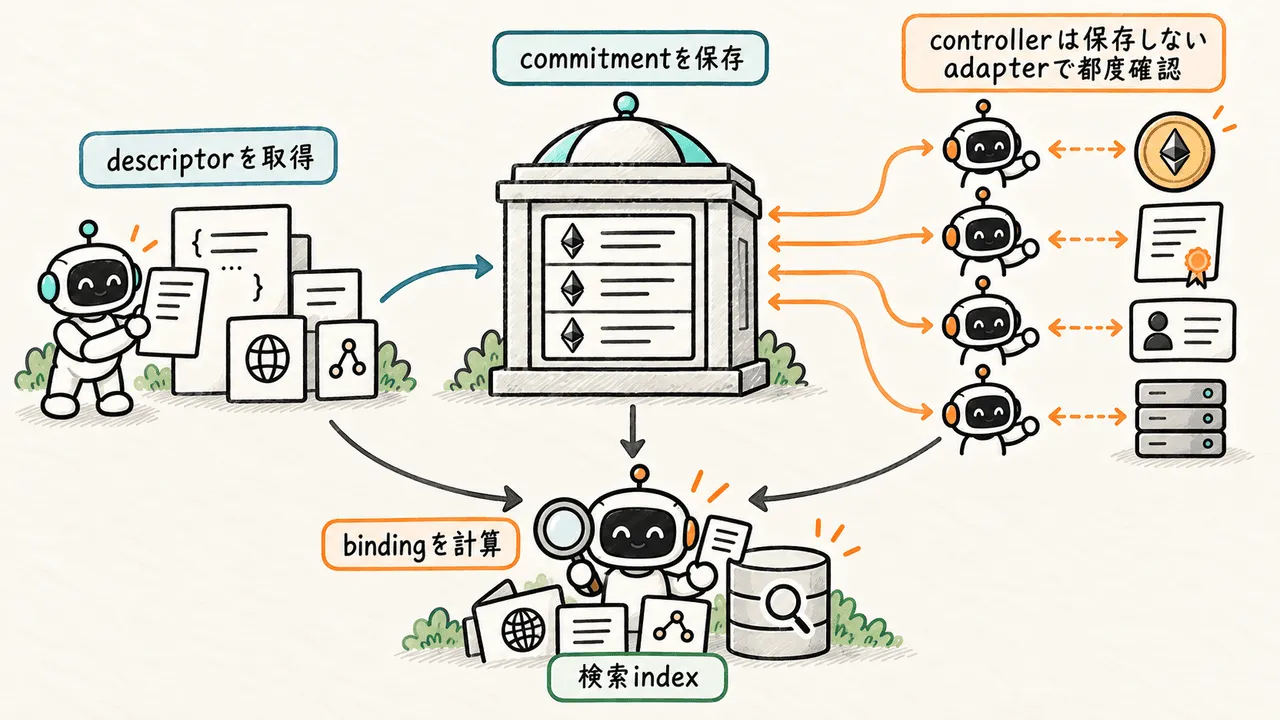
Kernel storage boundary
ARDOnchainRegistry.sol stores records, kind-to-adapter mappings, domain claims, claim indexes, and signature nonces.
It does not store live controllers, escrow balances, or identity status.
The kernel queries the adapter during updates rather than relying on an old controller after a token transfer.
The kind table is write-once and the kernel is not upgradeable. After registering all four kinds, the instance owner can renounce ownership to disable further kind registration. The reported reference implementation runtime bytecode size is 9,939 bytes, a measurement rather than a normative limit.
Four adapters
SkillAdapter.sol checks skill-kernel interface support through ERC165 and reads the ERC721 owner and package hash.
TaskAdapter.sol reads ownership, cancellation status, escrow balance, settleBy, and task hash, treating only tasks with remaining rewards and valid deadlines as backed.
AgentAdapter.sol uses the address itself as controller and reads active identity status and a self-declared document digest from the configured identity registry.
RegistryAdapter.sol checks for a nonzero address and discriminator and returns the address itself as controller, but always reports false for backing.
On external-call failure, the adapters return zero or false values rather than reverting. This helps prevent a failed or burned anchor from interrupting enumeration of the entire registry.
Signature verification
For a contract controller, SignatureChecker.sol uses a static call to ERC1271 isValidSignature.
It rejects a result that does not contain the required magic value.
For EOAs it accepts 65-byte ECDSA signatures, checking v, low-s, and nonzero recovered signer.
Malformed return data or external-call failures produce a false verification result, causing the claim to revert.
Gateway synchronization
The reference gateway's indexer enumerates record IDs from Registered events and rereads each record and adapter's live values.
Its resolver retrieves descriptors and computes hash consistency, binding, level, and adoption.
The server replaces its in-memory index and lastSync only when the complete resolution pass succeeds.
The default synchronization interval is 15 seconds. If RPC synchronization fails, the previous index may remain in use. Confirmation depth, reorganization recovery, cache TTL, descriptor size limits and timeouts, and production SLAs are not fixed by the cited specification and reference implementation.
Search scoring, filtering, faceting, and pagination are reference gateway implementation choices. ARD's pageSize limit is 100, while the reference kernel caps claimants per domain at 64. These are distinct limits, not a general ERC8444 capacity limit.
Transfer and relisting on Sepolia
The official evidence describes an initial holder registering a skill record that appears in search results. Transferring the token changes the adapter's controller to the new holder while the record's attestor remains the previous holder. The gateway excludes the record as unadopted.
When the new holder recommits the same descriptor hash, the attestor changes and the record becomes discoverable again. The reported evidence demonstrates the transfer and adoption flow on a live network, but does not establish reorganization recovery or long-term availability.
Security
Canonical URNs and domains
Do not present a URN as canonical without a verified binding. If a domain ownership or manifest change removes the acknowledgment, mark the previously canonical URN stale.
A gateway alias must be scoped to the gateway's own domain. Because publishers can freely choose display names and descriptions, interfaces should display the anchor, binding, and level alongside them. A claim or acknowledgment alone does not establish mutual confirmation of the domain-address relationship. Search interfaces should distinguish canonical URNs from gateway aliases and show the binding status and observation time.
Descriptor substitution
If the host changes committed JSON content served at the descriptor URI, the content hash comparison detects the mismatch. A hash does not solve availability problems, false assertions in the committed contents, or unreasonable published prices.
A resolver may also report incorrect results. Consumers can independently recheck the anchor and descriptor hash on-chain or compare results from another gateway. Treat results without known synchronization time or referenced block as potentially stale.
Transfers and stale payment recipients
After a token transfer, the attestor and current controller differ until adoption. The resolver excludes the record from discovery and must not present the previous owner's endpoint, terms, or x402 payee as the new owner's offer.
Clients accessing inspection endpoints directly should perform the same comparison.
Do not use an unadopted offer solely because its level remains nonzero.
Omitting this check misrepresents old value-related information as endorsed by the current controller.
Similarly, inspect status and value:adopted separately rather than relying on the level to decide whether a suspended offer is usable.
Signatures and replay
Signed domain claims bind the digest to the chain ID, registry address, controller, nonce, and deadline. Even if another party submits the transaction first, the claim is recorded for the signing controller. Without domain acknowledgment, the binding does not become verified.
Review private-key management and the conditions under which contract accounts approve ERC1271 signatures. Display nonce and deadline in signing interfaces to avoid unintended long-lived authorizations.
Adapters and instance ownership
Adapters form a trust boundary for anchor existence, current controllers, and backing. Deployment documentation should publish the registry and four adapter addresses, code hashes, and corresponding kinds.
Kind registration is write-once, so an incorrectly registered adapter cannot be replaced within the same instance. Before registration, verify interface IDs, reported kinds, zero-value failure behavior, and target contract semantics. After fixing the four kinds, document the reason for retaining ownership or renounce it to disable further registration.
Conclusion
ERC8444 preserves ordinary ARD discovery while linking capabilities, rewarded tasks, agents, and discovery services to on-chain anchors. Integrations should distinguish relevance, binding, level, status, and adoption, and recheck the descriptor hash and live controller immediately before use.
I also publish articles on the following platforms.
My Japanese-language book on specification-driven development with LLMs was planned for publication at the time of writing. It covers hands-on examples, changes to development workflows, and practical tips.