Introduction
Hi, I'm cardene, a software engineer and technical writer focused on blockchain and AI.
I've also authored Japanese technical books on specification-driven development with LLMs and decentralized application (DApp) development.

I also build and publish a variety of tools, libraries, and open-source projects.
ERC-7829 proposes an NFT mechanism for managing digital works such as blogs, music, and videos while allowing multiple people to access them.
This article explains the proposal, with additional context and examples.

My other articles cover EIPs, BIPs, SLIPs, CAIPs, ENSIPs, RFCs, and ACPs.

Overview
ERC-7829 extends ERC-721 to represent data assets: digital works such as articles, videos, mini-games, and music.
The proposal has two central components. A modular data availability (DA) layer provides information and proofs about the integrity and availability of stored content. A new permission role, Reader, lets several addresses obtain reading rights for one token, reflecting the fact that digital content can be copied and accessed by multiple users.
| Term | Meaning |
|---|---|
| ERC-721 | Ethereum's standard for non-fungible tokens, which have distinct token identifiers. |
| Metadata | Information describing the content represented by an NFT, such as its URL, title, and creator. |
| Data availability (DA) | Mechanisms supporting access to data and verification of its integrity or availability. Here, the goal is to make missing, altered, or expired content detectable through on-chain information and proofs. |
| Reader | An address granted reading permission, distinct from the owner. Multiple readers can be registered for one token. |
This extension aims to reduce discrepancies between the NFT's value and the underlying content when externally stored data becomes unavailable, altered, or expired. It also lets applications reflect the replicability of digital works in their pricing and permission models.
The following diagram illustrates the architecture. A creator issues an extended ERC-721 token that references a modular DA layer. That layer supplies information for verifying data status, while the NFT grants permissions to multiple readers who access the underlying works. The original diagram labels are retained.
flowchart LR
    Creator[クリエイター] -->|発行| NFT[ERC-721拡張トークン]
    NFT -->|参照| DA[モジュール式DAレイヤー]
    DA -->|状態検証: 消失/改ざん/期限| OnChain[スマートコントラクト]
    NFT -->|権限付与| Readers[複数リーダー]
    Readers -->|アクセス| Content[ブログ/動画/音楽などのデータ資産]
Motivation
Traditionally, NFT value has often been associated with scarce ownership. Content referenced by metadata is treated as the underlying asset, and the owner may realize value by transferring the NFT.
However, transaction fees and storage costs can make on-chain representation impractical for lower-value creative works. Articles, videos, games, and music derive value from quality, reputation, and demand, but an individual sale may not justify high on-chain costs.
To reduce storage expenses, applications commonly store content off-chain or on another network and retain only a reference on-chain. A smart contract cannot directly inspect an arbitrary external resource to determine whether its contents have disappeared, changed, or expired. Trading of the NFT and associated contractual rights may nevertheless continue, creating a gap between the underlying data's availability and the value of the token.
ERC-7829 addresses this problem using a modular DA layer that supplies verifiable information about the underlying data. It also introduces readers so that several users can obtain access rights without transferring ownership.
This separates ownership from usage rights and gives creators more options than a one-time sale of an NFT. Users can benefit from better information about data integrity, subject to the security and availability assumptions of the selected storage system.
Related research
Existing approaches to NFT integrity have limitations. Storing all content on-chain can improve persistence and verifiability but is expensive, making it difficult to apply to lower-value content. Relying on attestations from trusted third parties reduces storage costs but introduces additional trust assumptions.
ERC-7829 proposes a modular DA layer rather than requiring all data to be stored on-chain or relying solely on a third-party attestation. It aims to make the existence, integrity, and expiration of content verifiable through appropriate storage commitments and proofs. The actual trust model depends on the selected implementation.
Specification
Terminology
ERC-7829 separates a data asset into three components.
| Component | Contents | Storage location |
|---|---|---|
| Storage metadata | Commitment, size, expiration, and uploader address. | On-chain storage contract |
| Permission metadata | Ownership, reader permissions, and addresses authorized to make changes. | On-chain permission contract |
| Data content | The actual uploaded data. | Off-chain storage nodes |
This separation enables on-chain management of metadata and permissions while keeping the underlying content in external storage.
Interface
The ERC-7829 interface is shown below.
interface IERC7829 is IERC721 {
    event UpdateReader(uint256 indexed tokenId, address indexed reader, bool valid);

    function setReader(uint256 tokenId, address reader, bool valid) external;

    function isReader(uint256 tokenId, address reader) external view returns (bool);

    function commitByTokenId(uint256 tokenId) external view returns (bytes);

    function sizeByTokenId(uint256 tokenId) external view returns (uint256);

    function expireByTokenId(uint256 tokenId) external view returns (uint64);
}
UpdateReader
event UpdateReader(uint256 indexed tokenId, address indexed reader, bool valid);Emitted when a reader is added to or removed from a data asset NFT. The event allows applications to track permission changes on-chain.
Parameters
tokenId: ID of the data asset NFT.reader: Address whose reader permission is being changed.valid: Whether the reader is enabled (true) or disabled (false).
setReader
function setReader(uint256 tokenId, address reader, bool valid) external;Adds or removes a reader associated with an NFT. Passing true grants reading permission; passing false revokes it. Reader status does not itself confer ownership or transfer authority.
Parameters
tokenId: ID of the data asset NFT.reader: Address whose permission is being granted or revoked.valid: Boolean controlling whether the reader is enabled.
isReader
function isReader(uint256 tokenId, address reader) external view returns (bool);Checks whether a specified address has reader status for a token.
Parameters
tokenId: ID of the NFT being queried.reader: Address being queried.
Return value
bool: True if the address is a reader; otherwise false.
commitByTokenId
function commitByTokenId(uint256 tokenId) external view returns (bytes);Returns the cryptographic commitment associated with the data asset. This commitment can be used to verify that supplied data corresponds to the committed content under the selected commitment scheme.
Parameters
tokenId: ID of the NFT.
Return value
bytes: The data asset's commitment.
sizeByTokenId
function sizeByTokenId(uint256 tokenId) external view returns (uint256);Returns the size of the data associated with the NFT, expressed in bytes. Storage verification and proof generation may use this value.
Parameters
tokenId: ID of the NFT.
Return value
uint256: Data size in bytes.
expireByTokenId
function expireByTokenId(uint256 tokenId) external view returns (uint64);Returns the expiration timestamp associated with the asset's storage. The proposal requires relevant operations, including transfers, approvals, and reader updates, to be blocked once the storage period expires.
Parameters
tokenId: ID of the NFT.
Return value
uint64: Expiration timestamp.
Metadata schema
The original data asset NFT metadata schema is shown below.
{
  "title": "Data Asset Metadata",
  "type": "object",
  "properties": {
    "name": {
      "type": "string",
      "description": "このNFTが表す資産の名前"
    },
    "description": {
      "type": "string",
      "description": "このNFTが表す資産の説明"
    },
    "commit": {
      "type": "string",
      "description": "データリソースを指すコミットハッシュ"
    },
    "size": {
        "type": "integer",
        "description": "データリソースのサイズ"
    },
    "expire": {
        "type": "integer",
        "description": "データリソースの有効期限"
    }
  }
}
The Japanese field descriptions respectively identify the asset's name, description, commitment hash, data size, and expiration.
A reader is authorized only to read; reader status does not permit transfers, approvals, or reader-management operations.
When an NFT is transferred to another address, for example Bob:
- Ownership is updated to the recipient.
- The token-specific approved address is cleared.
- Existing reader permissions remain in place.
Extension: Storage contract
ERC-7829 extends NFT metadata to allow uploaders to supply a certificate, such as a storage-node signature, when uploading content. The metadata includes at least:
commitsizeexpire- The uploader's address.
Implementers select a suitable storage system and modular DA layer or deploy their own.
The proposal requires relevant transfer, approval, and reader-setting operations to check that block.timestamp is less than expire. If the storage period has expired, the operation must revert.
Extension: Storage proofs
Storage proofs support verification of the availability of data and the validity of the NFT's metadata, particularly the expiration field. The proposal discusses KZG polynomial commitments as a possible technique.
KZG polynomial commitments
- Data is represented as a polynomial, using suitable setup parameters and group elements.
- A commitment C is derived from the data and recorded in metadata.
- A verifier checks a proof generated by the prover for a challenge or evaluation point.
A polynomial commitment alone does not ensure that the entire data asset remains retrievable.
Aggregating proofs
Compatible KZG opening proofs can be aggregated into a single proof. The aggregation procedure combines commitments using the appropriate protocol-defined coefficients and verifies the corresponding aggregated proof. Arbitrary proofs cannot safely be combined by simply summing commitments without the required checks.
Random sampling and challenges
Random sampling can reduce the cost of checking stored data. The sampling procedure must use sufficiently secure, unpredictable challenges appropriate to the threat model.
Optimistic proofs
To reduce gas costs, the proposal discusses optimistic validation of aggregated commitments, with a challenge period during which participants can dispute incorrect results.
- Successful challenge: the challenger receives a reward and the prover is penalized.
- Unsuccessful challenge: the challenger is penalized and the prover receives a reward.
The actual challenge and penalty rules depend on the DA implementation.
Additional considerations
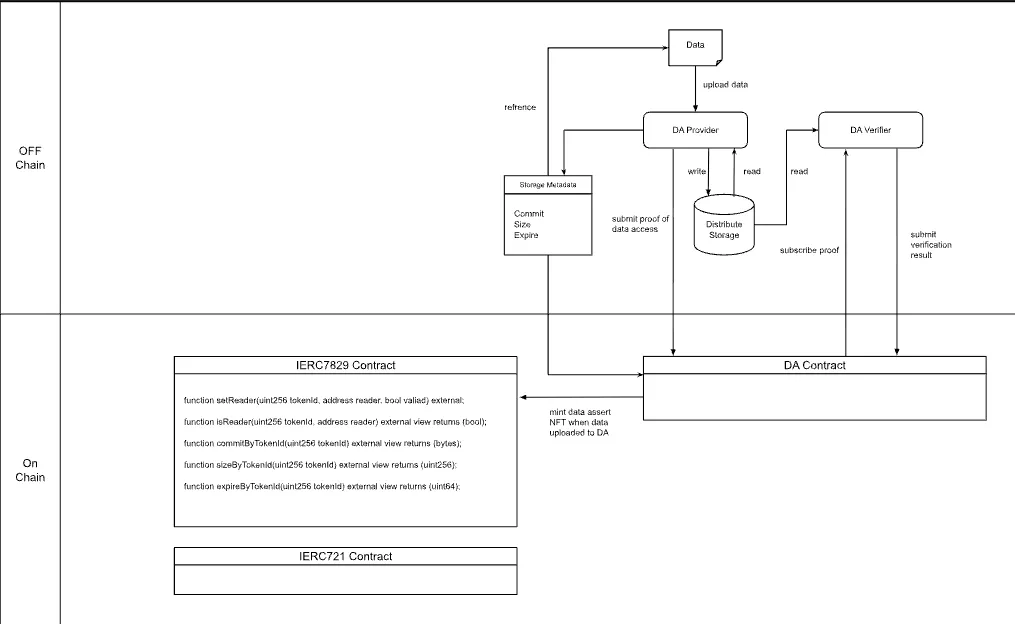
Data asset NFT integrity
The DA layer keeps the actual content off-chain and records storage metadata on-chain. This supports detection of unavailable, modified, or expired data through the selected proof mechanism.
The DA layer periodically generates, submits, and verifies storage proofs to provide evidence of the data's continuing availability.
Gas optimization
Fully verifying all stored data on-chain would be costly. The proposal therefore discusses optimistic proofs: certain claims are provisionally accepted and may be challenged later if incorrect.
This can reduce gas usage, provided the challenge mechanism is sound and honest verifiers can obtain the information needed to identify and dispute invalid claims.
Proof cycle workflow
The following original diagram illustrates the interactions among the DA provider, contract, and verifier.
sequenceDiagram
    participant Provider as DAプロバイダー
    participant Contract as DAコントラクト
    participant Verifier as DA検証者

    Provider->>Provider: サンプルデータを選択し証明を生成
    Provider->>Provider: 複数の証明を集約し単一の集約証明にまとめる
    Provider->>Contract: 集約証明を提出
    Contract->>Contract: 集約証明を検証
    Verifier->>Verifier: オフチェーンで再検証
    Verifier->>Contract: 不正が見つかれば詐欺証明(Fraud Proof)を提出
    Contract->>Verifier: 不正が認められた場合、報酬を与えペナルティを実行
Proof generation and aggregation
- The DA provider randomly samples portions of externally stored content and generates proofs.
- The provider aggregates multiple proofs and submits the aggregated proof to the DA contract.
- The contract performs the required verification of the submitted proof.
This enables more efficient availability checks under the selected sampling and verification model.
Fraud proof mechanism
The optimistic verification process allows some claims to be accepted provisionally, with fraud proofs available to dispute them.
- A DA verifier independently checks off-chain whether the aggregated proof was generated correctly.
- If the verifier detects an invalid proof, it submits a fraud proof to the DA contract.
- The contract verifies the challenge and, if valid, penalizes the provider and rewards the verifier.
The design aims to balance on-chain security and verification cost.
Reader
ERC-7829 allows several readers to be registered for the same data asset NFT. Unlike the owner, a reader has only the designated reading permission. Ownership need not change when access is granted to additional users.
Design rationale
| Property | Explanation |
|---|---|
| Replicability | Digital data can be copied without degrading its quality. Reader permissions let applications manage authorized access. |
| Value amplification | Owners may sell or rent access rights to several users while retaining ownership, potentially expanding the asset's utility and revenue opportunities. |
Creators can design shared-access or subscription models instead of relying solely on a single sale.
On-chain reader status does not itself prevent unauthorized copying or guarantee content confidentiality. An application must implement access enforcement, such as appropriate encryption or gateway authorization, and revocation cannot erase copies already obtained.
Compatibility
ERC-7829 extends ERC-721 and is intended to remain compatible with its interface, subject to the additional operational restrictions in the proposal.
Security considerations
The security of a data asset NFT depends both on the blockchain and on the modular DA layer. Implementers must carefully evaluate the selected DA system, including its proof mechanism, availability assumptions, challenge process, and access controls.
Citation
Allen Dong (@Allen2730), Lonika Zhang lonika@memolabs.net, Steven He steven@memolabs.net, "ERC-7829: Data Asset NFT [DRAFT]," Ethereum Improvement Proposals, no. 7829, November 2024. [Online serial]. Available: https://eips.ethereum.org/EIPS/eip-7829.
Conclusion
ERC-7829 proposes a way to represent digital works through NFTs while providing storage verification and multiple reader permissions. It separates ownership from access rights and makes the underlying data's storage status part of the asset's design.
If you have questions, feel free to contact me on Twitter.
You can also find my work on the following sites.


