Introduction
Hi, I'm cardene, a software engineer and technical writer focused on blockchain and AI.
I've also authored Japanese technical books on specification-driven development with LLMs and decentralized application (DApp) development.

I also build and publish a variety of tools, libraries, and open-source projects.
EIP-7973 proposes reducing the gas cost of repeated updates to account fields, such as the nonce, balance, and code hash, within a single transaction.
This article explains the following proposal.

More EIP, BIP, SLIP, CAIP, ENSIP, RFC, and ACP explainers:

Overview
EIP-7973 introduces warm metering for account writes. When an account's state is modified repeatedly within a transaction, subsequent writes may be charged at a lower rate.
What is warm metering?
Warm metering distinguishes between operations with different resource costs based on whether the relevant state has already been accessed or modified.
EIP-2929 introduced cold and warm access pricing for accounts and storage slots. EIP-7973 addresses the separate question of repeated writes to account state.
Updating the state commitment is one of the expensive operations involved in block construction. Multiple modifications to the same account can be consolidated before the resulting state root is computed.
EIP-7973 seeks to reflect that difference in resource usage through gas accounting.
Motivation
Cost differences between ETH and WETH transfers
Ethereum uses storage net metering introduced by EIP-2200. Repeated modifications to a storage slot can benefit from lower costs when the slot is already dirty, subject to the applicable storage pricing and refund rules.
For related background, see the following article referenced in the original.
Understanding smart contract vulnerabilities and becoming a bug hunter
Native ETH transfers modify account balances, whereas WETH transfers generally modify token balances stored in contract storage.
Under the pricing model discussed in the proposal, the account-write component of a native ETH transfer does not receive an equivalent discount simply because the same account has already been modified.
This discrepancy can create an incentive to use wrapped assets rather than native ETH. It could also disadvantage future value-transfer instructions, such as the proposed PAY or GAS2ETH mechanisms.
Actual ETH and WETH transfer costs depend on additional factors, including account access, contract execution, and storage changes. The proposal concerns a particular component of their gas accounting rather than guaranteeing equal total costs.
The cost of state-root updates
An Ethereum account is represented by a tuple containing its nonce, balance, storage root, and code hash in the global Merkle Patricia trie.
Changing an account field affects the state commitment. However, execution clients can accumulate multiple updates to the same account rather than recomputing the entire trie after every individual modification.
The marginal cost of subsequent writes can therefore be lower than that of the initial modification.
Proposed solution
EIP-7973 distinguishes between cold and warm account writes.
An account whose relevant state still matches its transaction-start state incurs the proposed cold-write charge. An already modified account can qualify for the lower warm-write charge.
The intention is to align gas pricing more closely with underlying state-update costs.
Specification
Parameters
The proposal version discussed in the original March 2026 article replaces GAS_CALL_VALUE and GAS_STORAGE_UPDATE with the following parameters:
| Parameter | Value | Description |
|---|---|---|
GAS_COLD_STORAGE_WRITE |
TBD | Cost associated with an update to the storage trie. |
GAS_COLD_ACCOUNT_WRITE |
TBD | Cost associated with an initial account-trie write. |
GAS_WARM_WRITE |
TBD | Lower cost associated with writing to already modified state. |
Parameter values
The original article describes these values as undetermined pending stateful benchmarking. This is a historical description of the proposal; it does not establish the latest parameter values or activation status.
Gas accounting for account-update instructions
The proposal considers account updates associated with instructions such as CREATE, CREATE2, and the CALL family. Only operations that actually modify the relevant account state should be understood as account writes; STATICCALL does not itself permit state modification.
flowchart TD
    A[アカウント更新オペコード実行] --> B{"アカウントのフィールドは\nトランザクション開始時と同じ?"}
    B -- はい(初回更新) --> C["GAS_COLD_ACCOUNT_WRITE\nを課金(高コスト)"]
    B -- いいえ(既に更新済み) --> D["GAS_WARM_WRITE\nを課金(低コスト)"]
The diagram is retained with its original Japanese labels. It illustrates the distinction between an account that matches its transaction-start state and one that has already been modified.
The proposed criterion compares the account state against its original value at the beginning of the transaction. A matching state is treated as clean, while a differing state is treated as dirty.
The following image compares the existing approach described in the article with the proposed pricing for repeated ETH transfers to the same address.
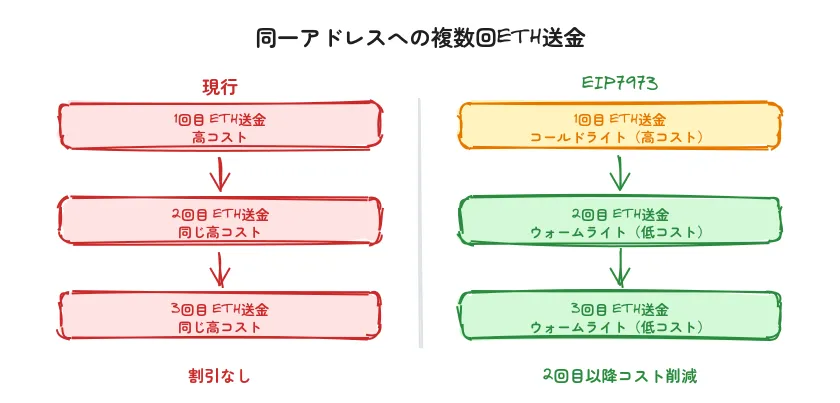
For example, the first balance modification of a recipient can incur GAS_COLD_ACCOUNT_WRITE. A second modification within the same transaction can qualify for GAS_WARM_WRITE if the account remains dirty.
This is not simply a count of calls: restoring the original state, reverting execution, or other state transitions can affect the relevant accounting conditions.
Changes to SSTORE gas accounting
The proposal also revises SSTORE pricing by distinguishing:
- The cost of updating the account tuple.
- The cost of updating the account's storage trie.
A storage change affects the account's storage commitment. Under the proposed accounting, an account already modified through SSTORE can qualify for warm account-write pricing where the required conditions are satisfied.
The original article illustrates the proposed calculation with the following Python-style pseudocode.
# 現在値とトランザクション開始時の値を取得
state = evm.message.block_env.state
original_value = get_storage_original(state, evm.message.current_target, key)
current_value = get_storage(state, evm.message.current_target, key)

# アカウント情報を取得(現在の状態とトランザクション開始時の状態)
original_account = get_account_original(state, evm.message.current_target)
account = get_account(state, evm.message.current_target)

gas_cost = Uint(0)

# アカウント書き込みコスト(コールド/ウォーム判定)
if account != original_account:
    gas_cost += GAS_WARM_WRITE          # 既に更新済み → ウォームライト
else:
    gas_cost += GAS_COLD_ACCOUNT_WRITE  # 初回更新 → コールドライト

# スロット固有のコスト(コールドアクセス判定)
if (target, key) not in accessed_storage_keys:
    accessed_storage_keys.add((target, key))
    gas_cost += GAS_COLD_SLOAD

# スロットの値変更に基づくコスト
if original_value == current_value and current_value != new_value:
    if original_value == 0:
        gas_cost += GAS_STORAGE_SET
    else:
        gas_cost += GAS_COLD_STORAGE_WRITE - GAS_COLD_SLOAD
else:
    gas_cost += GAS_WARM_ACCESS

# リファンドカウンター計算
if current_value != new_value:
    if original_value != 0 and current_value != 0 and new_value == 0:
        evm.refund_counter += int(GAS_STORAGE_CLEAR_REFUND)
    if original_value != 0 and current_value == 0:
        evm.refund_counter -= int(GAS_STORAGE_CLEAR_REFUND)
    if original_value == new_value:
        if original_value == 0:
            evm.refund_counter += int(GAS_STORAGE_SET - GAS_WARM_ACCESS)
        else:
            evm.refund_counter += int(GAS_COLD_STORAGE_WRITE - GAS_COLD_SLOAD - GAS_WARM_ACCESS)
        # アカウント書き込みがコールドだった場合のリファンド
        if account == original_account:
            evm.refund_counter += GAS_COLD_ACCOUNT_WRITE
The original code and its Japanese comments are preserved. It compares the original account state obtained through get_account_original with the current account state obtained through get_account.
It also accounts separately for cold storage-slot access, changes to the slot's value, and updates to the refund counter.
The refund logic addresses cases where a storage slot returns to its original value. The final conditional in this excerpt describes an adjustment involving GAS_COLD_ACCOUNT_WRITE.
The example is explanatory pseudocode, not a complete execution-client implementation. Its variables, refund conditions, and interaction with reverted execution must be checked against the applicable specification before implementation.
Compatibility with EIP-7928
The proposal also considers compatibility with block-level access lists (BALs) and parallel execution.
When an earlier transaction in the same block has modified an account and that modification is represented in the BAL, the applicable original state can be obtained from the corresponding BAL information rather than treating the block-start account state as the transaction-start state.
This distinction matters when multiple transactions in a block access or modify the same account.
Rationale
Why account updates are expensive
Ethereum's state is represented using a global Merkle Patricia trie. An account's storage root commits to that account's separate storage trie.
A storage modification can therefore affect both the account-specific storage commitment and the global state commitment.
Modifying an account's nonce or balance directly affects the global account state without requiring a change to its storage trie.
Although updating these commitments involves computation, clients can consolidate multiple state modifications before producing the resulting commitment. The proposal aims to reflect this lower marginal cost in the gas schedule.
Why full account-write net metering was not adopted
EIP-2200 provides storage net metering, including refund-counter adjustments when a slot returns to its original value.
The proposal considers applying a comparable approach more broadly to account writes, but the design described in the original article favors simplicity over introducing a full account-write net-metering mechanism.
This should be distinguished from the storage-related refund logic shown in the preceding pseudocode.
Pending benchmarks
The original article reports that the gas parameters were still subject to stateful benchmarking.
Such benchmarks are intended to measure the actual resource costs associated with state operations and inform the selection of appropriate gas prices.
Compatibility
Repricing consensus-critical operations requires a coordinated protocol upgrade.
Wallets
Wallets should obtain gas estimates from nodes that implement the relevant protocol rules. Outdated assumptions about account-write costs can produce inaccurate estimates.
Node software
RPC methods such as eth_estimateGas must reflect the gas accounting rules applicable to the target block or execution context.
With compatible node and wallet implementations, users can continue submitting transactions through their existing workflows.
Security
Lowering the cost of account-write operations can change the amount of work that fits within a transaction or block gas limit.
Further analysis is needed to evaluate the effects on applications, execution-client resource consumption, and denial-of-service resistance.
In particular, repeated state modifications and the creation of new persistent state have different resource implications. Gas pricing should account for these differences rather than assuming every discounted write is inexpensive in all execution contexts.
Benchmarking and security review are therefore important when selecting the relative prices of cold and warm writes.
References

Conclusion
EIP-7973 proposes warm account-write metering to reduce the marginal gas cost of repeated account modifications within a single transaction.
It addresses a difference between native ETH balance updates and storage-based token balance updates, aiming to align gas charges with the actual resource costs of modifying state.
The original proposal's parameter values and implementation details are subject to specification development and benchmarking. The examples above have not been independently executed or benchmarked as part of this translation.
Questions are welcome via Twitter @cardene777.
Other publications:


