Introduction
Hi, I'm cardene, a software engineer and technical writer focused on blockchain and AI.
I've also authored Japanese technical books on specification-driven development with LLMs and decentralized application (DApp) development.

I also build and publish a variety of tools, libraries, and open-source projects.
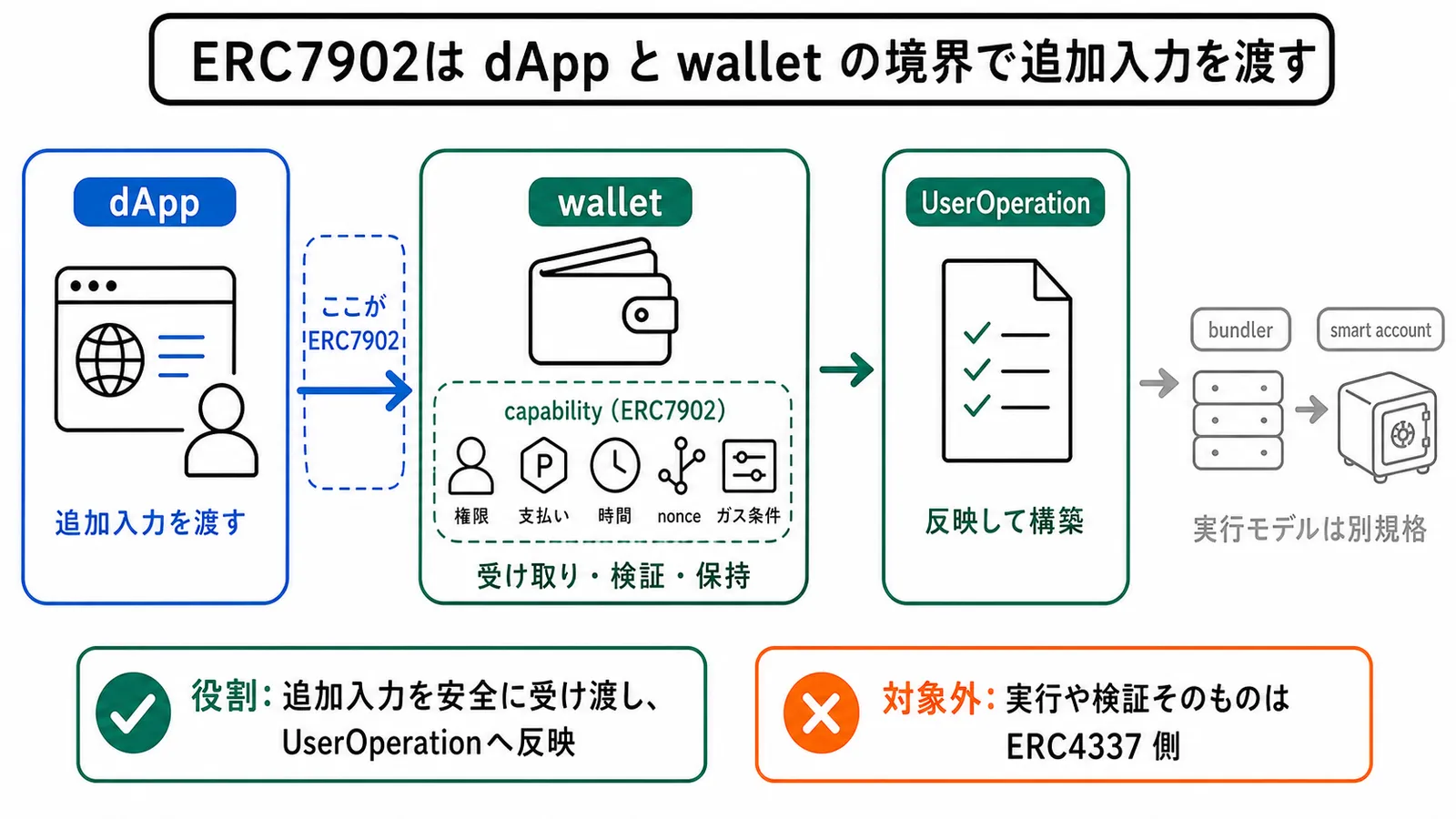
This article examines ERC7902, an extension to the Wallet Call API that allows dApps and wallets to exchange additional account abstraction (AA) settings.
The explanation follows the specification linked below. The original diagrams are retained; their labels are in Japanese.

I have also written about other EIPs, BIPs, SLIPs, CAIPs, ENSIPs, RFCs, and ACPs.





Overview
ERC7902 proposes using the capability mechanism in EIP5792 to let dApps pass additional parameters required for account abstraction to wallets.
For an introduction to EIP5792, see the following article.
[EIP5792] The Wallet Call API for batching on-chain calls
The original subtitle is "EIP-5792 Capabilities allowing dApps and wallets to exchange all AA specific UserOp fields." In other words, the AA-specific values needed to assemble a UserOperation can be exchanged as extensions to the Wallet Call API.
ERC4337 and ERC7769 define how AA works and how operations are submitted to a bundler. However, they do not provide a standard way for a dApp to ask the wallet to use a particular paymaster configuration, restrict the operation to a particular time window, or select a particular nonce lane.
For an introduction to ERC4337, see the following article.
[ERC4337] Account abstraction without protocol changes
For an introduction to ERC7769, see the following article.
[ERC7769] JSON-RPC API for ERC4337 contract accounts
ERC7902 fills that gap. By standardizing capability identifiers and input formats, AA-aware dApps can pass the additional settings they need through the Wallet Call API without relying on wallet-specific extensions.
As of May 4, 2026, ERC7902 had the status Draft.
It was not yet a finalized standard, so field names and operational details may change.
Motivation
Division of responsibilities among existing AA standards
Account abstraction standards already operate at several layers.
| Standard | Responsibility |
|---|---|
| ERC4337 | Defines the basic model for smart accounts and UserOperation. |
| ERC7769 | Defines the JSON-RPC interface for submitting a UserOperation to a bundler. |
| EIP5792 | Defines the Wallet Call API for submitting multiple calls between a dApp and a wallet. |
This division of responsibilities makes sense. However, an AA-aware dApp may need to pass more granular information to the wallet.
AA inputs that lack standardization
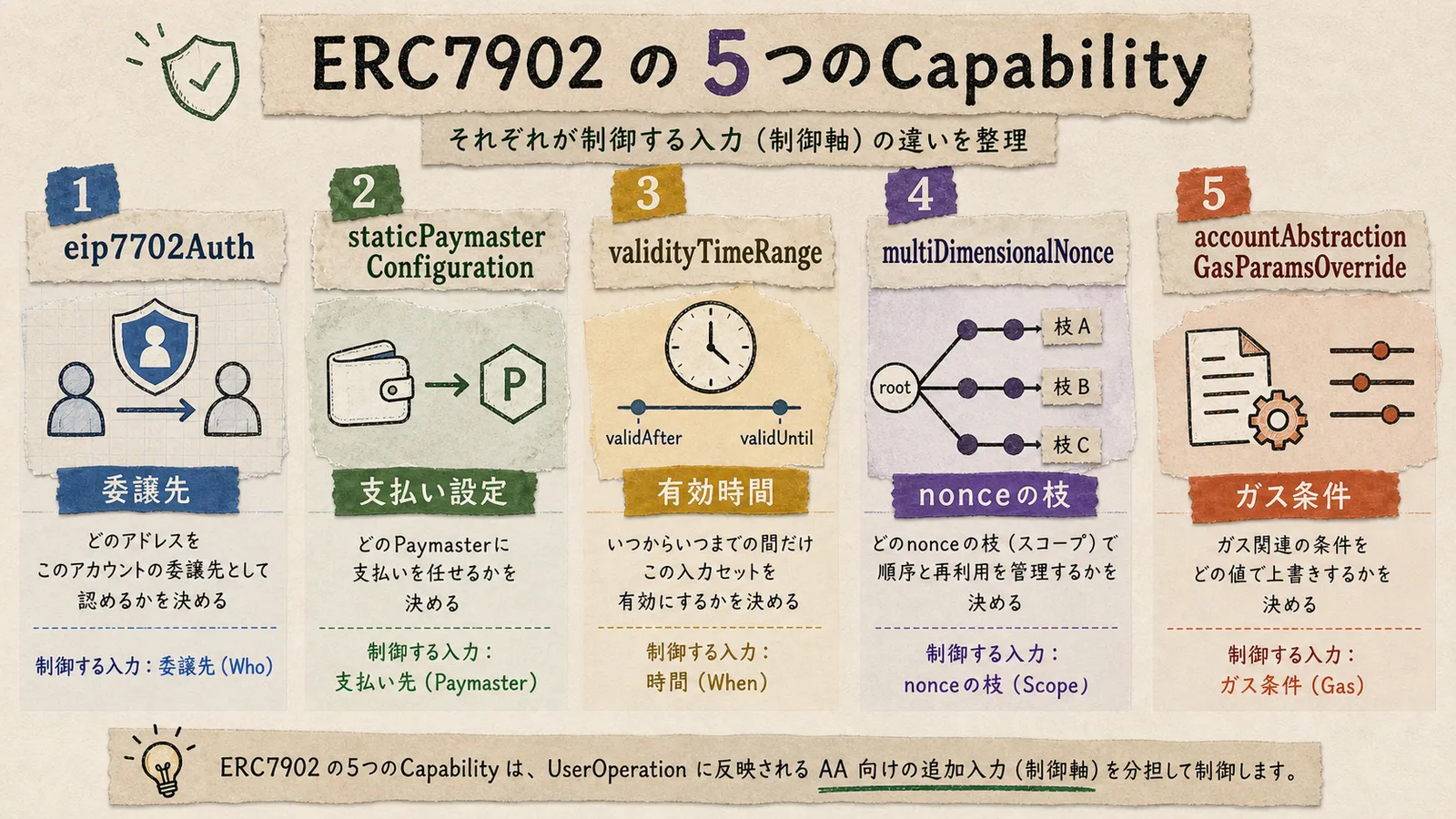
The original proposal identifies five main requirements.
- Specify the EIP7702 delegation target A dApp may want to control which implementation an EOA delegates to.
- Supply a static paymaster configuration
If the dApp has already resolved
paymasterandpaymasterData, it may want the wallet to use those exact values. - Restrict the validity window An operation may need to become valid only after a certain time or expire at a specified time, rather than being valid immediately after signing.
- Select a semi-abstracted nonce lane For an account with multidimensional nonces, the dApp may want to select which sequence to use.
- Override AA-specific gas values During development or for protocol-specific integrations, a dApp may need its own gas values instead of the wallet's automatic estimates.
These are important values in the UserOperation model. Without a standard way to pass them across the dApp–wallet boundary, implementations must rely on wallet-specific conventions.
EIP5792 capability extensions
EIP5792 was designed to allow capabilities to extend the Wallet Call API. ERC7902 uses that extension mechanism to standardize the names and types of additional AA parameters.
An AA-aware dApp can therefore query support through wallet_getCapabilities and include only the capabilities it needs in wallet_sendCalls.
Wallets can also advertise which additional settings they accept in a machine-readable form.
Specification
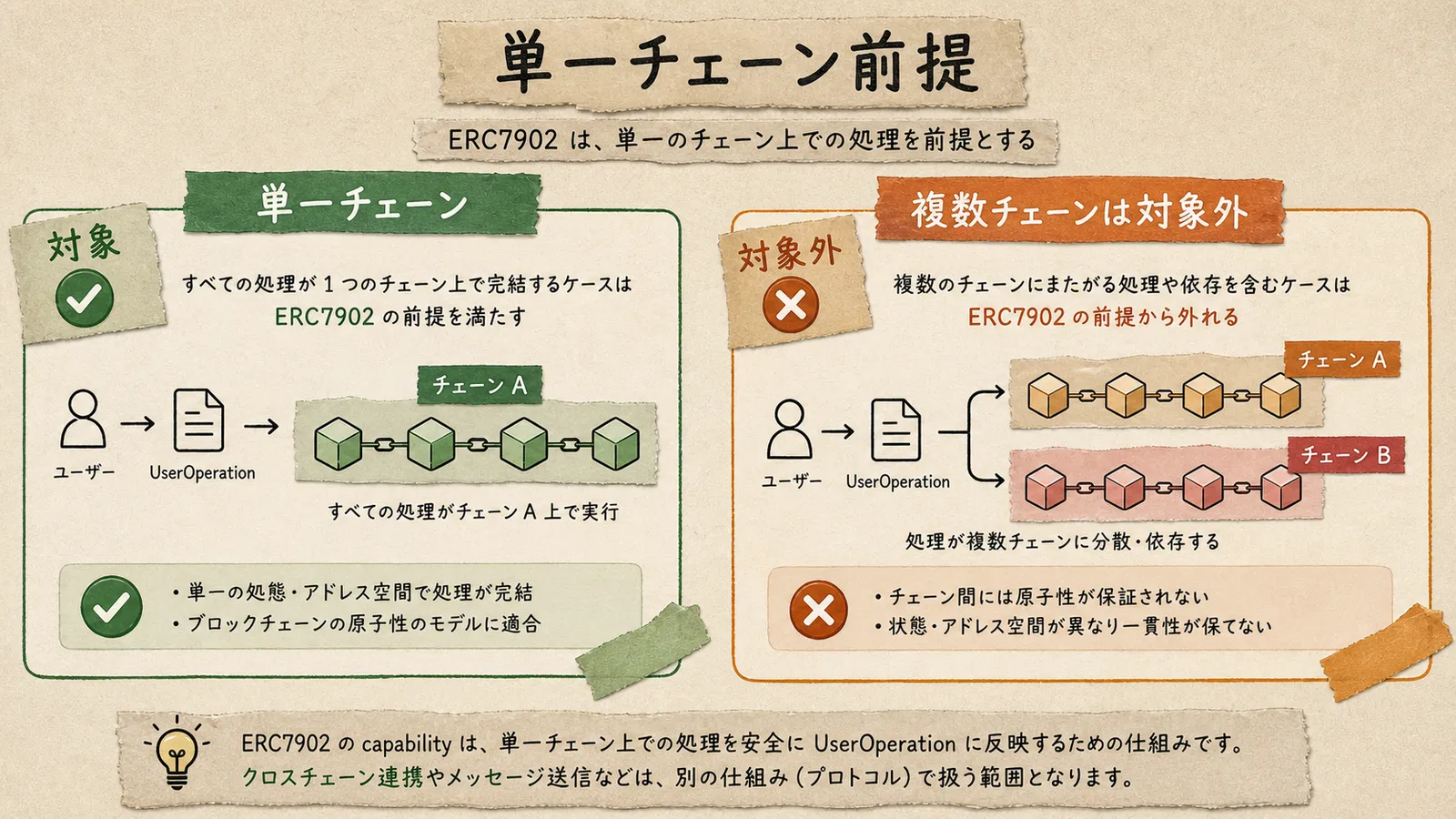
The specification is short and focuses on capability definitions. It starts with one requirement: AA operations in the EIP5792 context must execute atomically on a single chain.
Overall assumptions
This restriction keeps cross-chain operations and workflows that allow partial success outside the scope of the proposal. ERC7902 defines how to pass additional AA settings within one Wallet Call API request, assuming that the calls are handled together on the same chain.
eip7702Auth
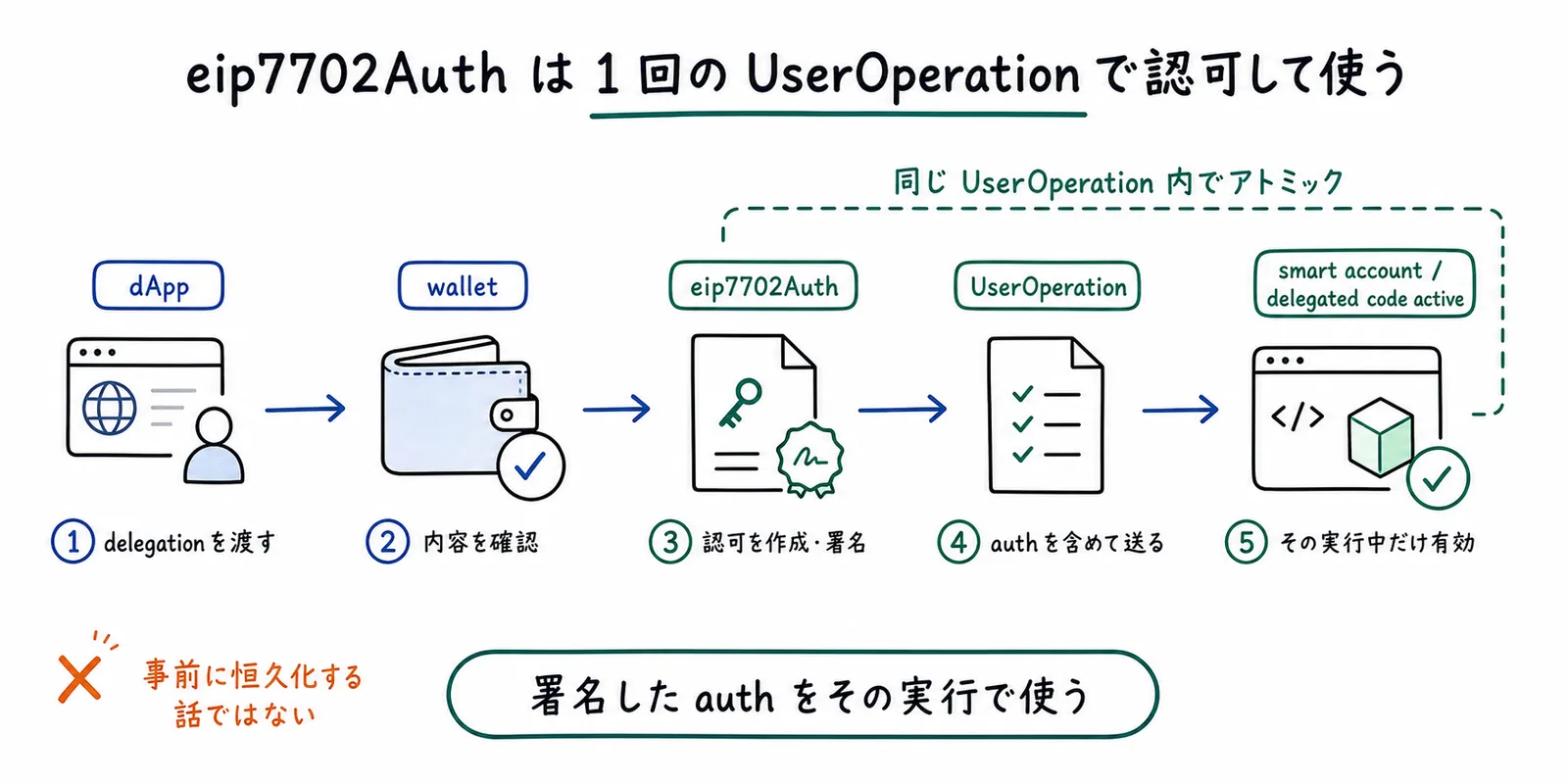
The eip7702Auth capability asks the wallet to construct EIP7702 authorization information.
For an introduction to EIP7702, see the following article.
[EIP7702] Giving EOAs smart contract account functionality
- Arguments
{
  account: `0x${string}`;
  delegation: `0x${string}`;
}
A wallet that supports this capability must generate an EIP7702-compatible transaction that sets the code delegation of the EOA identified by account to delegation.
The dApp can specify which EOA should delegate to which account implementation, and the wallet constructs the authorization tuple accordingly.
staticPaymasterConfiguration
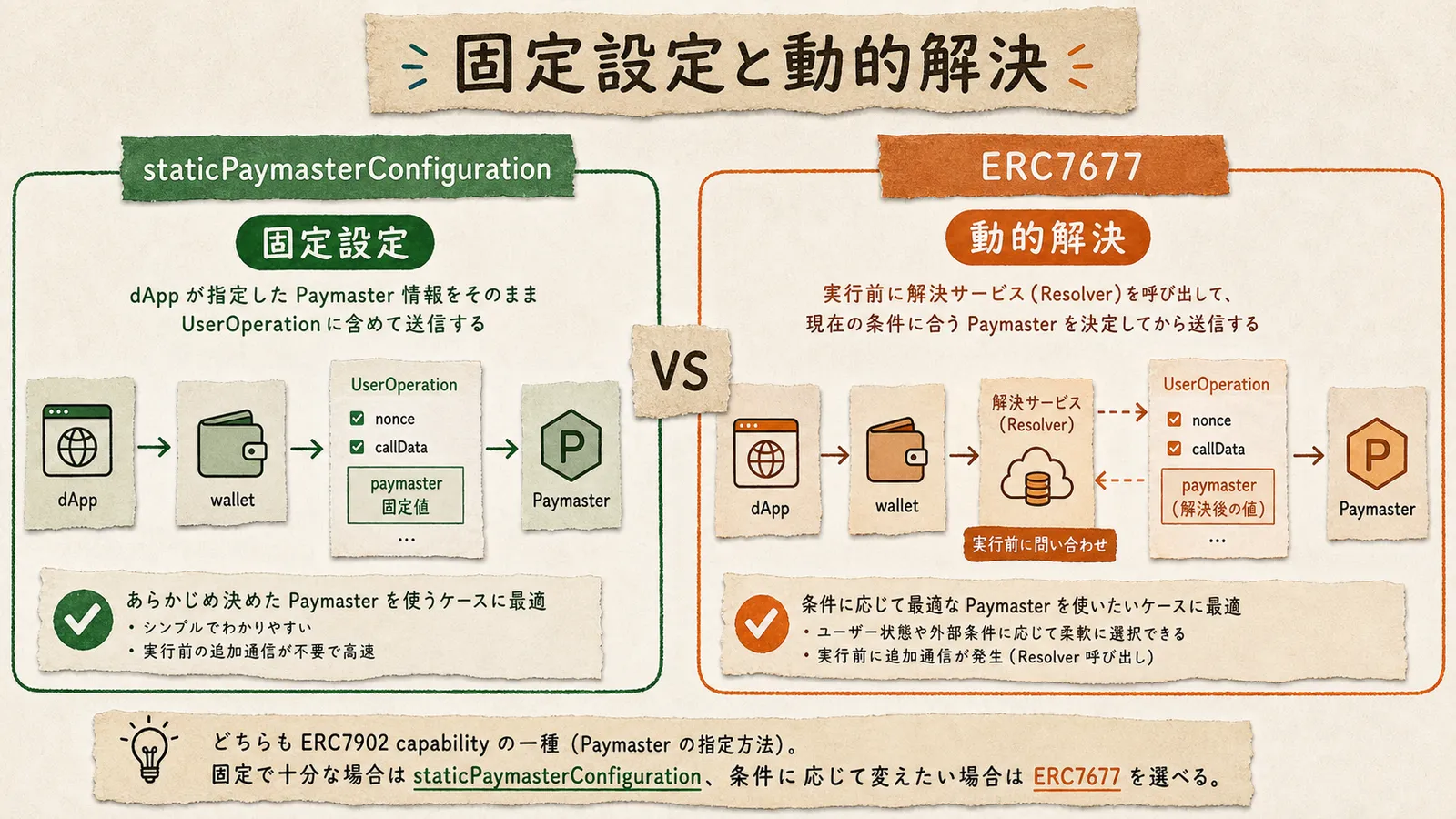
The staticPaymasterConfiguration capability supplies fixed paymaster settings that the wallet can use without any further resolution.
- Arguments
{
  paymaster: string;
  paymasterData: string;
  paymasterValidationGasLimit: `0x${string}`;
  paymasterPostOpGasLimit: `0x${string}`;
}
The original proposal explains that this eliminates the need for the "Wallet Application to resolve any dynamic configuration." The intended case is not one in which the wallet queries a web service for settings each time, but one in which the dApp supplies fixed values it has already resolved.
Dynamic paymaster resolution falls within the scope of ERC7677, rather than this proposal.
For an introduction to ERC7677, see the following article.
[ERC7677] How applications communicate with paymaster services
validityTimeRange
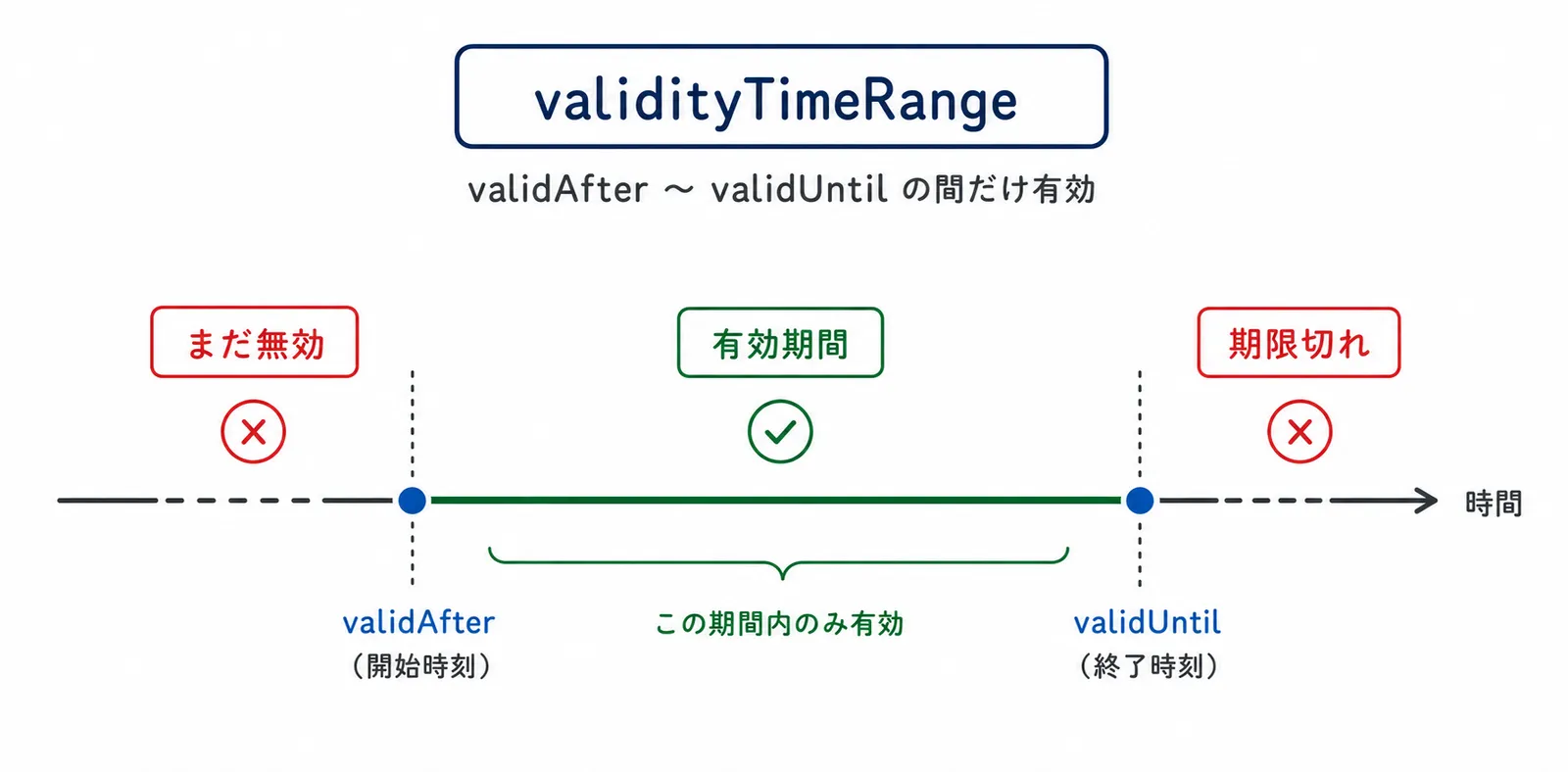
The validityTimeRange capability lets a dApp specify the period during which an operation is valid after signing.
- Arguments
{
  validAfter: `0x${string}`;
  validUntil: `0x${string}`;
}
The wallet must check that the time range is reasonable and display it to the user in a human-readable form.
The smart account must also enforce the interval from validAfter to validUntil as the transaction's validity period.
This capability is more than supplementary display information. The specified range must be respected during both signature confirmation and on-chain execution.
multiDimensionalNonce
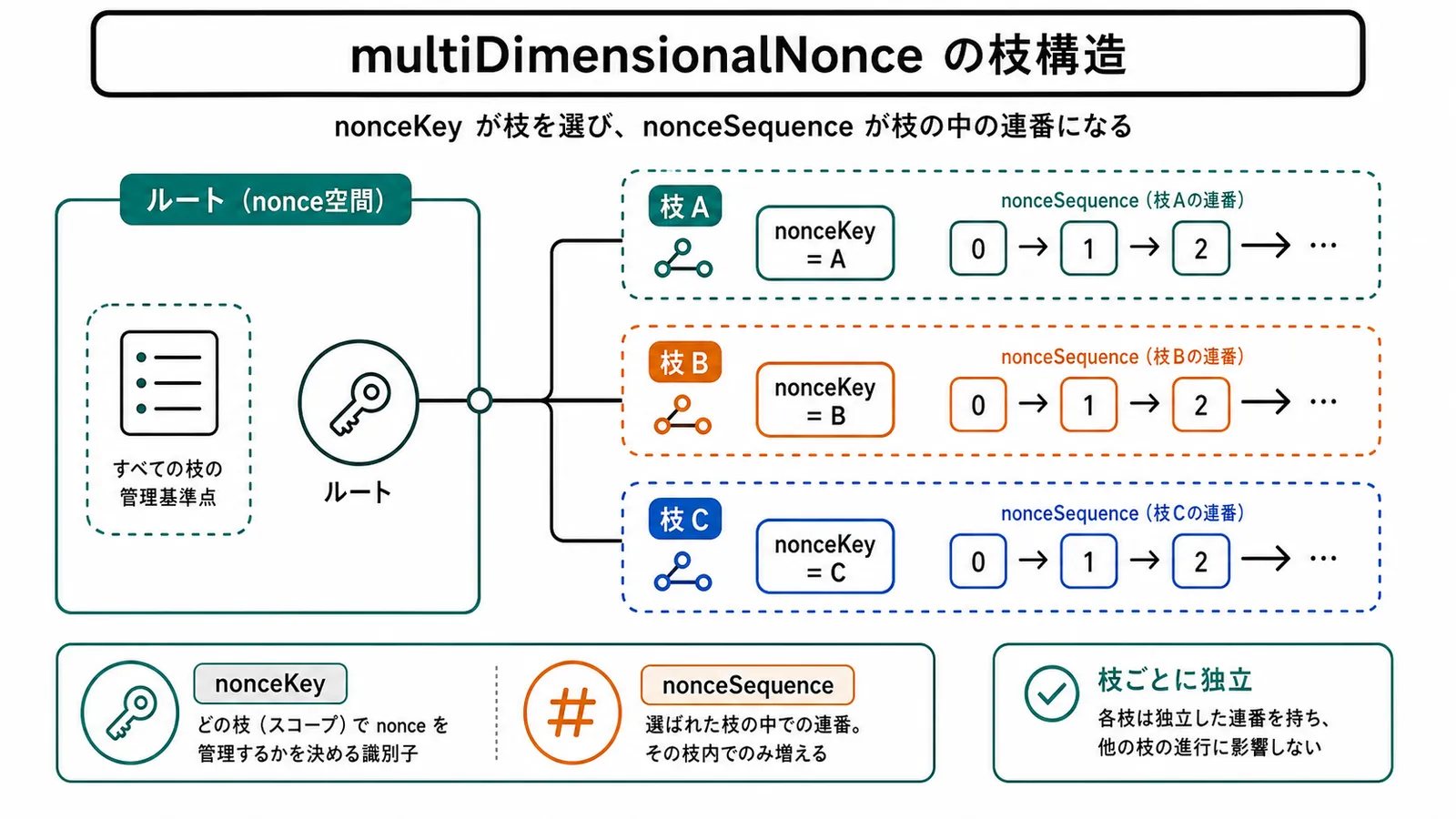
The multiDimensionalNonce capability lets a dApp specify the components of the semi-abstracted nonce defined in ERC4337.
- Arguments
{
  nonceKey: `0x${string}`;
  nonceSequence: `0x${string}`;
}
The proposal describes this as the "semi-abstracted nonce as defined in ERC-4337." Rather than passing a single sequential number, the dApp specifies both the lane and the sequence number within that lane.
For smart accounts that support multidimensional nonces, the wallet must use these values in the actual on-chain execution. This makes it easier for dApps to separate nonce lanes by purpose and manage nonces for parallel execution.
accountAbstractionGasParamsOverride
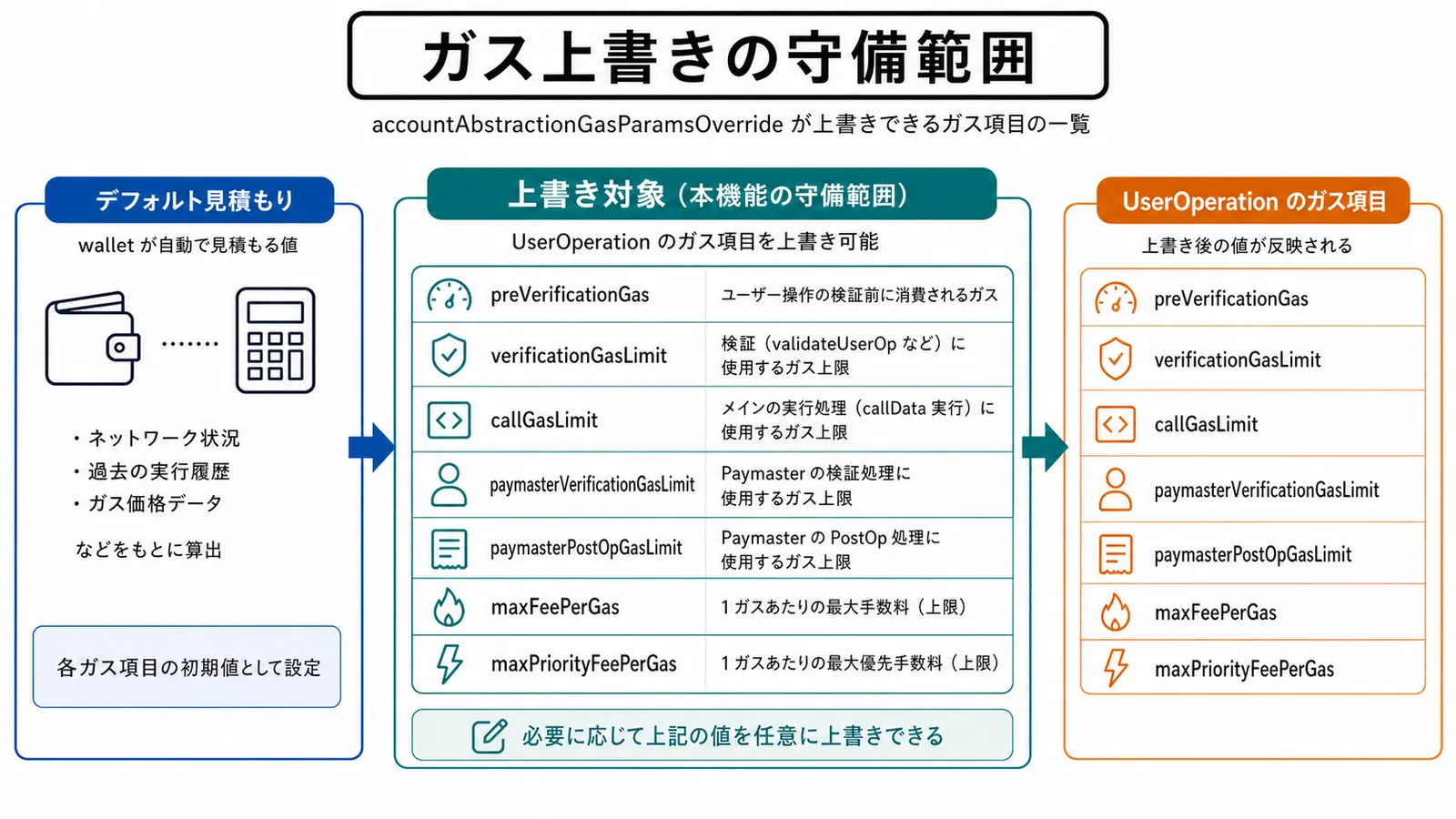
The accountAbstractionGasParamsOverride capability lets a dApp override AA-specific gas fields.
- Arguments
{
  preVerificationGas?: `0x${string}`;
  verificationGasLimit?: `0x${string}`;
  callGasLimit?: `0x${string}`;
  paymasterVerificationGasLimit?: `0x${string}`;
  paymasterPostOpGasLimit?: `0x${string}`;
  maxFeePerGas?: `0x${string}`;
  maxPriorityFeePerGas?: `0x${string}`;
}
The proposal emphasizes that this is a relatively low-level capability. It can be useful during development, debugging, or integrations tightly coupled to a particular version of a protocol. Production dApps, however, should generally rely on the wallet's higher-level functionality.
All fields are optional. A dApp can pass only the values it wants to override.
The wallet is expected to warn the user that the dApp has supplied override values and use those values. It may also reject the calls if the settings conflict.
Additional notes
Responsibilities of the five capabilities
All five capabilities provide additional values needed specifically for AA, but their responsibilities differ considerably.
| Capability | Purpose |
|---|---|
eip7702Auth |
Select the implementation to which an EOA delegates. |
staticPaymasterConfiguration |
Supply fixed paymaster configuration values. |
validityTimeRange |
Restrict when an operation is valid. |
multiDimensionalNonce |
Select the nonce lane and sequence number. |
accountAbstractionGasParamsOverride |
Override AA-specific gas values from the dApp. |
As the table shows, ERC7902 does not introduce one large new feature. Instead, it organizes the additional inputs often required by AA into distinct capabilities.
What ERC7902 does not cover
The proposal standardizes how additional settings are exchanged between dApps and wallets. The following concerns belong to other layers and are not addressed by this standard alone.
- Low-level communication with bundlers The RPC details for submitting a UserOperation to a bundler are defined by ERC7769.
- Dynamic paymaster resolution The process of obtaining paymaster configuration through a web service is defined by ERC7677.
- Smart account implementation The proposal does not determine which implementation to adopt or how to write its internal logic.
Within the broader AA architecture, ERC7902 is therefore responsible for exchanging inputs. It does not replace low-level submission protocols or establish the correctness of an account implementation.
Security
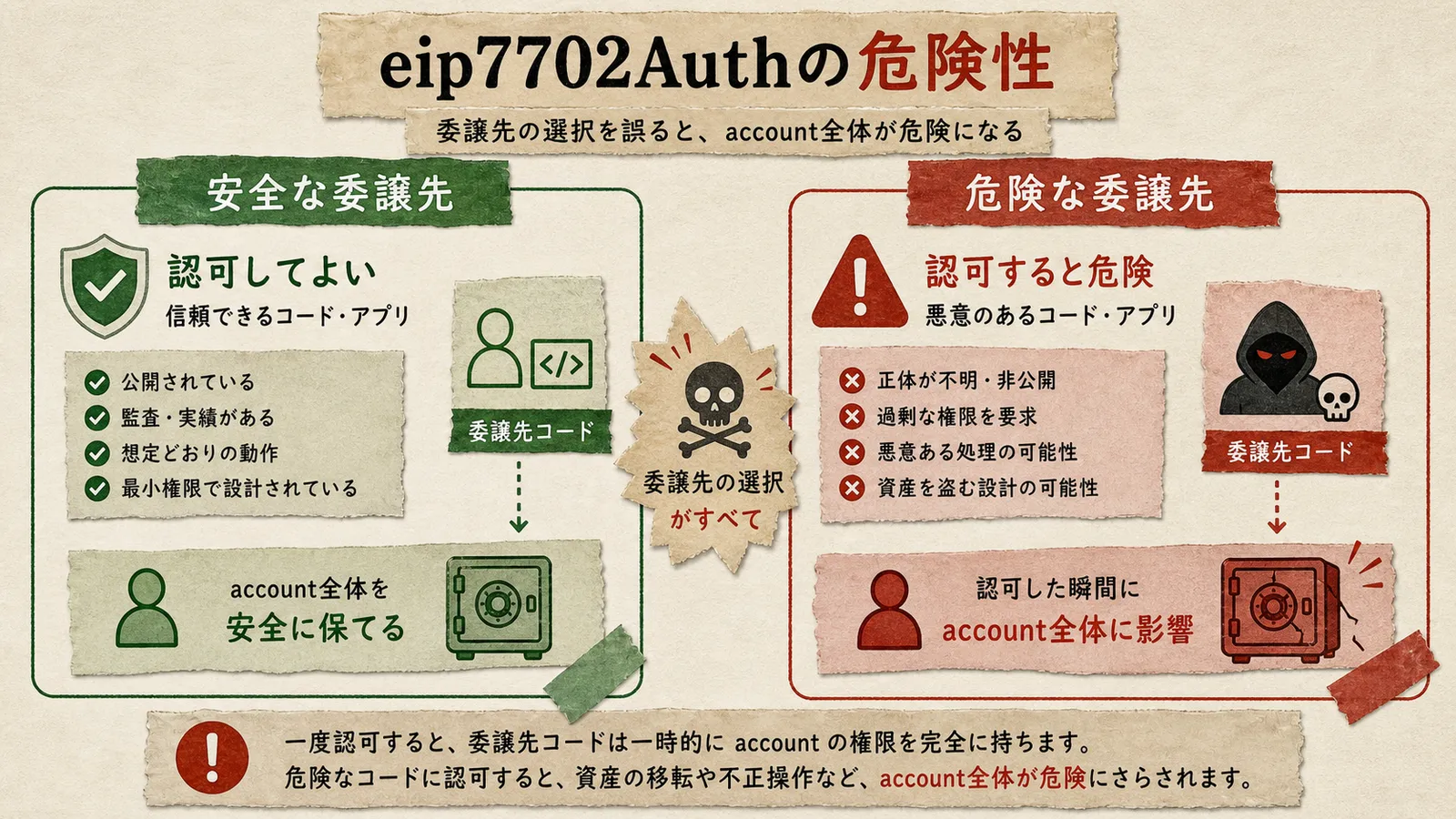
Risks of eip7702Auth
The original proposal states, This is by far the most sensitive capability in the document.
The potential damage from signing the wrong capability is unbounded: a malicious delegation could allow an attacker to drain all assets held by account.
Wallets must strictly restrict the delegation implementations they accept and allow only widely known, publicly audited implementations.
Simply trusting an address supplied by the dApp and asking the user to sign is insufficient.
Attack surface of staticPaymasterConfiguration
The proposal notes that incorrect paymaster or paymasterData values can be attack vectors.
For example, if a paymaster contract has ERC20 token allowances, those allowances could be abused.
For an introduction to ERC20, see the following article.
[ERC20] An introduction to ERC20 tokens
Wallets must therefore verify that the paymaster configuration reflects the user's intent, just as they inspect the calldata of an ordinary transaction.
Operational risks of gas overrides
The accountAbstractionGasParamsOverride capability is useful for dApps that understand the details of a protocol implementation.
Incorrect values, however, can cause execution failures or excessive fees.
This is why the original proposal says that "production dapps rely on higher-level features of Wallet Applications instead." In most cases, gas estimation should be left to the wallet, and overrides should be reserved for situations where they are genuinely necessary.
Conclusion
This article has covered ERC7902.
Rather than redefining AA itself, ERC7902 uses EIP5792 capabilities to exchange additional AA settings.
By standardizing eip7702Auth, staticPaymasterConfiguration, validityTimeRange, multiDimensionalNonce, and accountAbstractionGasParamsOverride, it aims to improve interoperability between AA-aware dApps and wallets.
However, eip7702Auth and staticPaymasterConfiguration also introduce significant attack surfaces.
Wallets in particular must scrutinize delegation targets and accepted paymaster settings even more carefully than ordinary signature requests.
I also publish articles on the following platforms.