Introduction
Hi, I'm cardene, a software engineer and technical writer focused on blockchain and AI.
I've also authored Japanese technical books on specification-driven development with LLMs and decentralized application (DApp) development.

I also build and publish a variety of tools, libraries, and open-source projects.
ERC-7947 proposes a common interface for recovering access to smart accounts.
This article explains the following proposal.

The interface allows a smart account to integrate multiple recovery providers so that users can recover access even if they lose their original signing key.
Overview
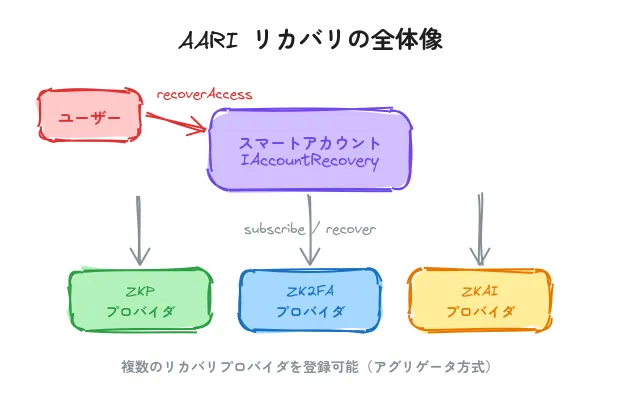
ERC-7947 defines the Account Abstraction Recovery Interface (AARI).
A smart account can recover access through recovery providers registered in advance. The proposal centers on recoverAccess(subject, provider, proof) and provides common operations for adding, removing, and querying recovery providers.
It is designed to be independent of a particular account abstraction mechanism, allowing integration with accounts using ERC-4337 or EIP-7702 where their authorization architecture supports it.
For ERC-4337, see the following article.
ERC-4337: Account abstraction without protocol-level changes
For EIP-7702, see the following article.
EIP-7702: Delegating EOA execution to smart contract code
Motivation
Account abstraction allows smart accounts to offer authentication and authorization mechanisms beyond direct management of an EOA private key. However, recovery mechanisms have historically differed between implementations.
Losing a private key
Losing the private key of an ordinary EOA can make it impossible to authorize further transactions from that account unless another applicable recovery mechanism already exists.
Smart accounts can also become inaccessible if all authorized credentials are lost. They therefore need recovery mechanisms designed into their authorization policies. Project-specific recovery interfaces can make it difficult to reuse recovery providers across accounts.
Potential applications of ZKAI and ZK2FA
Zero-knowledge artificial intelligence (ZKAI) and zero-knowledge two-factor authentication (ZK2FA) are examples of approaches that could support recovery based on alternative credentials.
ZKAI and ZK2FA
ZKAI combines zero-knowledge proofs with AI-related computations. A recovery implementation might, for example, verify a statement about biometric authentication without publicly revealing the underlying biometric data.
ZK2FA uses zero-knowledge techniques to prove an authentication condition without directly disclosing secret inputs such as passwords or authentication codes.
These approaches could be implemented as recovery providers. Their security depends on the precise statement being proved, enrollment process, credential entropy, and verification policy. A zero-knowledge proof alone does not establish a person's identity.
A marketplace for recovery providers
ERC-7947 allows a smart account to act as an aggregator of recovery providers.
Users can register several providers and choose recovery mechanisms that suit their needs. A common interface could make it easier to integrate independently developed recovery services and support a marketplace of compatible providers.
Registering several providers does not automatically establish a multi-provider threshold policy. Whether one provider can recover the account independently or several providers must cooperate depends on the account and provider implementation.
Specification
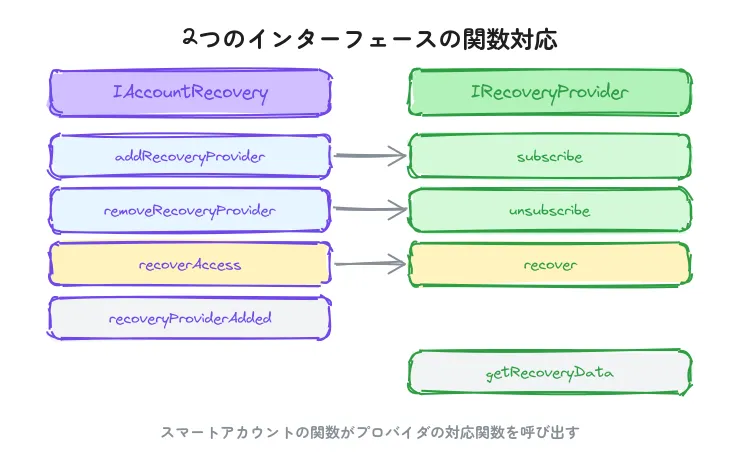
IAccountRecovery interface
A smart account implements this interface to manage recovery providers and recover access.
interface IAccountRecovery {
    event AccessRecovered(bytes subject);
    event RecoveryProviderAdded(address indexed provider);
    event RecoveryProviderRemoved(address indexed provider);

    function addRecoveryProvider(address provider, bytes memory recoveryData) external payable;
    function removeRecoveryProvider(address provider) external payable;
    function recoveryProviderAdded(address provider) external view returns (bool);
    function recoverAccess(
        bytes memory subject,
        address provider,
        bytes memory proof
    ) external returns (bool);
}
addRecoveryProvider
Registers a recovery provider.
- Parameters
providerAddress of the provider to add.recoveryDataCustom recovery data, such as a commitment, supplied to the provider.
- The function should be access-controlled.
- The provider must not be the zero address.
- The account must call the provider's subscribe function with the recovery data.
removeRecoveryProvider
Removes a registered recovery provider.
- Parameter
providerAddress of the provider to remove.
- The function should be access-controlled.
- The account must call the provider's unsubscribe function.
recoveryProviderAdded
Queries whether a recovery provider is registered.
- Parameter
providerAddress to check.
- Return value
- True if registered; otherwise false.
recoverAccess
Performs an account-access recovery operation.
- Parameters
subjectThe recovery subject, such as an encoded owner address, access-control role, or other authorization data.providerAddress of the recovery provider to use.proofRecovery proof, such as a zero-knowledge proof or a signature.
- Return value
- True on successful recovery. An unsuccessful operation may return false or revert according to the applicable implementation and specification.
- The account must verify that the provider is registered.
- The account must invoke the provider's recover function.
- Following successful proof verification, the account updates access according to the intended recovery subject.
Recovery flow
- The user registers a recovery provider in advance through addRecoveryProvider, supplying recovery data such as a cryptographic commitment.
- If the original signing key is lost, a recovery request is submitted through recoverAccess.
- The smart account calls the provider's recover function to verify and process the recovery proof. The provider updates its replay-prevention state where required.
- Following successful verification, the smart account updates the relevant access permissions.
sequenceDiagram
    participant U as ユーザー
    participant SA as スマートアカウント
    participant RP as リカバリプロバイダ

    Note over U,RP: 事前登録フェーズ
    U->>SA: addRecoveryProvider(provider, recoveryData)
    SA->>RP: subscribe(recoveryData)
    RP-->>SA: コミットメントを保存

    Note over U,RP: 復旧フェーズ
    U->>SA: recoverAccess(subject, provider, proof)
    SA->>RP: recover(object, proof)
    RP-->>SA: 証明を検証
    SA-->>U: アクセス権を更新
The original sequence diagram retains its Japanese labels. It shows the enrollment phase followed by proof verification and the account-access update.
IRecoveryProvider interface
A recovery provider implements this interface to manage account subscriptions and verify recovery proofs.
interface IRecoveryProvider {
    event AccountSubscribed(address indexed account);
    event AccountUnsubscribed(address indexed account);

    function subscribe(bytes memory recoveryData) external payable;
    function unsubscribe() external payable;
    function getRecoveryData(address account) external view returns (bytes memory);
    function recover(bytes memory object, bytes memory proof) external;
}
subscribe
Registers the calling smart account with the provider.
The provider associates recoveryData with msg.sender so that it can use the data when verifying subsequent recovery requests.
- Parameter
recoveryDataRecovery commitment, such as a hash or public output of a zero-knowledge proof.
unsubscribe
Cancels the calling account's subscription.
The provider must remove the associated recovery data according to the applicable interface requirements.
getRecoveryData
Retrieves the recovery data associated with an account.
- Parameter
accountAddress of the account whose recovery data is requested.
- Return value
- The associated recovery data.
recover
Processes recovery for the calling smart account.
The provider verifies the proof against recovery data associated with msg.sender and maintains appropriate replay-prevention state, such as a nonce. Invalid proofs must cause the operation to revert.
- Parameters
objectRecovery object, which can differ in representation from the account-level subject.proofProof authorizing the recovery.
Subscription and recovery
The provider and smart account interact through a subscription model.
During enrollment, the account supplies recovery data. This may be a commitment to a secret or a public value associated with a proof system rather than the secret itself.
During recovery, the provider checks the submitted proof against the registered recovery data. A zero-knowledge proof can establish knowledge of a secret without revealing the secret.
Replay prevention requires the proof to be bound to the intended recovery operation and the relevant freshness or nonce state. Updating a nonce is effective only if the verification logic actually enforces that binding.
Rationale
Design decisions
Compatibility with account abstraction mechanisms
The proposal does not depend on one particular account abstraction standard. Smart accounts using ERC-4337 or EIP-7702 can integrate the IAccountRecovery interface into their authorization architecture.
For EIP-7702, this does not mean that recovering the delegated account's application-level authorization recovers a lost EOA private key or removes the original key's protocol-level authority. The account's delegation and recovery design must account for that distinction.
Why subject and object use bytes
The subject parameter in recoverAccess and the object parameter in recover are represented as bytes rather than addresses.
Some smart accounts do not use a single owner address. They may use role-based access control, alternative credentials, or other authorization models.
A byte representation permits these implementations to encode their own recovery targets and authorization data.
Updating recovery commitments
A user may need to replace an existing commitment for security reasons.
The proposal describes performing unsubscribe followed by subscribe in a multicall, removing the previous recovery data and registering the new data. An account must ensure that both operations are appropriately authorized and that any required account-side registration state remains consistent.
Backward compatibility
ERC-7947 introduces an additional interface. Existing accounts that do not implement IAccountRecovery can continue operating without adopting the recovery mechanism.
Security
Account recovery is a security-critical part of a smart account's authorization architecture.
Access control
The addRecoveryProvider and removeRecoveryProvider functions require appropriate access control.
If an unauthorized party can register a malicious provider, that provider could potentially authorize an account takeover. Removing legitimate recovery providers could also make an account unrecoverable.
Implementations should additionally account for external-call failures, reentrancy, replay protection, and the binding between the verified proof and the exact authorization update.
Phishing risks
Users may be deceived into registering malicious recovery providers.
A provider that accepts invalid recovery proofs can compromise accounts that rely on it for recovery. Users and applications should evaluate the provider's implementation, administration, and trust assumptions before granting it recovery authority.
The interface examples are reproduced from the original article and have not been independently compiled or audited as part of this translation.
References
Conclusion
ERC-7947 proposes a common account recovery interface through which smart accounts can register recovery providers and recover access using proofs accepted by those providers.
It creates a foundation for interoperable recovery mechanisms, including implementations using zero-knowledge proofs or alternative authentication methods. Its security ultimately depends on the account's authorization policy and the recovery providers it trusts.
Other publications:




