Introduction
Hi, I'm cardene, a software engineer and technical writer focused on blockchain and AI.
I've also authored Japanese technical books on specification-driven development with LLMs and decentralized application (DApp) development.

I also build and publish a variety of tools, libraries, and open-source projects.
This article explores blockchain consensus algorithms. It covers proof of work (PoW), proof of stake (PoS), Tendermint, and proof of authority (PoA).
PoW
Proof of work (PoW) requires repeated hash calculations until a candidate block satisfies a specified condition. Finding a hash satisfying that condition requires computational work, so a valid proof provides evidence that the required work has been performed. Other block validity rules must still be checked. This supports maintaining a consistent transaction history without relying on one designated administrator.
Hashes
A hash function maps input data to a fixed-length output. Bitcoin uses SHA-256, a cryptographic hash function whose output changes unpredictably when the input changes slightly.
The following website demonstrates this behavior.
Enter a value in the Data field and observe the resulting hash.
Hello
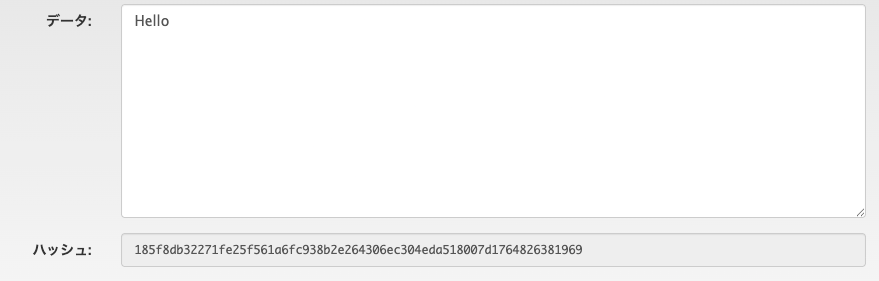
Hello

185f8db32271fe25f561a6fc938b2e264306ec304eda518007d1764826381969
Hello
Adding only a space after Hello produces a completely different hash from Hello.

Hello

2ec5a3f0c2fc3e6dcee0f6f3a5735a6c69d2056579a5452095b75802094043a8
Hello World
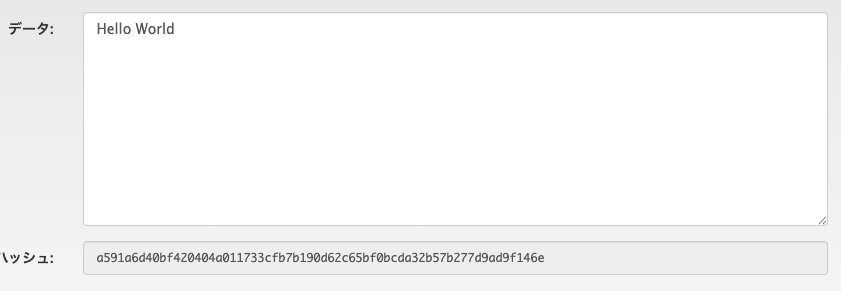
Hello World

a591a6d40bf420404a011733cfb7b190d62c65bf0bcda32b57b277d9ad9f146e
How PoW works
The following describes Bitcoin-style proof of work in detail.
1. Assemble the block header
Construct the header with the version, previous block hash, transaction Merkle root, timestamp, nBits, and nonce.
-
Previous block hash The double-SHA-256 hash of the preceding block header. This links successive blocks. Changing an earlier header breaks the existing links to its descendants.
-
Merkle root The root hash of the Merkle tree constructed from the block's transactions. It enables efficient verification that a transaction is included in the block. Changing the coinbase transaction, which is the first transaction and assigns the mining reward, changes the Merkle root and therefore the block header.
-
Timestamp Approximate block creation time, expressed as a Unix timestamp. It does not guarantee an exact real-world creation time. Nodes enforce timestamp rules, including the median-time-past requirement and a limit on future timestamps.
-
nBits (compact target representation) A compact representation from which the target threshold is decoded. A lower target makes valid hashes harder to find. Informally, the target determines how small the resulting hash must be, often illustrated by leading zero bits.
The difficulty adjustment algorithm determines
nBits. On Bitcoin mainnet, the target is adjusted every 2016 blocks, approximately two weeks.- Measure the elapsed time over the previous adjustment interval.
- Compare it with the target duration of 2016 × 10 minutes, or two weeks.
- If blocks were produced too quickly, reduce the target and increase difficulty.
- If they were too slow, increase the target and reduce difficulty, subject to the proof-of-work limit.
The adjustment is bounded so that difficulty changes by no more than a factor of four per interval, subject to rounding and the proof-of-work limit. Encode the adjusted target in the 32-bit compact format used by subsequent headers.
-
Nonce A 32-bit header field. Miners vary it when searching for a valid proof of work. When the nonce space is exhausted, a miner can change the extraNonce in the coinbase transaction, producing a different Merkle root and a new header search space.
Because the Merkle root commits to the transaction set, changing the coinbase transaction changes the root and header hash.
2. Determine the target
The header's nBits field encodes the target in compact form.
Miners decode it into the numerical target used to check the 256-bit proof-of-work hash.
Structure of nBits
The compact representation occupies four bytes (32 bits).
- Most significant byte Exponent.
- Remaining three bytes Encoded coefficient, including a sign bit that must not indicate a negative valid target.
Decode these fields to calculate the target.
Target calculation
Use the following expression for the ordinary positive compact representation.
- coefficient
The positive coefficient encoded in the lower three bytes of
nBits. - exponent
The integer exponent encoded in the highest byte of
nBits.
Worked example
The Bitcoin genesis block uses nBits = 0x1d00ffff.
- exponent = 0x1d = 29
- coefficient = 0x00ffff = 65535
Substituting into the formula gives:
= 65535 × 256^26 = 0x00000000FFFF0000000000000000000000000000000000000000000000000000
This is the target.
The proof-of-work condition compares the numerical double-SHA-256 digest of the header, interpreted using Bitcoin's conventions, with the target.
The condition digest ≤ target can be illustrated by leading zeros, although the full numerical comparison determines validity.
Why does any value below or equal to the target qualify rather than only an exact match?
Treating hashes as random values
For mining analysis, SHA-256 outputs are modeled as approximately uniformly distributed 256-bit values. PoW checks whether the resulting value is sufficiently small.
The condition is a threshold
The target specifies the maximum acceptable hash value.
If only digest = target qualified, the success probability of each independent trial would be .
Accepting all values up to the target allows difficulty to be tuned. The following expression approximates the probability; the exact inclusive count is target + 1.
Adjusting difficulty through the target threshold
- Larger target → wider accepted range → easier to find a qualifying digest → lower difficulty.
- Smaller target → narrower accepted range → harder to find a qualifying digest → higher difficulty.
An exact-match rule would not allow this adjustment and would make finding valid hashes impractical.
Lower targets require increasingly small numerical hashes. Requiring 20 leading zero bits gives a success probability of 1/2^20, or an expected 2^20 trials. Each additional required leading zero bit doubles the expected work.
Model the digest as a uniformly distributed 256-bit integer. Mining repeats trials until the digest is at or below the target.
Example 1: A larger target
Suppose the target is:
0x0000FFFFFFFFFFFFFFFFFFFFFFFFFFFFFFFFFFFFFFFFFFFFFFFFFFFFFFFFFFFF- The leading 16 bits (two bytes) must be zero.
- The remaining bits are unrestricted, giving a probability of 1 / 2^16 ≈ 1/65,536.
- The expected number of trials is approximately 65,000.
Example 2: A smaller target
Now reduce the target as follows.
0x0000000FFFFFFFFFFFFFFFFFFFFFFFFFFFFFFFFFFFFFFFFFFFFFFFFFFFFFFFFF- Roughly 28 leading bits must be zero.
- The corresponding illustrative success probability is 1 / 2^28 ≈ 1/268,435,456.
- The expected trial count rises to hundreds of millions.
3. Search the nonce space
Miners repeatedly hash candidate block headers to find a valid proof of work. For example, vary the 32-bit nonce and calculate double SHA-256, checking whether the result satisfies the target. If no nonce qualifies, vary the coinbase extraNonce. This changes the Merkle root and header, enabling another search.
Because this search is probabilistic, the exact time of success is unpredictable. The smaller the target, the greater the expected number of trials; reducing the target by a factor of two approximately doubles the work.
The following demonstration illustrates repeated hashing.
The default view looks like this.

For example, enter Hello in the data field.
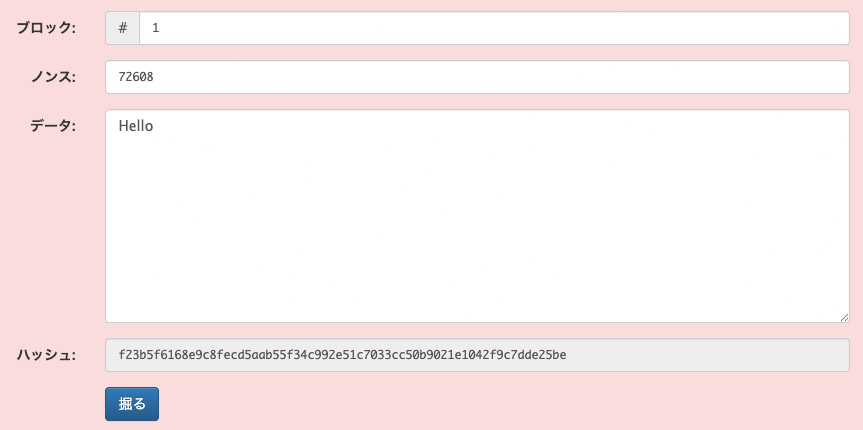
The block hash changes, so a qualifying nonce must be found again.

Click the mining button. The demonstration changes the nonce until it finds a hash beginning with four hexadecimal zeroes.
Requiring four leading hexadecimal zeroes corresponds to requiring 16 leading zero bits and can be expressed as a target threshold.
The following target accepts every value with 16 leading zero bits.
target = 0x0000FFFFFFFFFFFFFFFFFFFFFFFFFFFFFFFFFFFFFFFFFFFFFFFFFFFFFFFFFFFFThe validation condition is digest ≤ target; in this example, search for a digest whose first four hexadecimal digits are zero.
4. Propagate a block that meets the target
Once a valid header is found, propagate the block, including its transactions, to the network. Miners have an incentive to propagate their valid blocks promptly. Several miners may find competing blocks at roughly the same time, temporarily creating a fork.
5. Verification by other nodes
Receiving nodes compute the header's double-SHA-256 digest and check it against the required target. The proof check requires one double-hash operation and an integer comparison.
Finding a qualifying header may require a very large number of trials. This asymmetry between expensive proof generation and inexpensive proof verification is central to PoW. Nodes can reject invalid proof-of-work headers cheaply, while separately enforcing the remaining block and transaction rules.
Block production
The following website demonstrates block construction. Its default view is shown below.
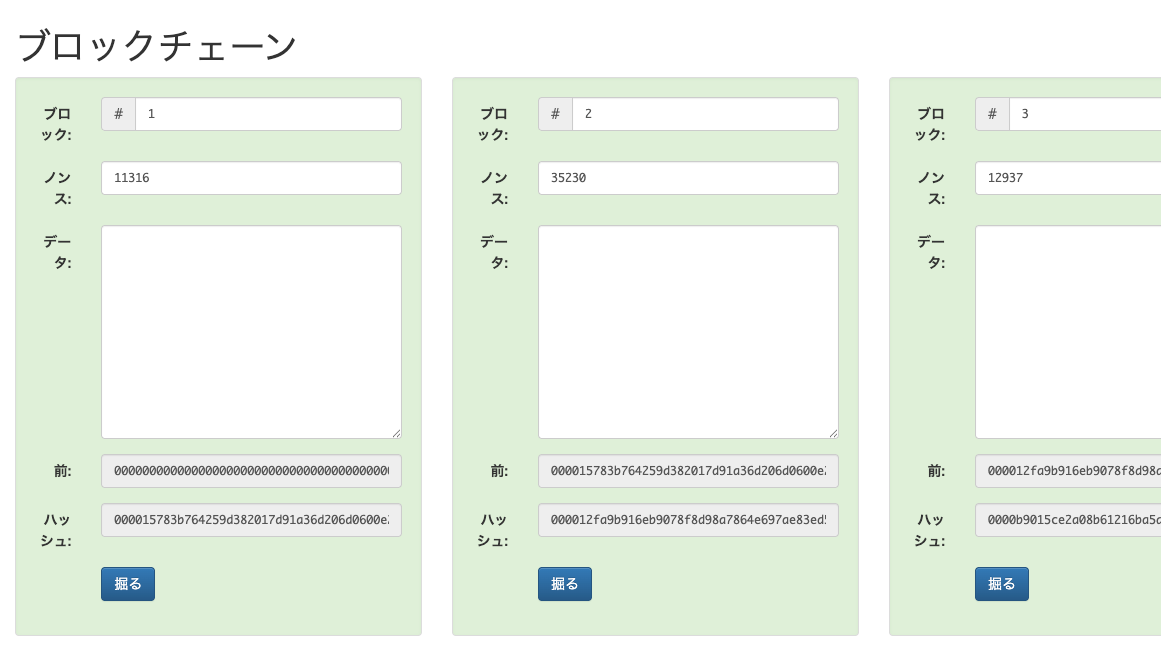
Suppose the data in block 2 is changed.
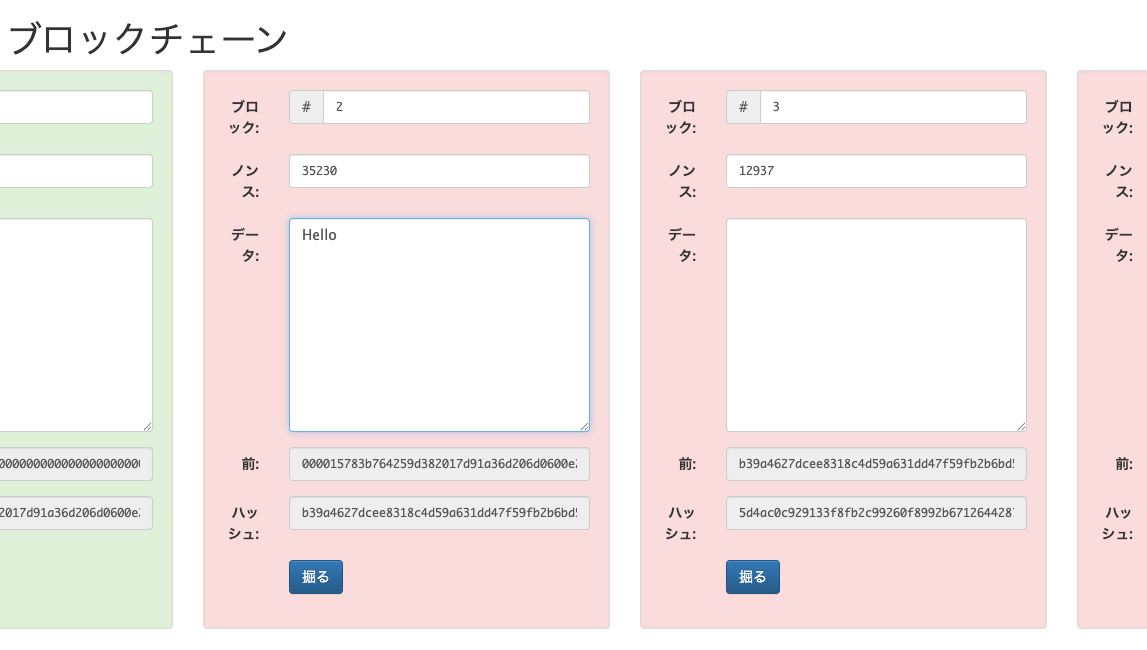
Block 2's hash changes. This invalidates the existing previous-block reference in its successor. Rebuilding a consistent modified chain requires updating the links and finding valid proofs of work for all affected descendants.
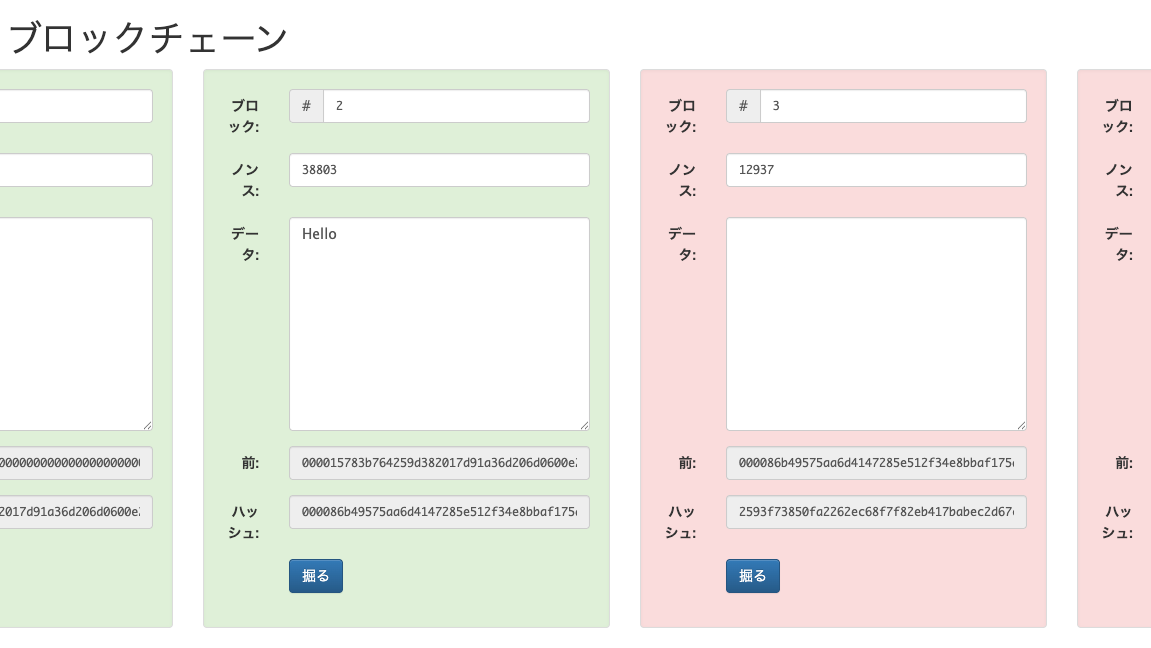
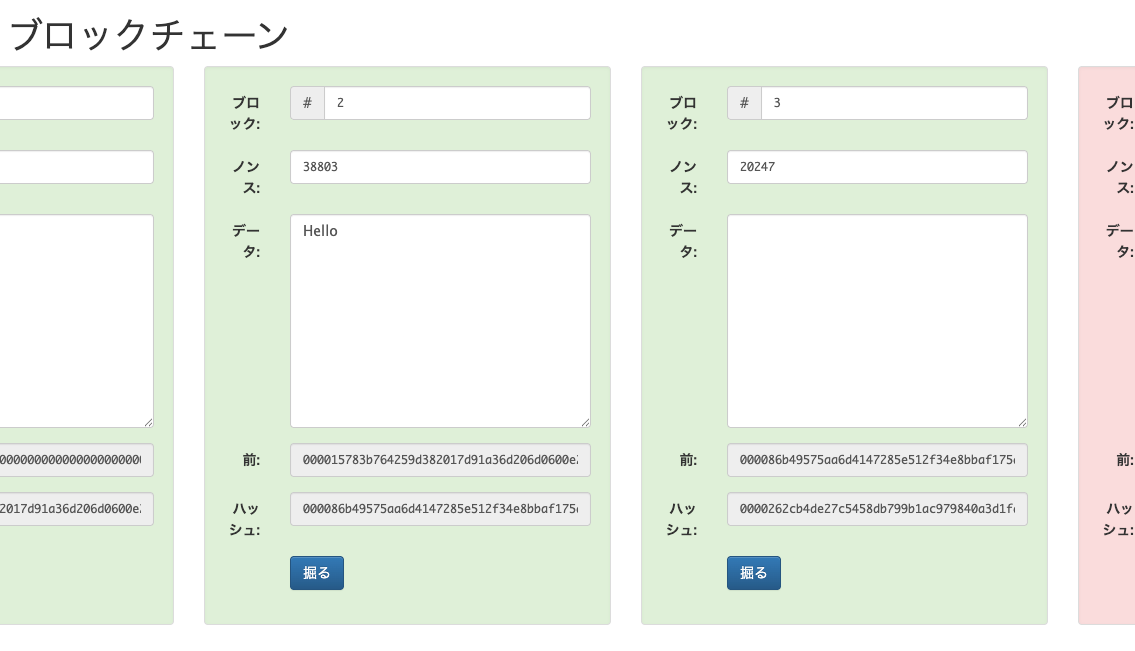
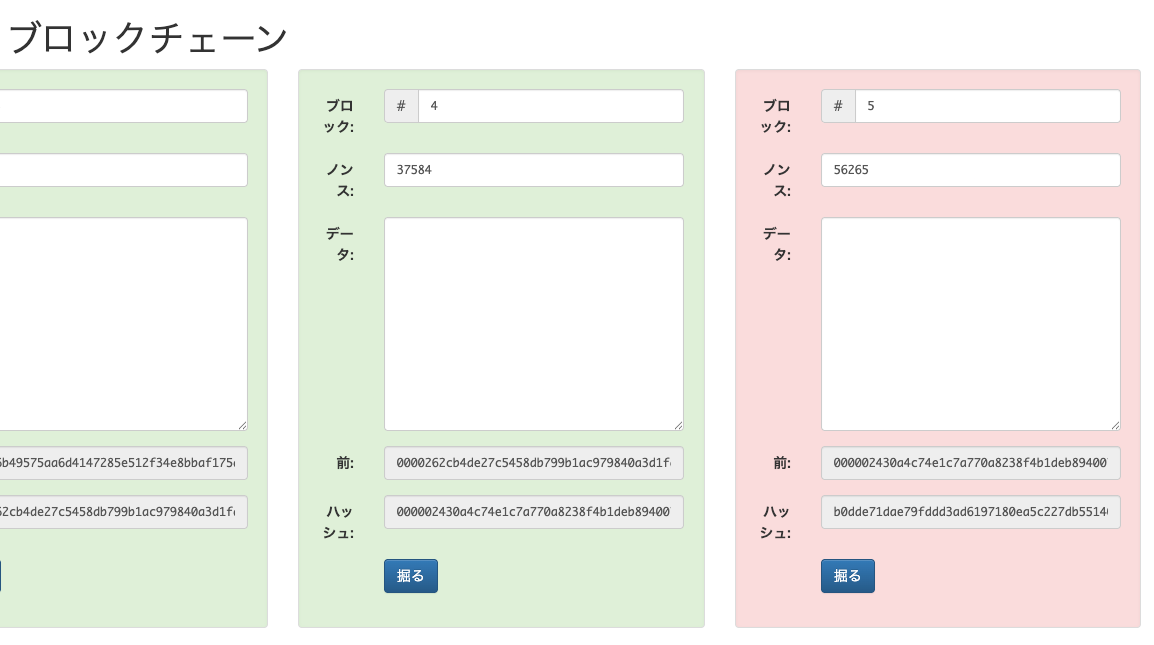
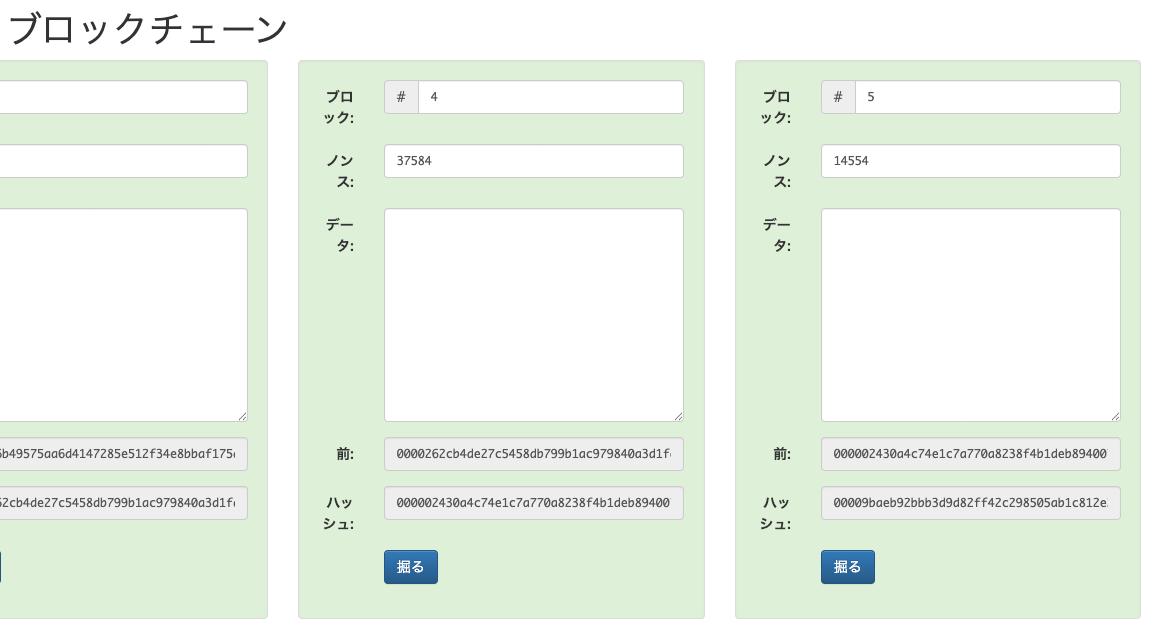
The demonstration restores valid links and proof-of-work conditions by mining each affected block in turn. Real nodes also enforce transaction validity and cumulative-work chain selection.
Efficient verification
Checking a header's proof of work requires approximately constant computational work. The following steps verify the proof using the header alone.
- Receive the block header
Obtain the header containing
version,prev-hash,merkle-root,timestamp,nBits, andnonce. The proof-of-work check does not require the transaction bodies, although full block validation does. - Apply double SHA-256 Hash the header twice with SHA-256 to obtain the digest. A change to the input changes the digest unpredictably.
- Compare the digest with the target The proof check succeeds if the digest is at or below the required valid target. Lower targets impose more demanding proof conditions.
The verifier performs one double-SHA-256 operation and an integer comparison. Miners, by contrast, may need many trials with different header values. This lets nodes reject invalid proofs efficiently.
Resistance to history modification
Each block references the preceding block's hash. Modifying an earlier block requires rebuilding the affected chain and its proofs of work.
To replace the honest chain, an attacker must produce a valid alternative with greater cumulative work while the honest network continues producing blocks.
Under the usual honest-majority hash-rate assumptions, the probability of a minority attacker catching up decreases as confirmations accumulate. Additional confirmations therefore reduce reorganization risk, but do not provide absolute finality.

As illustrated, changing an earlier block requires recomputing valid links and proofs for the subsequent blocks. Meanwhile, honest miners continue extending the existing chain. Even if a minority attacker happens to find several blocks quickly, overtaking a growing honest chain becomes increasingly unlikely as the work deficit grows.
Consensus
Nodes select the valid chain with the greatest cumulative proof of work, called chainwork. The familiar term longest chain refers more precisely to the chain with the greatest cumulative work, not necessarily the most blocks. Nodes calculate cumulative work from the blocks' targets and can switch their active chain tip when a valid alternative has greater work.
Before accepting a chain, nodes enforce its required proof-of-work conditions and transaction rules, including signature and double-spend checks. Invalid blocks cannot make a chain acceptable by contributing more apparent work.
How nodes converge
- Competing blocks and forks Nearly simultaneous discoveries may temporarily produce competing chain tips.
- Convergence If one valid branch accumulates more work, nodes prefer that branch. Continued block production tends to resolve temporary forks.
- Transaction confirmation confidence As further blocks accumulate on top of a transaction's block, the work required to replace its history increases. Applications often wait for multiple confirmations; six is a traditional Bitcoin example, not a guarantee or universal requirement.
Difficulty adjustment
Bitcoin headers contain nBits.
It represents the target compactly. The proof-of-work digest must be at or below the decoded target required by consensus.
A lower target requires a smaller digest and implies greater difficulty.
Difficulty is expressed as follows, increasing as the target decreases.
The network hash rate varies over time.
More miners or faster hardware tend to shorten block intervals at an unchanged target.
Departures or equipment failures tend to lengthen them.
Bitcoin mainnet adjusts the target every 2016 blocks to maintain an average block interval near ten minutes.
The adjustment uses the elapsed time (actual_timespan) between the relevant interval endpoints and compares it with the two-week target (target_timespan).
If the measured duration is shorter than the target duration, new_target decreases and mining becomes harder.
If it is longer, the target increases and mining becomes easier, subject to the maximum permitted target.
The measured timespan is bounded between one-quarter and four times the target duration to limit abrupt changes.
The new target is encoded in compact form for the next interval's nBits.
Example
If network hash rate approximately doubles, an interval tends to finish in about half the previous time.
The formula then gives approximately half the previous target and twice the difficulty (max_target / target).
Conversely, halving hash rate tends to double the target and halve difficulty, within the applicable bounds.
Repeated adjustments help maintain the desired average block-production rate.
Reference
- https://bitcoin.org/files/bitcoin-paper/bitcoin_jp.pdf
- https://developer.bitcoin.org/reference/block_chain.html
- https://learnmeabitcoin.com/technical/block/bits
PoS
Overview
Ethereum PoS uses validators with staked ETH to propose blocks and submit attestations supporting consensus. Time is divided into 12-second slots and 32-slot epochs, approximately 6.4 minutes. Protocol selection procedures use RANDAO-derived seeds to assign block proposers and attestation committees.
RANDAO
How RANDAO works
- Combining validator contributions
In Ethereum's Beacon Chain, a selected proposer produces a BLS signature over the current epoch in the RANDAO signing domain.
It includes that signature as the
randao_revealin its proposed block. The protocol verifies the reveal and XORs its hash into the current RANDAO mix. This accumulates contributions to the randomness used by subsequent selections. The secret-value commit-reveal example below is an analogy, not Ethereum's literal procedure. - Randomness mixing
The Beacon Chain maintains accumulated RANDAO mixes. VDFs have been discussed as possible additional randomness mechanisms, but are not part of the RANDAO reveal process described here.
The stored
randao_mixcontributes to seed derivation for later validator assignments.
Assignment process
The protocol derives selection seeds from stored mixes using the applicable lookahead and domain rules. These seeds support the following assignments.
block proposerSelect a proposer for each slot using the protocol's balance-weighted selection procedure.committeeDerive committee assignments by shuffling the active validator set.
Illustrative example of randomness mixing
-
Suppose there are three validators.
- V1
- V2
- V3
-
In this simplified commit-reveal analogy, each has a secret seed.
- V1 →
s1 = 0xA3F... - V2 →
s2 = 0xC9D... - V3 →
s3 = 0x117...
- V1 →
-
They commit to
hash(s1),hash(s2), andhash(s3). -
They subsequently reveal
s1,s2, ands3. -
Combine these values through XOR.
textrandao_mix = s1 ⊕ s2 ⊕ s3Example:
texts1 = 1010 (binary) s2 = 1100 s3 = 0111 randao_mix = 1010 ⊕ 1100 = 0110 randao_mix = 0110 ⊕ 0111 = 0001The illustrative resulting mix is
0001.
Proposer selection
Suppose there are 1000 active validators.
- Assign indices from 0 to 999.
- For illustration only, take the mix modulo 1000. Ethereum's actual proposer-selection algorithm uses hashed seeds and effective-balance weighting, not simply this operation.
randao_mix = 0001 (=1)
1 mod 1000 = 1
In this simplified example, validator index 1 becomes the proposer.
Committee selection
Suppose the illustrative committee contains 128 validators.
-
Use the seed to derive a shuffled selection from indices 0 through 999.
-
An illustrative result might look as follows.
text[5, 217, 398, 777, ...]
These selected validators form the example committee. Real committee sizes and assignments depend on the protocol and active set.
Aggregator selection
To reduce attestation message overhead, eligible committee members can act as aggregators.
Validators determine aggregator eligibility using the protocol's selection-proof rule.
Eligible aggregators combine compatible attestations and their BLS signatures into aggregated messages.
Aggregation allows blocks to carry many validators' votes more efficiently.
Ethereum PoS combines LMD-GHOST and Casper FFG.
LMD-GHOST supplies fork choice, while Casper FFG provides checkpoint justification and finalization.
Finality concerns checkpoints and their ancestors rather than automatically finalizing a newly proposed block.
justification
A checkpoint may become justified through a supermajority link supported by at least two-thirds of active effective stake, under the FFG rules. Its root is the chain root at the epoch boundary, which may refer to an earlier block if the boundary slot is empty. Justification establishes a checkpoint that can subsequently be finalized under the applicable rules.
finality
In the ordinary consecutive-checkpoint case, a justified checkpoint followed by the required justified successor becomes finalized. Consensus fork choice does not permit reorganizing finalized history under normal protocol operation.
A common idealized finality timescale is two epochs. At 32 twelve-second slots per epoch, two epochs are 64 slots, or 12 minutes 48 seconds. Actual transaction finality latency depends on inclusion time and whether sufficient votes arrive.
How PoS works
Consensus voting power depends on validators' effective staked balances. Validators earn applicable rewards for correctly performing assigned proposal and attestation duties. The protocol distinguishes ordinary penalties from slashable offenses.
- Ordinary missed or incorrect duties Missing or late attestations may reduce rewards or incur applicable penalties.
- Slashable offenses Conflicting proposals for the same slot, conflicting votes for the same target epoch, and surround votes are examples of slashable behavior, potentially causing stake loss and forced exit.
If finality fails to progress for an extended period, an inactivity leak can activate. This penalizes validators failing to participate appropriately, reducing their effective weight over time and helping the participating validators regain a two-thirds supermajority.
Inactivity Leak
Ethereum normally finalizes checkpoints through supermajority voting, but prolonged non-finalization may require a recovery mechanism. The inactivity leak is designed for this situation.
The mechanism imposes additional penalties on validators that fail to make the required target votes, helping participating validators regain sufficient effective voting weight.
Activation condition
The protocol checks whether finality delay exceeds MIN_EPOCHS_TO_INACTIVITY_PENALTY (four epochs in the cited design), rather than simply counting four missing block confirmations.
This reflects an extended failure to finalize checkpoints.
Behavior
During an inactivity leak, the applicable attestation reward and penalty rules change.
| Operation | Behavior |
|---|---|
| Attestation rewards | Ordinary attestation participation rewards are suppressed during the leak. |
| Penalties for nonparticipation | Validators missing the required target votes incur additional inactivity penalties based on their inactivity scores. |
| Proposer and committee rewards | Other reward mechanisms, including applicable proposer and sync committee rewards, have their own rules. |
As the balances and effective weights of nonparticipating validators decline, participating validators can eventually represent at least two-thirds of the active effective stake. This can enable finality to resume.
Inactivity scores recover under the protocol's rules after finality resumes; past balance penalties are not automatically refunded.
Fork choice (LMD-GHOST)
Validators submit attestations as assigned. These include a vote for the perceived head. The latest-message-driven fork-choice rule uses the latest relevant vote from each validator. The vote weight is based on effective balance.
- Starting from the applicable justified root, the algorithm follows the eligible child subtree with greatest weight until selecting a head, subject to additional fork-choice rules.
- The selected block is the current
head, which can change as new blocks and votes arrive.
LMD-GHOST uses recent validator votes to determine which eligible branch a node should extend.
Checkpoints and finality (Casper FFG)
Ethereum uses epoch checkpoints as the basis for justification and finalization.
- Checkpoint definition An epoch checkpoint identifies the chain root at its boundary. If its first slot is empty, the root can refer to an earlier block.
- justification A valid supermajority link supported by at least two-thirds of active effective balance can justify its target checkpoint. Effective balance determines voting weight. The original 32 ETH maximum applies to ordinary non-compounding validators; the Pectra-era design also supports higher effective balances for eligible compounding validators, up to 2048 ETH. The applicable effective-balance maximum depends on the validator's configuration.
- finalization Under the normal consecutive-checkpoint rule, a justified checkpoint is finalized when its required justified successor is established.
- Meaning of finality Normal consensus fork choice does not reorganize the finalized checkpoint or its ancestors. They are treated as finalized history under the protocol's security assumptions.
Timing
- One epoch = 32 slots = 384 seconds (6 minutes 24 seconds).
Under ideal conditions, checkpoint finalization typically takes about two epochs, or 12 minutes 48 seconds. Transaction confirmation to finality varies with its position within an epoch. The original approximation of about 2.5 epochs (roughly 15 minutes) is an illustrative estimate, not a deadline.
PoS workflow
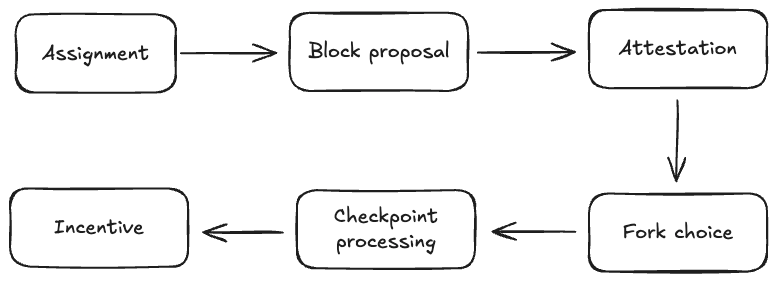
sequenceDiagram
    participant VP as Validator (Proposer)
    participant VC as Validator (Committee)
    participant AG as Aggregator (Validator)
    participant BN as Beacon Node (Consensus)
    participant EX as Execution Client (EVM)
    participant GS as Gossip network

    Note over BN: Select proposer and committee<br/>using RANDAO-derived seeds

    VP->>EX: Obtain execution payload
    VP->>BN: Construct new block
    VP->>GS: Broadcast block

    VC->>BN: Verify received block
    VC->>GS: Submit attestation (head, source, target)

    AG->>VC: Collect compatible attestations
    AG->>BN: Construct aggregate attestation
    AG->>GS: Gossip aggregate attestation

    BN->>BN: Fork choice (LMD-GHOST)<br/>Determine head
    BN->>BN: Checkpoint processing (Casper FFG)<br/>Justification / finalization

    BN->>VP: Apply applicable rewards or penalties
    BN->>VC: Apply applicable rewards or penalties
    BN->>AG: Apply applicable rewards or penalties
Gossip network
Ethereum uses gossip networking to distribute information needed by PoS consensus. Nodes communicate with peers, which relay eligible received messages to other peers. The term gossip reflects this propagation pattern.
This distributes proposals, attestations, and aggregated attestations. Nodes perform relevant validation and deduplication before accepting or relaying messages, although delivery is not guaranteed under all network conditions.
Gossip networking supports the distribution of data used by fork choice and finality processing.
-
Duty assignment Protocol-derived seeds and shuffling determine proposer and committee duties. Aggregator eligibility is determined separately through selection proofs. Each slot lasts 12 seconds; 32 slots form an epoch.
-
block proposalThe selected proposer obtains the execution payload, constructs a block, and broadcasts it. The block includes the proposer'srandao_reveal.This reveal is a verified BLS signature contribution to protocol randomness. Ethereum derives it from the epoch and the proposer's validator signing key, not from a separately submitted arbitrary secret commitment. Its hash is mixed into
randao_mixfor subsequent seed derivation. -
Submit attestations Assigned committee members validate the relevant block and submit attestations. An attestation includes:
- A head vote.
- A source checkpoint vote.
- A target checkpoint vote. Aggregators combine compatible attestations and propagate them for inclusion in eligible subsequent blocks.
-
Fork choice (LMD-GHOST) Nodes apply the fork-choice algorithm using the latest relevant votes weighted by effective balance. The selected head may change as new blocks and votes arrive.
-
Checkpoint processing (Casper FFG) The protocol processes checkpoint votes and justifies checkpoints satisfying the relevant two-thirds supermajority conditions. The ordinary consecutive-checkpoint case finalizes the earlier justified checkpoint when the required successor is justified. Normal fork choice does not reorganize finalized history. Two epochs (64 slots, approximately 12 minutes 48 seconds) is a common idealized checkpoint-finality timescale.
-
Incentive accounting Validators receive applicable rewards for correctly performing assigned duties. Missing or incorrect attestation duties can incur penalties or lost rewards. Conflicting proposals, double votes, and surround votes can be slashable offenses involving stake penalties and forced exit. Prolonged failure to finalize can trigger the inactivity leak, allowing participating validators to regain sufficient effective voting weight.
Reference
- https://ethereum.org/ja/developers/docs/consensus-mechanisms/pos
- https://ethereum.org/ja/staking
- https://ethereum.org/ja/developers/docs/consensus-mechanisms/pos/block-proposal
- https://ethereum.org/ja/developers/docs/consensus-mechanisms/pos/gasper
- https://ethereum.org/ja/developers/docs/consensus-mechanisms/pos/pos-vs-pow
- https://github.com/ethereum/consensus-specs
Tendermint
Overview
Tendermint is a Byzantine fault-tolerant (BFT) consensus algorithm used in blockchain systems.
BFT
The Byzantine generals problem illustrates distributed agreement among participants communicating through messages. Participants must coordinate decisions despite possible delays, message loss, and malicious behavior. Some participants may send contradictory messages to different recipients or refuse to communicate. The question is whether honest participants can reach a consistent decision. The focus is agreement among honest participants, not which arbitrary action is intrinsically correct.
For n participants and up to f Byzantine faults, a representative bound for achieving safety and liveness under the relevant network assumptions is shown below.
When Byzantine voting power is below one-third, Tendermint can preserve safety and achieve liveness under its eventual-synchrony assumptions. Tendermint requires strictly more than two-thirds of voting power for its relevant quorums, not merely two-thirds.
It has three principal features.
- Immediate finality after commit Unlike probabilistic PoW confirmation, a valid Tendermint commit finalizes the block once the required precommit quorum is obtained.
- No mining Consensus is determined by signed votes rather than a proof-of-work race.
- Application flexibility through ABCI Tendermint provides consensus while applications integrate through the Application Blockchain Interface (ABCI). Developers implement application-specific transaction validation and state transitions without implementing consensus from scratch.
ABCI(Application Blockchain Interface)
Overview
ABCI (Application Blockchain Interface) connects the consensus engine to the application.
Tendermint Core handles consensus, networking, and block coordination. The application implements its own validation, fee accounting, authorization, and transaction-driven state transitions. ABCI specifies how the consensus engine and application communicate. Application logic can evolve independently of the consensus algorithm, subject to coordinated deterministic upgrades.
How it works
Tendermint Core can communicate with a separate application using ABCI over a socket or gRPC transport, or use an in-process connection where supported. The consensus engine passes relevant block and transaction data to the application, which returns validation and execution results. This separates consensus responsibilities from application state-transition logic.
The historical ABCI interface includes the following method groups. Newer ABCI versions reorganize block execution.
- CheckTx Perform checks before admitting transactions to the mempool. Application rules may check signatures, sizes, gas, fees, nonces, and conflicting transactions.
- DeliverTx Execute transactions in the agreed block and update application state.
- Commit Commit block processing and return or persist the resulting application state information according to the ABCI version.
- BeginBlock / EndBlock Perform block-level processing, such as evidence handling and reward or penalty accounting, at the relevant block lifecycle stages.
Role
ABCI separates consensus from application logic. This enables applications implemented in various programming languages to operate with Tendermint Core. The Cosmos SDK is a prominent example, implementing modules such as staking and governance through ABCI integration.
How Tendermint works
Validators
Validators are participants with assigned voting power. Voting power can be assigned according to stake or application-specific rules. With less than one-third Byzantine voting power, safety and liveness hold under the relevant protocol and network assumptions. Validators vote through signed messages weighted by their voting power.
Height/Round
Each block height is associated with the decision on one block.
If agreement is not reached in a round, the protocol can advance to another round at the same height.
Each round has a proposer selected through a voting-power-weighted rotation. Timeouts and voting conditions govern advancement if a proposal is absent, invalid, or does not obtain the required quorum.
Validators may vote nil when they cannot support a proposed block.
Voting phases
At each height, the protocol proceeds through proposal and voting phases.
- Propose The proposer constructs a candidate block, typically using transactions from the mempool.
- Prevote Validators verify the proposal and prevote for the block or nil according to the validation and lock rules.
- Precommit A validator observing a valid quorum of strictly more than two-thirds prevotes for a block can lock and precommit it under the protocol rules. If no block is ready to commit, the precommit and timeout rules allow another round.
- Commit A valid commit of strictly more than two-thirds precommit voting power for the same block in the same round finalizes that block.
Tendermint uses locking rules. A validator locks on a block when the relevant prevote quorum and proposal conditions are satisfied, restricting its votes in later rounds. A later valid quorum may allow the validator to update or release its lock according to the protocol's round and lock rules. These rules help prevent conflicting commits under the assumed fault bound.
Polka
A polka is a quorum of prevotes representing strictly more than two-thirds of voting power for a value in a round; the block-valued case is discussed here.
A prevote is the first voting phase for the round. If votes are split, no proposed block may obtain a quorum. A block receiving the required prevote quorum can proceed to the corresponding lock and precommit processing.
Immediate finality
A valid same-round precommit quorum of strictly more than two-thirds voting power commits the block. Under the protocol's safety assumptions, committed blocks do not require additional confirmation depth to guard against ordinary forks. If a round cannot commit, the protocol advances at the same height until agreement becomes possible.
Tendermint workflow
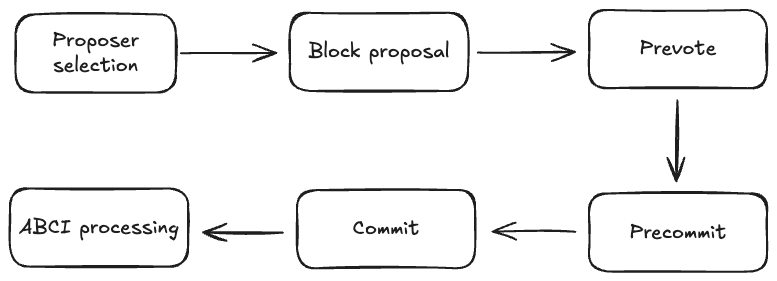
- Proposer selection(weighted round-robin) Assign one proposer for each round of a height. Selection uses voting-power-weighted rotation. If a round fails to reach agreement, its timeout and voting rules allow a new round with another proposer. Selecting a proposer does not itself establish consensus.
Weighted rotation
Tendermint chooses proposers with a long-term frequency proportional to their voting power. The mechanism also distributes opportunities across rounds rather than selecting independently without accounting for prior selections. It uses a weighted round-robin mechanism based on proposer priority.
Each validator has a voting power and a mutable priority. The simplified stable-validator-set procedure is as follows.
- Accumulate priorities
Add
voting_power[i]topriority[i]for each validator. Higher-power validators accumulate priority faster. - Select a proposer Choose the validator with the greatest priority. Resolve ties deterministically using the prescribed validator ordering.
- Adjust priority
Subtract
total_voting_powerfrom the selected validator's priority. This reduces its relative priority after selection.
Repeating these steps distributes proposal opportunities approximately in proportion to voting power over time.
Example
Suppose validators A, B, and C have voting powers 50, 30, and 20, with initial priorities of zero. The total voting power is 100.
- After the first accumulation:
priority = [50, 30, 20]→ choose A → subtract 100 from A →[-50, 30, 20]. - After the second accumulation:
[0, 60, 40]→ choose B →[0, -40, 40]. - After the third accumulation:
[50, -10, 60]→ choose C →[50, -10, -40]. - After the fourth accumulation:
[100, 20, -20]→ choose A →[0, 20, -20].
Over time, selection frequency follows the approximate ratio A:B:C = 5:3:2.
Validator-set changes
In the historical Tendermint ABCI model, the application returns validator updates in EndBlock. Updates produced at height H generally take effect for consensus at H+2, not H+1.
Applications should distinguish update publication, next-validator-set commitment, and the height at which the updated set participates in consensus.
- Block proposal(from Mempool) The proposer collects transactions, constructs a candidate block, and broadcasts the proposal. The proposal includes the block and its consensus-related metadata and signature; the block header includes the previous block reference and proposer address. The proposed block remains a candidate until the voting requirements are met. Validators may vote nil if they cannot support a proposal.
- Prevote Validators prevote for the appropriate valid block or nil, subject to their lock rules. A polka occurs when the relevant prevote quorum is observed. For a block-valued polka, strictly more than two-thirds of voting power prevotes for the same block in a round. The quorum is relevant to precommit, locking, and unlocking decisions. If the required conditions are not satisfied, the protocol's voting and timeout rules allow advancement to another round.
- Precommit(lock / polka) Validators precommit the appropriate value according to the observed prevotes and lock conditions. A validator locked on a block is constrained in its subsequent votes at the same height. Switching requires the applicable evidence of a later-round quorum and satisfaction of the lock-update or unlocking rules. This supports safe progress despite competing proposals.
- Commit(finality) A valid quorum of strictly more than two-thirds precommits for the same block in one round commits that block. The protocol does not ordinarily reorganize committed blocks under its safety assumptions. If a round cannot commit, another round at the same height can be used.
- ABCI processing(DeliverTx → EndBlock → Commit)
After consensus, the engine applies the agreed block through the relevant ABCI methods.
- DeliverTx Execute transactions and update application state under its validation, fee, nonce, and authorization rules.
- EndBlock Perform block-level processing, including applicable evidence, slashing, reward, and penalty logic.
- Commit Commit the resulting application state and proceed to the next height.
sequenceDiagram
    autonumber
    participant P as Proposer
    participant V1 as Validator A
    participant V2 as Validator B
    participant V3 as Validator C
    participant N as Gossip Network
    participant A as Application (ABCI)

    Note over V1,V3: Height = H, Round = r

    %% Proposer selection
    V1->>V1: Proposer selection (weighted rotation)
    V2->>V2: Compute the same proposer
    V3->>V3: Compute the same proposer
    V1-->>P: Proposer = P (resolve ties deterministically)

    %% Proposal
    P->>P: Collect transactions from mempool
    P->>N: Broadcast block proposal

    %% Prevote
    N->>V1: Receive proposal
    N->>V2: Receive proposal
    N->>V3: Receive proposal
    V1->>V1: Validate header, signature, and consistency
    V2->>V2: Validate
    V3->>V3: Validate
    V1->>N: Prevote (block or nil)
    V2->>N: Prevote (block or nil)
    V3->>N: Prevote (block or nil)
    V1->>V1: Check for a greater-than-two-thirds prevote quorum
    V2->>V2: Check for a greater-than-two-thirds prevote quorum
    V3->>V3: Check for a greater-than-two-thirds prevote quorum
    Note over V1,V3: More than two-thirds prevotes for block establish polka

    %% Precommit + Lock
    alt polka established
      V1->>N: Precommit (block)
      V2->>N: Precommit (block)
      V3->>N: Precommit (block)
      V1->>V1: Lock on the block
      V2->>V2: Lock on the block
      V3->>V3: Lock on the block
    else No block quorum (simplified timeout path)
      V1->>V1: Advance to round r+1
      V2->>V2: Advance to round r+1
      V3->>V3: Advance to round r+1
    end

    %% Commit (finality)
    V1->>V1: Check precommit quorum
    V2->>V2: Check precommit quorum
    V3->>V3: Check precommit quorum
    Note over V1,V3: More than two-thirds precommits for same block
    V1->>V1: Commit block
    V2->>V2: Commit block
    V3->>V3: Commit block

    %% ABCI execution
    V1->>A: DeliverTx (execute transactions and update state)
    V2->>A: DeliverTx
    V3->>A: DeliverTx
    V1->>A: EndBlock (evidence, rewards, penalties)
    V2->>A: EndBlock
    V3->>A: EndBlock
    V1->>A: Commit (application state)
    V2->>A: Commit
    V3->>A: Commit

    Note over V1,V3: Height H complete; advance to H+1
Tendermint timing
Commit latency depends on block construction, network propagation, and configured timeouts; seconds to tens of seconds are illustrative possibilities. A healthy network may commit in one round, while failed proposals or missing quorums can require additional rounds.
Reference
- https://docs.tendermint.com
- https://github.com/tendermint/tendermint
- https://tendermint.com/static/docs/tendermint.pdf
PoA
Overview
Proof of authority (PoA) describes permissioned consensus mechanisms in which authorized signers or validators produce and authenticate blocks. Unlike open PoW or permissionless PoS systems, PoA relies on a configured validator set, often associated with identifiable organizations. The trust model centers on who may become a signer and how validator-set changes are authorized. Governance contracts or explicit configuration can make these management rules transparent and auditable.
How PoA works
Validator or sealer set
The network maintains a set of accounts authorized to participate in block production. Depending on the implementation, configuration, header voting, or an on-chain contract manages validator membership. Restricting participation mitigates anonymous Sybil admission, but the security of the membership policy remains critical.
Two broad block-production models
The following compares two families of PoA protocols.
- Slot- or turn-based PoA (Clique and Aura) Authorized signers take turns according to the protocol's scheduling rules. Clique assigns an in-turn signer by block height, while Aura uses time-based steps. Clique permits eligible out-of-turn signers to produce fallback blocks; Aura has its own step and validator rules and should not be treated as identical. These mechanisms have been used in Ethereum-compatible networks.
- BFT-style PoA (IBFT2 and QBFT) These protocols use proposal and voting phases with a protocol-defined supermajority commit quorum, providing finality under their Byzantine fault assumptions. Hyperledger Besu supports these BFT-style private-network consensus options.
Finality and safety
- Turn-based model Some protocols, such as Clique, resolve competing blocks through fork choice and may undergo short reorganizations. Applications may wait for confirmation depth, although Aura's finality behavior depends on its specific implementation.
- BFT model
A valid commit finalizes a block under the protocol's safety assumptions.
In the classic
n = 3f + 1configuration, a quorum of2f + 1participants intersects other such quorums in at least one honest participant when at mostfare Byzantine. Use the concrete protocol's quorum formula.
Governance and operation
Define validator replacement, admission, removal, voting policies, and timeout settings through the applicable governance or configuration mechanism. An auditable management procedure supports operational transparency. Misbehaving validators may be removed through the prescribed governance process.
Use cases
PoA suits networks where the authorized participating organizations are known. A restricted validator set may support relatively low-latency operation, making these protocols useful for consortium and development networks. Public deployments are also possible, but require explicit decisions about trust concentration and governance.
PoA workflow
Turn-based flow (Clique-style illustration)
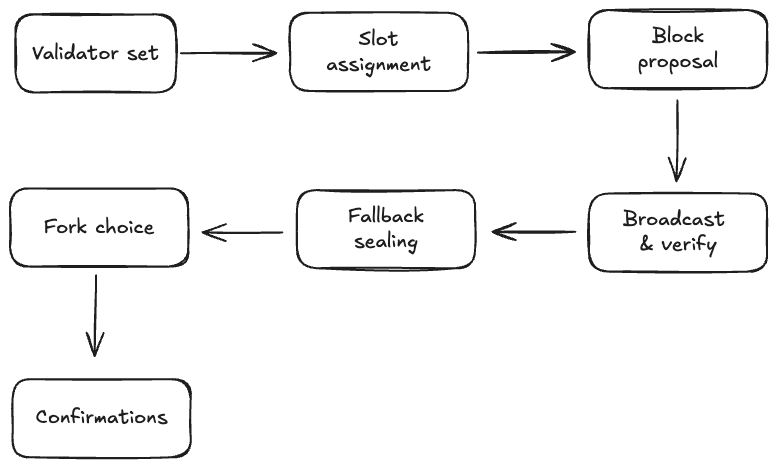
sequenceDiagram
    autonumber
    participant V as Validator (in-turn)
    participant O as Validator (out-of-turn)
    participant N as Network (Gossip)
    participant P as Peers

    %% 1. Validator set
    Note over V,O: Validator membership is configured by the protocol

    %% 2. Slot assignment
    V->>V: Determine in-turn signer

    %% 3. Block proposal
    V->>V: Collect transactions from mempool
    V->>V: Construct and sign block

    %% 4. Broadcast & verify
    V->>N: Gossip block
    N->>P: Relay block to peers
    P->>P: Check signer authorization<br/>Validate transactions and header
    P-->>N: Reject invalid blocks

    %% 5. Fallback sealing
    alt In-turn signer does not produce a block
        O->>O: Eligible out-of-turn signer produces block
        O->>N: Propagate alternative block
    end

    %% 6. Fork choice
    alt Competing blocks at the same height
        P->>P: Apply fork-choice rules
        Note over P: Compare cumulative difficulty<br/>In-turn blocks carry greater weight
    end

    %% 7. Confirmations
    P->>P: Wait for chosen confirmation depth
    Note over P: Confirmation depth reduces reorganization risk
1. Validator set
The network maintains its authorized signer set. Membership may be managed by configuration, header voting, or an on-chain validator-management contract, depending on the implementation. This restricts unauthorized Sybil participation but does not itself guarantee the honesty or legal identity of signers.
2. Slot assignment
In a turn-based protocol, the scheduling rule determines the preferred signer. For example, Clique derives the in-turn signer from the block height and ordered signer set. Other protocols use different schedules. A deterministic schedule can reduce unnecessary competition.
3. Block proposal
An eligible signer obtains transactions from the mempool and constructs a candidate block. The block's signature allows nodes to authenticate the signer under the protocol rules.
4. Broadcast & verify
Blocks propagate through the peer-to-peer network. Receiving nodes perform the relevant checks.
- Whether the block signer is authorized.
- Whether the header and transactions satisfy protocol rules.
Invalid blocks are rejected when detected.
Gossip is a mechanism for disseminating information through peer-to-peer networks. Nodes relay eligible messages to other peers. Repeated relay spreads information through the connected network.
The pattern resembles the spread of a rumor, giving gossip its name.
5. Fallback sealing
In Clique, eligible out-of-turn signers can produce a block if the preferred signer does not. This helps tolerate some offline signers, subject to signer eligibility, recency, and other protocol constraints.
6. Fork choice
Multiple blocks at the same height can create a fork. Clique uses its chain-selection rule to determine the preferred valid chain.
- In-turn blocks receive higher difficulty weight than out-of-turn blocks.
- Compare cumulative difficulty to select the preferred valid branch.
7. Confirmations
Clique does not provide BFT-style immediate finality and may experience reorganizations. Other turn-based protocols have their own finality rules. Applications may wait for a chosen confirmation depth to reduce reorganization risk. This is confirmation-based confidence rather than an unconditional finality guarantee.
BFT-style flow (IBFT2 and QBFT)
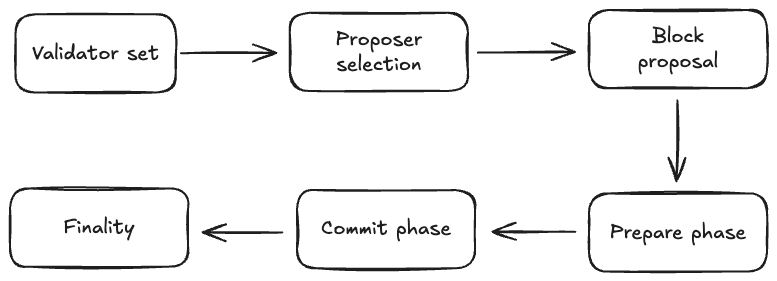
sequenceDiagram
    autonumber
    participant V as Validators
    participant P as Proposer
    participant N as Network (Gossip)

    %% 1. Validator set
    Note over V,P: Authorized validator set is configured

    %% 2. Proposer selection
    V->>P: Select round proposer

    %% 3. Block proposal
    P->>P: Collect transactions from mempool
    P->>P: Construct and sign block
    P->>N: Propagate proposal
    N->>V: Deliver block proposal

    %% 4. Prepare phase
    V->>N: Send Prepare messages
    N->>V: Relay Prepare messages

    %% 5. Commit phase
    V->>N: Send Commit messages
    N->>V: Relay Commit messages

    %% 6. Finality
    alt Required commit quorum obtained
        V->>V: Finalize block
    else Insufficient votes
        V->>P: Timeout and round-change procedure
    end
1. Validator set
As with other PoA designs, an explicit validator set governs participation. The applicable validator-management rules determine which accounts may participate in consensus.
2. Proposer selection
The protocol selects a proposer for each round. The proposer-selection policy depends on the implementation.
3. Block proposal
The selected proposer constructs a block using available transactions. It signs and propagates the proposal to the validators.
4. Prepare phase
Validators that accept the proposal send Prepare messages according to the protocol rules. These indicate support for the candidate in the current round.
5. Commit phase
After satisfying the preparation conditions, validators send Commit messages.
For the classic n = 3f + 1 fault model, a 2f + 1 quorum is sufficient under the assumed maximum of f Byzantine validators. Actual implementations specify the precise quorum and round rules.
6. Finality
A valid commit quorum finalizes the block under the protocol's safety assumptions. This commit-based finality distinguishes BFT-style PoA from confirmation-based designs such as Clique.
Reference
- https://kando.tech/sites/default/files/2021-10/POA%20Whitepaper.pdf
- https://ethereum.org/developers/docs/consensus-mechanisms/poa
- https://openethereum.github.io/Permissioning
- https://openethereum.github.io/Proof-of-Authority-Chains
- https://besu.hyperledger.org/private-networks/how-to/configure/consensus
- https://besu.hyperledger.org/private-networks/concepts/poa
Conclusion
This article explored blockchain consensus algorithms.
I also publish articles on the following platforms.




