Introduction
Hi, I'm cardene, a software engineer and technical writer focused on blockchain and AI.
I've also authored Japanese technical books on specification-driven development with LLMs and decentralized application (DApp) development.

I also build and publish a variety of tools, libraries, and open-source projects.
This article covers ERC5173, a proposed multi-generation reward mechanism for previous owners of non-fungible tokens (NFTs).
This explanation translates, summarizes, and expands on the following specification.

As of October 21, 2023, ERC5173 was at the Draft stage.
I have also written about other ERCs.

Overview
The proposed ERC5173 gives owners of ERC721 tokens (NFTs) an opportunity to benefit from future price appreciation even after selling their tokens.
For more about ERC721, see the following resource.
This is called the Future Rewards (FR) extension.
ERC5173 also introduces a participatory value amplification framework, under which creators, buyers, and sellers collaborate to increase value and share the resulting benefits.
The proposal seeks to address challenges faced by traders and move beyond a zero-sum approach toward a fairer and mutually beneficial system.
Aligning the interests of service providers and users is intended to create a sustainable trading environment that benefits both.
Owners of tokens conforming to ERC5173 may benefit from price appreciation while holding the token and receive future rewards (FR) after selling it.
By reducing divisions and encouraging shared prosperity, ERC5173 aims to strengthen ties between participants.
The NFT Future Rewards (nFR) framework allows sellers, including the original Minter, to share future rewards with eligible previous owners under the selected distribution rules.
Motivation
Trading markets face abusive practices such as spoofing, insider trading, and wash trading, which often impose losses on ordinary traders.
Spoofing The practice of using deceptive orders or transactions to misrepresent market conditions. For example, suppose trader A intends to sell a substantial quantity of a stock. Deceptive buy orders may give the misleading impression that the market price is supported. Other traders may interpret that apparent demand as a sign of rising prices. The trader then sells the shares they actually intended to sell. Other traders may trade based on misleading information, enabling the manipulator to obtain an improper advantage.
Insider trading Trading in a market using material nonpublic information. For example, suppose a company executive learns about an upcoming product announcement several weeks in advance. The information has not yet been disclosed to ordinary investors, but the executive uses it to decide whether to buy or sell the company's shares. Trading on such information can confer an unfair advantage and may constitute illegal insider trading.
Wash trading Transactions in which a trader effectively trades with themselves, primarily to create misleading market activity or prices rather than to make a genuine exchange. For example, trader B holds stock X and engages in artificial buying activity. Corresponding sales occur through another account controlled by the same trader. These are not genuine arm's-length transactions; they are intended to manipulate market activity. Other investors may be misled by the apparent price appreciation even though the activity does not represent genuine independent demand.
These abusive trading practices threaten market fairness and transparency and are closely monitored by regulators.
Traders can become caught in a cycle of greed and fear. However, the emergence of non-fungible tokens (NFTs) and the possibility of tracking their transactions create an opportunity to rethink unequal value distribution.
The implementation of ERC5173 establishes rules for sharing profits across the ownership history of a token, with the aim of benefiting market participants. It introduces a value amplification system that rewards buyers and owners for contributing to price discovery. The model seeks to align incentives and create economic rules that benefit both buyers and sellers.
Unlike physical art or collectibles, NFTs can record ownership history and contributions to value discovery. Recording price changes for each ERC721 token enables a future rewards program intended to compensate owners fairly. The program aims to level the playing field and give ordinary traders opportunities to participate in the rewards.
In addition to promoting a new gift-economy model, the framework is intended to discourage transactions that circumvent rules established by artists and marketplaces. It seeks to promote transparency and integrity within the trading ecosystem.
Applying this value amplification framework to wrapped ERC20 token trading could also incorporate identity into transaction valuation and sales data, potentially changing how assets are traded. This broader application would add another dimension to each transaction.
For more about ERC20, see the following resource.
Specification
Contracts conforming to ERC721 can adopt this EIP to provide a standard mechanism for sharing future profits with buyers and previous owners.
When implementing the EIP, a contract must provide the following two important functions.
awardFutureBuyer- A function for rewarding future buyers.
awardPreviousOwners- A function for rewarding previous owners.
This EIP creates opportunities to share future profits among owners involved in ERC721 token transactions. It seeks to establish a means for participants to share profits fairly and improve the sustainability of the token ecosystem.
pragma solidity ^0.8.0;

import "@openzeppelin/contracts/utils/introspection/IERC165.sol";

/*
 *
 * @dev Interface for the Future Rewards Token Standard.
 *
 * A standardized way to receive future rewards for non-fungible tokens (NFTs.)
 *
 */
interface IERC5173 is IERC165 {

    event FRClaimed(address indexed account, uint256 indexed amount);

    event FRDistributed(uint256 indexed tokenId, uint256 indexed soldPrice, uint256 indexed allocatedFR);

    event Listed(uint256 indexed tokenId, uint256 indexed salePrice);

    event Unlisted(uint256 indexed tokenId);

    event Bought(uint256 indexed tokenId, uint256 indexed salePrice);

    function list(uint256 tokenId, uint256 salePrice) external;

    function unlist(uint256 tokenId) external;

    function buy(uint256 tokenId) payable external;

    function releaseFR(address payable account) external;

    function retrieveFRInfo(uint256 tokenId) external returns(uint8, uint256, uint256, uint256, uint256, address[] memory);

    function retrieveAllottedFR(address account) external returns(uint256);

    function retrieveListInfo(uint256 tokenId) external returns(uint256, address, bool);

}
list
function list(uint256 tokenId, uint256 salePrice) external;Overview
Lists an NFT for sale and sets its sale price.
Details
This function adds the NFT identified by the specified token ID to the listings and sets its sale price. Other users can then see the price when considering a purchase.
Parameters
tokenId- Unique token identifier.
salePrice- Sale price of the NFT.
unlist
function unlist(uint256 tokenId) external;Overview
Removes the NFT with the specified token ID from the listings.
Details
This function removes the specified NFT from the listings. The NFT is no longer offered for sale.
Parameters
tokenId- Unique token identifier.
buy
function buy(uint256 tokenId) payable external;Overview
Purchases the NFT with the specified token ID.
Details
This function allows the caller to purchase the specified NFT. The buyer pays ETH and acquires ownership of the NFT.
Parameters
tokenId- Unique token identifier.
releaseFR
function releaseFR(address payable account) external;Overview
Releases future rewards (FR) to a specified account.
Details
This function releases future rewards (FR) allocated to the specified account. The account can thereby receive its FR.
Parameters
account- Address of the account receiving FR.
retrieveFRInfo
function retrieveFRInfo(uint256 tokenId) external returns(uint8, uint256, uint256, uint256, uint256, address[] memory);Overview
Retrieves future reward (FR) information for a specified token ID.
Details
This function retrieves the future reward information associated with the specified NFT. It includes information such as the FR type, total amount, distributable amount, and ownership information.
Parameters
tokenId- Unique token identifier.
Return values
uint8- FR type.
uint256- Total FR amount.
uint256- Distributable FR amount.
uint256- Current owner's future reward amount.
uint256- Previous owner's future reward amount.
address[] memory- List of NFT owners.
retrieveAllottedFR
function retrieveAllottedFR(address account) external returns(uint256);Overview
Retrieves the total future reward (FR) amount allocated to a specified account.
Details
This function retrieves the aggregate future rewards allocated to the account.
Parameters
account- Address of the account whose FR allocation is being queried.
Return values
uint256- Total future reward amount allocated to the account.
retrieveListInfo
function retrieveListInfo(uint256 tokenId) external returns(uint256, address, bool);Overview
Retrieves listing information for a specified token ID.
Details
This function retrieves listing information associated with the token ID. It includes the token price, seller address, and whether the listing is active.
Parameters
tokenId- Unique token identifier.
Return values
uint256- Token price.
address- Seller address.
bool- Listing status (active or inactive).
An nFR (NFT Future Rewards) contract must maintain and update reward information for each token ID.
The data in the FRInfo struct can be stored in one mapping or divided among multiple mappings.
The contract must provide public mappings or public functions through which clients can access privately stored information.
This enables clients to retrieve and verify the data.
An nFR contract must store the relevant data for each token ID and provide a mechanism through which clients can retrieve and verify it. This makes future reward information accessible and enables data consistency checks.
struct FRInfo {
        uint8 numGenerations; //  Number of generations corresponding to that Token ID
        uint256 percentOfProfit; // Percent of profit allocated for FR, scaled by 1e18
        uint256 successiveRatio; // The common ratio of successive in the geometric sequence, used for distribution calculation
        uint256 lastSoldPrice; // Last sale price in ETH mantissa
        uint256 ownerAmount; // Amount of owners the Token ID has seen
        address[] addressesInFR; // The addresses currently in the FR cycle
}

struct ListInfo {
        uint256 salePrice; // ETH mantissa of the listed selling price
        address lister; // Owner/Lister of the Token
        bool isListed; // Boolean indicating whether the Token is listed or not
}
An nFR (NFT Future Rewards) smart contract must also store the ListInfo associated with each token ID in a mapping.
The mechanism for retrieving the corresponding ListInfo must be publicly accessible.
This allows relevant information to be retained for each token and retrieved when needed.
The nFR smart contract must also store and update the Ether amount allocated to each address in the _allotedFR mapping.
The _allotedFR mapping must be public, or a public function must expose the FR payment allocated to an address.
This enables tracking and verification of the reward payments allocated to each address.
Fixed-point percentages
_allocatedFR is calculated using fixed-point percentages with a scaling factor of 1e18 (X/1e18).
For example, 5% is represented by 5e16.
This maintains consistency across implementations and allows percentages to be expressed precisely. The original explanation describes a range from -1e18 to 1 after scaling; the applicable bounds must be checked against the specification and implementation.
Default FR information
Default FRInfo must be stored to maintain backward compatibility with the ERC721 minting function.
An implementation may also provide a function for updating the default FRInfo.
This default information is used when a token is created and can be updated as required.
ERC721 overrides
An nFR (NFT Future Rewards) contract must override certain ERC721 functions. These overrides enable future value sharing in token transactions. Specifically, the following three functions must be overridden.
_mint
Invoked when issuing a new token. The nFR contract must override this function to establish the default future reward (FR) model and grant the new owner participation in the reward cycle.
_transfer
Invoked when transferring token ownership.
The nFR contract must treat the token as sold for 0 ETH and update its state after a successful transfer.
To prevent FR circumvention, it must also prevent transfers to the caller itself or to an address already in the FR sliding window.
_burn
Invoked when burning a token.
After a successful burn, the nFR contract must delete the FR information and ListInfo associated with that token ID.
For safe transfers and mints, implementations may also need to explicitly invoke the ERC721 _checkOnERC721Received function after minting or transferring.
This checks that a contract recipient supports receiving the NFT.
Safe transfer
Wallets, brokers, and auction applications that accept safe transfers must implement the ERC721 receiver interface. This is the standard mechanism for safely transferring tokens to contracts.
Listing, unlisting, and buying
The list, unlist, and buy functions are essential components of the token sale process.
Implementing them enables tokens to be offered and purchased.
list offers a token for sale, unlist cancels the offer, and buy purchases a token from another user.
These functions facilitate marketplace transactions.
function list(uint256 tokenId, uint256 salePrice) public virtual override {
   //...
}


function unlist(uint256 tokenId) public virtual override {
   //...
}

function buy(uint256 tokenId) public virtual override payable {
   //...
}
list
Receives a token ID (tokenId) and sale price (salePrice), verifies that the caller (msg.sender) is the token owner or an approved account, and updates the corresponding ListInfo.
This records that the token is listed for sale and specifies its price.
Emit a Listed event after listing.
unlist
Receives a token ID (tokenId), verifies ownership or the relevant authority, and deletes the corresponding ListInfo.
Emit an Unlisted event to indicate that the token has been removed from the listings.
buy
Receives the token ID (tokenId) and must be payable.
Check that the sale price (salePrice) equals msg.value, the amount of Ether sent with the transaction, and that the token is listed.
If the conditions are satisfied, call the FR contract's _transferFrom function to complete the transaction.
Also check that the buyer does not already appear in the FR sliding window.
This validates the transaction and allows the required FR amount to be retained by the contract.
Emit a Bought event after execution.
These functions provide the mechanisms for managing listings and executing token sales.
Future rewards: the _transferFrom function
This function must be invoked by contracts supporting nFR (NFT Future Rewards), while backward compatibility with contracts without nFR support can also be considered.
The function is defined as follows.
function transferFrom(address from, address to, uint256 tokenId, uint256 soldPrice) public virtual override payable {
    //...
}
It determines whether a transaction is profitable based on the token's previous sale price (lastSoldPrice).
After transferring the NFT through the ERC721 transfer mechanism, if the transaction generates no profit, perform the following operations.
- Update
lastSoldPricefor the corresponding token ID. - Increment the owner count.
- Update ownership information.
- Transfer
msg.value, the Ether attached to the transaction, to the listing party.
If the transaction generates a profit, perform the following operations instead.
- Call
_distributeFR. - Update
lastSoldPrice. - Increment the owner count.
- Update ownership information.
Either _distributeFR or the FR contract's _transferFrom function must send the listing party the difference between msg.value and the FR allocated among _addressesInFR.
Once the operation completes, clear the corresponding ListInfo.
The override must ensure that the recipient is neither the sender nor an address already in the FR sliding window. This enforces the transaction's eligibility conditions.
Calculating future rewards
The following explains how future rewards are calculated.
A contract supporting this standard provides a mechanism for sharing realized profits from NFT transactions with previous owners.
function _calculateFR(uint256 totalProfit, uint256 buyerReward, uint256 successiveRatio, uint256 ownerAmount, uint256 windowSize) pure internal virtual returns(uint256[] memory) {
    //...
}
Consider a concrete example. When a seller sells their token, they must share a portion of the realized profit with the previous ten owners under the example distribution rule. If the token increases in value through subsequent trades, that seller may also receive future rewards.
If an owner incurs a loss during their holding period, they are not required to share profit from that sale. However, they may still receive future rewards from subsequent owner generations when those owners realize a profit.
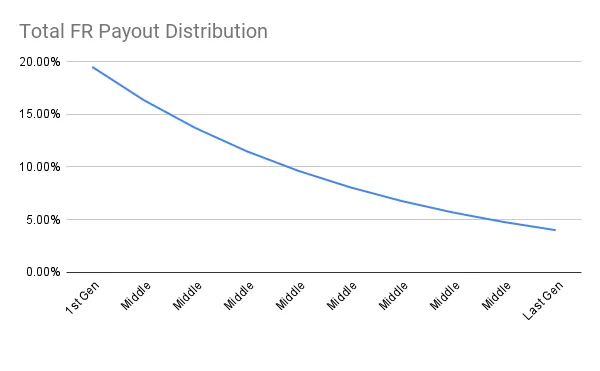
Eligible buyers and owners receive a fraction (r) of the profit (P) realized from an NFT transaction. The remaining proceeds return to the seller.
A sliding-window mechanism (n) determines which previous owners receive rewards. Owners are arranged in a queue, from the earliest eligible owner to the owner immediately preceding the current owner (the last generation). The first generation is the oldest eligible owner within the window covering the relevant preceding generations. The profit-sharing window has a fixed size, spanning from the first to the last eligible generation.
Profit distribution should be available only to previous owners within that window.
In this example, profits are distributed according to a geometric sequence, with the last generation (the owner immediately preceding the current seller) receiving a portion of the profit. The remaining rewards go to the intermediate-generation (Mid-Gen) owners; under the illustrated curve, earlier purchasers receive more. The oldest eligible owner is determined by the sliding window. Under this example, the earliest eligible owner receives the largest reward.
Distributing future rewards
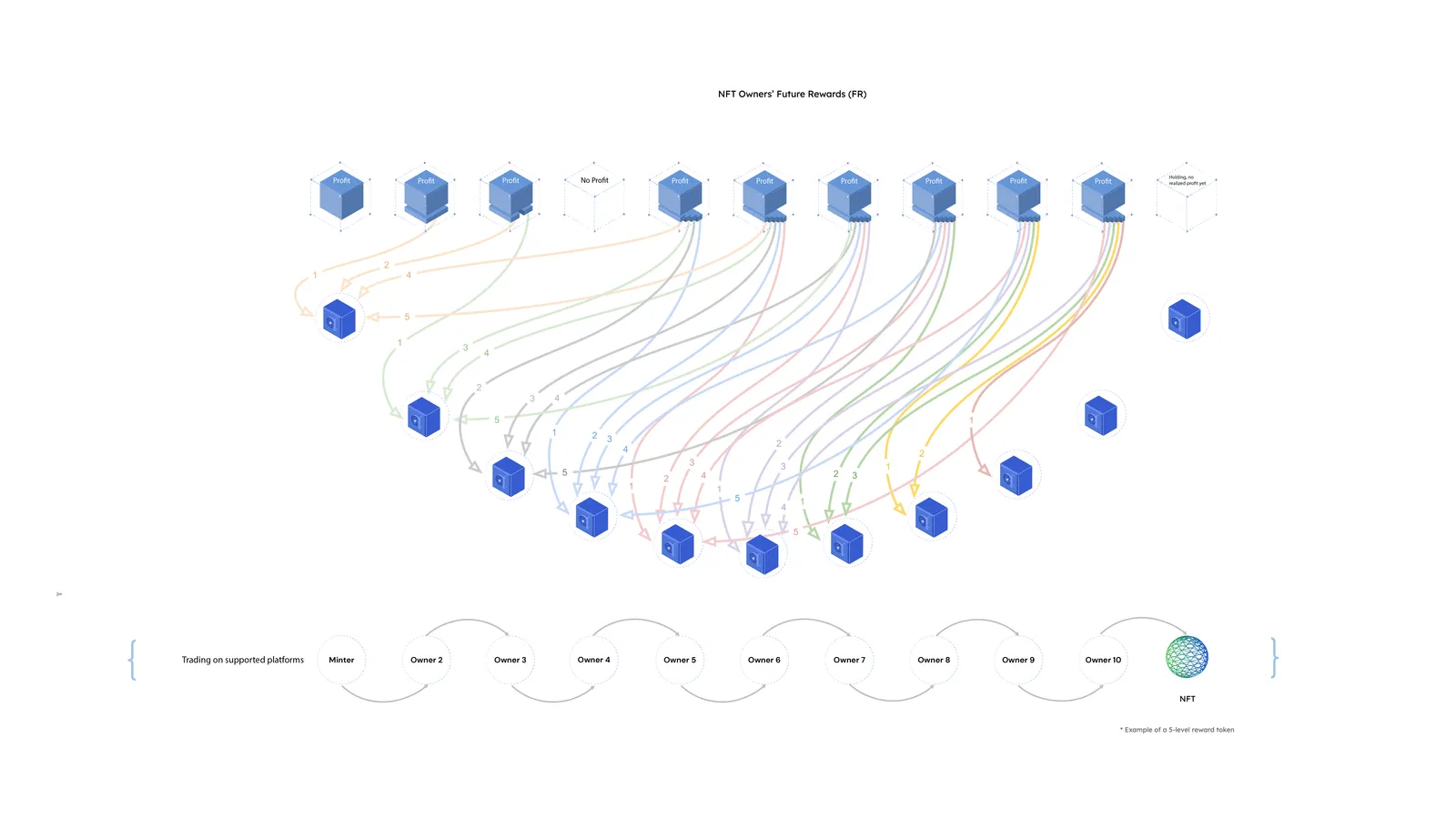
Figure 2 illustrates a future reward distribution program across five generations, calculated from the actual profits realized by owners.
function _distributeFR(uint256 tokenId, uint256 soldPrice) internal virtual {
    //...
    emit FRDistributed(tokenId, soldPrice, allocatedFR);
}
_distributeFR must be called from the FR contract's _transferFrom function when a transaction generates a profit.
It determines which addresses receive FR, excluding the final address in addressesInFR from the calculation.
If no eligible addresses exist, as on the first sale, the function either handles the payment itself, returns 0 if _transferFrom handles payment, or sends msg.value to the listing party.
It calculates the difference between the current sale price and lastSoldPrice, then invokes _calculateFR to determine the appropriate reward allocations.
It distributes FR in the required order.
The contract then calculates the total allocated reward (allocatedFR) and returns the difference between soldPrice and allocatedFR to the listing party.
Finally, emit an FRDistributed event.
The function may also return allocatedFR.
This allows _transferFrom to use allocatedFR when calculating the payment to the listing party.
Claiming future rewards
Receiving future rewards
Future reward payments should use a pull-payment model, as illustrated by OpenZeppelin's PaymentSplitter contract. Users can withdraw their rewards at a time of their choosing. A successful payment should trigger an FRClaimed event.
The following function is used to claim future rewards:
function releaseFR(address payable account) public virtual override {
    //...
}
This function withdraws future rewards allocated to the account supplied as an argument (address payable account).
Users can specify their account to receive future rewards.
On success, an FRClaimed event records the reward payment.
The pull-payment model gives users flexibility in choosing when to withdraw their future rewards.
Shifting ownership generations
Shifting ownership generations is the process of updating the sequence of previous and new owners when token ownership changes.
The _shiftGenerations function implements this process.
It is called whenever token ownership transfers, regardless of whether the sale generates a profit.
It operates as follows.
- Transfer ownership of the token from the previous owner to the new owner.
- The previous owner moves into the ownership history, and the recipient becomes the current owner. The ownership generations thereby advance.
- When the window is full, remove the oldest owner from the list. This is important for token management and calculating future rewards.
- Update the current owner and append the new ownership information to the list.
This process allows the contract to track previous token owners and calculate future rewards. As each new owner acquires the token, the ownership history is updated and the oldest generation leaves the window when required.
Additional considerations
Fixed-point percentages with 10^18
In fixed-point arithmetic, 1e18 represents 100%, and 1e16 represents 1%.
This is a common fixed-point approach in Solidity libraries.
Regarding payment events, each NFT contract exists independently, and a marketplace contract can emit an event when an item is sold. However, emitting events for reward payments themselves is also important. Recipients of royalties or future rewards may not know that an NFT has been resold or may not be monitoring sales. They therefore need a way to verify that payment occurred. This provides an alternative to simply inspecting the recipient's ETH wallet balance.
Recipients of secondary-sale proceeds can inspect information exposed by the NFT sale contract and its associated payment mechanism. Payment events record the relevant details, allowing interested parties to track and verify them. ERC2981 provides a related royalty information standard; transparent payment reporting is useful when integrating royalty and reward mechanisms.
For more about ERC2981, see the following resource.
[ERC2981] Understanding the NFT Royalty Standard
Counting all previous owners (n) versus only profitable owners
When comparing the total number of ownership generations (n) with the number of profitable owners, the relevant count for sharing profits with subsequent owners is the total number of generations, not merely the profitable ones. Figure 3 illustrates this point.
The total ownership generation count (n) is an important factor when determining how profits are shared with subsequent NFT owners. All relevant ownership generations are therefore considered. If every owner in the relevant sequence realizes a loss, no profit is available to distribute as future rewards. See the security considerations for further details.
This approach is intended to prevent the accumulation of reward-bearing ownership positions; where all sales incur losses, there is no profit from which to distribute future rewards. The proposal aims to encourage transactions while discouraging artificial accumulation of ownership generations.
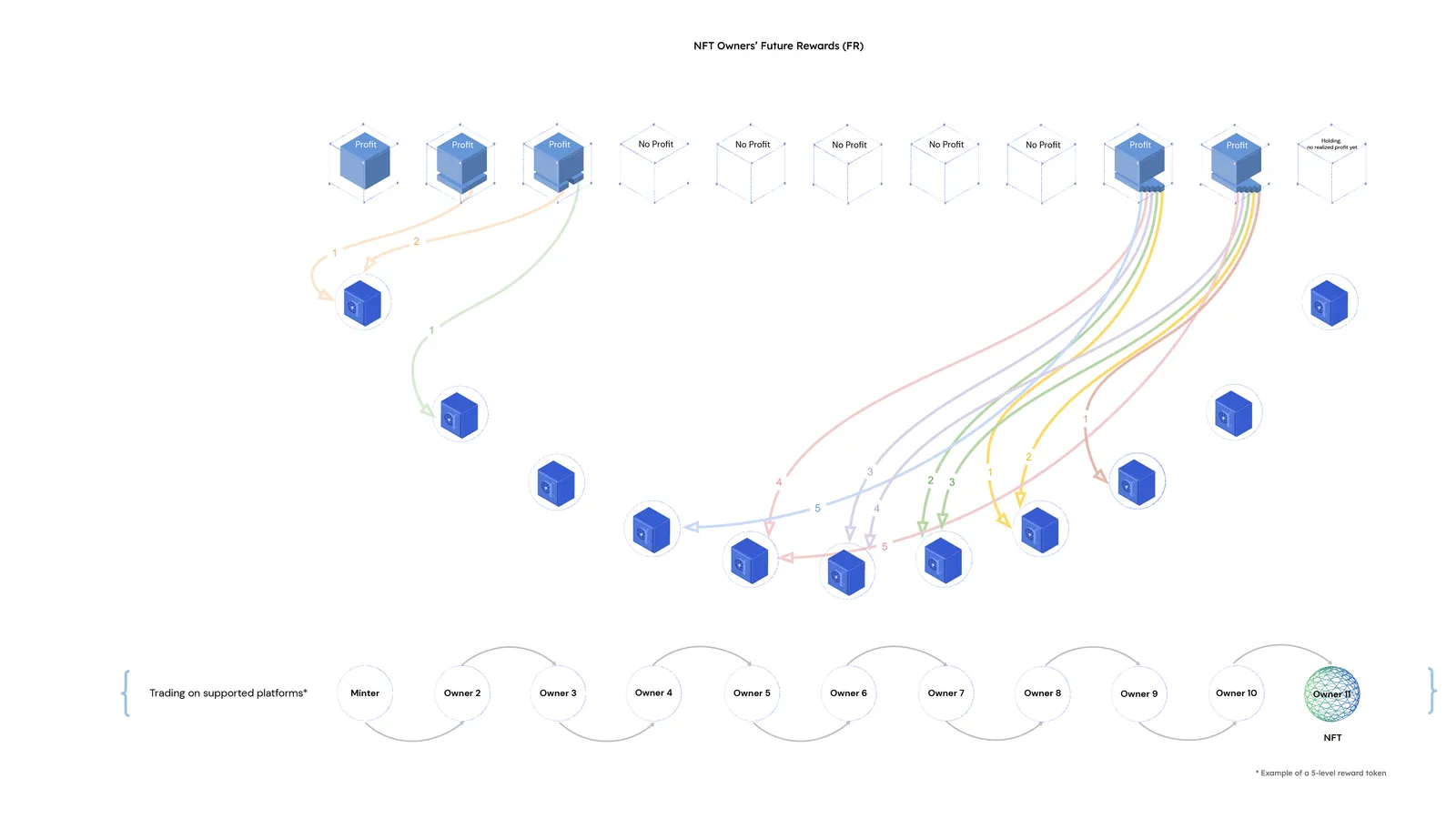
Single-generation and multi-generation rewards
Under a single-generation reward system, a new buyer or owner receives a portion of realized profits from only the next eligible generation. In other words, the reward is paid only from the first profitable subsequent owner under the relevant rule. Under a multi-generation reward system, a buyer may receive future rewards even years after the purchase. This may be relevant for NFTs with potential for long-term appreciation. Rewards may be paid across multiple generations, resulting in accumulated distributions.
The proposal allows marketplace operators to choose between single-generation and multi-generation distribution systems. The platform operator determines which reward model to use. This enables selection of reward models suited to different NFT collections and projects.
Direct FR payments from sellers versus contract-managed payments
An FR payment taken directly from sale proceeds can be immediate and final. This is significant for fraud detection and security. A smart contract calculates the FR amounts for each previous ownership generation and processes payments according to other criteria established by the marketplace. For example, marketplace criteria may account for low wallet reputation scores or patterns of consecutive orders detected using temporal heuristics.
Thus, FR payments can be made directly from sale proceeds or calculated and managed by a smart contract. The former provides immediate, final payment, while the latter provides flexibility to process payments subject to various conditions. These approaches enable control over the payment process and support security measures.
Equal and linear reward distributions
Equal FR payments
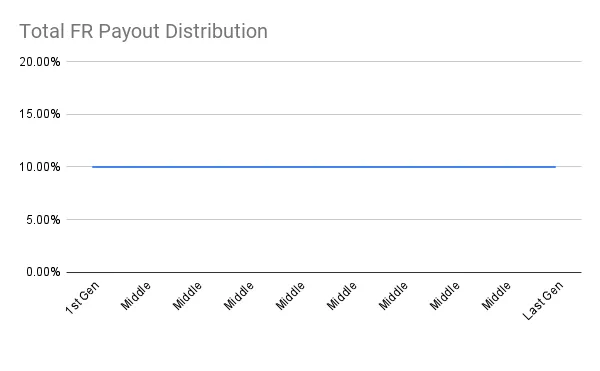
When a future owner realizes a profit, FR may be distributed equally among all eligible owners. All eligible owners receive the same proportion under an equal distribution (see Figure 4).
An exponential reward curve may be preferable in some cases. Such a curve can provide somewhat greater rewards to the latest buyers at a given point in the distribution schedule. The distribution curve can also allow earlier generations to accumulate greater rewards as the FR distribution period approaches its end. In this way, early participation can be rewarded. However, the illustrated approach is less extreme than a distribution based on an arithmetic sequence (see Figure 5).
The system is intended not to discriminate among buyers. Every buyer passes through the same distribution curve. Thus, buyers follow equivalent reward rules regardless of when they acquired the NFT or their ownership generation.
FR distribution using an arithmetic sequence
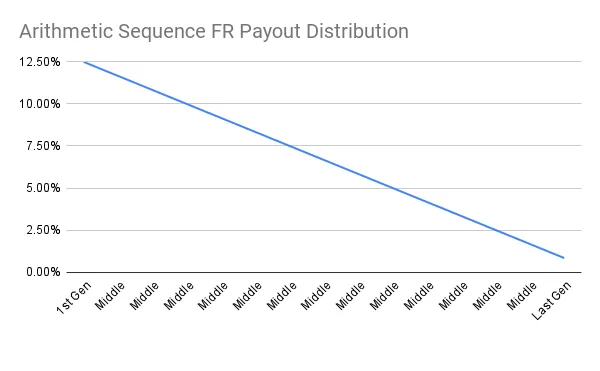
Profits are distributed according to the arithmetic sequence 1, 2, 3, ....
The first owner receives one share, the second receives two shares, the third receives three shares, and so on.
Backward compatibility
The proposal is designed to be compatible with the existing ERC721 and ERC2981 standards. It can also be adapted to integrate with ERC1155.
Tests
The following diagram visualizes the test cases.
https://eips.ethereum.org/assets/eip-5173/animate-1920x1080-1750-frames.gif?raw=true
Reference implementation
The implementation uses OpenZeppelin contracts and the PRB Math library developed by Paul R Berg for fixed-point arithmetic. It demonstrates the nFR interface and an ERC721 implementation using an extension conforming to the nFR standard.
// SPDX-License-Identifier: CC0-1.0
// Contract based on [https://docs.openzeppelin.com/contracts/3.x/erc721](https://docs.openzeppelin.com/contracts/3.x/erc721)
pragma solidity ^0.8.0;

import "@openzeppelin/contracts/token/ERC721/ERC721.sol";
import "@openzeppelin/contracts/utils/Counters.sol";
import "@openzeppelin/contracts/access/Ownable.sol";
import "@openzeppelin/contracts/token/ERC721/extensions/ERC721URIStorage.sol";
import "./nFR.sol";

contract MyNFT is ERC721URIStorage, Ownable, nFR {
    using Counters for Counters.Counter;
    Counters.Counter private _tokenIds;

    constructor() ERC721("MyNFT", "NFT") {}

    function mintNFT(address recipient, uint8 numGenerations, uint256 percentOfProfit, uint256 successiveRatio, string memory tokenURI)
        public onlyOwner
        returns (uint256)
    {
        _tokenIds.increment();

        uint256 newItemId = _tokenIds.current();
        _mint(recipient, newItemId, numGenerations, percentOfProfit, successiveRatio);
        _setTokenURI(newItemId, tokenURI);

        return newItemId;
    }

    function mintERC721(address recipient, string memory tokenURI) public onlyOwner {
        _tokenIds.increment();

        uint256 newItemId = _tokenIds.current();
        _mint(recipient, newItemId);
        _setTokenURI(newItemId, tokenURI);
    }

    function setDefaultFRInfo(uint8 numGenerations, uint256 percentOfProfit, uint256 successiveRatio) public onlyOwner {
        _setDefaultFRInfo(numGenerations, percentOfProfit, successiveRatio);
    }

    function burnNFT(uint256 tokenId) public onlyOwner {
        _burn(tokenId);
    }

    function _burn(uint256 tokenId) internal override(nFR, ERC721URIStorage) {
        super._burn(tokenId);
    }

    function _transfer(address from, address to, uint256 tokenId) internal override(ERC721, nFR) {
        super._transfer(from, to, tokenId);
    }

    function _mint(address to, uint256 tokenId) internal virtual override(ERC721, nFR) {
        super._mint(to, tokenId);
    }

    function supportsInterface(bytes4 interfaceId) public view virtual override(ERC721, nFR) returns (bool) {
        return super.supportsInterface(interfaceId);
    }

    function tokenURI(uint256 tokenId)
        public
        view
        override(ERC721, ERC721URIStorage)
        returns (string memory)
    {
        return super.tokenURI(tokenId);
    }
}
Source: https://eips.ethereum.org/assets/eip-5173/Implementation/nFRImplementation.sol
Distributing NFT royalties to artists and creators
The proposal argues that artist royalties should be handled on-chain. It supports the ERC2981 NFT royalty standard.
Platforms can support royalties for the same NFT using on-chain parameters and functionality.
- If there is no profit, no profit-sharing payment is incurred.
- Previous ownership is important to a collection's provenance and value.
- Previous owners should receive compensation for their contributions to ownership history.
- FR (future rewards) gives buyers and owners incentives intended to discourage circumvention of royalty payment schemes.
Distribution of NFT owner future rewards (FR)
Calculating future rewards
When an NFT is sold, the realized profit (P) is shared among eligible buyers and owners. Previous owners receive a fraction of that profit (P), known as future rewards (FRs). The seller receives the remaining profit.
A sliding-window mechanism determines which previous owners participate in profit sharing. Think of the ownership history as a queue extending from the first owner to the current owner. The fixed-size profit-sharing window extends backward from the owner immediately preceding the current owner toward the first owner. Only previous owners within the window participate in the distribution.
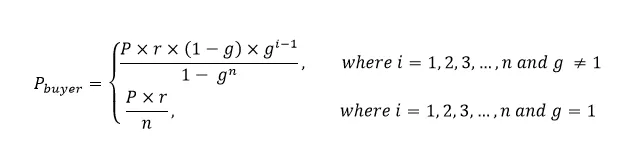
The equation works as follows.
- P (total profit) is the sale price of the NFT minus its acquisition price.
- In other words, P represents the realized price difference.
- r (buyer reward ratio) is the proportion of total profit P allocated to buyer rewards.
- The total profit is distributed according to this ratio.
- g (common ratio) is the ratio between consecutive terms in a geometric sequence.
- It determines how rewards vary between ownership generations.
- For example, if g is
2, the reward for the next term is twice that of the preceding term.
- n (actual participating owner count) represents the number of eligible owners participating in future reward sharing.
- Calculating n takes into account the current owner count (m) and the sliding-window size (w).
- Specifically, calculate it using
n = min(m, w). - This caps the number of owners at the window size.
This equation calculates profit distribution in NFT sales. It accounts for factors such as the buyer reward ratio and the common ratio controlling the geometric reward pattern. The actual number of reward recipients (n) is limited by the window size.
Converting the calculation into code
pragma solidity ^0.8.0;
//...

/* Assumes usage of a Fixed Point Arithmetic library (prb-math) for both int256 and uint256, and OpenZeppelin Math utils for Math.min. */
function _calculateFR(uint256 P, uint256 r, uint256 g, uint256 m, uint256 w) pure internal virtual returns(uint256[] memory) {
        uint256 n = Math.min(m, w);
        uint256[] memory FR = new uint256[](n);

        for (uint256 i = 1; i < n + 1; i++) {
            uint256 pi = 0;

            if (successiveRatio != 1e18) {
                int256 v1 = 1e18 - int256(g).powu(n);
                int256 v2 = int256(g).powu(i - 1);
                int256 v3 = int256(P).mul(int256(r));
                int256 v4 = v3.mul(1e18 - int256(g));
                pi = uint256(v4 * v2 / v1);
            } else {
                pi = P.mul(r).div(n);
            }

            FR[i - 1] = pi;
        }

        return FR;
}
Security considerations
Payment attacks
Introducing royalty and realized-profit reward collection, distribution, and payments to ERC721 increases the potential attack surface. Reentrancy protection across payment-related functions is important for preventing reentrancy attacks. This mitigates an important attack vector in payment processing.
Royalty circumvention
The current ERC721 standard permits transfers that do not necessarily result in creator royalty payments.
Off-platform sales can cause the recorded acquisition cost of a new buyer to be zero, potentially increasing the future reward (FR) liability on a subsequent sale.
This means that either the buyer or seller bears the cost of sharing a portion (P x r) of realized profits with previous owners.
The incentive design aims to make royalty circumvention less attractive to buyers.
FR accumulation through wash sales
The Quantexa blog and BeInCrypto articles describe wash trading in unregulated cryptocurrency trading platforms and NFT marketplaces. Wash trading can confer unfair advantages, inflate prices, and facilitate money laundering. If one entity occupies multiple ownership generations to accumulate future rewards, it can undermine the integrity of the system.
Wash trading by users
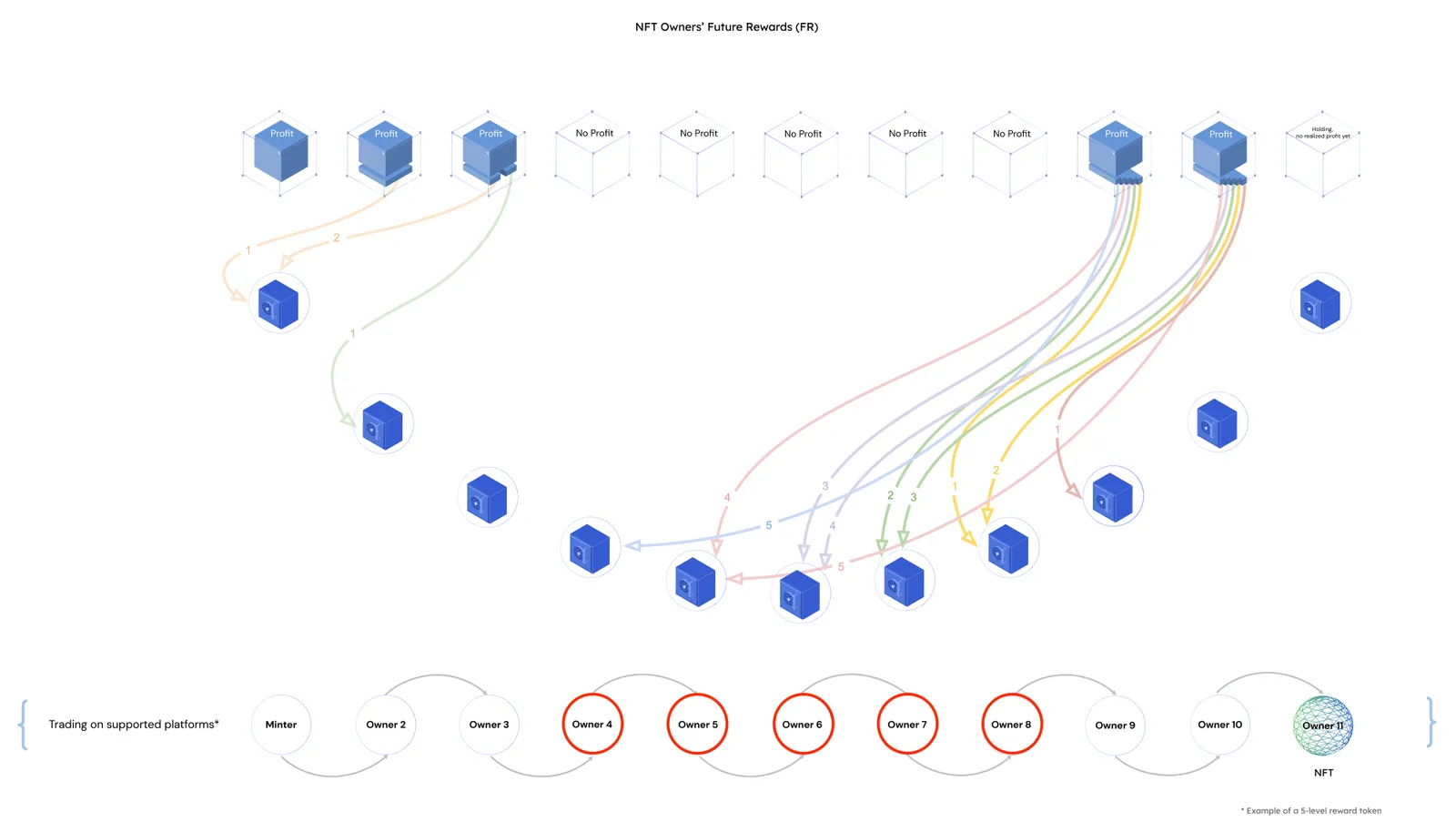
This refers to artificial transactions between wallets controlled by the same entity, recorded as sales at a loss. Such repeated self-dealing can distort the future reward (FR) distribution by concentrating ownership positions (see Figure 6). Wallet reputation scores may be used as one measure to discourage this behavior. For example, a new wallet with little transaction history may be subject to marketplace restrictions on FR distribution; such signals are not conclusive evidence of misconduct.
The proposal seeks to avoid concentrating most future rewards among a small number of wash traders. One approach to reducing wash trading and excessive reward accumulation is to make these practices economically unattractive. Possible countermeasures include incentives based on wallet reputation and holding periods. Such mechanisms may reduce both parties' rewards when a new wallet is involved or the holding period is below a threshold.
Wash trading by marketplace operators
The proposal identifies marketplace-level misconduct as a particularly serious concern. According to Decrypt, some marketplaces have been implicated in wash trading or criticized for failing to address it. The authors of the ERC also describe their own experience with this phenomenon. The authors recount that, in 2018, an executive at a highly ranked cryptocurrency exchange allegedly boasted about artificial trading in newly listed tokens, describing it as market making. The authors state that the exchange remained among the top five when they wrote the account.
The proposal raises concerns about operators engaging in self-dealing or colluding with users to handle royalty and future reward payments off-platform. Exchanges need robust mechanisms for detecting and preventing self-dealing. Users should be able to scrutinize marketplace activity transparently. The proposal also suggests that marketplaces give customers free access to on-chain transaction monitoring tools such as Chainalysis Reactor.
Long or cyclic FR ownership histories
Malicious actors may create extremely long or cyclic histories of future reward recipients. Applications attempting to distribute FR can consequently run out of gas and fail. Clients are therefore responsible for checking that contracts they interact with maintain a reasonable number of ownership generations. This helps prevent loops from exhausting the available gas.
References
Yale ReiSoleil (@longnshort), dRadiant (@dRadiant), D Wang, PhD david@iob.fi, "ERC-5173: NFT Future Rewards (nFR) [DRAFT]," Ethereum Improvement Proposals, no. 5173, May 2022. [Online serial]. Available: https://eips.ethereum.org/EIPS/eip-5173.
Conclusion
This article covered ERC5173, a proposed multi-generation reward mechanism for previous owners of non-fungible tokens (NFTs). I hope it helped clarify the mechanism.
If you have questions, feel free to reach out via Twitter DM.
I also publish articles on the following platforms.


