Introduction
Hi, I'm cardene, a software engineer and technical writer focused on blockchain and AI.
I've also authored Japanese technical books on specification-driven development with LLMs and decentralized application (DApp) development.

I also build and publish a variety of tools, libraries, and open-source projects.
This article examines EIP-1, the document that defines the purpose and guidelines of Ethereum Improvement Proposals. It reflects the original article's May 2024 context; editorial requirements and repository organization may change over time.
This article explains the proposal, with additional context and examples.

You can find my other proposal articles here.

What is an EIP?
EIP stands for Ethereum Improvement Proposal. An EIP is a design document providing information to the Ethereum community or describing a proposed feature for Ethereum.
Purpose of EIPs
EIPs serve three main purposes.
- Proposing new features: Formalize proposed extensions and improvements to Ethereum.
- Collecting technical feedback: Gather input from developers and users to refine designs.
- Documenting design decisions: Record why a design was selected and why it is necessary, improving transparency.
EIPs are version-controlled text files maintained on GitHub. Their revision history helps developers follow changes to proposals. Ideally, implementers also publish lists of the EIPs they support so users can determine the implementation status of clients or libraries.
Types of EIPs
Ethereum Improvement Proposals fall into three main types.
Standards Track EIP
A Standards Track EIP describes changes that affect Ethereum implementations or the interoperability of applications. Examples include network protocol changes, block or transaction validity rules, and application-level conventions.
Core
Changes requiring a consensus fork, or improvements relevant to discussions among core developers. Historical examples include EIP-5 and EIP-101.
For background on EIP-5, see:
EIP-5: Paying gas only for memory actually used
Networking
Improvements to networking protocols, such as devp2p, the Light Ethereum Subprotocol, and historical specifications for Whisper and Swarm.
devp2p (EIP-8)
devp2p provides networking protocols for communication among Ethereum nodes. EIP-8 addresses compatibility and robustness, allowing implementations using different protocol versions to establish connections more reliably.
Light Ethereum Subprotocol
This subprotocol was designed for light clients rather than full nodes. Its goal was to allow light clients to retrieve the information they needed efficiently while interacting with the Ethereum network.
Whisper and Swarm networking specifications
Whisper was designed as an asynchronous messaging protocol with privacy-oriented properties. Related proposals sought to improve messaging efficiency and security.
Swarm is a decentralized storage and content distribution protocol intended to support distributed storage and retrieval for applications. Improvements to its protocols aim to make data access more efficient and reliable.
Interface
Improvements to client API and language-level conventions, such as method names (EIP-6) and contract ABIs.
For background on EIP-6, see:
EIP-6: Renaming SUICIDE to SELFDESTRUCT
ERC
Application-level standards and conventions, such as the ERC-20 token interface and the ERC-137 naming system.
For background on ERC-20, see:
For background on ERC-137, see:
ERC-137: Associating names with addresses through ENS
Meta EIP
A Meta EIP describes changes to processes surrounding Ethereum, such as decision-making procedures, development practices, or community workflows.
Informational EIP
An Informational EIP describes Ethereum design issues or provides general guidance and information to the community. It does not necessarily propose a new feature, and its recommendations are not inherently mandatory.
EIP workflow
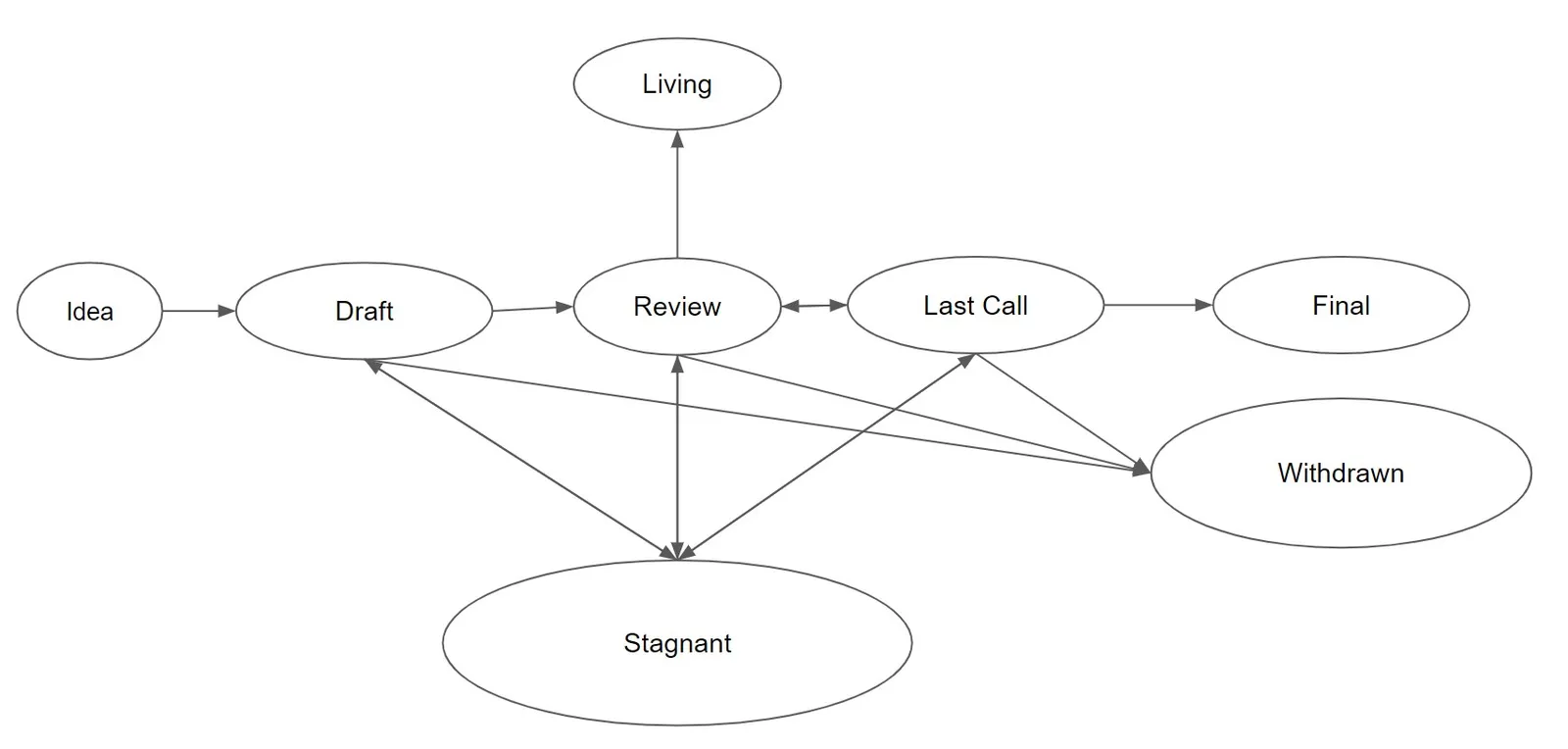
The EIP process uses the following stages and statuses.
- Idea: An initial idea that has not yet become a formal draft. It is not tracked as an EIP in the repository and may be discussed on community forums.
- Draft: The proposal is formalized and initially merged into the EIP repository.
- Review: The author marks the proposal as ready for peer review.
- Last Call: The final review period, generally lasting 14 days. Substantive changes during this period require returning the proposal to Review.
- Final: The EIP is considered a finalized specification. Changes are generally limited to errata and non-normative clarifications. Final status does not necessarily mean a protocol change has been activated.
- Stagnant: A Draft, Review, or Last Call EIP that has had no activity for six months may move to Stagnant. Authors or editors can reactivate it by returning it to the appropriate earlier status.
- Withdrawn: The author withdraws the proposal. This is a terminal status, and the same EIP number cannot be reactivated.
- Living: A document intended to be updated continuously rather than reaching a fixed final state. EIP-1 itself is an example.
Authors should discuss originality and feasibility with the community early in the process, including on the Ethereum Magicians forum. After formalizing an idea, the author is responsible for developing the proposal and responding to feedback. In the case of a Core EIP, client implementers need sufficient information to understand and implement the proposed change, and implementations may be needed to demonstrate feasibility.
Components of a successful EIP
The following sections describe the document structure.
Preamble
An RFC 822-style header contains metadata such as the EIP number, title (up to 44 characters), description (up to 140 characters), and author details. The title and description should not contain the assigned EIP number.
RFC 822 defined a format for internet email messages.
Abstract
A concise summary of the technical proposal. A reader should be able to understand what the EIP does from this section alone.
Motivation (optional)
Particularly useful for proposals changing the Ethereum protocol. It explains why the existing specification is insufficient to address the problem.
Specification
Describes the proposed feature or change in sufficient technical detail. The original article labels this section optional, but a precise specification is essential for a Standards Track proposal.
Rationale
Explains why the chosen design was selected, discusses alternatives and related work, and addresses concerns raised during discussion.
Backwards Compatibility (optional)
An EIP introducing backwards-incompatible changes must explain those incompatibilities and their implications.
Test Cases (optional where applicable)
Test cases are required for changes affecting consensus. They may appear inline or in separate files.
Reference Implementation (optional)
An implementation or example that helps readers understand and implement the proposed specification.
Security Considerations
Discusses the security implications of the proposed changes.
Copyright Waiver
EIPs are intended for the public domain under the applicable copyright waiver.
EIP format and template
EIPs are written in Markdown and follow the repository's template.
EIP header
An EIP begins with an RFC 822-style metadata header. The header supports identification and tracking of proposals.
- eip: The assigned EIP number.
- title: The proposal title.
- description: A concise description.
- author: Author names and identifiers, such as GitHub usernames or email addresses. At least one author should have a GitHub username so they can receive and respond to proposed changes.
- discussions-to: The URL of the official discussion thread.
- status: One of Draft, Review, Last Call, Final, Stagnant, Withdrawn, or Living.
- last-call-deadline: The end date of the Last Call period; required for that status.
- type: Standards Track, Meta, or Informational.
- category: Core, Networking, Interface, or ERC; required for Standards Track proposals.
- created: The date associated with the creation of the EIP, in the prescribed format.
- requires: The numbers of other EIPs on which the proposal depends.
- withdrawal-reason: A reason for withdrawal, required when the status is Withdrawn.
Linking to external resources
External references in EIP documents must follow rules intended to make the referenced material stable and identifiable. Resources can move, disappear, or change, so references should identify the relevant version.
Ethereum Execution Client Specifications
References to execution client specifications should identify a specific commit.
[Ethereum Execution Client Specifications](https://github.com/ethereum/execution-specs/blob/9a1f22311f517401fed6c939a159b55600c454af/README.md)Ethereum Consensus Layer Specifications
References to consensus layer specifications should likewise be anchored to a particular commit.
[Beacon Chain](https://github.com/ethereum/consensus-specs/blob/26695a9fdb747ecbe4f0bb9812fedbc402e5e18c/specs/sharding/beacon-chain.md)Ethereum Networking Specifications
Links to networking specifications should reference an exact commit.
[Ethereum Wire Protocol](https://github.com/ethereum/devp2p/blob/40ab248bf7e017e83cc9812a4e048446709623e8/caps/eth.md)World Wide Web Consortium (W3C)
The guidelines permit appropriate W3C specifications, with links anchored to dated documents in the technical report namespace. The historical example below is a Candidate Recommendation Draft; readers should consult the applicable editorial rules for the permitted maturity level.
[Secure Contexts](https://www.w3.org/TR/2021/CRD-secure-contexts-20210918/)Web Hypertext Application Technology Working Group (WHATWG)
Links to WHATWG specifications should identify a specific commit snapshot.
[HTML](https://html.spec.whatwg.org/commit-snapshots/578def68a9735a1e36610a6789245ddfc13d24e0/)Internet Engineering Task Force (IETF)
Links may reference published RFCs with assigned RFC numbers.
[RFC 8446](https://www.rfc-editor.org/rfc/rfc8446)Bitcoin Improvement Proposal
References to BIPs should be anchored to a specific commit.
[BIP 38](https://github.com/bitcoin/bips/blob/3db736243cd01389a4dfd98738204df1856dc5b9/bip-0038.mediawiki)National Vulnerability Database (NVD)
References to CVE records include the relevant last-modified timestamp.
[CVE-2023-29638 (2023-10-17T10:14:15)](https://nvd.nist.gov/vuln/detail/CVE-2023-29638)Digital Object Identifier System (DOI)
A DOI reference identifies the associated document and should include a URL pointing to a freely accessible copy, following the applicable citation format.
This is a sentence with a footnote.[^1]

[^1]:
```csl-json
{
  "type": "article",
  "id": 1,
  "author": [
    {
      "family": "Jameson",
      "given": "Hudson"
    }
  ],
  "DOI": "00.0000/a00000-000-0000-y",
  "title": "An Interesting Article",
  "original-date": {
    "date-parts": [
      [2022, 12, 31]
    ]
  },
  "URL": "https://sly-hub.invalid/00.0000/a00000-000-0000-y",
  "custom": {
    "additional-urls": [
      "https://example.com/an-interesting-article.pdf"
    ]
  }
}
# Referencing other EIPs

References to other EIPs follow these conventions.

- Use the identifier EIP-N, where N is the assigned number, or ERC-N for ERC-category documents as described in the style guide.
- Use relative repository links rather than absolute GitHub links.
- For example, a link to EIP-1 uses the relative path `./eip-1.md`.

# Auxiliary files

Images, diagrams, and other supporting files should be stored in the proposal-specific directory `assets/eip-N`.

Use relative links to reference these files from the proposal. For example, an image associated with EIP-1 can be referenced using `../assets/eip-1/image.png`.

# Transferring EIP ownership

An author may no longer have time to maintain an EIP or may become unreachable. In these cases, another contributor may seek to take over its maintenance.

A prospective successor should contact both the original author and the EIP editors. If the original author does not respond, the editors may decide whether ownership should be transferred.

# Responsibilities of EIP editors

EIP editors perform initial editorial assessment and manage proposals submitted to the repository.

- **Assess the proposal:** Check that it is technically understandable and sufficiently complete, even if it is unlikely to be accepted.
- **Review the title:** Confirm that it accurately describes the proposal.
- **Review language and markup:** Check spelling, grammar, sentence structure, Markdown formatting, and code style.
- **Request revisions when necessary:** Give authors specific instructions if the proposal is not ready.
- **Process a ready proposal:** Assign an EIP number, normally according to the repository's numbering conventions, merge the relevant pull request, and notify the author about the following steps. Numbers may be reassigned when inappropriate number selection is suspected.

Editors primarily perform administrative and editorial work rather than deciding whether a proposed technical change should be adopted by Ethereum. They monitor changes and help correct structural, grammatical, spelling, and markup issues.

# Style guide

The EIP style guide defines conventions for titles, descriptions, identifiers, and normative language.

### Title

The title should not contain the word "standard" or its derivatives, nor should it contain the assigned EIP number.

### Description

The description should likewise omit "standard" and its derivatives and the assigned EIP number.

### EIP identifiers

Use ERC-X to refer to ERC-category proposals and EIP-X for proposals in other categories, where X is the assigned number.

### RFC 2119 and RFC 8174

EIPs are encouraged to use the normative language defined by RFC 2119 and RFC 8174. Keywords such as MUST, MUST NOT, REQUIRED, SHALL, SHALL NOT, SHOULD, SHOULD NOT, RECOMMENDED, NOT RECOMMENDED, MAY, and OPTIONAL have the meanings defined by those documents when used as specified.

The appropriate normative-language declaration should appear at the beginning of the specification section when applicable.

# History

EIP-1 draws heavily on Bitcoin's BIP-0001, which in turn was adapted from Python's PEP-0001. BIP-0001 was written by Amir Taaki, drawing on text from PEP-0001 written by Barry Warsaw, Jeremy Hylton, and David Goodger.

The PEP authors are not responsible for the Ethereum improvement process. Comments concerning Ethereum and EIPs should be directed to the EIP editors.

# Citation

Martin Becze <mb@ethereum.org>, Hudson Jameson <hudson@ethereum.org>, et al., "EIP-1: EIP Purpose and Guidelines," Ethereum Improvement Proposals, no. 1, October 2015. [Online serial]. Available: https://eips.ethereum.org/EIPS/eip-1.

# Citation

Martin Becze <mb@ethereum.org>, Hudson Jameson <hudson@ethereum.org>, et al., "EIP-1: EIP Purpose and Guidelines," Ethereum Improvement Proposals, no. 1, October 2015. [Online serial]. Available: https://eips.ethereum.org/EIPS/eip-1.

# Conclusion

EIP-1 provides the framework for writing, reviewing, maintaining, and classifying Ethereum Improvement Proposals. Understanding these guidelines helps developers interpret proposal statuses and contribute to Ethereum's standardization process.

If you have questions, feel free to contact me on Twitter.

[Twitter @cardene777](https://twitter.com/cardene777)

You can also find my work on the following sites.

https://chaldene.net/

https://zenn.dev/heku

https://cardene.substack.com/

https://mirror.xyz/0xcE77b9fCd390847627c84359fC1Bc02fC78f0e58

https://cardene.dev/proposals