Introduction
Hi, I'm cardene, a software engineer and technical writer focused on blockchain and AI.
I've also authored Japanese technical books on specification-driven development with LLMs and decentralized application (DApp) development.

I also build and publish a variety of tools, libraries, and open-source projects.
This article covers EIP-8133, which documents how Ethereum upgrades are named.
Ethereum upgrades have names such as Frontier, London, Altair, Shapella, and BPO1, depending on their era and the layer they affect. EIP-8133 brings these naming conventions together in a single reference.
The discussion below follows the proposal at the following link, as covered in the original July 2026 article. The illustrations are reproduced from the Japanese article and retain their Japanese labels.

Overview
EIP-8133 is an informational EIP documenting Ethereum's network upgrade naming conventions.
It does not specify new protocol features or changes to client implementations. Instead, it describes the origins of upgrade names, the layers to which they apply, combined names, and the numbering conventions for Blob Parameter Only (BPO) upgrades.
Ethereum's upgrade names have evolved from early milestone names to historical cities, glaciers, execution-layer city names, consensus-layer star names, post-Merge combined names, and BPO numbers. These names are more than nicknames: they indicate the era and type of upgrade.
The illustration below provides an overview of the naming categories.
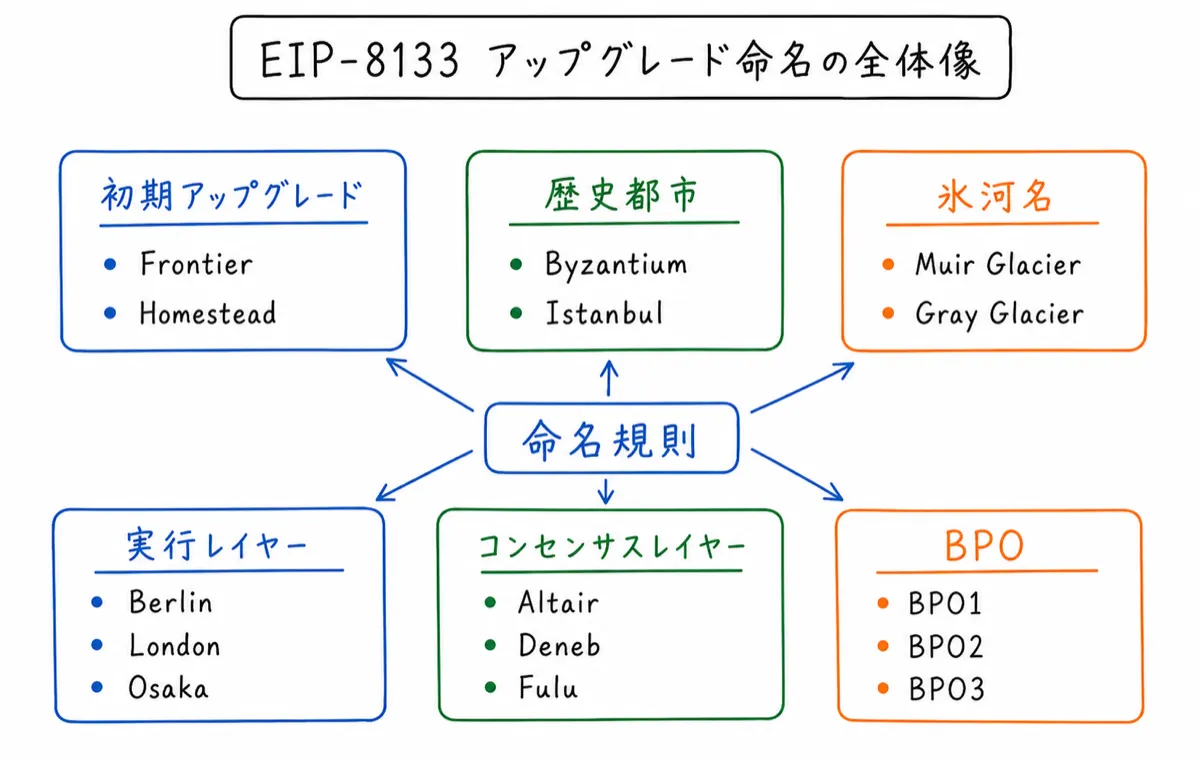
The illustration groups the names into six categories. Early upgrade names and glacier names are closely tied to their historical context, while execution-layer and consensus-layer names reflect the separation of the layers after the Merge.
Motivation
Ethereum continues to undergo network upgrades across several areas, including the transition from Proof of Work (PoW) to Proof of Stake (PoS), the separation of the execution and consensus layers, and the gradual expansion of blob capacity. As a result, an upgrade name alone does not always reveal whether it refers to a change in the execution layer, the consensus layer, or both.
Shanghai and Capella, for example, are independent layer-specific names. Shapella, by contrast, is the combined name used in external communications. Without a clear distinction, specifications, client implementations, operational procedures, and community discussions can become misaligned.
EIP-8133 documents the naming practices already in use and provides a common reference for interpreting upgrade names. It does not, however, impose fixed names for future upgrades. Future names continue to be determined through community coordination and the respective Meta EIPs.
Specification
EIP-8133 organizes upgrade names into the following categories.
| Category | Naming convention | Examples |
|---|---|---|
| Early upgrades | Names representing development phases or major milestones | Frontier, Homestead |
| Historical cities | Historically connected city names from the Metropolis era | Byzantium, Constantinople, Istanbul |
| Glaciers | Glacier names indicating a response to the Difficulty Bomb |
Muir Glacier, Arrow Glacier, Gray Glacier |
| Execution layer | Cities hosting Devcon or Devconnect | Berlin, London, Shanghai, Osaka |
| Consensus layer | Star names in alphabetical order | Altair, Bellatrix, Capella, Deneb |
| Combined names | Portmanteaus for simultaneous upgrades | Shapella, Dencún, Pectra, Fusaka |
| BPO | Sequential BPO<n> numbers |
BPO1, BPO2, BPO3 |
Early upgrades
Early Ethereum upgrades used thematic names associated with the experimental state of the network, significant milestones, or features that were actually shipped.
The principal examples are as follows.
| Name | Role |
|---|---|
| Frontier | Initial phase of Ethereum mainnet |
| Frontier Thawing | Relaxation of restrictions following Frontier |
| Homestead | Transition to a more stable network phase |
| DAO Fork | Response to the DAO incident |
| Tangerine Whistle | Emergency response to denial-of-service attacks |
| Spurious Dragon | Response to empty accounts created by attacks |
Frontier and Homestead mark milestones in the network's progression toward production use. Tangerine Whistle and Spurious Dragon reflect the technical context of the time, including attack mitigation and state cleanup.
Historical cities
The Metropolis era used the names of historically connected cities. Byzantium, Constantinople, St. Petersburg, and Istanbul were adopted to represent stages in the maturation of the protocol.
| Name | Notes |
|---|---|
| Byzantium | First major upgrade of the Metropolis era |
| Constantinople | Major upgrade following Byzantium |
| St. Petersburg | Adjustment activated at the same block height as Constantinople |
| Istanbul | Major upgrade later in the Metropolis era |
St. Petersburg was activated at the same block height as Constantinople to remove EIP1283, which had been scheduled for inclusion in Constantinople.
The naming convention provided consistency during a period of frequent upgrades.
For more on EIP-1283, see the following article.
EIP-1283: SSTORE Gas Optimization
Glaciers
Upgrades primarily intended to address the Difficulty Bomb were named after glaciers.
The Difficulty Bomb gradually increases mining difficulty to encourage the transition from PoW to PoS.
Glacier names indicate temporary measures to delay the Ice Age associated with increasing mining difficulty.
| Name | Role |
|---|---|
| Muir Glacier | Delays the Difficulty Bomb |
| Arrow Glacier | Delays the Difficulty Bomb |
| Gray Glacier | Delays the Difficulty Bomb |
The name Gray Glacier also reflects the approaching Merge. Gray Glacier merges with another glacier, a parallel to Ethereum's transition to PoS.
Execution layer
Execution-layer upgrades can be named after cities that have hosted Devcon or Devconnect. The convention began with Devcon host cities and later expanded to Devconnect host cities.
The main examples are as follows.
| Execution-layer name | Origin |
|---|---|
| Berlin | Devcon 0 |
| London | Devcon 1 |
| Paris | EthCC |
| Shanghai | Devcon 2 |
| Cancun | Devcon 3 |
| Prague | Devcon 4 |
| Osaka | Devcon 5 |
| Amsterdam | Devconnect 1 |
| Bogotá | Devcon 6 |
Paris is an exception: its name comes from EthCC rather than Devcon or Devconnect. It was used for the execution-layer upgrade associated with the Merge to commemorate a major Ethereum community event.
Future execution-layer names can also draw on Devcon and Devconnect host cities. The proposal lists Istanbul, Bangkok, Buenos Aires, and Mumbai among the past or announced host cities.
Consensus layer
Consensus-layer upgrades are named after stars in alphabetical order. Each upgrade name must be a recognized star name selected by community consensus.
This convention was established after the launch of the Beacon Chain. Starting with Altair, the first consensus-layer upgrade, the initial letters progress through Bellatrix, Capella, Deneb, Electra, Fulu, Gloas, and Heze.
| Order | Consensus-layer name |
|---|---|
| A | Altair |
| B | Bellatrix |
| C | Capella |
| D | Deneb |
| E | Electra |
| F | Fulu |
| G | Gloas |
| H | Heze |
Star names are relatively free of political associations and internationally recognizable. Following alphabetical order also makes the convention easy to extend to future upgrades.
The Merge
The Merge has a special place in Ethereum's naming conventions. Subsequent simultaneous upgrades sometimes use a combined name formed from the execution-layer and consensus-layer names. The Merge itself, however, does not use a combined name.
Bellatrix was first activated on the consensus layer. It enabled the Beacon Chain to recognize and coordinate the execution-layer transition. Paris was then activated on the execution layer, transitioning Ethereum mainnet from PoW to PoS.
| Item | Details |
|---|---|
| Consensus layer | Bellatrix |
| Bellatrix activation | September 6, 2022, Epoch 144896 |
| Execution layer | Paris |
| Paris activation | September 15, 2022, 06:42 UTC |
| Transition condition | Reaching Terminal Total Difficulty |
| Transition block | 15,537,393 |
| Canonical name | The Merge |
Bellatrix began the operational transition, and Paris completed the protocol transition. The canonical name for the entire sequence of events is The Merge.
Combined names
After the Merge, execution-layer and consensus-layer upgrades may be activated simultaneously. Each layer retains its own independent canonical name. For external communication and coordination, however, a combined name may be formed from the two names.
The following illustration shows the relationship between names after the Merge.
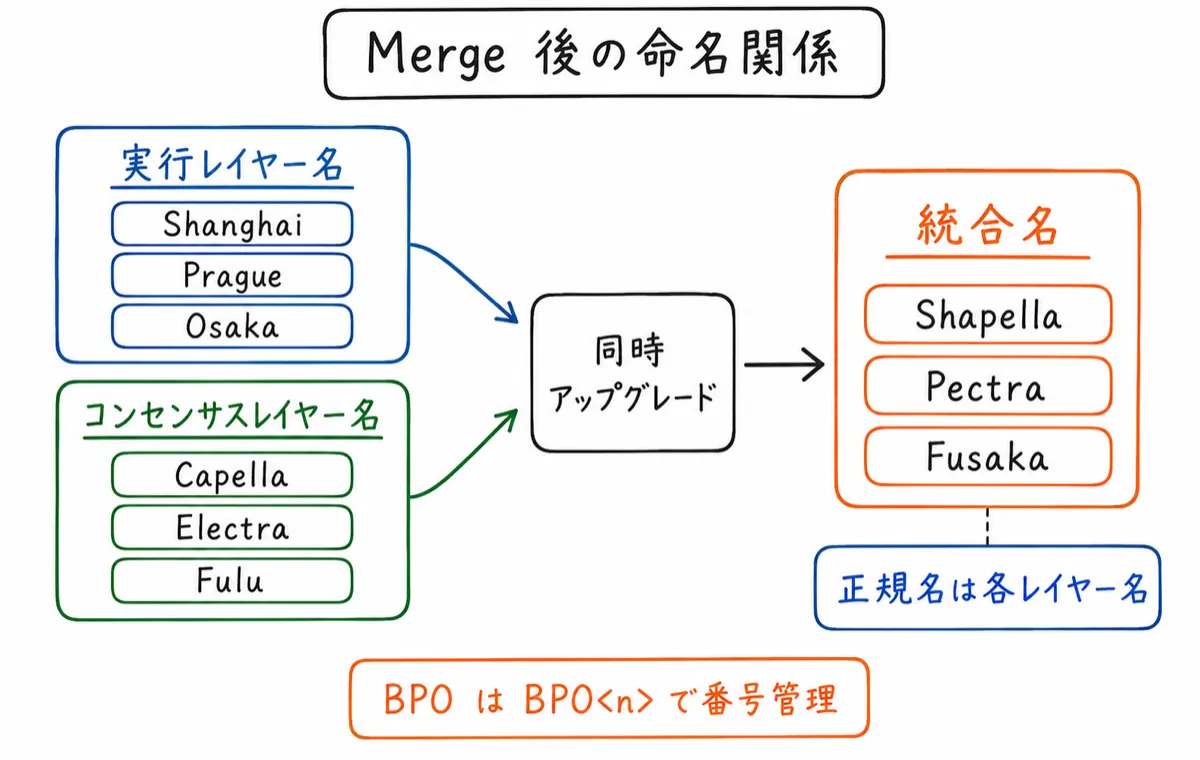
Combined names are useful shorthand, but they do not replace the canonical names used in specifications, client implementations, and protocol documentation. In implementation and specification contexts, layer-specific names such as Shanghai and Capella remain canonical.
The principal combined names are as follows.
| Combined name | Origin |
|---|---|
| Shapella | Shanghai and Capella |
| Dencún | Deneb and Cancún |
| Pectra | Prague and Electra |
| Fusaka | Fulu and Osaka |
| Glamsterdam | Gloas and Amsterdam |
| Hegotá | Heka and Bogotá (example in the proposal) |
These combined names serve as shorthand for discussions across the ecosystem. Rather than inferring the scope of a change from the combined name alone, check the separate execution-layer and consensus-layer names when necessary.
BPO
BPO upgrades are network upgrades that change only blob-related parameters. They adjust capacity parameters such as the blob target and blob maximum, without including additional protocol changes. This mechanism is used to expand Ethereum's data availability capacity gradually.
EIP-7892 defines the BPO upgrade mechanism and the BPO<n> numbering convention.
In BPO names, n is a monotonically increasing positive integer starting at 1.
The sequence itself therefore provides the names: BPO1, BPO2, BPO3, and so on.
For more on EIP-8134 (BPO1), see the following article.
EIP-8134: BPO1, a Lightweight Upgrade Changing Only Blob Parameters
For more on EIP-8135 (BPO2), see the following article.
EIP-8135: BPO2, Further Expanding Blob Capacity
BPO upgrades do not use city or star names because they follow a template with a limited scope of changes. Sequential numbers make the order and scope directly identifiable, whereas descriptive names would add an extra layer of interpretation. BPO upgrades can also be deployed independently or alongside larger upgrades. Even in the latter case, the numerical identifier remains the canonical reference.
Rationale
Status of the naming conventions
EIP-8133 does not establish an authority that unilaterally determines future upgrade names. It documents observed practices and provides a reference for using the same names consistently across specifications, implementations, coordination, and community discussions.
This distinction matters. Ethereum upgrade names reflect not only technical specifications but also community coordination, the history of events, and the roadmap. Naming decisions therefore remain the responsibility of the individual upgrade's Meta EIP and community consensus.
Why combined names are not canonical
Combined names such as Shapella and Pectra are convenient in discussions and announcements. In client implementations and specifications, however, the execution and consensus layers are affected by different changes. Treating a combined name as the sole canonical name would obscure which layer's specification is being referenced.
Combined names are therefore used for external communication, while layer-specific names such as Shanghai and Capella remain canonical in specifications. This separation preserves both readability and implementation accuracy.
Why BPO upgrades are numbered
BPO upgrades gradually adjust parameters governing blob capacity. Because the scope is limited, assigning thematic names such as city or star names would make their purpose unnecessarily difficult to identify.
The BPO<n> format makes the sequence, scope, and relationship to previous upgrades directly traceable.
The progression from BPO1 to BPO2 to BPO3 indicates the order in which blob capacity adjustments occur.
Compatibility
EIP-8133 is an informational proposal and introduces no protocol changes. It therefore introduces no compatibility issues for existing clients, smart contracts, network operations, or applications.
Security
EIP-8133 documents naming conventions and adds no new execution rules, validation conditions, or on-chain processing. The proposal itself therefore introduces no security changes.
References

Conclusion
This article covered EIP-8133 and the conventions for naming Ethereum upgrades.
Ethereum upgrade names follow several conventions, including early milestones, historical cities, glaciers, execution-layer cities, consensus-layer stars, combined names, and BPO numbers. EIP-8133 collects these conventions in one reference to reduce ambiguity across specifications, implementations, operations, and community discussions.
I also publish articles on the following platforms.




