Introduction
Hi, I'm cardene, a software engineer and technical writer focused on blockchain and AI.
I've also authored Japanese technical books on specification-driven development with LLMs and decentralized application (DApp) development.

I also build and publish a variety of tools, libraries, and open-source projects.
Background
ERC-7007 proposes issuing NFTs for AI-generated content and verifying the generation process cryptographically on-chain.
This article translates and explains the proposal below.

I also cover other EIPs, BIPs, SLIPs, CAIPs, ENSIPs, RFCs, and ACPs.

Overview
The Verifiable AIGC-NFT Standard extends ERC-721 to register and verify AI-generated content (AIGC).
addAigcDataregisters generated data.verifychecks the validity of generated data.AigcDataannounces the registration of generated data.- The optional Enumerable and Updatable extensions expose prompt associations and allow updates.
- A JSON schema defines the metadata structure.
The proposal accommodates zero-knowledge machine learning (zkML) and optimistic machine learning (opML). A token is identified by its prompt, allowing users to link the issued NFT to verifiable evidence about the generation process.
Motivation
Background and goals
ERC-721 alone does not tell a buyer which model and prompt produced an NFT's content. ERC-7007 provides a way to prove the relationship between an AI model, its inputs, and its output. Owners and buyers can verify provenance claims, while model authors and creators can use that evidence in attribution and revenue-sharing systems.
Proof types
| Proof type | Purpose | Main technique |
|---|---|---|
| Validity proof | Prove that the correct computation produced the output. | zkML |
| Fraud proof | Allow invalid outputs to be challenged. | opML |
Developers can choose the approach that fits their use case.
How zkML works
zkML uses zero-knowledge proofs to establish that a model produced the correct output for an input without disclosing information that the proof keeps private.
- The model owner publishes the trained model and its proof-verification contract to Ethereum.
- A user submits an inference task with a prompt.
- A node holding the model performs inference, generates a proof, and sends the result and proof to the verifier.
- After verification, the user can own the corresponding output as an NFT.
The proof binds the result to the specified computation, preventing tampering from passing verification.
How opML works
Like optimistic rollups, opML initially accepts a result provisionally and lets others challenge it if they detect an error.
- The model owner publishes the trained model to Ethereum.
- The user submits an inference task with a prompt.
- A node holding the model executes inference and posts the output on-chain.
- Other nodes can check the result during the challenge period.
- If the period ends without a challenge, the output is accepted and the user can own the result as an NFT.
This approach can reduce proof-generation costs relative to zkML while preserving a mechanism for disputes.
Uses of the standard
Developers and creators can use verifiable prompt-to-output links when publishing or selling AI art, writing, or music. Potential applications include minting a unique NFT for a prompt and proving the association, routing part of a sale to the model creator, and tracking and monetizing outputs from an open-source model. The verification interface provides provenance evidence that these applications can use for attribution and revenue distribution.
Example zkML AIGC-NFT workflow
Workflow diagram
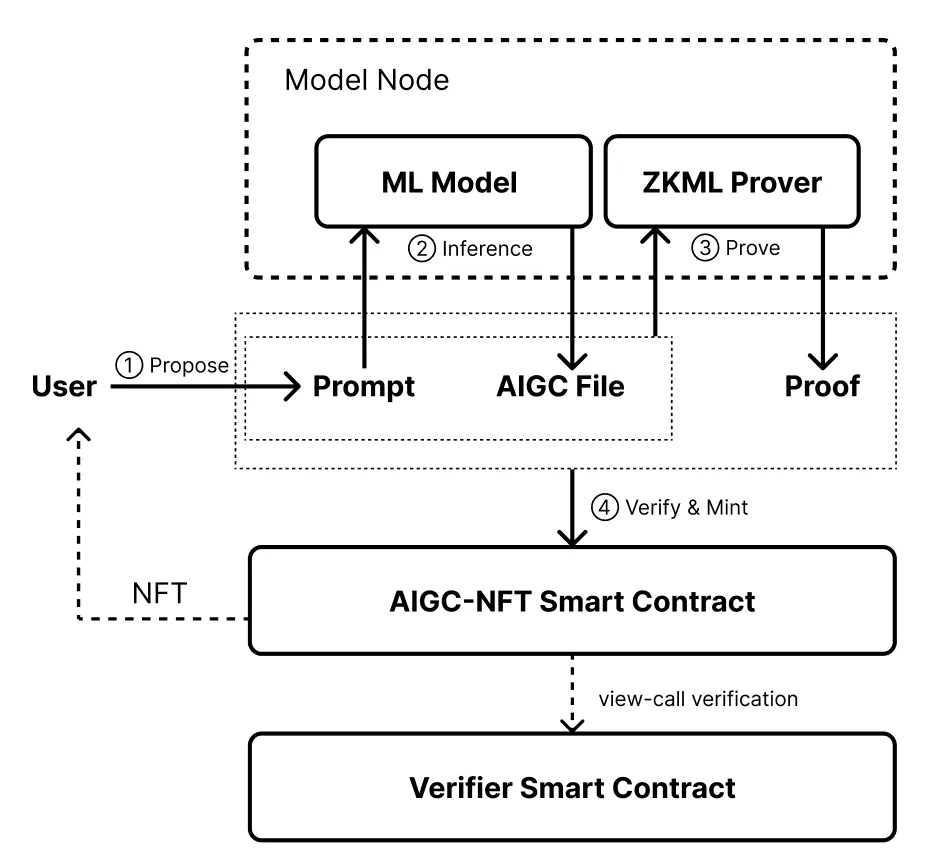
Component roles
| Component | Role |
|---|---|
| ML Model | Holds trained weights and runs inference on the input. |
| zkML Prover | Generates a zero-knowledge proof for the inference result. |
| AIGC-NFT Smart Contract | Implements the proposal and the ERC-721 functionality. |
| Verifier Smart Contract | Checks the inference task and proof and returns a boolean result. |
The workflow follows the prompt through inference, proof generation, verification, and NFT issuance.
Specification
Implementation requirements
| Required interface | Role |
|---|---|
| IERC7007 | Defines how AIGC data is added and verified. |
| ERC-721 | Provides standard NFT issuance, ownership, and transfer behavior. |
| ERC-165 | Identifies the interfaces the contract supports. |
IERC7007 interface
The core interface links generated data to an NFT and checks the relationship among prompt, aigcData, and proof using a zkML or opML verification mechanism.
Complete interface
pragma solidity ^0.8.18;

/**
 * @dev Required interface of an ERC7007 compliant contract.
 * Note: the ERC-165 identifier for this interface is 0x702c55a6.
 */
interface IERC7007 is IERC165, IERC721 {
    /**
     * @dev Emitted when `tokenId` token's AIGC data is added.
     */
    event AigcData(
        uint256 indexed tokenId,
        bytes indexed prompt,
        bytes indexed aigcData,
        bytes proof
    );

    /**
     * @dev Add AIGC data to token at `tokenId` given `prompt`, `aigcData`, and `proof`.
     */
    function addAigcData(
        uint256 tokenId,
        bytes calldata prompt,
        bytes calldata aigcData,
        bytes calldata proof
    ) external;

    /**
     * @dev Verify the `prompt`, `aigcData`, and `proof`.
     */
    function verify(
        bytes calldata prompt,
        bytes calldata aigcData,
        bytes calldata proof
    ) external view returns (bool success);
}
AigcData
event AigcData(
    uint256 indexed tokenId,
    bytes indexed prompt,
    bytes indexed aigcData,
    bytes proof
);
The event announces which token received new generated data.
tokenIdidentifies the token.promptis the input used for generation.aigcDatais the generated content in bytes, such as an image, audio, or video.proofcontains verification data produced by zkML or opML.
addAigcData
function addAigcData(
    uint256 tokenId,
    bytes calldata prompt,
    bytes calldata aigcData,
    bytes calldata proof
) external;
Associates the inference result and its proof with a token. The arguments are tokenId for the NFT, prompt for the input, aigcData for the generated output, and proof for the zkML or opML evidence.
verify
function verify(
    bytes calldata prompt,
    bytes calldata aigcData,
    bytes calldata proof
) external view returns (bool success);
Checks whether the provided prompt, aigcData, and proof are consistent under the chosen zkML or opML method. It returns true on successful verification and false otherwise.
Enumerable
This optional extension exposes the association between prompts and token IDs.
Complete interface
pragma solidity ^0.8.18;

/**
 * @title ERC7007 Token Standard, optional enumeration extension
 * Note: the ERC-165 identifier for this interface is 0xfa1a557a.
 */
interface IERC7007Enumerable is IERC7007 {
    /**
     * @dev Returns the token ID given `prompt`.
     */
    function tokenId(bytes calldata prompt) external view returns (uint256);

    /**
     * @dev Returns the prompt given `tokenId`.
     */
    function prompt(uint256 tokenId) external view returns (string calldata);
}
tokenId
function tokenId(bytes calldata prompt) external view returns (uint256);Takes the prompt bytes and returns the identifier of the NFT generated from that prompt.
prompt
function prompt(uint256 tokenId) external view returns (string calldata);Looks up the prompt associated with the supplied NFT identifier and returns it as bytes.
Updatable
This optional extension lets opML implementations update aigcData when the challenge process requires a correction.
Complete interface
pragma solidity ^0.8.18;

/**
 * @title ERC7007 Token Standard, optional updatable extension
 * Note: the ERC-165 identifier for this interface is 0x3f37dce2.
 */
interface IERC7007Updatable is IERC7007 {
    /**
     * @dev Update the `aigcData` of `prompt`.
     */
    function update(
        bytes calldata prompt,
        bytes calldata aigcData
    ) external;

    /**
     * @dev Emitted when `tokenId` token is updated.
     */
    event Update(
        uint256 indexed tokenId,
        bytes indexed prompt,
        bytes indexed aigcData
    );
}
update
function update(
    bytes calldata prompt,
    bytes calldata aigcData
) external;
Replaces the AIGC data associated with a prompt, for example to reflect a corrected result after a challenge. It accepts the target prompt and the replacement aigcData.
Update
event Update(
    uint256 indexed tokenId,
    bytes indexed prompt,
    bytes indexed aigcData
);
Announces a replacement of AIGC data associated with an existing NFT. It identifies the updated token, the associated prompt, and the replacement data.
Metadata JSON schema
AIGC-NFT metadata follows this JSON schema.
{
  "title": "AIGC Metadata",
  "type": "object",
  "properties": {
    "name": {
      "type": "string",
      "description": "Identifies the asset to which this NFT represents"
    },
    "description": {
      "type": "string",
      "description": "Describes the asset to which this NFT represents"
    },
    "image": {
      "type": "string",
      "description": "A URI pointing to a resource with mime type image/* representing the asset to which this NFT represents. Consider making any images at a width between 320 and 1080 pixels and aspect ratio between 1.91:1 and 4:5 inclusive."
    },
    "prompt": {
      "type": "string",
      "description": "Identifies the prompt from which this AIGC NFT generated"
    },
    "aigc_type": {
      "type": "string",
      "description": "image/video/audio..."
    },
    "aigc_data": {
      "type": "string",
      "description": "A URI pointing to a resource with mime type image/* representing the asset to which this AIGC NFT represents."
    },
    "proof_type": {
      "type": "string",
      "description": "validity (zkML) or fraud (opML)"
    }
  }
}
It standardizes how metadata identifies the original prompt, media type, and verification method.
Model publication
ERC-7007 leaves model publication to implementations. The article describes publishing a commitment, such as a hash or signature, for the trained model on Ethereum before inference. The verify function can then check the model against that commitment, giving users a way to identify and verify which model produced an output.
Additional notes
Token uniqueness
The article describes deriving the tokenId from a hash of the prompt. Hashing gives the same prompt the same identifier, makes collisions between different prompts unlikely, and can prevent issuing duplicate tokens for the same prompt under a given model and seed. This uniqueness applies within the issuing contract's rules.
Supporting different proof mechanisms
| Proof type | Technique | Purpose | Finality |
|---|---|---|---|
| Validity proof | zkML | Prove that the result is correct. | Can finalize once the proof verifies. |
| Fraud proof | opML | Detect and correct invalid results. | Requires a challenge window. |
The addAigcData and verify arguments can represent either mechanism. The Updatable extension accommodates data corrections after an opML challenge, so projects can choose either immediate verification or optimistic verification.
Why the verify interface is designed this way
The read-only verify function checks generated data without changing state.
How verification works
| Proof mechanism | Check | Condition |
|---|---|---|
| zkML | Check the zero-knowledge proof. | The proof must be valid. |
| opML | Check that the challenge period ended and the data is current. | The data must reflect the finalized result. |
Design considerations
For zkML, the function returns true only when the proof verifies. For opML, it can return true once the challenge period is over and the data is current. The opML proof argument can be empty when the implementation relies on the elapsed challenge period and dispute mechanism. In both cases the function indicates whether the data has reached its verified or finalized state.
Why the addAigcData interface is designed this way
addAigcData associates the generated output with its prompt and token and serves as the entry point for registering the result during minting.
Flexibility
| Proof mechanism | Invocation | Verification condition |
|---|---|---|
| zkML | Call after generating the proof. | verify must return true. |
| opML | May be called before the challenge period ends. | A later update can reflect the final result. |
Although zkML proof generation takes time, smaller workloads can be verified and registered promptly. opML can handle larger workloads and update the data after the challenge period if needed.
Design rationale
The different invocation times accommodate both approaches. zkML can suit tasks with manageable proving costs, while optimistic verification can suit larger workloads.
Why the function is called update
ERC-7007 uses update for changes to the registered output.
Rationale
Successful opML challenges are expected to be uncommon. The name describes the occasional replacement of data. Requiring a separate finalize call for every token would incur gas even when the registered output needs no change.
Compatibility
ERC-7007 extends ERC-721 without changing standard behavior for ownership, transfers, or metadata lookup. Existing asset managers and viewers can continue to use the ERC-721 interface while applications that understand AIGC can access its additional operations.
| Aspect | Explanation |
|---|---|
| Inheritance | Adds AIGC registration and verification interfaces to ERC-721 features. |
| Compatibility | Preserves ERC-721 behavior and adds AIGC-specific operations. |
| Benefit | Existing tooling can remain in use while applications add content verification. |
Reference implementations
| Component | Description |
|---|---|
| ERC-7007 for zkML and opML | Minimal examples for the two proof mechanisms. |
| ERC-7007 Enumerable Extension | An implementation for looking up prompts and token IDs. |
These references illustrate how to register and verify AIGC data.
Security considerations
Front-running risk
A party observing a pending mint could try to claim the same prompt before the original submitter. Implementations need a prompt acquisition process that preserves the original submitter's opportunity to complete the claim.
Requirements
| Technique | Description | Goal |
|---|---|---|
| Timelock | Delay the point at which an action takes effect. | Give the legitimate applicant time to complete the process. |
| Commit–reveal | Submit a commitment first and disclose the data later for verification. | Keep the prompt private until the reveal. |
| Other defenses | Use other mechanisms that mitigate front-running. | Preserve fair prompt acquisition. |
Example commit–reveal flow
- The user submits only a commitment to the prompt.
- Once the commitment is included, the user discloses the prompt in the reveal phase.
- The contract checks the reveal against the commitment before accepting the claim.
The prompt remains hidden before the reveal. Implementations also need to ensure the reveal can only complete the original claimant's commitment.
AIGC data changes during an opML challenge
The challenge period is the window in which others can dispute the result. The optional Updatable extension lets an implementation replace aigcData when a dispute requires a correction.
Requirements
Implementations should treat changes to aigcData as critical state transitions and apply the same security and verification procedures as at initial mint. Indexers should watch Update events and account for finality before displaying the result.
Example update flow
- Confirm the challenge window has ended or the applicable update conditions are met.
- Replace
aigcDatathrough the extension. - Confirm that the contract emits
Update. - Have the indexer ingest the event and use the latest data.
Citation
Cathie So (@socathie), Xiaohang Yu (@xhyumiracle), Conway (@0x1cc), Lee Ting Ting (@tina1998612), Kartin kartin@hyperoracle.io, "ERC-7007: Verifiable AI-Generated Content Token," Ethereum Improvement Proposals, no. 7007, May 2023. [Online serial]. Available: https://eips.ethereum.org/EIPS/eip-7007.
Conclusion
ERC-7007 proposes representing AI-generated content as NFTs and verifying the generation process cryptographically on-chain.
Questions are welcome by direct message.
Find more of my writing and resources here.


