Introduction
Hi, I'm cardene, a software engineer and technical writer focused on blockchain and AI.
I've also authored Japanese technical books on specification-driven development with LLMs and decentralized application (DApp) development.

I also build and publish a variety of tools, libraries, and open-source projects.
This article examines EIP4844, which introduces blob-carrying transactions to publish large amounts of data on Ethereum.
This explanation translates, summarizes, and expands on the following specification.

As of January 20, 2024, the proposal was in Review status. The parameters and roadmap discussed below reflect the historical specification and FAQ, not necessarily the current network configuration.
I have also written about other EIPs.

Overview
Blob-carrying transactions are a transaction type for publishing large amounts of data on Ethereum. Unlike ordinary transaction calldata, the contents of the attached blobs are not directly accessible during EVM execution. Participants can nevertheless verify cryptographic commitments and proofs concerning that data.
An important feature is that the transaction format is designed with future data sharding in mind. Sharding is an approach to distributing work or data across parts of a network. Ethereum's rollup-centric design focuses on scaling data availability rather than dividing EVM execution among independent shards. The format is intended to remain useful as Ethereum scales its data availability capacity.
Motivation
At the time of the proposal, rollups were regarded as Ethereum's most credible short-, medium-, and potentially long-term scaling solution. High Layer 1 transaction fees motivated the transition toward rollups. Rollups such as Optimism and Arbitrum offered substantially lower fees, and the proposal cited ZK rollup estimates of roughly 40–100 times lower fees than the base layer.
Even these fees could remain too expensive for many users.
Data sharding was proposed as a longer-term solution.
The historical roadmap envisaged approximately 16MB of dedicated data capacity per block for rollup use.
Implementing that design would take time.
EIP4844 provides an intermediate step toward full data sharding. It introduces the transaction format intended for sharding without implementing full sharding itself. In the original design, consensus nodes download blob data associated with the beacon chain but may discard it after the required availability period. The original parameters target approximately 0.375 MiB of blobs per block, with a maximum of approximately 0.75 MiB, below the historical full-sharding target.
Beacon Chain
The Beacon Chain forms the basis of Ethereum's proof-of-stake consensus layer. It was introduced separately from Ethereum's original proof-of-work chain and uses proof of stake (PoS). Validators stake assets as collateral to participate in consensus and support network security. The Beacon Chain coordinates consensus and provides a foundation for protocol upgrades. It also supports the roadmap for scaling data availability.
Proof-of-stake consensus The Beacon Chain provided the foundation for Ethereum's transition from proof of work to proof of stake. Under PoS, validators with staked ETH participate in block proposals and attestations instead of miners competing through computational work.
Scalability and efficiency The Beacon Chain provides infrastructure for subsequent scalability upgrades. PoS reduces energy-intensive computation relative to PoW; switching consensus alone does not directly increase execution throughput.
Preparing for sharding The Beacon Chain supports subsequent work on sharding. Traditional sharding proposals divide a network into smaller parts. The rollup-centric Ethereum roadmap instead emphasizes distributed data availability.
Foundation for protocol upgrades The Beacon Chain became the basis of Ethereum's consensus layer and subsequent upgrades.
Staking and rewards Participants can stake ETH and earn applicable validator rewards. Block proposers may also receive execution-layer priority fees and other execution-related revenue.
Decentralization and security PoS uses economic incentives and penalties to secure consensus. Its decentralization and security depend on stake distribution, protocol rules, and validator operation.
Consensus nodes
Consensus nodes run software responsible for Ethereum's consensus protocol. They validate consensus-layer information and track the canonical chain, working with execution clients to check execution payload validity. They participate in the network's block propagation and verification processes. Nodes that also run activated validators with staked ETH can participate in proposing and attesting to blocks and receive applicable rewards.
In the original EIP4844 design, consensus nodes obtain blob data associated with beacon blocks but are not required to retain it indefinitely. This limits long-term storage requirements.
Specification
Parameters
The following table reproduces the original proposal's parameters.
| Parameter | Value |
|---|---|
BLOB_TX_TYPE |
Bytes1(0x03) |
BYTES_PER_FIELD_ELEMENT |
32 |
FIELD_ELEMENTS_PER_BLOB |
4096 |
BLS_MODULUS |
52435875175126190479447740508185965837690552500527637822603658699938581184513 |
VERSIONED_HASH_VERSION_KZG |
Bytes1(0x01) |
POINT_EVALUATION_PRECOMPILE_ADDRESS |
Bytes20(0x0A) |
POINT_EVALUATION_PRECOMPILE_GAS |
50000 |
MAX_BLOB_GAS_PER_BLOCK |
786432 |
TARGET_BLOB_GAS_PER_BLOCK |
393216 |
MIN_BLOB_GASPRICE |
1 |
BLOB_GASPRICE_UPDATE_FRACTION |
3338477 |
GAS_PER_BLOB |
2**17 |
HASH_OPCODE_BYTE |
Bytes1(0x49) |
HASH_OPCODE_GAS |
3 |
MIN_EPOCHS_FOR_BLOB_SIDECARS_REQUESTS |
4096 |
These values describe the historical EIP4844 configuration.
Aliases
| Type | Base Type | Additional Checks |
|---|---|---|
Blob |
ByteVector[BYTES_PER_FIELD_ELEMENT * FIELD_ELEMENTS_PER_BLOB] |
|
VersionedHash |
Bytes32 |
|
KZGCommitment |
Bytes48 |
Perform IETF BLS signature “KeyValidate” check but do allow the identity point |
KZGProof |
Bytes48 |
Same as for KZGCommitment |
Cryptographic Helpers
The proposal uses cryptographic methods and types defined in the pinned consensus 4844 specs. These are the relevant consensus-layer specifications for Deneb.
Two functions used by the proposal are defined in polynomial-commitments.md.
verify_kzg_proof()- Verifies a Kate-Zaverucha-Goldberg (KZG) polynomial evaluation proof.
verify_blob_kzg_proof_batch()- Verifies multiple blob KZG proofs together in a batch.
These functions support checking correspondence between blobs, commitments, and proofs.
Helpers
The kzg_to_versioned_hash function
def kzg_to_versioned_hash(commitment: KZGCommitment) -> VersionedHash:
    return VERSIONED_HASH_VERSION_KZG + sha256(commitment)[1:]
This function derives a versioned hash from a KZG commitment.
Apply SHA-256 to the commitment, replace the first byte with VERSIONED_HASH_VERSION_KZG, and retain the remaining 31 bytes.
The result identifies the commitment scheme and commitment through a fixed-width hash.
KZG commitments
A KZG commitment is a cryptographic commitment to a polynomial. It compactly represents data interpreted as a polynomial and supports proofs of evaluation at particular points. The binding property makes it computationally difficult to open the same commitment to inconsistent polynomial values.
Recipe-sharing analogy (from ChatGPT)
Suppose you want to share a special cake recipe with a friend. Instead of sharing the entire recipe immediately, you give your friend a compact commitment to it.
-
Create a commitment
- Process the recipe through an appropriate encoding and commitment construction.
- The result commits to the recipe without reproducing its full text. A commitment alone should not be treated as a guarantee of confidentiality.
-
Share the commitment
- Give the commitment to your friend.
- Your friend can keep it as a reference against which later evidence can be checked.
-
Verify the recipe
- Later, reveal the recipe.
- Your friend can check whether the revealed data correspond to the original commitment.
The compact commitment in the analogy corresponds to the KZG commitment. KZG provides a way to commit to polynomial data and efficiently verify evaluation proofs without supplying the entire polynomial for every check. In Ethereum, this supports cryptographic consistency checks; data availability is enforced separately.
For a more detailed treatment of the mathematics, see the following resources.
The fake_exponential function
def fake_exponential(factor: int, numerator: int, denominator: int) -> int:
    i = 1
    output = 0
    numerator_accum = factor * denominator
    while numerator_accum > 0:
        output += numerator_accum
        numerator_accum = (numerator_accum * numerator) // (denominator * i)
        i += 1
    return output // denominator
The fake_exponential function approximates an exponential using integer arithmetic.
A Taylor expansion expresses a function using a series of polynomial terms.
The function approximates factor * e**(numerator / denominator) using the supplied arguments.
It accumulates successive terms in a loop, adjusting each term using the denominator and index i, before dividing the result by the denominator.
This provides a deterministic integer calculation suitable for protocol fee accounting.
Taylor expansions
A Taylor expansion approximates a function using a polynomial around a point. It represents a complicated function locally in a simpler form.
The basic idea is as follows.
-
Approximate a function around a point
- Choose a point around which to expand the function.
- To approximate around , use the function value and derivatives at that point.
-
Represent the approximation as a polynomial The polynomial's coefficients depend on the derivatives of the function. The terms use the function value, first derivative, second derivative, third derivative, and so on.
-
Taylor expansion formula
- The Taylor expansion of has the following form.
Here, , , and are the first, second, and third derivatives at . denotes the factorial of , the product of integers from 1 through .
- Approximation accuracy
- For suitable functions within the convergence region, including more terms can improve the approximation.
- In practical calculations, truncate the infinite series according to the required accuracy.
Taylor expansions are used throughout physics and engineering to analyze complicated functions. For example, they can simplify mathematical models and engineering calculations.
A Taylor polynomial approximates a function through simpler polynomial terms.
Imagine a complicated mountain profile. A mathematical function describes its shape. Standing at one point, you may find that a small surrounding region appears nearly flat. Its height at that point corresponds to the constant term, the function value.
Looking slightly farther away reveals the slope. The first derivative describes that slope.
Over a larger region, curvature becomes apparent. The second derivative describes the local curvature.
A Taylor expansion thus combines the function value, slope, curvature, and higher-order information around a chosen point. For a convergent expansion, higher-order terms can give a closer approximation to the original curve.
Blob transaction
A blob transaction is a transaction type introduced under the EIP2718 typed transaction envelope. It extends the ordinary Ethereum transaction structure with blob-specific fields.
TransactionPayload
[chain_id, nonce, max_priority_fee_per_gas, max_fee_per_gas, gas_limit, to, value, data, access_list, max_fee_per_blob_gas, blob_versioned_hashes, y_parity, r, s]Its payload is serialized as an RLP (Recursive Length Prefix) list of fields such as chain_id, nonce, and max_priority_fee_per_gas.
Many fields retain the meanings introduced by EIP1559.
RLP
RLP is a serialization format used by Ethereum. It encodes byte strings and recursively nested lists, with integers represented using their canonical byte encoding.
RLP encoding basics
RLP encoding depends on the item type and byte length. Short byte strings have compact encodings, while longer strings and lists include length information.
Examples: strings and lists
- Encoding a string
Consider RLP-encoding the string "dog". This string is encoded as follows.
- Determine the byte length ("dog" is three bytes).
- For a byte string of this length (up to 55 bytes, except for the special single-byte case), add the length to 128 to form the prefix.
- For "dog", the prefix is
128 + 3 = 131, or0x83in hexadecimal.
- For "dog", the prefix is
- Append the original bytes after the prefix.
- The RLP encoding of "dog" is
0x83646f67.
- The RLP encoding of "dog" is
- Encoding a list
Consider encoding the list ["cat", "dog"].
- Encode each element separately.
- "cat" becomes
0x83636174and "dog" becomes0x83646f67.
- "cat" becomes
- Concatenate the encoded elements.
- This produces
0x8363617483646f67.
- This produces
- Compute the list prefix from the combined payload length, eight bytes here.
- For eight bytes, the prefix is
192 + 8 = 200, or0xC8in hexadecimal.
- For eight bytes, the prefix is
- The resulting RLP encoding of ["cat", "dog"] is
0xC88363617483646f67.
Summary
Ethereum uses RLP to represent data consistently. Byte strings are encoded according to their length and contents, and lists are encoded recursively. This gives Ethereum a deterministic serialization format.
The to field
The to field must contain a 20-byte address.
Unlike transaction types allowing an empty destination for contract creation, blob transactions cannot directly create a contract.
max_fee_per_blob_gas and blob_versioned_hashes
max_fee_per_blob_gas caps the acceptable blob gas price; blob_versioned_hashes lists the versioned hashes referencing the transaction's blobs.
ReceiptPayload
The transaction receipt contains the status, cumulative gas used, logs bloom, and logs, encoded in RLP.
rlp([status, cumulative_transaction_gas_used, logs_bloom, logs])Blob transactions provide dedicated data-publication capacity for workloads such as rollups.
Signatures
keccak256(BLOB_TX_TYPE || rlp([chain_id, nonce, max_priority_fee_per_gas, max_fee_per_gas, gas_limit, to, value, data, access_list, max_fee_per_blob_gas, blob_versioned_hashes])).The following describes the signature construction for a blob transaction. Signatures authenticate the transaction sender and protect the signed fields against undetected changes.
-
Signature values
y_parity,r, andsare the three transaction signature fields.- They enable verification and recovery of the signing account.
-
secp256k1 signatures
- Ethereum uses ECDSA over the secp256k1 elliptic curve.
- A private key signs the specified transaction digest.
-
Digest construction
- The signature is created over a transaction digest.
- Compute it using
keccak256over theBLOB_TX_TYPEbyte followed by the RLP-encoded unsigned transaction fields.
-
Transaction fields
- The signed transaction data includes the following fields.
chain_id(chain identifier).nonce(account transaction nonce).- Fee fields (
max_priority_fee_per_gas,max_fee_per_gas) andgas_limit. - Destination address (
to). - Transferred value (
value). - Input data (
data). - Access list (
access_list). - Maximum blob gas fee (
max_fee_per_blob_gas). - Versioned blob hashes (
blob_versioned_hashes).
The signature binds these fields to the sender's authorization and detects unauthorized changes.
Header extensions
EIP4844 adds fields to the execution block header. They record blob gas consumption and accumulated excess blob gas.
rlp([
    parent_hash,
    0x1dcc4de8dec75d7aab85b567b6ccd41ad312451b948a7413f0a142fd40d49347, # ommers hash
    coinbase,
    state_root,
    txs_root,
    receipts_root,
    logs_bloom,
    0, # difficulty
    number,
    gas_limit,
    gas_used,
    timestamp,
    extradata,
    prev_randao,
    0x0000000000000000, # nonce
    base_fee_per_gas,
    withdrawals_root,
    blob_gas_used,
    excess_blob_gas,
])-
blob_gas_used
- Total blob gas consumed by transactions in the block.
- This records the block's blob gas usage.
-
excess_blob_gas
- Accumulated excess blob gas carried into the block relative to the configured target.
- The value increases when usage exceeds the target and decreases when usage falls below it, subject to a floor of zero.
def calc_excess_blob_gas(parent: Header) -> int:
    if parent.excess_blob_gas + parent.blob_gas_used < TARGET_BLOB_GAS_PER_BLOCK:
        return 0
    else:
return parent.excess_blob_gas + parent.blob_gas_used - TARGET_BLOB_GAS_PER_BLOCK-
Calculation
calc_excess_blob_gascalculates the new value using the parent block'sexcess_blob_gasandblob_gas_used.- This tracks cumulative demand relative to the blob gas target.
-
RLP encoding
- The block header's RLP encoding includes the new fields.
- Block propagation and validation account for these fields.
The new fields support a separate resource accounting and fee mechanism for blob data.
Gas accounting
Blob gas is a distinct resource introduced by the proposal.
-
Blob gas
- Blob gas accounts for data-publication capacity consumed by blobs.
- It is distinct from execution gas and has a separate fee market inspired by EIP1559.
-
Calculating the blob gas price
- The block header's
excess_blob_gasdetermines the blob base fee. - The price per unit depends on cumulative usage relative to the target, not simply the size of one transaction.
- The block header's
-
Calculating the data fee
calc_data_feemultiplies the transaction's total blob gas by the current blob gas price.
-
Transaction validity changes
- Block validation includes additional checks on blob gas usage.
- These enforce the new resource limits and fee requirements.
-
Data fee treatment
- The blob fee is deducted from the sender's balance and burned before transaction execution.
- It is not refunded if execution reverts.
Separate blob gas accounting allows blob publication costs to respond to demand independently of execution gas.
Opcode for retrieving versioned hashes
EIP4844 adds the EVM opcode BLOBHASH.
-
BLOBHASH behavior
BLOBHASHexposes a versioned blob hash to contract execution.- It pops an index from the stack and pushes the corresponding element of the transaction's
blob_versioned_hasheslist. - This list contains the versioned hashes referencing blobs attached to the transaction.
-
Index handling
- If the index is less than the length of
blob_versioned_hashes, push the corresponding hash. - Otherwise, push a zero-filled
bytes32value.
- If the index is less than the length of
-
Gas cost
- The opcode costs
HASH_OPCODE_GAS. - The gas charge accounts for executing this instruction.
- The opcode costs
The opcode gives contracts access to blob references, not the blob contents themselves.
Point evaluation precompile
def point_evaluation_precompile(input: Bytes) -> Bytes:
    """
    Verify p(z) = y given commitment that corresponds to the polynomial p(x) and a KZG proof.
    Also verify that the provided commitment matches the provided versioned_hash.
    """
    # The data is encoded as follows: versioned_hash | z | y | commitment | proof | with z and y being padded 32 byte big endian values
    assert len(input) == 192
    versioned_hash = input[:32]
    z = input[32:64]
    y = input[64:96]
    commitment = input[96:144]
    proof = input[144:192]

    # Verify commitment matches versioned_hash
    assert kzg_to_versioned_hash(commitment) == versioned_hash

    # Verify KZG proof with z and y in big endian format
    assert verify_kzg_proof(commitment, z, y, proof)

    # Return FIELD_ELEMENTS_PER_BLOB and BLS_MODULUS as padded 32 byte big endian values
    return Bytes(U256(FIELD_ELEMENTS_PER_BLOB).to_be_bytes32() + U256(BLS_MODULUS).to_be_bytes32())
The precompile at POINT_EVALUATION_PRECOMPILE_ADDRESS verifies a KZG proof that the polynomial represented by a blob commitment evaluates to a specified value at a specified point.
It costs POINT_EVALUATION_PRECOMPILE_GAS and executes the following logic.
def point_evaluation_precompile(input: Bytes) -> Bytes:
    """
    Verify p(z) = y given commitment that corresponds to the polynomial p(x) and a KZG proof.
    Also verify that the provided commitment matches the provided versioned_hash.
    """
    # Input encoding: versioned_hash | z | y | commitment | proof; z and y are padded 32-byte big-endian values
    assert len(input) == 192
    versioned_hash = input[:32]
    z = input[32:64]
    y = input[64:96]
    commitment = input[96:144]
    proof = input[144:192]

    # Verify that the supplied commitment matches the versioned hash
    assert kzg_to_versioned_hash(commitment) == versioned_hash

    # Verify the KZG proof using big-endian z and y
    assert verify_kzg_proof(commitment, z, y, proof)

    # Return FIELD_ELEMENTS_PER_BLOB and BLS_MODULUS as padded 32-byte big-endian values
    return Bytes(U256(FIELD_ELEMENTS_PER_BLOB).to_be_bytes32() + U256(BLS_MODULUS).to_be_bytes32())
This is a new Ethereum precompile. It verifies a particular type of mathematical proof, a KZG evaluation proof.
-
Purpose
- The precompile verifies a proof that the polynomial committed by the supplied commitment satisfies
p(z) = y.
- The precompile verifies a proof that the polynomial committed by the supplied commitment satisfies
-
Input processing
- The input consists of
versioned_hash,z,y,commitment, andproof. - The precompile parses these fields and performs the required checks.
- The input consists of
-
Commitment and versioned-hash verification
- Verify that the supplied commitment derives the supplied versioned hash.
- This binds the supplied commitment to the referenced blob.
-
KZG proof verification
- Verify the KZG proof against
commitment,z, andyto check the evaluation claimp(z) = y. - The proof establishes correspondence with the polynomial represented by the commitment under the KZG security assumptions.
- Verify the KZG proof against
-
Output
- Return
FIELD_ELEMENTS_PER_BLOBandBLS_MODULUSin big-endian form.
- Return
The precompile supports on-chain verification of claimed evaluations against blob commitments. It also rejects noncanonical field elements.
The polynomial p(x)
A polynomial is a fundamental mathematical expression. It consists of a sum of powers of a variable, typically , multiplied by coefficients.
Example polynomial
The following expression is a polynomial.
In this expression:
- is the variable.
- , , and are the terms.
- , , and are their coefficients.
Powers in a polynomial
The terms correspond to powers of . In this example:
- is the degree-two term, with coefficient
3. - is the degree-one term, with coefficient
2. - is the degree-zero (constant) term, with coefficient
5.
Evaluating a polynomial
Substitute a value for to calculate the polynomial's value. For example, evaluating at gives:
A polynomial can thus be evaluated at different input values to obtain corresponding outputs.
Summary
Polynomials consist of powers of a variable multiplied by coefficients and summed together. They play a fundamental role in algebra, calculus, and other mathematical fields. They are also used to model real-world phenomena.
Consensus-layer validation
The proposal introduces new data-handling procedures in Ethereum's consensus layer.
-
Sidecar design
- The execution payload contains the transaction encoding, including blob references.
- Blob bodies are not embedded directly in the beacon block body; they are propagated separately as blob sidecars associated with the block.
- This separates data distribution from the execution payload.
-
Data availability
- The consensus layer is responsible for checking availability of the referenced data.
- This is necessary for the data availability guarantees provided by the protocol.
-
Role of the ethereum/consensus-specs repository
- It defines changes to beacon-chain processing, peer-to-peer networking, and validator behavior.
- These include constructing beacon blocks with blob commitments and publishing associated sidecars.
The separation prepares the network for future scaling of data availability. In the original Deneb design, consensus nodes still obtain the full blob data. Later data-availability mechanisms can build on this separation to reduce per-node bandwidth requirements.
Execution-layer validation
def validate_block(block: Block) -> None:
    ...

    # check that the excess blob gas was updated correctly
    assert block.header.excess_blob_gas == calc_excess_blob_gas(block.parent.header)

    blob_gas_used = 0

    for tx in block.transactions:
        ...

        # modify the check for sufficient balance
        max_total_fee = tx.gas * tx.max_fee_per_gas
        if get_tx_type(tx) == BLOB_TX_TYPE:
            max_total_fee += get_total_blob_gas(tx) * tx.max_fee_per_blob_gas
        assert signer(tx).balance >= max_total_fee

        ...

        # add validity logic specific to blob txs
        if get_tx_type(tx) == BLOB_TX_TYPE:
            # there must be at least one blob
            assert len(tx.blob_versioned_hashes) > 0

            # all versioned blob hashes must start with VERSIONED_HASH_VERSION_KZG
            for h in tx.blob_versioned_hashes:
                assert h[0] == VERSIONED_HASH_VERSION_KZG

            # ensure that the user was willing to at least pay the current blob gasprice
            assert tx.max_fee_per_blob_gas >= get_blob_gasprice(block.header)

            # keep track of total blob gas spent in the block
            blob_gas_used += get_total_blob_gas(tx)

    # ensure the total blob gas spent is at most equal to the limit
    assert blob_gas_used <= MAX_BLOB_GAS_PER_BLOCK

    # ensure blob_gas_used matches header
    assert block.header.blob_gas_used == blob_gas_used
The proposal extends execution-layer block validation. Additional checks account for blob transactions and blob gas.
-
Excess blob gas check
- Verify that the block header's
excess_blob_gasmatches the value calculated from the parent header.
- Verify that the block header's
-
Per-transaction checks
- Verify sufficient sender balance and applicable blob transaction requirements, including supported versioned-hash prefixes and adequate maximum blob gas fee.
-
Track blob gas usage
- Sum the blob gas consumed by the block's transactions and enforce the configured maximum.
-
Header consistency
- Verify that calculated total blob gas usage equals the header field.
These checks enforce blob transaction validity and resource accounting at the execution layer.
Networking
Blob transactions have two distinct representations. The representations serve transaction propagation and block inclusion.
-
Transaction wrapper
- In
PooledTransactionsmessages, the EIP2718 blob transaction payload is wrapped with its associated blob data. - The wrapper is
rlp([tx_payload_body, blobs, commitments, proofs]), containing the transaction body, blob data, commitments, and proofs.
- In
-
Components
tx_payload_body- Transaction payload body.
blobs- List of blobs.
commitments- List of KZG commitments for the blobs.
proofs- List of corresponding blob KZG proofs.
-
Validation
- Nodes validate
tx_payload_bodyand its correspondence with the wrapper data. - Check that the numbers of versioned hashes, blobs, commitments, and proofs match, that each commitment derives its versioned hash, and that the blob KZG proofs verify the correspondence between blobs and commitments.
- Nodes validate
-
Propagation
- Blob transactions are announced through
NewPooledTransactionHashesrather than proactively broadcast in full. - Peers can request the transaction data they need, helping manage bandwidth.
- Blob transactions are announced through
This design accounts for the larger network representation of blob transactions. Validation checks establish that the transaction's blob references match the supplied data.
Additional considerations
The path toward sharding
EIP4844 represents an intermediate stage of Ethereum's data-sharding roadmap.
Introducing blob transactions
The proposal introduces the blob transaction format intended for future data scaling. The original target provides approximately 0.375 MiB of blob capacity per slot, with relatively low fees when usage remains below capacity.
Purpose of the intermediate step
At the time, rollups relied primarily on calldata for data publication. Blobs provide a separately priced alternative. The transaction format lets rollups migrate their data publication mechanism in preparation for future scaling of blob capacity.
Work toward full sharding
The proposal introduces a transaction type and execution-layer logic needed for the subsequent roadmap. It also separates blob data availability from execution-payload validation and introduces an independent blob fee mechanism.
Remaining work
The historical roadmap described further work on data availability sampling and proposer-builder separation (PBS) to avoid requiring individual validators to process very large amounts of data.
The proposal prepares Ethereum for scaling its data availability capacity.
Rollup operation
Rollups can move from publishing data in calldata to publishing it in blobs. This supplies temporary data availability through a separate fee market and can reduce publication costs.
-
Data availability and cost
- Publish rollup block data in blobs to obtain protocol-backed availability during the required period, potentially at lower cost than calldata.
- Rollup protocols need the data available for the relevant verification period, not necessarily retained forever by every Ethereum node.
-
Optimistic rollup fraud proofs
- Optimistic rollup dispute procedures may need to present particular underlying data when verifying a disputed execution claim.
- KZG evaluation proofs can establish correspondence between supplied data and a referenced blob commitment during verification.
-
ZK rollup commitments and proofs
- ZK rollups may publish both the blob commitment and a commitment used internally by their proof system, then prove that they refer to the same data.
- This links the rollup's internal proof system to the data made available by Ethereum.
This approach facilitates rollup migration toward future data availability scaling. Separately priced data capacity can reduce data-publication costs and improve rollup practicality.
Versioned hashes and precompile return data
Versioned hashes provide an extensible way to reference blob commitments from the execution layer.
-
Using versioned hashes
- Rollups and other contracts reference versioned hashes rather than embedding a particular commitment representation directly, allowing for future commitment schemes.
- This preserves the fixed-width reference format even if future protocol upgrades introduce new schemes; compatible verification logic may still require updates.
-
Point evaluation and finite fields
- Point evaluation operates over a finite field, whose modulus is necessary for the associated arithmetic.
- Returning the modulus lets contracts obtain the relevant field parameters.
-
Precompile return values
- The point evaluation precompile returns the number of field elements per blob and the field modulus.
- This exposes parameters needed by callers and supports forward-compatible interface design.
- Callers that do not need the return values can ignore them.
These choices reduce dependence on hardcoded commitment representations and field parameters. They support future protocol upgrades.
Blob gas price update rule
Ethereum's blob gas price follows a self-adjusting fee mechanism. It adjusts the fee according to cumulative blob gas use relative to the target.
How the self-adjusting formula works
The rule approximates MIN_BLOB_GASPRICE * e**(excess_blob_gas / BLOB_GASPRICE_UPDATE_FRACTION).
Here, excess_blob_gas measures accumulated usage above the target, subject to its zero floor. The target per block is TARGET_BLOB_GAS_PER_BLOCK.
Like EIP1559, the mechanism provides feedback between demand and price.
If usage exceeds the target, accumulated excess increases and the next block's blob base fee rises according to the exponential relationship. Higher fees are intended to moderate demand, moving average use toward the target.
Per-block behavior
A block's blob gas consumption affects the next block's excess and therefore its blob fee. The change depends on consumption relative to the target.
The approximate behavior is as follows.
If block N consumes X blob gas, block N+1 updates the excess by X - TARGET_BLOB_GAS_PER_BLOCK, bounded below by zero. Away from the floor and rounding effects, the price changes by a factor of approximately e**((X - TARGET_BLOB_GAS_PER_BLOCK) / BLOB_GASPRICE_UPDATE_FRACTION).
Stability considerations
The cumulative-excess formula gives a consistent response to aggregate usage when the zero floor is not encountered, rather than guaranteeing stable prices under every demand pattern. This resembles EIP1559 while using a different adjustment mechanism.
Controlling the maximum rate of change
BLOB_GASPRICE_UPDATE_FRACTION controls the sensitivity of the blob base fee.
With the historical target and maximum, the parameter was chosen for a maximum per-block increase factor of approximately e**(TARGET_BLOB_GAS_PER_BLOCK / BLOB_GASPRICE_UPDATE_FRACTION) ≈ 1.125.
This bounds per-block fee increases under those parameters.
The self-adjusting fee mechanism responds to demand for limited blob capacity. It provides a separate means of regulating data publication.
Throughput
The original proposal sets a target and maximum blob gas amount per block.
-
Target and maximum
TARGET_BLOB_GAS_PER_BLOCKoriginally corresponds to three blobs, or 0.375 MiB of encoded blob data per block.MAX_BLOB_GAS_PER_BLOCKoriginally corresponds to six blobs, or 0.75 MiB per block.
-
Purpose of the initial limits
- These relatively small initial values limit the network impact of introducing blobs.
- They allow the network to gain operational experience while limiting additional load.
-
Future upgrades
- Subsequent upgrades can increase the limits as the network's data-handling capacity improves.
- This supports gradual scaling toward the roadmap's data-availability goals.
The initial limits balance additional capacity with network resource requirements; they are historical parameters rather than a statement of current limits.
Compatibility
Blob non-accessibility
Blob transactions use different representations in the mempool and execution payload. The full network wrapper can be reduced to the execution transaction representation, but the blob data cannot be reconstructed from the latter alone.
-
Blob location and accessibility
- Blob bodies are propagated separately from the execution payload.
- The consensus layer associates them with beacon blocks through commitments and blob sidecars.
-
Web3 API limitations
- Ordinary execution-layer transaction APIs expose the transaction representation, not necessarily the corresponding blob bodies.
- Applications retrieving blob contents need appropriate consensus-layer or archival data interfaces.
The separation supports future scaling upgrades but changes how developers retrieve transaction-associated data.
Mempool considerations
The proposal discusses how large blob transactions affect Ethereum's mempool.
-
Large network representation
- Blob transaction wrappers contain substantial data, creating additional resource-exhaustion risks.
- Large calldata transactions already present related risks, but blob sizes make resource controls important.
-
Announcement-based propagation
- Announcing blob transactions rather than broadcasting the full wrappers lets peers control requested data.
- Nodes can adjust requests according to available resources.
-
More granular control through EIP5793
- EIP5793 proposes adding transaction type and size information to
NewPooledTransactionHashesannouncements. - This allows nodes to make more informed decisions about which transactions to request.
- EIP5793 proposes adding transaction type and size information to
-
Fee bump requirements
- The historical proposal recommends requiring a 1.1-fold blob gas price increase for mempool replacement.
- Such a policy raises the cost of repeated replacements; actual node admission and replacement policies may differ.
These measures aim to manage resource consumption and maintain mempool stability.
Security
The proposal examines the additional bandwidth requirements and ongoing storage burden.
-
Additional bandwidth requirements
- The original maximum of approximately 0.75 MiB of additional blob data per beacon block was compared with the then-theoretical maximum execution block size, an increase of roughly 40%.
- The authors considered the additional bandwidth manageable under the assumptions of the proposal.
-
Fixed slot duration
- After the Merge, Ethereum uses fixed-duration slots rather than proof-of-work block intervals.
- This makes timing more predictable, but does not guarantee timely propagation or a block in every slot.
-
Limiting ongoing storage load
- Temporary blob storage limits ongoing requirements compared with permanently increasing calldata publication.
- The original blob sidecar serving requirement was approximately 18 days, contrasted with the proposed one-year execution-history retention window.
The proposal seeks to increase available data capacity while keeping bandwidth and storage requirements manageable.
References
Vitalik Buterin (@vbuterin), Dankrad Feist (@dankrad), Diederik Loerakker (@protolambda), George Kadianakis (@asn-d6), Matt Garnett (@lightclient), Mofi Taiwo (@Inphi), Ansgar Dietrichs (@adietrichs), "EIP-4844: Shard Blob Transactions [DRAFT]," Ethereum Improvement Proposals, no. 4844, February 2022. [Online serial]. Available: https://eips.ethereum.org/EIPS/eip-4844.
Further reading
See the following resources for more detail.


Frequently asked questions
The following adapts selected questions from the linked historical FAQ. Its examples reflect earlier design assumptions and may differ from the parameters in the specification above.

What is Danksharding?
Danksharding is an Ethereum data-sharding design that simplifies several aspects of earlier sharding proposals.
Rollup-centric roadmap
Danksharding follows Ethereum's rollup-centric roadmap. It focuses on providing data space for blobs rather than independently scaling transaction execution across shards. Ethereum checks blob data availability rather than executing the data as transactions. Rollup protocols use this data capacity to support higher throughput.
Unified fee market
A feature of the historical Danksharding design is a unified fee market. Rather than separate shard blocks with independent proposers, one block proposal covers the transactions and data selected for a slot.
Proposer-builder separation (PBS)
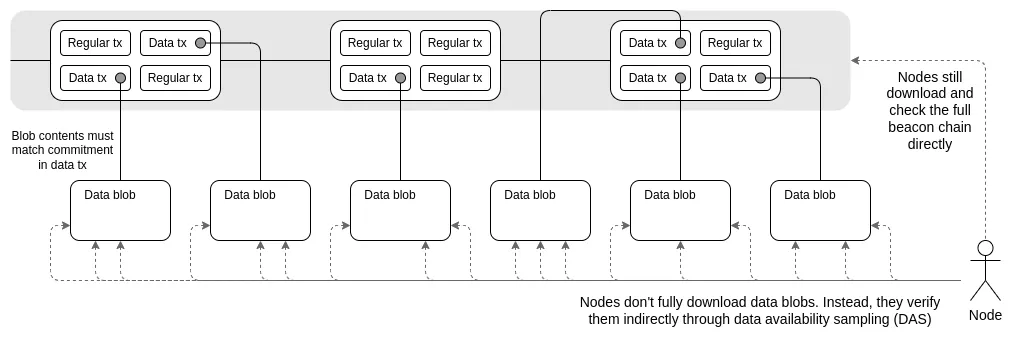
The design discusses separating block construction from proposal to avoid imposing large data-processing requirements on all validators. Builders compete to construct block contents, while proposers select an eligible bid under the relevant protocol. Data availability sampling is intended to enable verification without requiring every participant to download all the data.
These changes aim to scale data availability while retaining accessible validator requirements.
What is proto-danksharding (EIP4844)?
Proto-danksharding is an intermediate step toward Danksharding.
Principal features
It introduces blob-carrying transactions. The transaction format resembles an ordinary typed transaction but references additional data blobs. A blob contains roughly 125 KiB of usable data with a straightforward encoding; its contents are not accessible directly from EVM execution. Blob publication uses a separate fee market.
Managing data bandwidth
Under the original proposal, validators and consensus clients obtain complete blobs to check availability. The historical FAQ used an illustrative maximum of 1 MB per slot, compared with a full Danksharding target of 16 MB. These are earlier roadmap estimates, not the finalized initial Deneb limits.
Improved scalability
A distinct blob resource limit and fee market allow data publication to scale separately from ordinary execution gas. This is intended to improve rollup scalability.
Proto-danksharding introduces the transaction format and data availability infrastructure ahead of further scaling upgrades.
Why add 1 MB of downloadable block data rather than making calldata ten times cheaper?
The historical FAQ compares average and worst-case resource consumption.
Average and worst-case load
At the time of that discussion, average Ethereum blocks were described as roughly 90 kB, with a theoretical maximum near 1.8 MB. The discrepancy depends in part on calldata pricing.
Problems with a single gas market
A single gas limit makes it difficult to regulate average and worst-case consumption of different resources independently. Transactions allocate varying amounts of gas to calldata and other operations. Worst-case resource requirements can therefore limit average utilization.
Moving toward a multidimensional fee market
Separate pricing and capacity limits can more directly regulate different resources. This permits additional data capacity without relying solely on calldata gas pricing.
Proto-danksharding and EIP4488
The historical FAQ uses illustrative average and maximum values of 1 MB and 2 MB for proto-danksharding, and 350 kB and 1.4 MB for EIP4488 with a fivefold increase in calldata usage. These estimates describe that earlier comparison rather than deployed parameters.
| Average case block size | Worst case block size | |
|---|---|---|
| Status quo | 85 kB | 1.8 MB |
| EIP-4488 | Unknown; 350 kB if 5x growth in calldata use | 1.4 MB |
| Proto-danksharding | 1 MB (tunable if desired) | 2 MB |
Such designs aim to increase average data capacity while controlling worst-case resource requirements.
What if larger blocks cause disk usage to grow substantially?
EIP4488 and proto-danksharding were expected to affect Ethereum's data-storage requirements.
Increased data growth
The historical estimates projected approximately 2.5 TB of additional data per year. Full sharding was estimated to add approximately 40 TB of blob data per year, making permanent retention by every client impractical.
History expiry
The FAQ discusses history expiry (EIP4444) in connection with EIP4488. History expiry limits the period for which nodes need to serve older historical data. For proto-danksharding, consensus clients can discard blobs after the required availability window; the historical FAQ uses 30 days as an illustrative duration.
Consensus-client storage load
Temporary retention can limit additional disk requirements to hundreds of gigabytes in the illustrated scenario, depending on actual throughput and retention settings.
Importance of expiry mechanisms
Because individual nodes have finite storage, scaling data publication requires mechanisms that do not require all nodes to retain all data forever. These mechanisms support sustainable long-term node operation.
The proposals illustrate approaches to managing Ethereum's historical data growth.
How can users access old blobs after a 30-day retention period?
This historical question concerns archival access after the protocol's required serving window.
Purpose of the consensus protocol
Ethereum consensus provides a secure, real-time record and data availability mechanism rather than a guarantee that every node permanently archives all historical data.
Feasibility of archival storage
The FAQ treats an annual data volume of 2.5 TB as potentially manageable for dedicated users and researchers.
Historical data storage
Applications may retain their own relevant data. Other proposed archival approaches include distributed storage such as BitTorrent, extensions to the Ethereum Portal Network, explorers, API providers, researchers, enthusiasts, and third-party indexing protocols.
Limits of archival storage
At much higher volumes, such as an illustrative 500 TB per year, the risk that some data becomes unavailable increases. This is one factor limiting practical data availability scaling and archival access.
The protocol's temporary availability guarantee must be distinguished from separate long-term archival services.
What format does blob data use, and how is it committed?
EIP4844 represents blob data through field elements and polynomial commitments.
Blob representation
A blob is a vector of 4096 field elements, each representing a value within the specified field. The vector represents evaluations of a polynomial over a finite field. Implementers can use established cryptographic libraries rather than implementing the mathematics themselves.
KZG commitments
The blob's KZG commitment is a commitment to the polynomial; the execution-layer versioned hash is derived from that commitment. Using a trusted setup in Lagrange form, the commitment can be computed as a linear combination of elliptic curve points.
Simplifying integration
The FAQ suggests treating commitment calculation as an opaque cryptographic primitive. Use a correct implementation of the specified KZG operations rather than substituting an ordinary hash function.
Why use a hash of the KZG commitment rather than the commitment itself?
The following explains EIP4844's versioned-hash representation.
KZG commitments and versioned hashes
EIP4844 references commitments through versioned hashes.
The KZG version uses the byte 0x01 followed by the last 31 bytes of the commitment's SHA-256 hash.
EVM compatibility
The 32-byte representation fits the EVM's native word size. A KZG commitment itself occupies 48 bytes.
Future compatibility
Versioning accommodates the possibility of future commitment schemes, including schemes designed for post-quantum security. The reference format can remain 32 bytes even when the commitment scheme changes.
This provides an extensible reference format suited to EVM execution.
What are the two precompiles discussed in the early proto-danksharding FAQ?
The early FAQ discussed a blob-verification precompile and a point-evaluation precompile. The EIP4844 specification reproduced above introduces only the point-evaluation precompile; the full-blob verification mechanism below is historical design discussion, not a second deployed EVM precompile.
Optimistic rollups only need to actually provide the underlying data when fraud proofs are being submitted. The fraud proof submission function would require the full contents of the fraudulent blob to be submitted as part of calldata. It would use the blob verification function to verify the data against the versioned hash that was submitted before, and then perform the fraud proof verification on that data as is done today.
The early design considered optimistic rollup fraud-proof submissions that provide the full disputed blob in calldata, check its correspondence with the previously submitted reference, and verify the fraud proof against that data.
The point-evaluation precompile receives a versioned hash, evaluation point, claimed value, KZG commitment, and evaluation proof.
It verifies the claim that the polynomial represented by the referenced blob satisfies P(x) = y.
This is useful to ZK rollups, among other applications.
ZK rollups would provide two commitments to their transaction or state delta data: the kzg in the blob and some commitment using whatever proof system the ZK rollup uses internally. They would use a commitment proof of equivalence protocol, using the point evaluation precompile, to prove that the kzg (which the protocol ensures points to available data) and the ZK rollup’s own commitment refer to the same data.
A ZK rollup can commit to transaction or state-delta data using both the blob's KZG commitment and its own proof-system commitment. A commitment-equivalence protocol using point evaluation can establish that both commitments refer to the same data.
Many optimistic rollup designs use interactive fraud proofs that require only a small amount of data in the final round. For those designs, point-evaluation proofs can be more appropriate than verifying an entire blob in the EVM.
Role of the proposed full-blob verification precompile
The historical proposal considered verifying that supplied full blob contents match a versioned hash. Such a mechanism could support verification of data presented in optimistic rollup disputes, but it is not a second precompile in EIP4844.
Role of the point-evaluation precompile
It verifies an evaluation proof against the commitment corresponding to the specified versioned hash. This can support rollups checking data-related commitments.
Optimistic rollups and point evaluation
Many optimistic rollup designs use multi-round fraud proofs requiring only a small amount of data in their final round. Point-evaluation proofs can support these designs without presenting the entire blob.
Conclusion
This article examined EIP4844 and its blob-carrying transaction format for publishing large amounts of data on Ethereum. I hope it helped clarify the design.
If you have questions, feel free to reach out through Twitter DM.
I also publish articles on the following platforms.

