Introduction
Hi, I'm cardene, a software engineer and technical writer focused on blockchain and AI.
I've also authored Japanese technical books on specification-driven development with LLMs and decentralized application (DApp) development.

I also build and publish a variety of tools, libraries, and open-source projects.
This article examines ERC5252, a standard intended to prevent asset loss by extending the account-bound token mechanism proposed in ERC5114.
The following material is translated, summarized, and supplemented with explanations.

As of October 14, 2023, 5252 was at the Review stage.
Overview
This Ethereum Improvement Proposal introduces a smart contract design pattern intended to ensure transparency in asset management and investment while maintaining independence from financial operators. Specifically, it introduces a method of using separate finance contracts to manage individual assets. This gives investors greater sovereignty over their assets. Separating investor funds from management fees explicitly in individual smart contracts protects investors against arbitrary losses imposed by the management team.
The proposal extends the existing ERC5114 standard with functionality for managing multiple wallets.
For more on ERC5114, see the following article.
[ERC5114] Understanding SBT-Like Tokens Bound to NFTs and Addresses
Investors can thereby move funds between different wallets more easily.
This proposal improves how individuals protect their assets and manage investments transparently and effectively. It aims to maintain individual sovereignty, reduce risks posed by financial operators, and facilitate asset transfers.
Motivation
Decentralized finance (DeFi) faces trust challenges. DeFi smart contracts often act as proxies, with their actual logic residing in separate logic contracts.
Consider a DeFi platform on which two users, A and B, exchange assets.
-
Ordinary smart contract
- Suppose user A needs to send ether (ETH) to user B.
- In this case, an ordinary smart contract directly executes the transaction to withdraw ETH from A and send it to B.
- The smart contract's logic is transparent, and the actions of A and B are recorded on the blockchain.
- Users rely on the smart contract's logic.
-
Proxy smart contract
- With a proxy smart contract, transaction execution takes place through a separate smart contract (the logic contract).
- User A submits a transaction to the proxy contract, and the logic contract performs the operation according to that transaction.
- The proxy contract acts as an interface, forwarding user requests to the logic contract.
- The original discussion characterizes a proxy as having fewer restrictions than an ordinary smart contract and therefore lower security risk.
- However, because it relies on the logic contract, the trustworthiness of that contract matters.
In this example, the proxy smart contract delegates user operations to the logic contract and plays a relatively unrestricted role itself. Users depend on the trustworthiness of the logic contract and must therefore verify its legitimacy.
Many projects also use multisignature wallets with excessive privileges. Furthermore, it is difficult to verify independently whether a stablecoin holds sufficient assets to maintain its value, which can lead to substantial financial losses. Examples include Celsius's official bankruptcy announcement, the depegging of UST (Terra's stablecoin), and the failure of the Anchor protocol. Under these circumstances, even in Web3.0, it is difficult to entrust investments entirely to operators or intermediaries.
Smart contracts are intended to implement promises expressed in code and are designed to improve trustworthiness. However, existing DeFi contracts typically manage all investor funds using very few smart contracts, and trusted keys may retain complete control. Investors must therefore entrust their funds entirely to contract operators and may not actually control their own assets.
The individual finance contract approach, by contrast, provides greater transparency. Using a separate finance contract for each individual makes asset activity easier to track. Investors can thus monitor the movement of their funds in greater detail. The pattern also introduces a special token, a non-transferable account-bound token (ABT), for storing credentials from individual finance contracts.
This approach addresses trust issues in DeFi and offers investors greater transparency and a more effective way to manage their assets.
Comparing Off-chain Identity and Soulbound Token Credentials
This EIP discusses off-chain identity solutions and credentials based on soulbound tokens.
The backends of off-chain identity solutions depend on trust in their operators, so the entire system tends to rely on those operators. These solutions rely on operator trust rather than the mathematical proofs underlying blockchain technology, such as proof of work and proof of stake. Because off-chain identities store identity information outside the blockchain, the proposal views them as conflicting with fundamental cryptocurrency principles.
Soulbound tokens, by contrast, offer an alternative for providing trustworthy credentials. They rely on mathematical proofs and provide credentials that can be verified on-chain. Identity information itself is not stored outside the blockchain; instead, only token metadata is stored off-chain.
This EIP proposes soulbound tokens as an alternative approach to off-chain identity information. It aims to provide reliable on-chain credentials without relying on trust in an operator.
Specification
The specification consists of two patterns: interaction and governance.
Interaction
Interfaces
The interaction pattern consists of contracts with five distinct roles. Their responsibilities are as follows.
Account-Bound Token Contract
This contract grants users with credentials permission to interact with a finance contract. Users holding the token can therefore interact with the finance contract.
Manager Contract
The manager contract establishes initial contact with investors and coordinates subsequent interactions. It serves as the initial point of contact for investors and provides instructions for subsequent operations.
Factory Contract
The factory contract creates separate finance contracts for individual users. Each user has a dedicated finance contract.
Finance Contract
The finance contract manages interactions with the investor. These include asset management, transaction execution, and other operations.
Extension
An extension is a contract that provides specific additional or extended functionality. It is used to incorporate additional functionality into the platform as needed.
In this pattern, account-bound tokens grant users permission to interact with finance contracts, the manager contract serves as the initial point of contact, the factory creates individual finance contracts, and finance contracts process interactions. Extension contracts provide additional functionality where necessary.
Each contract has a distinct role, forming an effective interaction pattern collectively.
Requirements
Soulbound or Account-Bound Token Contract
A non-fungible token conforming to ERC721.
Credentials are represented as metadata through the tokenURI() function.
The factory is referenced to verify token creation.
Account-bound and soulbound tokens are distinguished according to whether they are transferable.
Manager Contract
Uses a factory to create unique contracts. Stores the relevant configuration of financial parameters.
Factory Contract
Clones finance contracts using a consistent implementation. Creates unique contracts through the sole factory authorized to create account-bound tokens. Maintains the latest account-bound token ID.
Finance Contract
The finance contract is initialized only once by the factory contract through its constructor. Funds cannot be transferred to other contracts or accounts unless the account-bound token holder signs. State-changing functions accept calls only from the account-bound token holder, while functions accessible to everyone are documented as global functions. Each finance contract represents only transactions involving account-bound token holders. When soulbound tokens are used, it represents only transactions involving the private key holder.
This contract design protects credential and access security while enabling transparent operations.
Contracts
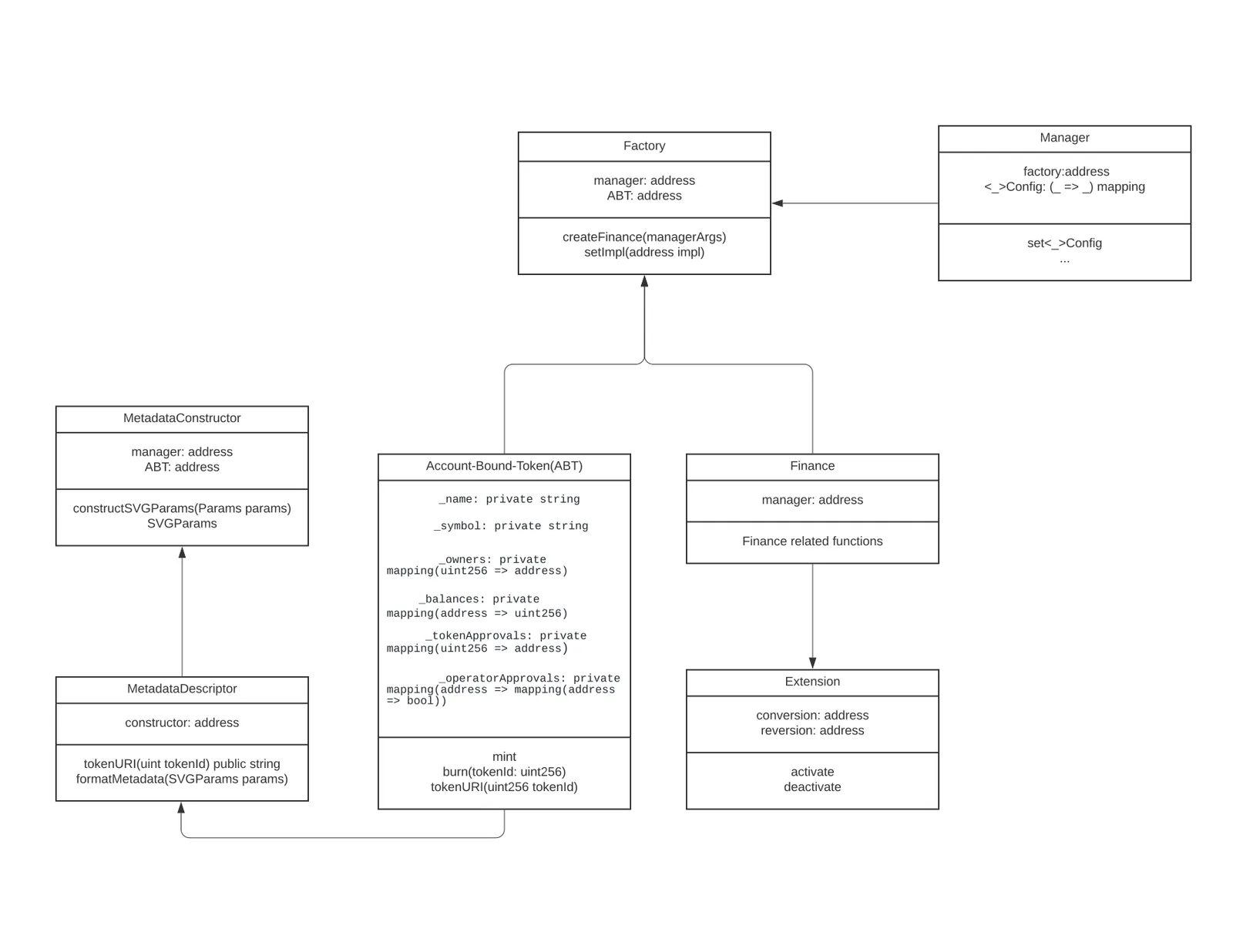
Manager Contract
The manager contract is the entry point for investor interactions and stores the finance contract parameters.
Factory Contract
The factory manages contract bytecode for investor fund management and clones finance contracts based on the manager contract's approval. It also creates the account-bound tokens necessary to interact with finance contracts.
Finance Contract
The finance contract defines the rules for managing investor funds. It can be accessed only by an account holding the account-bound token. When investors deposit funds in the manager contract, the funds are sent to the finance contract's account after deducting fees.
Account-Bound Token
The account-bound token contract in this EIP holds finance contract data and can incorporate additional metadata. For example, if there is a money-market lending finance contract, its account-bound token can use SVG to display the balance held under the agreement.
Extension
An extension contract is a separate contract that can utilize funds locked within a finance contract. It can access the finance contract based on approval from an operator managed by the manager contract. One potential use case is a membership service.
Metadata
The metadata contract stores metadata associated with an account's credentials. Credential-related data is stored under specified keys. Images are typically displayed as SVG, although off-chain images are also possible.
These contracts improve investor asset management and access security.
Governance
The governance pattern consists of two components: the Influencer and the Governor.
Requirements
Influencer Contract
This contract manages the multiplier applied to scores when voting. It defines the decimals used for score normalization. It enables governance to determine factor parameters.
Governor Contract
This contract follows the OpenZeppelin Governor contract. It retrieves the information required for multiplier calculation from the Influencer contract. It restricts account-bound token transfers after claiming influence to prevent double voting.

The Influencer contract manages voting score multipliers and normalization information, allowing governance to adjust factor parameters. The Governor contract follows the OpenZeppelin standard, obtains the required information from the Influencer contract, and prevents double voting involving account-bound tokens.
From Token Governance to Contribution-Based Governance
| Token governance | Credential-based governance | |
|---|---|---|
| Authority | More tokens confer greater power. | More contributions confer greater power. |
| Incentives | More tokens provide greater incentives. | More contributions provide greater incentives. |
| Sanctions | No sanctions. | Loss of authority. |
| Allocation | Token holders exercise authority. | Those with the greatest influence exercise authority. |
This table illustrates the differences between token-based and credential-based governance. In token-based governance, token quantities determine power and incentives; in credential-based governance, contributions affect power and incentives. Token-based governance has no sanctions and assigns authority to token holders, while credential-based governance applies sanctions through loss of power and assigns authority to those with the greatest influence.
Because token governance depends solely on token quantities, its sustainability is challenging. Under this approach, an individual holding 51% or more of the tokens can seize control, raising fairness concerns.
The proposed governance approach emphasizes actual contributions to the protocol. It offers the following advantages.
Introducing Penalties
The proposed governance mechanism can penalize controllers who attempt to undermine the protocol. In other words, actions that violate the rules can be sanctioned.
Effective Incentives
Incentives can be provided effectively to contributors. Participants who contribute to maintaining and developing the protocol can be rewarded.
Assigning Authority to Responsible Participants
Power is not assigned solely to token holders but is determined by actual contributions to the protocol. Specifically, account-bound tokens (ABTs) confer voting power representing contributions to the protocol. This new voting power is called influence.
The proposed governance approach aims to distribute power based on actual protocol contributions rather than token holdings alone, creating a fairer and more sustainable system.
Calculating Influence
Influence is a multiplier applied to tokens staked in a DAO. This multiplier enables DAO contributors to exercise greater voting power. Influence is calculated as follows.
Contribution Matrix Scoring
First, a contribution matrix is constructed for contributors. The matrix contains scores evaluating each contributor's contribution. Contributions are calculated based on various factors.
Score Normalization
The calculated scores are normalized to indicate each member's position within the overall distribution. This shows each member's contribution relative to the distribution as a whole.
Determining the Multiplier
Finally, an influence multiplier is determined based on each community member's position. Different community members are thereby assigned different voting power, adjusted according to their contributions.
This process distributes voting power based not only on token holdings but also on actual contributions, creating a fairer and more sustainable governance system.
Calculating Scores
| Factor | Description |
|---|---|
| α (alpha) | Represents the contribution value from the current finance contract for each proposal. |
| β (beta) | Represents the time for which each finance contract has been maintained, measured with respect to the proposal timestamp. |
The table describes the two factors α and β. These factors are used to evaluate proposals and represent their relative importance. The combined factor importance is the sum of the weights of all factors. When submitting a proposal, the community can normalize these factors so their contributions to the proposal evaluation are balanced.
α (Alpha)
For each proposal, this represents the contribution value from the current finance contract. It evaluates how much value each finance contract contributes to the proposal.
β (Beta)
This represents the time for which each finance contract has been maintained, measured with respect to the proposal timestamp. It measures each contract's ongoing contribution to the protocol.
These factors are used to evaluate proposals, and the community can normalize them when submitting a proposal so their contributions to the evaluation are balanced.
(score per each ABT) = α * (contribution value) + β * (time that abt was maintained from now)Normalization
Normalization is a method for evaluating DAO users' contributions fairly. The normalized score is calculated from the state when a proposal is submitted and serves as a measure of each account-bound token's contribution. The calculation follows this formula.
(Normalized score per each ABT) = α * (contribution value)/(total contribution value at submitting tx) + β * (time that abt was maintained)/(time passed from genesis to proposal creation)(Normalized score of each ABT) = α * (Contribution value) / (Total contribution value at proposal submission) + β * (Time that ABT was maintained) / (Time elapsed from genesis to proposal creation)
In this formula, the score is calculated using two factors.
Contribution Value
Weighted by α. Represents the contribution from each finance contract. It indicates how much value each contract contributes to the proposal.
Time That the ABT Was Maintained
Weighted by β. Represents the time for which each finance contract was maintained. It measures the contract's ongoing contribution to the protocol.
Combining these factors yields a normalized score for each ABT. The normalized score ranges from 0 to 1 and evaluates user contributions fairly. In this system, α and β are adjusted to sum to 1.
Normalization is a method for evaluating contributions on a common basis and fairly calculating the influence of each DAO member.
Multiplier
The multiplier is determined linearly using the base factor (b) and multiplier (m). This is an important component of calculating influence, the voting power multiplier.
The formula for calculating influence is as follows.
(influence) = m * (sum(normalized_score))(Influence) = m * (Sum of normalized scores)
In this formula, the normalized scores are summed and multiplied by m to obtain the final influence value.
This method applies the multiplier to each member's total normalized score to calculate their influence. Influence is a key measure determining a member's voting power, and the multiplier adjusts that value.
The multiplier affects the sum of normalized scores and is used to determine the final influence value.
Example
Consider a concrete example. Suppose a user has influence and total voting power calculated under the following conditions.
- The user holds three account-bound tokens with normalized scores of
1.0,0.5, and0.3. - The user also holds
100locked tokens. - The multiplier (m) is
0.5. - The base factor (b) is
1.5.
- First, sum the normalized scores of the account-bound tokens and calculate their average.
- Multiply the average normalized score by the multiplier, then add the base factor to calculate influence.
- Calculate total voting power by multiplying influence by the square root of the locked token quantity.
The original example reports that the user has total voting power of 24, which can be used to participate in DAO votes and decisions.
This calculation takes the user's contributions, normalized scores, locked token quantity, multiplier, and base factor into account to determine the final voting power.
Stakers vs. Enforcers
The following table summarizes the roles, population, contributions, and influence of Stakers and Enforcers.
| Role | Population | Contribution | Influence | |
|---|---|---|---|---|
| Stakers | Stake governance tokens to vote. | Majority. | Lower impact. | Square root of the number of locked tokens. |
| Enforcers | Contribute to the system, can propose rule changes, and have 1.5 times the voting power. | Minority. | Greater impact. | Influence × square root of the number of locked tokens. |
According to the table, Stakers primarily participate in voting by staking governance tokens. They constitute the majority, but their individual influence is relatively small. Enforcers, by contrast, contribute to the system, can propose rule changes, and have 1.5 times the voting power. Enforcers constitute a minority, but their individual contributions are greater, and their influence increases with the number of locked tokens.
Stakers
Stakers vote on Enforcer proposals and receive dividends on their staked tokens. Their primary role is to vote on system proposals and stake tokens for that purpose. Staking allows them to participate in governance and receive rewards for holding tokens.
Enforcers
Enforcers assume risks associated with protocol management, make proposals, and contribute to protocol changes. Their primary role is to propose protocol changes and work toward implementing them. Enforcers contribute to protocol health and development and may therefore receive special privileges and voting power.
Stakers stake tokens, vote, and receive rewards, while Enforcers work on managing and improving the protocol. Both contribute to protocol operation and growth, but their responsibilities differ.
Contracts
Influencer Contract
The Influencer contract stores influence settings and measures contributions arising from activity in the account-bound token contracts registered by users. It locks those account-bound tokens until the proposal is finalized.
Its role is to measure user contributions and lock tokens until the proposal is finalized.
Governor Contract
The Governor contract is compatible with the existing OpenZeppelin Governor contract. It is suited to specific use cases, uses the Influencer for management, and is configured to allow changes to manager configuration parameters. Only Enforcers may propose new parameters.
The Governor contract is used for specific cases involving management and modification of manager configuration parameters, and only Enforcers can propose new parameters.
These contracts contribute to protocol governance and parameter changes.
Additional Details
Gas Savings for End Users
Using multiple contracts can reduce gas costs over the long term.
These savings, however, are achieved through the clone factory pattern.
Ordinarily, a single contract manages user state globally, which can cause individual users interacting with the contract to pay storage costs associated with other users' data.
For example, with contracts such as MakerDAO, the original discussion notes that operating costs sometimes exceeded 0.1 ETH, limiting users' minimum deposits.
Rather than charging future users inefficient gas costs n times, the design uses one contract per user.
Separating Investor Funds From Operating Funds
Investor funds and operating fees are strictly separated within smart contracts, protecting investors against misuse of funds by the management team. Investor funds are stored separately from operating funds, and management fees are explicitly defined. This protects investor funds from misuse of operating funds by the management team.
Using multiple contracts can reduce gas costs, while separating investor funds from operating funds improves security and efficiency.
Backwards Compatibility
There are no known backwards compatibility issues.
Reference Implementation
The reference implementation is available in the following GitHub repository.
https://github.com/ethereum/EIPs/tree/master/assets/eip-5252/contracts
Security Considerations
Factory Contract
The factory contract ensures that finance contracts are registered with the factory and that they submit legitimate transactions. It manages finance contract registration and transaction legitimacy.
Reentrancy Protection
Reentrancy protection is important for each user-facing function in the manager and finance contracts. Guards are applied to prevent reentrancy and state is updated before delegate calls. Reentrancy is a security vulnerability that requires preventive measures. Reentrancy could cause finance contracts to be created twice, potentially compromising the entire system.
Locking Influence
When a user locks influence to vote on a proposal, the associated account-bound token can no longer be transferred to another wallet. This is an important security measure for maintaining legitimate and consistent voting. Without influence locking, influence could be counted twice, undermining system reliability.
Citation
Hyungsuk Kang (@hskang9), Viktor Pernjek (@smuxx), "ERC-5252: Account-bound Finance [DRAFT]," Ethereum Improvement Proposals, no. 5252, June 2022. [Online serial]. Available: https://eips.ethereum.org/EIPS/eip-5252.
Conclusion
This article covered ERC5252, a standard intended to prevent asset loss by extending the account-bound token mechanism proposed in ERC5114. I hope you found it useful.
If you have questions, feel free to contact me by direct message on Twitter.
I also share information on other platforms, so feel free to explore them.

