Introduction
Hi, I'm cardene, a software engineer and technical writer focused on blockchain and AI.
I've also authored Japanese technical books on specification-driven development with LLMs and decentralized application (DApp) development.

I also build and publish a variety of tools, libraries, and open-source projects.
This article explores ERC-7779, a proposal that enables EOAs made delegatable by EIP-7702 to migrate safely across wallet implementations by checking their storage layouts.
This article translates, summarizes, and supplements the proposal linked below. The original article was published on January 20, 2026. The existing illustration is retained and may contain Japanese labels.

I have also covered various EIPs, BIPs, SLIPs, CAIPs, ENSIPs, RFCs, and ACPs:

Overview
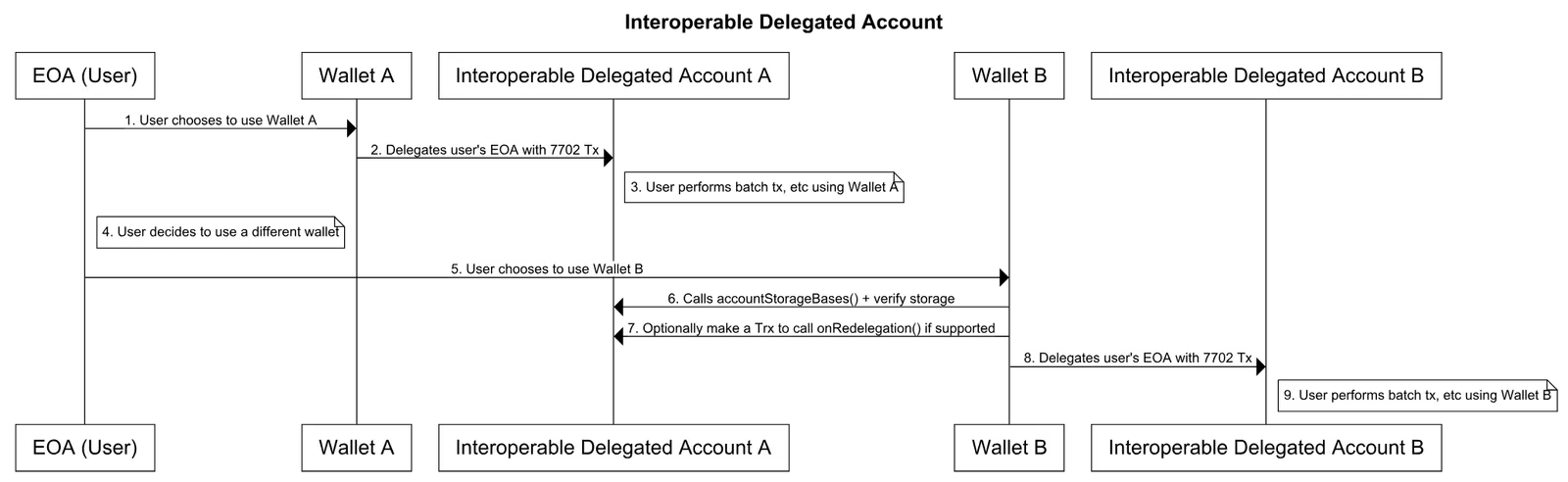
ERC-7779 proposes common interfaces that enable delegated EOAs, introduced by EIP-7702, to operate safely and consistently across different wallet and smart account implementations.
For more on EIP-7702, see the following article.
[EIP-7702] How EOAs Gain Contract Account Functionality
With EIP-7702, externally owned accounts (EOAs), which previously acted simply as signing entities, can delegate contract-like execution logic. This enables advanced functionality such as:
- Sponsored gas payments (gasless transactions)
- Executing multiple operations together (batched transactions)
- Recurring payments and automated execution
- Complex DeFi operations in a single step
Turning an EOA into a smart account substantially improves the user experience. At the same time, it introduces a new problem: storage collisions and storage management during redelegation.
A delegated EOA uses storage according to the layout of the smart account contract to which it delegates. When it redelegates to a different smart account implementation, several risks arise:
- The existing storage layout may collide with the new implementation's layout.
- Incorrect slot overwrites may render the account unusable.
- Authorization and validation logic may be corrupted, putting assets at risk.
To address these problems, ERC-7779 standardizes:
- A common interface for retrieving the storage base slots used by a delegated account.
- An optional mechanism for safely cleaning up old storage during redelegation.
This allows redelegation and wallet migration across different smart account implementations to take place safely and predictably.
The specification is not exclusive to EIP-7702. It describes a general design applicable to smart accounts and smart contracts that use custom storage slot layouts.
Motivation
Following the integration of EIP-7702 into mainnet, many EOA wallets are expected to evolve from traditional accounts that simply manage keys into EOAs delegated to smart account implementations. The reason is the user experience that this makes possible:
- Executing a token swap and approval in a single transaction
- Automated subscription payments
- Having a third party cover gas fees
- Flexible customization of security rules
However, delegated EOAs use smart contract storage internally, so wallet-specific information is persisted on-chain, including:
- Nonce management
- Configuration values for validation logic
- Module configuration
- Authorization data
The important point is that even if a user changes wallet applications, the EOA retains the same address; only the delegation target changes. In other words, the private key and address remain the same, but the new smart account implementation interprets the account's internal storage using its own layout.
Traditional EOAs consisted simply of a private key and an address, making them fully interoperable across wallets. The ability to migrate immediately to a different wallet by importing a mnemonic helped preserve user sovereignty.
Delegated EOAs introduce new migration risks:
- Storage layouts become implementation-specific.
- Different slot layouts can lead to collisions.
- Improper redelegation can leave an account locked.
Similar compatibility problems also exist in account abstraction wallets (such as those based on ERC-4337). However, because seamless wallet migration has traditionally been taken for granted with EOAs, the impact of this problem is considerably greater.
For more on ERC-4337, see the following resources.

[ERC-4337] Implementing Account Abstraction Without Protocol Changes
ERC-7779 is therefore designed with the following objectives.
| Objective | Description |
|---|---|
| Standardize storage bases | Allow the storage regions used by delegated contracts to be identified safely. |
| Improve redelegation safety | Provide a mechanism to explicitly clean up and reset data from the old implementation. |
| Enable wallet portability | Allow users to switch wallets without having to manage differences between implementations. |
| Preserve user sovereignty | Maintain the freedom to migrate using a private key even in the smart account era. |
As a result, ERC-7779 serves as an EOA compatibility layer in the EIP-7702 era. It provides a foundation for preserving wallet portability while enabling safe redelegation, both of which could otherwise be compromised by the transition to smart accounts.
Additional considerations
Checking storage bases
ERC-7779 emphasizes the ability of wallets to verify storage safety before redelegating to another implementation. One might assume that the keccak256 hash space is large enough to prevent collisions if different wallets use different bases, but ERC-7779 takes the opposite approach: verification is worthwhile rather than leaving safety to probability.
The reason is that a storage collision can be catastrophic. When an EOA changes its delegated implementation, a different layout is applied to the storage space of the same address. An accidental or intentional collision can directly lead to an account lockout or a vulnerability.
The idea is similar to checking facet storage layouts in a Diamond (ERC-2535) to avoid collisions. Rather than assuming a hash is sufficient protection, the approach is to verify safety in practice.
Following this principle, accountStorageBases() is designed to return not only the bases used by the current implementation, but also the complete history of previously used bases.
When a wallet scans the EOA's storage before delegation, it can therefore assess risks across regions used by previous implementations as well.
The key points are summarized below.
| Objective | What ERC-7779 provides | Expected benefit |
|---|---|---|
| Avoid collisions before redelegation | Retrieve the history of storage bases via accountStorageBases() |
Assess the distance and collision risk between regions containing existing data and regions used by the new implementation in advance. |
| Avoid relying on hash probabilities | Expose storage bases to support scanning and evaluation | Make delegation decisions based on evidence rather than assumptions. |
Optional onRedelegation()
onRedelegation() is optional to lower the barrier to ERC-7779 compliance.
Not every account implementation requires a pre-redelegation hook, and some designs are not suited to using one.
Examples include:
- Implementations without state that needs to be cleaned up before redelegation
- Implementations that make extensive use of
mapping, making uninitialization impractical - Implementations with complex data structures for which reverting to an earlier state is contrary to their design
Importantly, onRedelegation() does not impose an obligation to completely erase storage.
Rather than demanding complete erasure, ERC-7779 calls for best-effort cleanup or preparatory operations required for redelegation.
Compatibility
Existing smart accounts developed before the discussion of EIP-7702 may not support ERC-7779 without modification. Many existing implementations lack:
- A way to expose identification information, such as
accountId() - A way to expose storage bases, including their history, such as
accountStorageBases() - An optional hook for preparing for redelegation, such as
onRedelegation()
To support ERC-7779, existing smart accounts will therefore require changes such as implementing the interfaces and maintaining a history of storage bases.
Although ERC-7779 primarily targets smart account implementations for EOAs, its underlying principles have broader applications. Any smart account or smart contract using custom storage slots may encounter the same problems, including storage collisions and residual state during migration.
Security
Authenticating calls to onRedelegation
Only the legitimate owner should be allowed to call onRedelegation().
Without owner authentication, a third party could trigger cleanup operations without authorization, damaging or weakening the account.
The specification calls for a mechanism that properly authenticates the owner.
As discussed in the preceding explanation, the basic assumption is to check msg.sender against the owner.
Requirements imposed by the standard versus actual implementation behavior
ERC-7779 is designed to require accounts to:
- Provide appropriate storage base information via
accountStorageBases() - If
onRedelegation()is supported, perform best-effort storage cleanup - Use
keccak256()for storage slot calculations
Whether an implementation actually behaves this way, however, depends on the implementation itself. An implementation may expose the expected interface while behaving incorrectly or maliciously.
The specification therefore allows information to be verified off-chain when appropriate. Here, off-chain verification means not only reading on-chain values but also checking external information to establish whether an implementation is known to be safe, has been audited, or has exhibited suspicious behavior in the past.
Complete storage erasure is not always possible
Completely wiping storage may be impractical for some implementations.
In particular, mapping and complex data structures cannot reliably be fully reset unless a list of their keys is maintained.
ERC-7779 therefore recommends complete erasure while recognizing that there may be exceptions. Even in those cases, implementations are expected to perform the best cleanup they can.
Preventing initialization hijacking after onRedelegation
After onRedelegation(), it is dangerous if an unauthorized third party can invoke initialization (initializer).
For example, a third party could initialize an account immediately after it has been cleaned up, replacing its permissions or signers.
ERC-7779 therefore calls for precautions to ensure that after onRedelegation() is called, an arbitrary third party cannot invoke the initializer.
Do not reset replay protection
onRedelegation() must not reset replay protection.
Replay protection prevents the same signature or operation from being executed repeatedly. Nonce management is a common example.
Resetting this protection can enable signature replay attacks in which old signatures are reused.
ERC-7779 therefore requires onRedelegation() not to reset replay protection.
Beware of implementations falsely claiming ERC compliance
Because ERC-7779 is an ERC, anyone can claim to comply with it. An implementation may nevertheless be noncompliant or behave unsafely.
ERC-7779 therefore recommends verifying that an implementation is known to be safe and conforms to the standard. The key point is that the standard alone cannot guarantee safety; the implementation's trustworthiness must also be verified.
Requiring keccak256 for slot calculations while allowing flexible preimage values
To reduce collisions, ERC-7779 requires keccak256() for storage slot calculations.
However, the implementation is free to choose the string used as input to the hash (the preimage).
The preimage may consist of a name, version, or combination of information. This makes it easier to create unique storage bases for different implementations.
Citation
David Kim (@PowerStream3604), Richard Meissner (@rmeissner), Akshay Patel (@akshay-ap), Joshua Kim (@LightningHun), Fangting (@trinity-0111), Yoav Weiss (@yoavw), "ERC-7779: Interoperable Delegated Accounts [DRAFT]," Ethereum Improvement Proposals, no. 7779, October 2024. [Online serial]. Available: https://eips.ethereum.org/EIPS/eip-7779.
Conclusion
This article covered ERC-7779, a proposal that enables EOAs made delegatable by EIP-7702 to migrate safely across different wallet implementations by verifying their storage layouts. I hope it has been helpful.
If you have questions, feel free to reach out via Twitter DM:
I also publish content on other platforms:


