Introduction
Hi, I'm cardene, a software engineer and technical writer focused on blockchain and AI.
I've also authored Japanese technical books on specification-driven development with LLMs and decentralized application (DApp) development.

I also build and publish a variety of tools, libraries, and open-source projects.
This article examines EIP-8062, which proposes a 0.05% fee on sweep withdrawals (partial withdrawals) from 0x01 validators to encourage stake consolidation and improve fairness between validators.
This article translates, summarizes, and expands on the sources below, as discussed in the original article dated March 9, 2026. The existing diagrams are retained, including their Japanese labels.


I also cover a range of EIPs, BIPs, SLIPs, CAIPs, ENSIPs, RFCs, and ACPs.

Overview
EIP-8062 proposes charging a 0.05% fee on partial sweep withdrawals from validators with 0x01 withdrawal credentials. These withdrawals automatically transfer the portion of a validator's balance above 32 ETH.
Ethereum's fast finality roadmap relies heavily on staking service providers (SSPs) migrating from 0x01 validators to 0x02 compounding validators.
However, 0x01 validators can automatically withdraw balances above 32 ETH at no cost, leaving little incentive to migrate.
The proposal makes a small change to the process_withdrawals() function and introduces the constant WITHDRAWAL_FEE_FRACTION = 2000 to charge a fee on sweep withdrawals.
0x01 and 0x02 are prefixes of validator withdrawal credentials.
0x01 identifies conventional validators whose balances above 32 ETH are automatically withdrawn to the execution layer (EL).
0x02 identifies compounding validators: instead of being automatically withdrawn, excess balances accumulate, allowing an effective balance of up to 2048 ETH.
Motivation
The proposal addresses several problems.
Fast Finality and Stake Consolidation
Ethereum's fast finality roadmap aims to reduce the size of the active validator set. Two approaches are under consideration.
One is Orbit SSF, in which the active set rotates according to validator weights. Large consolidated validators remain active at all times, while smaller validators participate less frequently.
The other approach allocates a fixed number of validator seats (for example, the top 8,192), with only the largest validators obtaining seats.
Both approaches require stake consolidation to achieve sufficient stake weight and optimal performance.
Stake consolidation means that instead of operating many 32 ETH 0x01 validators, SSPs combine them into fewer, larger 0x02 compounding validators.
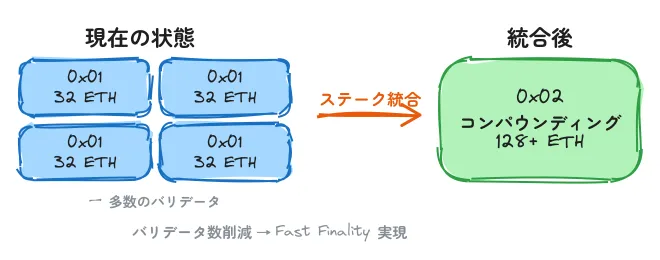
EIP-7251 lays the groundwork for stake consolidation by raising the maximum effective balance to 2048 ETH.
[EIP7251] Understanding the 2048 ETH Staking Limit
Advantages of 0x01 Validators
0x01 validators have the following advantages over 0x02 validators.
| Item | 0x01 validator |
0x02 validator |
|---|---|---|
| Sweep withdrawal fee | Free | Not applicable (no automatic withdrawals) |
| Average idle capital | Approximately 0.01175 ETH | Approximately 0.75 ETH |
| Capital efficiency | High | Low (particularly noticeable at intermediate balances) |
| Resource consumption | Consumes resources on both the CL and EL | EL-triggered withdrawals are already charged on the EL |
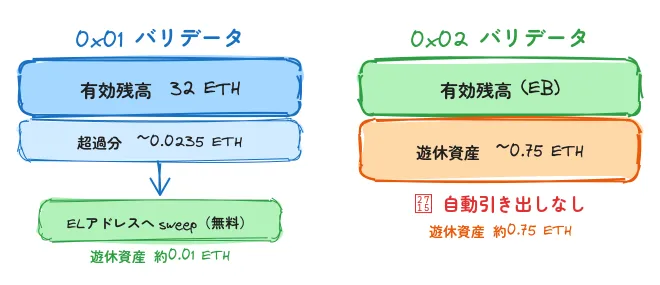
0x01 validators have almost no idle capital because balances above 32 ETH are automatically withdrawn free of charge.
Under the current hysteresis design, 0x02 validators hold an average of 0.75 ETH above their effective balance, and that excess does not earn staking rewards.
Sweep withdrawals also consume resources on both the consensus layer (CL) and the execution layer (EL), without being charged for them.
Given that Ethereum's roadmap depends on migration to 0x02 validators, continuing to give 0x01 validators an accounting advantage is undesirable.
Addressing the Problem with a Fee
The proposal addresses these issues by imposing a 0.05% fee on sweep withdrawals from 0x01 validators.
The average sweep withdrawal is approximately 0.0235 ETH, so the fee per withdrawal is about 11,750 Gwei.
The annual fee for one validator is approximately 0.00048 ETH, equivalent to about $2 at the ETH price used in the original analysis.
An SSP operating 50,000 0x01 validators (slightly less than 5% of all staked ETH) would pay roughly $100,000 per year, providing a moderate incentive to consolidate.
The fee is proportional to the withdrawal amount rather than fixed.
This accounts for the possibility that consolidation substantially reduces the number of 0x01 validators.
With fewer validators, sweeps occur more frequently, and fees are collected more often.
A percentage-based fee keeps the annual cost to stakers constant even when each withdrawal is smaller.
Specification
Parameters
| Constant | Value |
|---|---|
WITHDRAWAL_FEE_FRACTION |
2000 |
The fee rate is 1 / WITHDRAWAL_FEE_FRACTION = 1 / 2000 = 0.05%.
Changes to the process_withdrawals Function
Inside process_withdrawals(), the fee on sweep withdrawals from 0x01 validators is calculated and burned on the CL.
The modified code is shown below.
def process_withdrawals(state: BeaconState, payload: ExecutionPayload) -> None:
    ...
    # In this existing for-loop, calculate a fee before decreasing the balance
    for w in expected_withdrawals:
        vi = w.validator_index
        fee = 0
        if not has_compounding_withdrawal_credential(state.validators[vi]) and w.amount != state.balances[vi]:
            fee = w.amount // WITHDRAWAL_FEE_FRACTION
        decrease_balance(state, vi, w.amount + fee)
The change adds minimal logic to the existing for loop. For each withdrawal, a fee applies if both conditions are met.
- The validator does not have
0x02compounding credentials (i.e., it has0x01credentials). - The withdrawal amount does not equal the validator's entire balance (it is a partial sweep withdrawal rather than a full exit).
The fee is calculated by integer-dividing the withdrawal amount by WITHDRAWAL_FEE_FRACTION. It is added to the withdrawal amount and deducted from the validator's balance.
Because the fee is burned on the CL rather than transferred to the EL, the validator's balance falls slightly below 32 ETH.
flowchart TD
    A["0x01 バリデータ残高<br>32.0235 ETH"] --> B["sweep引き出し額<br>amount = 0.0235 ETH"]
    B --> C{"0x01クレデンシャル?<br>かつ部分引き出し?"}
    C -->|Yes| D["手数料計算<br>fee = amount ÷ 2000<br>≈ 11,750 Gwei"]
    C -->|No| E["fee = 0"]
    D --> F["decrease_balance<br>amount + fee を残高から差引"]
    E --> F
    F --> G["amount → EL引き出しアドレスへ"]
    F --> H["fee → CLでバーン(消滅)"]

    style A fill:#a5d8ff,stroke:#1971c2
    style B fill:#ffd8a8,stroke:#e8590c
    style C fill:#eebefa,stroke:#9c36b5
    style D fill:#ffc9c9,stroke:#e03131
    style G fill:#b2f2bb,stroke:#2f9e44
    style H fill:#ffc9c9,stroke:#e03131
EIP-4895 defines validator withdrawals from the Beacon Chain to the EVM. This proposal adds a fee to the sweep withdrawal mechanism introduced by EIP-4895.
[EIP4895] Understanding Validator Withdrawals from the Beacon Chain to the EVM
Additional Considerations
Fee Levels
At a CL yield of 3%, the annual cost per validator is 32 × 0.03 / 2000 = 0.00048 ETH.
The table below shows the costs for different numbers of validators.
| Number of validators (share of stake) | Annual cost (ETH) | Annual cost (USD) |
|---|---|---|
| 1 (approx. 0.0001%) | 0.00048 | Approx. $2 |
| 100 (approx. 0.01%) | 0.048 | Approx. $200 |
| 10,000 (approx. 1%) | 4.8 | Approx. $20,000 |
| 50,000 (approx. 5%) | 24 | Approx. $100,000 |
| 100,000 (approx. 10%) | 48 | Approx. $200,000 |
For a solo staker operating one 0x01 validator, an annual fee of $2 is unlikely to justify migration.
By contrast, an SSP operating 50,000 0x01 validators (slightly less than 5% of the total stake) faces an annual cost of $100,000, a moderate incentive to consolidate.
Under perfect competition, SSPs cannot pass this cost on to customers, putting pressure on them to consolidate.
Migration costs, such as modifying smart contracts or the opportunity cost of exiting and re-entering, may exceed the annual fee.
However, once the fee is introduced and the protocol commits to phasing out 0x01 validators, migration will eventually be necessary.
A more accurate comparison is therefore between the recurring fee and the financing cost of migration, which is naturally lower.
Gas Cost Rationale
The fee is designed to approximate the workload on the EL. At the average base fee over the preceding year (4.53 gwei), the gas consumed by a sweep withdrawal is estimated at approximately 2,204 gas.
| Item | Gas | Rationale |
|---|---|---|
| Cold account access | 500 gas | First access to an account without code (in accordance with EIP-2780) |
| Account trie write | 1000 gas | One write to an account leaf (in accordance with EIP-2780) |
| Withdrawal data calldata | 704 gas | 44 bytes of EIP-4895 withdrawal data (index 8 + validator_index 8 + address 20 + amount 8) × 16 gas/byte |
| Total | 2,204 gas |
The estimated fee is 2,204 × 4.53 = 9,984 Gwei, although recent base fees at the time of the original analysis were lower.
This calculation does not include the CL sweep workload for 0x01 validators.
For EIP-7002 withdrawals (EL-triggered partial withdrawals) from 0x02 validators, the CL workload is also uncharged, but the EL withdrawal trigger incurs a higher charge.
Validators with 2048 ETH are exempt from sweep withdrawal fees. The reasons given are to avoid discouraging consolidation and because 2048 ETH is the maximum stake the protocol is currently designed to handle.
Capital Efficiency and Opportunity Cost
Besides free sweep withdrawals, 0x01 validators have another advantage: capital efficiency.
Under the current hysteresis design, 0x02 compounding validators hold an average of 0.75 ETH in idle capital above their effective balance (EB).
This occurs because validators whose balances increase gradually hold between 0.25 and 1.25 ETH more than their EB.
Hysteresis introduces a buffer for effective balance updates, preventing the EB from changing frequently in response to small fluctuations in the actual balance.
For example, increasing the EB by 1 ETH requires the balance to reach EB + 1.25 ETH, whereas decreasing the EB by 1 ETH requires the balance to fall below EB - 0.25 ETH (as specified in EIP-7251).
As a result, 0x02 validators retain an average of 0.75 ETH above their EB as idle capital that does not earn staking rewards.
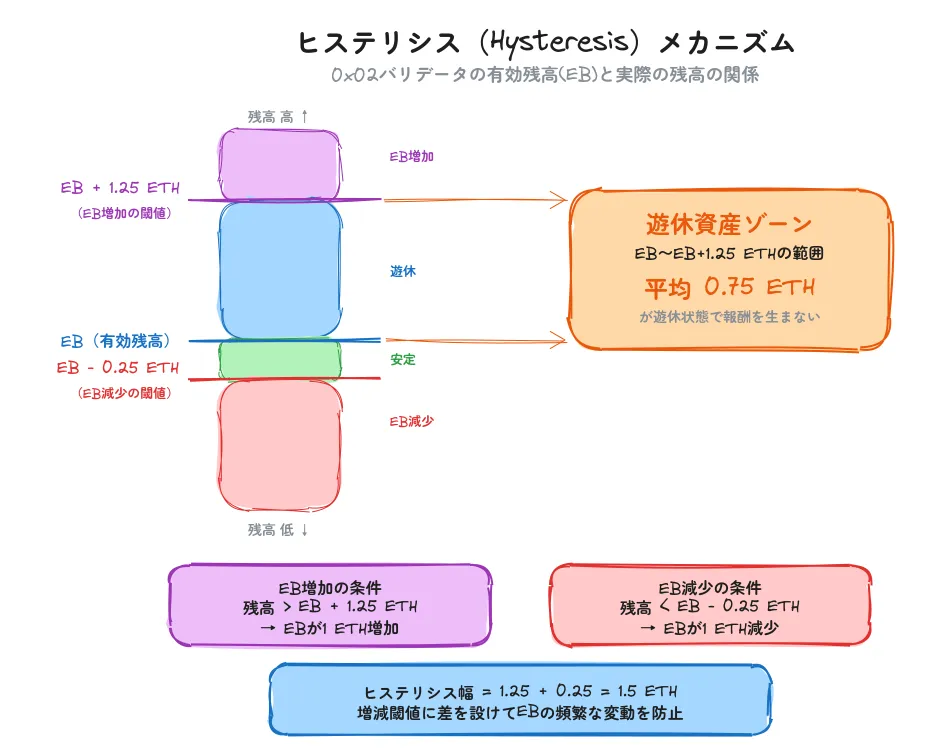
Meanwhile, the average idle capital of 0x01 validators is only 0.0235 / 2 = 0.01175 ETH, making them substantially more capital-efficient, particularly compared with 0x02 validators with intermediate balances.
The following figure shows the relative change in staking yield for each validator configuration against a neutral EB design, where the effective balance equals the actual balance on average as the latter increases.
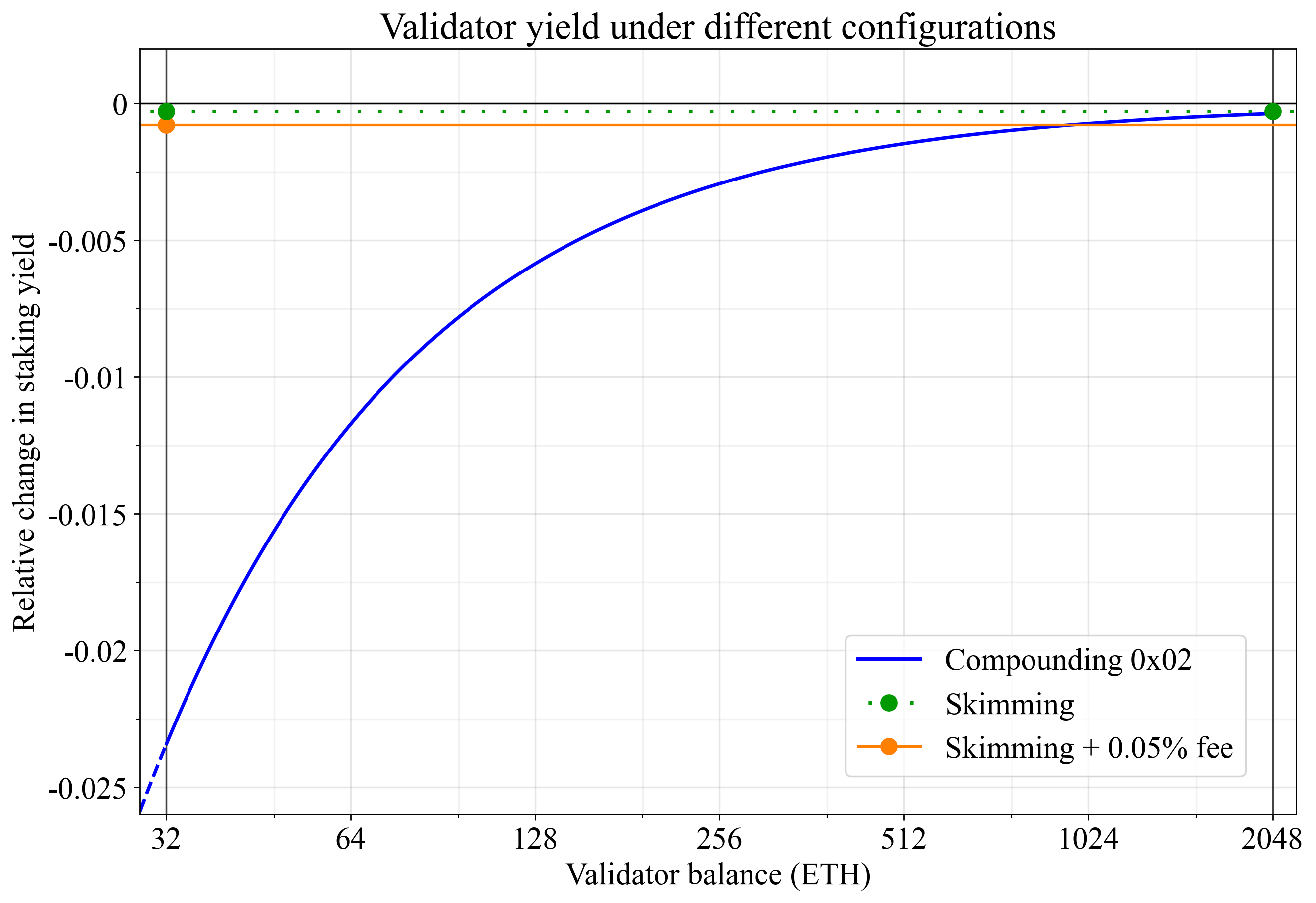
The blue line shows the yield of 0x02 compounding validators, reduced by an EB that is 0.75 ETH lower on average.
The green circles show the yield of 32 ETH and 2048 ETH skimming validators (0x01).
The orange line shows the effect of the proposed 0.05% fee.
This fee does not fully offset the yield drag experienced by 0x02 validators with balances below approximately 1,000 ETH.
EIP-8068 addresses the difference in capital efficiency through a neutral EB design, raising the hysteresis thresholds by +0.5 so that the EB equals the actual balance on average as it grows.
If adopted, this design would move the blue line in Figure 1 to the baseline (the black line).
If EIP-8068 is not included in the same hard fork as this proposal, alternative specifications with a higher compensating fee are also being considered.
However, raising the fee alone cannot resolve another problem.
0x02 validators can exploit hysteresis by reaching an EB of 33 ETH and then making a partial withdrawal to retain an EB of 33 ETH with an actual balance of 32.75 ETH.
An alternative specification in EIP-8068 could address this issue separately.
Alternative Specifications
If EIP-8068 is not included in the same hard fork, a higher fee could compensate for the lower capital efficiency of 0x02 validators.
The following figure shows three alternative fee rates as red lines.
The white squares mark the validator balances at which 0x01 and 0x02 validators have equal capital efficiency under the proposed fees.
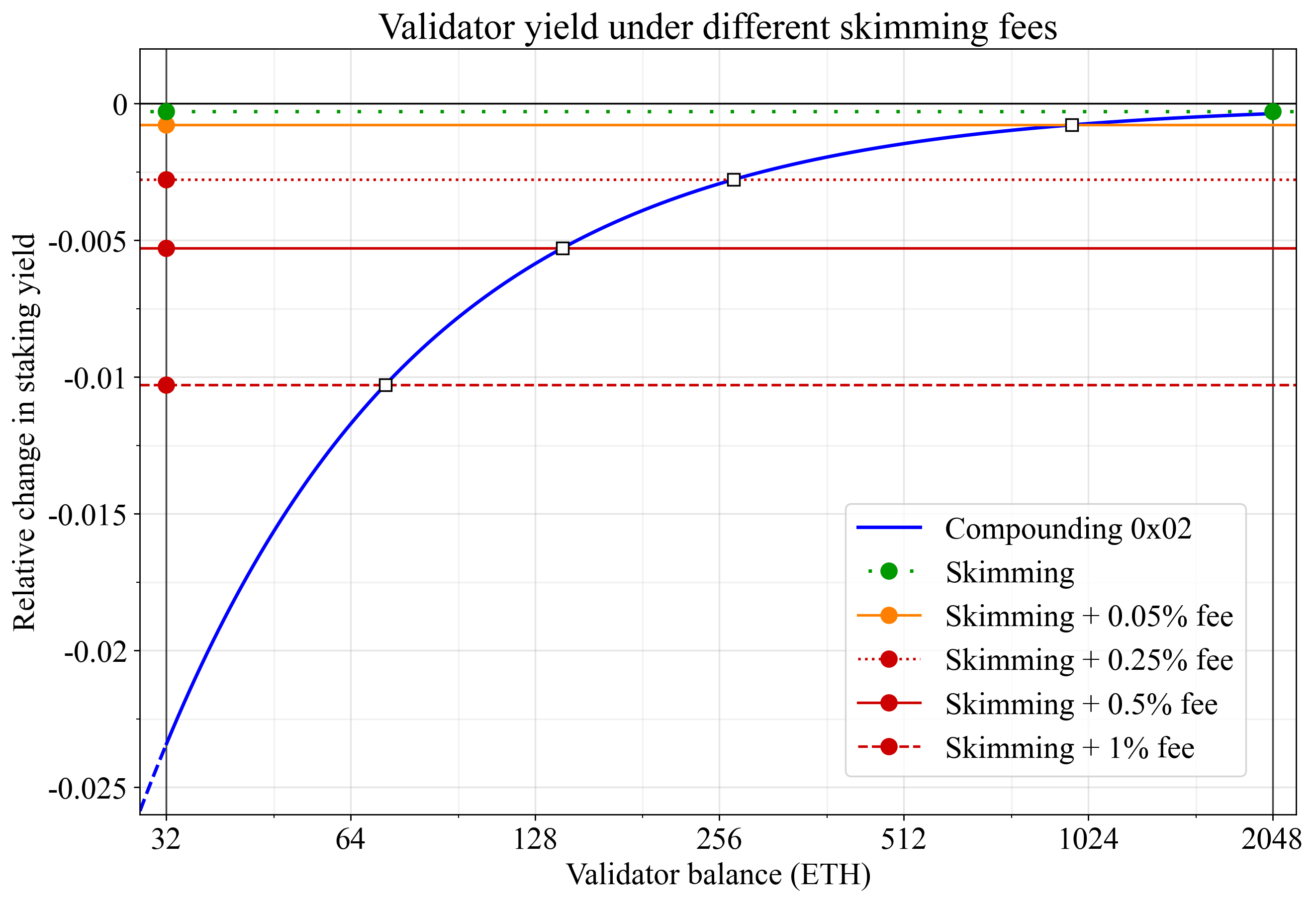
The table below summarizes the alternative fee rates.
| Fee rate | WITHDRAWAL_FEE_FRACTION |
Characteristics |
|---|---|---|
| 0.05% (proposed) | 2000 | Minimal fee approximating the EL workload |
| 0.25% | 400 | More moderate compensation |
| 0.5% | 200 | A 32 ETH 0x01 validator has the same capital efficiency as a 0x02 validator with approximately 128 ETH |
| 1% | 100 | For operators of multiple validators, consolidation into 0x02 is always neutral or beneficial |
The costs of adopting a 0.5% fee (WITHDRAWAL_FEE_FRACTION = 200) are shown below.
| Number of validators (share of stake) | Annual cost (ETH) | Annual cost (USD) |
|---|---|---|
| 1 (approx. 0.0001%) | 0.0048 | Approx. $20 |
| 100 (approx. 0.01%) | 0.48 | Approx. $2,000 |
| 10,000 (approx. 1%) | 48 | Approx. $200,000 |
| 50,000 (approx. 5%) | 240 | Approx. $1,000,000 |
| 100,000 (approx. 10%) | 480 | Approx. $2,000,000 |
With a 0.5% fee, the additional annual cost is $20 per validator. An SSP operating 5% of the total stake would incur a loss of $1 million per year, providing a stronger incentive to consolidate.
Security
To the authors' knowledge, no security risks associated with this proposal have been identified.
Since the fee is burned on the CL, it introduces no additional attack surface on the EL.
The proposal also makes only a minimal change to the existing process_withdrawals() function, limiting the complexity of the new logic.
References
Conclusion
This article covered the sweep withdrawal fee mechanism that EIP-8062 proposes for 0x01 validators. I hope it helped clarify the proposal.
If you have questions, feel free to send me a message on Twitter.
I also publish on the following platforms.


