Introduction
Hi, I'm cardene, a software engineer and technical writer focused on blockchain and AI.
I've also authored Japanese technical books on specification-driven development with LLMs and decentralized application (DApp) development.

I also build and publish a variety of tools, libraries, and open-source projects.
This article covers ERC6956, which proposes asset-bound NFTs that establish a one-to-one relationship between physical or digital assets and on-chain NFTs through an ANCHOR.
This explanation translates, summarizes, and expands on the following specification.

As of January 13, 2024, ERC6956 was in Review status.
I have also written about other EIPs.

Overview
The standard extends ERC721 to integrate physical and digital assets with dApps.
An ASSET, such as a physical object, is marked with a uniquely identifiable ANCHOR. The design aims to establish a secure, inseparable one-to-one relationship between the anchor and an on-chain NFT throughout the asset's lifecycle.
For more about ERC721, see the following article.
An ORACLE plays a central role in this process.
Through an ATTESTATION, an oracle attests that control of the asset has been established when a destination address is specified for an operation such as minting, transferring, burning, or approving a token.
This evidence is established off-chain. The on-chain contract verifies that a trusted oracle signed the attestation before authorizing the applicable operation.
The key idea is authorization through PROOF-OF-CONTROL of the asset rather than requiring the existing NFT owner's signature, subject to the configured authorization and lock rules.
An attestation-authorized operation such as transferAnchor(attestation) can be submitted permissionlessly, without signatures from the current token owner or destination address.
This can make transfers more flexible.
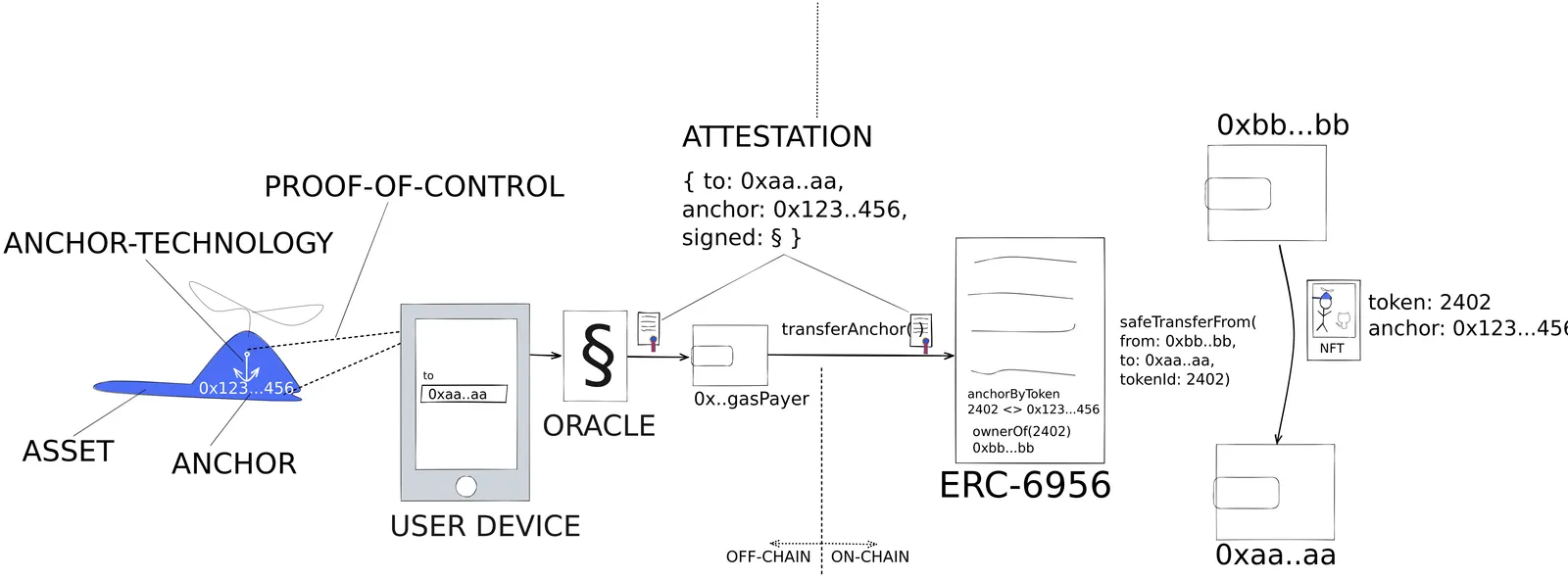
Figure 1 illustrates an asset-bound NFT transfer flow in which a user interacts with the physical asset using a smartphone and specifies the destination address. This can facilitate integration of physical assets and digital NFTs into Web3 applications.
-
Asset
- A physical or digital asset represented through an on-chain anchor.
- The anchor is the asset's unique identifier, shown here as
0x123...456.
-
Anchor technology
- The technology binding an asset to its anchor.
- It provides an identifiable link whose on-chain representation can be verified, subject to the security of the underlying anchor technology.
-
User device
- The device through which a user interacts with the asset and specifies a destination address.
- The illustrated
to 0xaa..aais the destination wallet address.
-
Oracle
- A service conveying off-chain evidence to an on-chain contract. Here, the oracle supplies an attestation concerning the anchor.
-
Attestation
- Signed evidence concerning an anchor, submitted to the ERC6956 smart contract after the oracle has verified the relevant conditions.
- The illustration includes
to 0xaa..aa, anchor: 0x123...456, signed: {}.
-
ERC-6956
- The smart contract proposed by the standard.
- It records information about the token associated with an anchor and its on-chain owner.
-
NFT
- An NFT represented by
token: 2402, anchor: 0x123...456.
- An NFT represented by
-
On-chain and off-chain
- These terms distinguish activities outside the blockchain from those performed on it.
- An attestation bridges the off-chain verification process and on-chain authorization.
The diagram illustrates how a physical or digital asset can be registered and managed through a blockchain. Anchor technology establishes the asset identifier, and an oracle's evidence is processed by an ERC6956 smart contract. The resulting NFT records the on-chain ownership associated with the asset; legal ownership and the truth of the off-chain evidence are separate matters.
Motivation
ERC721 establishes a standard interface for NFTs, which can represent physical property, digital collectibles, or rights.
In this context, the proposal calls the things of value represented by such tokens ASSETS.
ERC721 NFTs can represent interests in physical property, such as artwork or real estate, rather than only digital art. They can also represent digital collectibles, limited-edition cards, game items, or more abstract responsibilities and rights.
Tokenization enables on-chain ownership records to be tracked transparently. The model can represent physical and digital objects as well as various rights and responsibilities, expanding potential NFT applications. Examples include interests in artworks, rare game items, and rights such as copyright, where the applicable legal and technical arrangements support the representation.
ERC721 provides a way to represent ownership-related information across physical and digital contexts, although the token interface alone does not establish legal title.
Problem
ERC721 NFTs may represent ownership of digital or physical assets. The interface is particularly suited to on-chain assets whose possession is defined by holding a token from a particular contract, or where the NFT metadata constitutes the asset. NFT metadata, such as images and attributes, is often treated as part of the asset class, with rarity influencing perceived value.
However, some problems are not addressed by ERC721 alone. They become especially apparent when the NFT represents an off-chain asset, such as physical property, a digital collectible, an in-game asset, or a responsibility. Ownership and possession may change repeatedly throughout an asset's lifecycle. These changes may transfer rights, privileges, or obligations between parties. Tokenization is incomplete if those characteristics and obligations are not reliably associated with the token. Off-chain assets are often linked to NFTs by including their identifiers in token metadata.
The integrity problem is that NFT metadata can be mutable and stored off-chain.
An asset identifier in mutable metadata forms a weak link when its only association with the NFT is through tokenURI.
An NFT is a uniquely identifiable on-chain digital asset whose token ownership can be tracked.
Many NFTs expose tokenURI, which references associated metadata.
Metadata can contain images, descriptions, attributes, and asset identifiers.
The problem arises when this metadata is mutable. Its contents may change over time. For example, information about a physical object represented by an NFT may be updated.
An asset identifier in mutable metadata referenced through tokenURI therefore provides only a weak binding.
The relationship between the NFT and the underlying asset can change if the identifier is altered.
This may make reliable tracking of the represented asset difficult.
One way to protect metadata integrity is to store its hash on-chain.
However, committing to the entire metadata document creates another issue.
Many applications need fields other than the asset identifier, such as attributes or play time, to remain updateable.
Off-chain resources referenced by tokenURI must also remain available, but examples of lost IPFS content and unavailable metadata providers demonstrate that availability cannot be assumed.
Some designs make ownership or acquisition of the off-chain asset conditional on ownership of its on-chain representation. A common example is burning a token to redeem a physical asset, after which the token no longer maintains a continuing ownership record. The proposal identifies a need for the converse mechanism: control of an off-chain asset should be able to determine control of its on-chain representation. If the current NFT owner is uncooperative or unable to sign, conventional transfer authorization can prevent the records from being reconciled.
Many implementations use mutable off-chain metadata without a strong asset binding.
Others attempt to preserve integrity by hashing the metadata and storing the hash on-chain against a tokenId.
This approach is unsuitable when fields other than the asset identifier must evolve over time.
ASSET-BOUND NON-FUNGIBLE TOKENS
The proposed standard strengthens the representation of physical or digital off-chain assets through an inseparable anchor to an on-chain NFT. Its objective is to allow verified control of an off-chain asset to determine control of the associated NFT.
In the intended model, changes in control of the off-chain asset should be reflected in ownership of the anchored NFT. The mechanism should work even when the current NFT owner is uncooperative. Control of the asset therefore takes precedence over mere possession of the NFT under the asset-bound model.
The proposal introduces an asset-bound NFT whose on-chain control can be reassigned through evidence of off-chain asset control. The asset-bound NFT can also associate digital metadata with the asset through its anchor. For physical objects, this enables the design of phygital assets with closely linked physical and digital components. The metadata itself may remain mutable.
The proposal adds an attestation-based authorization mechanism to ERC721 transfer controls. A trusted oracle signs an attestation off-chain after verifying control of the asset and the specified destination address. An attestation-authorized transaction can be submitted without separate signatures or approvals from the current token owner or recipient.
The authors identify two possible secondary benefits: lower onboarding barriers for Web2 users and improved recovery or security properties. For example, sponsored transactions can allow users to mint or transfer tokens without holding native gas tokens themselves. Asset-based recovery may reduce certain fraud or mistake-related risks, depending on the oracle, anchor technology, and operational controls.
The standard aims to establish a strong relationship between off-chain assets and on-chain NFTs. This can improve traceability and support new forms of NFT usage. It may also reduce onboarding barriers and enable more accessible asset-management workflows. This is particularly relevant to phygital assets combining physical objects with digital representations.
Related work
The approach focuses on integrating physical or digital assets that do not themselves have signing capabilities into decentralized applications. It differs from proposals requiring cryptographic chips in the assets. Such proposals may rely on an asset's embedded signing capability, whereas ERC6956 delegates evidence verification and signing to an oracle.
A cryptographic chip's address can nevertheless serve as an anchor, enabling combinations with other solutions. The anchor supplies an identifier for the asset's on-chain representation, making integration with dApps easier.
The objective is to make assets without native signing capabilities usable in decentralized applications. An oracle-based anchor can link an asset to an NFT without requiring a cryptographic chip to sign messages. This broadens the potential range of assets and application designs.
Specification
Definitions
ANCHOR
An anchor is a unique identifier for a physical or digital off-chain asset. It identifies the asset regardless of its physical or digital nature.
ANCHOR-TECHNOLOGY
Anchor technology must provide a binding that cannot be separated from the asset by physical or other means within the relevant threat model. It must allow the oracle to establish control of the asset beyond reasonable doubt. Physical assets introduce additional physical-security considerations.
ASSET
An asset is a physical or digital thing represented by an NFT under the proposed standard. Typically, the asset itself lacks signing capabilities.
ATTESTATION
An attestation confirms that proof of control of the asset was established when specifying the destination or beneficiary address.
PROOF-OF-CONTROL
Proof of control establishes that a party possesses or otherwise controls the asset. The method depends on the asset and can involve technical, legal, or other evidence. For physical assets, control is typically established through physical proximity between the asset and the device used to specify the destination address.
ORACLE
An oracle has signing capabilities and signs attestations off-chain. Its signatures must be verifiable on-chain.
The standard aims to integrate physical or digital assets with blockchains by anchoring them to NFTs. Oracles and attestations establish the evidence used to authorize token operations; their reliability depends on the proof-of-control mechanism.
Base interface
All conforming contracts must implement the proposed base interface, ERC721, and ERC165.
For more about ERC165, see the following article.
[ERC165] Detecting Supported Smart Contract Interfaces
// SPDX-License-Identifier: MIT OR CC0-1.0
pragma solidity ^0.8.18;

/**
 * @title IERC6956 Asset-Bound Non-Fungible Tokens
 * @notice Asset-bound Non-Fungible Tokens anchor a token 1:1 to a (physical or digital) asset and token transfers are authorized through attestation of control over the asset
 * @dev See https://eips.ethereum.org/EIPS/eip-6956
 *      Note: The ERC-165 identifier for this interface is 0xa9cf7635
 */
interface IERC6956 {

    /** @dev Authorization, typically mapped to authorizationMaps, where each bit indicates whether a particular ERC6956Role is authorized
     *      Typically used in constructor (hardcoded or params) to set burnAuthorization and approveAuthorization
     *      Also used in optional updateBurnAuthorization, updateApproveAuthorization, I
     */
    enum Authorization {
        NONE,               // = 0,      // None of the above
        OWNER,              // = (1<<OWNER), // The owner of the token, i.e. the digital representation
        ISSUER,             // = (1<<ISSUER), // The issuer of the tokens, i.e. this smart contract
        ASSET,              // = (1<<ASSET), // The asset, i.e. via attestation
        OWNER_AND_ISSUER,   // = (1<<OWNER) | (1<<ISSUER),
        OWNER_AND_ASSET,    // = (1<<OWNER) | (1<<ASSET),
        ASSET_AND_ISSUER,   // = (1<<ASSET) | (1<<ISSUER),
        ALL                 // = (1<<OWNER) | (1<<ISSUER) | (1<<ASSET) // Owner + Issuer + Asset
    }

    /**
     * @notice This emits when approved address for an anchored tokenId is changed or reaffirmed via attestation
     * @dev This emits when approveAnchor() is called and corresponds to ERC-721 behavior
     * @param owner The owner of the anchored tokenId
     * @param approved The approved address, address(0) indicates there is no approved address
     * @param anchor The anchor, for which approval has been changed
     * @param tokenId ID (>0) of the anchored token
     */
    event AnchorApproval(address indexed owner, address approved, bytes32 indexed anchor, uint256 tokenId);

    /**
     * @notice This emits when the ownership of any anchored NFT changes by any mechanism
     * @dev This emits together with tokenId-based ERC-721.Transfer and provides an anchor-perspective on transfers
     * @param from The previous owner, address(0) indicate there was none.
     * @param to The new owner, address(0) indicates the token is burned
     * @param anchor The anchor which is bound to tokenId
     * @param tokenId ID (>0) of the anchored token
     */
    event AnchorTransfer(address indexed from, address indexed to, bytes32 indexed anchor, uint256 tokenId);
    /**
     * @notice This emits when an attestation has been used indicating no second attestation with the same attestationHash will be accepted
     * @param to The to address specified in the attestation
     * @param anchor The anchor specified in the attestation
     * @param attestationHash The hash of the attestation, see ERC-6956 for details
     * @param totalUsedAttestationsForAnchor The total number of attestations already used for the particular anchor
     */
    event AttestationUse(address indexed to, bytes32 indexed anchor, bytes32 indexed attestationHash, uint256 totalUsedAttestationsForAnchor);

    /**
     * @notice This emits when the trust-status of an oracle changes.
     * @dev Trusted oracles must explicitly be specified.
     *      If the last event for a particular oracle-address indicates it's trusted, attestations from this oracle are valid.
     * @param oracle Address of the oracle signing attestations
     * @param trusted indicating whether this address is trusted (true). Use (false) to no longer trust from an oracle.
     */
    event OracleUpdate(address indexed oracle, bool indexed trusted);

    /**
     * @notice Returns the 1:1 mapped anchor for a tokenId
     * @param tokenId ID (>0) of the anchored token
     * @return anchor The anchor bound to tokenId, 0x0 if tokenId does not represent an anchor
     */
    function anchorByToken(uint256 tokenId) external view returns (bytes32 anchor);
    /**
     * @notice Returns the ID of the 1:1 mapped token of an anchor.
     * @param anchor The anchor (>0x0)
     * @return tokenId ID of the anchored token, 0 if no anchored token exists
     */
    function tokenByAnchor(bytes32 anchor) external view returns (uint256 tokenId);

    /**
     * @notice The number of attestations already used to modify the state of an anchor or its bound tokens
     * @param anchor The anchor(>0)
     * @return attestationUses The number of attestation uses for a particular anchor, 0 if anchor is invalid.
     */
    function attestationsUsedByAnchor(bytes32 anchor) view external returns (uint256 attestationUses);
    /**
     * @notice Decodes and returns to-address, anchor and the attestation hash, if the attestation is valid
     * @dev MUST throw when
     *  - Attestation has already been used (an AttestationUse-Event with matching attestationHash was emitted)
     *  - Attestation is not signed by trusted oracle (the last OracleUpdate-Event for the signer-address does not indicate trust)
     *  - Attestation is not valid yet or expired
     *  - [if IERC6956AttestationLimited is implemented] attestationUsagesLeft(attestation.anchor) <= 0
     *  - [if IERC6956ValidAnchors is implemented] validAnchors(data) does not return true.
     * @param attestation The attestation subject to the format specified in ERC-6956
     * @param data Optional additional data, may contain proof as the first abi-encoded argument when IERC6956ValidAnchors is implemented
     * @return to Address where the ownership of an anchored token or approval shall be changed to
     * @return anchor The anchor (>0)
     * @return attestationHash The attestation hash computed on-chain as `keccak256(attestation)`
     */
    function decodeAttestationIfValid(bytes memory attestation, bytes memory data) external view returns (address to, bytes32 anchor, bytes32 attestationHash);

    /**
     * @notice Indicates whether any of ASSET, OWNER, ISSUER is authorized to burn
     */
    function burnAuthorization() external view returns(Authorization burnAuth);

    /**
     * @notice Indicates whether any of ASSET, OWNER, ISSUER is authorized to approve
     */
    function approveAuthorization() external view returns(Authorization approveAuth);

    /**
     * @notice Corresponds to transferAnchor(bytes,bytes) without additional data
     * @param attestation Attestation, refer ERC-6956 for details
     */
    function transferAnchor(bytes memory attestation) external;

    /**
     * @notice Changes the ownership of an NFT mapped to attestation.anchor to attestation.to address.
     * @dev Permissionless, i.e. anybody invoke and sign a transaction. The transfer is authorized through the oracle-signed attestation.
     *  - Uses decodeAttestationIfValid()
     *  - When using a centralized "gas-payer" recommended to implement IERC6956AttestationLimited.
     *  - Matches the behavior of ERC-721.safeTransferFrom(ownerOf[tokenByAnchor(attestation.anchor)], attestation.to, tokenByAnchor(attestation.anchor), ..) and mint an NFT if `tokenByAnchor(anchor)==0`.
     *  - Throws when attestation.to == ownerOf(tokenByAnchor(attestation.anchor))
     *  - Emits AnchorTransfer
     *
     * @param attestation Attestation, refer ERC-6956 for details
     * @param data Additional data, may be used for additional transfer-conditions, may be sent partly or in full in a call to safeTransferFrom
     *
     */
    function transferAnchor(bytes memory attestation, bytes memory data) external;

     /**
     * @notice Corresponds to approveAnchor(bytes,bytes) without additional data
     * @param attestation Attestation, refer ERC-6956 for details
     */
    function approveAnchor(bytes memory attestation) external;

     /**
     * @notice Approves attestation.to the token bound to attestation.anchor. .
     * @dev Permissionless, i.e. anybody invoke and sign a transaction. The transfer is authorized through the oracle-signed attestation.
     *  - Uses decodeAttestationIfValid()
     *  - When using a centralized "gas-payer" recommended to implement IERC6956AttestationLimited.
     *  - Matches the behavior of ERC-721.approve(attestation.to, tokenByAnchor(attestation.anchor)).
     *  - Throws when ASSET is not authorized to approve.
     *
     * @param attestation Attestation, refer ERC-6956 for details
     */
    function approveAnchor(bytes memory attestation, bytes memory data) external;

    /**
     * @notice Corresponds to burnAnchor(bytes,bytes) without additional data
     * @param attestation Attestation, refer ERC-6956 for details
     */
    function burnAnchor(bytes memory attestation) external;

    /**
     * @notice Burns the token mapped to attestation.anchor. Uses ERC-721._burn.
     * @dev Permissionless, i.e. anybody invoke and sign a transaction. The transfer is authorized through the oracle-signed attestation.
     *  - Uses decodeAttestationIfValid()
     *  - When using a centralized "gas-payer" recommended to implement IERC6956AttestationLimited.
     *  - Throws when ASSET is not authorized to burn
     *
     * @param attestation Attestation, refer ERC-6956 for details
     */
    function burnAnchor(bytes memory attestation, bytes memory data) external;
}
Authorization
enum Authorization {
    NONE,
    OWNER,
    ISSUER,
    ASSET,
    OWNER_AND_ISSUER,
    OWNER_AND_ASSET,
    ASSET_AND_ISSUER,
    ALL
}
Overview An enum representing authorization for various token operations.
Details
It specifies whether operations by the token owner, issuer, or asset controller are authorized.
The values represent individual roles or combinations of roles, as defined by the enum.
For example, OWNER_AND_ISSUER authorizes both the owner and issuer.
Parameters
NONE- No role is authorized.
OWNER- The token owner is authorized.
ISSUER- The token issuer is authorized.
ASSET- The asset controller is authorized through an attestation.
OWNER_AND_ISSUER- Both the owner and issuer are authorized.
OWNER_AND_ASSET- Both the owner and asset controller are authorized.
ASSET_AND_ISSUER- Both the asset controller and issuer are authorized.
ALL- The owner, issuer, and asset controller are all authorized.
AnchorApproval
event AnchorApproval(address indexed owner, address approved, bytes32 indexed anchor, uint256 tokenId);Overview Emitted when the approved address for an anchored token ID changes or is reaffirmed.
Details
This event is emitted by approveAnchor() and corresponds to ERC721 approval behavior.
It allows changes to approval for the token associated with an anchor to be tracked.
Parameters
owner- Owner of the anchored token ID.
approved- Approved address;
address(0)denotes the absence of an approved address.
- Approved address;
anchorAnchor whose approval changed.tokenId- Anchored token ID.
AnchorTransfer
event AnchorTransfer(address indexed from, address indexed to, bytes32 indexed anchor, uint256 tokenId);Overview Emitted when ownership of an anchored NFT changes through any supported mechanism.
Details
It accompanies the token-ID-based ERC721 Transfer event and identifies the transfer from the anchor's perspective.
It allows ownership changes associated with the anchor to be tracked.
Parameters
from- Previous owner;
address(0)denotes minting.
- Previous owner;
to- New owner;
address(0)denotes burning.
- New owner;
anchor- Anchor associated with the token ID.
tokenId- Anchored token ID.
AttestationUse
event AttestationUse(address indexed to, bytes32 indexed anchor, bytes32 indexed attestationHash, uint256 totalUsedAttestationsForAnchor);Overview Emitted when an attestation is consumed and another attestation with the same hash must no longer be accepted.
Details This event accompanies an attestation-authorized state change concerning an anchor. It records consumption of the attestation for replay protection.
Parameters
to- Address specified in the attestation.
anchor- Anchor specified in the attestation.
attestationHash- Attestation hash.
totalUsedAttestationsForAnchor- Total number of attestations consumed for the specified anchor.
OracleUpdate
event OracleUpdate(address indexed oracle, bool indexed trusted);Overview Emitted when an oracle's trust status changes.
Details Trusted oracles must be explicitly designated. If the latest event concerning an oracle indicates trust, its attestations can be considered for acceptance, subject to the remaining validity checks. The event records which oracle addresses are trusted to sign attestations.
Parameters
oracle- Address of the oracle signing attestations.
trustedtrueif the address is trusted, orfalseif trust is revoked.
anchorByToken
function anchorByToken(uint256 tokenId) external view returns (bytes32 anchor);Overview Returns the anchor corresponding to a token ID.
Details
The function returns the anchor mapped one-to-one to the specified token ID.
It returns 0x0 if the token ID does not represent an anchor.
Parameters
tokenId- Anchored token ID (
>0).
- Anchored token ID (
Return value
anchor- Anchor bound to the token ID, or
0x0if no anchor is associated with it.
- Anchor bound to the token ID, or
tokenByAnchor
function tokenByAnchor(bytes32 anchor) external view returns (uint256 tokenId);Overview Returns the token ID corresponding to an anchor.
Details
The function returns the token ID mapped one-to-one to the specified anchor.
It returns 0 if no token exists for the anchor.
Parameters
anchor- Anchor (
>0x0).
- Anchor (
Return value
tokenId- Anchored token ID, or
0if the anchor has no token.
- Anchored token ID, or
attestationsUsedByAnchor
function attestationsUsedByAnchor(bytes32 anchor) view external returns (uint256 attestationUses);Overview Returns the number of attestations consumed to change the state of an anchor or its token.
Details
The function reports the total number of attestations used for anchor state changes.
It returns 0 for an invalid anchor.
Parameters
anchor- Anchor (
>0).
- Anchor (
Return value
attestationUses- Number of attestations consumed for the anchor, or
0if invalid.
- Number of attestations consumed for the anchor, or
decodeAttestationIfValid
function decodeAttestationIfValid(bytes memory attestation, bytes memory data) external view returns (address to, bytes32 anchor, bytes32 attestationHash);Overview Decodes a valid attestation and returns its destination address, anchor, and attestation hash.
Details The function decodes an attestation only when validity conditions are satisfied, including non-consumption, a trusted oracle signature, and the applicable time window. It reverts for an invalid or previously consumed attestation.
Parameters
attestation- Attestation in the ERC6956 format.
data- Optional additional data.
- When
IERC6956ValidAnchorsis implemented, this data may contain the proof as its first ABI-encoded argument.
Return value
to- Address to receive ownership or approval of the anchored token.
anchor- Anchor (
>0).
- Anchor (
attestationHash- On-chain hash of the attestation (
keccak256(attestation)).
- On-chain hash of the attestation (
burnAuthorization
function burnAuthorization() external view returns(Authorization burnAuth);Overview
Indicates which of ASSET, OWNER, and ISSUER are authorized to burn tokens.
Details
Returns an Authorization enum value identifying the authorized roles.
This identifies which roles may burn the token.
Return value
burnAuth- Burn authorization.
- Value of the
Authorizationenum.
approveAuthorization
function approveAuthorization() external view returns(Authorization approveAuth);Overview
Indicates which of ASSET, OWNER, and ISSUER are authorized to approve tokens.
Details
Returns an Authorization enum value identifying the roles authorized to grant approval.
This identifies the roles that may approve the token.
Return value
approveAuth- Approval authorization.
- Value of the
Authorizationenum.
transferAnchor
function transferAnchor(bytes memory attestation) external;Overview Changes ownership of an anchored NFT using an attestation.
Details
A valid attestation signed by a trusted oracle authorizes assignment of the anchored NFT to attestation.to, subject to other applicable restrictions.
The function uses decodeAttestationIfValid to perform the necessary checks.
Parameters
attestation- Attestation.
approveAnchor
function approveAnchor(bytes memory attestation) external;Overview Grants approval for an anchored token through an attestation.
Details The function uses a valid oracle-signed attestation to grant token approval. It is available only when approval by the asset controller is authorized.
Parameters
attestation- Attestation.
burnAnchor
function burnAnchor(bytes memory attestation) external;Overview Burns an anchored token using an attestation.
Details
A valid oracle-signed attestation authorizes burning the anchored token.
The function uses decodeAttestationIfValid to perform the necessary checks.
The operation is available only when burning by the asset controller is authorized.
Parameters
attestation- Attestation.
Base interface considerations
The proposed base interface includes the following requirements and recommendations.
-
Implement ERC721 and ERC165.
- This provides the standard NFT interface and interface detection.
-
Provide bidirectional mappings through
tokenByAnchor(anchor)andanchorByToken(tokenId).- Each anchor has at most one token, establishing the intended one-to-one relationship.
-
Provide a mechanism for determining whether an anchor is valid. Implementing the ValidAnchors interface is recommended.
- This restricts asset-bound NFT operations to valid anchors.
-
Implement
decodeAttestationIfValid(attestation, data)to verify and decode attestations.- It returns the destination address, anchor, and attestation hash.
-
decodeAttestationIfValidmust not modify state.- This allows callers to check validity without consuming the attestation.
-
Revert if the attestation was not signed by a trusted oracle, is expired or not yet valid, or has already been consumed (the original description mistakenly says unused).
- If AttestationLimited or ValidAnchors is implemented, enforce its additional conditions.
-
The anchor release mechanism determines whether an anchored NFT may be transferred independently of its asset.
- By default, anchors are not released for ordinary transfers; the Floatable extension provides the relevant release mechanism.
-
Extend ERC721 transfer behavior to reject ordinary transfers when the anchor is not released, and reject unsupported batch transfers.
- Emit
AnchorTransferfor the applicable ownership change.
- Emit
-
Implement state-changing operations such as
transferAnchor(..),burnAnchor(..), andapproveAnchor(..), usingdecodeAttestationIfValid()to obtain the destination, anchor, and hash.- Record consumed attestation hashes, increment the anchor's attestation usage count, and emit
AttestationUsed.
- Record consumed attestation hashes, increment the anchor's attestation usage count, and emit
-
transferAnchor(attestation)follows the applicable ERC721 safe-transfer behavior and emits the required events.- If
tokenByAnchor(anchor)==0, mint a new NFT.
- If
-
Implementing
tokenURI(tokenId)with an anchor-based URI is recommended.- This associates metadata with the asset's anchor.
- Using the anchor rather than the token ID is preferable because the token ID mapping is unknown before an anchor's initial use.
The interface provides a framework for anchoring assets to NFTs and managing their transfers, with the objective of improving traceability.
Oracle
-
An oracle must provide an attestation that the destination address was specified under the required proof-of-control conditions for the corresponding anchor.
-
The attestation must contain the following ABI-encoded information.
- to
- Address of the recipient or beneficiary, such as a transfer destination or approved account.
- ANCHOR
- Asset identifier maintaining a one-to-one association with the asset.
- attestationTime
- Time at which the oracle signed the attestation, in Unix seconds.
- validStartTime
- Start of the attestation validity period, in Unix seconds.
- validEndTime
- End of the attestation validity period, in Unix seconds.
- signature
- Ethereum signature (65 bytes).
- The oracle's signature over the hash of the ABI-encoded attestation fields (
to,anchor,attestationTime,validStartTime,validEndTime), according to the prescribed signing format.
- to
-
The specific method for establishing proof of control through anchor technology is outside the scope of the standard.
These requirements define how the oracle constructs the evidence used to authorize asset-related token operations. They support auditable transfers and approvals, subject to the trust assumptions of the oracle.
AttestationLimited interface
Conforming contracts may implement the proposed AttestationLimited interface.
// SPDX-License-Identifier: MIT OR CC0-1.0
pragma solidity ^0.8.18;
import "./IERC6956.sol";

/**
 * @title Attestation-limited Asset-Bound NFT
 * @dev See https://eips.ethereum.org/EIPS/eip-6956
 *      Note: The ERC-165 identifier for this interface is 0x75a2e933
 */
interface IERC6956AttestationLimited is IERC6956 {
  enum AttestationLimitPolicy {
    IMMUTABLE,
    INCREASE_ONLY,
    DECREASE_ONLY,
    FLEXIBLE
  }

  /// @notice Returns the attestation limit for a particular anchor
  /// @dev MUST return the global attestation limit per default
  ///      and override the global attestation limit in case an anchor-based limit is set
  function attestationLimit(bytes32 anchor) external view returns (uint256 limit);

  /// @notice Returns number of attestations left for a particular anchor
  /// @dev Is computed by comparing the attestationsUsedByAnchor(anchor) and the current attestation limit
  ///      (current limited emitted via GlobalAttestationLimitUpdate or AttestationLimit events)
  function attestationUsagesLeft(bytes32 anchor) external view returns (uint256 nrTransfersLeft);

  /// @notice Indicates the policy, in which direction attestation limits can be updated (globally or per anchor)
  function attestationLimitPolicy() external view returns (AttestationLimitPolicy policy);

  /// @notice This emits when the global attestation limit is updated
  event GlobalAttestationLimitUpdate(uint256 indexed transferLimit, address updatedBy);

  /// @notice This emits when an anchor-specific attestation limit is updated
  event AttestationLimitUpdate(bytes32 indexed anchor, uint256 indexed tokenId, uint256 indexed transferLimit, address updatedBy);

  /// @dev This emits in the transaction, where attestationUsagesLeft becomes 0
  event AttestationLimitReached(bytes32 indexed anchor, uint256 indexed tokenId, uint256 indexed transferLimit);
}
AttestationLimitPolicy
enum AttestationLimitPolicy {
    IMMUTABLE,
    INCREASE_ONLY,
    DECREASE_ONLY,
    FLEXIBLE
}
Overview An enum defining policies for changing attestation usage limits.
Details It represents the policy governing changes to the attestation limit for an anchor. Each policy specifies whether the configured limit can increase or decrease; consuming an individual attestation is distinct from changing this limit.
Parameters
IMMUTABLE- The attestation limit is fixed.
- Once configured, it cannot be changed.
INCREASE_ONLY- The limit may only increase.
- Once increased, it cannot subsequently be decreased.
DECREASE_ONLY- The limit may only decrease.
- Once decreased, it cannot subsequently be increased.
FLEXIBLE- The limit may increase or decrease.
- Allows flexible adjustment of the configured limit.
GlobalAttestationLimitUpdate
event GlobalAttestationLimitUpdate(uint256 indexed transferLimit, address updatedBy);Overview Emitted when the global attestation usage limit is updated.
Details It records changes to the global limit. The global limit provides a default applicable to anchors under the implementation's rules.
Parameters
transferLimit- Updated attestation usage limit.
updatedBy- Address that updated the limit.
AttestationLimitUpdate
event AttestationLimitUpdate(bytes32 indexed anchor, uint256 indexed tokenId, uint256 indexed transferLimit, address updatedBy);Overview Emitted when an anchor-specific attestation usage limit changes.
Details It records an update to the limit for a particular anchor. This allows a specific limit to be associated with an individual anchor or token.
Parameters
anchor- Anchor whose limit was updated.
tokenId- Token ID associated with the anchor.
transferLimit- Updated attestation usage limit.
updatedBy- Address that updated the limit.
AttestationLimitReached
event AttestationLimitReached(bytes32 indexed anchor, uint256 indexed tokenId, uint256 indexed transferLimit);Overview Emitted when an anchor reaches its attestation usage limit.
Details It indicates that the configured number of attestation uses has been reached. No remaining uses are available under the current limit.
Parameters
anchor- Anchor that reached its usage limit.
tokenId- Token ID associated with the anchor.
transferLimit- Attestation usage limit that was reached.
attestationLimit
function attestationLimit(bytes32 anchor) external view returns (uint256 limit);Overview Returns the attestation usage limit for a particular anchor.
Details It returns the configured limit applicable to the specified anchor. By default, the global limit applies; an anchor-specific limit may override it.
Parameters
anchor- Anchor whose attestation limit is queried.
Return value
limit- Attestation usage limit for the specified anchor.
attestationUsagesLeft
function attestationUsagesLeft(bytes32 anchor) external view returns (uint256 nrTransfersLeft);Overview Returns the remaining number of attestation uses for an anchor.
Details
It calculates the number of remaining uses for the specified anchor.
This is derived from the current limit and attestationsUsedByAnchor(anchor), accounting for the configured global or anchor-specific limit.
Parameters
anchor- Anchor whose remaining uses are queried.
Return value
nrTransfersLeft- Remaining attestation uses for the specified anchor.
attestationLimitPolicy
function attestationLimitPolicy() external view returns (AttestationLimitPolicy policy);Overview Returns the policy governing updates to global or anchor-specific attestation limits.
Details It identifies the rules for changing attestation limits. These rules apply to changes to the global or individual anchor limits.
Return value
policy- Policy for updating attestation usage limits.
- Value of the
AttestationLimitPolicyenum.
AttestationLimited interface considerations
Extending the base interface
This interface extends the proposed base interface. It provides additional functionality on top of the base operations.
Defining and exposing the attestation limit policy
Define one of the attestation limit update policies and expose it through attestationLimitPolicy().
The policies are FIXED, INCREASE_ONLY, DECREASE_ONLY, and FLEXIBLE, which allows increases and decreases.
Recommended global limit
A global attestation limit that can be overridden per anchor is recommended.
This applies when the policy is not FIXED.
Implementing attestationLimit(anchor)
Implement attestationLimit(anchor) to specify the total permitted number of attestation uses for an anchor.
Changes to its return value must respect the attestation limit policy.
Implementing attestationUsagesLeft(anchor)
Implement attestationUsagesLeft(anchor) to return the remaining uses for the anchor.
This is derived from the difference between the applicable limit and attestationsUsedByAnchor(anchor), with no remaining uses once the limit is reached.
These requirements provide a mechanism for limiting attestation-authorized operations concerning anchors. They allow applications to control how often the asset-based authorization mechanism may be used.
Floatable interface
Contracts may implement the proposed Floatable extension.
// SPDX-License-Identifier: MIT OR CC0-1.0
pragma solidity ^0.8.18;
import "./IERC6956.sol";

/**
 * @title Floatable Asset-Bound NFT
 * @notice A floatable Asset-Bound NFT can (temporarily) be transferred without attestation
 * @dev See https://eips.ethereum.org/EIPS/eip-6956
 *      Note: The ERC-165 identifier for this interface is 0xf82773f7
 */
interface IERC6956Floatable is IERC6956 {
  enum FloatState {
    Default, // 0, inherits from floatAll
    Floating, // 1
    Anchored // 2
  }

  /// @notice Indicates that an anchor-specific floating state changed
  event FloatingStateChange(bytes32 indexed anchor, uint256 indexed tokenId, FloatState isFloating, address operator);
  /// @notice Emits when FloatingAuthorization is changed.
  event FloatingAuthorizationChange(Authorization startAuthorization, Authorization stopAuthorization, address maintainer);
  /// @notice Emits, when the default floating state is changed
  event FloatingAllStateChange(bool areFloating, address operator);

  /// @notice Indicates whether an anchored token is floating, namely can be transferred without attestation
  function floating(bytes32 anchor) external view returns (bool);

  /// @notice Indicates whether any of OWNER, ISSUER, (ASSET) is allowed to start floating
  function floatStartAuthorization() external view returns (Authorization canStartFloating);

  /// @notice Indicates whether any of OWNER, ISSUER, (ASSET) is allowed to stop floating
  function floatStopAuthorization() external view returns (Authorization canStartFloating);

  /**
    * @notice Allows to override or reset to floatAll-behavior per anchor
    * @dev Must throw when newState == Floating and floatStartAuthorization does not authorize msg.sender
    * @dev Must throw when newState == Anchored and floatStopAuthorization does not authorize msg.sender
    * @param anchor The anchor, whose anchored token shall override default behavior
    * @param newState Override-State. If set to Default, the anchor will behave like floatAll
    */
  function float(bytes32 anchor, FloatState newState) external;
}
FloatState
enum FloatState {
    Default, // 0, inherits from floatAll
    Floating, // 1
    Anchored // 2
}
Overview An enum representing an anchor's floating state.
Details
The enum identifies whether the anchor follows the default or an explicit floating configuration.
Default inherits the global floatAll setting, while Floating and Anchored specify the corresponding states explicitly.
Parameters
Default- Inherit the global
floatAllsetting.
- Inherit the global
Floating- The token is floating.
Anchored- The token remains anchored.
FloatingStateChange
event FloatingStateChange(bytes32 indexed anchor, uint256 indexed tokenId, FloatState isFloating, address operator);Overview Emitted when an anchor's floating state changes.
Details It records the new floating state for a particular anchor.
Parameters
anchor- Anchor whose floating state changed.
tokenId- Token ID associated with the anchor.
isFloating- New floating state.
operator- Address that changed the state.
FloatingAuthorizationChange
event FloatingAuthorizationChange(Authorization startAuthorization, Authorization stopAuthorization, address maintainer);Overview Emitted when floating authorization changes.
Details It records changes to authorization for starting and stopping floating. This identifies the roles permitted to enable or disable floating.
Parameters
startAuthorization- Updated authorization to start floating.
stopAuthorization- Updated authorization to stop floating.
maintainer- Address that updated authorization.
FloatingAllStateChange
event FloatingAllStateChange(bool areFloating, address operator);Overview Emitted when the default floating state changes.
Details It records a change to the default floating configuration across anchors. Anchors configured to follow the global default are affected by that setting.
Parameters
areFloating- New default floating setting.
operator- Address that changed the state.
floating
function floating(bytes32 anchor) external view returns (bool);Overview
The floating function returns whether the token associated with an anchor can be transferred without an attestation.
Details It returns a Boolean indicating whether the specified anchor's token is currently floating.
Parameters
anchor: Anchor to check.
Return value
trueif floating; otherwisefalse.
floatStartAuthorization
function floatStartAuthorization() external view returns (Authorization canStartFloating);Overview
Indicates which of OWNER, ISSUER, and ASSET are authorized to start floating.
Details Returns the authorization for enabling floating. It identifies which roles can move a token into the floating state.
Return value
- An
Authorizationenum value specifying who may start floating.
floatStopAuthorization
function floatStopAuthorization() external view returns (Authorization canStartFloating);Overview
Indicates which of OWNER, ISSUER, and ASSET are authorized to stop floating.
Details Returns the authorization for disabling floating. It identifies which roles may end the floating state.
Return value
- An
Authorizationenum value specifying who may stop floating.
float
function float(bytes32 anchor, FloatState newState) external;Overview
Changes the floating state of an anchor or resets it to the default floatAll behavior.
Details
The function sets an explicit anchor-specific state or resets it to inherit the global default.
When newState is Floating, authorization under floatStartAuthorization is required.
When newState is Anchored, authorization under floatStopAuthorization is required.
Parameters
anchor- Anchor whose floating state is changed or reset.
newStateFloatStatevalue specifying the new state or reset to default.
Floatable interface considerations
- If
floating(anchor)returnstrue, the token identified bytokenByAnchor(anchor)must support transfers without an attestation.- Such transfers use ordinary ERC721 authorization, illustrated by
ERC721.isApprovedOrOwner(msg.sender, tokenId)in the historical implementation context.
- Such transfers use ordinary ERC721 authorization, illustrated by
A floating token can be transferred without oracle-signed proof of control, subject to ordinary ERC721 authorization and any additional restrictions. The token can therefore circulate separately from possession of the asset while floating. This provides flexibility for use cases requiring temporarily independent token transfers. The extension supports different asset and token-management scenarios.
ValidAnchors-Interface
Contracts may implement the proposed ValidAnchors extension.
// SPDX-License-Identifier: MIT OR CC0-1.0
pragma solidity ^0.8.18;
import "./IERC6956.sol";

/**
 * @title Anchor-validating Asset-Bound NFT
 * @dev See https://eips.ethereum.org/EIPS/eip-6956
 *      Note: The ERC-165 identifier for this interface is 0x051c9bd8
 */
interface IERC6956ValidAnchors is IERC6956 {
    /**
     * @notice Emits when the valid anchors for the contract are updated.
     * @param validAnchorHash Hash representing all valid anchors. Typically Root of Merkle-Tree
     * @param maintainer msg.sender when updating the hash
     */
    event ValidAnchorsUpdate(bytes32 indexed validAnchorHash, address indexed maintainer);

    /**
     * @notice Indicates whether an anchor is valid in the present contract
     * @dev Typically implemented via MerkleTrees, where proof is used to verify anchor is part of the MerkleTree
     *      MUST return false when no ValidAnchorsUpdate-event has been emitted yet
     * @param anchor The anchor in question
     * @param proof Proof that the anchor is valid, typically MerkleProof
     * @return isValid True, when anchor and proof can be verified against validAnchorHash (emitted via ValidAnchorsUpdate-event)
     */
    function anchorValid(bytes32 anchor, bytes32[] memory proof) external view returns (bool isValid);
}
ValidAnchorsUpdate
event ValidAnchorsUpdate(bytes32 indexed validAnchorHash, address indexed maintainer);Overview Emitted when the set of valid anchors is updated.
Details It records changes to the anchors recognized by the contract. A common implementation represents this set with a Merkle root used to verify membership.
Parameters
validAnchorHash- Hash representing the valid anchors.
- Typically a Merkle root.
maintainer- Address that updated the hash, usually
msg.sender.
- Address that updated the hash, usually
anchorValid
function anchorValid(bytes32 anchor, bytes32[] memory proof) external view returns (bool isValid);Overview Returns whether a particular anchor is valid for the current contract.
Details
A typical implementation uses a Merkle tree to verify whether the supplied anchor belongs to the valid set.
The function checks the supplied proof against the valid-anchor hash recorded through ValidAnchorsUpdate and returns the result.
If no ValidAnchorsUpdate event has been emitted, it must return false.
Parameters
anchor- Anchor to verify.
proof- Evidence of anchor validity, typically a Merkle proof.
Return value
isValidtrueif the proof establishes anchor membership against the valid-anchor hash; otherwisefalse.
ValidAnchors interface considerations
-
Implement
validAnchor(anchor, proof).- This function determines whether the anchor is valid and returns the result.
- In a Merkle-based implementation, return
truefor a valid membership proof andfalseotherwise.
-
Its principal purpose is to establish whether an anchor is recognized by the contract.
- A Merkle proof can establish membership in a set of valid anchors represented by a Merkle root.
-
This provides an efficient mechanism for verifying anchor validity.
- The security of the result depends on the integrity of the valid-anchor set and its verification procedure.
The ValidAnchors interface provides a mechanism for checking whether a particular anchor is valid. It supports controlled use of asset-bound NFTs through anchor verification.
Additional considerations
Why use an anchor-to-tokenId mapping?
In collectible applications, particular token IDs may have special significance.
For example, a token with tokenId=1 may be valued because it represents the first claimed asset.
An issuer might also offer benefits to the first 100 asset-bound NFT owners.
Such cases can be implemented by observing blockchain state transitions, but reflecting claim order in token IDs can be more convenient for users.
For security and privacy reasons, sequential anchor identifiers should be avoided.
Why are tokenId=0 and anchor=0x0 invalid?
This improves gas efficiency. A mapping returns zero for an unset key. Reserving zero identifiers allows absence to be detected without additional existence flags in some designs.
Why extend ERC721 rather than a multi-token standard for mass-produced assets?
Even mass-produced assets can have individual characteristics and ownership histories that require non-fungible representation. The design establishes a one-to-one mapping between an asset, represented by its unique anchor, and its token.
Why provide burnAnchor() and approveAnchor()?
Asset-bound NFT operations are intended to remain usable even when the token is assigned to an arbitrary address, an address without an available private key, or a contract that does not ordinarily support ERC721. Applicable safe-transfer checks still matter. Because verified asset control can authorize token operations, the interface supports approval and burning through attestations.
Other approaches, such as burning and reminting through a mechanism based on Consensual Soulbound Tokens (ERC5484), were considered but not adopted.
When to implement AttestationLimited
Implement the extension when an asset should have a limited number of attestation-authorized operations or when such limits are needed for security.
Why does the IERC6956Floatable.FloatState enum exist?
It enables a gas-efficient global floatAll() implementation.
This allows the default floating state to be managed collectively while retaining individual anchor overrides.
Why is there no floating(tokenId) function?
This would resemble the isTransferable(tokenId,...) mechanisms proposed in other EIPs.
The proposed interface allows equivalent lookup through floating(anchorByToken(tokenId)).
Why separate authorization to start and stop floating?
Different roles may need authority to enable or disable floating, depending on the use case. In many cases the issuer should be able to control floating for the collection.
These questions explain the rationale for the interface and its design choices. They address flexibility, efficiency, and security in asset-bound NFT applications.
Use cases and recommended interface combinations
Possession-based use cases (IERC6956)
Possession of an asset plays an important role in many social and economic contexts. For example, possession of the ball matters in some sports. Asset possession or ownership may carry obligations or privileges, and assets may be pledged as collateral, lent, or used to generate income.
Possession-based token gating
A guest possessing a limited-edition T-shirt can receive an NFT granting access to a VIP lounge.
Possession-based digital twins
A gamer possessing physical sneakers receives an NFT representing a digital twin wearable in a virtual environment.
Scarcity-based digital twins
A sneaker manufacturer may limit the collection to five digital twins to create scarcity. Any implementation must preserve the standard's one-to-one anchor-to-token relationship.
Lendable digital twins
A gamer may lend a floating sneaker NFT to a friend for use in a virtual environment.
Protecting ownership against theft
An application may wish to prevent NFT transfers following theft of an off-chain asset, or enable recovery through verified control under an appropriate policy.
Selling a mortgaged house
In an illustrative design, an NFT represents an ownership interest while a financing provider locks transfers to reflect a mortgage. The mortgage must be settled before the lock permits NFT transfer, under the applicable legal and contractual arrangements.
Selling a leased house
A lease-related encumbrance may be reflected by a lock on an asset-bound NFT, with transfer and refinancing subject to appropriate authorization and legal requirements.
Purchasing a new car with a down payment
A buyer configures a car and makes a down payment, with an anchor assigned for the future vehicle. The NFT may remain floating and transferable before the vehicle is produced. Under the associated contract, the token holder at delivery may hold the right to receive the car and the obligation to pay the remaining balance.
Purchasing a barrel of oil through a futures contract
A buyer acquires a contractual position concerning future delivery of a barrel of oil. At maturity, an applicable physical-delivery futures contract may require delivery acceptance; this obligation should not be confused with an ordinary option.
These examples illustrate different possession- and ownership-based scenarios linking assets and NFTs. An NFT can represent an access entitlement associated with a limited-edition product or a digital twin of a physical item. Other possible applications include theft-related controls and representing encumbrances such as mortgages or leases. The examples show potential applications for physical and digital assets, including evidence of ownership-related rights, access management, and asset transactions. The underlying legal rights and off-chain enforcement must be established separately.
These applications may require extensions to the base IERC6956 interface.
Lockable behavior can be combined with ERC721 extensions implementing restrictions or encumbrances, such as ERC5192 or ERC6982 where appropriate.
In the historical reference implementation, checking lock status through _beforeTokenTransfer() is recommended.
The lock check must apply to both ordinary ERC721 transfers and attestation-authorized transfers through transferAnchor(), regardless of the hook design used by the implementation.
For more about ERC5192, see the following article.
[ERC5192] Understanding Non-Transferable Soulbound Tokens
For more about ERC6982, see the following article.
[ERC6982] Understanding Gas-Efficient NFT Locking
The following table shows suggested extensions and authorization settings for the use cases.
| Use case | approveAuthorization | burnAuthorization | IERC6956Floatable | IERC6956AttestationLimited | Lockable |
|---|---|---|---|---|---|
| Managed possession | |||||
| Token gating | ASSET | ANY | incompatible | - | - |
| Digital twin | ASSET | ANY | incompatible | - | - |
| Scarce digital twin | ASSET | ANY | incompatible | required | - |
| Lendable digital twin | OWNER_AND_ASSET | ASSET | required | - | - |
| Managed ownership | |||||
| Protection against theft | OWNER or OWNER_AND_ASSET | ANY | optional | - | required |
| Sale of a mortgaged house | ASSET or OWNER_AND_ASSET | ANY | optional | optional | required |
| Sale of a leased house | ASSET or OWNER_AND_ASSET | ANY | optional | optional | required |
| New car purchase with a down payment | ASSET or OWNER_AND_ASSET | ANY | optional | optional | required |
| Purchase of a barrel of oil through a futures contract | ASSET or OWNER_AND_ASSET | ANY | optional | optional | required |
Legend:
- required
- Required for implementing the use case as described.
- incompatible
- Should not be implemented for this use case because of security risks.
- optional
- May be implemented.
The table provides guidance for selecting extensions and authorization settings. For example, token gating uses asset-based approval authorization and excludes the Floatable extension. Protection against theft requires lock functionality in this example and uses owner-based or owner-and-asset-based approval authorization.
Compatibility
The proposed standard extends ERC721 and provides an optional IERC6956Floatable interface. It adds attestation-based authorization while retaining the familiar ERC721 interface. The proposal recommends considering this interface for asset-bound applications, particularly physical assets, together with suitable ERC721 extensions.
Interfaces exposing NFT transferability to marketplaces can also be useful. Examples include ERC6454 and ERC5484 where their respective semantics are appropriate.
For more about ERC6454, see the following article.
[ERC6454] Detecting Whether an NFT Is Transferable
For more about ERC5484, see the following article.
[ERC5484] Assigning Soulbound Token Burn Authorization at Minting
Many ERC721 extensions add further restrictions to transfers; compatible designs can apply these restrictions to asset-bound NFTs as well.
In the historical hook-based implementation, _beforeTokenTransfer() must be invoked for all transfers, including those authorized by attestations.
The reference implementation also proposes _beforeAnchorUse(), invoked only when an attestation is used as authorization.
These features combine ERC721 interface compatibility with asset-based authorization and optional restrictions, supporting physical-asset applications.
Tests
See the following for tests of the proposed base interface implementation.
https://eips.ethereum.org/assets/eip-6956/test/ERC6956.ts
See the following for tests covering the base interface and the Floatable, ValidAnchors, and AttestationLimited extensions.
https://eips.ethereum.org/assets/eip-6956/test/ERC6956Full.ts
Implementation
A minimal implementation supporting only the proposed base interface is available below.
https://eips.ethereum.org/assets/eip-6956/contracts/ERC6956.sol
An implementation supporting the base interface and the Floatable, ValidAnchors, and AttestationLimited extensions is available below.
https://eips.ethereum.org/assets/eip-6956/contracts/ERC6956Full.sol
See the following minimal TypeScript example using ethers to generate attestations.
https://eips.ethereum.org/assets/eip-6956/minimalAttestationSample.ts
Security
Can a thief control the NFT if the asset is stolen?
Yes, absent additional restrictions, the standard intentionally allows verified control of the underlying asset to authorize operations on its associated NFT. This can include physical possession obtained through theft. The oracle attests to control of the asset, not necessarily whether that control is lawful. If a recipient of a stolen asset interacts with its anchor, the associated on-chain address may provide evidence useful to an investigation, but it does not by itself establish a person's identity or guilt. The standard can be combined with lock mechanisms that temporarily or permanently restrict attestation-authorized operations.
Avoiding depletion of sponsored gas funds with attestation limits
Transaction fees are an important resource-pricing mechanism in blockchain applications. Gas costs impose a cost on transaction execution and discourage some forms of resource abuse. Permissionless attestation-authorized operations may be used in deployments where the issuer sponsors transaction fees. Repeated sponsored operations can exhaust a sponsor's funds unless issuance, usage, and sponsorship policies impose appropriate limits. Attestation limits provide one control alongside rate limiting and gas budgets.
Why hash serial numbers?
Sequential identifiers can reveal production volumes, which many manufacturers may prefer not to disclose. Hashing or encrypting serial numbers can obscure the direct numbering scheme. Plain hashes of predictable serial numbers are susceptible to guessing, so appropriate secret salts or other privacy-preserving constructions may be needed.
These considerations illustrate how the proposed standard handles asset-to-NFT associations, security properties, and operations. The oracle, anchor-verification method, and identifier handling are important parts of an asset-bound NFT design.
Physical-asset security considerations
Oracles for physical anchors
An oracle must establish the required physical proximity between the physical anchor and associated object and the input device specifying the destination address, such as a smartphone. The acceptable distance typically ranges from a few millimeters to a few meters, depending on the technology. Physical presence must be verified beyond reasonable doubt under the relevant threat model. The method must resist copying, replay, and spoofing, including presentation attacks. The implementation must account for an untrusted party attempting to obtain an incorrect attestation without legitimate access to the physical object.
Physical assets
A physical asset must contain an anchor uniquely identifying the object. This may be derived from a serial number, with a privacy-preserving representation preferred over a plain sequential value. The asset should include physical security features or markings that enable the oracle to verify its physical presence. Anchor technology with security features resistant to cloning is recommended. Easily copied identifiers, such as ordinary barcodes or standard NFC tags without additional authentication, are generally unsuitable as the sole proof-of-control mechanism. Cloning includes physical and digital copies.
These considerations describe security requirements for binding physical assets to NFTs. Reliable physical-presence verification, resistance to cloning and spoofing, and the security of the asset's unique identifier are essential. They strengthen the reliability of the binding across different applications, subject to the implementation's trust and threat model.
References
Thomas Bergmueller (@tbergmueller), Lukas Meyer (@ibex-technology), "ERC-6956: Asset-bound Non-Fungible Tokens [DRAFT]," Ethereum Improvement Proposals, no. 6956, April 2023. [Online serial]. Available: https://eips.ethereum.org/EIPS/eip-6956.
Conclusion
This article examined ERC6956, which proposes asset-bound NFTs linking physical or digital assets to on-chain NFTs one-to-one through anchors. I hope it helped clarify the design.
If you have questions, feel free to reach out through Twitter DM.
I also publish articles on the following platforms.

