Introduction
Hi, I'm cardene, a software engineer and technical writer focused on blockchain and AI.
I've also authored Japanese technical books on specification-driven development with LLMs and decentralized application (DApp) development.

I also build and publish a variety of tools, libraries, and open-source projects.
This article examines EIP8130, which proposes account abstraction through on-chain account configuration and a new transaction type.
Rather than relying on simulations of arbitrary wallet code for every transaction admission decision, EIP8130 explicitly identifies the signature Verifier and records the owner's configuration on-chain.
It incorporates additional signature schemes, batched execution, gas sponsorship, and migration from existing EOAs into a transaction structure that the protocol can validate before execution.
The following specification is the basis for this explanation.

The proposal leaves AA_TX_TYPE and several key system addresses as TBD.
The focus here is therefore on the allocation of responsibilities rather than on their eventual concrete values.
Overview
EIP8130 proposes native transactions supporting account abstraction.
It combines a new EIP2718 typed transaction with an Account Configuration Contract that manages the owner configuration of each account.
For more about EIP2718, see the following article.
[EIP2718] Understanding Extensible Ethereum Transaction Types
The central idea is to separate signature verification from wallet implementation logic.
A transaction explicitly identifies its Verifier, allowing nodes to assess verification costs and admission criteria before executing arbitrary wallet code.
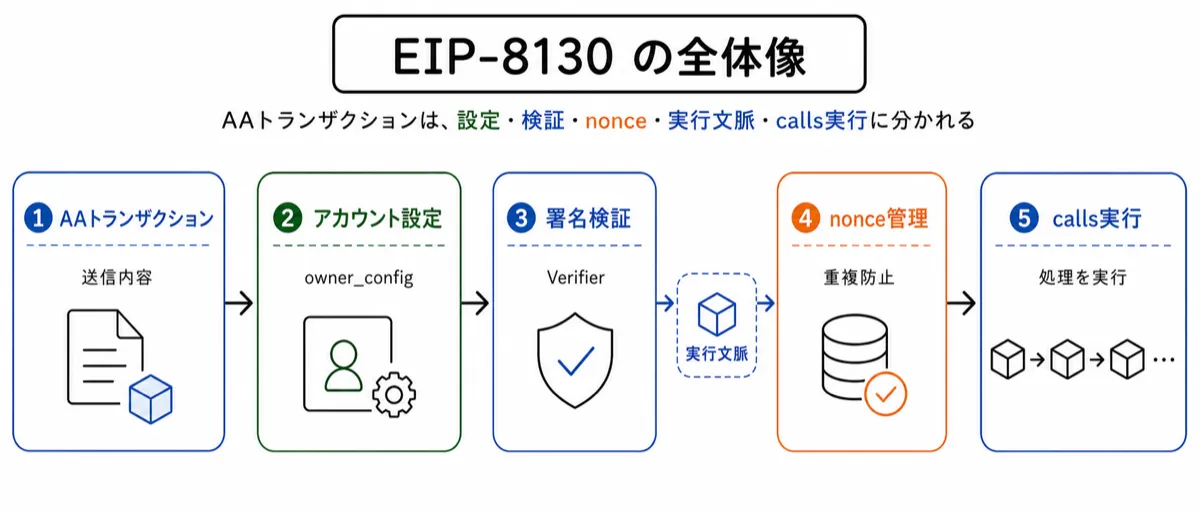
An AA transaction authenticates its owner using Account Configuration and the Verifier, manages its nonce through the Nonce Manager, and executes calls with information supplied through Transaction Context.
Instead of concentrating responsibility in wallet code, the proposal separates owner configuration, signature verification, nonce management, and execution context into protocol-level components.
This separation allows additional verification schemes, such as P-256, passkeys, multisignature authentication, and future post-quantum signatures, to be introduced alongside secp256k1 through Verifier contracts. Restricting mempool admission to a common set of verifiers helps nodes predict validation workloads.
Motivation
Existing account abstraction designs often delegate validation logic to wallet code. This can require nodes to simulate arbitrary EVM execution before admitting a transaction. Rejecting invalid transactions consequently requires additional mechanisms such as state-access tracking, execution traces, and reputation management.
EIP8130 moves validation from arbitrary wallet code to an explicitly identified Verifier.
Because the verification scheme is known in advance, nodes can accept approved verifiers and reject those outside their allowlist before executing their code.
Extending signature schemes
Ordinary Ethereum transactions use ECDSA signatures over secp256k1. Wallet authentication methods are no longer limited to this scheme. Passkeys, secure hardware on mobile devices, multisignature arrangements, organizational accounts, and future post-quantum signatures all motivate the ability to choose authentication schemes per account.
The proposal introduces signature schemes through Verifier contracts.
A verifier derives an ownerId from the signature data, and the protocol checks whether that owner ID is registered for the relevant account.
The protocol therefore does not need to encode each scheme's public-key format or verification procedure directly.
The boundary between wallets and nodes
Wallets need flexibility in authentication, while nodes need predictable validation costs to protect their mempools.
By identifying the Verifier explicitly, the design allows wallets to choose an authentication scheme and nodes to determine admissibility using a common verifier set.
This boundary helps reconcile wallet flexibility with predictable node operation. The objective is to bring account abstraction into the protocol without introducing unrestricted arbitrary-code execution into mempool validation.
Specification
Constants
The main values defined in the proposal are listed below.
Values marked TBD are intended to be determined as the proposal develops.
| Name | Value | Purpose |
|---|---|---|
AA_TX_TYPE |
TBD |
New EIP2718 transaction type |
AA_PAYER_TYPE |
TBD |
Identifier byte used for payer signature domain separation |
AA_BASE_COST |
15000 |
Base intrinsic gas cost of an AA transaction |
ACCOUNT_CONFIG_ADDRESS |
TBD |
Address of the account configuration contract |
ECRECOVER_VERIFIER |
address(1) |
Reserved address representing native ECDSA verification |
REVOKED_VERIFIER |
type(uint160).max |
Marker that revokes the implicit EOA owner |
NONCE_MANAGER_ADDRESS |
TBD |
Address of the nonce management precompile |
TX_CONTEXT_ADDRESS |
TBD |
Address of the transaction context precompile |
DEFAULT_ACCOUNT_ADDRESS |
TBD |
Default implementation for automatic EOA delegation |
DEPLOYMENT_HEADER_SIZE |
14 |
Deployment header size in bytes |
NONCE_KEY_MAX |
2^256 - 1 |
Special key representing nonce-free mode |
ECRECOVER_VERIFIER is not an ordinary verifier contract; it is a reserved value instructing the protocol to perform ECDSA verification directly.
It works with the implicit EOA owner rule so existing EOAs can use AA transactions without prior registration.
Account configuration
Each account registers its owners through the account configuration contract at ACCOUNT_CONFIG_ADDRESS.
An owner is identified by an ownerId.
The owner ID is a 32-byte identifier. Each verifier determines how to derive it from the relevant public-key material.
The owner configuration is packed into a single storage slot called owner_config.
| Field | Byte position | Purpose |
|---|---|---|
verifier |
0-19 |
Address of the verifier responsible for signature verification |
scope |
20 |
Authentication contexts in which the owner may be used |
reserved |
21-31 |
Reserved for future extensions; must be zero |
Packing one owner's configuration into one slot allows the protocol to read the values required for owner and permission checks with one SLOAD.
The public key itself is not stored. Instead, it is supplied as verifier-specific data during signature verification.
Avoiding persistent storage of large public keys limits state growth even for schemes such as post-quantum signatures with large public-key material.
Implicit EOA owners
Even for an account without an explicit registration, the EOA is treated as an implicit owner if ownerId == bytes32(bytes20(account)) under the native ECDSA verification rule.
Its scope is 0x00, allowing authentication in every context.
This rule enables existing EOAs to send AA transactions without registering an owner first.
To revoke the implicit EOA owner, the relevant slot is instead populated with REVOKED_VERIFIER.
This distinguishes an empty slot from one that has explicitly revoked the implicit owner.
Owner Scope
scope is a bitmask specifying the authentication contexts in which an owner is authorized.
0x00 indicates no scope restrictions; for nonzero values, only contexts with their corresponding bits set are authorized.
| Bit | Value | Name | Authentication context |
|---|---|---|---|
| 0 | 0x01 |
SIGNATURE |
ERC1271-compatible signature verification through verifySignature() |
| 1 | 0x02 |
SENDER |
Sender authentication through sender_auth |
| 2 | 0x04 |
PAYER |
Gas-payment authorization through payer_auth |
| 3 | 0x08 |
CONFIG |
Authorization for owner configuration changes |
For related contract-account signature verification mechanisms, see the following article.
[ERC6492] Verifying Signatures from Undeployed Contract Accounts
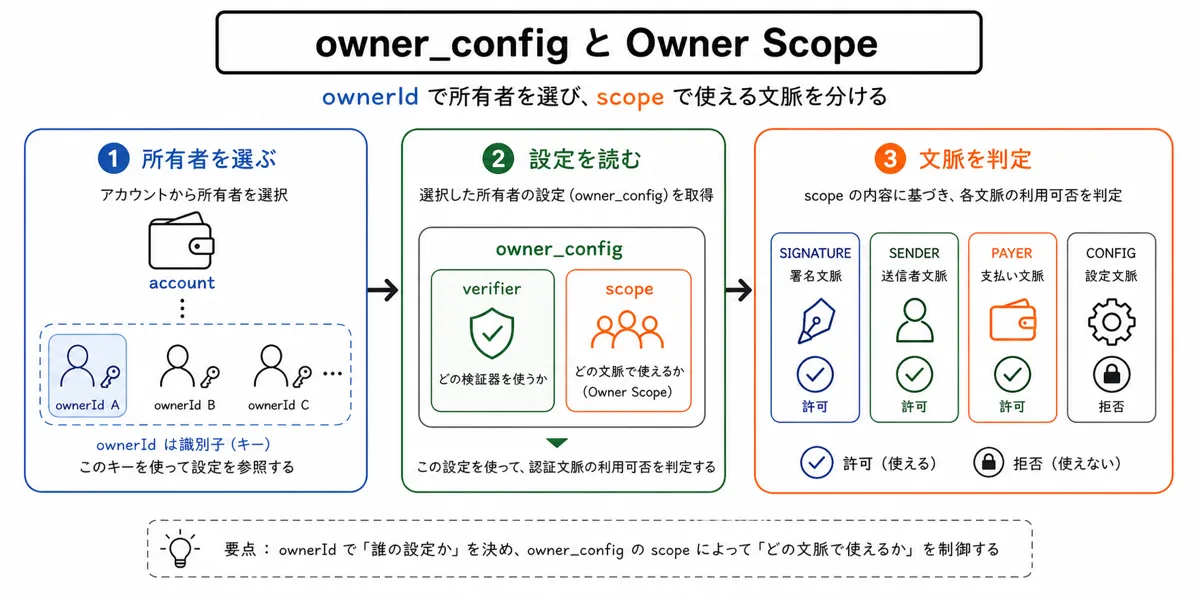
Even when an account has multiple owners, scope separates permissions for signature verification, transaction sending, gas payment, and configuration changes.
A verifier returns an ownerId; the protocol makes the final authorization decision using owner_config and scope.
For example, a dedicated gas-sponsorship owner may be assigned only the PAYER scope.
That owner can authorize gas payment, but cannot execute calls as the account's sender or modify its owner configuration.
Two-dimensional nonces
Nonces are managed by the precompile at NONCE_MANAGER_ADDRESS.
An AA transaction contains both a nonce_key and a nonce_sequence.
nonce_key |
Name | Purpose |
|---|---|---|
0 |
Standard channel | Ordinary sequential nonce; the usual mempool channel |
1 through NONCE_KEY_MAX - 1 |
User-defined channel | Independent parallel lanes managed by wallets |
NONCE_KEY_MAX |
Nonce-free mode | Does not read nonce state; uses a short expiry and transaction-hash deduplication to limit reuse |
The relationship between nonce_key and nonce_sequence is illustrated below.
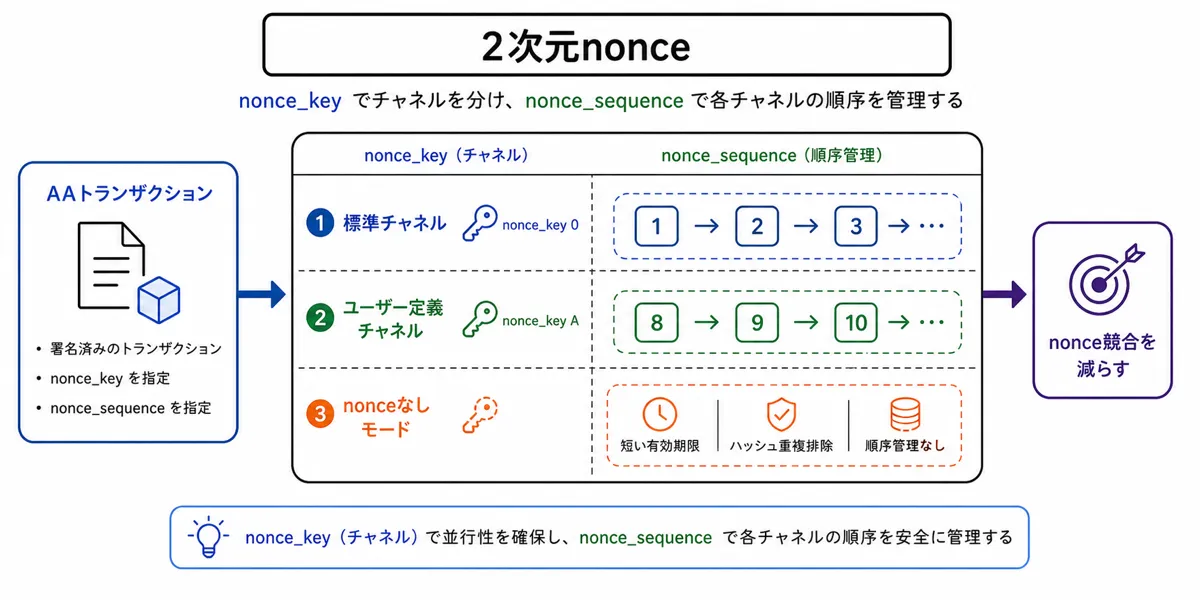
nonce_key selects an independent channel, and nonce_sequence manages ordering within that channel.
Nonce-free mode forgoes sequential ordering and instead relies on short validity periods and transaction-hash deduplication to limit reuse.
Using separate nonce keys can reduce nonce contention between different workflows. For example, assigning recurring payments and ordinary signed operations to separate channels can reduce the likelihood that pending transactions in one channel block the other.
When using NONCE_KEY_MAX, nonce_sequence must be 0.
The expiry field must also be nonzero.
Instead of using persistent nonce state, this mode uses a short expiry and mempool deduplication of identical transaction hashes to limit replay.
Account locking
An account can lock its owner configuration.
While locked, configuration changes through account_changes and through applySignedOwnerChanges() during EVM execution are rejected.
The lock state is packed into a single slot containing locked, unlock_delay, and unlocks_at.
Unlocking is delayed: initiateUnlock() first establishes an unlock timestamp, and configuration changes become permitted when block.timestamp >= unlocks_at.
Locking also matters for mempool validation. With a fixed owner set, nonce consumption becomes a principal factor invalidating previously validated transactions. This makes it easier for nodes to configure higher mempool limits for locked accounts.
Delegation indicators
EIP8130 uses the same delegation indicator as EIP7702.
When an account's code is 0xef0100 || target, the account is treated as delegating to the code at target.
For more about EIP7702, see the following article.
[EIP7702] Delegating EOA Execution to Smart Contract Code
When an operation requires executing code at a delegated account, the code at the target address is loaded.
If an EOA sends an AA transaction while its code is empty and neither creation nor delegation is specified, the protocol automatically delegates it to DEFAULT_ACCOUNT_ADDRESS.
This automatic delegation persists.
Verifier contracts
A Verifier is a contract responsible for verifying signatures.
Every verifier accepts a hash and signature data and returns the authenticated owner ID.
The minimal verifier interface is shown below.
interface IVerifier {
    function verify(
        bytes32 hash,
        bytes calldata data
    ) external view returns (bytes32 ownerId);
}
A return value of bytes32(0) is treated as an invalid signature.
The protocol looks up the returned ownerId in owner_config and checks whether the stored verifier matches.
The verifier executes through STATICCALL.
A delegated account cannot be used as a verifier.
The protocol rejects a verifier whose code starts with 0xef0100.
Common verifier set
Allowing arbitrary verifiers could lead to inconsistent transaction admission across nodes. The proposal therefore defines a common set of verifiers that conforming nodes must accept for admission.
The initial set is listed below.
| Name | Algorithm | Verifier |
|---|---|---|
k1 |
secp256k1 |
ECRECOVER_VERIFIER |
p256 |
P-256 | On-chain contract |
passkey |
WebAuthn / FIDO2 | On-chain contract |
delegate |
Signature delegation | On-chain contract |
For secp256k1, the protocol recognizes address(1) and performs ecrecover directly.
For other verifiers, it invokes the contract's verify() function.
Supported account types
EIP8130 supports three categories: existing EOAs, new accounts, and existing smart accounts.
| Account | Usage | Recovery or migration |
|---|---|---|
| Existing smart contract | Register owners in the account configuration contract | Use the recovery mechanism of the wallet implementation |
| EOA | Send AA transactions with the existing secp256k1 key |
Ordinary transactions and EIP7702 transactions remain available, subject to applicable authorization rules |
| New account | Create using the create entry in account_changes |
Configure initial owners and verifiers together |
Existing ERC4337 smart accounts can migrate without redeploying the account.
Use importAccount() to verify an ERC1271 signature and register initial owners, then update the wallet logic to use verifySignature() or getOwnerId().
Existing UserOperation flows through the EntryPoint can continue alongside AA transactions.
For more about ERC4337, see the following article.
[ERC4337] Account Abstraction Without Protocol Changes
AA transaction format
An AA transaction is an EIP2718 typed transaction beginning with AA_TX_TYPE.
Its structure is shown below.
AA_TX_TYPE || rlp([
  chain_id,
  sender,
  nonce_key,
  nonce_sequence,
  expiry,
  max_priority_fee_per_gas,
  max_fee_per_gas,
  gas_limit,
  account_changes,
  calls,
  payer,
  sender_auth,
  payer_auth
])

call = rlp([to, data])
The principal fields serve the following purposes.
| Field | Purpose |
|---|---|
chain_id |
Chain ID as defined by EIP155 |
sender |
Sending account; empty for native EOA signature recovery |
nonce_key |
Nonce channel |
nonce_sequence |
Expected sequence in the selected channel |
expiry |
Expiration time; 0 denotes no expiry |
gas_limit |
Gas limit for sender-side validation, intrinsic cost, configuration changes, and execution of calls |
account_changes |
Array of account creation, owner changes, and delegations |
calls |
Array of execution phases containing calls |
payer |
Empty for sender-funded gas; an address for sponsored gas |
sender_auth |
Sender authentication data |
payer_auth |
Payer authentication data |
For more about EIP155, see the following article.
[EIP155] Preventing Cross-Chain Replay of Ethereum Transactions
If sender is empty, sender_auth is a 65-byte ECDSA signature.
The protocol recovers the sender using ecrecover and treats ownerId as bytes32(bytes20(sender)).
If sender is present, sender_auth has the following byte layout.
sender_auth = verifier(20 bytes) || dataThe first 20 bytes specify the verifier; the remaining data contains verifier-specific authentication data.
For ECRECOVER_VERIFIER, data contains an ECDSA signature.
Signature verification
Verification proceeds in the following order.
- Resolve the sender.
If
senderis empty, recover it fromsender_authusingecrecover. Otherwise, interpret the first 20 bytes ofsender_authas the verifier address. - Establish the transaction context.
Make
sender,payer, andcallsavailable throughTX_CONTEXT_ADDRESS. - Verify the signature.
For native EOA signatures and
ECRECOVER_VERIFIER, the protocol performsecrecoverdirectly. Otherwise, invokeverifier.verify(hash, data)usingSTATICCALL. - Authorize the owner.
Read
owner_config(sender, ownerId)and check whether the stored verifier matches. An empty slot authorizes the owner only if the implicit EOA owner rule is satisfied. - Check the scope.
Require
SENDERforsender_auth,PAYERforpayer_auth,SIGNATUREforverifySignature(), andCONFIGfor configuration changes.
The implicit EOA owner rule is available only through native ECDSA signature verification.
An arbitrary verifier cannot authenticate an unregistered EOA simply by returning bytes32(bytes20(sender)).
This prevents malicious verifiers from claiming ownership of unconfigured EOAs.
Signature hashes
Sender and payer signatures are domain-separated using distinct identifier bytes. This prevents reuse of the same signature across sender and payer authentication contexts.
The sender signature covers the transaction body excluding sender_auth and payer_auth.
keccak256(AA_TX_TYPE || rlp([
  chain_id,
  sender,
  nonce_key,
  nonce_sequence,
  expiry,
  max_priority_fee_per_gas,
  max_fee_per_gas,
  gas_limit,
  account_changes,
  calls,
  payer
]))
The payer signature uses AA_PAYER_TYPE and excludes payer and both authentication data fields.
keccak256(AA_PAYER_TYPE || rlp([
  chain_id,
  sender,
  nonce_key,
  nonce_sequence,
  expiry,
  max_priority_fee_per_gas,
  max_fee_per_gas,
  gas_limit,
  account_changes,
  calls
]))
For native EOA signature recovery, the encoded transaction's sender field is empty.
When constructing the payer signature hash, however, insert the recovered sender address in the sender position.
Without the resolved sender, payer authorization could be replayed by another EOA whose transaction has matching nonce fields, fees, and calls.
The responsibilities of sender and payer authentication are illustrated below.
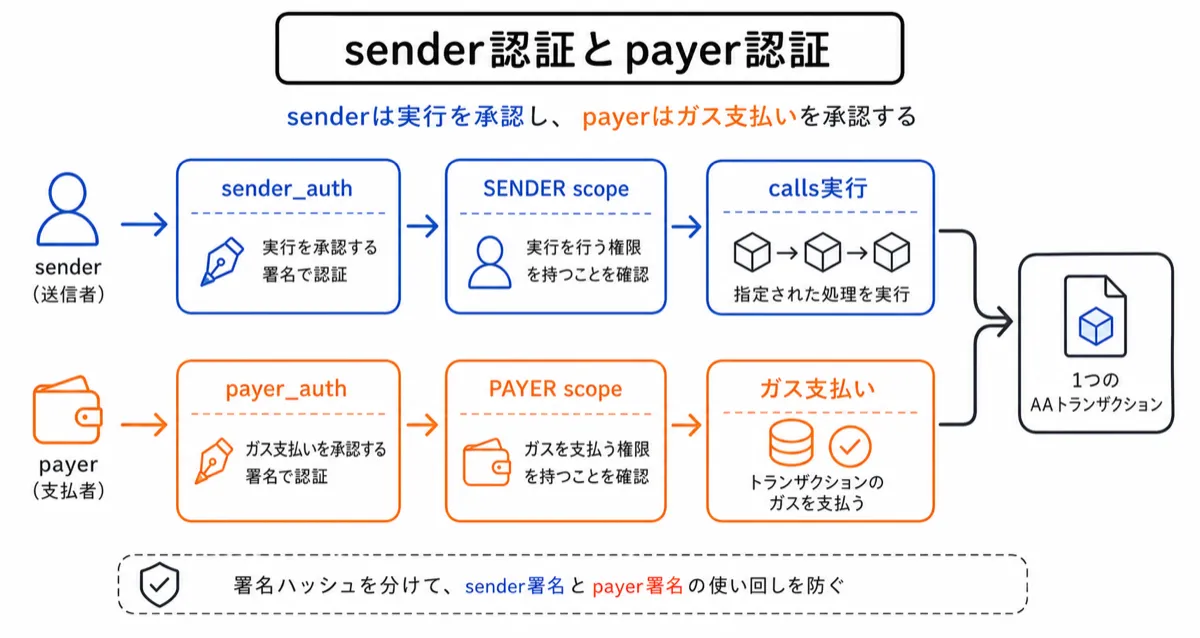
sender_auth authorizes execution of calls, while payer_auth authorizes gas payment.
Separate scopes and signing hashes keep execution authority distinct from payment authority.
Gas payment
Gas payment is determined by payer and payer_auth.
payer |
payer_auth |
Funding account |
|---|---|---|
| Empty | Empty | The sender pays for its own transaction |
| 20-byte address | `verifier |
For sponsored gas, read the payer's owner_config and verify payer_auth in the PAYER context.
Payer authentication costs are measured separately from the sender's gas_limit, so the payer's choice of verifier does not reduce the gas available for the calls.
The sender's signature includes the chosen payer. A different payer therefore cannot be substituted arbitrarily after the sender signs.
account_changes
account_changes is an array of account state changes applied before call execution.
It contains three types of entries.
| Type | Name | Purpose |
|---|---|---|
0x00 |
create | Create a new account and register its initial owners |
0x01 |
config change | Add or remove owners |
0x02 |
delegation | Configure EIP7702-style code delegation |
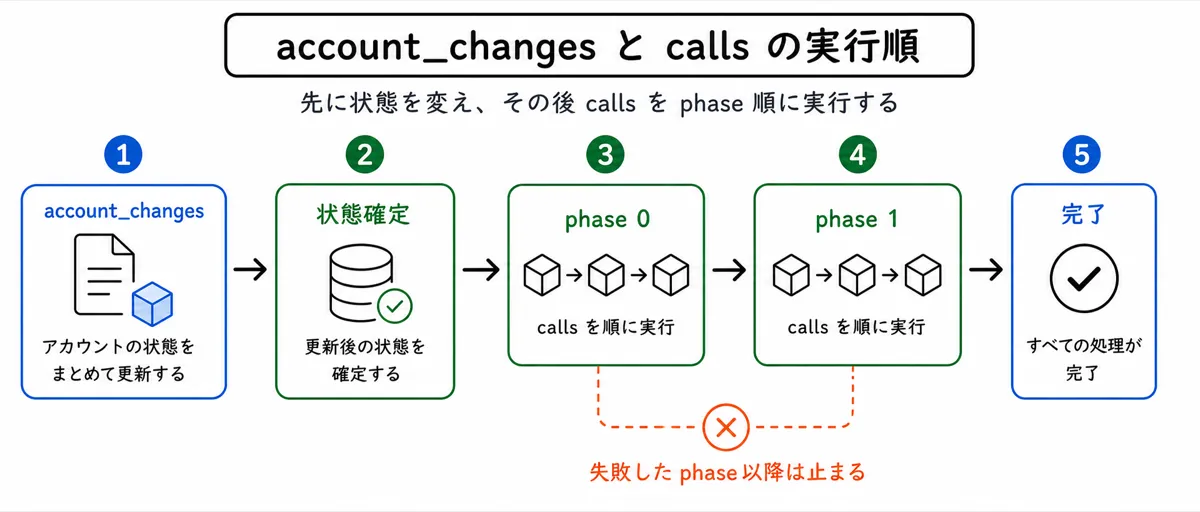
account_changes is processed before calls.
Account creation, owner configuration changes, delegation, and code installation precede the execution of calls grouped into phases.
The create entry
A create entry creates a new smart account within a single transaction.
The format is shown below.
rlp([
  0x00,
  user_salt,
  runtimeBytecode,
  initial_owners
])
initial_owners is an array of [verifier, ownerId, scope] entries.
The account address is derived in CREATE2 style using ACCOUNT_CONFIG_ADDRESS as the deployer.
The initial owners are sorted by ownerId before being included in the hash.
This makes address derivation independent of the supplied ordering of the same owner set.
sorted_owners = sort(initial_owners, by: ownerId)
owners_commitment = keccak256(ownerId_0 || verifier_0 || scope_0 || ...)
effective_salt = keccak256(user_salt || owners_commitment)
address = keccak256(
  0xff || ACCOUNT_CONFIG_ADDRESS || effective_salt || keccak256(deployment_code)
)[12:]
runtimeBytecode is installed directly at the account address.
Deployment does not execute initialization code. Any required initialization is performed through subsequent calls.
The config change entry
A config change entry describes additions or removals of owners.
The format is shown below.
rlp([
  0x01,
  chain_id,
  sequence,
  owner_changes,
  auth
])
If chain_id is 0, the same signed change may be used on multiple chains.
A specific chain ID restricts the change to that chain.
Both forms advance sequence, establishing the order of owner configuration changes.
The entries in owner_changes have the following meanings.
change_type |
Name | Value used |
|---|---|---|
0x01 |
authorizeOwner |
verifier、ownerId、scope |
0x02 |
revokeOwner |
ownerId |
auth is verified against the owner configuration effective when the change is applied.
When multiple configuration changes are supplied, each subsequent authorization is verified against the state produced by preceding changes.
The signer must have the CONFIG scope.
The delegation entry
A delegation entry configures EIP7702-style code delegation for the sender account.
rlp([
  0x02,
  target
])
A target of address(0) clears the delegation, leaving the account without delegated code.
Delegation is allowed only when the account has no code or when its existing code is a delegation indicator beginning with 0xef0100.
This entry cannot overwrite ordinary smart contract code.
The entry is authorized through sender_auth.
Only the sender's implicit EOA owner with the CONFIG scope may authorize it.
On chains without EIP8130, ordinary EIP7702 transactions perform the corresponding delegation.
Executing calls
After processing account_changes, the protocol executes calls.
Each call is dispatched directly to the target address on behalf of the sender.
| Parameter | Value |
|---|---|
from |
sender |
to |
call.to |
tx.origin |
sender |
msg.sender observed by the target |
sender |
msg.value |
0 |
data |
call.data |
The calls do not include an ETH value field.
To transfer ETH, wallet code uses the CALL opcode.
The protocol does not directly move ETH on behalf of the sender as part of a call's parameters.
calls is an array of execution phases.
Calls within a phase execute atomically. If any call reverts, all state changes within that phase are discarded.
Phases after the reverting phase are not executed.
However, state changes from previously successful phases remain.
Common execution patterns include the following.
| Execution pattern | Example | Behavior |
|---|---|---|
| Single call | [[{to, data}]] |
Execute one call in one phase |
| Atomic batch | [[call_a, call_b, call_c]] |
All calls succeed or the phase reverts |
| Sponsor payment followed by user operations | [[sponsor_payment], [user_action_a, user_action_b]] |
Execute phase 1 atomically after the payment in phase 0 succeeds |
Transaction Context
The precompile at TX_CONTEXT_ADDRESS exposes read-only information about the current AA transaction.
Verifiers and wallet code can retrieve only the context information they need.
Its principal functions are shown below.
struct Call {
    address to;
    bytes data;
}

interface ITxContext {
    function getSender() external view returns (address);
    function getPayer() external view returns (address);
    function getOwnerId() external view returns (bytes32);
    function getCalls() external view returns (Call[][] memory);
    function getMaxCost() external view returns (uint256);
    function getGasLimit() external view returns (uint256);
}getSender(), getPayer(), getCalls(), getMaxCost(), and getGasLimit() are available during both validation and execution.
getOwnerId() is available only during execution, after the authenticated owner has been determined.
On chains without EIP8130, no code is installed at this address. The call therefore has no precompile-provided context. The proposal assumes zero-valued context for portability, and verifiers that require an EIP8130 context should fail when it is unavailable.
Portability
The proposal considers both chains supporting EIP8130 and chains without it. The following table summarizes how the components are used.
| Component | EIP8130 chain | Chain without EIP8130 |
|---|---|---|
Account Configuration Contract |
The protocol reads storage directly; the EVM interface is also available | Operates as an ordinary smart contract |
Verifier |
The protocol invokes it using STATICCALL |
Invoked by wallet or account configuration contracts |
| Code delegation | The delegation entry in account_changes |
Ordinary EIP7702 transaction |
Transaction Context |
Precompile exposes transaction context | No precompile context; zero-value fallback assumed by the proposal |
Nonce Manager |
Managed through a precompile | Existing mechanisms such as the ERC4337 EntryPoint |
Deploying the relevant contracts at deterministic CREATE2 addresses facilitates using the same management infrastructure across chains.
Mempool validation
A node follows the steps below when admitting a transaction to its mempool.
- Check the structure.
Parse
sender_authand verify that there is at most onecreateentry, that it appears first if present, and that there is at most onedelegationentry. - Resolve the sender.
Use the supplied sender, or recover it from
sender_authwithecrecoverif the field is empty. - Determine the effective owner state.
Use initial owners if a
createentry is present; otherwise, read the account configuration storage. - Check configuration changes and delegation. Verify that the account is not locked where required and that the current code permits delegation.
- Verify sender authentication.
Check that the resolved owner has the
SENDERscope. If adelegationentry is present, the owner must also satisfy the implicit EOA rule and have theCONFIGscope. - Resolve the payer.
For self-funded gas, check the sender's balance. For sponsored gas, check the payer's
owner_configandPAYERscope. - Check the nonce, balance, and expiry.
For a standard nonce, require the current nonce to match
nonce_sequence. For nonce-free mode, require a short expiry and deduplicate identical hashes. - Check the mempool capacity limit. Verify that the number of pending transactions associated with each gas payer remains within the node's configured limit.
Nodes maintain an allowlist that includes the common verifier set. Accepting additional verifiers can introduce inconsistent admission policies across nodes, so the proposal recommends not extending that set.
Block execution
AA transactions included in a block are processed in the following order.
- Check lock state and delegation conditions.
If
account_changescontains configuration changes or delegation, verify that the sender is not locked. - Charge gas to the payer. Charge the sender for self-funded gas or the specified payer for sponsored gas.
- Advance the nonce.
If
nonce_key != NONCE_KEY_MAX, increment the nonce for(sender, nonce_key). - Apply automatic delegation if needed.
If the sender has no code and neither a
createnordelegationentry is present, delegate it toDEFAULT_ACCOUNT_ADDRESS. - Process
account_changes. Apply creation, configuration changes, delegation, and code installation in the specified order. - Establish the transaction context.
Make
sender,payer,ownerId, andcallsavailable throughTransaction Context. - Execute calls. Follow the phase-level revert rules.
Unused gas is refunded to the payer.
When configuration changes, account creation, or delegation succeeds, the protocol injects logs such as OwnerAuthorized, AccountCreated, and DelegationApplied into the receipt.
These protocol-injected logs are emitted only for EIP8130 transactions.
RPC extensions
eth_getTransactionCount is extended to accept an optional nonceKey.
This permits queries for nonces outside the standard channel.
The receipt includes the following fields.
| Field | Purpose |
|---|---|
payer |
Gas payer: the sender for self-funded gas or the specified payer for sponsored gas |
status |
0x01 if every phase succeeds; 0x00 if any phase reverts |
phaseStatuses |
Array indicating the success or failure of each phase |
Existing tools that interpret status == 1 as success retain that behavior when all phases succeed.
phaseStatuses provides the per-phase details.
Additional considerations
Why use verifier contracts?
A verifier is an extension point for signature schemes. For contract-based verification schemes, the protocol need not implement the algorithm-specific procedure for verifying a signature against a public key. It handles the owner ID returned by the verifier. Adding such a scheme therefore need not introduce an algorithm-specific branch into the protocol.
Permission separation is enforced through scope, not by the verifier itself.
The protocol can enforce contexts such as SENDER, PAYER, and CONFIG independently of the verifier's cooperation.
Why implement the Nonce Manager as a precompile?
Nonces are updated by almost every AA transaction. Owner configurations, in contrast, change relatively infrequently. The design separates nonces from ordinary account configuration storage by placing nonce management in a dedicated precompile.
Only the read-only getNonce() operation is exposed to the EVM.
The protocol writes nonce updates directly during AA transaction processing.
interface INonceManager {
    function getNonce(address account, uint256 nonceKey) external view returns (uint64);
}
Why do calls omit value?
Calls in AA transactions contain only to and data, with msg.value always set to 0.
To send ETH, the account's wallet code performs a CALL.
The protocol does not move the sender's ETH directly through the call parameters. ETH transfer policy remains with the wallet code, while the AA transaction structure focuses on the call sequence and authentication.
Why is owner scope necessary?
Without scope, every registered owner would have the same permissions.
This would prevent separation of owners for signature verification, transaction sending, gas sponsorship, and owner configuration changes.
For example, a wallet could use a passkey for everyday operations, a hardware key for configuration changes, and another payer key solely for gas-payment authorization.
scope is the bitmask enforcing these responsibilities at the protocol level.
Why avoid storing public keys?
Storing public keys on-chain increases persistent storage per owner. P-256 keys are comparatively small, but large post-quantum public keys could consume substantial storage for a single owner.
EIP8130 stores only the ownership identifier and its associated verifier and scope configuration.
Public-key material is included in the authentication data, from which the verifier derives the owner ID.
Keeping the public-key material in calldata rather than persistent storage limits state growth.
Compatibility
Existing EOAs and smart contracts remain supported. AA functionality is opt-in.
EOAs can continue sending ordinary transactions.
When sending an AA transaction for the first time, an EOA may be automatically delegated to DEFAULT_ACCOUNT_ADDRESS when applicable.
To choose a delegation target, use the delegation entry in account_changes or an ordinary EIP7702 transaction, subject to the relevant authorization rules.
ERC4337 infrastructure also remains usable.
By registering owners and integrating verifySignature(), existing smart accounts can support both native AA transactions and ERC4337 UserOperations.
The account configuration and verifier contracts can also be used on chains without EIP8130.
However, because Transaction Context and Nonce Manager are protocol-level features, reproducing the same behavior completely requires a chain supporting EIP8130.
Reference implementation
The proposal provides interfaces named IAccountConfiguration, IVerifier, ITxContext, and INonceManager.
The main interfaces are excerpted here.
IAccountConfiguration covers account creation, owner configuration changes, locking, signature verification, and configuration queries.
interface IAccountConfiguration {
    struct OwnerConfig {
        address verifier;
        uint8 scopes;
    }

    struct Owner {
        bytes32 ownerId;
        OwnerConfig config;
    }

    struct OwnerChange {
        bytes32 ownerId;
        uint8 changeType;
        bytes configData;
    }

    event OwnerAuthorized(address indexed account, bytes32 indexed ownerId, OwnerConfig config);
    event OwnerRevoked(address indexed account, bytes32 indexed ownerId);
    event AccountCreated(address indexed account, bytes32 userSalt, bytes32 codeHash);
    event DelegationApplied(address indexed account, address target);

    function createAccount(
        bytes32 userSalt,
        bytes calldata bytecode,
        Owner[] calldata initialOwners
    ) external returns (address);

    function applySignedOwnerChanges(
        address account,
        uint64 chainId,
        OwnerChange[] calldata ownerChanges,
        bytes calldata auth
    ) external;

    function verifySignature(
        address account,
        bytes32 hash,
        bytes calldata signature
    ) external view returns (bool verified);

    function getOwnerConfig(
        address account,
        bytes32 ownerId
    ) external view returns (OwnerConfig memory);
}
createAccount() derives the account address using its initial owners and installs the runtime bytecode.
applySignedOwnerChanges() provides a portable EVM-based mechanism for applying signed owner changes.
verifySignature() supports ERC1271-compatible signature verification.
IVerifier is a compact interface.
Differences between signature schemes are encapsulated in data.
interface IVerifier {
    function verify(
        bytes32 hash,
        bytes calldata data
    ) external view returns (bytes32 ownerId);
}
This minimal interface facilitates adding signature schemes.
A new authentication mechanism can implement verify() with the same return format, leaving the protocol to perform the owner_config and scope checks.
Security
Validation
For a stateless verifier, the principal causes of invalidation of previously validated transactions include revocation of owner_config and nonce consumption.
For a state-dependent verifier, changes to the state it reads can also invalidate transactions.
Tracking those dependencies remains a mempool concern.
Replay protection
AA transactions contain chain_id, a two-dimensional nonce, and expiry.
For ordinary nonces, verify nonce_sequence for each (sender, nonce_key) pair.
Because nonce-free mode does not use nonce state, short validity periods and deduplication of identical hashes are important.
Block builders must not include duplicate nonce-free transactions with identical hashes. Nodes are also expected to reject nonce-free transactions with excessively long validity periods from their mempools.
Owner Scope
The protocol checks scope after executing the verifier.
Returning an owner ID cannot grant authority beyond its registered scope.
Separating payer owners from sender owners is particularly important.
An owner with only PAYER authority can authorize gas payment but cannot execute operations as the sender.
An owner with only SENDER authority can execute operations but cannot authorize gas sponsorship for another party in the payer context.
The implicit EOA rule
Implicit EOA ownership is recognized only through native secp256k1 signature verification.
This applies when recovering the sender from sender_auth using ecrecover or when using ECRECOVER_VERIFIER.
Allowing an arbitrary verifier to authenticate an unregistered EOA merely by returning bytes32(bytes20(sender)) would allow unauthorized authentication.
The proposal limits the implicit EOA rule to native ECDSA verification, closing that avenue of unauthorized authentication.
Payer signature reuse
Sender and payer signatures are domain-separated by AA_TX_TYPE and AA_PAYER_TYPE.
The payer signing hash also includes the resolved sender address.
For native EOA signature recovery, the encoded sender field is empty, but the payer signing hash uses the recovered sender.
Omitting the resolved sender would permit cross-account reuse of payer authorization for transactions with matching nonce fields, fees, and calls.
Including the resolved sender in the hash binds the payer's approval to that particular sender.
Account creation
The create entry commits to initial_owners through the salt.
This prevents a different initial owner set from being installed at the same derived account address merely by reusing the same user_salt and code.
Wallet bytecode must be safe to install before initialization.
Because a create entry directly installs runtime bytecode, any required initialization is handled through subsequent calls.
Conclusion
This article examined EIP8130, which proposes account abstraction through on-chain account configuration and a new transaction type.
EIP8130 separates account abstraction validation from wallet code into verifiers, owner_config, scopes, two-dimensional nonces, and payer authentication.
It seeks to make validation costs more predictable before transaction admission while allowing wallets to introduce authentication methods such as passkeys and post-quantum signatures.
Its migration mechanisms for existing EOAs and ERC4337 smart accounts make it a significant proposal for bringing account abstraction closer to native protocol functionality.
I also publish articles on the following platforms.




