Introduction
Hi, I'm cardene, a software engineer and technical writer focused on blockchain and AI.
I've also authored Japanese technical books on specification-driven development with LLMs and decentralized application (DApp) development.

I also build and publish a variety of tools, libraries, and open-source projects.
ERC-8152 makes it easier to deploy the logic modules a proxy uses at the same address on different chains. The address is derived from the runtime bytecode itself. In upgradeable designs such as Diamond and UUPS, this gives teams a way to reuse and verify the same logic without tracking different implementation addresses on each chain.
This article walks through the proposal below.

I also cover other EIPs, BIPs, SLIPs, CAIPs, ENSIPs, RFCs, and ACPs.





Overview
ERC-8152 standardizes logic called through a proxy's delegatecall as Content-Addressable Logic Modules (CALM).
A logic module's address serves as a cryptographic commitment to its runtime bytecode. Identical bytecode can therefore be deployed at the same address on different EVM chains, making it easier to find the same module across chains.
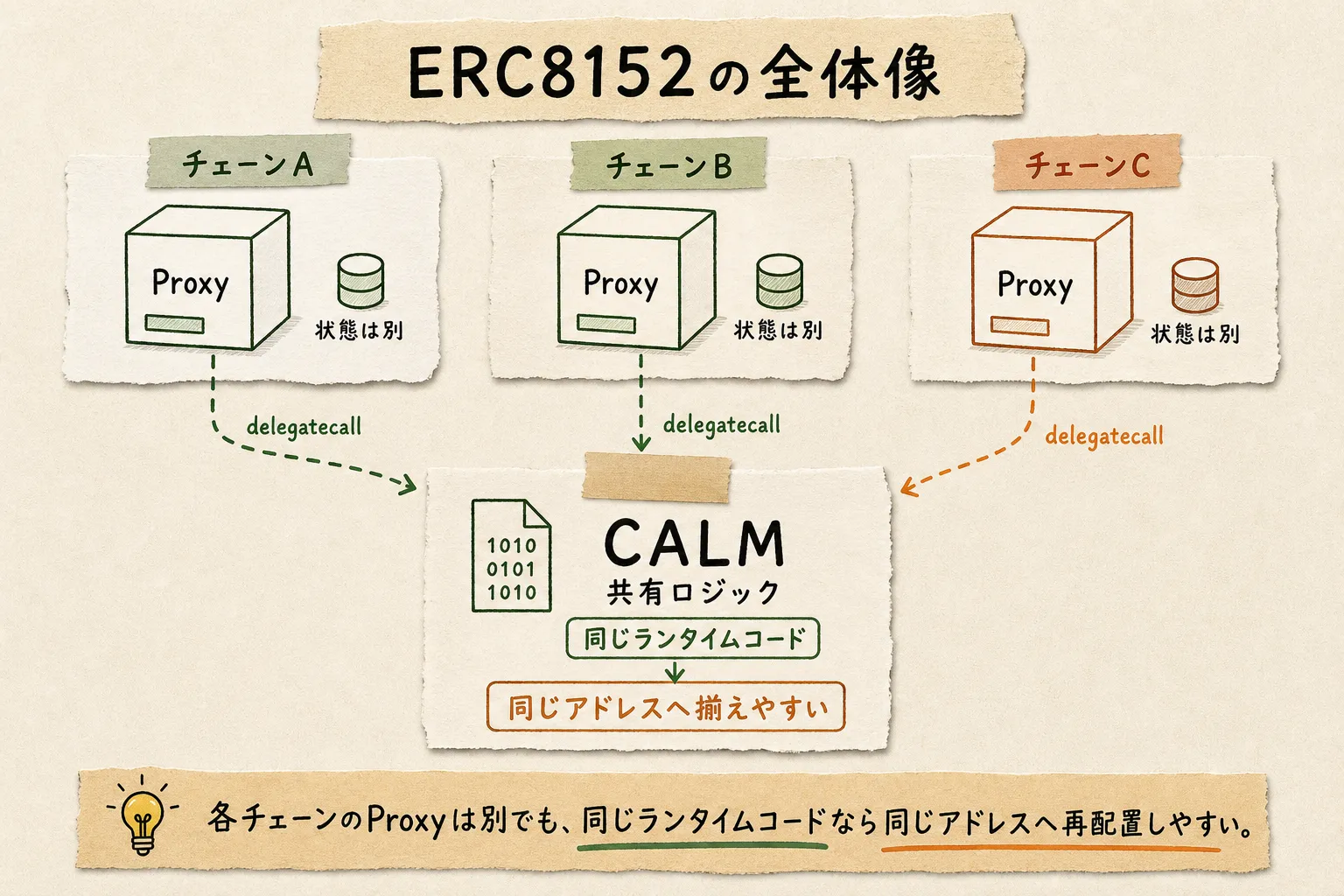
The diagrams retain their Japanese labels. The first diagram shows how different chains can have different proxies while sharing logic at the same address.
CALM works with existing proxy designs and storage isolation schemes. These related standards serve the following roles.
| Standard | Role |
|---|---|
| ERC-2535 | Defines the Diamond pattern, which routes calls to different pieces of logic called facets. |
| ERC-8153 | A related proposal for facet-based Diamonds. |
| ERC-8167 | Defines a Modular Dispatch Proxy for assigning modules by selector. |
| ERC-1822 | Defines the UUPS pattern for replacing the implementation contract. |
For more on ERC-2535, see the article below.
[ERC-2535] 💎 How the Diamond Pattern Works
For more on ERC-1822, see the article below.
[ERC-1822] How Contract Upgrades Work in the UUPS Pattern
Conventional libraries and facets often have different addresses across chains or deployments even when they implement the same behavior. This complicates reuse of audited logic, cross-chain verification, and tracking copies of the same implementation.
ERC-8152 avoids features such as constructors, immutables, and SELFDESTRUCT, which can affect address reproducibility or code persistence. The result is a module whose runtime bytecode acts as its identity, so teams can share logic based on the code itself.
Motivation
Existing proxies can spread identical logic across different addresses
In Diamond and UUPS designs, users interact with a proxy that delegates execution to facets or an implementation contract. This works well for upgrades and separating functionality, but deploying the same logic to multiple chains does not guarantee that it will receive the same address.
An implementation audited on one chain may appear at a different address on another even if it comes from the same source. Operators have to manage deployment addresses per chain, while integrators must verify that each address contains the expected code.
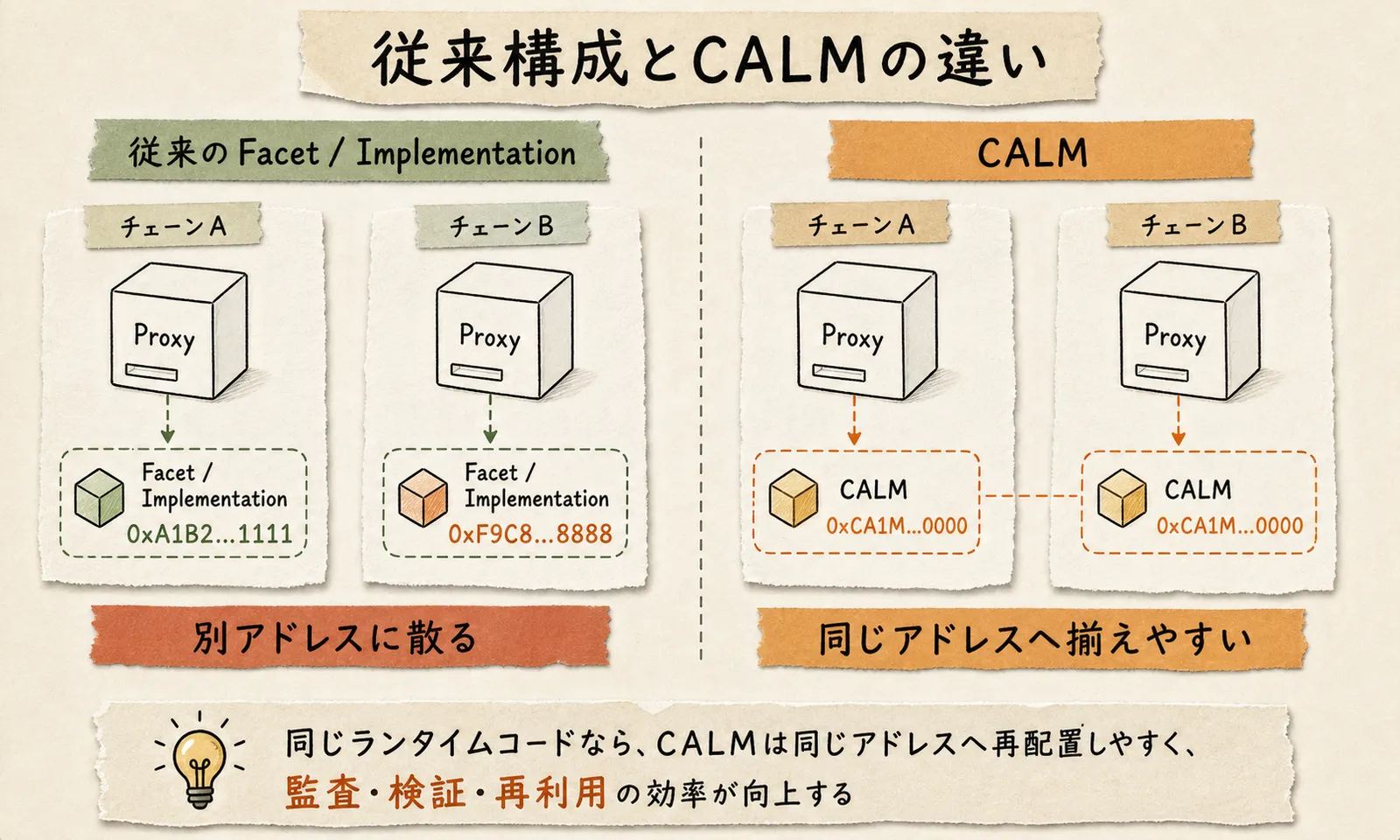
On the left, each chain has its own implementation address to track. On the right, runtime bytecode gives users a way to find shared logic at the same address.
Problems CALM aims to solve
ERC-8152 addresses four main problems.
- Reuse identical logic at the same address. When runtime code is identical, deploying it at a common address makes it easier to track across EVM chains.
- Simplify cross-chain verification. Integrators can check that logic at a given address is the same on mainnet and on an L2.
- Make audit results easier to reuse. Teams can track a shared module instead of managing an audit target that appears at different addresses in each deployment.
- Explore execution and gas benefits of sharing. The proposal considers future improvements to address warming and more efficient code caching in nodes.
Why runtime bytecode is the basis for addressing
Runtime bytecode is what actually executes on-chain. Source code and contract names are insufficient to identify it. Constructor behavior and different immutable values can lead to different deployed code or addresses even when two implementations look similar.
Sharing logic at a common address therefore requires minimizing what varies at deployment time. The constraints below help keep the deployed module reproducible.
Specification
Specification update: The current ERC requires deterministic storage offsets and requires the logic contract address to be derived from runtime bytecode. The translated discussion below reflects the wording of the Japanese article.
CALM execution model
CALM is designed to run as a logic module in the proxy's storage context. A call through delegatecall updates the proxy's state instead of storing state at the CALM module's address.
The specification does not require checks that prevent the module from having storage of its own. When used with a proxy, however, the module is expected to access the proxy's state safely.
Storage isolation
CALM modules should use deterministic storage offsets to avoid collisions. Namespaces or agreed slots make it clear which areas a module accesses.
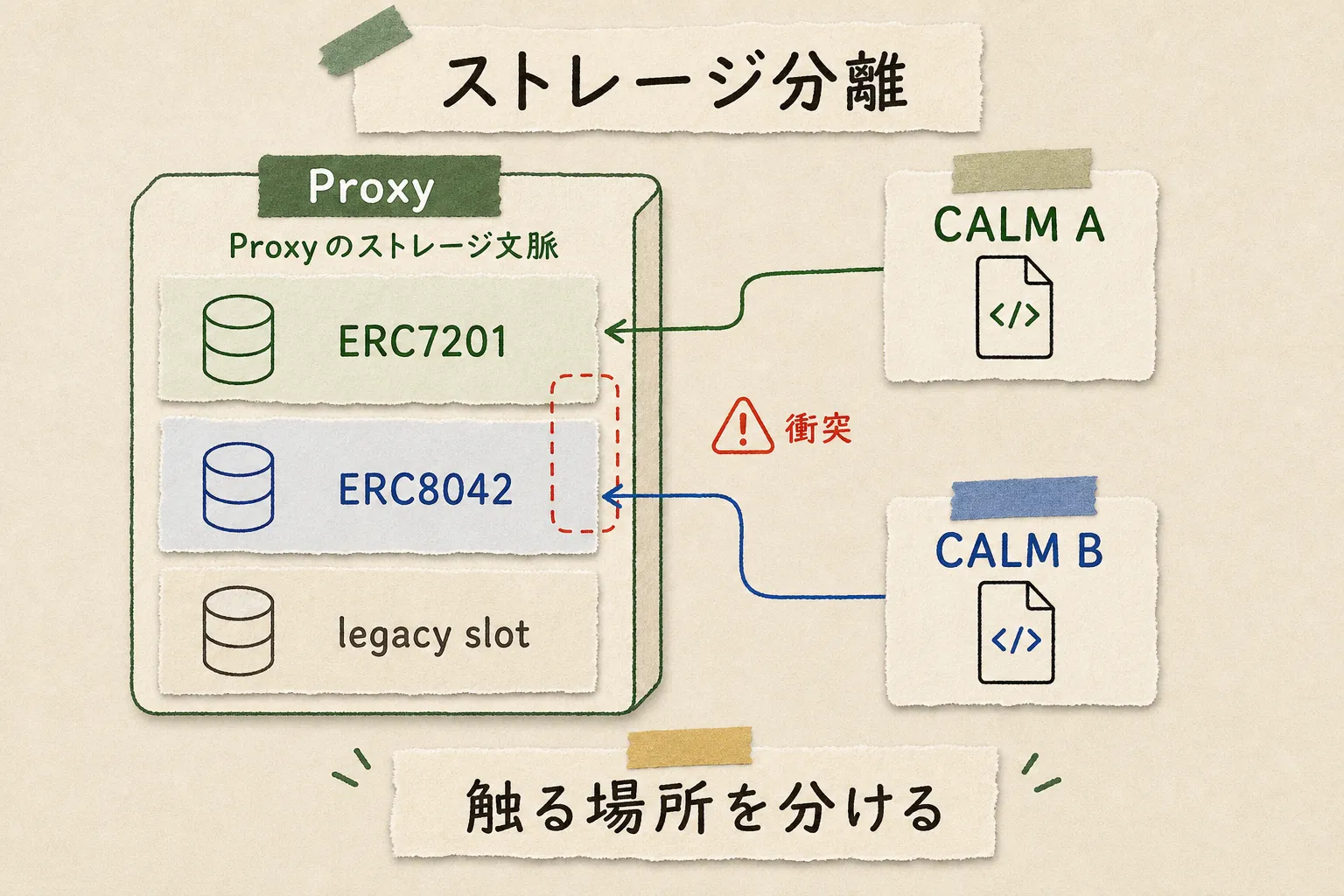
The diagram shows why modules must agree on which area of proxy storage they access instead of maintaining module-local state.
ERC-7201 defines namespaced storage, while ERC-8042 proposes standardizing Diamond Storage.
For more on ERC-7201, see the article below.
[ERC-7201] How Namespaced Storage Works
For more on ERC-8042, see the article below.
[ERC-8042] Defining Diamond Storage Locations with Human-Readable Strings
Namespaced isolation is generally the safer approach. The proposal also allows legacy storage layouts starting at slot zero for compatibility with existing proxies.
In either case, integrators need to know which slots a module affects. Otherwise, replacing a module can corrupt state. ERC-8152 emphasizes this point and encourages disclosing storage impact in the Impact Manifest described below.
Deployment constraints
A conforming CALM module must meet several constraints at deployment.
No constructor logic
CALM initcode must do nothing beyond deploying the runtime bytecode. Constructor side effects cannot be reproduced simply by redeploying the runtime bytecode at the same address on another chain.
Deployment therefore puts the finished runtime code in place without performing state initialization or branching on deployment-time conditions.
No immutables
Immutable values are embedded in runtime code at deployment. Changing a value changes the bytecode hash and can produce a different address.
Because ERC-8152 uses bytecode identity to establish module identity, it excludes deployment-specific differences such as immutables.
Redeployment at the same address
A CALM address should be derived from publicly known constants and the runtime bytecode. The proposal expresses this relationship conceptually as follows.
address = function(<publicly known constants>, runtimeBytecode)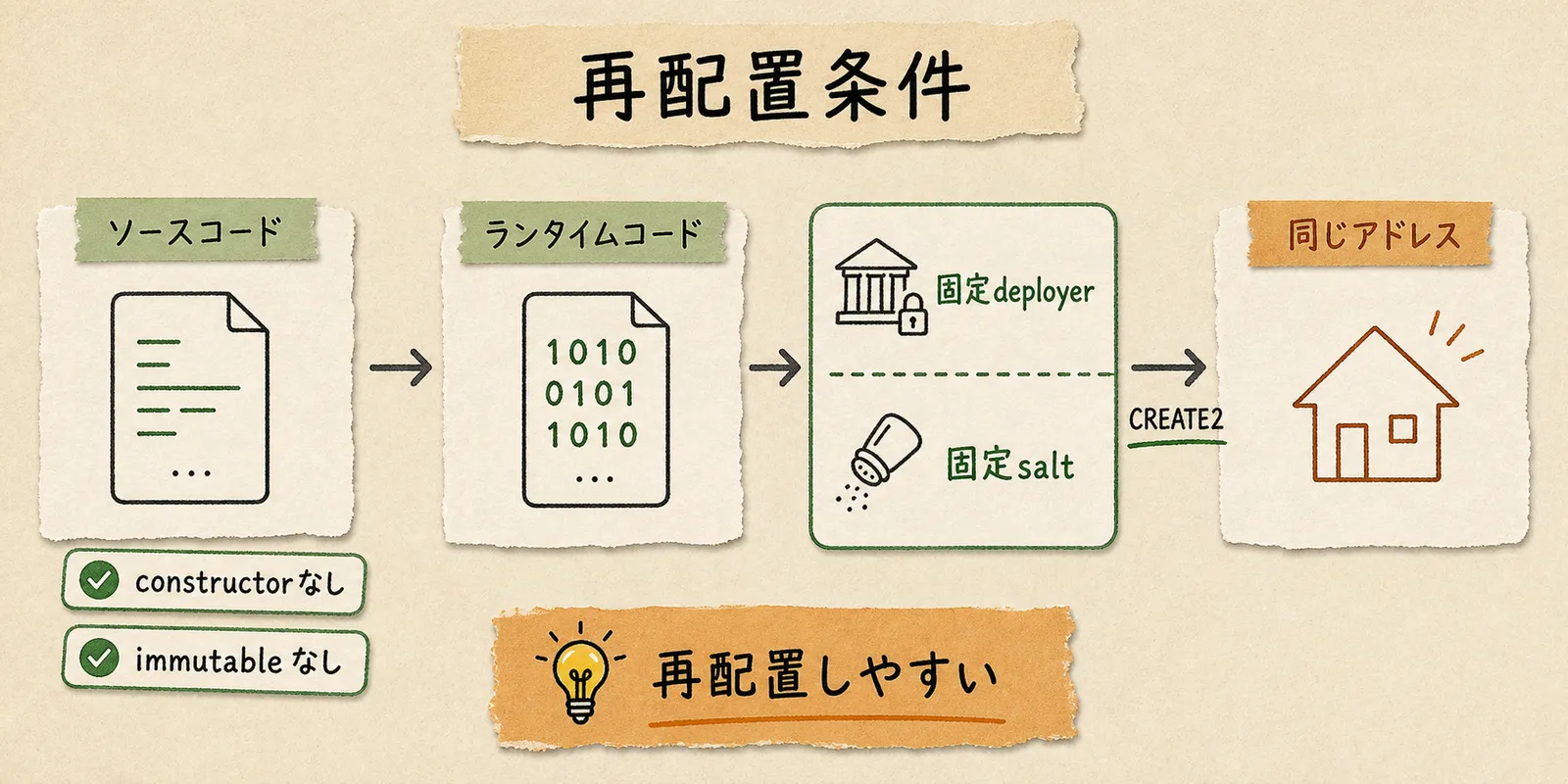
The diagram shows how fixed deployment inputs and the runtime bytecode produce the same address without constructor logic or immutables. Examples of publicly known constants include a fixed salt, fixed micro-constructor bytecode, and a deployer contract that can be deployed at the same address on different chains. What matters is that anyone can use the same inputs to reproduce the deployment.
Anyone who finds useful logic on one chain can therefore deploy a copy at the same address on another. They do not need a specific operator to perform the deployment. This makes audited modules easier to reuse and track across chains.
Runtime constraints
No SELFDESTRUCT
CALM must not contain SELFDESTRUCT. It must also avoid calling contracts that contain that instruction through delegatecall.
A module that can disappear is a poor long-term dependency for a proxy. The proposal discusses EIP-6049 and EIP-6780 and favors logic that can be referenced persistently despite differences among chains.
No direct access to module-local storage
CALM acts as a stateless module that operates on proxy state. Relying on storage at the module's own address would change the meaning of its logic when invoked through a proxy.
This constraint formalizes conventions already familiar from facets and library-style logic.
Capability and Impact Manifest
The proposal introduces a Capability and Impact Manifest. A CALM header or NatSpec can describe the storage a module accesses, its external dependencies, and the EVM features it needs. The proposal anticipates a separate standard that would formalize the schema.
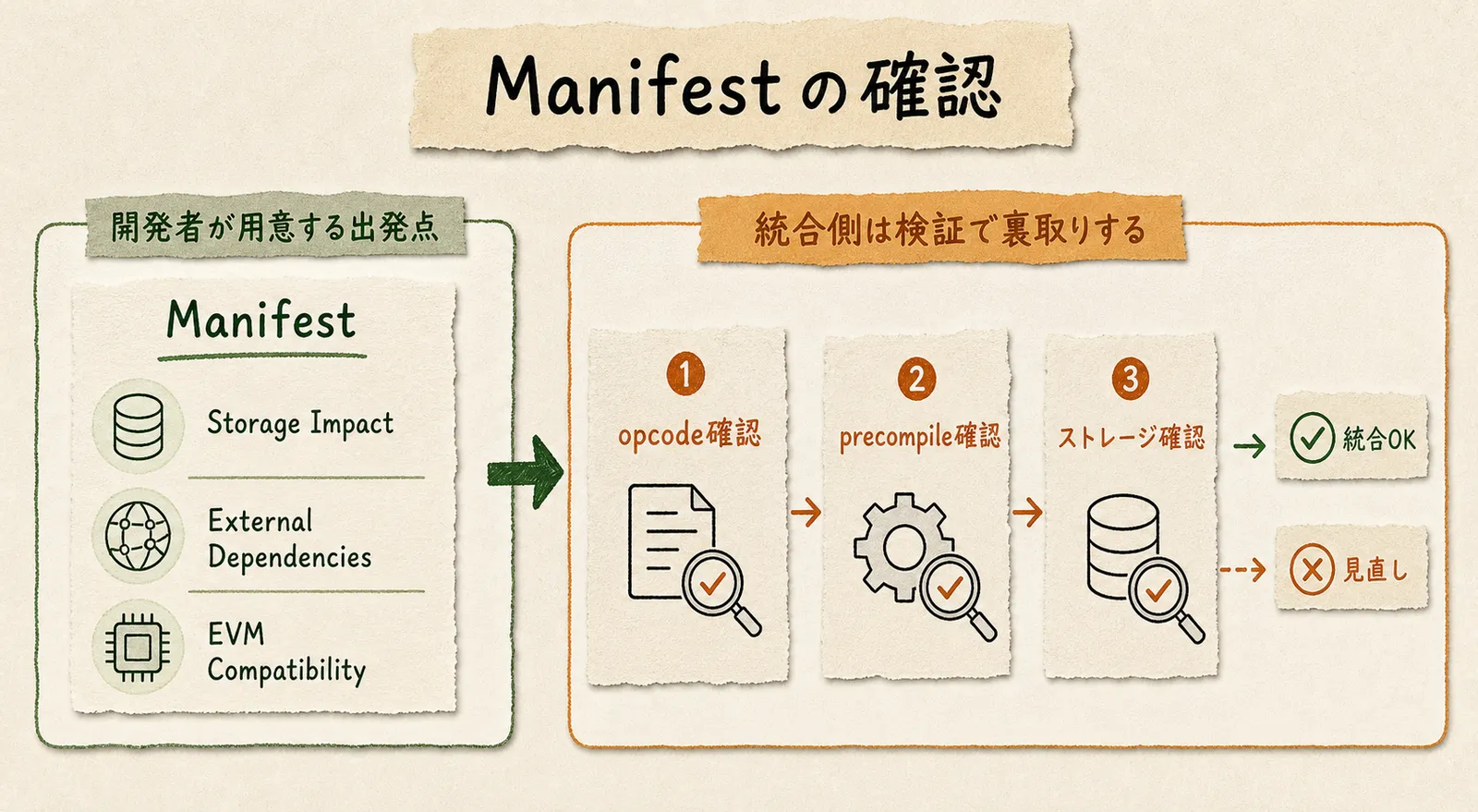
| Item | What to document |
|---|---|
| Storage Impact | Namespaces, slots, and areas of storage the module accesses |
| External Dependencies | Dependencies on external contracts, DELEGATECALL, or deterministic factories |
| EVM Compatibility | Required opcode extensions, precompiles, or hard forks |
The manifest is a declaration by the module's developer. Integrators should confirm it through static analysis or other verification tools.
Dispatch models
ERC-8152 describes two execution models, one grouping multiple functions into a module and one assigning a single piece of logic to each selector.
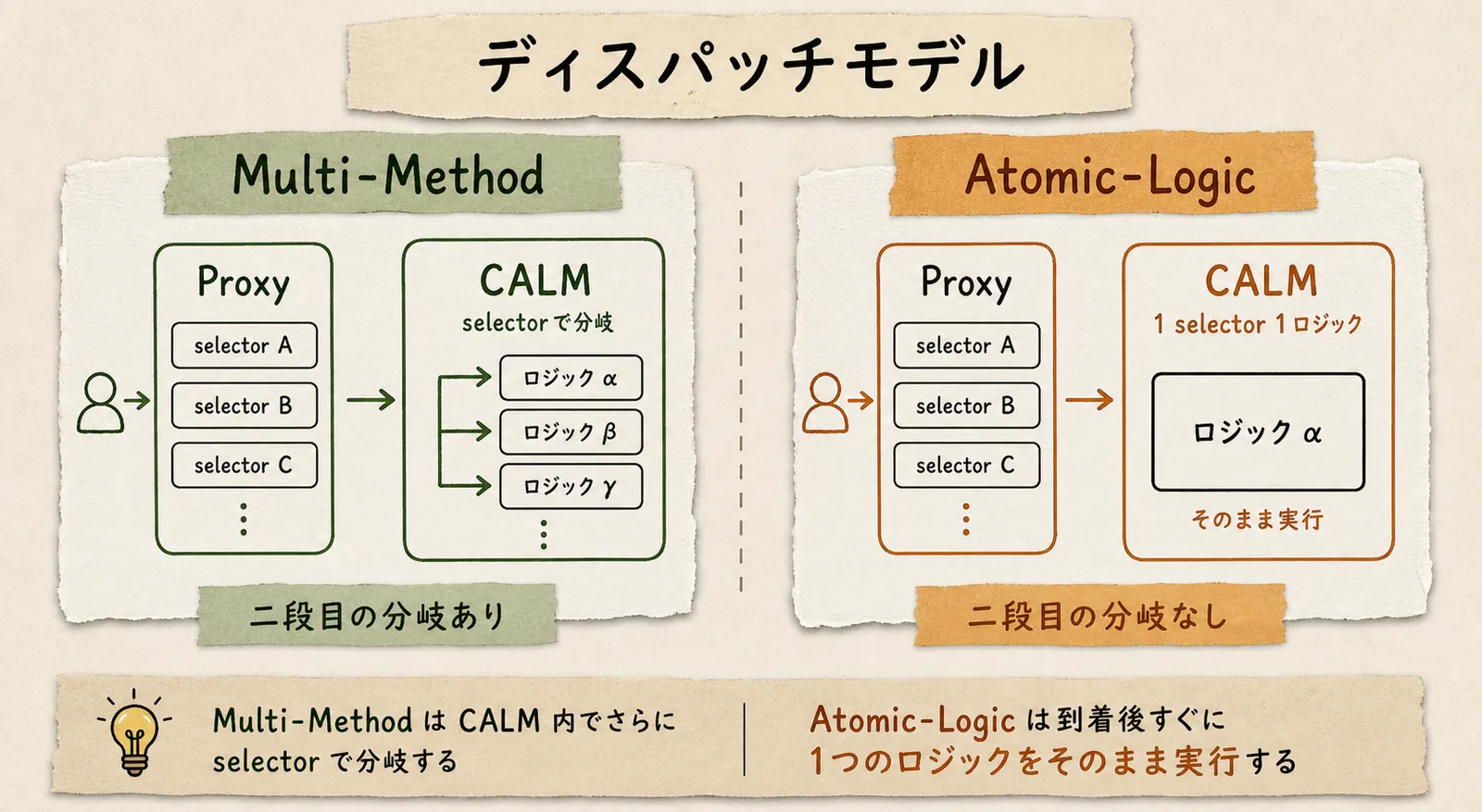
| Model | Description | Suitable uses |
|---|---|---|
| Multi-Method | An internal dispatcher selects a function using msg.sig, as in a conventional Solidity contract. |
Facets that group related functions |
| Atomic-Logic | The module skips internal selector dispatch and implements one operation in fallback(). |
Single-purpose logic that needs to stay as small as possible |
A Diamond proxy normally calls a facet using delegatecall, and the facet then branches again on the selector. That second dispatch is redundant for a facet containing a single operation.
Mapping a selector directly to a CALM module with one operation lets it start executing immediately. This is similar to a single-function facet.
Additional considerations
Why sharing logic can affect gas and execution efficiency
One potential benefit depends on a future improvement to address warming, such as EIP-7863. If an earlier call warms a CALM address within a block, later transactions in the same block could benefit.
Existing clients can already cache frequently used bytecode. Consolidating identical logic at a shared address rather than scattering it across addresses can improve cache efficiency.
The proposal does not promise immediate, large gas savings. Its argument is that shared implementation addresses could reduce operational and execution costs over time.
Keeping or removing metadata
Solidity compilers normally append CBOR metadata to runtime bytecode. The metadata includes information about the source, ABI, and compiler settings. A change as small as editing a comment can therefore change the final bytecode.
For CALM, this creates a trade-off. The following diagram compares the options and distinguishes verification from validation.
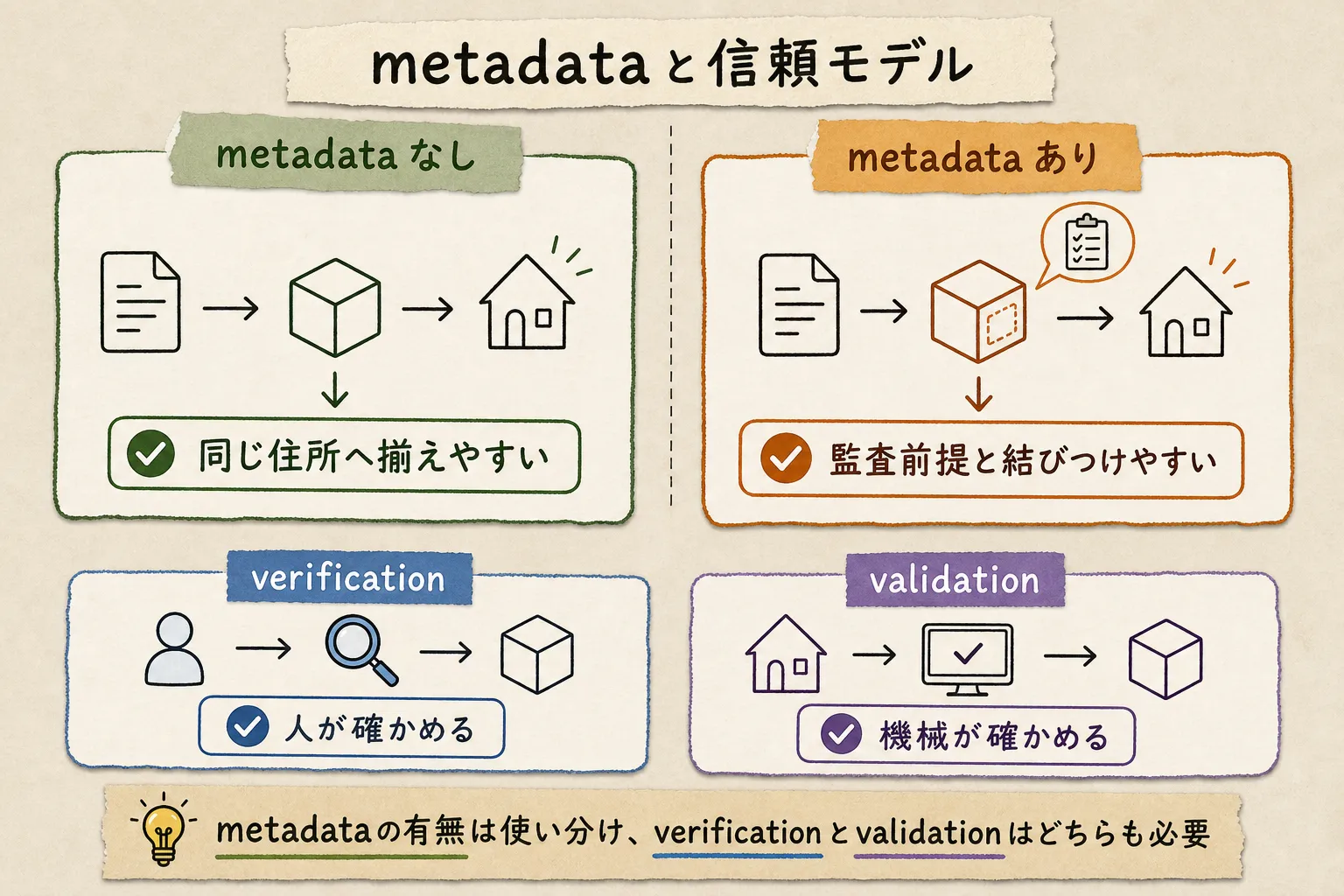
- Remove metadata. This makes it easier to derive an address from the logic itself.
- Keep metadata. This makes it easier to bind source comments, audit assumptions, and compiler settings to the address.
The proposal leaves the choice open. A simple module can omit metadata to make sharing easier. A more sophisticated, security-critical module can keep it to prioritize integrity.
Verification and validation
- Verification checks whether the stated source produces the deployed binary.
- Validation checks whether the address directly commits to the expected bytecode.
Verification helps readers trust what they see in the source. Validation provides a mechanically checkable link between address and bytecode. ERC-8152 calls for both, as they answer different questions.
Compatibility
ERC-8152 is compatible with common proxy architectures. The proposal lists ERC-2535, ERC-8153, ERC-8167, ERC-1822, and ERC-1167.
Integrators still need to align the storage isolation scheme, the selector-to-CALM mapping, and the chain features the modules require.
Mixing ERC-7201 and ERC-8042 warrants particular care. Modules that expect to access the same logical state can read different slots if their storage layout rules differ.
Reference implementation
The proposal illustrates the smallest form of an Atomic-Logic module with a module that only returns a value for decimals().
The first example is a Solidity implementation with only a fallback() function.
// SPDX-License-Identifier: MIT
pragma solidity 0.8.33;

contract Decimals_Const18_Optimized {
    fallback() external payable {
        assembly {
            mstore(0x00, 0x12)
            return(0x00, 0x20)
        }
    }
}
It returns 18 as the value of decimals(). Returning directly from fallback() skips the extra work of selector dispatch in a conventional function definition.
The sample compiler settings omit CBOR metadata and enable aggressive optimization.
[profile.default]
via_ir = true
optimizer_runs = 20_000_000
bytecode_hash = "none"
cbor_metadata = false
evm_version = "shanghai"
The resulting example runtime bytecode is 0x60125f5260205ff3. The proposal explains that the HashCarve Factory can reproduce the module at the same address on different chains.
A Vyper implementation of the same behavior can produce different bytecode and therefore a different address. ERC-8152 gives identical runtime bytecode a predictable address. It does not treat equivalent behavior as identical code.
Security considerations
Storage collisions
A CALM module operates directly on proxy state. Storage collisions are therefore a primary risk.
Two modules can use the same slot for different purposes, or modules following ERC-7201 and ERC-8042 can disagree on where the same logical state lives. Both can corrupt state. Reviewing an individual module is insufficient to catch these interactions, so integrators need to review the full proxy configuration.
Relying too heavily on manifests
An Impact Manifest is self-reported. A declaration that a module leaves storage untouched does not guarantee that the runtime bytecode does so.
Integrators should use static analysis or symbolic execution to check the following.
- Whether the module depends on opcodes the chain does not support.
- Whether it accesses undeclared storage or external dependencies.
- Whether it contains
SELFDESTRUCTor unsafedelegatecallpaths.
Misleading metadata or source descriptions
Even when source verification succeeds, comments or variable names can mislead readers. The proposal suggests that higher-risk modules can retain CBOR metadata to bind audit assumptions to the address.
Omitting metadata can improve reuse, but integrators also need to decide how much information for human verification they want to bind to the address.
Conclusion
ERC-8152 treats proxy logic as shared modules identified by runtime bytecode. It avoids constructors and immutables, calls for documenting storage impact and EVM dependencies, and makes it easier to redeploy identical logic at the same address. This helps teams verify and reuse code across chains. Integrators still need to review storage collisions, check manifest claims, and choose how to handle metadata.
Find more of my writing here.