Introduction
Hi, I'm cardene, a software engineer and technical writer focused on blockchain and AI.
I've also authored Japanese technical books on specification-driven development with LLMs and decentralized application (DApp) development.

I also build and publish a variety of tools, libraries, and open-source projects.
Background
ERC-8161 extends ERC-7540 so that a pending position from an asynchronous request can be transferred to another address.
This article walks through the proposal below.

I also cover other EIPs, BIPs, SLIPs, CAIPs, ENSIPs, RFCs, and ACPs.





Overview
ERC-8161 extends ERC-7540 to allow another controller to take over the balance of an asynchronous deposit or redemption request while the balance is in the Pending state.
Under ERC-7540, a request created through requestDeposit or requestRedeem advances through Pending, Claimable, and Claimed. ERC-7540 provides no direct way to move the pending position if a user changes wallets or wants to assign it to another account. ERC-8161 adds that option.
For background on ERC-7540, see the following article.
[ERC-7540] How ERC-4626 vaults separate deposit and redemption requests from execution
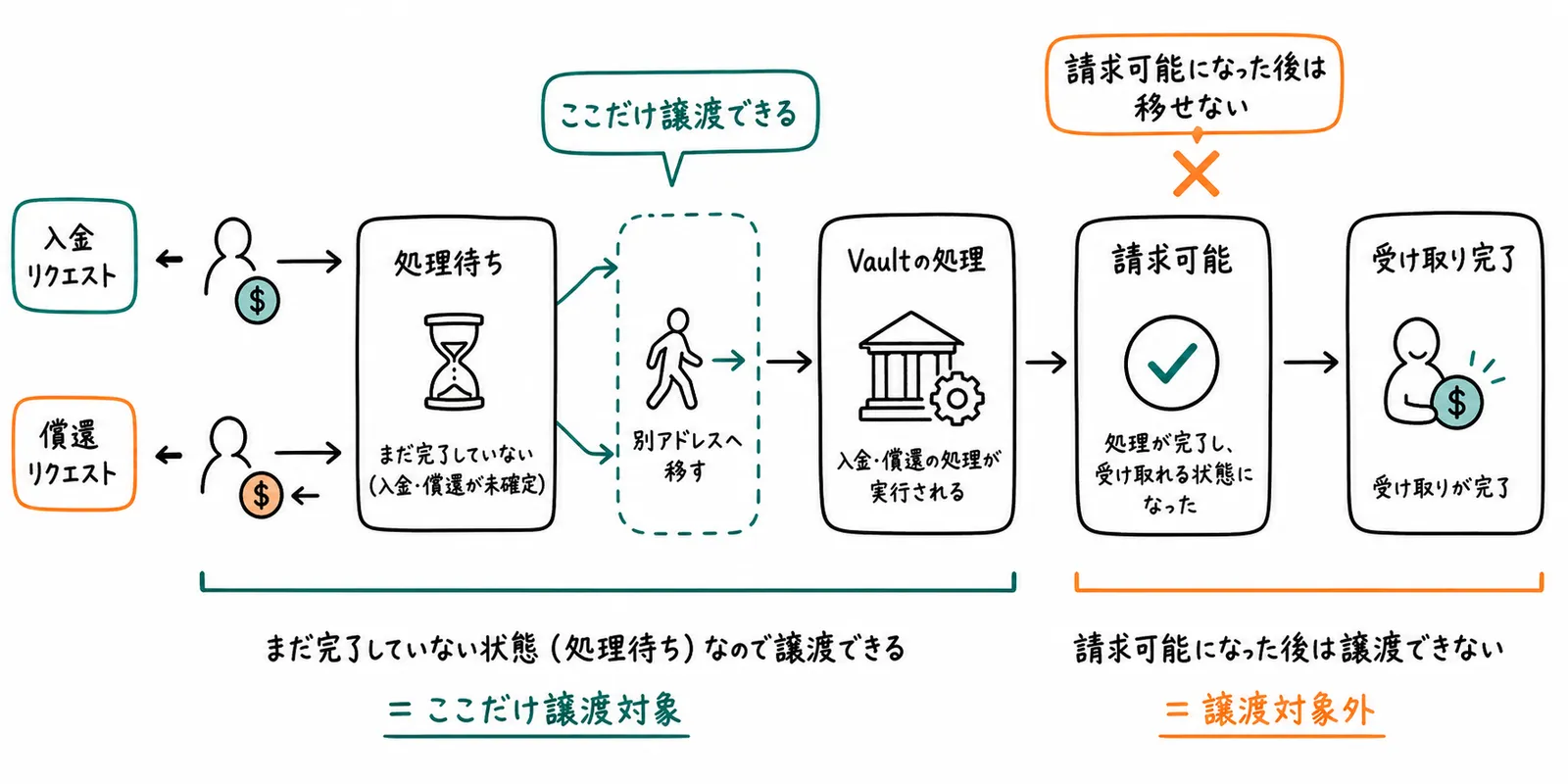
The diagrams retain their Japanese labels. The transfer is available only while the balance is Pending. A balance that has become Claimable can already be claimed and is outside ERC-8161's scope.
Motivation
Requests in an ERC-7540 asynchronous vault can remain Pending for a long time. Waiting periods are common in vaults that hold real-world assets, take time to process redemptions, or require liquidation or review.
This can create problems for users. If a user migrates to another wallet address, pending requests remain with the old controller. Separating accounts for bookkeeping or passing a pending position to another protocol is also difficult with ERC-7540 alone.
ERC-8161 allows users to move the pending balance itself without cancelling and resubmitting a request. That makes wallet migration, account reorganization, and handoffs of pending positions easier.
Why define deposit and redemption transfers separately?
ERC-8161 defines separate interfaces for deposit and redemption transfers. This follows ERC-7540, which lets vaults implement asynchronous deposits and asynchronous redemptions independently.
For a deposit request, the underlying assets are often already in the vault. For a redemption request, the accounting can vary by implementation. For example, the shares may already have been burned or may only be locked temporarily. A vault may therefore choose to support transfers on just one side.
| Implementation | Behavior |
|---|---|
| Deposits only | Implement only IERC7540DepositTransferable |
| Redemptions only | Implement only IERC7540RedeemTransferable |
| Both | Implement both interfaces |
| Neither | Continue operating as an ERC-7540 vault |
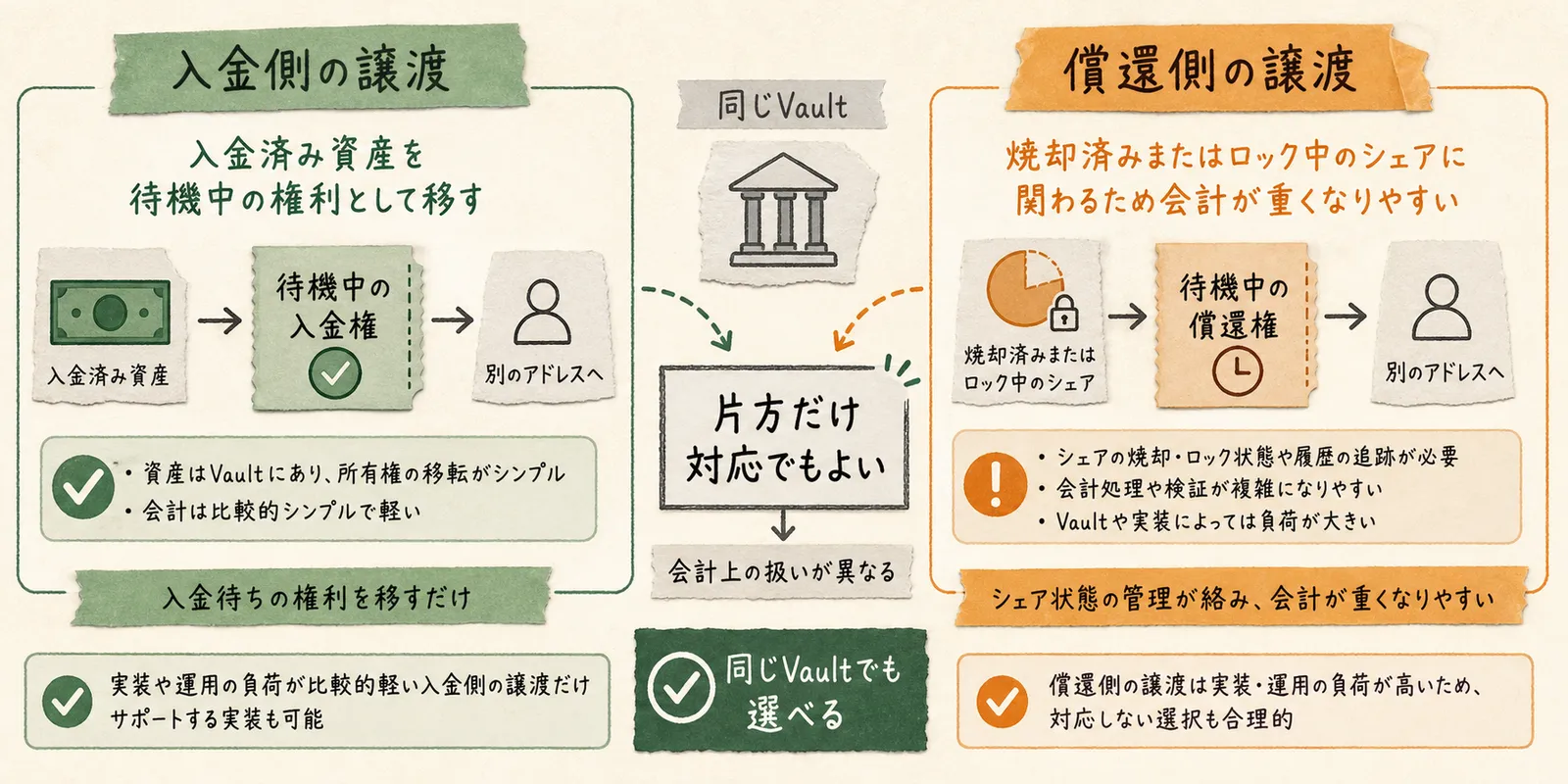
Both operations transfer rights that are still pending. They differ in how the vault accounts for and restricts the underlying assets or shares. The proposal allows a vault to support either operation independently.
Specification
Specification update: In the current ERC, both transfer events shown below include an additional non-indexed
address senderparameter. Redeem proceeds are also credited after deducting any fees. The examples below are preserved from the Japanese article.
The proposal defines which balance can move and then specifies two interfaces, one for deposits and one for redemptions. A transfer method reassigns the ERC-7540 pending balance identified by a requestId and controller from the old controller to the new one.
Which balance moves?
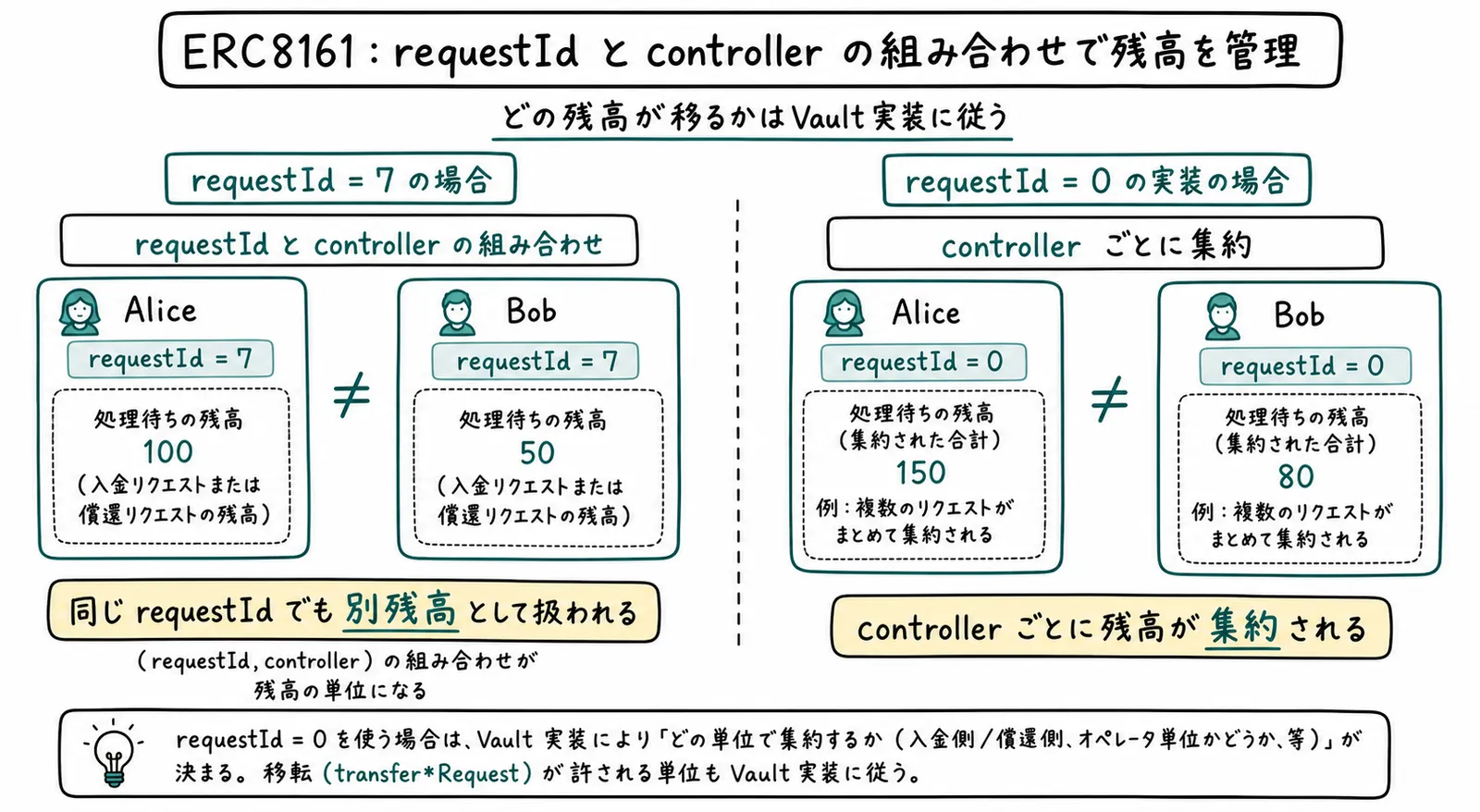
ERC-7540 tracks requests with different controller values separately, even when they share a requestId. ERC-8161 follows the same identification scheme. It moves the Pending balance identified by requestId and oldController to newController.
Some ERC-7540 implementations always return requestId == 0. They aggregate pending balances by controller rather than splitting them by request ID. The balance that moves under ERC-8161 follows the identification rules of the vault's ERC-7540 implementation.
A balance created by requestDeposit or requestRedeem can move while it is Pending. Once the vault processes the request and the balance becomes Claimable, the normal claim flow applies.
The same transfer method can therefore operate at different levels of granularity depending on the vault's ERC-7540 implementation. ERC-8161 uses the vault's existing rules for grouping pending balances. An integration must determine whether the vault tracks positions by the requestId and controller pair, as on the left, or aggregates them by controller, as on the right.
IERC7540DepositTransferable
A vault that supports transferring deposit requests implements IERC7540DepositTransferable. The interface adds one method and one event.
interface IERC7540DepositTransferable {
    event TransferDepositRequest(uint256 indexed requestId, address indexed from, address indexed to);

    function transferDepositRequest(
        uint256 requestId,
        address oldController,
        address newController
    ) external;
}
transferDepositRequest
This call transfers the entire pending deposit request balance for the specified requestId from oldController to newController. It moves the full balance that is pending at the time of the call.
- Parameters
| Parameter | Type | Meaning |
|---|---|---|
requestId |
uint256 |
Identifier of the request to transfer |
oldController |
address |
Controller that currently holds the pending balance |
newController |
address |
Controller receiving the balance |
After execution, pendingDepositRequest(requestId, oldController) decreases, and pendingDepositRequest(requestId, newController) increases by the same amount or by that amount less any fee the vault deducts, as allowed by the proposal.
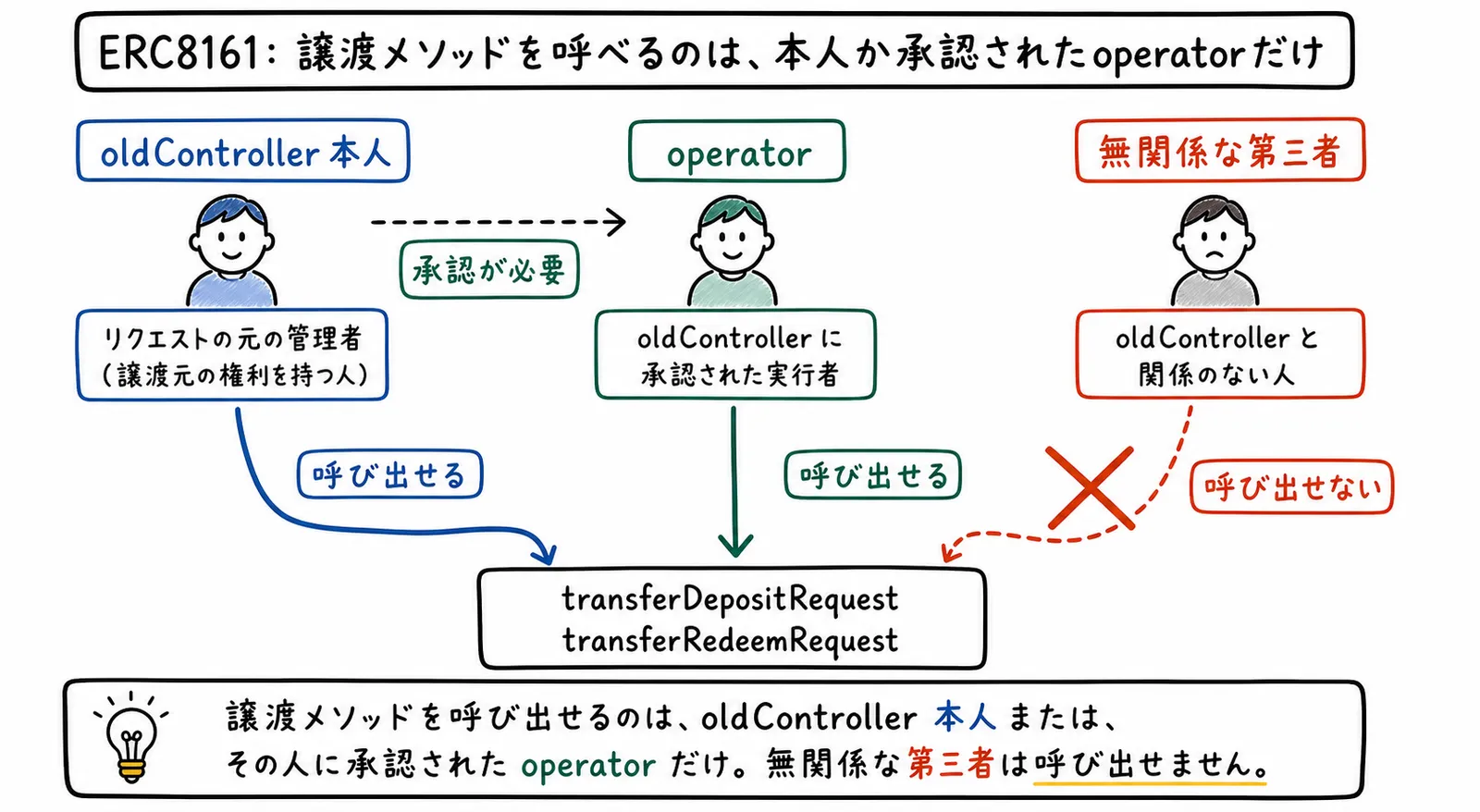
Only oldController or an account authorized as its operator can be msg.sender. This prevents an unauthorized third party from taking the pending position.
The authorization boundary makes the transfer an action taken by the controller or a delegated operator. This diagram shows who can call the method. The diagram in Security Considerations shows what an authorized operator can do with that access.
TransferDepositRequest
The vault must emit TransferDepositRequest when a deposit request transfer succeeds. Its three indexed fields are requestId, from, and to.
- Parameters
| Parameter | Type | Meaning |
|---|---|---|
requestId |
uint256 |
Identifier of the transferred request |
from |
address |
Previous controller |
to |
address |
New controller |
Indexers and frontends can use the event to track changes in who controls the pending position.
IERC7540RedeemTransferable
A vault that supports transferring redemption requests implements IERC7540RedeemTransferable. It follows the same structure as the deposit interface and operates on pendingRedeemRequest.
interface IERC7540RedeemTransferable {
    event TransferRedeemRequest(uint256 indexed requestId, address indexed from, address indexed to);

    function transferRedeemRequest(
        uint256 requestId,
        address oldController,
        address newController
    ) external;
}
transferRedeemRequest
This call moves the entire pending redemption request balance for the specified requestId from oldController to newController. Only the balance in Pending can move.
- Parameters
| Parameter | Type | Meaning |
|---|---|---|
requestId |
uint256 |
Identifier of the request to transfer |
oldController |
address |
Controller that currently holds the pending balance |
newController |
address |
Controller receiving the balance |
After execution, pendingRedeemRequest(requestId, oldController) decreases and pendingRedeemRequest(requestId, newController) increases. The msg.sender must be oldController or its operator.
Depending on the redemption implementation, the shares may have been burned or may be temporarily locked. The proposal standardizes the transfer method and leaves the vault's internal accounting to the implementation.
TransferRedeemRequest
The vault must emit TransferRedeemRequest when a redemption request transfer succeeds. The fields are the same as in the deposit event.
- Parameters
| Parameter | Type | Meaning |
|---|---|---|
requestId |
uint256 |
Identifier of the transferred request |
from |
address |
Previous controller |
to |
address |
New controller |
Why only full transfers?
The proposal specifies transfers of entire pending balances. ERC-7540 treats requests with the same requestId as fungible. Dividing the pending balance of a group would introduce questions about rounding, making only part of it claimable, and tracking the resulting positions.
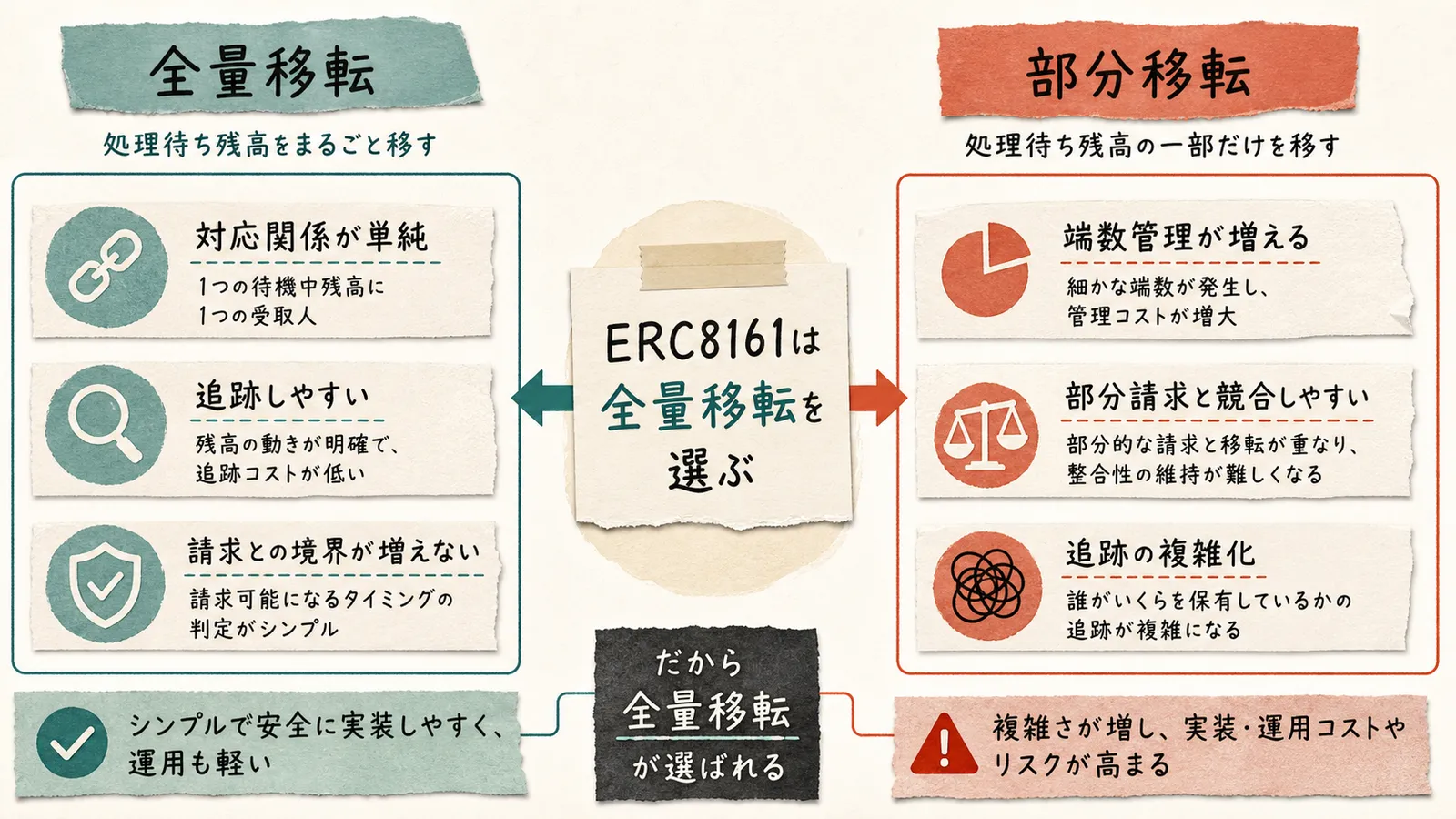
A full transfer reassigns the pending position from one holder to another. The interface is limited to managing Pending positions and leaves out trading rights to amounts that have already become claimable.
ERC-165 support
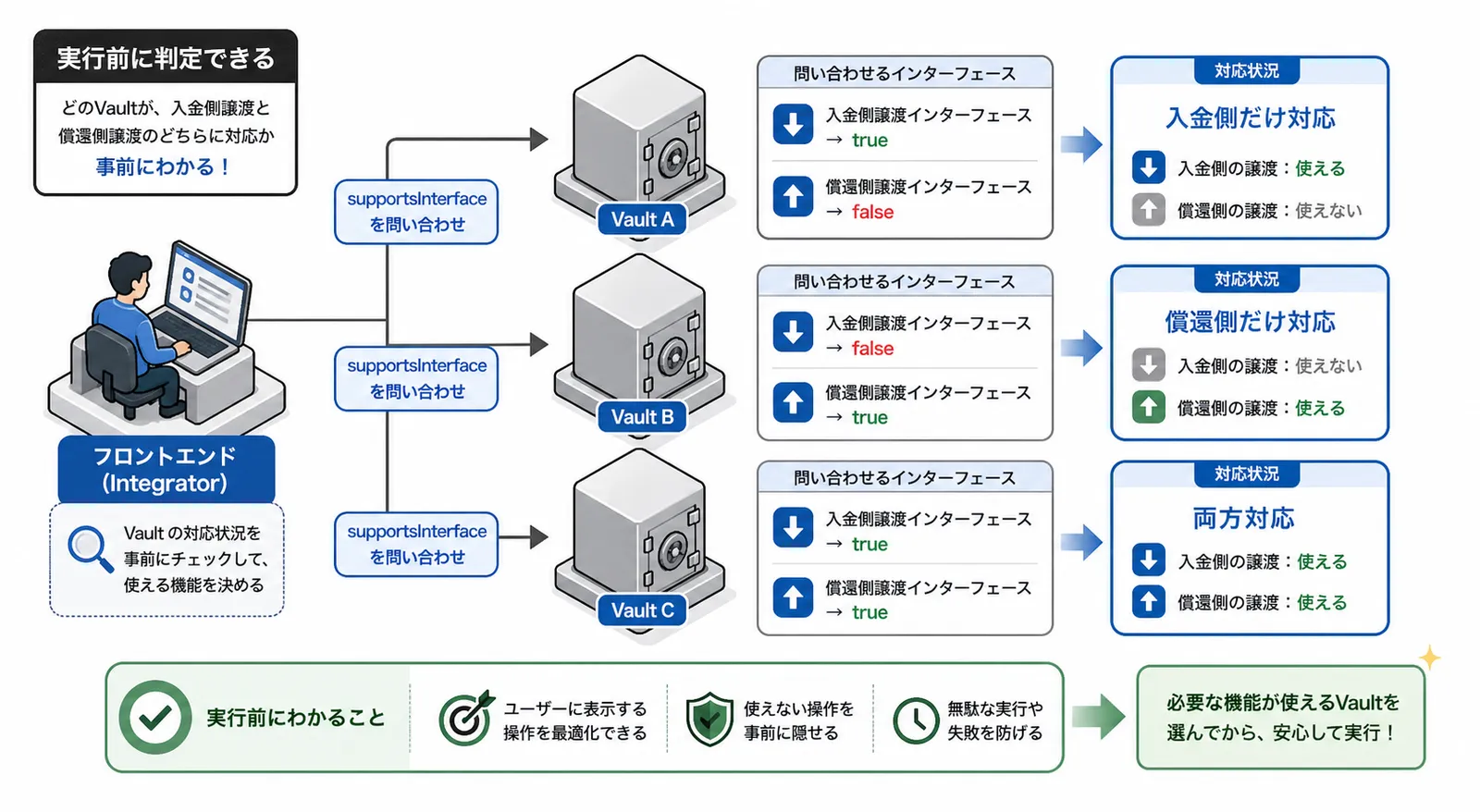
Contracts that implement this extension must also implement ERC-165's supportsInterface. Callers can use the appropriate interfaceId to determine which transfer interface the contract implements.
For background on ERC-165, see the following article.
[ERC-165] How to check whether a contract supports an interface
| Interface | ID to check with supportsInterface |
|---|---|
IERC7540DepositTransferable |
0x53b3bb0a |
IERC7540RedeemTransferable |
0x7846f5bd |
Before making a call, an integration can check whether the vault supports deposit transfers, redemption transfers, or both.
Checking first avoids sending a redemption transfer call to a vault that only supports deposit transfers. The UI can use the same check to determine which transfer buttons to display.
Additional notes
Why are Claimable balances outside the transfer interface?
The proposal restricts transfers to Pending balances. Once a balance is Claimable, the amount available to claim and the exchange ratio have already been determined. The controller can receive it through the normal claim call. Allowing transfers at this stage would raise questions about conflicts with partial claims and the value at which the balance changed hands.
ERC-8161 handles transfers of positions whose value has yet to be finalized. The existing flow handles balances once they become claimable. This keeps the interface's responsibility clear.
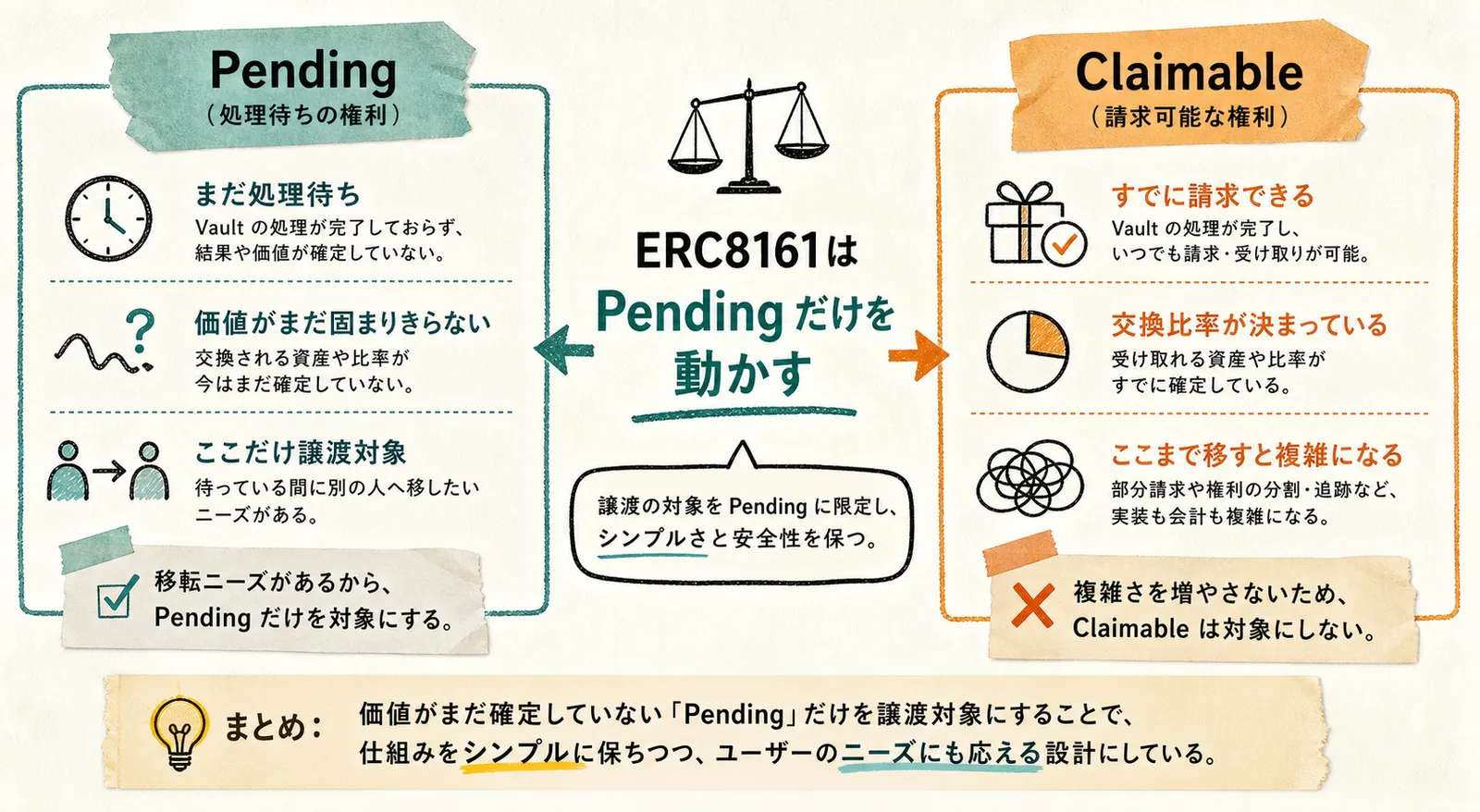
On the left, the outcome is still pending and a user may want to hand off the position. On the right, the user can already claim the balance. A parallel transfer path for the latter would create more opportunities for the claim and transfer to interfere with one another.
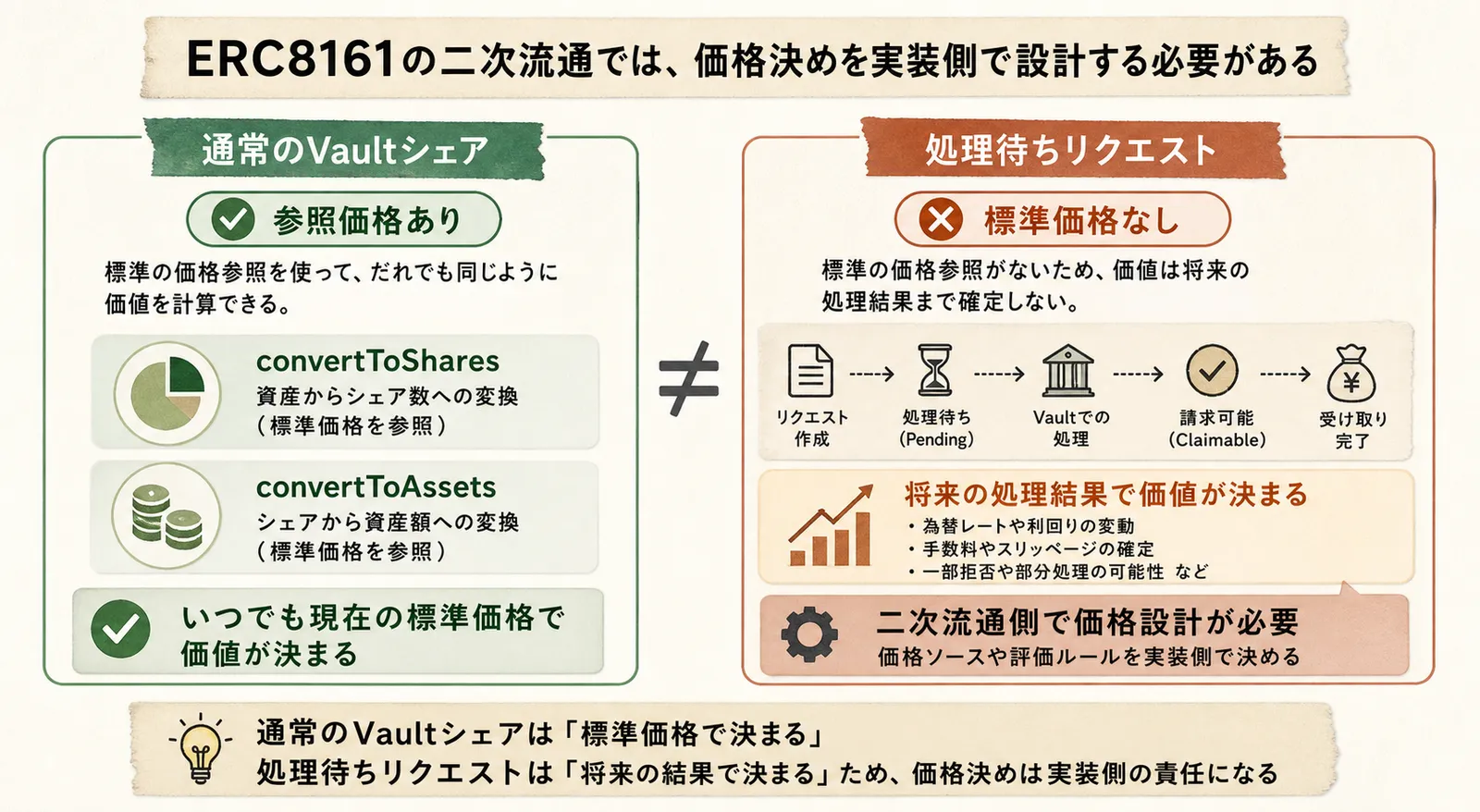
Secondary markets need their own pricing references
Vault shares have reference methods such as convertToShares and convertToAssets. Pending requests have no equivalent. For a Pending redemption request in particular, the number of assets ultimately returned may be uncertain until processing completes.
A secondary market for pending positions therefore needs its own pricing model. The standard defines how to transfer a position and leaves price discovery and settlement to the integration.
Transferability does not make a fair price immediately available. A vault share has a current reference value to start from, while a pending request lacks that common benchmark. Secondary-market designs need to account for wait times, fees, and uncertainty about the eventual payout.
Backward compatibility
ERC-8161 is backward compatible with ERC-7540. Vaults can keep processing asynchronous requests as before, and vaults that need transfers can adopt the extension without breaking existing ERC-7540 implementations.
Callers can use ERC-165's supportsInterface to check for the relevant transfer method before calling it. This avoids submitting a transfer to a vault that lacks support.
Security Considerations
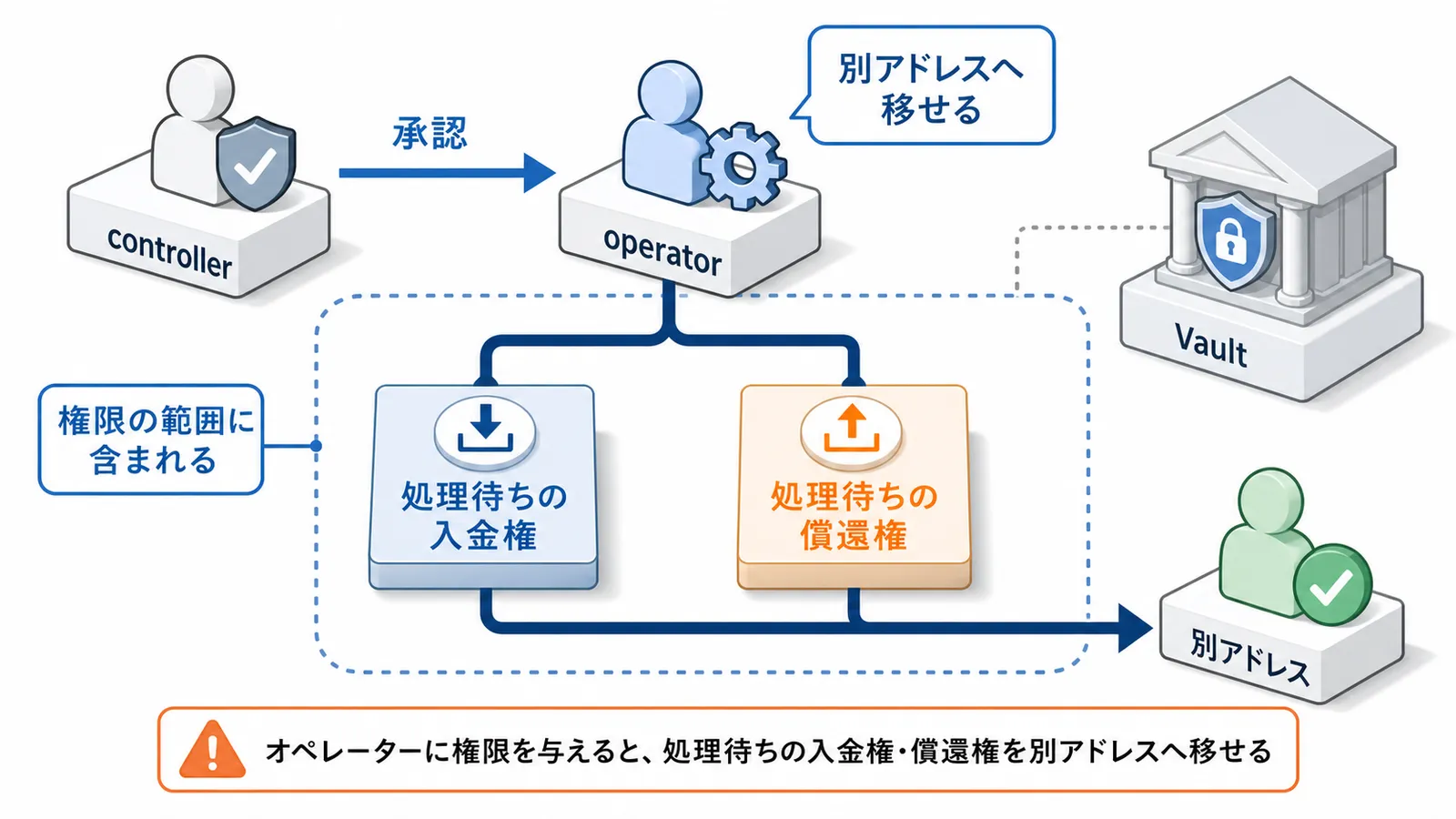
Operator approval includes the power to move a pending position
As in ERC-7540, an operator authorized by a controller can act on requests on the controller's behalf. Under ERC-8161, that authority includes moving a pending request to another address.
Users should understand that operator approval can allow the operator to move rights to assets or shares that are still pending. Wallets and frontends should make the scope of that approval clear. The earlier diagram shows that unauthorized third parties cannot call the method. This diagram shows what an approved operator is allowed to do. Security depends both on keeping out unauthorized callers and on the authority users grant their approved operator.
A pending position has no fixed price
Pending requests have no finalized standard on-chain price reference. On the redemption side in particular, the convertToAssets equivalent at the time of requestRedeem may differ from the eventual payout.
Transferability does not determine the position's value. A marketplace or intermediary handling these positions needs to choose when to estimate expected value and how to price the possibility of processing failure or delay.
Conclusion
ERC-8161 allows pending positions from ERC-7540 asynchronous requests to move to another address.
The extension focuses on Pending positions that may remain outstanding for a long time. That limited scope addresses practical issues in wallet migration, account reorganization, secondary markets, and protocol composability. Transfers apply only to Pending balances, and the standard provides no price reference, so integrations need to handle operator approval and pricing carefully.
Find more of my writing and resources here.