Introduction
Hi, I'm cardene, a software engineer and technical writer focused on blockchain and AI.
I've also authored Japanese technical books on specification-driven development with LLMs and decentralized application (DApp) development.

I also build and publish a variety of tools, libraries, and open-source projects.
When people use separate accounts for different purposes or chains, third parties cannot tell from their addresses alone whether two accounts belong to the same user, whether one is a delegate of the other, or whether they are unrelated. ERC8092 defines a common format for recording an association acknowledged by two accounts so that an application can check its validity period, signatures, and revocation status.
Overview
Consider a user with a primary account and a dedicated gaming account. Even if a game sees both addresses, it cannot determine whether the same user controls them. Relying on address matching alone prevents the user from carrying over achievements from the primary account to the gaming account and can lead to incorrectly linking another person's account just because its address looks similar.
Under ERC8092, the two parties that want to establish an association put the two accounts, the validity period, and application-specific supplementary information into one record. Both parties can sign the same contents. When an application receives the record, it checks the expiration and revocation status and verifies any signatures present. The record serves as evidence of an association between accounts.
A valid signature establishes that the signing party acknowledged the contents of the record. Whether the gaming account should receive the same permissions as the primary account, and which achievements it can inherit, is up to the application. ERC8092 standardizes the format for exchanging and verifying the association's contents, signatures, validity period, and revocation information.
Mutual agreement
An association record identifies the party initiating its creation and the party approving its contents. If the primary account is the approver and the gaming account is the initiator, both parties can inspect the same information about which accounts are being linked, when the association expires, and what it is for.
When both parties are required to sign, a unilateral claim cannot be treated as a mutually acknowledged association. In a use case where a trusted administrator registers associations, the consumer's policy may allow one or both signature fields to be empty.

Checks by the consumer
Finding a record is not sufficient reason for a consumer to accept an association. The consumer checks that the start time has been reached and that the expiration or revocation time has not been reached. If a signature field contains a value, the consumer verifies it using the specified method.
The consumer decides whether both signatures are mandatory. For associations that must be verified without trusting a third party, the consumer requires both signatures. Within a managed service, the identity of the storage operator and the parties authorized to register associations also inform that decision.
Motivation
A user may have more than one address. Separating accounts for asset custody, everyday activity, and individual applications can limit exposure of private keys and the scope of permissions. Across multiple chains, address representations and signature schemes may also differ.
If every application represents associations differently, consumers have to implement custom fields, signing methods, and revocation mechanisms for each one. An association created in one service cannot easily be carried over to another, and differences between implementations may cause an expired or revoked association to be accepted.
ERC8092 specifies a data format that separates the association's contents from its signatures, a validation sequence, requirements for storage providers, and a revocation mechanism. It does not prescribe whether an association represents another account belonging to the same person, a delegate authorized to perform operations, or a subordinate account within an organization. Consumers define the meaning of each use case and the operations permitted after verification.
Multiple accounts
Users can keep accounts separate and disclose their association only when needed. For example, a gaming account can demonstrate its association with a primary account without receiving authority to manage assets held by that primary account.
Disclosing an association, however, makes it easier to track previously separate addresses as potentially belonging to the same entity. Users should weigh the information they want to carry over against the consequences of disclosure and create associations for specific purposes.
A common format
A shared format allows consumers to check validity periods, revocation, and signatures in the same sequence. The fields in the received record and its validation conditions do not change depending on whether it is stored on-chain or off-chain.
A shared format does not standardize the meaning of an association. Consumers identify supported use cases and data formats explicitly so that supplementary data is not interpreted in a different context.
Specification
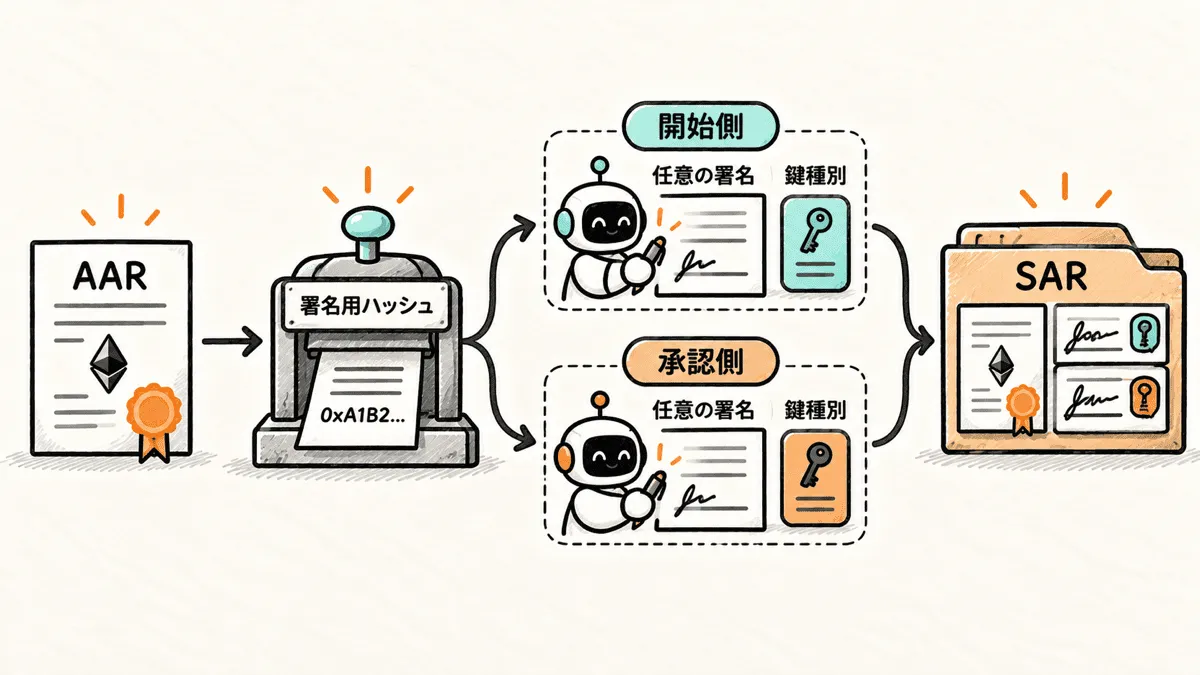
ERC8092 uses two structs. The inner struct fixes the contents that the parties agree on, while the outer struct adds signature verification methods, signatures, and a revocation timestamp.
AssociatedAccountRecord
The inner AssociatedAccountRecord, referred to below as AAR, holds the contents of the agreement.
It contains the initiator and approver accounts, the validity period, a four-byte value identifying how to interpret the association, and use-case-specific supplementary data.
struct AssociatedAccountRecord {
    bytes initiator;
    bytes approver;
    uint40 validAt;
    uint40 validUntil;
    bytes4 interfaceId;
    bytes data;
}
A party that supplies a signature checks the AAR's contents before signing. Even as additional fields are populated in the outer record during signature collection, the AAR remains unchanged. This makes it possible to establish that both parties signed the same association.
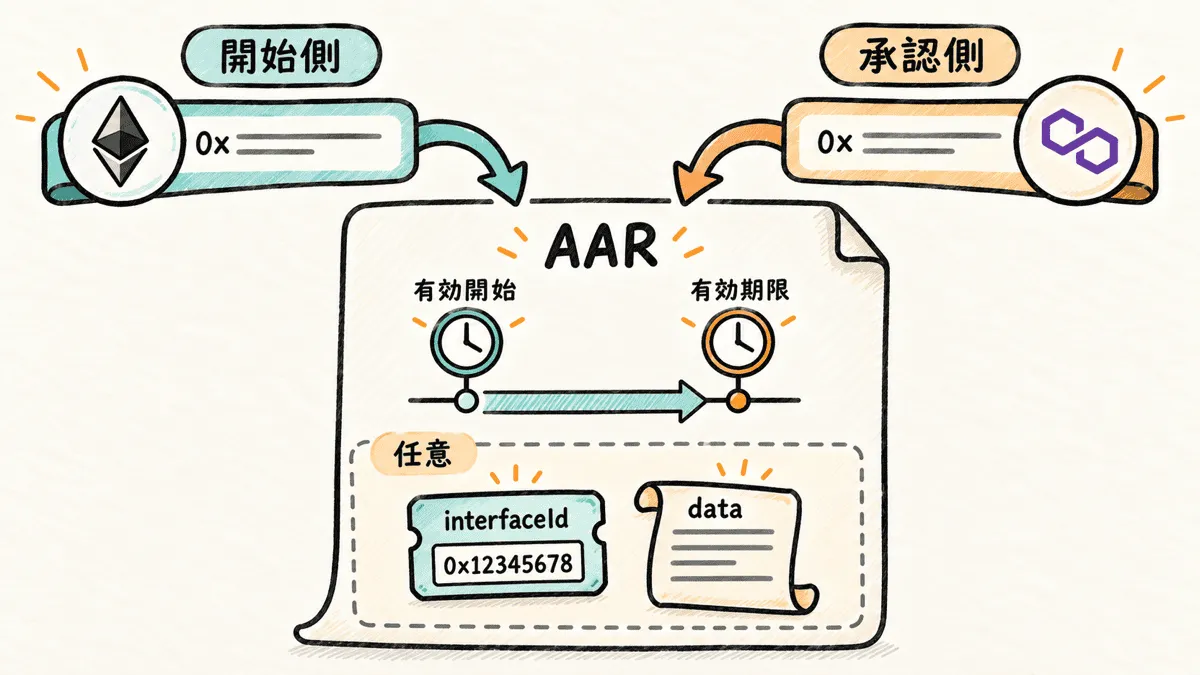
Fields
| Field | Type | Description |
|---|---|---|
initiator |
bytes |
Account that initiates creation of the association |
approver |
bytes |
Account that approves the association |
validAt |
uint40 |
Earliest timestamp at which the association can be used |
validUntil |
uint40 |
Expiration timestamp; 0 means no expiration |
interfaceId |
bytes4 |
Optional value identifying how to interpret data |
data |
bytes |
Optional supplementary data specific to the use case |
The initiator and approver fields use a format that identifies the chain and address representation in a single byte sequence.
Consumers extract the relevant chain and address to distinguish the accounts being associated.
This format is the interoperable address defined by ERC7930.
For more on ERC7930, see the following article.
[ERC7930] A Common Format for Addresses Across Chains
The interfaceId and data fields are optional.
In a delegation use case, interfaceId can identify how the supplementary data is decoded, while data can encode the operations or targets covered by the delegation.
ERC8092 does not define the supplementary data format itself, so a consumer does not use an association with an unfamiliar interfaceId to make authorization decisions.
SignedAssociationRecord
The outer SignedAssociationRecord, referred to below as SAR, adds signatures and revocation information to the AAR.
A consumer receives the SAR and verifies the inner AAR as the signed payload.
struct SignedAssociationRecord {
    uint40 revokedAt;
    bytes2 initiatorKeyType;
    bytes2 approverKeyType;
    bytes initiatorSignature;
    bytes approverSignature;
    AssociatedAccountRecord record;
}| Field | Type | Description |
|---|---|---|
revokedAt |
uint40 |
Timestamp at which the association is revoked; 0 means unset |
initiatorKeyType |
bytes2 |
Method used to verify the initiator's signature |
approverKeyType |
bytes2 |
Method used to verify the approver's signature |
initiatorSignature |
bytes |
Initiator's signature |
approverSignature |
bytes |
Approver's signature |
record |
AssociatedAccountRecord |
AAR that is the signed payload |
The revokedAt field sits outside the AAR and is not included in the signed payload.
This lets the storage provider update the value after receiving a revocation request, but it also means that a signature alone cannot establish the current revocation status.
Consumers retrieve the latest value from the authoritative storage location.
Key types
When a signature field contains a value, the corresponding key type ID selects the verification method.
A key type ID is two bytes long.
The Delegated value, 0x0000, is a special case in which authorization is delegated to another account or an external process.
The remaining IDs are divided into those that identify cryptographic curves directly and those that identify verification protocols involving passkeys or contracts.
Protocol IDs have the most significant bit set and are represented as 0x8000 | PROTOCOL_ID.
| Key ID | Type | Verification method |
|---|---|---|
0x0000 |
Delegated | Delegates authorization to another account, access control mechanism, or external process |
0x0001 |
K1 | secp256k1 |
0x0002 |
R1 | secp256r1 |
0x0003 |
BLS | BLS12-381 |
0x0004 |
EdDSA | Ed25519 |
0x8001 |
WebAuthn | WebAuthn or passkeys |
0x8002 |
ERC1271 | Contract account signature verification |
0x8003 |
ERC6492 | Signature verification that also supports undeployed contract accounts |
Delegated is not the name of a cryptographic curve. Implementations using this value publish a use-case-specific format so that consumers can interpret the delegation.
ERC1271 provides a way to pass a signature and message hash to a contract account and determine whether the contract accepts that signature. From its return value, the consumer determines whether the signature is valid under the contract's state at that time.
For more on ERC1271, see the following article.
[ERC1271] Contract-Based Signature Verification
ERC6492 provides a way to verify signatures for contract accounts that have not yet been deployed by packaging the deployment information together with the signature. A consumer can check whether the account would accept a signature even before that account exists on-chain.
For more on ERC6492, see the following article.
[ERC6492] Signature Verification for Undeployed Contract Accounts
Creating signatures
A party that supplies a signature signs structured data containing field names and types. Consumers can reconstruct the AAR to which a signature applies, field by field, and detect attempts to substitute an AAR with a different validity period or supplementary data. This signing scheme is EIP712.
For more on EIP712, see the following article.
[EIP712] Hashing and Signing Typed Structured Data
The digest to be signed is calculated as follows.
The bytes fields initiator, approver, and data are individually hashed first.
keccak256(abi.encodePacked(
    hex"1901",
    DOMAIN_SEPARATOR,
    keccak256(abi.encode(
        keccak256(
            "AssociatedAccountRecord(bytes initiator,bytes approver,uint40 validAt,uint40 validUntil,bytes4 interfaceId,bytes data)"
        ),
        keccak256(initiator),
        keccak256(approver),
        validAt,
        validUntil,
        interfaceId,
        keccak256(data)
    ))
))
The DOMAIN_SEPARATOR is constructed using only the name AssociatedAccounts and version 1.
It does not include a chainId or the storage contract address, allowing the same signed record to be transferred between chains and storage locations.
The signature prevents changes to the AAR but does not restrict its use to a particular chain.
Validation
When using a SAR, a consumer performs the following checks in order.
For on-chain validation, the current time is block.timestamp.
- Check that the current time is greater than or equal to
validAt. - If
validUntilis nonzero, check that the current time is earlier thanvalidUntil. - If
revokedAtis nonzero, check that the current time is earlier thanrevokedAt. - If
initiatorSignaturecontains a value, verify the initiator's signature using the method corresponding toinitiatorKeyType. - If
approverSignaturecontains a value, verify the approver's signature using the method corresponding toapproverKeyType.
An empty signature field skips the corresponding signature verification step. The standard therefore does not universally require two signatures. Where third-party trust is unacceptable, the consumer makes both signatures mandatory.
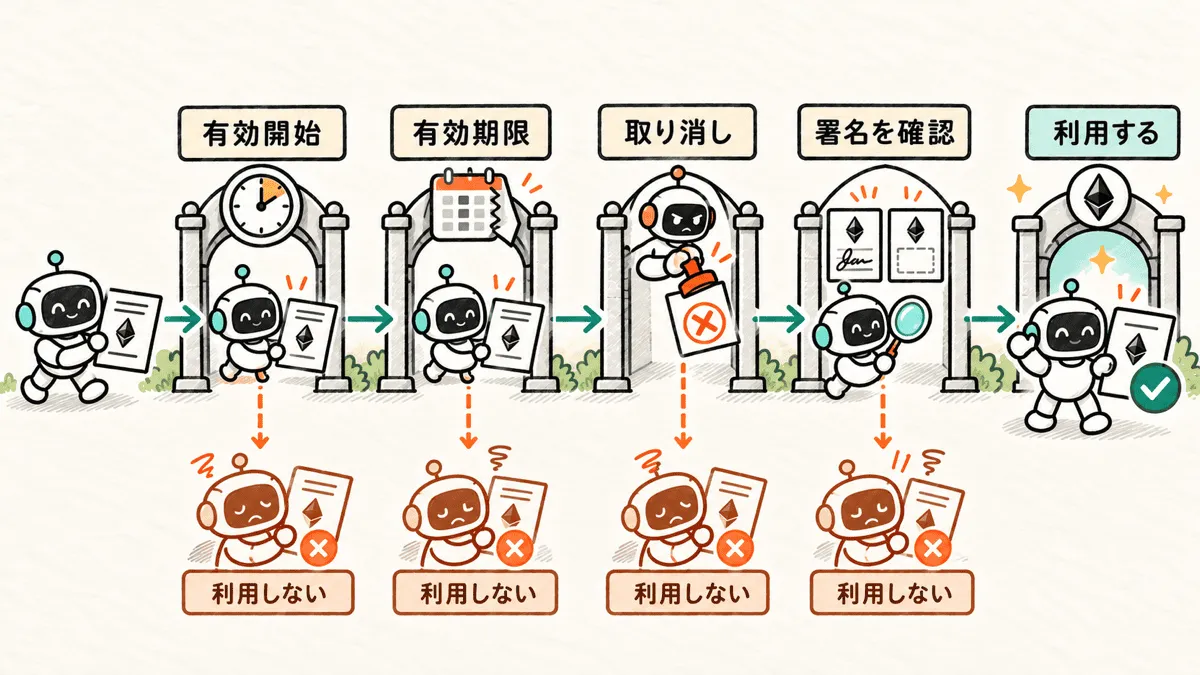
A record that has expired, reached its revocation time, or failed verification of a nonempty signature must not be used. When the consumer encounters an unsupported key type, it rejects the association as unsupported rather than accepting it without verification.
Storage
A SAR can be stored in an application-specific contract or an off-chain service. Regardless of the storage location, the record must be validated on receipt, and the parties must be able to revoke it.
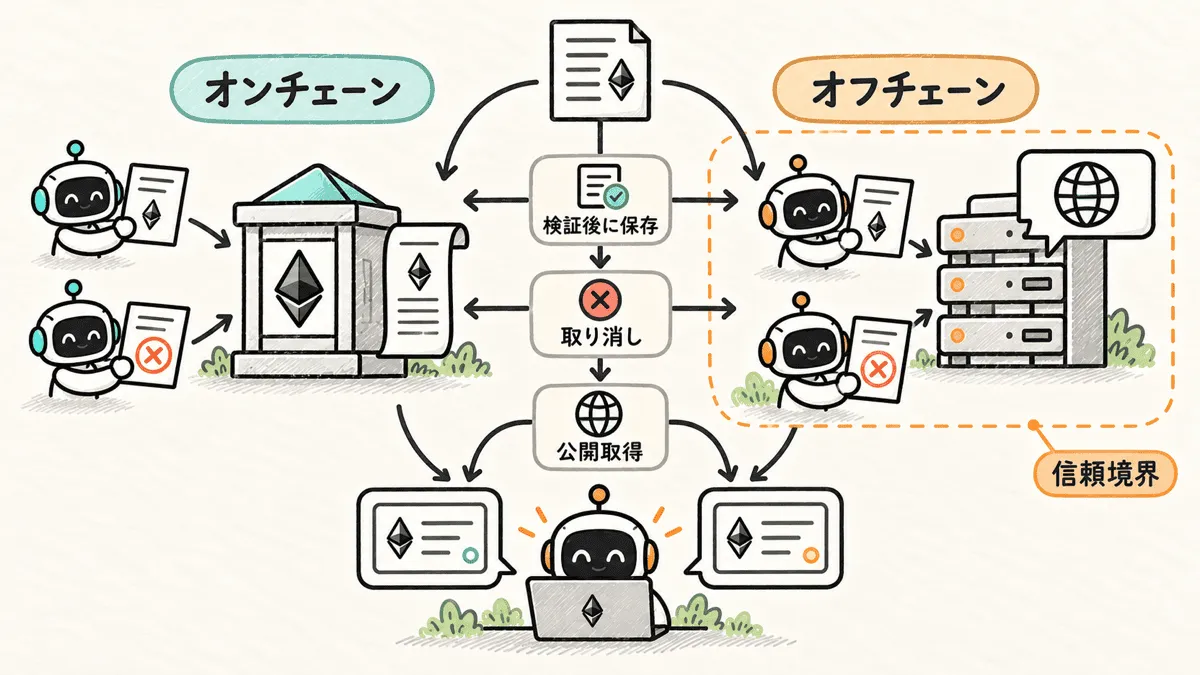
An on-chain storage contract validates the SAR before emitting the following event.
event AssociationCreated(
    bytes32 indexed hash,
    bytes32 indexed initiator,
    bytes32 indexed approver,
    SignedAssociationRecord sar
);| Field | Description |
|---|---|
hash |
EIP712 hash of the AAR |
initiator |
keccak256 hash of the initiator account in ERC7930 format |
approver |
keccak256 hash of the approver account in ERC7930 format |
sar |
Stored signed record |
An on-chain storage implementation also allows revocation at the same location.
The AssociationCreated event is useful for discovery, but consumers must check the stored revocation timestamp rather than infer current validity from event logs alone.
An off-chain storage provider exposes a public endpoint accessible to its intended consumers and validates associations before storing them. To make the storage location discoverable, the provider advertises it through a standard discovery mechanism, such as an ENS text record.
| Requirement | On-chain | Off-chain |
|---|---|---|
| Validation on receipt | Performed by the storage contract | Performed by the storage service |
| Retrieval | Contract state and event logs | Public endpoint |
| Revocation | Parties submit requests to the contract | Parties submit requests to the storage service |
| Main costs and constraints | Gas costs and supported verification methods | Operator availability and trust |
Revocation
Either the initiator or the approver can revoke an active association.
An on-chain storage contract sets revokedAt to the greater of the timestamp of the block in which it receives the request and the revocation timestamp specified by the party.
Specifying a future time schedules revocation while leaving the association usable until that time.
event AssociationRevoked(
    bytes32 indexed hash,
    bytes32 indexed revokedBy,
    uint256 revokedAt
);| Field | Description |
|---|---|
hash |
EIP712 hash of the AAR being revoked |
revokedBy |
keccak256 hash of the account that revoked the association |
revokedAt |
Timestamp at which the association becomes invalid |
If an association already has a revocation timestamp and another party specifies an earlier one, the earlier time takes precedence.
For example, if the approver schedules revocation for the following day and the initiator then revokes the association immediately, it becomes invalid at the current time.
Off-chain storage providers also accept revocation requests from either party and update revokedAt.
Additional considerations
Separating the AAR from the SAR allows the two signatures to be collected at different times without changing the contents that either party reviews. The storage location can be chosen for the use case, but if consumers do not establish which source is authoritative for revocation status, they may reach different conclusions from the same signed record.
Storage precedence
An application defines an authoritative storage location for each association. If the same association is stored both on-chain and off-chain, the on-chain information takes precedence.
Even if an off-chain response returns revokedAt = 0, the consumer does not use the association if it has been revoked on-chain.
Instead of deciding based solely on the received SAR, the consumer retrieves the latest status from the authoritative storage location.
Meaning of association data
The interfaceId and data fields can carry use-case-specific information, such as delegation, parent-child relationships, or the outcome of an identity verification process.
ERC8092 does not guarantee that this information is factually correct or that a particular permission should be granted based on the supplementary data.
Consumers define supported interfaceId and data formats and decide how the decoded values inform their decisions.
They reject records whose format they do not understand or whose purpose does not match the intended use.
Compatibility
The official ERC8092 specification does not contain a separate section describing compatibility with existing standards. The following considerations for integrating it into existing applications are derived from its data format and dependencies.
Additive integration
ERC8092 does not replace existing account addresses or signature schemes. Applications that use associations add SAR retrieval and validation, while applications without support can continue to operate without association records.
Even when multiple applications can read the same SAR, they do not necessarily permit the same operations. Each application determines the meaning of association data, its required signatures, and the authoritative storage location.
Dependencies
ERC8092 uses four existing standards. EIP712 binds the fields of the AAR to the signed payload, while ERC7930 distinguishes accounts on different chains and with different address formats. ERC1271 and ERC6492 are used to verify signatures from contract accounts, as distinct from ordinary accounts directly controlled by private keys.
Implementations can limit support to the key types they need. However, a SAR containing a signature that requires an unsupported key type cannot be treated as a valid association.
Security
A valid signature does not prove that the facts represented by the association data are true or that operations authorized using the association are safe. Consumers evaluate signature validity, revocation status, trust in the storage provider, and the consequences of disclosure separately.
Signature verification
Some key types may require substantial gas for on-chain verification, or a consumer may not have the corresponding verification method available. Consumers explicitly identify supported key types and reject associations when an unsupported value is encountered.
When using Delegated, the consumer interprets the published delegation format to determine who authorized whom to perform which operations, and until when. ERC1271 verification results depend on the contract's current state. ERC6492 includes processing for verification of undeployed accounts, so the consumer also limits the code executed and the gas consumed during verification.
Revocation information
The revokedAt field is not part of the signed AAR.
Even if a third party supplies an old SAR with revokedAt = 0, the signature over the AAR remains valid.
Consumers retrieve the revocation status from the authoritative storage location.
When using a cache, they check its update time before granting permissions or performing asset operations and limit reliance on stale state.
Regardless of whether the initiator or the approver revoked the association, the consumer reads revokedAt for the same SAR from the application's authoritative storage location.
For scheduled revocation, it also checks each time whether the current time has reached the specified timestamp.
Trust in storage providers
Off-chain storage providers may withhold records, delay updates, or return stale revocation information. Signature verification detects tampering with the AAR but cannot prove that a storage provider returned the latest record.
For associations requiring greater reliability, part of the revocation state can be recorded on-chain. When the same association exists in both locations, the on-chain state takes precedence. Even with multiple public endpoints, the number of responses alone does not establish correctness unless consumers can verify that the endpoints are synchronized with the same authoritative source. Applications disclose the storage location, update procedures, and conditions under which an outage causes an association to be rejected.
Scope of disclosure
Publishing an association allows accounts previously used for separate purposes to be linked as potentially belonging to the same entity. Even after on-chain revocation, the original creation event logs and transaction history remain.
Users should record only two accounts and supplementary data that they are willing to disclose. For temporary associations or associations whose disclosure should be limited, they can consider setting an expiration time and using off-chain storage. Names and contact information placed directly in the supplementary data can be read by third parties independently of the signature. Keep the data to the minimum needed to identify the use case, and explain the consequences of linking the two accounts to the user before publication.
Conclusion
ERC8092 provides a common representation of associations between two accounts, including agreed contents, signatures, validity periods, and revocation information. Rather than accepting an association based on signatures alone, consumers check expiration and revocation status at the authoritative storage location and use only associations that match their intended purpose.

For the original data structures and validation requirements discussed in this article, see the official specification.
