Introduction
Hi, I'm cardene, a software engineer and technical writer focused on blockchain and AI.
I've also authored Japanese technical books on specification-driven development with LLMs and decentralized application (DApp) development.

I also build and publish a variety of tools, libraries, and open-source projects.
Overview
To replace a signature scheme without interrupting voting or block proposals, operators must be able to verify before the transition that new keys are ready. Waiting until the transition date to prepare keys would leave the network uncertain about how many participants can sign using the new scheme.
Preregistering keys for future use
In Ethereum, Validators (participants responsible for voting and block proposals) and Builders (participants that construct the execution portion of blocks) register public keys in consensus-layer registries.
EIP8450 proposes adding public keys for future post-quantum signatures to these registries in advance.
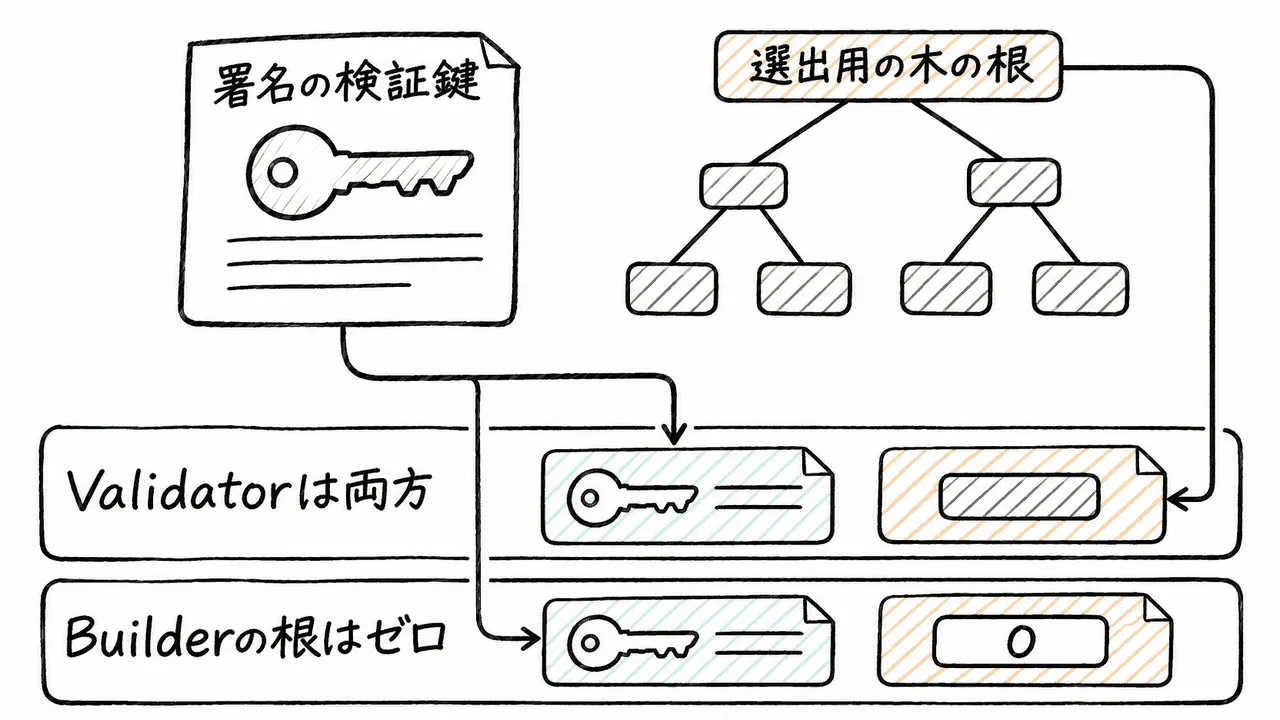
The post-quantum signature scheme uses leanXMSS, whose signature indexes are single-use. Validators also register the root of a tree that commits to randomness used for selection.
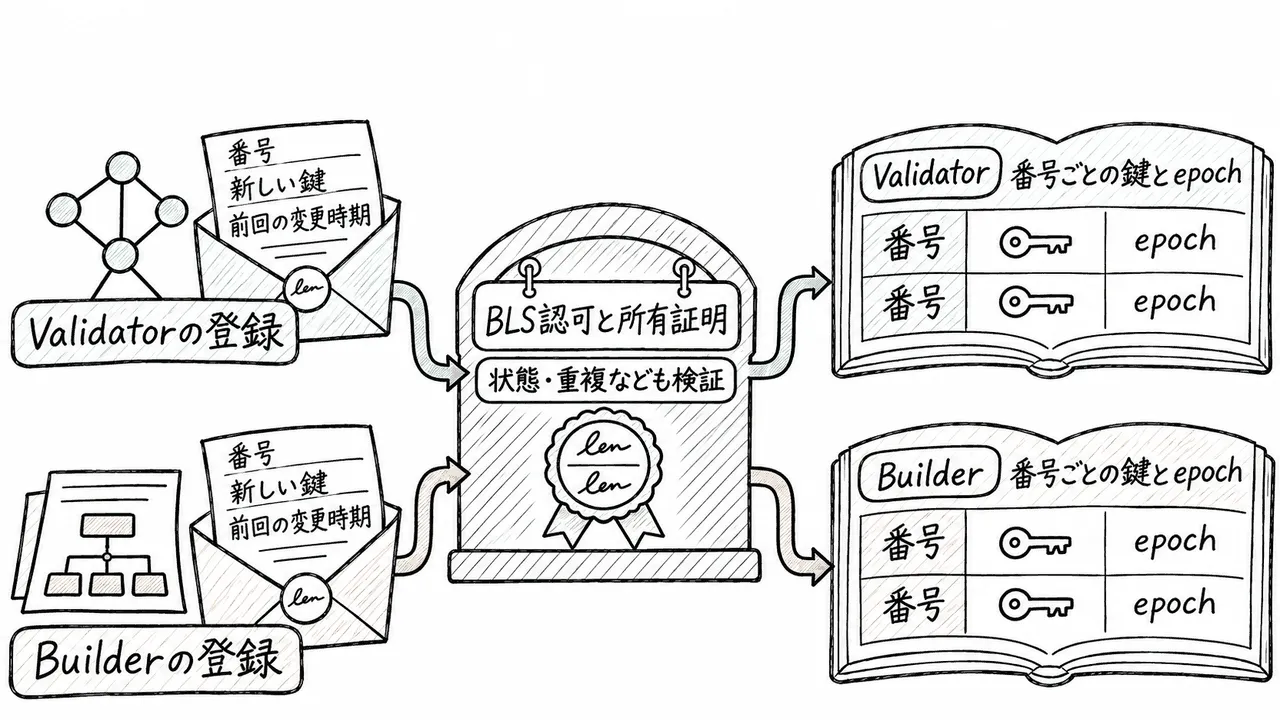
A registration submitter supplies both proof of possession of the new private key and a signature from the target participant's existing BLS key.
Nodes verify the target's status, signatures, and key uniqueness, among other conditions. Only after successful verification do they store the key material and change epoch at the corresponding index in the registry.
For example, registering a key for validator index 42 does not change the fact that subsequent votes are still signed with BLS.
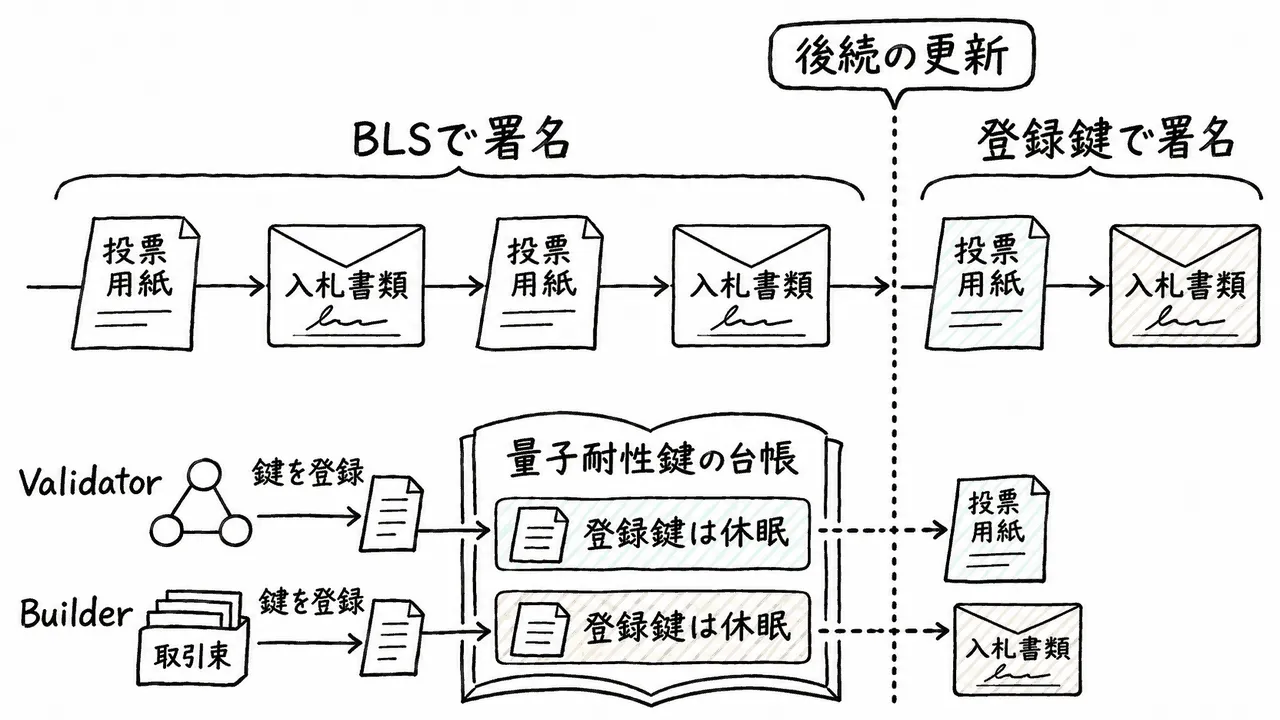
The stored keys remain dormant until a subsequent network upgrade switches the signature scheme. Separating these stages makes it possible to count the effective balance of active validators with registered keys and use that information to inform the transition decision. However, signing successfully once on the registration date does not guarantee access to the private key or functioning signing software on the transition date.
As checked on November 15, 2026, EIP8450 was in Draft status.
Neither the network upgrade introducing registration nor the date when registered keys will begin to be used has been finalized.
Motivation
Generate and register new keys while the existing signature scheme is still secure. Separating registration from the signature transition avoids concentrating operator preparations and the network upgrade on the same day.
Published signing keys and quantum computers
Validator votes, block proposals, and exit signatures, as well as builder execution payload bids and envelope signatures, use the BLS12-381 cryptographic scheme.
An execution payload contains the execution portion of a block, and an envelope is signed data used to deliver it.
The corresponding public keys can be inspected in consensus-layer registries.
If sufficiently powerful quantum computers become available, Shor's algorithm could allow private keys to be recovered from public keys. An attacker who obtains a private key can impersonate its owner and sign votes or bids. Participants whose public keys are already published cannot postpone key generation until such attacks begin.
Why registration and the signature transition are separate
Moving to post-quantum signatures requires generating new secret material, deploying signing software, and securely retaining both secret material and the record of used signature indexes. Staking pools must also coordinate operators and asset owners. If preparation begins only at the transition, the balance capable of participating under the new scheme cannot be assessed in advance.
Introducing registration first allows key generation, proof-of-possession verification, and registry updates to be tested in production while existing BLS signatures remain in use.
Counting the effective balance of active validators with registered keys provides information for deciding on a subsequent upgrade.
However, the registration rate is only an upper bound on actual transition readiness because it does not verify private key retention or signing software availability.
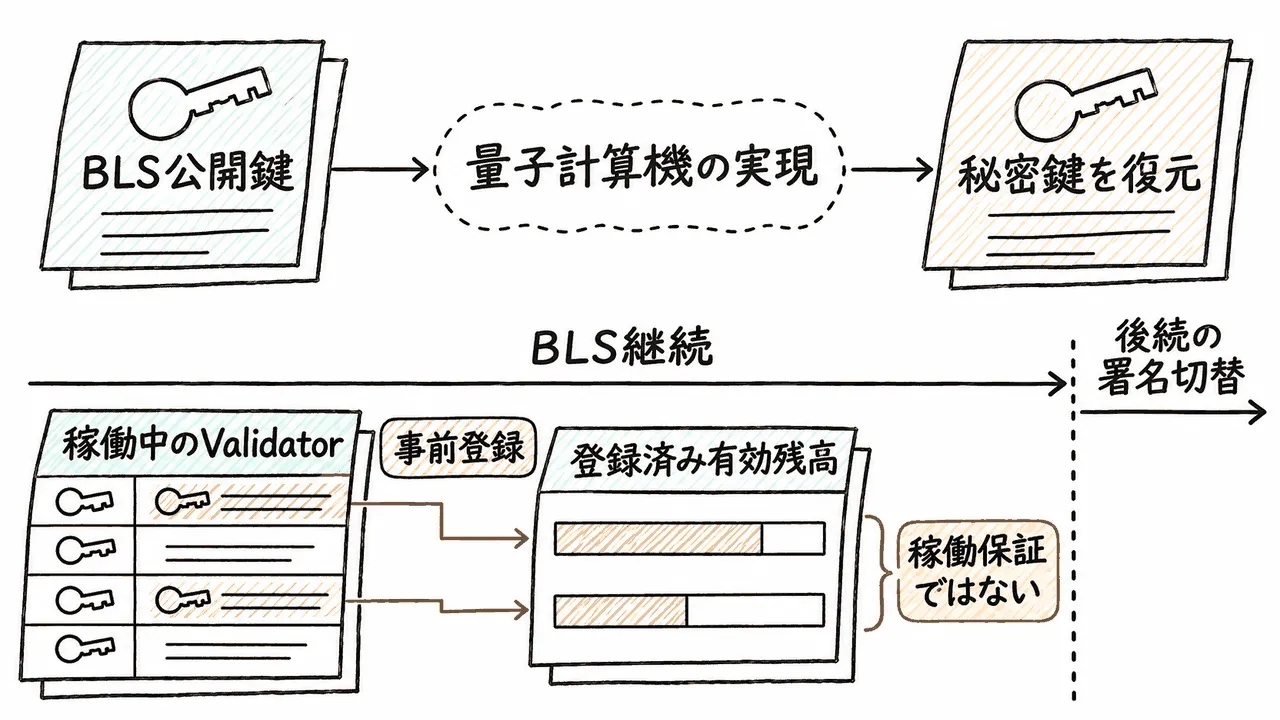
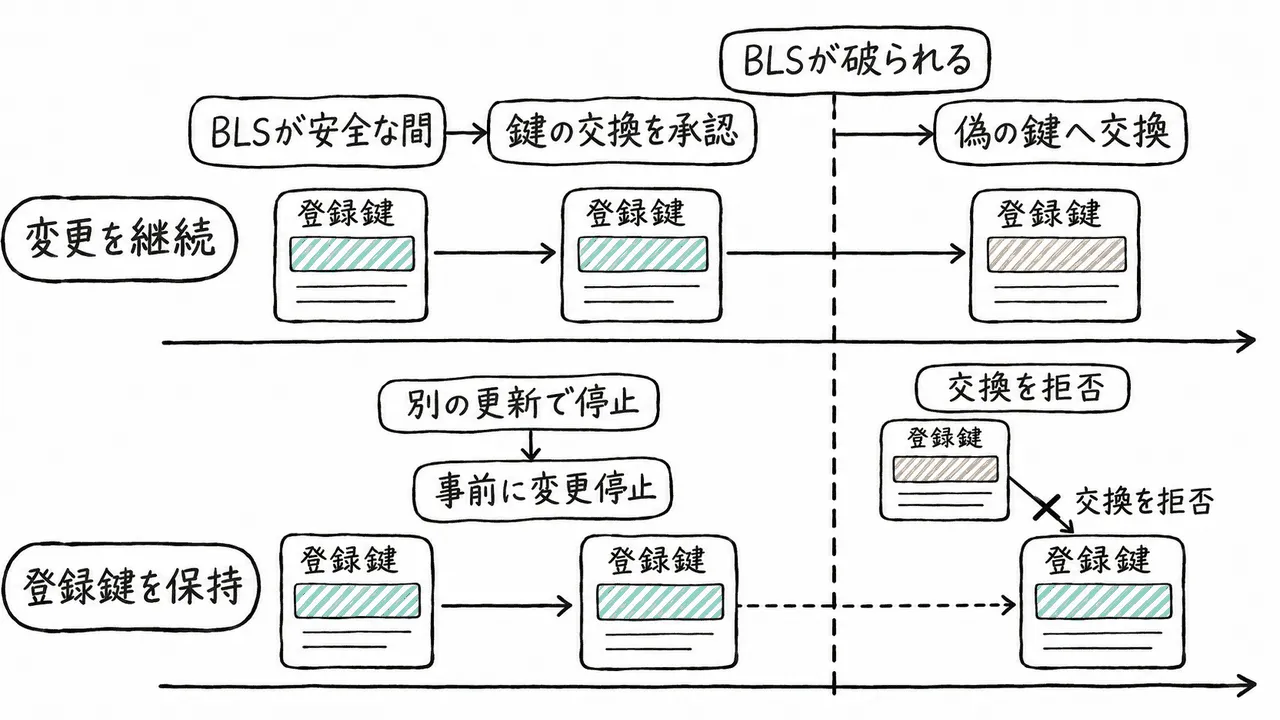
If sufficiently powerful quantum computers appear imminent, another network upgrade could disable key changes.
For keys registered before that freeze to be trusted as migration targets, the freeze must take effect before BLS is broken.
Specification
The existing signing key authorizes the registration target's index, new key material, and previous change epoch. Possession of the new signing key is proved separately. Only verified information is stored at the corresponding index in the registry.
Signing keys and randomness trees to register
Registered information consists of a key for signing messages and a tree root that commits to outputs used for selection.
leanXMSS is a signature scheme in which each signature index is used once. A public key is 32 bytes and a signature is 2404 bytes.
Signature indexes range from 0 to , with index 0 reserved for proof of key possession.
In the tree used for the selection VRF (verifiable random function), the operator holds a secret value for each leaf, and the published root commits to the entire tree.
Revealing the secret value at an index and its authentication path to the root allows a verifier to check the output for that index.
For the same root and index, only one output can pass verification unless a hash collision is found.
xmss.Verify
The signature verifier receives the public key, a 32-byte message, and the signature.
The interface returns True if the signature is valid and False otherwise.
def Verify(public_key: XMSSPublicKey, message: Bytes32, signature: XMSSSignature) -> bool: ...- Parameters
| Parameter | Meaning |
|---|---|
public_key |
Public key used for verification |
message |
32-byte value being signed |
signature |
Signature containing an index |
- Decode the signature and public key
- Verify the message using the key corresponding to the signature index
- Return
Falseon decoding or verification failure
- Return value
| Type | Result |
|---|---|
bool |
True only for a valid signature |
-
Execution conditions
Inputs whose public key or signature cannot be decoded are also rejected as invalid.
Verification uses the index contained in the signature.
The interface returns False rather than propagating an exception when the key or signature cannot be decoded.
It does not track whether an index has already been used; the signer is responsible for doing so.
vrf.Verify
Checks whether the information revealed from the tree corresponds to the root and index.
It returns a 32-byte output on success and None on failure.
def Verify(root: VRFRoot, index: Uint32, opening: bytes) -> Optional[Bytes32]: ...- Parameters
| Parameter | Meaning |
|---|---|
root |
Registered tree root |
index |
Position being opened |
opening |
Leaf secret and authentication path |
- Verify the leaf secret and authentication path
- Return the output if the path reaches the root
- Return value
| Type | Result |
|---|---|
Optional[Bytes32] |
Valid output, or None to indicate invalidity |
-
Execution conditions
Registration processing does not call this function. It verifies the correspondence between the root and position when used by a subsequent upgrade.
The root argument is the registered tree root, index is the position being opened, and opening contains the leaf secret and authentication path.
Registration does not invoke this function. Validator software checks its own tree before registration.
The subsequent upgrade that uses the tree will define how selection inputs map to indexes.
Registration data and storage
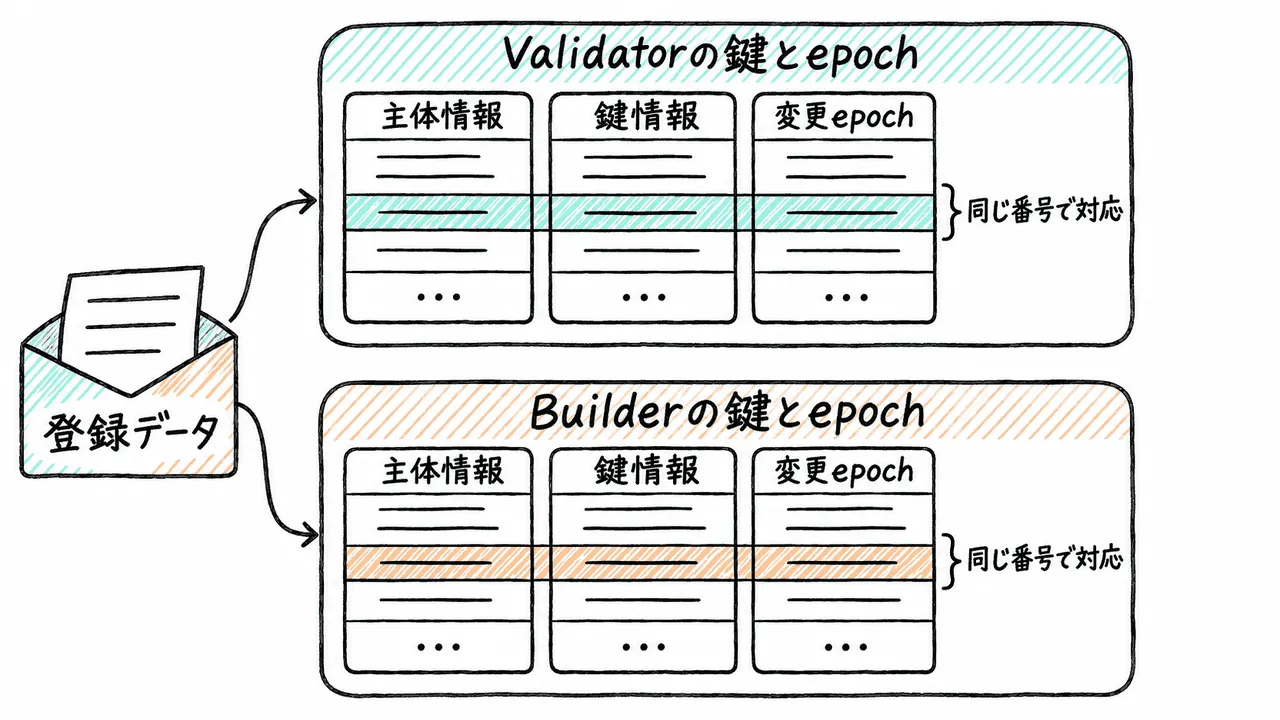
BeaconState, which holds consensus-layer state, gains separate lists of keys and change epochs for validators and builders.
The lists use the same indexes as the participant registries. For example, the key material and change epoch for index 42 are read from position 42 in their respective lists.
The existing Validator and Builder structures themselves remain unchanged.
PQKeyMaterial
Combines the public information for one registered participant into 64 bytes.
The signing key and randomness tree serve different purposes.
class PQKeyMaterial(Container):
    """
    The post-quantum keys of one validator or builder, as stored in the registry.

    Serializes to 32 + 32 = 64 bytes.
    """
    # leanXMSS public key.
    xmss_public_key: XMSSPublicKey
    # Root of the VRF tree, or zero for a builder.
vrf_root: VRFRoot| Field | Stored value | Registration condition |
|---|---|---|
xmss_public_key |
32-byte public signing key | Reject the all-zero value |
vrf_root |
32-byte tree root | Must be all-zero for builders |
A validator's root is not opened and verified during registration. Builders do not create selection proofs and therefore do not register a root. All-zero key material represents the unregistered state.
PQKeyRegistration
Combines the information being authorized: whose key is being registered and which previous change it follows.
The existing BLS key signs this entire structure.
class PQKeyRegistration(Container):
    """
    The message of a registration: which registrant, which keys, and after which change.
    """
    # Validator index, or builder index with BUILDER_INDEX_FLAG set, the keys are registered for.
    index: ValidatorIndex
    # Keys being registered.
    key_material: PQKeyMaterial
    # Epoch of the last change, or the never-registered marker of the index:
    # `FAR_FUTURE_EPOCH` for a validator, the deposit epoch for a builder.
previous_change_epoch: Epoch| Field | Meaning |
|---|---|
index |
Validator index, or builder index with BUILDER_INDEX_FLAG set |
key_material |
New public key and root to store |
previous_change_epoch |
Previous change epoch stored in the registry |
An epoch is a consensus time unit consisting of multiple slots.
An application whose previous value does not match the registry cannot be registered even if it is resubmitted later.
PQKeyPossession
A value signed by the holder of the new private key, binding the target participant's BLS public key to the new public key.
It includes the participant's existing public key rather than the registration index itself.
class PQKeyPossession(Container):
    """
    The message of a proof of possession: which registrant, and which leanXMSS key.
    """
    # BLS public key of the registrant.
    pubkey: BLSPubkey
    # Key whose possession is proven.
xmss_public_key: XMSSPublicKey| Field | Meaning |
|---|---|
pubkey |
BLS public key of the registration target |
xmss_public_key |
New public key whose possession is being proved |
Even if a participant with a different BLS public key copies a published key, registration fails unless that participant can produce a signature for this value.
A validator and builder sharing the same BLS key would have the same proof-of-possession message. To prevent simultaneous use, a uniqueness check also covers both registries.
SignedPQKeyRegistration
The submitted object included in a block combines the registration message and two signatures.
Anyone may submit it, but a submitter without the signatures has no authority to register a key.
class SignedPQKeyRegistration(Container):
    """
    A registration as it appears in a beacon block.
    """
    # Registration authorized by signature.
    message: PQKeyRegistration
    # leanXMSS signature of PQKeyPossession at leaf index PQ_POSSESSION_XMSS_INDEX.
    possession: XMSSSignature
    # BLS signature of message by the registrant's signing key.
signature: BLSSignature| Field | What is verified |
|---|---|
message |
Target, key material, and previous change epoch |
possession |
Proof of possession using signature index 0 of the new key |
signature |
Authorization using the target participant's BLS key |
The proof of possession establishes possession of the private key, while the BLS signature authorizes registration for the target.
Passing only one of these checks is insufficient to update the registry.
ValidatorPQKeyMaterial
A list storing PQKeyMaterial at the corresponding validator index.
An unregistered entry is all-zero.
class ValidatorPQKeyMaterial(ProgressiveList[PQKeyMaterial]):
    """
    Post-quantum keys of each validator, by validator index.

    A validator without keys holds the all-zero entry.
    """
The list is read using participant indexes. Entries are added and initialized at the same time as participants are added to the registry.
ValidatorPQKeyChangeEpochs
A list storing the previous change epoch at the corresponding validator index.
An unregistered entry uses the unset marker FAR_FUTURE_EPOCH.
class ValidatorPQKeyChangeEpochs(ProgressiveList[Epoch]):
    """
    Epoch of the last change of each validator's keys, by validator index.

    `FAR_FUTURE_EPOCH` marks a validator that has never registered keys.
    """
The list is read using participant indexes. Entries are added and initialized at the same time as participants are added to the registry.
BuilderPQKeyMaterial
A list storing PQKeyMaterial at the corresponding builder index.
Entries are all-zero when unregistered or when an index is reassigned.
class BuilderPQKeyMaterial(ProgressiveList[PQKeyMaterial]):
    """
    Post-quantum keys of each builder, by builder index.

    A builder without keys holds the all-zero entry.
    """
The list is read using participant indexes. Entries are added and initialized at the same time as participants are added to the registry.
BuilderPQKeyChangeEpochs
A list storing the previous change epoch at the corresponding builder index.
Its initial value is the builder's deposit epoch.
class BuilderPQKeyChangeEpochs(ProgressiveList[Epoch]):
    """
    Epoch of the last change of each builder's keys, by builder index.

    The builder's deposit epoch marks a builder that has never registered keys.
    """
The list is read using participant indexes. When an index used by a previous participant is assigned to another builder, the new deposit epoch is stored to prevent old applications from matching.
PQKeyRegistrations
An ordered list of SignedPQKeyRegistration objects in a block.
Initial registrations and key rotations together are limited to eight entries.
class PQKeyRegistrations(ProgressiveList[SignedPQKeyRegistration]):
    """
    Post-quantum key registrations included in a beacon block.
    """
The list orders applications included in a block; its positions are not participant indexes.
The target of each application is read from its message.index.
The number of registrations is checked before cryptographic verification, and blocks exceeding the limit are rejected.
BeaconBlockBody
pq_key_registrations is appended after the existing fields of the block body.
class BeaconBlockBody(ProgressiveContainer):
    ACTIVE_FIELDS = active_fields(width=14, gaps=(1, 6))  # [Modified in this EIP]

    # ... existing fields ...
pq_key_registrations: PQKeyRegistrations # [New in this EIP]| Field | Role |
|---|---|
pq_key_registrations |
List of signed registrations verified in this block |
ACTIVE_FIELDS indicates which positions in the structure are used.
Appending the new list preserves the positions of existing fields.
BeaconState
Four lists holding key material and change epochs for each participant are added to the state.
class BeaconState(ProgressiveContainer):
    ACTIVE_FIELDS = active_fields(width=50, gaps=(8, 9, 10, 28))  # [Modified in this EIP]

    # ... existing fields ...
    post_quantum_key_material: ValidatorPQKeyMaterial  # [New in this EIP]
    post_quantum_key_change_epochs: ValidatorPQKeyChangeEpochs  # [New in this EIP]
    builder_post_quantum_key_material: BuilderPQKeyMaterial  # [New in this EIP]
builder_post_quantum_key_change_epochs: BuilderPQKeyChangeEpochs # [New in this EIP]| Field | Referenced participant |
|---|---|
post_quantum_key_material |
Validator key material |
post_quantum_key_change_epochs |
Validator change epochs |
builder_post_quantum_key_material |
Builder key material |
builder_post_quantum_key_change_epochs |
Builder change epochs |
post_quantum_key_material and post_quantum_key_change_epochs have the same length as validators.
builder_post_quantum_key_material and builder_post_quantum_key_change_epochs have the same length as builders.
Entries remain even for exited participant indexes, so storage requirements are not determined solely by the number of active participants.
add_validator_to_registry
When a new validator is added to the registry through a deposit, its key material and change epoch are initialized at the same index.
The arguments are the state, BLS public key, withdrawal credentials, and deposit amount.
def add_validator_to_registry(
    state: BeaconState, pubkey: BLSPubkey, withdrawal_credentials: Bytes32, amount: Gwei
) -> None:
    index = get_index_for_new_validator(state)
    validator = get_validator_from_deposit(pubkey, withdrawal_credentials, amount)
    set_or_append_list(state.validators, index, validator)
    set_or_append_list(state.balances, index, amount)
    set_or_append_list(state.previous_epoch_participation, index, ParticipationFlags(0b0000_0000))
    set_or_append_list(state.current_epoch_participation, index, ParticipationFlags(0b0000_0000))
    set_or_append_list(state.inactivity_scores, index, Uint64(0))
    set_or_append_list(state.post_quantum_key_material, index, PQKeyMaterial())  # [New in this EIP]
set_or_append_list(state.post_quantum_key_change_epochs, index, FAR_FUTURE_EPOCH) # [New in this EIP]- Parameters
| Parameter | Meaning |
|---|---|
state |
Consensus state to update |
pubkey |
BLS public key of the deposit target |
withdrawal_credentials |
Withdrawal credentials |
amount |
Deposit amount |
- Determine the index and Validator to add
- Store the existing balance and participation records at the same index
- Initialize the new key material and change epoch to unregistered values
-
Execution conditions
Preserve the existing deposit processing requirements and keep both new lists aligned in length with the participant registry.
set_or_append_list receives the same index for the existing lists and the new lists.
The key material is all-zero, and the change epoch is FAR_FUTURE_EPOCH.
Initial registration is detected by whether key material is unset, so the rotation interval is not added to this far-future value.
add_builder_to_registry
Both adding a builder and reusing a builder index reset the key material to zero and set the change epoch to the new deposit epoch.
In addition to the state and public key, the arguments include the version, execution address, amount, and deposit slot.
def add_builder_to_registry(
    state: BeaconState,
    pubkey: BLSPubkey,
    version: Uint8,
    execution_address: ExecutionAddress,
    amount: Gwei,
    slot: Slot,
) -> None:
    index = get_index_for_new_builder(state)
    builder = Builder(
        pubkey=pubkey,
        version=version,
        execution_address=execution_address,
        balance=amount,
        deposit_epoch=compute_epoch_at_slot(slot),
        withdrawable_epoch=FAR_FUTURE_EPOCH,
    )
    set_or_append_list(state.builders, index, builder)
    set_or_append_list(state.builder_post_quantum_key_material, index, PQKeyMaterial())  # [New in this EIP]
set_or_append_list(state.builder_post_quantum_key_change_epochs, index, builder.deposit_epoch) # [New in this EIP]- Parameters
| Parameter | Meaning |
|---|---|
state |
Consensus state to update |
pubkey |
Builder's BLS public key |
version |
Builder version |
execution_address |
Execution-layer address |
amount |
Deposit amount |
slot |
Slot in which the deposit is applied |
- Determine the allocated index and deposit epoch
- Store the new Builder information at that index
- Reset the key material to zero and set the change epoch to the deposit epoch
-
Execution conditions
Both newly assigned and reused indexes receive the same initialization, without retaining the old key or previous value.
The deposit_epoch calculated from the deposit slot remains unchanged throughout that builder's lifetime.
Even if the index is reused after withdrawal, the old participant's change epoch is not inherited, preventing replay of previously signed applications.
A deposit using a public key that is still in the registry is an additional deposit, not an index reassignment.
An index can be reassigned only after the participant exits and waits at least one epoch for withdrawal eligibility. The previous value of an old application is therefore earlier than the new deposit epoch.
To maintain this condition, MIN_BUILDER_WITHDRAWABILITY_DELAY is also set to at least 1.
upgrade_to_<fork>
The fork that introduces registration receives the pre-upgrade state pre and creates unregistered entries for all existing participants.
The returned post is a BeaconState with the new lists.
def upgrade_to_<fork>(pre: heze.BeaconState) -> BeaconState:
    post = BeaconState(
        # ... existing fields carried over from `pre` ...
        # [New in this EIP]
        post_quantum_key_material=ValidatorPQKeyMaterial(
            data=[PQKeyMaterial() for _ in pre.validators]
        ),
        # [New in this EIP]
        post_quantum_key_change_epochs=ValidatorPQKeyChangeEpochs(
            data=[FAR_FUTURE_EPOCH for _ in pre.validators]
        ),
        # [New in this EIP]
        builder_post_quantum_key_material=BuilderPQKeyMaterial(
            data=[PQKeyMaterial() for _ in pre.builders]
        ),
        # [New in this EIP]
        builder_post_quantum_key_change_epochs=BuilderPQKeyChangeEpochs(
            data=[builder.deposit_epoch for builder in pre.builders]
        ),
    )
return post- Parameters
| Parameter | Meaning |
|---|---|
pre |
Pre-upgrade Heze state |
- Carry over fields from the existing state
- Create all-zero key material for each validator and builder
- Set participant-specific unregistered epochs and return the new state
- Return value
| Type | Result |
|---|---|
BeaconState |
Post-upgrade state with four additional lists |
-
Execution conditions
At the introducing fork, initialize lists with lengths corresponding to all existing participants.
Existing validators start with all-zero key material and FAR_FUTURE_EPOCH.
Existing builders start with all-zero key material and their own deposit epoch.
The fork name will be replaced once the target upgrade is selected, so <fork> is not a finalized network name.
Initial registration and proof of key possession
For example, an unregistered validator assigned index 42 registers public key K1 and root R1 at epoch 1000.
Index 42, 1000, K1, and R1 are illustrative values.
The application uses FAR_FUTURE_EPOCH as the previous change epoch and authorizes the entire registration with the existing BLS key.
The new key K1 also creates a proof of possession at signature index 0, binding the target's BLS public key to K1.
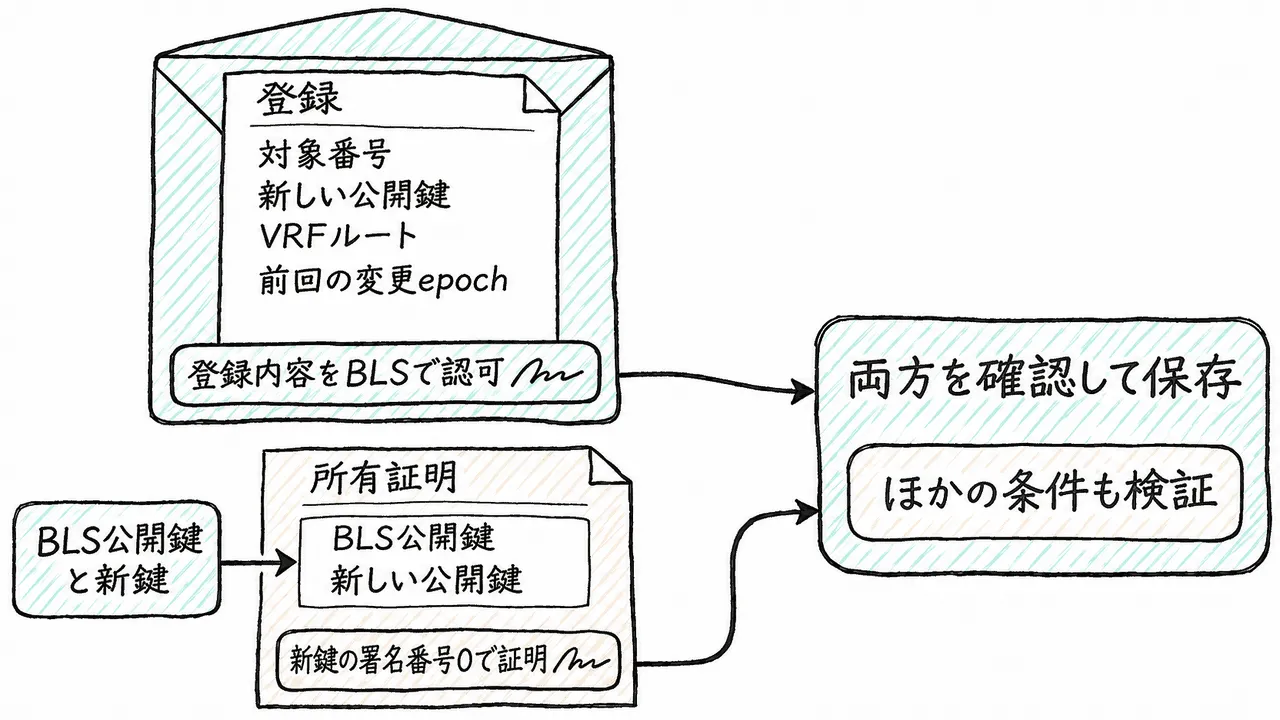
Registration signatures use DOMAIN_PQ_KEY_REGISTRATION = 0x12000000, while proofs of possession use DOMAIN_PQ_KEY_POSSESSION = 0x13000000.
Domains distinguish signature purposes. Both are calculated using the genesis fork version and genesis_validators_root.
The latter is a root representing the validator set at chain genesis, used in the calculation to prevent reuse on another chain.
Signatures for the same purpose remain valid across ordinary forks.
get_xmss_signature_index
Reads the first four bytes of a signature in little-endian order and returns its signature index.
For proof of possession, this value must be zero before cryptographic verification is attempted.
def get_xmss_signature_index(signature: XMSSSignature) -> Uint32:
    """
    Return the leaf index that a signature carries.
    """
return Uint32(int.from_bytes(signature[0:4], ENDIANNESS))- Parameters
| Parameter | Meaning |
|---|---|
signature |
Byte sequence containing the signature index |
- Extract the first four bytes
- Return the little-endian 32-bit value
- Return value
| Type | Result |
|---|---|
Uint32 |
Index contained in the signature |
-
Execution conditions
This function performs no cryptographic verification by itself.
For example, the leading bytes 00 00 00 00 indicate index 0, while 01 00 00 00 indicates index 1.
Reading the index alone does not establish the validity or full length of the signature; subsequent verification must also succeed.
is_valid_pq_possession_proof
Receives the state, target BLS public key, new public key, and proof of possession, returning True if possession is proved.
If the signature index is not zero, it immediately returns False.
def is_valid_pq_possession_proof(
    state: BeaconState, pubkey: BLSPubkey, xmss_public_key: XMSSPublicKey, proof: XMSSSignature
) -> bool:
    """
    Check that the holder of a leanXMSS key signed it for a BLS public key, at leaf index PQ_POSSESSION_XMSS_INDEX.

    The domain uses the genesis fork version, so a proof stays valid across forks.
    """
    if get_xmss_signature_index(proof) != PQ_POSSESSION_XMSS_INDEX:
        return False
    possession = PQKeyPossession(pubkey=pubkey, xmss_public_key=xmss_public_key)
    domain = compute_domain(
        DOMAIN_PQ_KEY_POSSESSION, GENESIS_FORK_VERSION, state.genesis_validators_root
    )
return xmss.Verify(xmss_public_key, compute_signing_root(possession, domain), proof)- Parameters
| Parameter | Meaning |
|---|---|
state |
State containing the chain's genesis root |
pubkey |
BLS public key of the registration target |
xmss_public_key |
New public key |
proof |
Proof of possession generated with the new key |
- Check for signature index 0
- Construct the proof message binding the target's BLS public key and the new key
- Calculate the domain using the genesis fork version and verify the signature
- Return value
| Type | Result |
|---|---|
bool |
True only for a valid proof of possession at index 0 |
-
Execution conditions
A different index, a different signed message, or an invalid cryptographic signature results in
False.
Next, construct PQKeyPossession, calculate the 32-byte signing value incorporating the purpose and chain, and pass it to xmss.Verify.
A proof intended for a different BLS public key fails verification because the signed message changes.
The proof of possession does not include the VRF root, but the BLS signature authorizing the entire registration includes it.
The initial registration does not check the rotation interval. Once a validator's deposit has been processed and an index assigned, it can register before activation. A builder, in contrast, registers after its deposit epoch is finalized and it becomes active, specifying that deposit epoch as the previous value.
Registration validation and block processing order
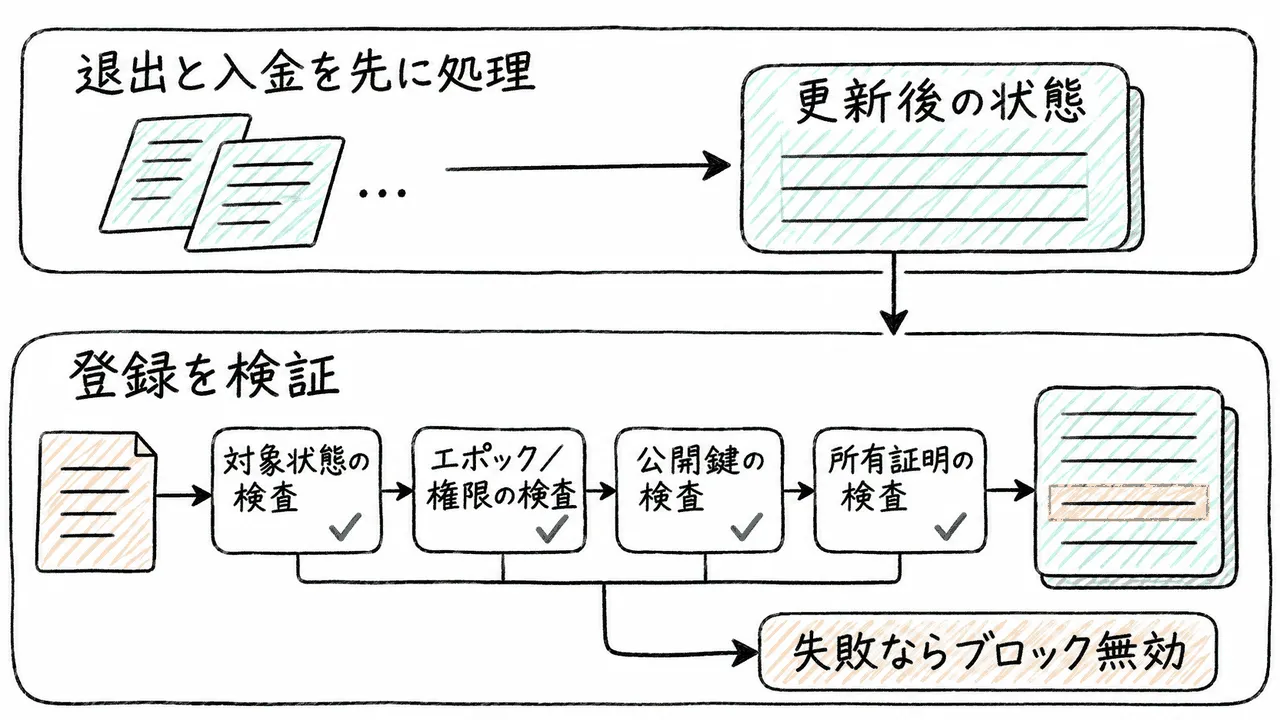
A block proposer checks registrations against the state after exits and deposits in that block have been processed. If a registration is included based only on signature checks against the pre-exit state, an earlier operation in the same block may cause the target to exit and invalidate the entire block.
is_pq_public_key_in_use
Reads key material for both validators and builders and returns True if any participant currently holds the specified public key.
The target's own currently held key also counts as a duplicate.
def is_pq_public_key_in_use(state: BeaconState, xmss_public_key: XMSSPublicKey) -> bool:
    """
    Return whether any validator or builder holds the leanXMSS key.
    """
    entries = list(state.post_quantum_key_material) + list(state.builder_post_quantum_key_material)
return any(entry.xmss_public_key == xmss_public_key for entry in entries)- Parameters
| Parameter | Meaning |
|---|---|
state |
State containing both registration registries |
xmss_public_key |
Key to check for duplication |
- Combine validator and builder key material
- Return whether any key matches
- Return value
| Type | Result |
|---|---|
bool |
True if the key is currently in use |
-
Execution conditions
The function does not check the history of previously released keys.
Clients can avoid scanning by maintaining a mapping from public keys to indexes. During key rotation or builder index reassignment, remove the released key from that mapping. Because the registry does not retain the history of released keys, signers remain responsible for identifying keys that have been used before.
process_operations
Receives the state, block body, and parent slot; checks the registration count, processes existing operations first, and processes registrations last.
The function returns no value; successful changes are applied to the state.
def process_operations(state: BeaconState, body: BeaconBlockBody, parent_slot: Slot) -> None:
    # ... existing length checks ...
    assert len(body.pq_key_registrations) <= MAX_PQ_KEY_REGISTRATIONS  # [New in this EIP]

    # ... existing operation processing ...
for_ops(body.pq_key_registrations, process_pq_key_registration) # [New in this EIP]- Parameters
| Parameter | Meaning |
|---|---|
state |
State reflecting preceding requests |
body |
Block body |
parent_slot |
Parent slot passed to existing processing |
- Check that there are no more than eight registrations
- Process existing block operations
- Process signed registrations in list order
-
Execution conditions
Exceeding the count limit or violating an individual registration condition invalidates the block.
parent_execution_requests are processed before this function by process_parent_execution_payload, which applies the parent execution payload.
For example, registration fails for a target whose exit request has already been applied there.
Registration also fails in the block that reassigns an index to a new builder because its deposit epoch is not yet finalized.
process_pq_key_registration
Receives the state and signed registration, then checks the target, replay protection, authorization, key material, and proof of possession in order.
The key material and current epoch are stored only if all checks pass.
def process_pq_key_registration(
    state: BeaconState, signed_registration: SignedPQKeyRegistration
) -> None:
    registration = signed_registration.message
    key_material = registration.key_material

    if is_builder_index(registration.index):
        builder_index = convert_validator_index_to_builder_index(registration.index)
        assert builder_index < len(state.builders)
        # Builders register once active, so after their deposit epoch is finalized
        assert is_active_builder(state, builder_index)
        # Builders make no selection proofs
        assert key_material.vrf_root == VRFRoot()
        pubkey = state.builders[builder_index].pubkey
        stored_key = state.builder_post_quantum_key_material[builder_index].xmss_public_key
        last_change_epoch = state.builder_post_quantum_key_change_epochs[builder_index]
    else:
        validator_index = registration.index
        assert validator_index < len(state.validators)
        assert state.validators[validator_index].exit_epoch == FAR_FUTURE_EPOCH
        pubkey = state.validators[validator_index].pubkey
        stored_key = state.post_quantum_key_material[validator_index].xmss_public_key
        last_change_epoch = state.post_quantum_key_change_epochs[validator_index]

    # Replay protection and rate limit
    assert registration.previous_change_epoch == last_change_epoch
    if stored_key != XMSSPublicKey():
        assert get_current_epoch(state) >= last_change_epoch + MIN_PQ_KEY_CHANGE_DELAY

    # Authorization by the registrant's BLS signing key
    domain = compute_domain(
        DOMAIN_PQ_KEY_REGISTRATION, GENESIS_FORK_VERSION, state.genesis_validators_root
    )
    assert bls.Verify(pubkey, compute_signing_root(registration, domain), signed_registration.signature)

    # A new leanXMSS key, whose possession is proven
    assert key_material.xmss_public_key != XMSSPublicKey()
    assert not is_pq_public_key_in_use(state, key_material.xmss_public_key)
    assert is_valid_pq_possession_proof(
        state, pubkey, key_material.xmss_public_key, signed_registration.possession
    )

    if is_builder_index(registration.index):
        state.builder_post_quantum_key_material[builder_index] = key_material
        state.builder_post_quantum_key_change_epochs[builder_index] = get_current_epoch(state)
    else:
        state.post_quantum_key_material[validator_index] = key_material
state.post_quantum_key_change_epochs[validator_index] = get_current_epoch(state)- Parameters
| Parameter | Meaning |
|---|---|
state |
State after applying preceding operations in this block |
signed_registration |
Registration containing two signatures |
- Check the target, previous change epoch, and rotation interval
- Check BLS authorization, nonzero and unique new key material, and proof of possession
- Store the new key material and current epoch only on success
-
Execution conditions
A block containing a registration that fails even one condition is invalid.
- Check that the registration target exists and meets the participation conditions A validator must not have initiated its exit. For a builder, also check that it is active and that the root being registered is zero.
- Check the previous value and rotation interval Compare the application's previous change epoch with the registry. If a key is already registered, also verify that at least 256 epochs have elapsed since the previous change.
- Verify authorization by the target's existing key
Verify the signature over the entire registration using the target's
BLSpublic key. The submitter's address does not confer authorization. - Check the new key and proof of possession Reject an all-zero key or a key currently used by any participant. Verify the proof of possession generated with the new key at signature index 0.
- Store the key material and change epoch
Replace the key material at the target index and set the change epoch to the current
epoch.
If even one assert fails, the block containing the registration is invalid.
A valid proof of possession does not suffice if the BLS signature is invalid. Even two valid signatures do not suffice if the previous value or exit status is inconsistent.
Key rotation and replay rejection
If the seed of the new private key or signing state is lost, or an incorrect key was registered, the target's BLS key can authorize rotation to a different new key.
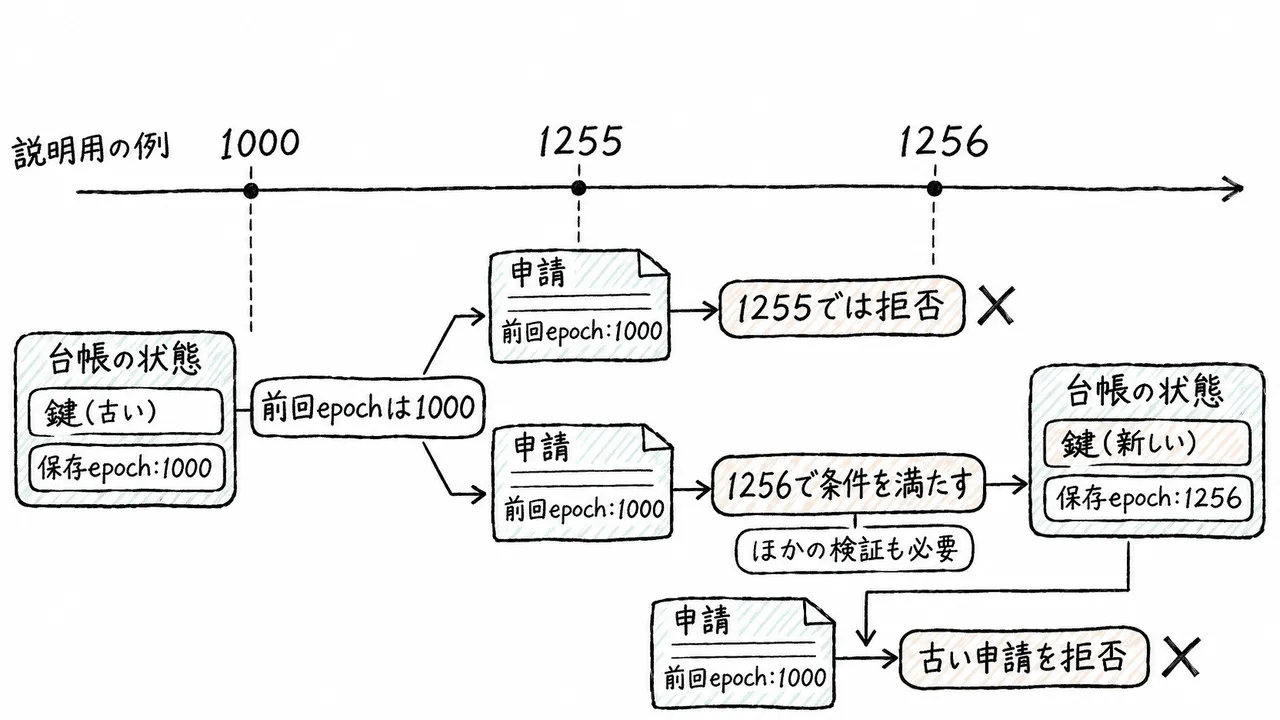
However, rotations at the same index must be separated by at least MIN_PQ_KEY_CHANGE_DELAY = 256 epochs.
The minimal test preset uses 8, and all configurations must use a value of at least 1.
For example, a key registered at epoch 1000 cannot be rotated at 1255. At 1256, rotation can succeed if all other checks pass.
The rotation application specifies 1000 as previous_change_epoch, and the stored value becomes 1256 after success.
Resubmitting the same application with a previous value of 1000 is subsequently rejected because the stored value no longer matches.
Even when only the root needs correction, the same public key is rejected because it is already in use by the target. It is also possible to rotate to a new signing key while retaining the same root. This restriction is not a wall-clock expiration. It checks that the previous value matches the registry and that the required number of epochs has elapsed.
Network propagation
Nodes receive signed registrations on the dedicated pq_key_registration topic and proceed from inexpensive checks to cryptographic verification.
Conditions that can differ because nodes are at different states result in IGNORE: the message is not forwarded.
Conditions that establish invalidity, such as an invalid signature, result in REJECT.
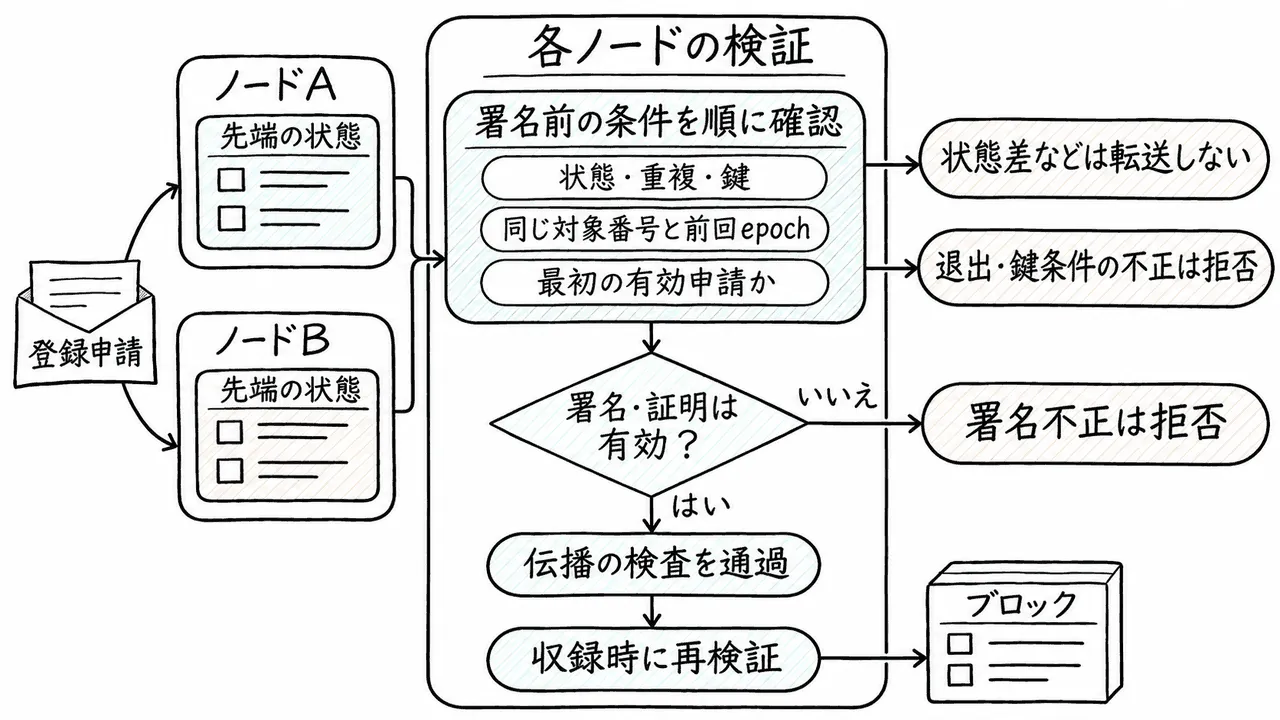
| Check order | Result if the condition fails | Condition checked |
|---|---|---|
| 1 | IGNORE |
The introducing fork has been reached, accounting for clock tolerance |
| 2 | IGNORE |
The latest head state contains the new registries |
| 3 | IGNORE |
The target index exists in the latest head state |
| 4 | REJECT |
The target has not initiated an exit |
| 5 | IGNORE |
The builder's deposit epoch precedes the finalized checkpoint |
| 6 | REJECT |
The builder's root is zero |
| 7 | IGNORE |
This is the first valid registration for the target index and previous epoch pair |
| 8 | IGNORE |
The previous epoch matches the registry |
| 9 | IGNORE |
The rotation interval has elapsed if a key is already registered |
| 10 | REJECT |
The new key is not all-zero |
| 11 | IGNORE |
The new key is not in use anywhere in the registries |
| 12 | REJECT |
The target's BLS signature is valid |
| 13 | REJECT |
The proof of possession for the target is valid |
Some nodes may not yet know the target index immediately after a deposit, so an unknown index alone does not establish invalidity.
Similarly, duplicate keys and previous values can differ depending on a node's head state, so these checks result in IGNORE.
A nonzero builder root or invalid signature, by contrast, results in REJECT.
While the first accepted application for the same target index and previous value remains valid, nodes ignore revised versions. If an incorrect key is registered, the operator must wait until the rotation interval has elapsed after inclusion before replacing it. If another target registers the same key first and the original application becomes invalid in finalized state, nodes may clear their first-seen record. Even an application that passed gossip validation must be checked again against the state immediately before inclusion.
verify_block_body_operation_limits
Checks the registration count during block gossip and raises GossipReject if there are more than eight entries.
The argument is the received block body; there is no return value on success.
def verify_block_body_operation_limits(body: BeaconBlockBody) -> None:
    # ... existing checks ...

    # [REJECT] The PQ key registration count is within the limit
    if len(body.pq_key_registrations) > MAX_PQ_KEY_REGISTRATIONS:  # [New in this EIP]
raise GossipReject("too many pq key registrations")- Parameters
| Parameter | Meaning |
|---|---|
body |
Block body checked during gossip |
- Read the registration count
- Raise
GossipRejectif the count exceeds eight
-
Execution conditions
Gossip rejects a block containing nine or more registrations before processing individual signatures.
This check runs before block processing. Even if every registration has a valid signature, a block containing nine or more registrations is not forwarded.
Additional considerations
The registration standard introduces key storage and authorization in advance and consolidates future signing purposes under a single key. Separating single-use signature indexes from selection randomness supports this design.
Distinct roles of signing keys and randomness
A single validator signs multiple messages even within one slot.
Because leanXMSS signatures contain indexes, different purposes can be assigned different indexes under one key without registering a separate key for each purpose.
Compared with combining the scheme with a separate stateless signature scheme, this avoids adding a second key and verifier.
Using signature outputs directly as selection randomness, however, could allow a signer to choose a favorable result from multiple possible signatures for the same input.
The root of a VRF that commits to one output per input position is therefore registered before the input becomes known.
However, registration does not check whether the tree is valid. Operators must retain a tree they can open rather than assume that storing the root is sufficient.
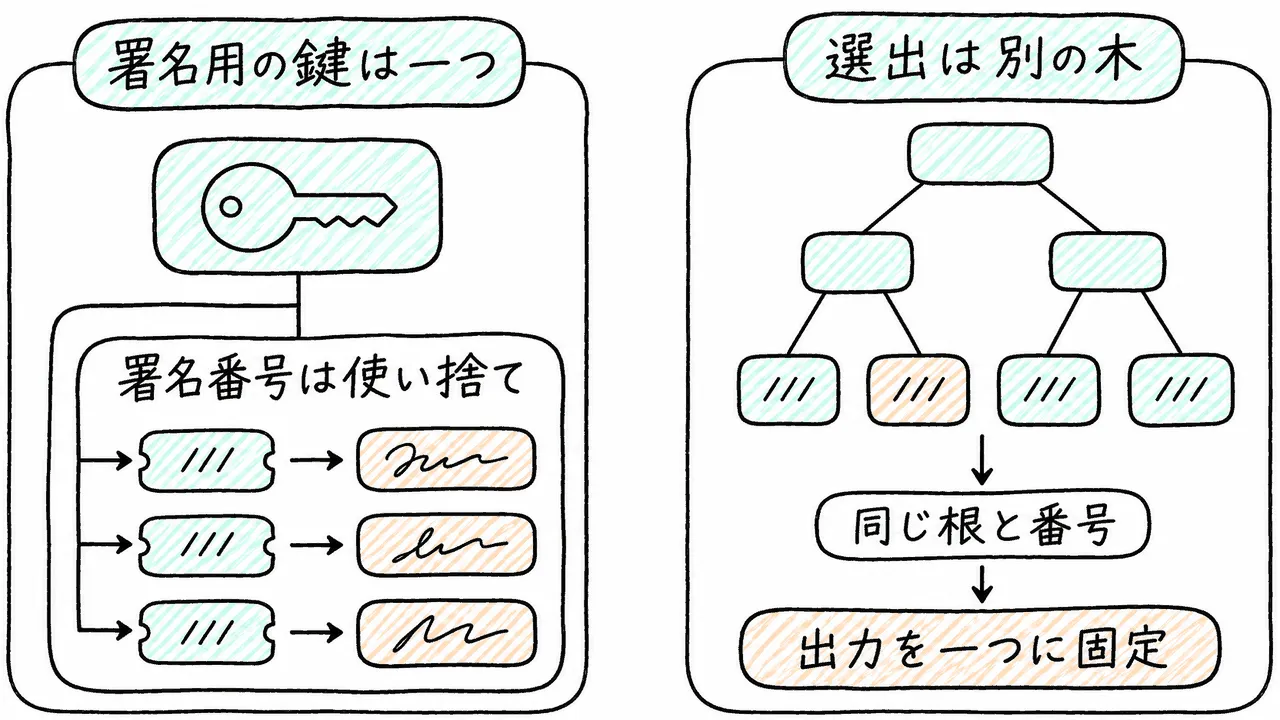
Single-use signature indexes
Index 0 is used exclusively for proof of possession bound to the registration target's BLS public key, not for votes or proposals.
Remaining indexes can be assigned by selecting an unused index and recording its consumption, or by allocating fixed index ranges to slots.
Neither method permits signing twice at the same index, even when signing the same message again.
If a block containing a registration is reorganized out of the chain, resubmit the same saved signed bytes instead of generating another proof of possession.
The leanXMSS seed and VRF leaf secrets should not be derived from the BLS private key.
This avoids a dependency that could allow the new secret material to be computed if the BLS private key is recovered in the future.
Registration limits and registry capacity
MAX_PQ_KEY_REGISTRATIONS = 8 limits the combined number of initial registrations and rotations per block.
Each entry contains an eight-byte index, 64 bytes of key material, an eight-byte previous change epoch, a 2404-byte proof of possession, and a 96-byte BLS signature, totaling 2580 bytes.
Eight entries occupy 20640 bytes, or approximately 20 KiB of additional block data.
Verification is likewise limited to at most eight BLS and eight leanXMSS checks.
Registering one million validators eight at a time requires 125000 full blocks. Assuming 12-second slots, a block in every slot, and every registration slot used for initial registrations, this takes approximately 17 days. Rotations, builder registrations, and missed blocks increase the time required, while shorter slots reduce it.
The registry stores 64 bytes of key material and eight bytes of change epoch per index.
Including exited participants, the storage requirement is approximately 72 MB per million indexes allocated over time.
The eight-entry block limit constrains per-block load, but long-term state growth as indexes accumulate remains.
Compatibility
Introducing this mechanism requires a consensus-layer hard fork. The upgrade adds preregistration processing while preserving existing signature authentication.
Signature processing remains unchanged after registration
Because registered keys remain dormant, votes, block proposals, and bids continue to use BLS authentication.
Unregistered participants do not lose their roles solely because of this upgrade.
Key rotation replaces stored bytes; it does not immediately change the signing key used for votes.
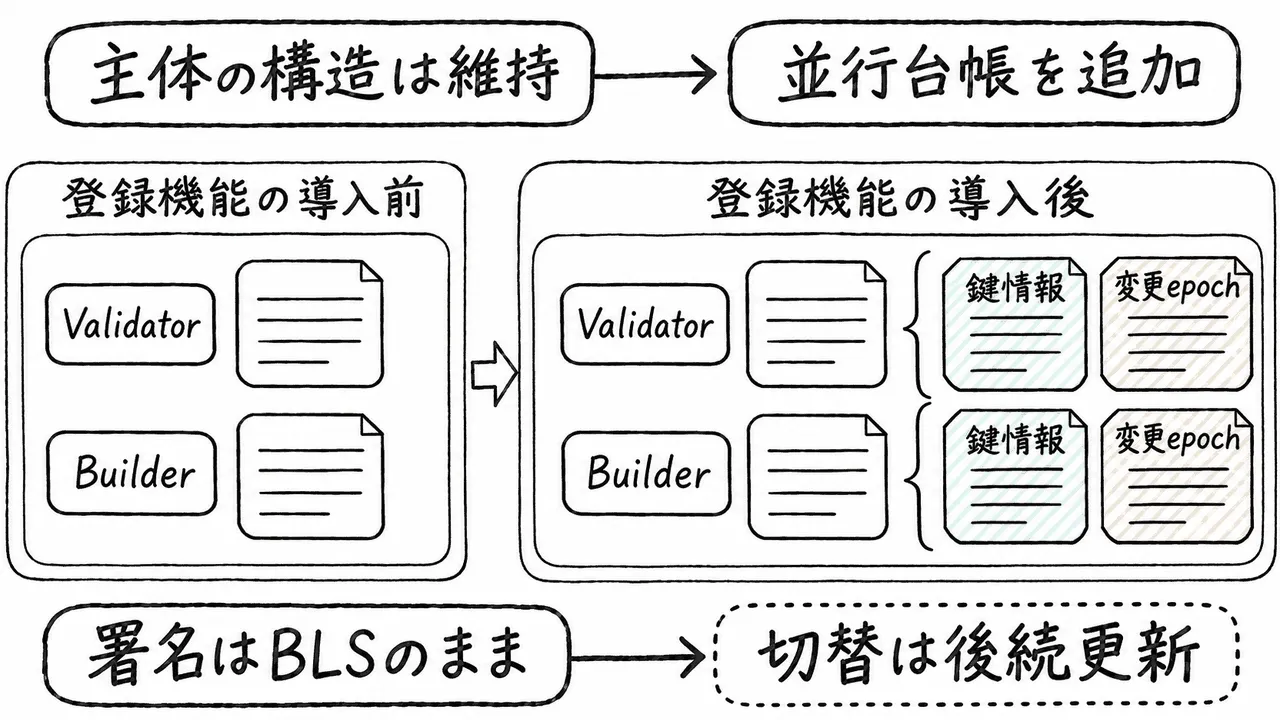
Authorization takes place entirely through consensus-layer operations.
There is no mechanism for asset owners to authorize registration by submitting a request to a new execution-layer contract.
Regardless of the withdrawal credential format, the target's BLS key authorizes registration and rotation.
State extension and the builder registry
The ProgressiveContainer introduced by EIP7495 provides a basis for extending state fields while preserving existing field positions.
The new registry lists are added through this mechanism, so generalized indexes for the existing Validator and Builder structures themselves remain unchanged.
Existing proofs against those structures and light-client reference positions remain unaffected until the signature transition.
Inspecting active_fields, which identifies active field positions, shows where new lists are appended while preserving existing positions.
This makes it possible to check whether the extended BeaconState and BeaconBlockBody contain the new registration fields.
The ProgressiveList introduced by EIP7916 defines a list format designed to accommodate additional elements.
The registration standard uses parallel lists in this format because key material and change epochs are referenced using the same indexes as participants.
Examining the list element types and index relationships makes it possible to associate participant 42 with key entry 42. Comparing the participant list length with the lengths of the new lists also checks that key material and change epochs are initialized when new participants are added.
EIP7732 defines the registry of builders that construct execution payloads, along with signatures on their bids and envelopes.
Key registration uses indexes from that registry and distinguishes them from validator indexes using BUILDER_INDEX_FLAG.
Check the target index carrying BUILDER_INDEX_FLAG and the deposit epoch of the builder at that index.
This distinguishes validators from builders and establishes the conditions for rejecting old applications after index reuse.
Deposit and exit requests introduced by EIP8282 are processed before registration and may change whether a target is active or who occupies an index.
These requests modify builder state; they do not allow asset owners to authorize post-quantum key registration.
Check the builder index and deposit epoch after applying deposit and exit requests. Comparing the new deposit epoch with an old application's previous value confirms that a previous participant's registration cannot be applied after index reassignment.
Private key storage and tracking consumed signature indexes should follow EIP8310.
That standard extends the encrypted key storage format and defines the authoritative storage for used indexes and the order in which consumption must be recorded before a signature is returned externally.
The key file itself is not the authoritative record of state that changes with each signature. Fixed assignment uses slashing-protection records, while free assignment uses dedicated, atomically updated storage.
Used indexes are not stored in the registration BeaconState.
Check the rule requiring consumption of an index to be durably recorded before the signature is returned externally. After selecting an index and confirming that it is unused, signature computation and state persistence may occur in either order, but the signature must not be returned externally until both are complete. The storage and recording order establish conditions for preventing reuse caused by restoring old backups or multiple signers selecting the same index.
The registered key material does not include a cryptographic scheme version. If the scheme changes before the signature transition, the introducing fork must define how existing registrations are handled and introduce new domains for registration and proof of possession. Signatures for the previous scheme must not be reapplied, and historical registrations are distinguished by their change epochs.
Test cases
Test the cryptographic module's inputs and outputs separately from registration state transitions. A cryptographically valid signature can still be rejected because of exit status or the previous change epoch.
Key and signature test vectors
The pinned version of EthLib referenced by the specification contains test vectors for key generation, signing, and verification.
Verification takes a 32-byte public key, a 32-byte message, and a 2404-byte signature and returns a Boolean indicating validity.
Inputs of different lengths are rejected, with null as the output in the test format.
The registration-side xmss.Verify converts decoding failures to False rather than propagating exceptions.
| Test target | Condition checked in the pinned implementation | Expected result |
|---|---|---|
| Valid verification vector | Both layers are valid and the result matches the public key root | true |
| Tampering with one layer | Flip one bit at the beginning of the target field | false if validity is lost |
| Public key length | Anything other than 32 bytes | Decoding error |
| Signature length | Anything other than 2404 bytes | Decoding error |
| Proof-of-possession index | Anything other than 0 | Registration-side False |
Successful decoding and signature validity are distinct. For example, a byte sequence of exactly 2404 bytes may decode into the expected structure without its authentication path reaching the public key. The expected results shown here are based on the official formats and code branches; they do not represent an execution of the entire test vector suite.
Registration and rotation state-transition tests
For state transitions, pair a successful case with rejection cases that each change only one condition. For example, take a rotation that succeeds at epoch 1256 and move it to 1255 to check that the interval validation rejects it. Also check that a registration which succeeds on its own is rejected if an earlier operation in the same block initiates the target's exit.
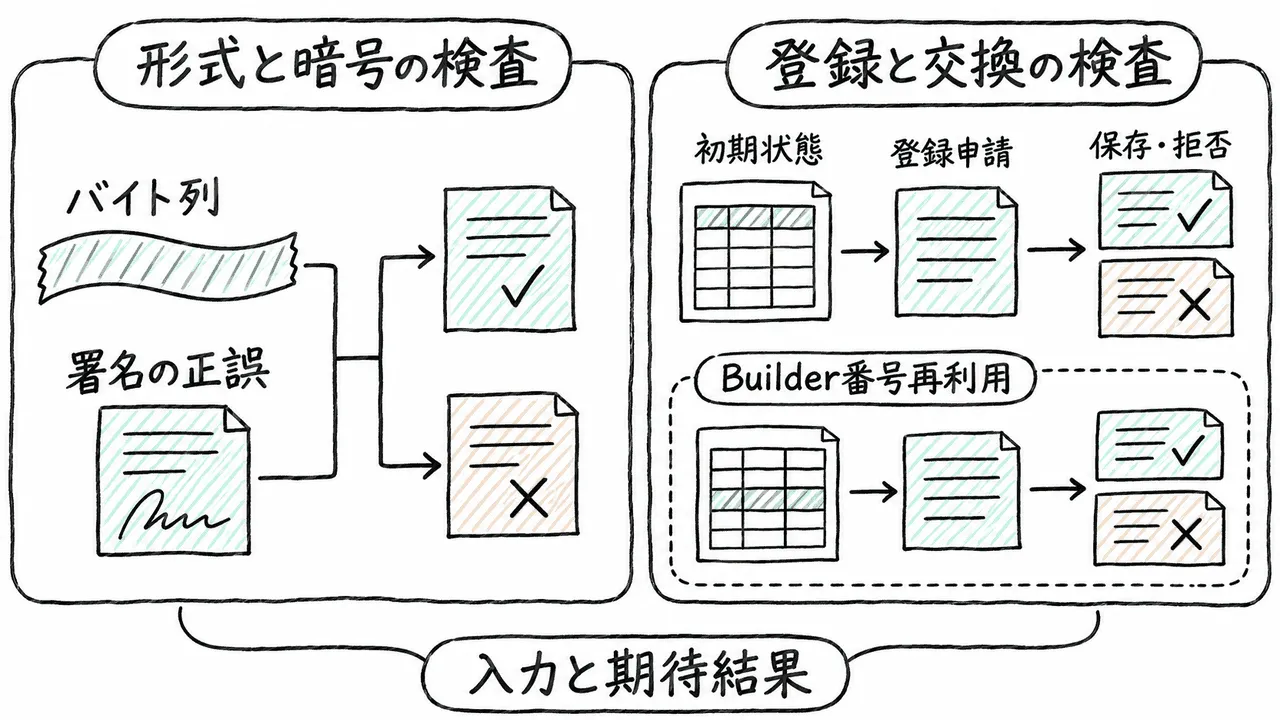
| Input state or operation | Expected result |
|---|---|
| Valid initial registration for an unregistered validator | Store key material and current epoch |
| Rotation to a different key after 256 epochs | Store the key even if the root is retained |
| Rotation within 255 epochs | Invalid block |
Replay with the old previous_change_epoch |
Invalid block |
| Target has exited or exits in the same block | Invalid block |
| Active builder with a zero root | Successful registration |
| Inactive builder, nonzero root, or out-of-range index | Invalid block |
| All-zero key, in-use key, invalid proof, or signature index other than 0 | Invalid block |
| Two participants register the same key in one block | The later registration is invalid |
| Block contains nine registrations | Reject during gossip |
| Old application submitted after builder index reuse | Invalid because the previous value differs |
| Fork and participant addition | Check initial key values and list lengths |
Exit checks include proposer and attester slashings, voluntary exits, withdrawal requests, consolidation requests, and builder exit requests.
For index reuse, also test the case in which the same BLS key returns after an intervening builder has occupied the index.
The registry may accept reregistration of a released key, but this violates the signer's prohibition on key reuse.
Evaluate registry acceptance separately from compliance with operational rules.
Reference implementation
The registration standard defines the cryptographic interface and required properties independently of the internal construction.
Decoding and two-layer signature verification can be examined in the officially referenced EthLib commit 6390c73ef040311e807b9047d99dca6b1be1c42f.
Decoding public keys and signatures
Serialization.lean splits a 32-byte public key into a 16-byte root and a 16-byte public parameter.
The public parameter is public information supplied to hash computations for that key.
decodePublicKey returns .badPublicKeySize when the length is incorrect.
Signature decoding likewise checks the total length before reading the leading index, bottom layer, and top layer.
The following is decodeSignature from the pinned implementation.
def decodeSignature (bytes : ByteArray) : Except XmssError Signature :=
  if h : bytes.size = SIG_SIZE then
    .ok { leafIndex := UInt32.ofNat (fromLittleEndian
            (readBytes bytes 0 LEAF_INDEX_SIZE (by simp only [h, SIG_SIZE]; omega)))
          bottom := decodeLayerSignature bytes LEAF_INDEX_SIZE
            (by simp only [h, SIG_SIZE]; omega)
          top := decodeLayerSignature bytes (LEAF_INDEX_SIZE + LAYER_SIG_SIZE)
            (by simp only [h, SIG_SIZE]; omega) }
  else
    .error (.badSignatureSize bytes.size)
After the first four bytes, the decoder reads 1200 bytes starting at offset 4 as the bottom layer and 1200 bytes starting at offset 1204 as the top layer.
Each layer consists of a 16-byte randomizer, 58 chain values totaling 928 bytes, and a 16-level authentication path totaling 256 bytes.
The randomizer is a public value used to construct the hash value for signing, and chain values are intermediate values of the one-time signature's hash chains.
decodeLayerSignature partitions these ranges without performing cryptographic verification.
A 2403-byte signature results in .badSignatureSize 2403; the decoder does not pad it before verification.
Even if a 2404-byte signature decodes successfully, whether its index is the registration-reserved index 0 is a separate check.
The pinned implementation's encodePublicKey, encodeLayerSignature, and encodeSignature serialize values in the same order.
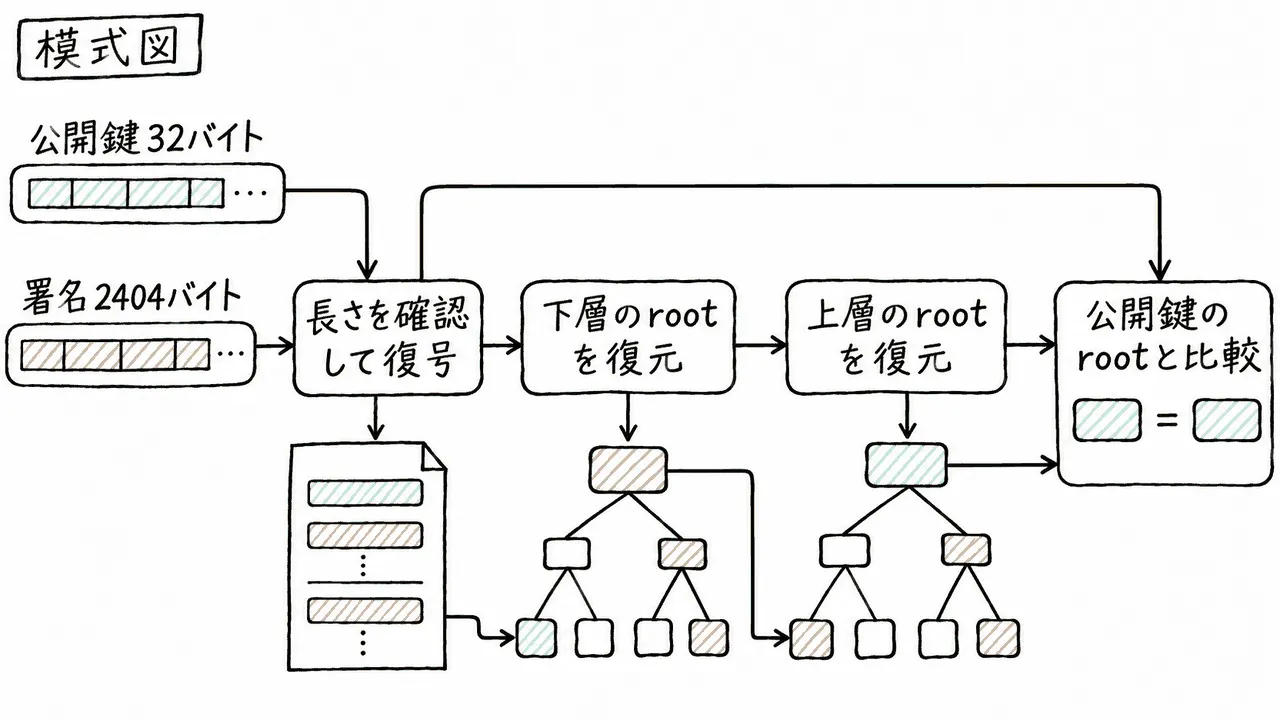
Constants in the pinned implementation establish the relationship between decoding lengths and cryptographic inputs. Length constants determine which byte ranges the decoder reads. The constants and structure types themselves do not cause runtime failures or registry updates.
| Constant | Value | What it determines |
|---|---|---|
DIGEST_LEN |
16 | Byte length of tree nodes and hash values |
PUBLIC_PARAM_LEN |
16 | Byte length of the public parameter |
ADDRESS_LEN |
16 | Byte length of the address distinguishing hash invocation positions |
MESSAGE_LEN |
32 | Byte length of the message hash provided by the signing caller |
RANDOMIZER_LEN |
16 | Byte length of the randomizer used to find an admissible codeword |
SEED_LEN |
32 | Byte length of the secret seed from which all secret material is derived |
SEED_TAG |
Eight bytes of leanXMSS |
Prefix distinguishing seed derivation from other schemes |
CHAIN_LENGTH |
4 | Hash-chain positions 0 through 3 selected by a two-bit digit |
DIGITS |
64 | Number of two-bit digits in a 16-byte hash value |
V |
58 | Number of hash chains in one one-time key |
TARGET_SUM |
106 | Sum of the digits in an admissible codeword |
CHAIN_HASHES |
68 | Total number of hash-chain steps traversed in each layer's verification |
MAX_RANDOMIZER_TRIALS |
Maximum number of trials to find a codeword during signing | |
LAYER_HEIGHT |
16 | Height of the tree at each layer |
LOG_LIFETIME |
32 | Number of bits in the signature index across both layers |
PUB_KEY_SIZE |
32 | Total public key length |
LEAF_INDEX_SIZE |
4 | Total signature index length |
LAYER_SIG_SIZE |
1200 | Combined length of the randomizer, chain values, and authentication path |
SIG_SIZE |
2404 | Combined length of the index and both signature layers |
The remaining six digits that do not correspond to the 58 chains must be zero in an admissible codeword. Fixing the digit sum at 106 results in chain steps during verification. If the codeword does not meet these conditions, subsequent leaf reconstruction fails.
The decoded types also have corresponding byte representations.
| Structure type | Fields | Decoding role |
|---|---|---|
PublicKey |
root and publicParam |
Top-layer root used for the final comparison and the public parameter used for hashing |
LayerSignature |
randomizer, chainValues, and path |
Information for reconstructing a tree root from one layer's one-time signature |
Signature |
leafIndex, bottom, and top |
Index, bottom-layer signature, and top-layer signature |
Being able to decode data into a type does not establish that its authentication path is correct. Encoding functions produce byte sequences from in-memory structures, and decoding functions perform the reverse operation. Neither modifies the registration registry or the authoritative record of consumed indexes.
Two-layer signature verification
On the key generation side, keyGen in KeyGen.lean takes a uniformly random 32-byte seed and returns a SecretKey and PublicKey.
The SecretKey holds only seed, and SecretKey.publicKey is the direct call used to calculate the public key.
The following code from the pinned implementation shows that direct call.
def keyGen (seed : Seed) : SecretKey × PublicKey :=
  let sk : SecretKey := ⟨seed⟩
  (sk, sk.publicKey)
SecretKey.publicKey uses SecretKey.publicParam and SecretKey.schemeSeed, computes the height-16 top-layer tree, and returns its root.
SecretKey.schemeSeed calls schemeSeed, which prepends SEED_TAG to the original seed and hashes the result.
SecretKey.publicParam calls publicParamOf, which calculates the public parameter from the derived seed.
Rather than invoking these derivation functions directly, keyGen reaches them indirectly through public key computation.
The key generation caller stores the seed; this function does not persist a file. If the seed can be reproduced, the trees and public key can be recalculated, but this does not allow records of consumed signature indexes to be rolled back safely. Key generation, encoding, and signing are not directly required for consensus. Consensus uses the result of the verification interface.
layerRoot in Verify.lean reconstructs a leaf from the one-time signature and follows the 16-level authentication path to calculate the tree root.
If the input hash value is not an admissible codeword under the signature scheme, leaf reconstruction fails and the root becomes none.
verify computes the bottom-layer root and then proceeds to the top-layer root authenticating that bottom-layer root.
The following is the verification function from the pinned implementation.
def verify (pk : PublicKey) (msg : Message) (sig : Signature) : Bool :=
  let pp := pk.publicParam
  let root? : Option Digest := do
    let bottomRoot ← layerRoot pp .bottom sig.leafIndex.toNat (packBytes msg) sig.bottom
    layerRoot pp .top (bottomTree sig.leafIndex) (packBytes bottomRoot) sig.top
  decide (root? = some pk.root)
First, verify the 32-byte message using the bottom-layer one-time key to obtain the 16-byte root of the bottom-layer tree.
Then bottomTree calculates the quotient of the signature index divided by , and the corresponding top-layer key verifies the bottom-layer root.
The result is true only if both layers succeed and the final root matches the public key's root.
If either layer fails with none, or verification reaches a different root, the result is false.
For example, for index 65536, the bottom-layer signature index is 65536 and the corresponding top-layer position is 1. The top layer authenticates the root of this bottom-layer tree. Verifying only the message and omitting the top layer would not establish its connection to the public key. However, registration proofs of possession accept only index 0.
signLayer in Sign.lean constructs the one-time signature and authentication path, returning .noAdmissibleEncoding if it cannot find an admissible codeword.
sign signs the message in the bottom layer, signs the bottom-layer root in the top layer, and combines both layers.
Signing in this pinned implementation is deterministic, but the registration standard does not assume determinism and prohibits signing the same content again at the same index.
The cryptographic module also does not track consumed indexes. The caller is responsible for assigning indexes, recording their consumption, and resubmitting saved signatures. Invoking the cryptographic verifier alone does not check signature-index reuse or registration authorization.
Security
Registration authenticity depends on both an existing BLS signature and possession of the new key.
Separate conditions remain concerning signature-index management, duplicate registered keys, and the timing of the future transition.
Freezing registration changes before BLS is broken
An attacker capable of forging BLS signatures can generate a post-quantum key and authorize registration or rotation at someone else's index.
The 256-epoch limit constrains the frequency of changes at the same index, but it does not distinguish forged authorization from legitimate signatures.
Even a preregistered key can be replaced by an attacker while changes remain permitted.
The signature transition must therefore occur while BLS is still believed to be secure, or a separate fork must freeze registration changes before it is broken.
The fork that begins using post-quantum keys for protocol duties also disables BLS-authorized rotation.
Otherwise, after BLS is broken, an attacker could replace even the new keys already in use.
Duplicate keys and reuse of single-use indexes
The registry prevents duplicate registration of public keys currently used across validators and builders.
Otherwise, multiple participants could claim a signature made with the same key as evidence of their own participation.
A proof of possession containing the target's BLS public key protects against copying an as-yet-unregistered public key before its owner registers it.
However, released keys are removed from the registry, so consensus may accept their reregistration.
For a validator and builder sharing the same BLS public key, an earlier proof of possession may even be reusable without modification.
Signers must use one key for one registration for one participant and must never return to a previously registered key.
Moving the same key to a target with a different BLS public key would require signing a different message at index 0.
This violates the prohibition on reusing single-use indexes.
If a future fork allows the BLS public key itself to change, the binding to existing proofs of possession must also be reconsidered.
Builder index reuse
The index of a builder that has exited and withdrawn is reassigned to another builder. Checking application ownership by index alone risks applying signed data from a previous participant as a registration for a new participant. When adding the new participant, key material is reset to all-zero and the previous change epoch is set to the new deposit epoch.
The previous participant's final change epoch is at or before its exit, and the new deposit occurs after a withdrawal waiting period of at least one epoch.
The previous value in an old application does not match the new deposit epoch and is rejected.
This difference in epochs also prevents replay when the same BLS public key returns to an index after an intervening participant.
Moreover, initial registration requires the deposit epoch to have finalized and the builder to be active, so registration at an index reused within the same block is also impossible.
Registration rate and actual operational readiness
Registration demonstrates that the participant could sign once at the time of registration. It does not verify continued seed retention, consistency of signing state, or whether the signing software will work on the transition date. Registered effective balance is an upper bound on readiness, so a transition decision should allow a margin above the two-thirds participation needed for finality.
When aggregating registered balance, select only active validators and sum their effective balances, which represent voting weight. Do not substitute the balances of all participants, including exited ones, or a simple sum of actual deposited amounts. Use the total active effective balance as the denominator so that the result can be compared with the participation required for finality.
Copying a VRF root
A VRF root can be registered even if it matches another validator's root.
A copier cannot construct a proof before the owner reveals the opening, but can reuse the same output and proof after disclosure.
Duplicate signing public keys are rejected, whereas duplicate roots are allowed. The subsequent upgrade that uses the tree must account for such sharing.
Copying the root alone does not reveal the secret leaf values before disclosure.
However, when already disclosed openings can be used, multiple participants obtain the same output.
Registration proofs of possession cover the signing public key; they should not be interpreted as preventing root copying.
Cryptographic security proofs and targets
The leanXMSS specification uses Keccak-256 and proves 127-bit classical strong unforgeability in the random oracle model.
The 64-bit security level against quantum computation is a parameter target, not a proven lower bound.
Strong unforgeability refers to the difficulty of producing another valid signature distinct from signatures an attacker has already obtained.
| Target | Attack and assumptions | Interpretation of value |
|---|---|---|
leanXMSS |
Classical strong forgery in the random oracle model | Proven 127-bit security |
leanXMSS |
Quantum-computational attacks | Parameters targeting 64-bit security |
32-byte VRF node |
Classical collision search | Approximately hash evaluations |
32-byte VRF node |
Quantum collision search | Approximately hash evaluations |
Signature forgery and hash collision searches are different attacks. A proof, a parameter target, and a search-cost estimate should not be combined into one security metric.
Conclusion
EIP8450 enables validators and builders to use their existing BLS keys to authorize and preregister keys for future use before the signature transition.
Separating registration from activation makes readiness observable, but operators remain responsible for retaining secret material and managing signature indexes until the transition.
The period during which keys can be rotated and the subsequent upgrade that disables BLS authorization are what make preregistration a trustworthy migration mechanism.
The official registration specification and cryptographic implementation are available at the following links.
