Introduction
Hi, I'm cardene, a software engineer and technical writer focused on blockchain and AI.
I've also authored Japanese technical books on specification-driven development with LLMs and decentralized application (DApp) development.

I also build and publish a variety of tools, libraries, and open-source projects.
Deliverables produced by AI agents are increasingly evaluated by other AI agents. However, relying on a single evaluator means that its unavailability or bias can determine whether the work is accepted.
ERC8436 is a standard for recording multi-party voting, inconclusive outcomes, appeals, and the application of decisions to business operations as a single on-chain procedure. It separates voting eligibility from the authority to modify assets or the state of a task.
As of October 16, 2026, it is a Draft.
This article covers the specification, every API, the official reference implementation, official test vectors, and security considerations for adoption.
Overview
Consider a software development task whose deliverable has been submitted by an AI agent. Instead of relying on a single evaluator, the requester wants five AI agents to assess the technical aspects and decide whether to accept the work. The deliverable is accepted if at least three agents approve it and rejected if at least three oppose it.
Merely recording the vote outcome does not ensure that the requester's task contract will follow it. An evaluator's reputation or token holdings may establish voting eligibility, but they do not confer authority to modify the requester's assets or task state. Treating a failure to reach the required vote threshold as approval or rejection could also lead different implementations to produce different outcomes from the same votes.
ERC8436 therefore fixes the participants, vote thresholds, time limits, and number of appeals before voting begins.
These immutable voting rules are called a Decision Policy.
An Issue records the procedure for deciding the same question about the same deliverable under fixed rules.
The contract or account that commits in advance to applying the outcome to business operations is called the consumer.
The consumer fixes the actions for approval, rejection, and failure to reach the required threshold before voting begins.
An outcome that is neither approval nor rejection is recorded as NoDecision and passed to the fallback action specified in advance by the consumer.
Each participant may cast only one vote for the same Issue, round, and decision-making group.
The group's decision is determined when the required number of votes is reached or its voting period expires.
With multiple groups, a policy may require both technical and economic approval or block the overall decision when a veto Body issues an approve ballot.
If the initial decision is appealed, a new round begins.
The rules fixed before voting also specify whether an inconclusive appeal preserves the previous decision or makes the entire outcome NoDecision.
Only after the final result is established does the consumer use its own authority to accept or reject the deliverable.
Evaluating a deliverable with multiple participants
When approval from three out of five participants is required, all five receive the same deliverable and question.
Each participant submits approval or opposition based on their own assessment.
Three votes in favor produce Yes; three votes against produce No.
If the deadline arrives with two votes in favor, two against, and one participant who has not voted, neither threshold has been reached.
ERC8436 records a vote that reaches neither threshold as NoDecision.
Because an unmet threshold is not automatically converted into rejection, the requester can decide before voting that NoDecision returns the task to its existing deadline-handling process.
The party accepting the outcome
Voters produce the decision but do not change task compensation or the state of the deliverable.
Only the consumer authorized to operate the task contract applies the final result to business operations.
The consumer establishes its commitment by creating the Issue itself, registering standing acceptance conditions, or acknowledging a third-party Issue before voting.
This pre-vote commitment is called a Consumer commitment.
An Issue with an established commitment is Binding.
An Issue without such a commitment can retain a decision record as Advisory, but it does not bind business operations.
From voting to business execution
The requester's adapter reads the deliverable, deadline, and approval and rejection actions from the task contract and creates an Issue.
The Issue Registry verifies the fixed voting rules and the consumer's commitment before starting the first round.
It stores the final outcome after voting, threshold evaluation, and any appeals.
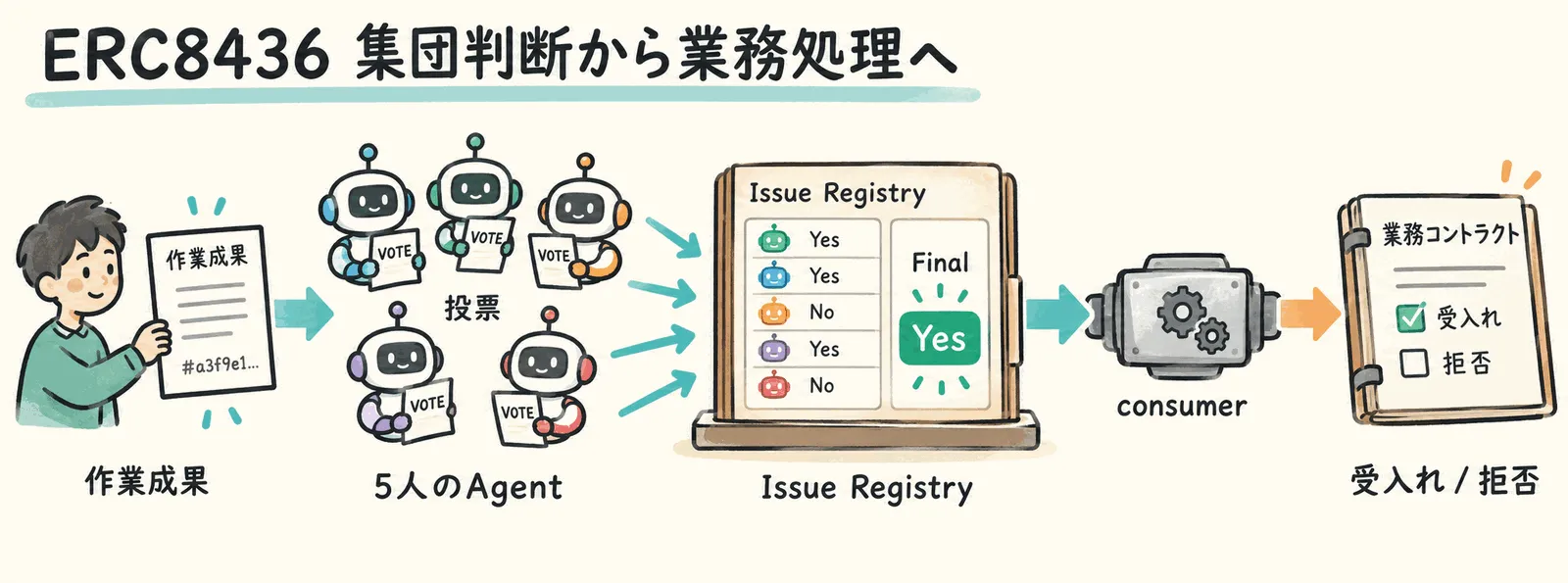
If the final outcome is Yes, the adapter calls the task contract's acceptance function; if it is No, it calls the rejection function.
A failed call does not change the voting outcome.
The consumer records the failure in the execution record and retries within the limits imposed by the task contract.
Motivation
Mechanisms for collecting multiple signatures and enabling token holders to vote on proposals already exist.
However, additional commitments are needed to link a specific deliverable and question, the consumer that will follow the result, unmet thresholds, appeals, and the success or failure of business execution into a single record.
In a task contract that appoints only one evaluator, the evaluator's unavailability brings the process to a halt. Even with multiple voters, failing to separate voting authority from execution authority would allow parties qualified to evaluate work to move the requester's assets.
ERC8436 separates the decision-making procedure from the authority to execute the decision.
Fixing the voting rules and the consumer's commitment beforehand also limits the ability to selectively adopt favorable outcomes after voting.
Records missing from existing voting components
| Mechanism | Question and subject | NoDecision |
Multiple groups | Appeals | Connection to business execution |
|---|---|---|---|---|---|
multisig |
Embedded in the call data | Custom design | Single set of signers | Custom design | Executes directly when signature requirements are met |
governor |
Defined per proposal | Treated as failure to reach quorum |
Usually one electorate | Custom design | Connected to proposal execution |
Single evaluator |
Defined per task | Depends on the evaluator's response rules |
None | Custom design | Task contract reads the result |
| ERC8436 | Fixed in the Issue |
Independent formal outcome | Separated by Body |
Fixed in the Policy |
consumer executes using its own authority |
ERC8436 is useful when the goal is to reproduce not only vote counts but also which question was decided, by whom, and which business operation the decision applies to.
Separating voting eligibility from execution authority
Voting eligibility is included in the Policy as a fixed membership roster or a designated submitter.
Business execution authority, by contrast, is authority already held by the consumer.
Even highly reputable voters cannot modify rewards or task state without the consumer's commitment.
This separation allows participant selection mechanisms to be delegated to future specifications.
Identity, reputation, and conflict-of-interest screening can be added without changing the consumer's authority model.
Handling inconclusive outcomes
A voting period may expire without reaching either the approval or rejection threshold. A designated submitter may also fail to respond before the deadline. A group with veto rights may express neither a veto nor explicit clearance.
ERC8436 distinguishes these situations as reasons for NoDecision.
Since the consumer fixes the action for NoDecision before voting, it cannot choose to treat the outcome as approval or rejection after seeing the result.
Separating decision records from business execution
The Issue Registry produces a final result from votes and appeals.
It does not modify assets or task state in external contracts.
The consumer reads the final result and sends an approval or rejection action to a contract it is authorized to operate.
If the external call fails, the final result is not rolled back; an execution record of Failed is retained.
Decision finalization and successful business execution can therefore be audited separately.
Specification
ERC8436 defines an architecture in which a Policy Registry and an Issue Registry are deployed together.
The Policy Registry stores immutable voting rules, and the Issue Registry stores individual decision cases, voting rounds, and final results.
ACDFTypes
The ACDFTypes library defines the Enum types and structs shared by a Policy, an Issue, a round, and results.
BodyKind
enum BodyKind { ROSTER_KOFN, AUTHORIZED_SUBMITTER }BodyKind specifies whether a decision-making group decides through voting by a fixed roster or through a result submitted by a designated submitter.
| Value | Input | Decision |
|---|---|---|
ROSTER_KOFN |
Each member of the roster votes |
Decided by K votes in favor or N-K+1 votes against |
AUTHORIZED_SUBMITTER |
One address submits a result |
Uses the submitted Yes, No, or NoDecision value |
Acceptance
enum Acceptance { ON_CHAIN_TALLY, SIGNED_BALLOTS, AUTHORIZED_SUBMITTER }Acceptance specifies how a Body receives inputs for its decision.
| Value | Input condition | Subsequent evaluation |
|---|---|---|
ON_CHAIN_TALLY |
The voter sends a transaction directly |
Checks the roster and duplicates, then adds the vote to the tally |
SIGNED_BALLOTS |
The voter signs and any relayer submits the ballot |
Applies the same tally rules after signature verification |
AUTHORIZED_SUBMITTER |
A designated submitter sends the Body result |
Adopts the submitted result without counting individual votes |
Combinator
enum Combinator { BODY, ALL, ANY, KOFM, VETO }Combinator specifies how to combine four-valued decisions from a Body or child Node.
| Value | Condition | Combined result |
|---|---|---|
BODY |
References one Body |
Returns the Body value |
ALL |
All children are Yes |
Returns Yes; if any child is No, returns No |
ANY |
At least one child is Yes |
Returns Yes; if all are No, returns No |
KOFM |
K of M children are Yes |
Returns Yes when the threshold is reached, No when it is unreachable |
VETO |
Separately references a target Node and a veto Body |
Yes from the veto Body produces No; explicit No passes through the target |
VetoSilence
enum VetoSilence { PASS_THROUGH, REQUIRE_CLEARANCE }VetoSilence specifies what happens when a veto Body fails to reach a decision before its deadline.
In a veto Body, Yes from an approve ballot means a veto, while No means explicit clearance.
PASS_THROUGH passes the target result through in case of silence; REQUIRE_CLEARANCE produces NoDecision because there is no explicit No.
| Value | Input or stored state | Subsequent evaluation | Example |
|---|---|---|---|
PASS_THROUGH |
The veto Body remains silent until the deadline |
Uses the target value |
Passes Yes from a technical Body directly to the root |
REQUIRE_CLEARANCE |
The veto Body remains silent until the deadline |
Produces NoDecision(NO_CLEARANCE) |
Waits for an explicit No from a review Body |
AppealStanding
enum AppealStanding { ANYONE, CONSUMER_OR_FILER }AppealStanding specifies who may initiate an appeal.
ANYONE permits any address, while CONSUMER_OR_FILER permits only the consumer or the Issue creator.
| Value | caller condition |
Subsequent evaluation | Example |
|---|---|---|---|
ANYONE |
Any caller |
Checks the window and appeal count |
A keeper sends an appeal transaction |
CONSUMER_OR_FILER |
consumer or filer |
Rejects everyone else | The requester or Issue creator requests reconsideration |
AppealMode
enum AppealMode { PRESERVE_UNLESS_OVERTURNED, REQUIRE_FRESH_DECISION }AppealMode specifies whether the previous round's decision is preserved when an appeal round produces NoDecision.
PRESERVE_UNLESS_OVERTURNED adopts the latest Yes or No; REQUIRE_FRESH_DECISION makes the entire Issue outcome NoDecision.
| Value | appeal outcome |
Final outcome |
Example |
|---|---|---|---|
PRESERVE_UNLESS_OVERTURNED |
New round is NoDecision |
Adopts the latest Yes or No |
Preserves Yes from round 1 |
REQUIRE_FRESH_DECISION |
New round is NoDecision |
Makes the entire Issue outcome NoDecision |
Reconsideration fails to reach the threshold, so no effect is selected |
BodySpec
struct BodySpec {
    BodyKind kind;
    Acceptance acceptance;
    address[] members;
    uint32 k;
    uint64 window;
}
The BodySpec struct groups the participants, input method, threshold, and deadline for a decision-making group.
The Policy creator includes it in the PolicySpec, the Policy Registry stores it, and Body evaluation in the Issue Registry and the bodyOf function refer to it.
- Fields
| Field | Description |
|---|---|
kind |
Selects roster voting or a designated submitter. |
acceptance |
Selects on-chain voting, signed ballots, or result submission. |
members |
Unique, non-zero participants. There is one entry for the designated-submitter method. |
k |
Number of votes in favor required for roster voting. |
window |
Number of seconds during which inputs are accepted from the start of the round. |
Node
struct Node {
    Combinator op;
    uint32 body;
    uint32 k;
    uint32 target;
    uint32 vetoBody;
    VetoSilence silence;
    uint32[] children;
}
The Node struct specifies the logic used to combine Body results.
nodes[0] is the root that returns the final decision.
The Policy creator constructs the tree, the Policy Registry stores it, and the nodeStatus function in the Issue Registry evaluates it up to the root.
- Fields
| Field | Description |
|---|---|
op |
Selects a Body reference, ALL, ANY, K-of-M, or VETO. |
body |
The Body index referenced by BODY. |
k |
Number of Yes values required for KOFM. |
target |
Index of the Node protected by VETO. |
vetoBody |
Index of the Body with veto rights. |
silence |
Specifies how silence from the veto Body is handled. |
children |
Child Node indices referenced by ALL, ANY, or K-of-M. |
PolicySpec
struct PolicySpec {
    bytes32 family;
    uint32 version;
    bytes32 previous;
    address updateAuthority;
    BodySpec[] bodies;
    Node[] nodes;
    uint32 maxAppeals;
    uint64 appealWindow;
    uint8 appealable;
    AppealStanding appealStanding;
    AppealMode appealMode;
    uint64 maxTotalDuration;
    uint64 ackWindow;
    bool allowAdvisory;
    bytes32 descriptorHash;
}
The PolicySpec struct combines voting eligibility, thresholds, composition rules, timing, appeals, and acceptance conditions.
Because policyId is computed from the ABI encoding of all fields, discrepancies between descriptive JSON and executable rules can be detected.
The Policy creator passes it to registerPolicy, the Policy Registry stores it immutably, and the Issue Registry and individual read functions reference it.
- Fields
| Group | Fields | Meaning |
|---|---|---|
| Version | family, version, previous, updateAuthority |
Reference to the preceding Policy, increasing version number, and publishing authority. |
| Decision | bodies, nodes |
Participants, thresholds, and composition tree. |
appeal |
maxAppeals, appealWindow, appealable, appealStanding, appealMode |
Appeal count, timing, eligible parties, and adoption rules. |
| Timing | maxTotalDuration, ackWindow |
Limits on the overall procedure and subsequent acknowledgment. |
| Auxiliary | allowAdvisory, descriptorHash |
Permission to begin as Advisory and the hash of an off-chain description. |
ProcedureState
enum ProcedureState { None, Filed, Deciding, Provisional, Final, Withdrawn }ProcedureState records where an Issue is in its lifecycle, from filing to termination.
| Value | Stored state | Permitted operations |
|---|---|---|
None |
The Issue does not exist |
Reject subsequent operations |
Filed |
Filed but voting has not begun | Accept acknowledgment, Advisory admission, expiry, or withdrawal |
Deciding |
A round is in progress |
Accept ballots, Body result submissions, and settle |
Provisional |
The round outcome is determined and the appeal window is open |
Accept appeal or finalize |
Final |
The final result has been stored | The consumer may execute the result |
Withdrawn |
Withdrawn before voting | Reject subsequent operations as a terminal state |
OutcomeType
enum OutcomeType { None, Decided, NoDecision }OutcomeType indicates whether a Yes or No decision was reached at Final, or whether no decision could be reached.
With None, no effect is executed; with Decided, the effect corresponding to outcomeYes is selected; with NoDecision, disposition is selected.
| Value | Stored state | Subsequent evaluation | Example |
|---|---|---|---|
None |
Before Final or before a result is stored |
Do not execute an effect |
An Issue in Deciding |
Decided |
Yes or No stored at Final |
Select an effect using outcomeYes |
Call accept for Yes |
NoDecision |
Inconclusive outcome stored at Final |
Use the preconfigured disposition |
Return to the fallback process when quorum is not met |
AcceptanceMode
enum AcceptanceMode { CONSUMER_FILED, STANDING_ACCEPTANCE, POST_ACK }AcceptanceMode specifies how the consumer fixes its commitment to follow the outcome before voting.
| Value | Operation establishing commitment | admission |
|---|---|---|
CONSUMER_FILED |
The consumer creates the Issue itself |
Immediately begins as Binding |
STANDING_ACCEPTANCE |
The consumer registers conditions in advance |
Begins as Binding when the conditions match |
POST_ACK |
A filer creates the issue and the consumer acknowledges it within the deadline |
Begins as Binding after acknowledgment |
EffectClass
enum EffectClass { Advisory, Binding }EffectClass indicates whether the final result has a prior commitment from the consumer.
Advisory retains only a decision record, whereas Binding has fixed effects and an obligation.
| Value | Stored state | Subsequent evaluation | Example |
|---|---|---|---|
Advisory |
No consumer commitment |
Do not record enactment |
Admit an unacknowledged Issue as an advisory decision |
Binding |
consumer, effects, and obligation are fixed |
An effect may be selected after Final-Decided |
Accept the task on Yes |
NodeStatus
enum NodeStatus { Pending, Yes, No, NoDecision }NodeStatus is the current four-valued decision of a Body or composition Node.
For example, a K-of-N vote returns Yes when its approval threshold is reached, No when the blocking threshold is reached, and Pending when neither is reached before the deadline.
Pending can change as inputs arrive, Yes and No are substantive decisions, and NoDecision means that decision conditions were not satisfied in time.
Reason
enum Reason {
    NONE,
    QUORUM_NOT_MET,
    SUBMITTER_SILENT,
    VETOED,
    NO_CLEARANCE,
    NOT_REACHED,
    TOTAL_TIMEOUT,
    NO_ACCEPTANCE
}
Reason records the reason for NoDecision, a veto, or missing acceptance.
| Value | Trigger condition |
|---|---|
NONE |
No special failure reason |
QUORUM_NOT_MET |
Roster voting does not reach the required threshold |
SUBMITTER_SILENT |
The designated submitter fails to submit before the deadline |
VETOED |
The veto Body vetoes the decision |
NO_CLEARANCE |
A veto Body requiring explicit clearance remains silent |
NOT_REACHED |
A combined result cannot be derived from child Node values |
TOTAL_TIMEOUT |
The round does not finish before the hard deadline |
NO_ACCEPTANCE |
POST_ACK is not acknowledged |
EnactmentStatus
enum EnactmentStatus { NotEnacted, Enacted, Failed }EnactmentStatus indicates whether the consumer successfully applied the Final result to the business contract.
Failed may later be updated to Enacted, but Enacted is terminal.
| Value | Stored state | Subsequent evaluation | Example |
|---|---|---|---|
NotEnacted |
No execution report | Wait for execution or a retry | Immediately after Final-Decided |
Failed |
Failed target call reported |
Retry if conditions permit again | accept fails due to a deadline condition |
Enacted |
Successful effect reported |
Reject further updates | Record completion of accept |
Subject
struct Subject {
    uint256 chainId;
    address target;
    uint256 id;
    bytes32 dataHash;
}
The Subject struct fixes what is being evaluated, at which target, and on which chain.
The filer or adapter constructs it, the Issue Registry stores it in the Issue, and getIssue and the consumer adapter use it for verification.
- Fields
| Field | Description |
|---|---|
chainId |
The chain to which the evaluated subject belongs. |
target |
The task contract or other target contract. |
id |
Identifier of a task, submission, or token. |
dataHash |
A hash fixing the specific content to evaluate. |
IssueInput
struct IssueInput {
    bytes32 policyId;
    AcceptanceMode mode;
    bytes32 acceptanceId;
    address consumer;
    Subject subject;
    bytes32 question;
    bytes32 effectYes;
    bytes32 effectNo;
    bytes32 disposition;
    bytes32 obligationId;
    uint64 consumerDeadline;
}
The IssueInput struct groups the values supplied by the filer when creating an Issue.
file validates the values according to the acceptance mode. After admission, they are fixed in the Issue in the Issue Registry and can be read through getIssue.
- Fields
| Group | Fields | Meaning |
|---|---|---|
| Rules | policyId, mode, acceptanceId |
Applicable Policy and the consumer's commitment. |
| Parties and subject | consumer, subject, question |
Executing party, evaluated subject, and question. |
| Outcome handling | effectYes, effectNo, disposition |
Actions for Yes, No, and NoDecision. |
| Obligation and deadline | obligationId, consumerDeadline |
Scope preventing concurrent Issue instances and the consumer's deadline. |
StandingAcceptanceInput
struct StandingAcceptanceInput {
    bytes32 policyId;
    address subjectTarget;
    bytes32 question;
    address[] filers;
    bytes32 effectYes;
    bytes32 effectNo;
    bytes32 disposition;
    bytes32 obligationId;
    uint64 validUntil;
}
The StandingAcceptanceInput struct groups conditions that the consumer applies in advance to future Issue instances.
A zero value for subjectTarget or question acts as a wildcard, and an empty filers array permits any filer.
The consumer passes it to registerStandingAcceptance, the Issue Registry stores it as an acceptance record, and file checks it for a match.
When obligationId == 0, the obligationId for the Issue is derived from the ABI encoding of the exact Subject at admission, so the filer cannot choose the exclusion scope.
- Fields
| Field | Description |
|---|---|
policyId |
The exact Policy to accept. |
subjectTarget |
zero is a wildcard; otherwise, the target must match. |
question |
zero is a wildcard; otherwise, the question must match. |
filers |
An address allowed to create an Issue. An empty array imposes no restriction. |
effectYes |
The effect committed to for Yes. |
effectNo |
The effect committed to for No. |
disposition |
Handling for NoDecision. |
obligationId |
Exclusion scope. If zero, derived from the exact Subject. |
validUntil |
Expiry of the standing registration. |
Issue
struct Issue {
    bytes32 policyId;
    AcceptanceMode mode;
    EffectClass effectClass;
    ProcedureState state;
    address filer;
    address consumer;
    bytes32 acceptanceId;
    Subject subject;
    bytes32 question;
    bytes32 effectYes;
    bytes32 effectNo;
    bytes32 disposition;
    bytes32 obligationId;
    bytes32 obligationKey;
    uint64 filedAt;
    uint64 admittedAt;
    uint64 consumerDeadline;
    uint64 hardDeadline;
    uint64 finalAt;
    uint32 roundCount;
    OutcomeType outcomeType;
    bool outcomeYes;
    Reason reason;
    uint32 sourceRound;
    uint64 decidedAt;
}
The Issue struct stores the values fixed at admission, deadlines, current state, and adopted result.
After Final, outcomeType, sourceRound, and decidedAt allow the adopted round decision to be traced.
The Issue Registry creates or updates it through file, acknowledge, and admitAdvisory; getIssue returns all stored values.
- Fields
| Group | Fields | Description |
|---|---|---|
| Rules and state | policyId, mode, effectClass, state |
Fixed Policy, admission method, binding status, and procedural state. |
| Parties and subject | filer, consumer, acceptanceId, subject, question |
Filer, executing party, standing registration, evaluated subject, and question. |
| Handling and exclusion | effectYes, effectNo, disposition, obligationId, obligationKey |
Handling of the final result and the key preventing concurrent Issue instances. |
| Timestamps | filedAt, admittedAt, consumerDeadline, hardDeadline, finalAt |
Filing, admission, consumer deadline, procedural limit, and finalization time. |
| Result | roundCount, outcomeType, outcomeYes, reason, sourceRound, decidedAt |
Number of round instances, outcome type, approval or rejection, reason, adopted round, and decision formation time. |
RoundState
struct RoundState {
    uint64 startedAt;
    uint64 deadline;
    bool settled;
    NodeStatus status;
    Reason reason;
    uint64 at;
    uint64 appealOpenUntil;
}
The RoundState struct stores the start, decision formation, settle state, and appeal deadline for a round.
at is not the time of the settle transaction, but the time at which votes or a deadline made the root value immutable.
The Issue Registry updates it when the round begins and through settleRound; getRound returns its history.
- Fields
| Field | Description |
|---|---|
startedAt |
Start time of the round. |
deadline |
End time determined by the longest Body window. |
settled |
Indicates whether the root result has been stored. |
status |
The four-valued decision produced by settle. |
reason |
Reason for the decision or NoDecision. |
at |
Time at which the decision stopped changing. |
appealOpenUntil |
Latest time until which appeals are accepted. |
BodyState
struct BodyState {
    uint32 yes;
    uint32 no;
    bool submitted;
    NodeStatus submitted_;
    uint64 decidedAt;
}
The BodyState struct stores vote counts or the designated submitter's value for each Body.
Read yes and no for roster voting, and submitted and submitted_ for a designated submitter.
The Issue Registry updates it when a ballot is accepted or a Body result is submitted; getBodyState and bodyStatus reference it.
- Fields
| Field | Description |
|---|---|
yes |
Number of accepted approve ballot submissions. |
no |
Number of accepted block ballot submissions. |
submitted |
Indicates whether the designated submitter has submitted. |
submitted_ |
Yes, No, or NoDecision submitted by the designated submitter. |
decidedAt |
Time the threshold was reached or the result was submitted. |
Enactment
struct Enactment {
    EnactmentStatus status;
    address reporter;
    bytes32 ref;
    uint64 at;
}
The Enactment struct stores the outcome of the consumer executing a business effect, the reporter, external reference, and report time.
The consumer reports through recordEnactment, the Issue Registry stores the record by the tuple of Issue, consumer, and effect ID, and getEnactment returns it.
- Fields
| Field | Description |
|---|---|
status |
Execution state: NotEnacted, Failed, or Enacted. |
reporter |
The consumer that reported the execution result. |
ref |
Reference linking an external transaction or failure reason. |
at |
Report time. |
Result
struct Result {
    ProcedureState state;
    OutcomeType outcomeType;
    bool outcomeYes;
    Reason reason;
    uint64 decidedAt;
    uint64 finalAt;
    bytes32 policyId;
    uint32 roundCount;
    uint32 sourceRound;
    EffectClass effectClass;
    address consumer;
    bytes32 effectYes;
    bytes32 effectNo;
    bytes32 disposition;
    bytes32 obligationId;
    bool adoptedFromEarlierRound;
}
The Result struct allows a client to read the current state, final decision, adopted round, consumer, and business effect together.
Only after confirming both state == Final and outcomeType == Decided should the effect corresponding to outcomeYes be selected.
The Issue Registry constructs it from the stored Issue and round history, and getResult returns it to the consumer adapter or client.
- Fields
| Group | Fields | Description |
|---|---|---|
| Procedure | state, outcomeType, outcomeYes, reason |
Current state, outcome type, approval or rejection, and reason. |
Timestamps and round |
decidedAt, finalAt, roundCount, sourceRound, adoptedFromEarlierRound |
Decision formation, finalization, number of round instances, source round, and flag indicating adoption from an earlier round. |
| Rules and parties | policyId, effectClass, consumer |
Policy, binding status, and executing party. |
| Handling | effectYes, effectNo, disposition, obligationId |
Handling for Yes, No, and NoDecision, and the obligation scope. |
Conformance and signature prerequisites
A client should not trust only the registry address; it checks support for the required interface ID using supportsInterface.
ERC165 defines this query mechanism.
The interface ID of the Policy Registry is 0xb362eb4e, and that of the Issue Registry is 0xd31aae30.
See the following article for more information about ERC165.
[ERC165] Understanding how to check whether a contract supports a particular interface
Signed voting includes the Issue, round, Body, voter, approval or rejection, chain ID, and registry address in the same digest.
EIP712 defines a format in which wallets and contracts construct a digest using the same field order.
This allows a client to verify that a signature is not intended for another round or registry.
See the following article for more information about EIP712.
[EIP712] Understanding typed structured data hashing and signing
If the voter is a contract account, the Issue Registry invokes isValidSignature using staticcall and verifies the magic value.
ERC1271 defines this verification mechanism.
The ballot is accepted only when the contract wallet approves the signature under its current authorization configuration.
See the following article for more information about ERC1271.
[ERC1271] Understanding contract-based signature verification
IACDFPolicyRegistry
IACDFPolicyRegistry is the interface for registering immutable Policy instances and reading family versions, Body and Node definitions, and timing settings.
supportsInterface
function supportsInterface(bytes4 interfaceId) external view returns (bool);Returns whether the Policy Registry supports the specified interface ID.
-
Receive the
IDThe
clientsupplies theIDof theAPIset it intends to use. -
Check support
Compare it with the implemented
IDvalues. -
Return a boolean
Return
trueif supported, orfalseotherwise.
- Arguments
| Argument | Description |
|---|---|
interfaceId |
The four-byte interface ID to check. |
- Return values
| Return value | Description |
|---|---|
bool |
Whether the interface is supported. |
-
Execution conditions
-
This is a
viewfunction and does not modifystorage. -
An unsupported
IDreturnsfalserather than causing arevert.
Timing
struct Timing {
    uint32 maxAppeals;
    uint64 appealWindow;
    uint8 appealable;
    T.AppealStanding appealStanding;
    T.AppealMode appealMode;
    uint64 maxTotalDuration;
    uint64 ackWindow;
    bool allowAdvisory;
    uint64 roundDuration;
}
The Timing struct groups the Policy settings for round duration, appeals, overall deadlines, and subsequent acknowledgment so that a client can read them together.
- Fields
| Field | Description |
|---|---|
maxAppeals |
Number of additional round instances permitted. |
appealWindow |
Duration of the appeal window in seconds. |
appealable |
bit flags indicating appealable outcomes. |
appealStanding |
Parties eligible to appeal. |
appealMode |
Handling when an appeal round produces NoDecision. |
maxTotalDuration |
Overall time limit after admission, in seconds. |
ackWindow |
Acknowledgment window for POST_ACK, in seconds. |
allowAdvisory |
Indicates whether an unacknowledged Issue may move to Advisory. |
roundDuration |
round duration in seconds, derived from the largest Body window. |
PolicyRegistered
event PolicyRegistered(bytes32 indexed policyId, bytes32 indexed family, uint32 version, address indexed by);An event emitted when a new Policy is stored.
- Fields
| Field | Description |
|---|---|
policyId |
Identifier computed from the entire Policy. |
family |
The Policy family. |
version |
Version number within the family. |
by |
The address that registered the Policy. |
The event allows the registrant and version to be searched, while the full contents of Body and Node definitions are retrieved through read functions.
policyIdOf
function policyIdOf(T.PolicySpec calldata spec) external pure returns (bytes32);Computes policyId from the ABI encoding of the entire PolicySpec.
-
Encode the
PolicyUse
abi.encodeon the struct containingBodyandNodedefinitions, timing,authority, and thedescriptor hash. -
Compute the
hashApply
keccak256to the encoded result. -
Return the identifier
Return a
bytes32value that identifies the samePolicybefore and after registration.
- Arguments
| Argument | Description |
|---|---|
spec |
The entire Policy for which to compute the identifier. |
- Return values
| Return value | Description |
|---|---|
bytes32 |
The policyId determined by PolicySpec. |
-
Execution conditions
-
This is a
purefunction; it does not check registration status orPolicyvalidity. -
A
clientcan compare the registration result against its precomputed value.
registerPolicy
function registerPolicy(T.PolicySpec calldata spec) external returns (bytes32 policyId);Validates and stores the Policy structure, family version, and timing conditions.
-
Validate the
PolicyCheck
BodyandNodedefinitions,role,window, appeals, and the overall deadline. -
Validate the
familyversionFor the first version,
claimthefamily. For subsequent versions, verifyauthority,previous == latest policyId, andversion > latest version. -
Store the
PolicyStore the entire
PolicySpecand derivedroundDuration, then emit the event.
- Arguments
| Argument | Description |
|---|---|
spec |
The entire Policy to register. |
- Return values
| Return value | Description |
|---|---|
policyId |
Identifier of the stored Policy. |
-
Execution conditions
-
There must be between 1 and 32
Bodydefinitions and between 1 and 64Nodedefinitions. -
Each
membermust be non-zeroand unique. -
The
treemust not contain cycles or duplicateroleassignments for aBody. -
Only the
family'supdate authoritymay register a subsequent version. -
Its
previousmust match thelatest policy ID, and itsversionmust exceed the latest version. -
Versions do not need to be consecutive (
latest + 1). -
If validation fails, neither the
Policynor thefamilyinformation is stored.
policyExists
function policyExists(bytes32 policyId) external view returns (bool);Returns whether the specified Policy has been registered.
-
Receive the identifier
The
clientsupplies thepolicyIdto check. -
Read the registration status
Read the existence flag in the
Policy Registry. -
Return a boolean
Return
trueif registered.
- Arguments
| Argument | Description |
|---|---|
policyId |
The Policy to check. |
- Return values
| Return value | Description |
|---|---|
bool |
Registration status. |
-
Execution conditions
-
An unregistered
IDreturnsfalse. -
Does not modify
storage.
familyAuthority
function familyAuthority(bytes32 family) external view returns (address);Returns the address authorized to register the next version of a Policy family.
-
Specify the
familyThe
clientsupplies thefamily IDto audit. -
Read the
authorityRetrieve the current
updateAuthoritydesignated by the latestPolicy. -
Return the
addressReturn the party authorized to publish the next version.
- Arguments
| Argument | Description |
|---|---|
family |
Identifier of the Policy family. |
- Return values
| Return value | Description |
|---|---|
address |
The family's update authority. |
-
Execution conditions
-
An unregistered
familyreturns thezero address. -
This authority does not allow modification of an existing
Policy.
familyLatest
function familyLatest(bytes32 family) external view returns (bytes32 policyId, uint32 version);Returns the latest ID and version number of a Policy family.
-
Specify the
familySupply the
family IDwhose update history is to be checked. -
Read the latest values
Retrieve the most recently registered
policyIdandversion. -
Return both values
Return them in a form that allows a
clientto identify a candidate for a newIssue.
- Arguments
| Argument | Description |
|---|---|
family |
Identifier of the Policy family. |
- Return values
| Return value | Description |
|---|---|
policyId |
The latest Policy in the family. |
version |
The latest version number. |
-
Execution conditions
-
Existing
Issueinstances are not automatically updated to the latest value. -
The
consumerfixes the exactpolicyIdit accepts.
roundDurationOf
function roundDurationOf(bytes32 policyId) external view returns (uint64);Returns the maximum duration of one round in seconds, derived from the Body window values in the Policy.
-
Specify the
PolicySupply the
policyIdwhose deadline is to be checked. -
Read the stored duration
Retrieve the
roundDurationcomputed at registration. -
Return the duration in seconds
Return a value enabling the
clientto predict theround deadline.
- Arguments
| Argument | Description |
|---|---|
policyId |
The target Policy. |
- Return values
| Return value | Description |
|---|---|
uint64 |
Maximum duration of one round in seconds. |
-
Execution conditions
-
Specify a registered
Policy. -
An unregistered
IDis handled according to the implementation's rejection conditions.
timingOf
function timingOf(bytes32 policyId) external view returns (Timing memory);Returns the Policy's timing and appeal settings together.
-
Specify the
PolicyThe
clientsupplies thepolicyIdwhose deadlines it wants to evaluate. -
Read stored and derived values
Retrieve the timing
fieldvalues ofPolicySpecandroundDuration. -
Return the struct
Return values that allow
round,appeal, andhard deadlineto be compared using the same units.
- Arguments
| Argument | Description |
|---|---|
policyId |
The target Policy. |
- Return values
| Return value | Description |
|---|---|
Timing |
Timing and appeal settings of the Policy. |
-
Execution conditions
-
Specify a registered
Policy. -
Read this together with the
Issue Registry'sclock mode.
policyHeader
function policyHeader(bytes32 policyId) external view returns (bytes32 family, uint32 version, bytes32 previous, address updateAuthority, bytes32 descriptorHash);Returns a header for verifying the Policy family and off-chain description.
-
Specify the
PolicySupply the
policyIdwhose version and description are to be checked. -
Read the
headerRetrieve
family,version,previous,authority, and thedescriptor hash. -
Return the five values
Return values enabling a
clientto verify the lineage throughprevious, increasingversionnumbers, and the description'shash.
- Arguments
| Argument | Description |
|---|---|
policyId |
The target Policy. |
- Return values
| Return value | Description |
|---|---|
family |
The Policy family. |
version |
Version number within the family. |
previous |
The preceding policyId. |
updateAuthority |
The address authorized to register the next version. |
descriptorHash |
hash of the off-chain description. |
-
Execution conditions
-
descriptorHashis informational and is not used to evaluate votes. -
Read the executable rules from the stored
PolicySpec.
bodyCount
function bodyCount(bytes32 policyId) external view returns (uint256);Returns the number of Body definitions registered in a Policy.
-
Specify the
PolicySupply the
policyIdto read. -
Read the count
Retrieve the length of the stored
bodiesarray. -
Return the count
Return a value that identifies the valid
Bodyindices.
- Arguments
| Argument | Description |
|---|---|
policyId |
The target Policy. |
- Return values
| Return value | Description |
|---|---|
uint256 |
Number of Body definitions. |
-
Execution conditions
-
Specify a registered
Policy. -
Valid
Bodyindices range from zero to one less than the count.
bodyOf
function bodyOf(bytes32 policyId, uint32 body) external view returns (T.BodySpec memory);Returns the voting method, member roster, threshold, and window for the specified Body.
-
Specify the
PolicyandBodyindexThe
clientsupplies the position to check. -
Read the
BodyRetrieve the stored
BodySpec. -
Return the struct
Return values sufficient to reproduce
voter eligibilityand decision conditions.
- Arguments
| Argument | Description |
|---|---|
policyId |
The target Policy. |
body |
Zero-based Body index. |
- Return values
| Return value | Description |
|---|---|
BodySpec |
Complete configuration of the specified Body. |
-
Execution conditions
-
bodymust be less thanbodyCount. -
Out-of-range indices cause a
revert.
nodeCount
function nodeCount(bytes32 policyId) external view returns (uint256);Returns the number of Node definitions registered in a Policy.
-
Specify the
PolicySupply the
policyIdto read. -
Read the count
Retrieve the length of the stored
nodesarray. -
Return the count
Return a value that identifies the valid range of the composition
tree.
- Arguments
| Argument | Description |
|---|---|
policyId |
The target Policy. |
- Return values
| Return value | Description |
|---|---|
uint256 |
Number of Node definitions. |
-
Execution conditions
-
Specify a registered
Policy. -
The
rootisNode0.
nodeOf
function nodeOf(bytes32 policyId, uint32 node) external view returns (T.Node memory);Returns the composition rule for a specified Node.
-
Specify the
PolicyandNodeindexThe
clientsupplies the position to check. -
Read the
NodeRetrieve the stored
Nodestruct. -
Return the struct
Return values sufficient to recompute the
rootdecision fromBodyresults.
- Arguments
| Argument | Description |
|---|---|
policyId |
The target Policy. |
node |
Zero-based Node index. |
- Return values
| Return value | Description |
|---|---|
Node |
Complete configuration of the specified Node. |
-
Execution conditions
-
nodemust be less thannodeCount. -
Out-of-range indices cause a
revert.
Creating and admitting an Issue
There are three ways to establish the consumer's commitment.
mode |
Party creating the Issue |
When the commitment is established |
Without acknowledgment |
|---|---|---|---|
CONSUMER_FILED |
consumer |
When file is executed |
Not applicable |
STANDING_ACCEPTANCE |
Authorized filer |
When the registered conditions match | Reject creation of the Issue |
POST_ACK |
Any or authorized filer |
When the consumer calls acknowledge |
Proceed to expire or Advisory |
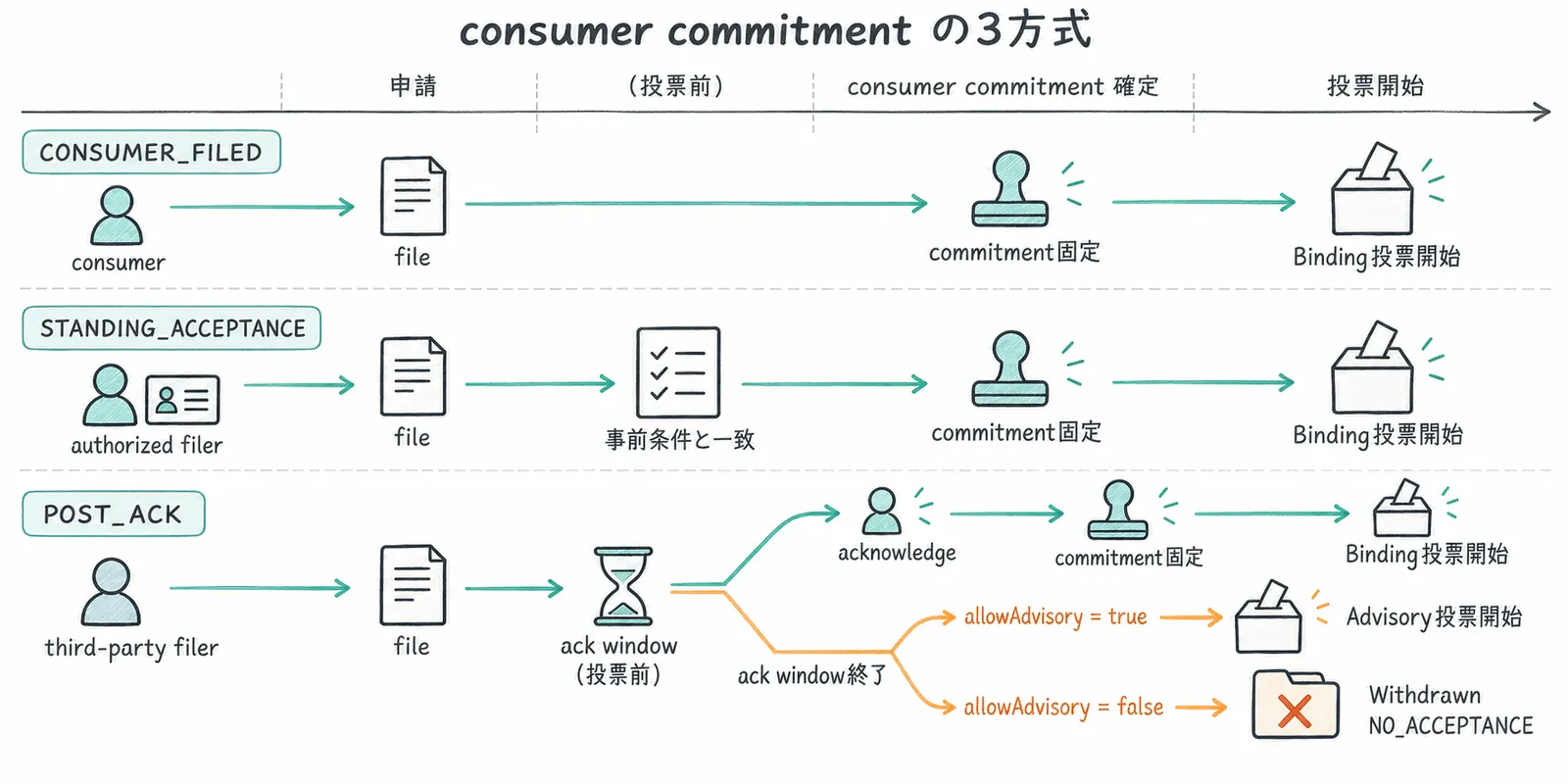
For a Binding Issue, derive obligationKey from consumer, obligationId, and question.
An obligation here represents a business obligation for which the same consumer must not submit the same question to multiple panel instances concurrently.
While an unfinished Issue exists for the same key, a second issue is rejected, preventing a party from submitting the same obligation to multiple panel instances and selecting only the favorable result.
At admission, the Policy, Subject, question, effects, disposition, consumer, and deadlines are fixed.
Revoking standing acceptance after voting starts does not interrupt an ongoing Issue.
withdrawal by a filer is limited to an Issue still in Filed for which voting has not begun.
Voting Body and composition Tree
Roster voting produces Yes with K approvals and No with N-K+1 opposing votes.
If neither threshold is reached before the window ends, the result is NoDecision.
A member may cast only one ballot per Issue, round, and Body.
Signed ballots use the same tallying rules.
The signature includes the round number, so a delayed transaction cannot be used as a vote for the next round.
If any signature in a batch is invalid, the entire transaction must revert.
With the designated-submitter method, the address registered in the Policy submits Yes, No, or NoDecision once.
If no result is submitted within the window, the reason is SUBMITTER_SILENT.
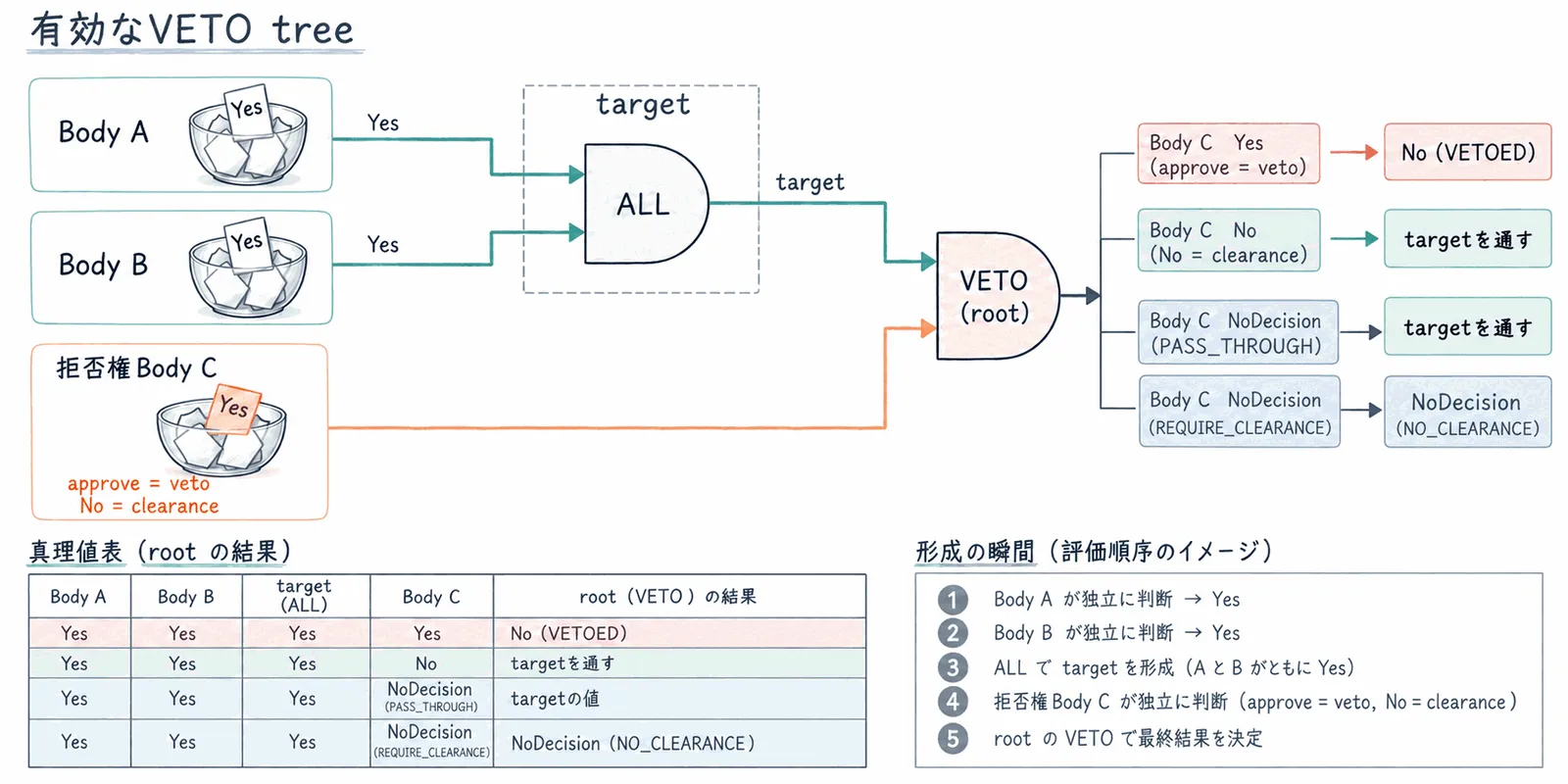
Votes for each Body are counted independently.
This local four-valued decision is called a Body decision and is used as a leaf or veto input in the composition tree.
Rather than combining technical and economic group votes in one ballot box, the tree combines the four-valued decisions of individual Body instances.
A Body must not appear in multiple BODY Node instances, and a veto Body must not be reused as a regular Body.
Procedure and Finality
An Issue proceeds from Filed to Deciding, then enters Provisional when the round outcome is determined.
If an appeal is filed, it returns to Deciding and begins a new round.
Without an appeal, it proceeds to Final.
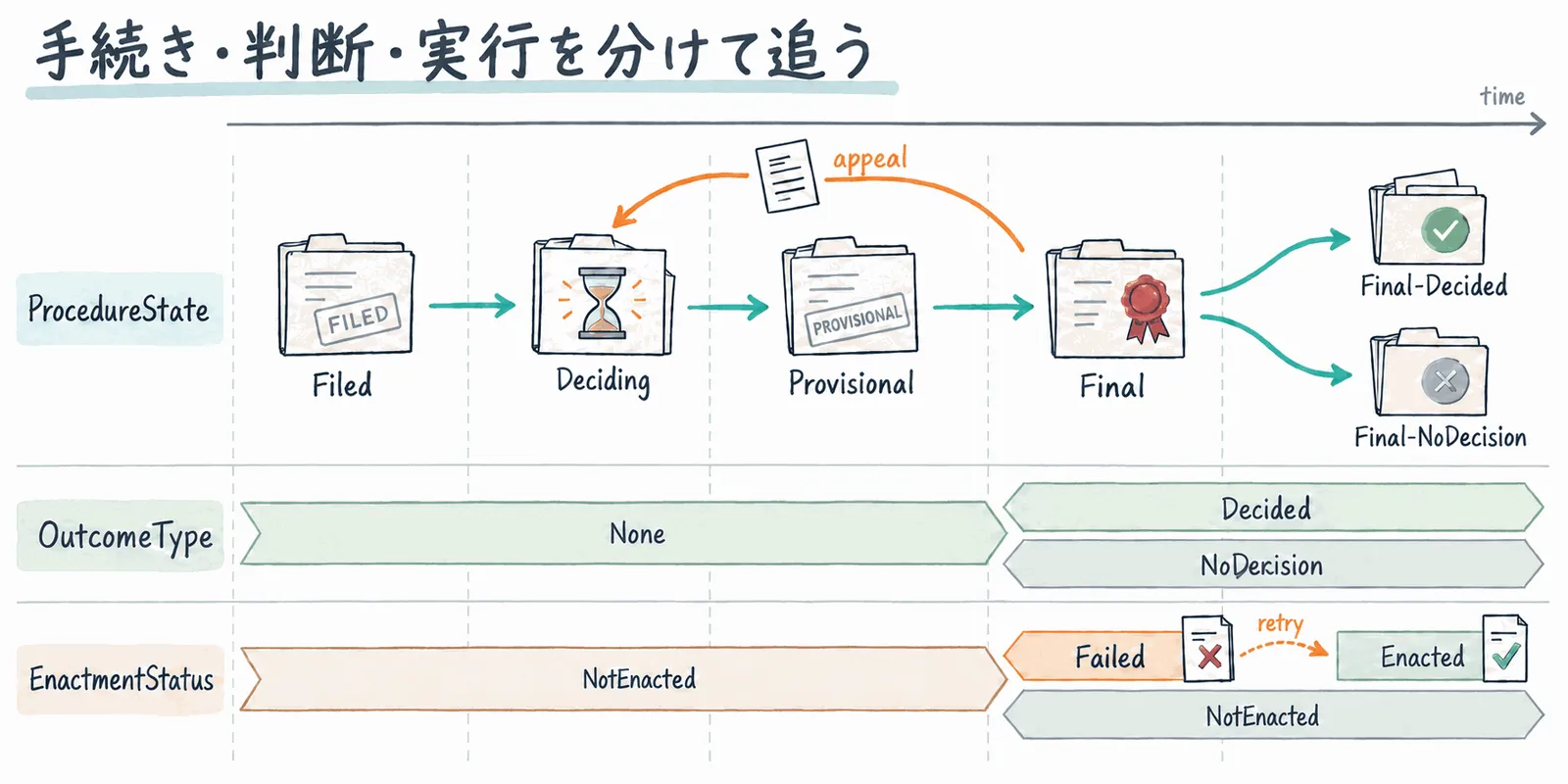
The appeal deadline is calculated from the time the required votes were reached or the window ended, not the time of the settle transaction.
The time when the decision can no longer change is called the Formation instant.
Delaying settle cannot extend the appeal window.
After the hard deadline calculated from maxTotalDuration has passed, anyone may call enforceHardDeadline.
If the state is Deciding and the current root is Pending, the active round is closed as NoDecision(TOTAL_TIMEOUT).
If it is already Yes or No, that decision is stored; if it is Provisional, the stored round is used.
Finally, apply the adoption rules of the appeal mode and terminate the procedure.
The procedural state Final, decision state Decided, and execution state Enacted are distinct values.
Combinations such as Final-NoDecision or Final-Decided with execution status Failed are possible.
IACDFRegistry
IACDFRegistry is the interface for storing the consumer's standing registrations, Issue instances, ballots, round instances, final results, and execution reports.
StandingAcceptanceRegistered
event StandingAcceptanceRegistered(bytes32 indexed acceptanceId, address indexed consumer, bytes32 indexed policyId);An event emitted when a consumer registers standing acceptance conditions.
- Fields
| Field | Description |
|---|---|
acceptanceId |
Identifier of the standing registration. |
consumer |
Party accepting the outcome. |
policyId |
The fixed Policy to be accepted. |
The Subject constraints, question constraints, filer list, effects, and deadlines cannot be reconstructed from this log alone.
When necessary, supplement it with the registration transaction inputs, off-chain indexing, or implementation-specific getters.
StandingAcceptanceRevoked
event StandingAcceptanceRevoked(bytes32 indexed acceptanceId, address indexed consumer);An event emitted when a consumer revokes standing acceptance conditions.
- Fields
| Field | Description |
|---|---|
acceptanceId |
The standing registration being revoked. |
consumer |
The consumer that performed the revocation. |
The registration cannot be used for a new Issue after revocation, but an Issue already admitted (admit) continues.
IssueFiled
event IssueFiled(bytes32 indexed issueId, bytes32 indexed policyId, T.AcceptanceMode mode, address indexed filer, address consumer);An event emitted when a new Issue is filed.
- Fields
| Field | Description |
|---|---|
issueId |
Identifier of the Issue. |
policyId |
The fixed Policy. |
mode |
Method of establishing the consumer commitment. |
filer |
Creator of the Issue. |
consumer |
Intended or confirmed consumer. |
This log identifies the filing party and mode of an Issue. Read Subject, question, effects, obligation, and deadlines through getIssue.
IssueAdmitted
event IssueAdmitted(bytes32 indexed issueId, T.EffectClass effectClass, address indexed consumer, uint64 admittedAt, uint64 hardDeadline);An event emitted when an Issue enters the voting procedure and round 1 begins.
- Fields
| Field | Description |
|---|---|
issueId |
The Issue undergoing admission. |
effectClass |
Advisory or Binding. |
consumer |
The consumer for a Binding issue. |
admittedAt |
Start time. |
hardDeadline |
Upper time limit for the entire procedure. |
This log tracks the start of voting and the overall limit. Obtain the deadline of round 1, Body settings, and Node tree through getRound and the Policy Registry's read API.
IssueAcknowledged
event IssueAcknowledged(bytes32 indexed issueId, address indexed consumer);An event emitted when the consumer acknowledges a POST_ACK Issue.
- Fields
| Field | Description |
|---|---|
issueId |
The acknowledged Issue. |
consumer |
Party that fixed the effects and obligation. |
This log tracks who acknowledged the issue. Read the confirmed effects, disposition, obligation, and consumer deadline through getIssue.
IssueWithdrawn
event IssueWithdrawn(bytes32 indexed issueId, T.Reason reason);An event emitted when an Issue terminates because it is withdrawn before voting or its acknowledgment period expires.
- Fields
| Field | Description |
|---|---|
issueId |
The terminated Issue. |
reason |
NONE or NO_ACCEPTANCE. |
This log tracks withdrawals or termination due to missing acknowledgment. Supplement it with getIssue to obtain the Subject, question, and proposed consumer value fixed before withdrawal.
BallotCast
event BallotCast(bytes32 indexed issueId, uint32 indexed round, uint32 indexed body, address voter, bool approve, bool signed);An event emitted when a ballot is accepted and the Body tally is updated.
- Fields
| Field | Description |
|---|---|
issueId |
The Issue being voted on. |
round |
One-based round number. |
body |
Body index. |
voter |
The voter. |
approve |
true for an approval vote. |
signed |
true when a relayer submits a signed ballot. |
This log allows accepted votes from each voter to be searched. Read the cumulative Body tally, threshold formation time, and voting status of other member entries through getBodyState and bodyStatus.
BodyResultSubmitted
event BodyResultSubmitted(bytes32 indexed issueId, uint32 indexed round, uint32 indexed body, address submitter, T.NodeStatus status);An event emitted when a designated submitter submits a Body result.
- Fields
| Field | Description |
|---|---|
issueId |
Target Issue. |
round |
Target round. |
body |
Target Body. |
submitter |
Submitter fixed in the Policy. |
status |
Submitted Yes, No, or NoDecision value. |
This log tracks the submitter's submission. Supplement it with getBodyState and nodeStatus for the submission flag, formation time, and composed root decision.
RoundSettled
event RoundSettled(bytes32 indexed issueId, uint32 indexed round, T.NodeStatus status, T.Reason reason, uint64 at, uint64 appealOpenUntil);An event emitted when the root Node value is stored as the round result.
- Fields
| Field | Description |
|---|---|
issueId |
Target Issue. |
round |
The round that was settled (settle). |
status |
Four-valued root decision. |
reason |
Reason for NoDecision or VETO. |
at |
Time at which the value formed. |
appealOpenUntil |
Appeal deadline. |
This log tracks the settle result. Read the round start and end times, current state of the Issue, and earlier round history through getRound and getIssue.
Appealed
event Appealed(bytes32 indexed issueId, uint32 indexed newRound, address indexed by);An event emitted when an appeal is accepted and a new round begins.
- Fields
| Field | Description |
|---|---|
issueId |
Target Issue. |
newRound |
Number of the newly started round. |
by |
address that submitted the appeal. |
This log tracks the start of the new round. Supplement it with getRound, getBodyState, and getResult to obtain the new round's deadline, tallies for each Body, and whether an earlier decision is adopted.
Finalized
event Finalized(bytes32 indexed issueId, T.OutcomeType outcomeType, bool outcomeYes, T.Reason reason, uint32 sourceRound);An event emitted when the final result of an Issue is stored.
- Fields
| Field | Description |
|---|---|
issueId |
The Issue that entered Final. |
outcomeType |
Decided or NoDecision. |
outcomeYes |
Yes or No when the outcome is Decided. |
reason |
Reason for NoDecision or the adopted decision. |
sourceRound |
The round that produced the adopted decision. |
This log tracks the final decision and adopted round. Read the consumer, effects, final timestamp, and flag indicating adoption from an earlier round through getResult.
EnactmentRecorded
event EnactmentRecorded(bytes32 indexed issueId, address indexed consumer, bytes32 indexed effectId, T.EnactmentStatus status, address reporter, bytes32 ref);An event emitted when a consumer reports the execution result of a business effect.
- Fields
| Field | Description |
|---|---|
issueId |
The original Issue. |
consumer |
Party that executed the effect. |
effectId |
Reference to the Yes or No effect. |
status |
Enacted or Failed. |
reporter |
Sender of the reporting transaction. |
ref |
Value referencing external execution. |
This log tracks execution reports from the consumer. The current state of the business contract and details of a successful execution transaction cannot be reconstructed from the registry alone; compare getEnactment with the target's own records.
Evidence
event Evidence(bytes32 indexed issueId, address indexed party, string evidenceURI);An event emitted when an evidence URI is attached to an Issue.
- Fields
| Field | Description |
|---|---|
issueId |
The Issue to which the evidence is attached. |
party |
The address that submitted the URI. |
evidenceURI |
String referencing the evidence. |
The registry does not verify the URI's contents or truthfulness.
supportsInterface
function supportsInterface(bytes4 interfaceId) external view returns (bool);Returns whether the Issue Registry supports the specified interface.
-
Receive the
IDThe
clientsupplies the requiredinterface ID. -
Check support
Compare against implemented
IDvalues. -
Return a boolean
Return
trueif supported.
- Arguments
| Argument | Description |
|---|---|
interfaceId |
Four-byte ID to check. |
- Return values
| Return value | Description |
|---|---|
bool |
Whether the interface is supported. |
-
Execution conditions
-
This is a
viewfunction and does not modifystorage. -
An unsupported
IDreturnsfalse.
policies
function policies() external view returns (IACDFPolicyRegistry);Returns the Policy Registry referenced by the Issue Registry.
-
Read the stored
addressRetrieve the
Policy Registryfixed at deployment. -
Return the
interfacetypeReturn a value allowing the
clientto read thePolicycontents.
- Return values
| Return value | Description |
|---|---|
IACDFPolicyRegistry |
The corresponding Policy Registry. |
-
Execution conditions
-
This is a
viewfunction and does not modifystorage. -
The
clientalso checks ERC165 support on the returnedregistry.
registerStandingAcceptance
function registerStandingAcceptance(T.StandingAcceptanceInput calldata input) external returns (bytes32 acceptanceId);Registers acceptance conditions in advance for future Issue instances to which the consumer intends to apply them.
-
Validate the conditions
Check that the
Policyis registered and botheffect IDvalues are non-zero. -
Fix the
consumerStore
acceptancewithmsg.senderas theconsumer. -
Return the identifier
Return the
acceptanceIdthat thefilerreferences infile.
- Arguments
| Argument | Description |
|---|---|
input |
Policy, subject, question, filer, effects, obligation, and deadline. |
- Return values
| Return value | Description |
|---|---|
acceptanceId |
Identifier of the stored standing registration. |
-
Execution conditions
-
The
consumermust call this function directly. -
Specify the exact registered
policyId. -
Reject an unregistered
policyIdor azero effect. -
The deadline and
filerlist are checked whenfileuses the standing registration.
revokeStandingAcceptance
function revokeStandingAcceptance(bytes32 acceptanceId) external;Allows a consumer to revoke standing acceptance, including its unused future applications.
-
Read the registration
Retrieve the
consumercorresponding toacceptanceId. -
Verify the
callerCompare the registered
consumerwithmsg.sender. -
Store the revocation
Record the
revokedstate and emit the event.
- Arguments
| Argument | Description |
|---|---|
acceptanceId |
Standing registration to revoke. |
-
Execution conditions
-
Only the registering
consumermay call this function. -
An
Issueadmitted (admit) before revocation continues. -
An unknown
IDis rejected because the caller does not match the storedconsumer. -
Repeated revocation by the same
consumeris permitted; therevokedstate is stored again and the event is emitted.
file
function file(T.IssueInput calldata input) external returns (bytes32 issueId);Creates a new Issue from the subject of the decision and the consumer commitment.
-
Validate inputs according to
modeDetermine whether the issue uses direct filing by the
consumer, standing acceptance, or subsequent acknowledgment. -
Store the
IssueStore the
Subject,question,Policy, and proposed or confirmedeffects. -
Start the procedure or await acknowledgment
If a
commitmenthas been established,admitthe issue; withPOST_ACK, leave it inFiled.
- Arguments
| Argument | Description |
|---|---|
input |
Policy, mode, consumer, Subject, question, effects, obligation, and deadline. |
- Return values
| Return value | Description |
|---|---|
issueId |
Identifier of the newly created Issue. |
-
Execution conditions
-
The
Policymust be registered. -
With
CONSUMER_FILED, theconsumerandcallermust match. -
With
STANDING_ACCEPTANCE, check thetarget,question,filer, and deadline against the registered conditions. -
For a
Binding Issue, reject filing if anotherIssuewith the sameobligationKeyis already active.
acknowledge
function acknowledge(bytes32 issueId, bytes32 effectYes, bytes32 effectNo, bytes32 disposition, bytes32 obligationId, uint64 consumerDeadline) external;Allows a consumer to fix the effects and obligation of a POST_ACK Issue before voting.
-
Check the
Issueand deadlineVerify
Filed,POST_ACK, and that the call falls within theack window. -
Fix the
consumer's valuesStore the
caller,effects,disposition,obligation, andconsumer deadline. -
Begin
round1admitthe issue asBindingand compute thehard deadline.
- Arguments
| Argument | Description |
|---|---|
issueId |
The Issue to acknowledge. |
effectYes |
The effect for Yes. |
effectNo |
The effect for No. |
disposition |
Handling for NoDecision. |
obligationId |
Obligation scope fixed by the consumer. |
consumerDeadline |
Execution deadline on the consumer side. |
-
Execution conditions
-
Only the
consumerdesignated in theIssuemay call this function. -
Reject calls after the
ack window. -
Reject the call if another
Issuefor the sameobligationis active.
admitAdvisory
function admitAdvisory(bytes32 issueId) external;Admits an unacknowledged POST_ACK Issue as Advisory, without binding business operations.
-
Check the
PolicysettingsRead whether
allowAdvisoryis enabled. -
Check the
IssuestateVerify that the
ack windowhas expired while the state remainsFiled. -
Start as
AdvisoryOpen
round1 without binding theconsumer effects.
- Arguments
| Argument | Description |
|---|---|
issueId |
The Issue to admit as Advisory. |
-
Execution conditions
-
Verify that the
PolicypermitsAdvisoryadmission. -
Anyone may call this function after the
ack windowexpires. -
Reject an
Issuealready processed byacknowledge,withdraw, oradmit. -
An
Advisoryissue does not create anactive obligation.
expireUnacknowledged
function expireUnacknowledged(bytes32 issueId) external;Terminates an unacknowledged Issue after the ack window expires.
-
Check the
IssueVerify that it is a
POST_ACKissue inFiled. -
Check the deadline
Use the
clockto determine whether theack windowhas expired. -
Move to
WithdrawnRecord
NO_ACCEPTANCEand emit the termination event.
- Arguments
| Argument | Description |
|---|---|
issueId |
The Issue to expire. |
-
Execution conditions
-
Anyone may call this function.
-
Reject an
Issuewhose deadline has not passed or that has already been acknowledged. -
Succeeds only when the
PolicysetsallowAdvisorytofalse. -
If
allowAdvisoryistrue, useadmitAdvisoryafter the deadline instead.
withdraw
function withdraw(bytes32 issueId) external;Allows the filer to withdraw an Issue before voting begins.
-
Verify the
callerCompare the
Issue'sfilerwithmsg.sender. -
Check the state
Verify that the
Issueis inFiled. -
Store the withdrawal
Move to
Withdrawnand emit the event.
- Arguments
| Argument | Description |
|---|---|
issueId |
The Issue to withdraw. |
-
Execution conditions
-
Only the
filermay call this function. -
An
Issuecannot be withdrawn afteradmission.
submitEvidence
function submitEvidence(bytes32 issueId, string calldata evidenceURI) external;Attaches a URI referencing evidence to an Issue through an event.
-
Check the
IssuestateVerify that it is in
Filed,Deciding, orProvisional. -
Receive the
URIReceive the evidence reference supplied by the
caller. -
Emit the event
Record the
Issue,caller, andURIin the event log.
- Arguments
| Argument | Description |
|---|---|
issueId |
The Issue to which the evidence is attached. |
evidenceURI |
String referencing off-chain evidence. |
-
Execution conditions
-
Evidence is not accepted in
FinalorWithdrawn. -
The
registrydoes not retrieve, verify, or execute the contents of theURI.
castBallot
function castBallot(bytes32 issueId, uint32 round, uint32 body, bool approve) external;Allows a voter to submit one ballot directly on-chain.
-
Check the target and eligibility
Check the
Issue, currentround,Body,member, andwindow. -
Check for duplicates
Verify that the same
voterhas not voted in the sameIssue,round, andBody. -
Update the tally
Store the approval or rejection
countand the votedkey, then emit the event.
- Arguments
| Argument | Description |
|---|---|
issueId |
The Issue being voted on. |
round |
One-based round number. |
body |
Index of the Body within the Policy. |
approve |
true for approval, false for opposition. |
-
Execution conditions
-
The
Bodymust useON_CHAIN_TALLY. -
The
callermust be aBody member. -
Reject ballots after the deadline, duplicate ballots, and ballots for an already decided
Body.
submitSignedBallots
function submitSignedBallots(bytes32 issueId, uint32 body, address[] calldata voters, bool[] calldata approves, bytes[] calldata signatures) external;Allows any relayer to submit multiple EIP712 signed ballots in a batch.
-
Check the arrays and current
roundCheck the lengths of all three arrays,
Issuestate,Bodymethod, andwindow. -
Verify each signed ballot
Check the
voter,roster, duplicate votes,digest, andEOAor ERC1271 signature. -
Store the entire
batchOnly if all ballots are valid, add each to the
countand emit the events.
- Arguments
| Argument | Description |
|---|---|
issueId |
The Issue being voted on. |
body |
The Body accepting signed ballots. |
voters |
The individual signers. |
approves |
Approval or rejection from each signer. |
signatures |
The individual EIP712 signatures. |
-
Execution conditions
-
The
Bodymust useSIGNED_BALLOTS. -
The signature
digestincludes the currentround. -
If even one ballot is invalid,
revertthe entirebatchwithout changing the tally.
submitBodyResult
function submitBodyResult(bytes32 issueId, uint32 round, uint32 body, T.NodeStatus status) external;Allows a designated submitter to submit Yes, No, or NoDecision for a Body.
-
Verify the submitter
Compare the
callerwith theBody memberspecified in thePolicy. -
Check the
roundandwindowVerify that this is the current
round, no result has been submitted, and the deadline has not passed. -
Store the result
Store the
status, submissionflag, and timestamp, then emit the event.
- Arguments
| Argument | Description |
|---|---|
issueId |
Target Issue. |
round |
Target round. |
body |
Body using the designated-submitter method. |
status |
Yes, No, or NoDecision. |
-
Execution conditions
-
The
Bodymust useAUTHORIZED_SUBMITTER. -
Reject submissions of
Pending, repeated submissions, and submissions after the deadline.
settleRound
function settleRound(bytes32 issueId) external;Evaluates the root Node of the current round and stores the round result.
-
Compute the
root statusEvaluate the
Bodytallies, submitted values,windowsettings, and compositiontree. -
Compute the
formation instantDetermine from votes or deadlines when the result became immutable.
-
Advance the state
Move to
Provisionalif anappealis permitted, or toFinalotherwise.
- Arguments
| Argument | Description |
|---|---|
issueId |
The Issue to settle (settle). |
-
Execution conditions
-
Anyone may call this function.
-
Verify that the issue is
Decidingand therootis notPending. -
Reject an already settled
round(settle).
appeal
function appeal(bytes32 issueId) external;Appeals a Provisional result and begins a new round.
-
Check
standingand deadlinesCheck the
caller,appeal window, appealableoutcome, and maximum appeal count. -
Record how the previous decision is handled
Preserve or invalidate the candidate for later adoption according to the
Policy'sappeal mode. -
Open a new
roundIncrement the
round countand store its start time anddeadline.
- Arguments
| Argument | Description |
|---|---|
issueId |
The Issue being appealed. |
-
Execution conditions
-
The
Issuemust beProvisional. -
If the
Policyrestrictsstanding, only theconsumerorfilermay call this function. -
Reject calls after the
appeal windowcloses, after the maximum count is reached, or after thehard deadline.
finalize
function finalize(bytes32 issueId) external;Moves a Provisional Issue to Final after its appeal window has expired.
-
Check the deadline
Use the
clockto determine whether theappeal windowhas expired. -
Determine the adopted
roundSelect the
Yes,No, orNoDecisionoutcome to adopt based on the finalroundandappeal mode. -
Store the
FinalresultStore the
outcome,reason,source round, and timestamp, then release theobligation.
- Arguments
| Argument | Description |
|---|---|
issueId |
The Issue to move to Final. |
-
Execution conditions
-
Anyone may call this function.
-
The
Issuemust beProvisional. -
Reject calls before the
appeal windowcloses.
enforceHardDeadline
function enforceHardDeadline(bytes32 issueId) external;Moves an Issue past the overall procedural deadline to Final based on the decisions formed so far and the appeal mode.
-
Check the
hard deadlineDetermine whether the current
clockvalue is past the stored limit. -
Store the active
roundresultIf the issue is
Deciding, read the currentroot; if it isYesorNo, store that decision. StoreNoDecision(TOTAL_TIMEOUT)only if it isPending. If the issue isProvisional, use the storedroundas is. -
Move the
IssuetoFinalSelect
DecidedorNoDecisionaccording to the adoption rules of theappeal modeand release theactive obligation.
- Arguments
| Argument | Description |
|---|---|
issueId |
The Issue to terminate forcibly. |
-
Execution conditions
-
Anyone may call this function.
-
Reject calls at or before the
hard deadline. -
Cannot execute in
FinalorWithdrawn.
recordEnactment
function recordEnactment(bytes32 issueId, bytes32 effectId, T.EnactmentStatus status, bytes32 ref) external;Records the result of the consumer applying a Final decision to a business contract.
-
Check the
IssueandconsumerVerify that the issue is
BindingandFinaland that thecalleris theconsumer. -
Check the
effectandstatusVerify that the
effect IDmatches either the registeredeffectYesoreffectNoand that the status isEnactedorFailed. -
Store the execution report
Store the
status,reporter,ref, and timestamp, then emit the event.
- Arguments
| Argument | Description |
|---|---|
issueId |
The original Issue. |
effectId |
The executed Yes or No effect. |
status |
Enacted or Failed. |
ref |
Reference to an external transaction or business record. |
-
Execution conditions
-
Only the
consumermay call this function. -
Execution cannot be recorded for
Advisory. -
The
Issue Registrydoes not verify thatoutcomeTypecorresponds to theeffect ID, nor does it categorically rejectFinal-NoDecision. -
The
consumeris responsible for selecting theeffect IDcorresponding to the adopted result and applyingdispositionwhen the outcome isNoDecision. -
Failedmay be updated toEnacted, but changes afterEnactedare rejected.
getResult
function getResult(bytes32 issueId) external view returns (T.Result memory);Returns the current state of an Issue and its decision and effects after Final.
-
Read the
IssueRetrieve the stored
state,outcome,consumer, andeffects. -
Assemble adoption information
Compute the
source roundandflagindicating adoption from an earlierround. -
Return the
ResultReturn a struct enabling the
clientto determine whether execution of aneffectis permitted.
- Arguments
| Argument | Description |
|---|---|
issueId |
The Issue to read. |
- Return values
| Return value | Description |
|---|---|
Result |
procedure, outcome, Policy, consumer, and effects. |
-
Execution conditions
-
This is a
viewfunction and does not modifystorage. -
Before
Final,outcomeTypeisNone.
getIssue
function getIssue(bytes32 issueId) external view returns (T.Issue memory);Returns all values fixed in an Issue and its current state.
-
Receive the identifier
The
clientspecifies theIssueto check. -
Read stored values
Retrieve
Subject,question,Policy,consumer, deadlines, and result. -
Return the
IssueReturn the values fixed at
admissionand the current state in one struct.
- Arguments
| Argument | Description |
|---|---|
issueId |
The Issue to read. |
- Return values
| Return value | Description |
|---|---|
Issue |
Stored contents of the Issue. |
-
Execution conditions
-
This is a
viewfunction and does not modifystorage. -
Unknown
IDvalues are handled according to the implementation'sreadrules.
getRound
function getRound(bytes32 issueId, uint32 round) external view returns (T.RoundState memory);Returns the start time, deadline, settle result, and appeal deadline of a specified round.
-
Specify the
IssueandroundSupply the position whose history is to be checked.
-
Read
RoundStateRetrieve the stored timestamps,
status, andreason. -
Return the struct
Return values that let the
clientdistinguish the formation instant from thesettletime.
- Arguments
| Argument | Description |
|---|---|
issueId |
Target Issue. |
round |
One-based round number. |
- Return values
| Return value | Description |
|---|---|
RoundState |
Stored contents of the specified round. |
-
Execution conditions
-
Specify an existing
round. -
This is a
viewfunction and does not modifystorage.
getBodyState
function getBodyState(bytes32 issueId, uint32 round, uint32 body) external view returns (T.BodyState memory);Returns the tally or designated submitter's submitted value for a specified Body.
-
Specify the position
Supply the
Issue,round, andBodyindices. -
Read stored values
Retrieve
yes,no, submissionflag, submittedstatus, and decision time. -
Return the struct
Return values enabling the
clientto recompute theBodydecision.
- Arguments
| Argument | Description |
|---|---|
issueId |
Target Issue. |
round |
Target round. |
body |
Target Body. |
- Return values
| Return value | Description |
|---|---|
BodyState |
Stored contents of the Body. |
-
Execution conditions
-
Specify valid
roundandBodyindices. -
This is a
viewfunction and does not modifystorage.
bodyStatus
function bodyStatus(bytes32 issueId, uint32 round, uint32 body) external view returns (T.NodeStatus status, T.Reason reason, uint64 at);Computes the current decision of a Body from stored ballots and the clock.
-
Read the
BodyinputsRetrieve the vote counts or the designated submitter's result and the
window. -
Determine the four-valued status
Evaluate the
threshold,blocking threshold, and deadline expiry. -
Return the decision
Return the
status,reason, and time at which the value formed.
- Arguments
| Argument | Description |
|---|---|
issueId |
Target Issue. |
round |
Target round. |
body |
Target Body. |
- Return values
| Return value | Description |
|---|---|
status |
Pending, Yes, No, or NoDecision. |
reason |
Reason for NoDecision or VETO. |
at |
Time at which the value formed. |
-
Execution conditions
-
This is a
viewfunction and does not modifystorage. -
If the
thresholdhas not been reached before the deadline, the status isPending.
nodeStatus
function nodeStatus(bytes32 issueId, uint32 round, uint32 node) external view returns (T.NodeStatus status, T.Reason reason, uint64 at);Evaluates the Body definitions and child Node instances below the specified Node and returns the current composed decision.
-
Read the
NodeRetrieve the
combinatorand its references from thePolicy. -
Combine the children's four-valued decisions
Apply the
ALL,ANY,K-of-M, orVETOrules. -
Return the decision
Return the
status,reason, andformation instant.
- Arguments
| Argument | Description |
|---|---|
issueId |
Target Issue. |
round |
Target round. |
node |
Target Node. |
- Return values
| Return value | Description |
|---|---|
status |
Composed four-valued decision. |
reason |
Reason for the composed result. |
at |
Time at which the composed value formed. |
-
Execution conditions
-
Specify a valid
Nodeindex. -
This is a
viewfunction and does not modifystorage.
hasVoted
function hasVoted(bytes32 issueId, uint32 round, uint32 body, address voter) external view returns (bool);Returns whether the specified voter has voted in the same Issue, round, and Body.
-
Construct the per-ballot
keyCombine the
Issue,round,Body, andvoter. -
Read the stored
flagRefer to the
mappingof accepted ballots. -
Return a boolean
Return
trueif the voter has voted.
- Arguments
| Argument | Description |
|---|---|
issueId |
Target Issue. |
round |
Target round. |
body |
Target Body. |
voter |
The address to check. |
- Return values
| Return value | Description |
|---|---|
bool |
Indicates whether the voter has voted. |
-
Execution conditions
-
Only accepted ballots produce
true. -
This is a
viewfunction and does not modifystorage.
activeIssueOf
function activeIssueOf(address consumer, bytes32 obligationKey) external view returns (bytes32);Returns the most recently stored Binding Issue for the same obligation of a consumer.
-
Specify the
consumerandkeySupply the pair used to check for concurrent
Issueinstances. -
Read the
active mappingRetrieve the value stored at
admissionand retained until a subsequentadmission. -
Return the
Issue IDReturn
zeroif unregistered; otherwise, return the lastIssue ID, including terminated issues.
If the returned Issue is in Final or Withdrawn, the exclusion constraint has been released, and a subsequent admission overwrites it with a new Issue ID.
Callers must not assume that an issue is active based on the return value alone; they should also check its state using getIssue.
- Arguments
| Argument | Description |
|---|---|
consumer |
Party executing the outcome. |
obligationKey |
key derived from the obligation and question. |
- Return values
| Return value | Description |
|---|---|
bytes32 |
Last Binding Issue ID, including terminated issues. Returns zero if unregistered. |
-
Execution conditions
-
An
Advisory Issuedoes not enter theactive mapping. -
This is a
viewfunction and does not modifystorage.
obligationKeyOf
function obligationKeyOf(address consumer, bytes32 obligationId, bytes32 question) external pure returns (bytes32);Computes the key identifying an obligation for the same question and consumer.
-
Encode the three values
Use
abi.encodeon theconsumer,obligation ID, andquestion. -
Compute the
hashApply
keccak256to the encoded result. -
Return the
keyReturn the
bytes32value used byactiveIssueOf.
- Arguments
| Argument | Description |
|---|---|
consumer |
Party executing the outcome. |
obligationId |
Obligation scope fixed by the consumer. |
question |
hash of the question being decided. |
- Return values
| Return value | Description |
|---|---|
bytes32 |
The obligation key. |
-
Execution conditions
-
This is a
purefunction and does not read or writestorage. -
A
Binding Issueuses a non-zeroobligationId.
getEnactment
function getEnactment(bytes32 issueId, address consumer, bytes32 effectId) external view returns (T.Enactment memory);Returns the execution result of an effect reported by the consumer.
-
Specify the lookup
keySupply the
Issue,consumer, andeffect ID. -
Read the execution record
Retrieve the
status,reporter,ref, and timestamp. -
Return the
EnactmentReturn a struct distinguishing successful execution, failed execution, and no report.
- Arguments
| Argument | Description |
|---|---|
issueId |
The original Issue. |
consumer |
Party executing the effect. |
effectId |
The effect for Yes or No. |
- Return values
| Return value | Description |
|---|---|
Enactment |
Stored contents of the execution report. |
-
Execution conditions
-
If no record exists, return the equivalent of
NotEnacted. -
This is a
viewfunction and does not modifystorage.
ballotDigest
function ballotDigest(bytes32 issueId, uint32 round, uint32 body, address voter, bool approve) external view returns (bytes32);Returns the EIP712 digest shared by the wallet and registry for signed ballots.
-
Encode the
ballot fieldvaluesInclude the
Issue,round,Body,voter, and approval or rejection in typeddata. -
Add the
domainInclude the
chain IDandIssue Registry addressin thedomain. -
Return the
digestReturn the 32-byte value that the
votersigns and theregistryverifies.
- Arguments
| Argument | Description |
|---|---|
issueId |
The Issue being voted on. |
round |
The round being signed for. |
body |
The Body being signed for. |
voter |
Signer. |
approve |
Approval or rejection. |
- Return values
| Return value | Description |
|---|---|
bytes32 |
EIP712 signature digest. |
-
Execution conditions
-
This is a
viewfunction that reads theregistry addressandchain ID. -
This function alone does not determine signature validity or voting eligibility.
clock
function clock() external view returns (uint48);Returns the current value used by the Issue Registry to calculate deadlines.
-
Read the
clock sourceRetrieve the
timestamporblocknumber used by the implementation. -
Convert to a 48-bit value
Represent it using an ERC6372-compatible type.
-
Return the current value
Return a value that the
clientcan compare with thedeadline.
- Return values
| Return value | Description |
|---|---|
uint48 |
Current contract clock value. |
-
Execution conditions
-
This is a
viewfunction and does not modifystorage. -
Check the unit using
CLOCK_MODE.
CLOCK_MODE
function CLOCK_MODE() external view returns (string memory);Returns the unit and mode of the clock function as a string.
-
Read the
modeRetrieve the
clock modefixed by the implementation. -
Return the string
Return a format that allows the
clientto comparedeadlinevalues in the same unit.
- Return values
| Return value | Description |
|---|---|
string |
ERC6372 clock mode. |
-
Execution conditions
-
The reference implementation uses
timestampvalues in seconds. -
Do not implicitly convert between
blocknumbers and seconds.
ERC6372 defines the interface that exposes the clock value and unit used for deadline calculations.
The client reads clock and CLOCK_MODE to compare the Body window, appeal window, and hard deadline in the same unit.
See the following article for more information about ERC6372.
[ERC6372] Understanding how to retrieve the time representation used by a contract
Errors
The standard divides rejection causes into five categories and recommends distinguishing them using a reason string or equivalent custom error.
The strings themselves are not interoperability requirements.
The reference implementation's revert strings are implementation-level clues for tracing these categories.
| Category | Examples of rejection | On failure |
|---|---|---|
Policy validation |
Too many Body definitions, duplicate member entries, cyclic tree, insufficient overall time limit |
Do not store the Policy |
Issues and acceptance |
Unregistered Policy, mismatched standing registration, expiry, active obligation |
Do not admit the Issue |
Voting |
Non-member, duplicate ballot, expired window, wrong round, invalid signature |
Do not change the tally |
Rounds and finality |
root is Pending, appeal outside its window, maximum count exceeded, before the hard deadline |
Do not change the procedure state |
Enactment |
Before Final, NoDecision, wrong consumer, wrong effect, updates after Enacted |
Do not change the execution record |
In every category, all storage updates and event emissions in a reverted (revert) transaction are rolled back.
Clock and Profile
The minimum profile consists of fixed-roster K-of-N voting, on-chain tallying, one Body, and no appeals.
Signed ballots, designated submitters, composition of multiple Body definitions, VETO, and appeals can be added as optional profile features.
Implementations expose supported interface ID values, the Body methods in each Policy, and the clock mode.
The client reads these values and excludes any registry or Policy that cannot support the required profile.
Eligibility calculation, random selection, weighted voting, non-binary outcomes, fees, executor, privacy, multi-consumer, and cross-chain receipt verification are reserved areas.
The ERC8436 kernel does not treat these as implemented features.
Additional notes
Why hash the executable rules themselves
The Policy Registry computes policyId from the entire executable PolicySpec, not merely the hash of a descriptive file.
A change to any participant, threshold, composition tree, timing setting, or appeal rule produces a different policyId.
A contract address or code hash alone cannot detect a change to the implementation of an Upgradeable proxy or a threshold stored in external storage.
The ERC8436 reference implementation is non-upgradeable and stores the executable parameters in the Policy Registry.
ERC1967 defines how to read a proxy's implementation, beacon, and admin from standard storage slot values.
When auditing a deployment, check not only the slot values but also the authority that can replace the implementation and the delegatecall paths.
See the following article for more information about ERC1967.
[ERC1967] Understanding contract upgrade mechanisms
Why separate subject from obligation
A Subject identifies what is being evaluated.
An obligation, by contrast, identifies the business obligation of the consumer for which only one Binding Issue may be active at a time.
If a different nonce is used for every deliverable to make each obligation distinct, the same question can be submitted to multiple panel instances.
Conversely, assigning the same obligation to every task would also block decisions on independent deliverables.
The adapter derives a stable scope from the task contract's task ID, submission ID, and version.
Four-valued composition and appeal mode
Composition using only Yes and No cannot distinguish a state that is still accepting inputs from an inconclusive result.
ERC8436 evaluates ALL, ANY, K-of-M, and VETO while preserving the distinction between Pending, Yes, No, and NoDecision.
The same distinction applies after an appeal.
With PRESERVE_UNLESS_OVERTURNED, an inconclusive appeal round (NoDecision) does not erase the previous decision.
With REQUIRE_FRESH_DECISION, the previous decision is removed from consideration when the appeal begins, so NoDecision in the new round becomes NoDecision for the entire Issue.
Boundary between decision and execution
A Final decision does not grant new authority to the consumer.
The consumer checks the current state and deadlines of the business contract it is already authorized to operate, then invokes the effect using its own authority.
A failed effect call does not change the decision in the Issue Registry.
A Failed enactment is recorded, and the consumer's own rules determine whether to retry, use the fallback procedure, or recover manually.
Extensions reserved by the standard
agent identity and reputation can serve as inputs for selecting roster candidates.
ERC8004 represents agent identity and trust signal values, but it does not automatically establish ERC8436 voting eligibility or consumer authority.
See the following article for more information about ERC8004.
[ERC8004] Understanding trustless agents
When adding weighted vote, sortition, non-binary outcome, privacy, fee, executor, or cross-chain result carriage features, fix the parameters affecting the Policy ID and their validation rules in a separate profile.
Test cases
Calculations fixed by the official vector files
The official assets include three Policy ID values, a ballot digest, 83 rows of K-of-N evaluation, 192 rows of composition evaluation, and two interface ID values.
Implementers can compare their own ABI encoding, EIP712 domain, four-valued composition, and ERC165 ID against the official values.
vector |
What to verify |
|---|---|
policy-id.json |
Whether the same policyId can be derived from the entire PolicySpec |
ballot-digest.json |
Whether the same digest can be derived from the chain, registry, Issue, round, Body, voter, and approval or rejection |
kofn-tally.json |
Threshold boundaries for Yes, No, Pending, and NoDecision |
composition.json |
Four-valued composition for ALL, ANY, and 2-of-3 |
interface-ids.json |
selector XOR for the two interface definitions |
integration evidence and its limitations
Revision 3 of the official discussion records execution on Sepolia of current Body role validation, VETO and ALL composition, on-chain voting, and the reject path.
The reference Issue Registry is 23,514 bytes with the IR pipeline, within the EIP170 limit of 24,576 bytes but with only 1,062 bytes of headroom.
See the following article for more information about EIP170.
[EIP170] Understanding the contract size limit at deployment
These provide evidence for the encoding and verified execution paths.
They do not guarantee production adoption by third parties, public network validation of every profile, operation of an executor, roster independence, or the truthfulness of votes.
Compatibility
Connecting an adapter to an existing contract
An existing contract that accepts a single evaluator or arbitrator address can designate an ERC8436 adapter as that address.
The adapter opens an Issue and translates its Final outcome into the existing accept or reject API, enabling integration without modifying the existing contract's interface.
ERC8183 defines the states of an agent commerce workflow involving a client, provider, and evaluator.
Placing an adapter in its single evaluator slot converts a decision across multiple Body instances into one evaluation outcome.
Use this mapping to select the corresponding API.
See the following article for more information about ERC8183.
[ERC8183] Escrow-based payment for requested work
Values obtained from related standards
The client checks supported API definitions through the ERC165 ID, signing scope through the EIP712 domain, contract voter signatures through the ERC1271 magic value, and deadline units through the ERC6372 clock mode.
Leaving even one of these implicit risks accepting a signature intended for another registry or confusing different time units.
ERC8033 defines a council oracle that assigns information agent instances and a judge to a specific query.
Use ERC8436 instead when multiple distinct Body instances, consumer commitment, NoDecision, and appeals must be fixed in one procedure record.
Draft status and pinning the policy version
ERC8436 is a Draft, and its interface or Policy layout may change.
Rather than relying only on the latest version of a family, the consumer pins the audited registry instance and exact policyId.
Registering a new Policy version does not automatically migrate existing Issue instances or standing acceptance records.
For migration, compare the old and new Policy definitions' Body, Node, timing, and appeal mode settings, then have the consumer explicitly accept the new policyId.
Reference implementation
The two registry contracts store the decision record; only the consumer adapter invokes the effect on the business contract.
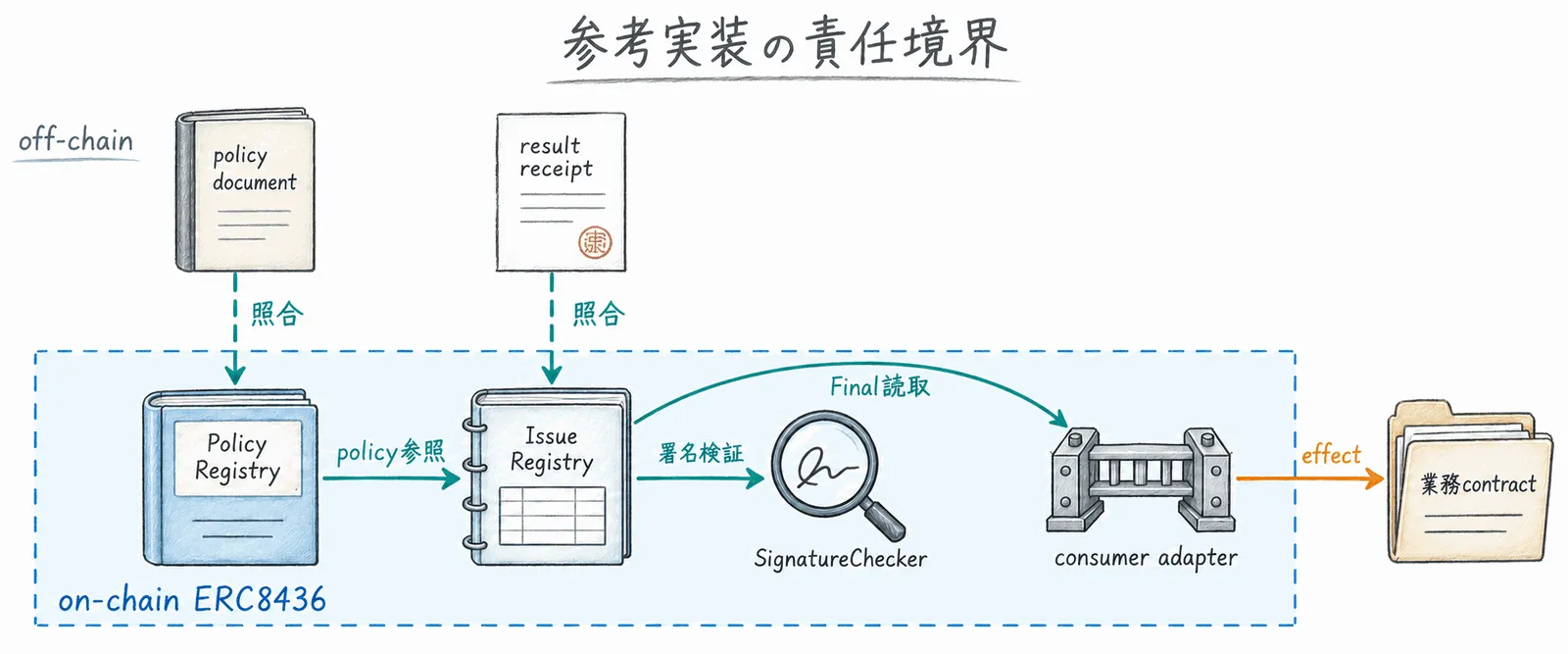
Storage and evaluation boundaries of the two registry contracts
The ACDFPolicyRegistry contract stores validated PolicySpec definitions and family version information.
The ACDFRegistry contract references that exact Policy and stores the Issue, round, ballot, result, and enactment records.
The latter contract's storage is referred to below as ACDFRegistry acceptance and issue mappings.
Signature verification boundary
The SignatureChecker library returns only the validity of ERC1271 and canonical ECDSA signatures.
The ACDFRegistry contract separately verifies member eligibility, the current round, the deadline, and duplicate ballots.
Execution boundary of the consumer adapter
The ACDFTaskTenderAdapter contract maps Final-Decided to the task contract's accept or reject function.
It uses catch to handle a failed target call and records Failed without changing the decision.
Boundary between the off-chain JSON Schema and authoritative registry
The official JSON Schema defines formats for exchanging a Policy document and procedure receipt between off-chain tool instances.
A receipt can carry Filed, Deciding, Provisional, Final, or Withdrawn; before Final, outcomeType is None.
Execution of an effect requires a separate check for Final.
A receipt contains the chain ID, Policy Registry, Issue Registry, and Issue ID.
A receipt is a carrier for verifying the record in the named registry, not an authoritative on-chain record in itself.
ACDFPolicyRegistry
Validating and storing a policy
ACDFPolicyRegistry._validate checks the number of Body and Node definitions, member entries, K values, window, tree, Body role, appeal, and duration.
Only after all validation is complete does _store save the entire Policy, existence flag, round duration, family authority, and latest version.
This entry point and storage process together form the ACDFPolicyRegistry.registerPolicy/_store path.
For a subsequent version, the caller, previous, and version are checked against current family information.
If a revert occurs midway, no mapping is updated.
The validation conditions are requirements of the standard, whereas the separation of private helper functions and the mapping layout are specific to the reference implementation.
Reading a policy
All executable parameters can be reconstructed through policyHeader, timingOf, bodyOf, and nodeOf.
The off-chain descriptor is linked through descriptorHash but is not used to evaluate votes.
ACDFRegistry
issue admission
The file, acknowledge, and admitAdvisory functions select consumer values according to the acceptance mode.
_admit checks the Policy, active obligation, consumer deadline, and hard deadline, then stores the Issue and round 1 in the same transaction.
In the reference implementation's file/acknowledge/_admit path, different acceptance methods converge on the same admission validation.
Deriving the Issue ID from a nonce and the arrangement of each private mapping are specific to the reference implementation.
consumer commitment, the values fixed at admission, and exclusivity of a Binding obligation are requirements of the standard.
ballot and four-valued evaluation
_castBallot checks member eligibility, the round, the window, and duplicate ballots before updating the tally.
_bodyStatus, _nodeStatus, and _vetoStatus compute four-valued decisions from stored ballots and the clock.
Below, this evaluation path is denoted as _castBallot/_bodyStatus/_nodeStatus/_vetoStatus.
If an invalid ballot causes a revert, none of the voted flag, tally changes, or events are retained.
K-of-N and composition semantics are requirements of the standard.
round and finalization
settleRound stores the root status and formation instant.
appeal checks standing, the window, and the maximum appeal count before opening a new round.
finalize and enforceHardDeadline determine the adopted result from the appeal mode and hard cap.
These state transitions and the internal finalization process together form the settleRound/appeal/enforceHardDeadline/_finalize path.
Recording enactment
recordEnactment checks Final, Binding, consumer, effect, and status.
Updates from Failed to Enacted are permitted, but changes after Enacted are rejected.
The function does not execute the external effect itself.
SignatureChecker
contract signatures and EOA signatures
SignatureChecker.isValid uses staticcall to invoke ERC1271's isValidSignature when the signer has code.
It checks that the call succeeds, that the return value is at least 32 bytes, and that the magic value is 0x1626ba7e.
For an EOA signature, it checks the 65-byte length, low-s, whether v is 27 or 28, and whether the recover result is non-zero.
A malformed signature or revert produces a bool value of false, and the batch caller causes the entire transaction to revert.
The reference implementation's revert strings are diagnostic aids; the strings themselves are not interoperability requirements.
ACDFTaskTenderAdapter
Opening an issue
ACDFTaskTenderAdapter.open does not derive the Subject or effects solely from caller inputs.
It reads the submission, result hash, task version, submission deadline, payment deadline, and effect ID values for accept and reject from the task contract.
After checking adapter authority, pending submission, and the consumer deadline, it creates a consumer-filed Binding Issue.
If the task's state has changed, the call must revert without opening an Issue.
Executing an effect
ACDFTaskTenderAdapter.execute reads Final-Decided from the Issue Registry and rechecks the current task state and deadlines.
It invokes accept for Yes or reject for No using try / catch.
On success, it updates the adapter state to enacted and reports Enacted to the Issue Registry.
If the target call fails, it retains Failed and a reason event and permits a retry.
JSONSchema
policy document and result receipt
policy-spec.schema.json defines the format for exchanging all PolicySpec field values between off-chain tool instances.
After schema validation, the tool recomputes policyId from every field, reads the same policyId and parameters from the Policy Registry, and verifies the executable rules.
result-receipt.schema.json carries every procedure state, outcome, Policy, Subject, consumer, effects, and enactment.
A receipt may be created before Final, but an irreversible effect may be executed only when the registry returns Final-Decided.
When referring to both formats together, this article uses policy-spec.schema.json / result-receipt.schema.json.
Security considerations
consumer authority and obligation scope
If a Binding Issue is created solely from a consumer address declared by the caller, a third party could commit to an effect outside its authority.
Verify direct file by the consumer, standing acceptance, or subsequent acknowledgment. The adapter derives the Subject and effects from the business contract's state.
If POST_ACK allows acknowledgment after voting, the consumer can convert only favorable results to Binding.
Therefore, establish acknowledgment before admission and voting, and move an unacknowledged Issue to Advisory or Withdrawn after the ack window ends.
Changing obligationId every time does not prevent panel shopping.
An overly broad value would also block independent Issue instances, so choose a granularity that consistently identifies the same business obligation.
Furthermore, allowing withdrawal after admission would permit discarding unfavorable interim results and resubmitting the case to a different panel.
Limit withdrawal to Filed before admission and retain the same Issue once voting begins, until Final or the hard deadline.
appeal and deadlines
With PRESERVE_UNLESS_OVERTURNED, deliberately causing an appeal round to produce NoDecision preserves the previous decision.
If the required safety property is a fresh decision on reconsideration, select REQUIRE_FRESH_DECISION.
Even when finalize and hard deadline enforcement are permissionless, they are not an automatic executor.
Operations must provide a path for a keeper, consumer, or user to submit a transaction after the deadline.
At admission, check hardDeadline <= consumerDeadline so that all round and appeal procedures fit within the consumer deadline.
However, if Final is formed immediately before the consumer deadline, almost no time remains to execute the effect. Leave an operational buffer between the adapter's arrival deadline and the consumer deadline.
Signatures and replay
The EIP712 domain prevents signatures from being transferred to another chain or registry.
Include the Issue, round, Body, voter, and approval or rejection in the signed data, and prevent reuse with a per-ballot key.
ERC1271 validity changes with contract state.
Because a registry does not retroactively invalidate accepted ballots, monitor the state at signature verification and transaction finality.
The threat model assumes that an attacker can resubmit a valid signature to another Issue, round, Body, chain, or registry.
If any part of the EIP712 domain or ballot field set is omitted, the same approval or rejection may be reused for an unintended case and potentially reach its threshold.
Verify the domain, all ballot field values, and the voted key together. Reject the entire batch if an ERC1271 staticcall for any ballot returns an invalid magic value or causes a revert.
However, the registry alone cannot prevent signing-key compromise, changes to a contract wallet's authority, or a chain reorg before finality.
roster and evidence
The kernel does not detect whether different address values are controlled by the same operator.
Verify identity, operator cap, conflict exclusion, stake, and reputation in the external profile that constructs the roster.
Treat the URI in an Evidence event as untrusted data.
Do not execute retrieved documents or AI prompt values as instructions; verify the content type, size, hash, and issuer on the consumer side.
Trust boundaries of the registry and chain
The consumer pins the registry instance, deployed bytecode, administrative authority, and exact Policy version.
The same interface ID does not guarantee that a malicious implementation follows the correct semantics.
An Issue reaching Final represents procedure finality on the relevant chain.
It does not establish resistance to a reorg on the source chain or verify a bridge or cross-chain receipt.
If an attacker deploys a fake registry returning the same interface ID, the consumer may be made to read nonexistent votes or altered results as legitimate decision records.
Accepting an unproven cross-chain receipt could also result in executing an effect based on Final from another chain or on the result of an old fork.
Pin the deployment address, runtime code, proxy administrative authority, Policy Registry, Issue Registry, and chain ID in an allowlist, and verify each receipt against the read result of the relevant registry.
Even with these safeguards, the source chain's finality assumption, bridge validator, and the consumer's own upgrade authority remain trust boundaries.
Conclusion
ERC8436 links collective decisions by AI agents to a specific Subject, question, Policy, and consumer commitment.
An unmet vote threshold is retained as NoDecision, and the rules for adopting a result after an appeal are fixed before voting.
The Policy Registry stores executable rules, while the Issue Registry stores ballots, round records, final results, and execution reports.
Only the consumer executes a business effect within its own authority, separating voting eligibility from the authority to move assets.
When adopting the standard, independently verify roster independence, the granularity of the obligation, appeal mode, clock units, keeper operations, the registry instance, and recovery after a failed effect.