Introduction
Hi, I'm cardene, a software engineer and technical writer focused on blockchain and AI.
I've also authored Japanese technical books on specification-driven development with LLMs and decentralized application (DApp) development.

I also build and publish a variety of tools, libraries, and open-source projects.
In this article, I use Bunzz's then-new DeCipher feature to examine the UniswapV2Factory contract in Uniswap V2.
DeCipher is a service that uses AI to generate smart contract documentation automatically.
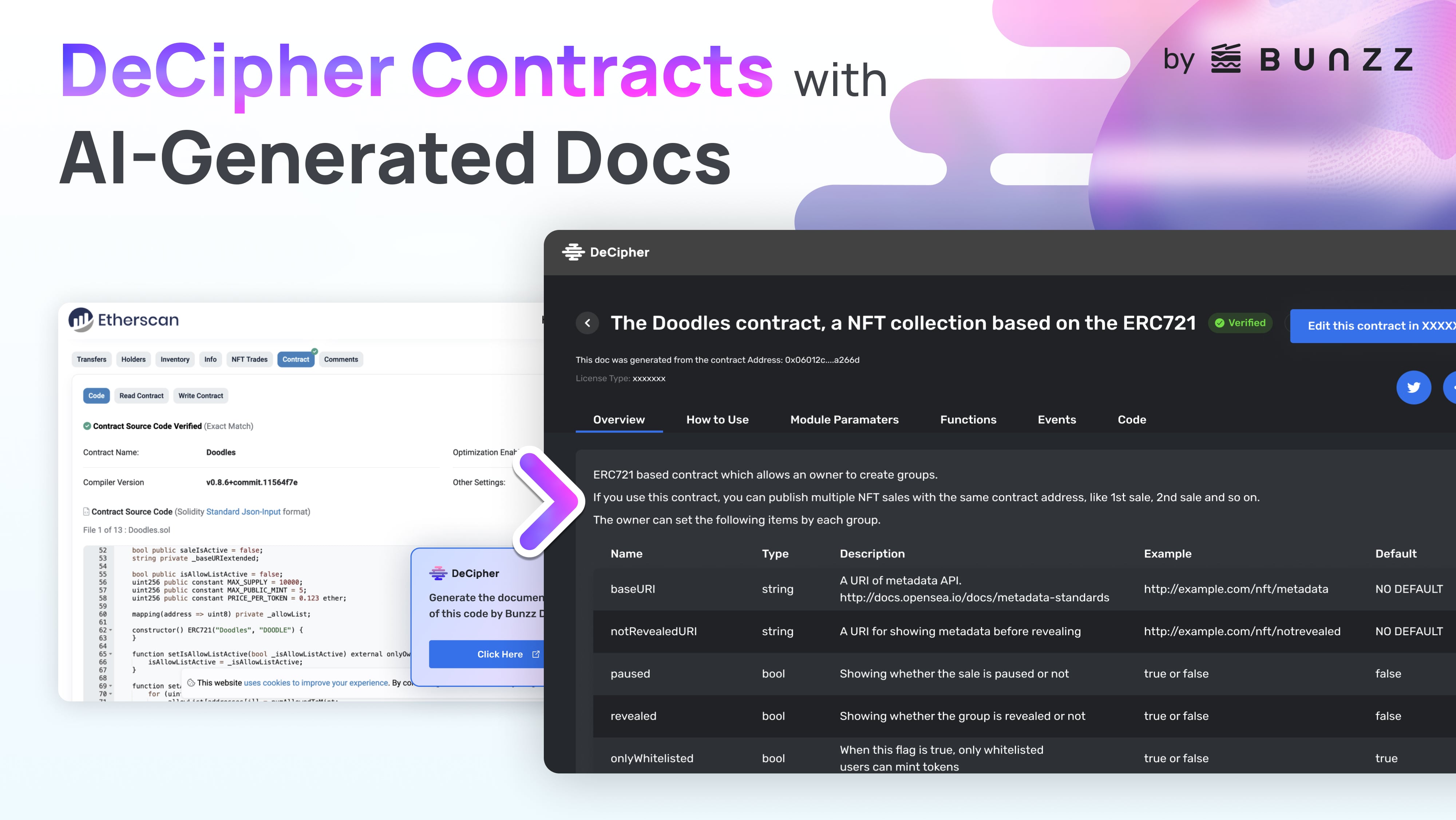
For a detailed guide to using the service, see the following article.
This article reflects my own experience using DeCipher. There may be inaccuracies, so please point them out in the comments.
The DeCipher page used in this article is linked below.
Overview
Summary
UniswapV2Factory is a key component of the Uniswap protocol and serves as a registry of all pair contracts deployed through the factory. It is responsible for creating and tracking liquidity pairs on Uniswap V2.
The factory manages information about token pairs used on Uniswap, such as WETH (the ERC20 representation of ETH) and DAI. This is important for token swaps and liquidity provision.
Purpose of the contract
The primary purpose of UniswapV2Factory is to prevent duplicate pairs for the same two tokens within the factory. Allowing duplicate pairs could fragment liquidity across multiple pools for the same tokens, reducing efficiency and disrupting smooth operation.
The factory achieves this by maintaining a registry of all pair contracts it has deployed. This registry serves as the canonical record of pairs for that factory, ensuring their uniqueness and avoiding unnecessary liquidity fragmentation.
Responsibilities of the contract
The UniswapV2Factory contract has several main responsibilities.
Creating pairs
The contract provides a method for creating new token pairs.
This is done through the createPair function.
The function takes two token addresses as arguments and returns the newly created pair address.
Retrieving pairs
The contract can retrieve information about existing pairs.
The getPair function provides this functionality.
It returns the pair address for the given token addresses, while allPairs returns the pair address at a specified index.
Counting pairs
The contract tracks the total number of pairs created.
This count is available through allPairsLength.
Fee management
The contract manages the protocol fee recipient (feeTo) and the address authorized to change that recipient (feeToSetter).
These addresses can be configured and retrieved using setFeeTo, feeTo, setFeeToSetter, and feeToSetter.
Recording events
Whenever a new pair is created, the contract emits a PairCreated event.
The event includes the addresses of both tokens and the pair contract itself.
In summary, the UniswapV2Factory contract plays an important role in the Uniswap protocol by managing the creation and retrieval of liquidity pairs and ensuring that each pair is unique within the factory. It helps avoid unnecessary liquidity fragmentation and supports efficient token swaps on Uniswap.
Usage
UniswapV2Factory is a core part of the Uniswap protocol and acts as a registry of all pair contracts it deploys. This guide explains how to use the contract step by step from the perspective of developers and technical operators.
Contract objectives
The primary objective of UniswapV2Factory is to manage and track the token pairs created through the factory. This prevents duplicate token pairs within the factory and provides a canonical registry of those Uniswap pairs.
1. Deploy the UniswapV2Factory contract
To operate your own factory instance, first deploy the UniswapV2Factory contract to Ethereum. The constructor runs during deployment. To use the existing Uniswap V2 factory, interact with its deployed address instead.
2. Create a new token pair
To create a new pair, call createPair with the two token addresses as arguments.
The function returns the newly created pair address.
3. Retrieve information about a token pair
Use getPair to retrieve information about a particular pair.
The function takes two token addresses and returns the corresponding pair contract address.
4. Retrieve the total number of pairs
Use allPairsLength to obtain the total number of pairs.
The function returns the number of pairs in the registry.
5. Retrieve a pair address by index
Use allPairs to retrieve a pair address at a particular index.
The function takes an index and returns the address of the corresponding pair.
6. Set the protocol fee recipient
Use setFeeTo to configure the address receiving protocol fees.
The function takes the recipient address as its argument and requires the caller to be the current fee setter.
7. Set the fee setter
Use setFeeToSetter to configure the address authorized to manage the fee settings.
The function takes the address of the new fee setter and must be called by the current fee setter.
Usage scenarios
Creating a new token pair
Calling createPair with two token addresses creates a new pair and adds it to the registry.
Querying information
Use getPair, allPairsLength, and allPairs to retrieve information about token pairs.
Managing fees
Use setFeeTo and setFeeToSetter to manage the protocol fee recipient and fee setter addresses.
State-changing function calls consume gas, with the amount depending on the complexity of the operation. Off-chain read-only calls do not require an on-chain gas payment. Make sure your wallet has sufficient ETH to cover transaction fees when submitting a transaction.
Parameters
_feeToSetter
_feeToSetter is the constructor argument specifying the initial address authorized to configure the fee recipient and fee setter in UniswapV2Factory.
The argument is supplied at deployment, but the stored feeToSetter value can subsequently be changed by its current holder.
Specifically, the UniswapV2Factory contract manages the protocol fee recipient (feeTo) and the fee setter (feeToSetter).
The former designates the recipient of protocol fees, while the latter identifies the address authorized to update that recipient.
The constructor parameter _feeToSetter is supplied only once, at deployment. It initializes the mutable state variable feeToSetter.
Contrary to the original description, the protocol fee recipient and fee setter can both be changed while the contract is operating, through the corresponding setter functions.
This access restriction is important for security and operations. Restricting updates to the authorized address helps protect the contract against unintended or unauthorized changes.
Functions
READ
allPairs
function allPairs(uint) external view returns (address pair);Retrieves the pair contract address at a given index in the allPairs array.
It returns the address of a pair created through the factory at the specified zero-based index.
To obtain the address of the first pair created, call allPairs(0).
To obtain the address of the second pair created, call allPairs(1).
Specifying the index in creation order retrieves the corresponding pair address.
Note that an out-of-bounds array index causes the call to fail; it does not return the zero address.
allPairsLength
function allPairsLength() external view returns (uint);Returns the length of the allPairs array.
This is the total number of token pairs created through the factory so far.
The function allows callers to determine how many token pairs the factory has created. This count can help assess the activity of Uniswap in decentralized finance (DeFi), although pair count alone does not measure trading volume or liquidity.
feeTo
function feeTo() external view returns (address);Returns the protocol fee recipient address.
Calling this function retrieves the account designated to receive protocol fees. In Uniswap V2, fees are distributed through liquidity tokens minted by pair contracts rather than collected directly by the factory.
feeToSetter
function feeToSetter() external view returns (address);Retrieves the value of the feeToSetter variable in UniswapV2Factory.
The fee setter is responsible for updating feeTo and transferring the fee-setting authority.
The function simply returns the address stored in feeToSetter.
Callers can use it to identify the current authorized fee setter and prepare interactions with functions that require this address.
getPair
function getPair(address tokenA, address tokenB) external view returns (address pair);Retrieves the address of the Uniswap V2 pair contract corresponding to the supplied token addresses, tokenA and tokenB.
Calling getPair on UniswapV2Factory establishes whether a pair contract for the two tokens already exists.
If the pair exists, the function returns its address.
If it does not exist, the function returns the zero address, 0x0, indicating that the specified pair has not yet been created.
Users can use this function to retrieve the pair contract address for a particular combination of tokens.
They can then interact with the pair, including for token swaps and liquidity provision.
WRITE
createPair
function createPair(address tokenA, address tokenB) external returns (address pair) {
        require(tokenA != tokenB, 'UniswapV2: IDENTICAL_ADDRESSES');
        (address token0, address token1) = tokenA < tokenB ? (tokenA, tokenB) : (tokenB, tokenA);
        require(token0 != address(0), 'UniswapV2: ZERO_ADDRESS');
        require(getPair[token0][token1] == address(0), 'UniswapV2: PAIR_EXISTS'); // single check is sufficient
        bytes memory bytecode = type(UniswapV2Pair).creationCode;
        bytes32 salt = keccak256(abi.encodePacked(token0, token1));
        assembly {
            pair := create2(0, add(bytecode, 32), mload(bytecode), salt)
        }
        IUniswapV2Pair(pair).initialize(token0, token1);
        getPair[token0][token1] = pair;
        getPair[token1][token0] = pair; // populate mapping in the reverse direction
        allPairs.push(pair);
        emit PairCreated(token0, token1, pair, allPairs.length);
}
Creates a new pair on the Uniswap V2 decentralized exchange. The function accepts the addresses of two ERC20 tokens, tokenA and tokenB, and creates the corresponding pair.
Parameters
tokenA- The address of the first ERC20 token supplied for the new pair.
tokenB- The address of the second ERC20 token supplied for the new pair.
setFeeTo
function setFeeTo(address _feeTo) external {
        require(msg.sender == feeToSetter, 'UniswapV2: FORBIDDEN');
        feeTo = _feeTo;
}
Sets the feeTo address.
The function accepts an address parameter called _feeTo and assigns it to feeTo.
The caller must be the current feeToSetter, which is initialized during deployment and may be updated afterward.
If the caller is not the current fee setter, the function reverts with the error message 'UniswapV2: FORBIDDEN'.
Parameters
_feeTo- The new
feeToaddress. - This becomes the designated recipient of protocol fees.
- The new
setFeeToSetter
function setFeeToSetter(address _feeToSetter) external {
        require(msg.sender == feeToSetter, 'UniswapV2: FORBIDDEN');
        feeToSetter = _feeToSetter;
}
Allows the current fee setter to change the feeToSetter address.
Only the current feeToSetter can call the function successfully; the contract does not define a separate owner for this purpose.
The new fee setter receives authority to change the protocol fee recipient and the fee setter itself.
Parameters
_feeToSetter- The newfeeToSetteraddress.
Events
PairCreated
Emitted whenever a new pair is created through the Uniswap V2 Factory contract. The event has four parameters.
token0- The address of the first token in sorted order.
token1- The address of the second token in sorted order.
pair- The address of the newly created pair.
token0 and token1 are the token addresses.
The two addresses are sorted so that the numerical value of token0 is always smaller than that of token1.
The order is therefore determined when the pair is created.
The fourth parameter is an unnamed unsigned integer (uint), described as the log value in the original article.
For the first pair created, this value is 1. For the second pair, it is 2.
The value continues to increase in creation order. The factory appends the pair to allPairs and emits the new array length; getPair separately indexes the pair by token addresses.
Code
IUniswapV2Factory
IUniswapV2Factory
pragma solidity =0.5.16;

interface IUniswapV2Factory {
    event PairCreated(address indexed token0, address indexed token1, address pair, uint);

    function feeTo() external view returns (address);
    function feeToSetter() external view returns (address);

    function getPair(address tokenA, address tokenB) external view returns (address pair);
    function allPairs(uint) external view returns (address pair);
    function allPairsLength() external view returns (uint);

    function createPair(address tokenA, address tokenB) external returns (address pair);

    function setFeeTo(address) external;
    function setFeeToSetter(address) external;
}
IUniswapV2Pair
IUniswapV2Pair
interface IUniswapV2Pair {
    event Approval(address indexed owner, address indexed spender, uint value);
    event Transfer(address indexed from, address indexed to, uint value);

    function name() external pure returns (string memory);
    function symbol() external pure returns (string memory);
    function decimals() external pure returns (uint8);
    function totalSupply() external view returns (uint);
    function balanceOf(address owner) external view returns (uint);
    function allowance(address owner, address spender) external view returns (uint);

    function approve(address spender, uint value) external returns (bool);
    function transfer(address to, uint value) external returns (bool);
    function transferFrom(address from, address to, uint value) external returns (bool);

    function DOMAIN_SEPARATOR() external view returns (bytes32);
    function PERMIT_TYPEHASH() external pure returns (bytes32);
    function nonces(address owner) external view returns (uint);

    function permit(address owner, address spender, uint value, uint deadline, uint8 v, bytes32 r, bytes32 s) external;

    event Mint(address indexed sender, uint amount0, uint amount1);
    event Burn(address indexed sender, uint amount0, uint amount1, address indexed to);
    event Swap(
        address indexed sender,
        uint amount0In,
        uint amount1In,
        uint amount0Out,
        uint amount1Out,
        address indexed to
    );
    event Sync(uint112 reserve0, uint112 reserve1);

    function MINIMUM_LIQUIDITY() external pure returns (uint);
    function factory() external view returns (address);
    function token0() external view returns (address);
    function token1() external view returns (address);
    function getReserves() external view returns (uint112 reserve0, uint112 reserve1, uint32 blockTimestampLast);
    function price0CumulativeLast() external view returns (uint);
    function price1CumulativeLast() external view returns (uint);
    function kLast() external view returns (uint);

    function mint(address to) external returns (uint liquidity);
    function burn(address to) external returns (uint amount0, uint amount1);
    function swap(uint amount0Out, uint amount1Out, address to, bytes calldata data) external;
    function skim(address to) external;
    function sync() external;

    function initialize(address, address) external;
}
IUniswapV2ERC20
IUniswapV2ERC20
interface IUniswapV2ERC20 {
    event Approval(address indexed owner, address indexed spender, uint value);
    event Transfer(address indexed from, address indexed to, uint value);

    function name() external pure returns (string memory);
    function symbol() external pure returns (string memory);
    function decimals() external pure returns (uint8);
    function totalSupply() external view returns (uint);
    function balanceOf(address owner) external view returns (uint);
    function allowance(address owner, address spender) external view returns (uint);

    function approve(address spender, uint value) external returns (bool);
    function transfer(address to, uint value) external returns (bool);
    function transferFrom(address from, address to, uint value) external returns (bool);

    function DOMAIN_SEPARATOR() external view returns (bytes32);
    function PERMIT_TYPEHASH() external pure returns (bytes32);
    function nonces(address owner) external view returns (uint);

    function permit(address owner, address spender, uint value, uint deadline, uint8 v, bytes32 r, bytes32 s) external;
}
IERC20
IERC20
interface IERC20 {
    event Approval(address indexed owner, address indexed spender, uint value);
    event Transfer(address indexed from, address indexed to, uint value);

    function name() external view returns (string memory);
    function symbol() external view returns (string memory);
    function decimals() external view returns (uint8);
    function totalSupply() external view returns (uint);
    function balanceOf(address owner) external view returns (uint);
    function allowance(address owner, address spender) external view returns (uint);

    function approve(address spender, uint value) external returns (bool);
    function transfer(address to, uint value) external returns (bool);
    function transferFrom(address from, address to, uint value) external returns (bool);
}
IUniswapV2Callee
IUniswapV2Callee
interface IUniswapV2Callee {
    function uniswapV2Call(address sender, uint amount0, uint amount1, bytes calldata data) external;
}
UniswapV2ERC20
UniswapV2ERC20
contract UniswapV2ERC20 is IUniswapV2ERC20 {
    using SafeMath for uint;

    string public constant name = 'Uniswap V2';
    string public constant symbol = 'UNI-V2';
    uint8 public constant decimals = 18;
    uint  public totalSupply;
    mapping(address => uint) public balanceOf;
    mapping(address => mapping(address => uint)) public allowance;

    bytes32 public DOMAIN_SEPARATOR;
    // keccak256("Permit(address owner,address spender,uint256 value,uint256 nonce,uint256 deadline)");
    bytes32 public constant PERMIT_TYPEHASH = 0x6e71edae12b1b97f4d1f60370fef10105fa2faae0126114a169c64845d6126c9;
    mapping(address => uint) public nonces;

    event Approval(address indexed owner, address indexed spender, uint value);
    event Transfer(address indexed from, address indexed to, uint value);

    constructor() public {
        uint chainId;
        assembly {
            chainId := chainid
        }
        DOMAIN_SEPARATOR = keccak256(
            abi.encode(
                keccak256('EIP712Domain(string name,string version,uint256 chainId,address verifyingContract)'),
                keccak256(bytes(name)),
                keccak256(bytes('1')),
                chainId,
                address(this)
            )
        );
    }

    function _mint(address to, uint value) internal {
        totalSupply = totalSupply.add(value);
        balanceOf[to] = balanceOf[to].add(value);
        emit Transfer(address(0), to, value);
    }

    function _burn(address from, uint value) internal {
        balanceOf[from] = balanceOf[from].sub(value);
        totalSupply = totalSupply.sub(value);
        emit Transfer(from, address(0), value);
    }

    function _approve(address owner, address spender, uint value) private {
        allowance[owner][spender] = value;
        emit Approval(owner, spender, value);
    }

    function _transfer(address from, address to, uint value) private {
        balanceOf[from] = balanceOf[from].sub(value);
        balanceOf[to] = balanceOf[to].add(value);
        emit Transfer(from, to, value);
    }

    function approve(address spender, uint value) external returns (bool) {
        _approve(msg.sender, spender, value);
        return true;
    }

    function transfer(address to, uint value) external returns (bool) {
        _transfer(msg.sender, to, value);
        return true;
    }

    function transferFrom(address from, address to, uint value) external returns (bool) {
        if (allowance[from][msg.sender] != uint(-1)) {
            allowance[from][msg.sender] = allowance[from][msg.sender].sub(value);
        }
        _transfer(from, to, value);
        return true;
    }

    function permit(address owner, address spender, uint value, uint deadline, uint8 v, bytes32 r, bytes32 s) external {
        require(deadline >= block.timestamp, 'UniswapV2: EXPIRED');
        bytes32 digest = keccak256(
            abi.encodePacked(
                '\x19\x01',
                DOMAIN_SEPARATOR,
                keccak256(abi.encode(PERMIT_TYPEHASH, owner, spender, value, nonces[owner]++, deadline))
            )
        );
        address recoveredAddress = ecrecover(digest, v, r, s);
        require(recoveredAddress != address(0) && recoveredAddress == owner, 'UniswapV2: INVALID_SIGNATURE');
        _approve(owner, spender, value);
    }
}
UniswapV2Pair
UniswapV2Pair
contract UniswapV2Pair is IUniswapV2Pair, UniswapV2ERC20 {
    using SafeMath  for uint;
    using UQ112x112 for uint224;

    uint public constant MINIMUM_LIQUIDITY = 10**3;
    bytes4 private constant SELECTOR = bytes4(keccak256(bytes('transfer(address,uint256)')));

    address public factory;
    address public token0;
    address public token1;

    uint112 private reserve0;           // uses single storage slot, accessible via getReserves
    uint112 private reserve1;           // uses single storage slot, accessible via getReserves
    uint32  private blockTimestampLast; // uses single storage slot, accessible via getReserves

    uint public price0CumulativeLast;
    uint public price1CumulativeLast;
    uint public kLast; // reserve0 * reserve1, as of immediately after the most recent liquidity event

    uint private unlocked = 1;
    modifier lock() {
        require(unlocked == 1, 'UniswapV2: LOCKED');
        unlocked = 0;
        _;
        unlocked = 1;
    }

    function getReserves() public view returns (uint112 _reserve0, uint112 _reserve1, uint32 _blockTimestampLast) {
        _reserve0 = reserve0;
        _reserve1 = reserve1;
        _blockTimestampLast = blockTimestampLast;
    }

    function _safeTransfer(address token, address to, uint value) private {
        (bool success, bytes memory data) = token.call(abi.encodeWithSelector(SELECTOR, to, value));
        require(success && (data.length == 0 || abi.decode(data, (bool))), 'UniswapV2: TRANSFER_FAILED');
    }

    event Mint(address indexed sender, uint amount0, uint amount1);
    event Burn(address indexed sender, uint amount0, uint amount1, address indexed to);
    event Swap(
        address indexed sender,
        uint amount0In,
        uint amount1In,
        uint amount0Out,
        uint amount1Out,
        address indexed to
    );
    event Sync(uint112 reserve0, uint112 reserve1);

    constructor() public {
        factory = msg.sender;
    }

    // called once by the factory at time of deployment
    function initialize(address _token0, address _token1) external {
        require(msg.sender == factory, 'UniswapV2: FORBIDDEN'); // sufficient check
        token0 = _token0;
        token1 = _token1;
    }

    // update reserves and, on the first call per block, price accumulators
    function _update(uint balance0, uint balance1, uint112 _reserve0, uint112 _reserve1) private {
        require(balance0 <= uint112(-1) && balance1 <= uint112(-1), 'UniswapV2: OVERFLOW');
        uint32 blockTimestamp = uint32(block.timestamp % 2**32);
        uint32 timeElapsed = blockTimestamp - blockTimestampLast; // overflow is desired
        if (timeElapsed > 0 && _reserve0 != 0 && _reserve1 != 0) {
            // * never overflows, and + overflow is desired
            price0CumulativeLast += uint(UQ112x112.encode(_reserve1).uqdiv(_reserve0)) * timeElapsed;
            price1CumulativeLast += uint(UQ112x112.encode(_reserve0).uqdiv(_reserve1)) * timeElapsed;
        }
        reserve0 = uint112(balance0);
        reserve1 = uint112(balance1);
        blockTimestampLast = blockTimestamp;
        emit Sync(reserve0, reserve1);
    }

    // if fee is on, mint liquidity equivalent to 1/6th of the growth in sqrt(k)
    function _mintFee(uint112 _reserve0, uint112 _reserve1) private returns (bool feeOn) {
        address feeTo = IUniswapV2Factory(factory).feeTo();
        feeOn = feeTo != address(0);
        uint _kLast = kLast; // gas savings
        if (feeOn) {
            if (_kLast != 0) {
                uint rootK = Math.sqrt(uint(_reserve0).mul(_reserve1));
                uint rootKLast = Math.sqrt(_kLast);
                if (rootK > rootKLast) {
                    uint numerator = totalSupply.mul(rootK.sub(rootKLast));
                    uint denominator = rootK.mul(5).add(rootKLast);
                    uint liquidity = numerator / denominator;
                    if (liquidity > 0) _mint(feeTo, liquidity);
                }
            }
        } else if (_kLast != 0) {
            kLast = 0;
        }
    }

    // this low-level function should be called from a contract which performs important safety checks
    function mint(address to) external lock returns (uint liquidity) {
        (uint112 _reserve0, uint112 _reserve1,) = getReserves(); // gas savings
        uint balance0 = IERC20(token0).balanceOf(address(this));
        uint balance1 = IERC20(token1).balanceOf(address(this));
        uint amount0 = balance0.sub(_reserve0);
        uint amount1 = balance1.sub(_reserve1);

        bool feeOn = _mintFee(_reserve0, _reserve1);
        uint _totalSupply = totalSupply; // gas savings, must be defined here since totalSupply can update in _mintFee
        if (_totalSupply == 0) {
            liquidity = Math.sqrt(amount0.mul(amount1)).sub(MINIMUM_LIQUIDITY);
           _mint(address(0), MINIMUM_LIQUIDITY); // permanently lock the first MINIMUM_LIQUIDITY tokens
        } else {
            liquidity = Math.min(amount0.mul(_totalSupply) / _reserve0, amount1.mul(_totalSupply) / _reserve1);
        }
        require(liquidity > 0, 'UniswapV2: INSUFFICIENT_LIQUIDITY_MINTED');
        _mint(to, liquidity);

        _update(balance0, balance1, _reserve0, _reserve1);
        if (feeOn) kLast = uint(reserve0).mul(reserve1); // reserve0 and reserve1 are up-to-date
        emit Mint(msg.sender, amount0, amount1);
    }

    // this low-level function should be called from a contract which performs important safety checks
    function burn(address to) external lock returns (uint amount0, uint amount1) {
        (uint112 _reserve0, uint112 _reserve1,) = getReserves(); // gas savings
        address _token0 = token0;                                // gas savings
        address _token1 = token1;                                // gas savings
        uint balance0 = IERC20(_token0).balanceOf(address(this));
        uint balance1 = IERC20(_token1).balanceOf(address(this));
        uint liquidity = balanceOf[address(this)];

        bool feeOn = _mintFee(_reserve0, _reserve1);
        uint _totalSupply = totalSupply; // gas savings, must be defined here since totalSupply can update in _mintFee
        amount0 = liquidity.mul(balance0) / _totalSupply; // using balances ensures pro-rata distribution
        amount1 = liquidity.mul(balance1) / _totalSupply; // using balances ensures pro-rata distribution
        require(amount0 > 0 && amount1 > 0, 'UniswapV2: INSUFFICIENT_LIQUIDITY_BURNED');
        _burn(address(this), liquidity);
        _safeTransfer(_token0, to, amount0);
        _safeTransfer(_token1, to, amount1);
        balance0 = IERC20(_token0).balanceOf(address(this));
        balance1 = IERC20(_token1).balanceOf(address(this));

        _update(balance0, balance1, _reserve0, _reserve1);
        if (feeOn) kLast = uint(reserve0).mul(reserve1); // reserve0 and reserve1 are up-to-date
        emit Burn(msg.sender, amount0, amount1, to);
    }

    // this low-level function should be called from a contract which performs important safety checks
    function swap(uint amount0Out, uint amount1Out, address to, bytes calldata data) external lock {
        require(amount0Out > 0 || amount1Out > 0, 'UniswapV2: INSUFFICIENT_OUTPUT_AMOUNT');
        (uint112 _reserve0, uint112 _reserve1,) = getReserves(); // gas savings
        require(amount0Out < _reserve0 && amount1Out < _reserve1, 'UniswapV2: INSUFFICIENT_LIQUIDITY');

        uint balance0;
        uint balance1;
        { // scope for _token{0,1}, avoids stack too deep errors
        address _token0 = token0;
        address _token1 = token1;
        require(to != _token0 && to != _token1, 'UniswapV2: INVALID_TO');
        if (amount0Out > 0) _safeTransfer(_token0, to, amount0Out); // optimistically transfer tokens
        if (amount1Out > 0) _safeTransfer(_token1, to, amount1Out); // optimistically transfer tokens
        if (data.length > 0) IUniswapV2Callee(to).uniswapV2Call(msg.sender, amount0Out, amount1Out, data);
        balance0 = IERC20(_token0).balanceOf(address(this));
        balance1 = IERC20(_token1).balanceOf(address(this));
        }
        uint amount0In = balance0 > _reserve0 - amount0Out ? balance0 - (_reserve0 - amount0Out) : 0;
        uint amount1In = balance1 > _reserve1 - amount1Out ? balance1 - (_reserve1 - amount1Out) : 0;
        require(amount0In > 0 || amount1In > 0, 'UniswapV2: INSUFFICIENT_INPUT_AMOUNT');
        { // scope for reserve{0,1}Adjusted, avoids stack too deep errors
        uint balance0Adjusted = balance0.mul(1000).sub(amount0In.mul(3));
        uint balance1Adjusted = balance1.mul(1000).sub(amount1In.mul(3));
        require(balance0Adjusted.mul(balance1Adjusted) >= uint(_reserve0).mul(_reserve1).mul(1000**2), 'UniswapV2: K');
        }

        _update(balance0, balance1, _reserve0, _reserve1);
        emit Swap(msg.sender, amount0In, amount1In, amount0Out, amount1Out, to);
    }

    // force balances to match reserves
    function skim(address to) external lock {
        address _token0 = token0; // gas savings
        address _token1 = token1; // gas savings
        _safeTransfer(_token0, to, IERC20(_token0).balanceOf(address(this)).sub(reserve0));
        _safeTransfer(_token1, to, IERC20(_token1).balanceOf(address(this)).sub(reserve1));
    }

    // force reserves to match balances
    function sync() external lock {
        _update(IERC20(token0).balanceOf(address(this)), IERC20(token1).balanceOf(address(this)), reserve0, reserve1);
    }
}
UniswapV2Factory
UniswapV2Factory
contract UniswapV2Factory is IUniswapV2Factory {
    address public feeTo;
    address public feeToSetter;

    mapping(address => mapping(address => address)) public getPair;
    address[] public allPairs;

    event PairCreated(address indexed token0, address indexed token1, address pair, uint);

    constructor(address _feeToSetter) public {
        feeToSetter = _feeToSetter;
    }

    function allPairsLength() external view returns (uint) {
        return allPairs.length;
    }

    function createPair(address tokenA, address tokenB) external returns (address pair) {
        require(tokenA != tokenB, 'UniswapV2: IDENTICAL_ADDRESSES');
        (address token0, address token1) = tokenA < tokenB ? (tokenA, tokenB) : (tokenB, tokenA);
        require(token0 != address(0), 'UniswapV2: ZERO_ADDRESS');
        require(getPair[token0][token1] == address(0), 'UniswapV2: PAIR_EXISTS'); // single check is sufficient
        bytes memory bytecode = type(UniswapV2Pair).creationCode;
        bytes32 salt = keccak256(abi.encodePacked(token0, token1));
        assembly {
            pair := create2(0, add(bytecode, 32), mload(bytecode), salt)
        }
        IUniswapV2Pair(pair).initialize(token0, token1);
        getPair[token0][token1] = pair;
        getPair[token1][token0] = pair; // populate mapping in the reverse direction
        allPairs.push(pair);
        emit PairCreated(token0, token1, pair, allPairs.length);
    }

    function setFeeTo(address _feeTo) external {
        require(msg.sender == feeToSetter, 'UniswapV2: FORBIDDEN');
        feeTo = _feeTo;
    }

    function setFeeToSetter(address _feeToSetter) external {
        require(msg.sender == feeToSetter, 'UniswapV2: FORBIDDEN');
        feeToSetter = _feeToSetter;
    }
}
SafeMath, Math, UQ112x112
SafeMath, Math, UQ112x112
// a library for performing overflow-safe math, courtesy of DappHub (https://github.com/dapphub/ds-math)

library SafeMath {
    function add(uint x, uint y) internal pure returns (uint z) {
        require((z = x + y) >= x, 'ds-math-add-overflow');
    }

    function sub(uint x, uint y) internal pure returns (uint z) {
        require((z = x - y) <= x, 'ds-math-sub-underflow');
    }

    function mul(uint x, uint y) internal pure returns (uint z) {
        require(y == 0 || (z = x * y) / y == x, 'ds-math-mul-overflow');
    }
}

// a library for performing various math operations

library Math {
    function min(uint x, uint y) internal pure returns (uint z) {
        z = x < y ? x : y;
    }

    // babylonian method (https://en.wikipedia.org/wiki/Methods_of_computing_square_roots#Babylonian_method)
    function sqrt(uint y) internal pure returns (uint z) {
        if (y > 3) {
            z = y;
            uint x = y / 2 + 1;
            while (x < z) {
                z = x;
                x = (y / x + x) / 2;
            }
        } else if (y != 0) {
            z = 1;
        }
    }
}

// a library for handling binary fixed point numbers (https://en.wikipedia.org/wiki/Q_(number_format))

// range: [0, 2**112 - 1]
// resolution: 1 / 2**112

library UQ112x112 {
    uint224 constant Q112 = 2**112;

    // encode a uint112 as a UQ112x112
    function encode(uint112 y) internal pure returns (uint224 z) {
        z = uint224(y) * Q112; // never overflows
    }

    // divide a UQ112x112 by a uint112, returning a UQ112x112
    function uqdiv(uint224 x, uint112 y) internal pure returns (uint224 z) {
        z = x / uint224(y);
    }
}
Conclusion
In this article, I used Bunzz's DeCipher feature to examine the UniswapV2Factory contract in Uniswap V2. I hope you found it useful. I plan to continue covering individual NFTs and smart contracts in future articles.
I also publish articles about blockchains and AI on my blog and Qiita. Feel free to explore them.
