Introduction
Hi, I'm cardene, a software engineer and technical writer focused on blockchain and AI.
I've also authored Japanese technical books on specification-driven development with LLMs and decentralized application (DApp) development.

I also build and publish a variety of tools, libraries, and open-source projects.
Overview
To verify transactions processed by a rollup after the fact, the data from before execution must remain retrievable from Ethereum. Increasing blob capacity while requiring every node to receive all the data, however, also increases bandwidth and storage requirements per node. If nodes receive only part of the data instead, they also need a way to detect data that a block producer has withheld.
EIP7594 divides blobs into smaller units and has different nodes store different parts.
Each node retrieves a subset from multiple peers to look for missing data, and can reconstruct the entire original dataset once it has collected enough pieces.
The mechanism that combines custody, sampling, and reconstruction is called PeerDAS.

How nodes share responsibility for columns
A blob is a large data container that allows rollups to submit transaction data to Ethereum.
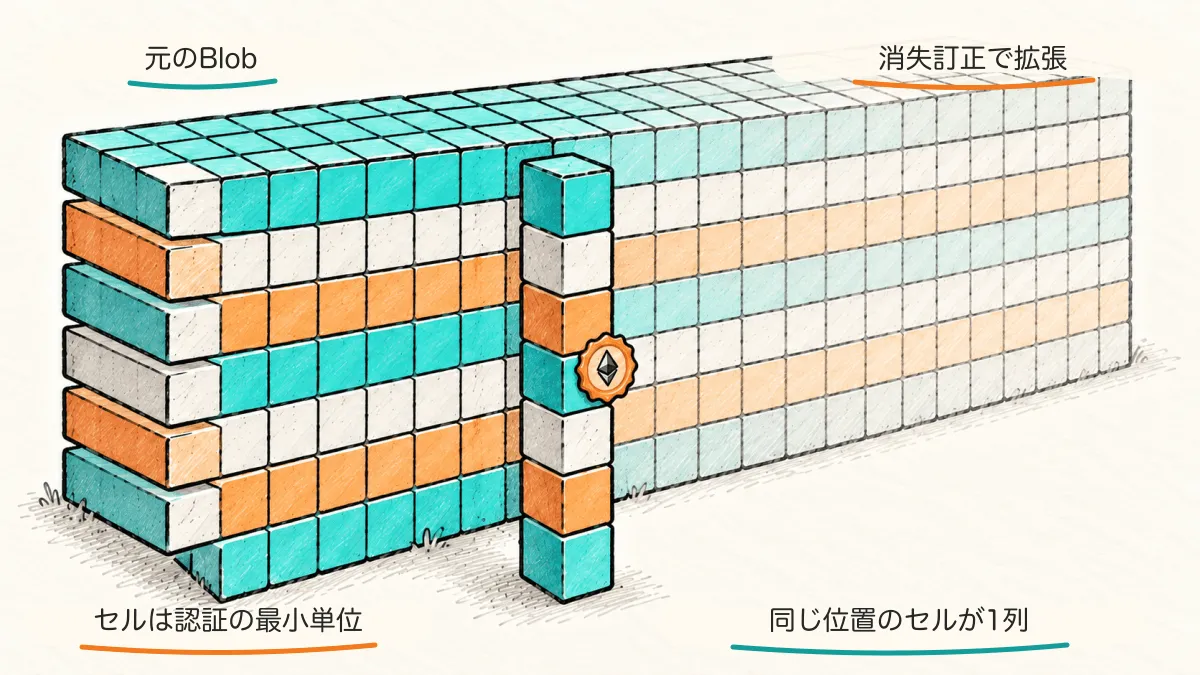
In EIP7594, each blob is divided into small units called cells and extended horizontally to twice its original size using erasure coding.
A column groups together the cells at the same position across multiple blobs.
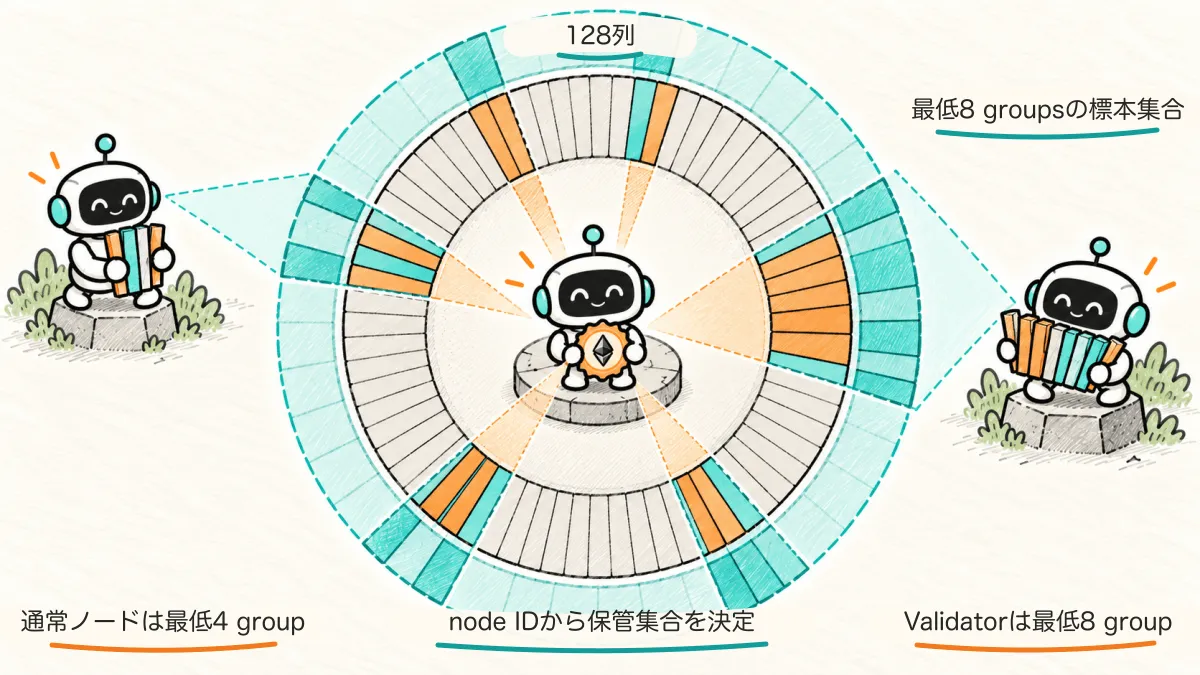
Each node continuously stores a subset of the 128 columns, determined by its node ID. Different nodes have different custody assignments, so columns can be distributed throughout the network without replicating every blob on every node. A node responsible for a column provides it when another node requests it.
Detecting missing data by sampling a subset of columns
Assigning custody alone does not detect column withholding by a block producer. Each node therefore requests columns from multiple peers, using a set that includes its custody columns or a set selected using local randomness. Retrieved columns come with cryptographic proofs, allowing the node to check that the data matches the commitments recorded in the block.
Different node IDs and random selections produce different combinations of requested columns. If a block producer withholds some columns, at least one sampling check becomes more likely to encounter missing data. Successful sampling, however, does not mean that the node has stored all the data. It is a local availability decision based on whether that node retrieved its selected columns.
Reconstructing the entire dataset from half the columns
Routine sampling does not collect all 128 columns. A node that has collected at least 64 columns for any reason can use erasure coding to compute the missing columns and reconstruct the entire extended matrix.
The figure of 64 is the reconstruction threshold, not the condition for successful sampling. Routine availability checks using a small number of columns and recovery using at least half the columns are separate operations.
Motivation
When EIP4844 was introduced, each consensus node downloaded every blob attached to a block. This makes it straightforward to check that data has been published, but increasing the blob count imposes the same additional bandwidth burden on every node. PeerDAS assigns responsibilities so that nodes can stop downloading the entire dataset while still detecting data withholding attacks.
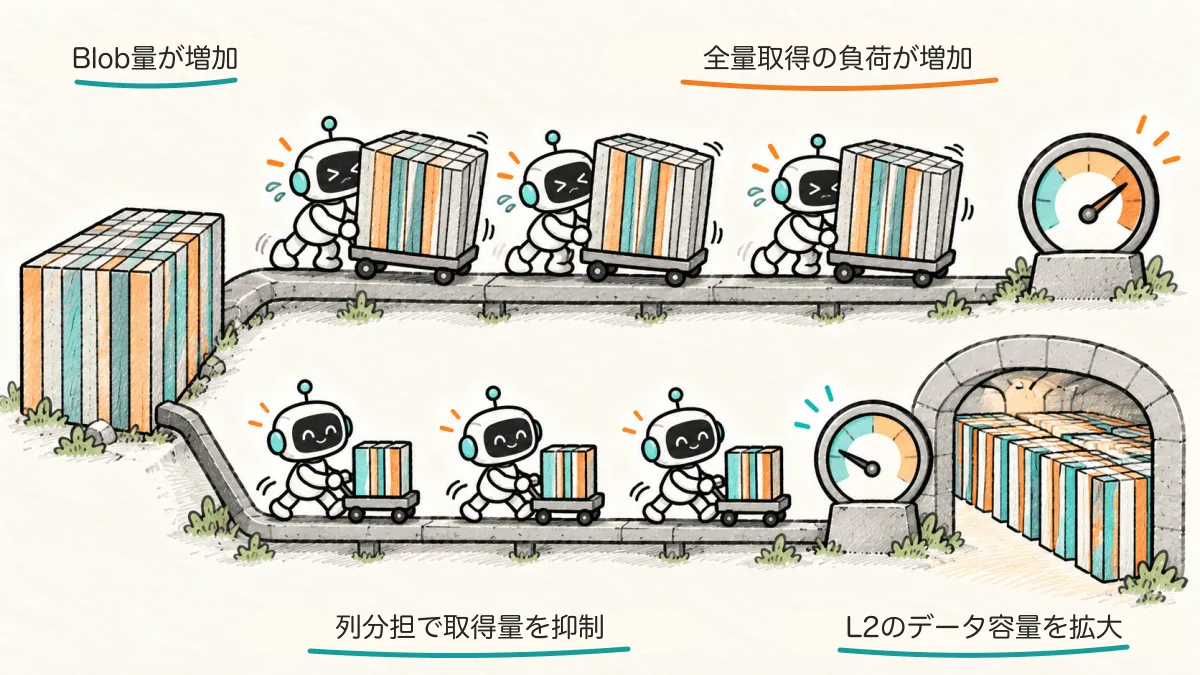
Full downloads constrain blob capacity
Rollups post the data from executed transactions to Ethereum as blobs. Users and verifiers need a period during which they can retrieve those blobs to reproduce the rollup's state.
If every consensus node receives every blob, doubling the blob capacity per block also roughly doubles the amount of data each node receives. Nodes running on residential connections or small machines face the same additional load, so continually increasing blob capacity alone narrows the pool of operators able to participate. To increase capacity for rollups while keeping node participation decentralized, the amount of data each node receives must be decoupled from the total data volume.
Why downloading less data is not enough
Simply reducing the amount of data each node receives can allow data withheld by a block producer to go unnoticed. If rollup users cannot retrieve the necessary data, they cannot reproduce the results of transaction execution. Valid commitments and proofs alone cannot establish that withheld portions of the data are retrievable.
The columns requested are therefore distributed across nodes, and each retrieved column is checked against its cryptographic proofs. To keep missing data hidden, an attacker must continue responding to the different columns selected by different nodes.
The responsibilities defined by PeerDAS
The sender of a blob transaction produces the original blob and proofs for verifying all the cells in the extended blob. The block producer broadcasts columns derived from the blobs to their corresponding destinations. Each node stores its custody columns, retrieves the columns selected for sampling from multiple peers, and determines locally whether the block can be considered available.
These responsibilities concern the distribution, custody, and verification of blobs on Ethereum's consensus network. PeerDAS does not change transaction execution or fraud-proof mechanisms within rollups. The strength of the availability decision depends on the number of participating nodes, peer diversity, sample size, and the combination of columns the attacker makes available.
Specification
PeerDAS consists of two stages: transforming blobs and distributing their columns, followed by custody, sampling, and reconstruction at individual nodes. The transaction pool also passes along the proofs used in these operations. Distinguishing who produces, stores, and verifies the data on receipt makes it possible to trace which failures halt the process.

Transforming blobs into cells and columns
Each blob forms one row of the extended matrix. The sender uses erasure coding to extend the row horizontally to twice its original size, then divides it into smaller, individually verifiable cells. Collecting the cells with the same index across all blobs forms one column.
This structure allows nodes to receive data by column rather than by blob. Because each column contains a portion of every blob, collecting distinct columns provides more fragments for reconstructing each blob.
DataColumnSidecar
When a column is broadcast, the network receives both the column data and the information needed to establish that it belongs to a particular block and its blobs.
This bundle is called a DataColumnSidecar.
The following table describes the fields in a DataColumnSidecar and what receiving nodes check.
| Field | What the receiving node checks |
|---|---|
index |
The index of the column among the 128 columns |
column |
The sequence of cells taken from the blobs |
kzg_commitments |
The commitments to the blobs corresponding to the cells |
kzg_proofs |
Proofs that the cells match their commitments |
signed_block_header |
The signed block to which the column belongs |
kzg_commitments_inclusion_proof |
Proof that the commitments are included in the block body |
The receiving node checks the format, including the column index and array lengths, before verifying inclusion in the block and the KZG proofs. If any check fails, it does not use that column in its availability decision.
Per-node custody columns
Each node deterministically selects custody groups from its node ID and continuously stores the corresponding columns. In the pinned Fulu specification, ordinary nodes are responsible for at least four groups, and nodes hosting validators for at least eight. The custody requirement increases as the validator balance grows.
A node increasing its custody count first retrieves historical columns for its new assignments. Only after it can serve those columns does it advertise the higher custody count to the network. Nodes also backfill their custody columns during synchronization to support a minimum serving window of 4096 epochs.
The same node ID is also used to select columns for sampling in each slot. This selection always includes the columns the node continuously stores. Peer sampling, which selects columns using local randomness, uses a different input to determine the columns.
Column distribution and retrieval
Columns constructed from a block are broadcast on gossip subnets corresponding to their column indices.
Nodes subscribed to the relevant subnets receive new DataColumnSidecar objects and verify their format, association with the block, and KZG proofs.
If gossip alone does not supply all the required columns, a node sends retrieval requests to its peers.
The protocol provides DataColumnSidecarsByRange for retrieving columns over a specified range and DataColumnSidecarsByRoot for requesting columns by block root and column index.

Gossip rejection and deferral
A receiving node rejects a message if it detects a mismatch between the column index and subnet, an invalid proposer signature, or a failed block inclusion or KZG proof. It also rejects the message if the parent block is invalid or the block does not descend from the finalized checkpoint.
By contrast, messages for future slots, messages whose parent blocks have not yet been retrieved, and previously seen duplicates cannot be declared invalid on that basis alone. The node ignores them or defers processing until the prerequisites are met. This decision is distinct from a sampling failure caused by an inability to retrieve columns from peers.
The ByRange retention window
For DataColumnSidecarsByRange, the beginning of the serving window is the later of the current epoch minus 4096 epochs and the Fulu activation epoch.
A node synchronizing from a weak subjectivity checkpoint also backfills its assigned columns for this range.
A peer unable to serve the required range returns ResourceUnavailable.
Persistent failures to respond can lead to a lower peer score or disconnection.
The ByRoot retrieval boundary
DataColumnSidecarsByRoot requests the corresponding DataColumnSidecar by specifying a block root and column index.
The earliest eligible point is the latest of the finalized epoch, the current epoch minus 4096 epochs, and the Fulu activation epoch.
A peer asked for a block root older than this boundary either returns ResourceUnavailable or omits the relevant columns from its response.
This boundary standardizes the amount of history nodes commit to serving.
Sampling and reconstruction
The pinned specification contains two sampling mechanisms that differ in how they select columns. Custody sampling uses the node ID to check a set that includes its custody columns every slot. Peer sampling uses local randomness to select columns that are harder for the queried peers to predict, and requests them from multiple peers.
Both mechanisms determine availability using a small number of columns. Reconstructing the entire matrix from at least 64 columns is a separate operation.
Custody sampling includes the custody set
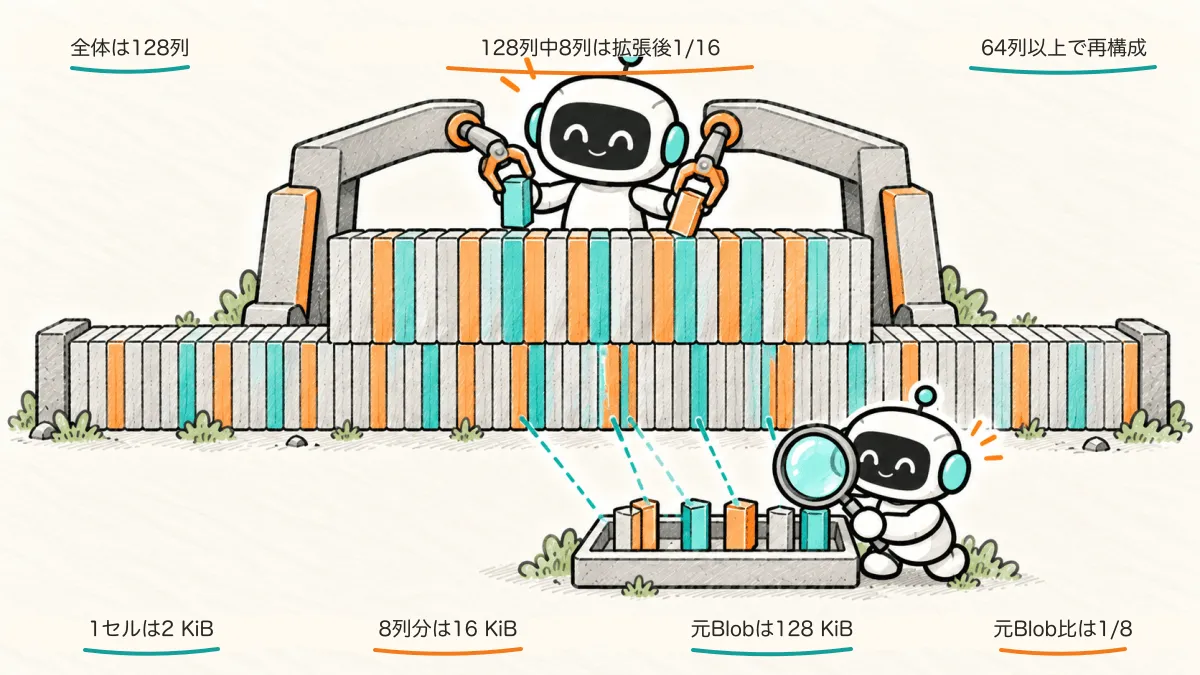
Each slot, a node retrieves at least eight columns from a set determined by its node ID. This set includes the custody columns it continuously stores. The extended matrix in the pinned specification has 128 columns, so eight is 1/16 of the extended column count.
If the node retrieves all eight selected columns and successfully verifies their proofs, its sampling check succeeds. If even one column cannot be retrieved, the condition for treating the block as available in fork choice is not met.
Peer sampling using local randomness
In peer sampling, a node uses local randomness to choose distinct columns uniformly.
It requests the selected columns from multiple peers responsible for them using DataColumnSidecarsByRoot.
Columns it already stores locally do not need to be requested again.
If more than the minimum number of columns are sampled, a mechanism that tolerates some missing samples can also be used, provided it maintains the same false-positive rate. The probability table in the supplementary document, however, assumes 16 samples per slot. These probabilities cannot be directly applied to the minimum of eight in the pinned core specification.
Reconstruction from at least half the columns
A node that has collected at least 64 of the 128 columns can use erasure coding to calculate the missing columns. Reconstructed columns can be redistributed to other nodes to recover withheld or temporarily missing columns.
A count of 64 is the threshold at which reconstruction becomes possible. Routine sampling does not require retrieving 64 columns, nor does successfully checking eight mean the entire dataset has been reconstructed.
Transaction pool proofs
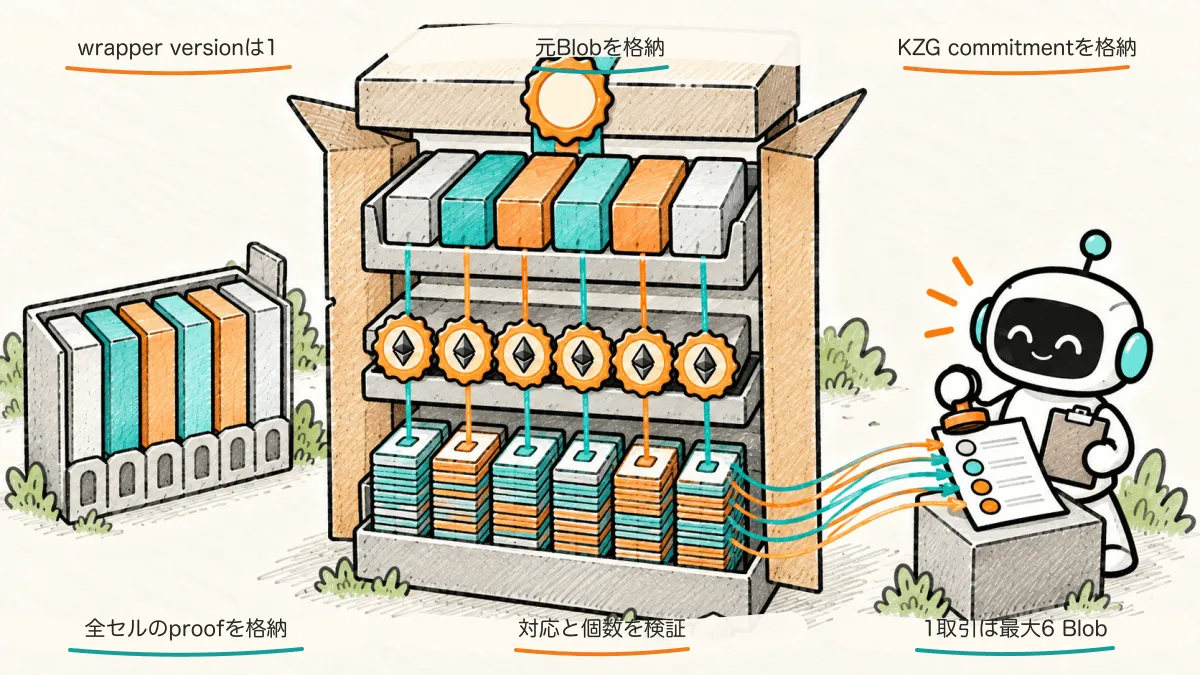
Generating proofs for all the cells in an extended blob requires more computation than verifying KZG proofs. The blob transaction sender therefore computes those proofs in advance and attaches them to the data sent to the transaction pool.
In addition to the transaction itself, the version 1 wrapper for PooledTransactions contains the following.
-
Original blobs
The unextended blobs into which the sender placed the rollup data.
-
KZG commitments
Commitments that allow the receiving side to check the blobs against the versioned hashes in the transaction.
-
KZG proofs for all cells
Proofs that can verify both the original cells and the cells produced by extension.
The receiving side checks that the numbers of blobs, commitments, and proofs correspond. It then checks the commitments computed from the blobs against the versioned hashes and verifies all the proofs in a batch. A transaction can contain at most six blobs. Wrappers with inconsistent counts or mismatched data are not accepted into the transaction pool.
Additional considerations
Using columns as the unit of sampling separates computation performed during block production from the data collected over the network for reconstruction. Moreover, even with the same sample size of eight columns, the denominator differs depending on whether it is the extended column count or the original blob size.
Why column sampling is used
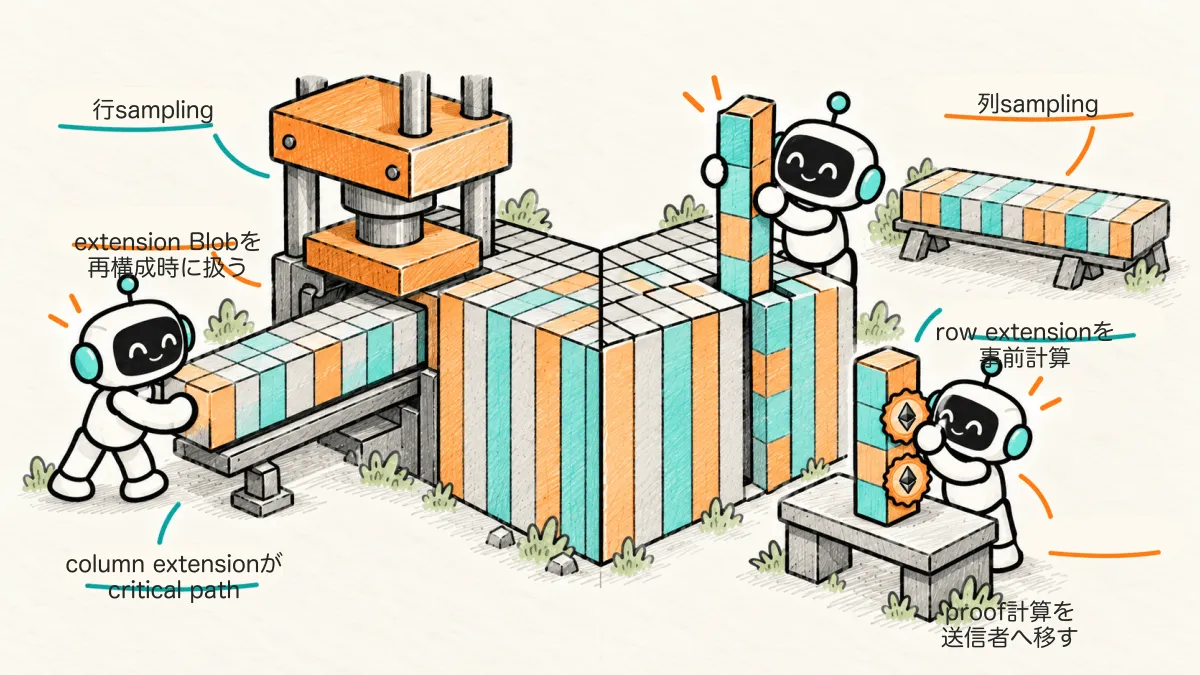
A column consists of cells at the same position that already exist across all blobs. With column sampling, the sender can extend a blob horizontally and generate proofs for all its cells in advance. The block producer can then use the received proofs and columns for distribution.
Row sampling, by contrast, requires producing extended rows during reconstruction that do not exist on the network independently of the original blobs. It also requires extension along the column dimension within the time constraints of block production. Sampling columns shifts expensive proof generation to the sender and reduces computation required from the block producer.
The different denominators behind 1/8 and 1/16
In the pinned specification, eight of 128 columns are sampled. Using the extended column count as the denominator yields 8 ÷ 128, or 1/16.
Each blob cell in a column, however, is 2 KiB, and the original blob is 128 KiB. The 16 KiB received from eight columns is 1/8 of the original blob size. The 1/8 figure in the proposal is a ratio relative to the original data volume, not the fraction of extended columns.
Backwards compatibility
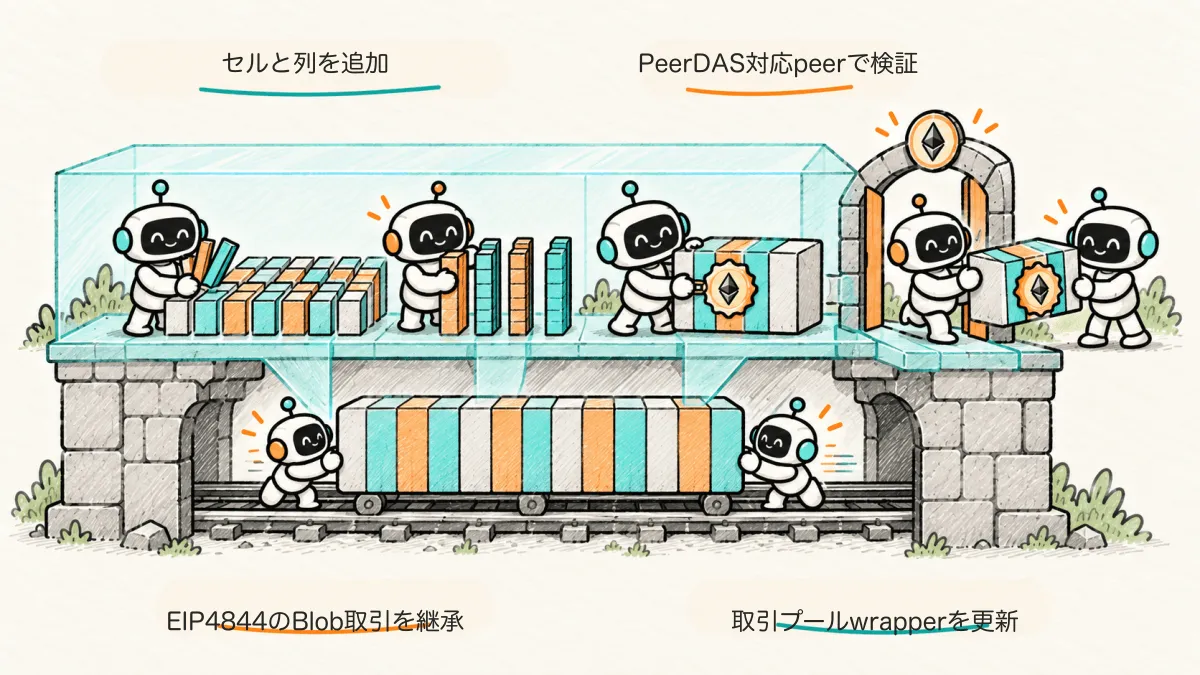
EIP7594 retains the blob transactions and KZG commitments introduced by EIP4844. It adds cell and column distribution to the consensus network and passes proofs for all cells to the transaction pool. Retaining an existing data format and not requiring client updates are two different things.
What PeerDAS inherits from EIP4844
A rollup sender puts large amounts of data into blobs and associates their KZG commitments with the transaction so that the blob contents can be checked later. The execution layer does not directly process blob contents; it refers to the commitments through versioned hashes. EIP4844 defines this relationship between blob transactions and their commitments.
For more on EIP4844, see the following article.
[EIP4844] Understanding Shard Blob Transactions
PeerDAS does not replace this relationship. It retains the original blobs and commitments submitted by the sender and the versioned hashes referenced by the execution layer, while changing the unit of distribution on the consensus network to columns.
New operations required for PeerDAS
PeerDAS-capable clients extend blobs to construct cells and columns, store custody columns, and handle column-specific gossip and retrieval requests.
In the transaction pool, clients receive proofs for all cells from the version 1 PooledTransactions wrapper and verify the correspondence between blobs and commitments.
Thus, backwards compatibility with EIP4844 does not mean existing clients can participate in PeerDAS without an upgrade. Clients need to implement the network messages, storage operations, sampling, and transaction pool validation.
Fusaka activation and the BPO boundary
The proposal has Final status. PeerDAS was introduced on Ethereum mainnet with the Fusaka upgrade on December 3, 2025. After activation, Blob Parameter Only upgrades separately modify the target and maximum blob counts per block.
The column and sample counts in the pinned PeerDAS specification, the limit of six blobs per transaction, and the per-block blob parameters are distinct values. Changing the per-block limit through a BPO upgrade does not make the transaction-level limit in EIP7594 equal to that value.
Test cases
The proposal does not include concrete test vectors; it refers to the consensus and execution specification test suites. The coverage visible in the public repositories is divided between column verification and reconstruction, and execution-layer boundaries for blob transactions.

Consensus-layer test coverage
The Fulu consensus specification tests cover fork transitions, data availability decisions in fork choice, custody group selection, column reconstruction, KZG operations, and network distribution.
The consensus tests cover the format and inclusion proofs of DataColumnSidecar, custody column selection, and handling of unavailable blocks.
These tests examine the boundary from receiving columns to deciding that a block is available. However, the published module names alone do not establish that every peer configuration and attack scenario has been automatically tested.
Execution-layer test coverage
The execution specification test changelog records tests for blob transaction submission, basic engine_getBlobsVX behavior, and the maximum blob count per transaction as part of EIP7594 support.
This covers blob retrieval between the execution and consensus layers and enforcement of the six-blob limit.
The documentation does not state that the same test suite guarantees every gossip and retrieval condition or all validation conditions of the PooledTransactions wrapper.
The existence of these tests should not be taken as evidence of broader network-wide coverage.
Why there is no reference implementation section
The proposal has no Reference Implementation section containing an implementation of the entire standard. The consensus and execution specification test suites provide material against which clients can check their implementations, but they are not code published as a single reference implementation.
This article therefore does not include a standalone reference implementation section and distinguishes published test coverage from conditions that cannot be established from it.
Security considerations
The main attack PeerDAS addresses is data withholding: a block producer hides some columns and misleads nodes into treating the missing data as available. When different nodes request different columns from multiple peers, the probability that an attacker can keep missing data hidden decreases. Sampling, however, is a decision based on network and probabilistic assumptions.
The data withholding attack
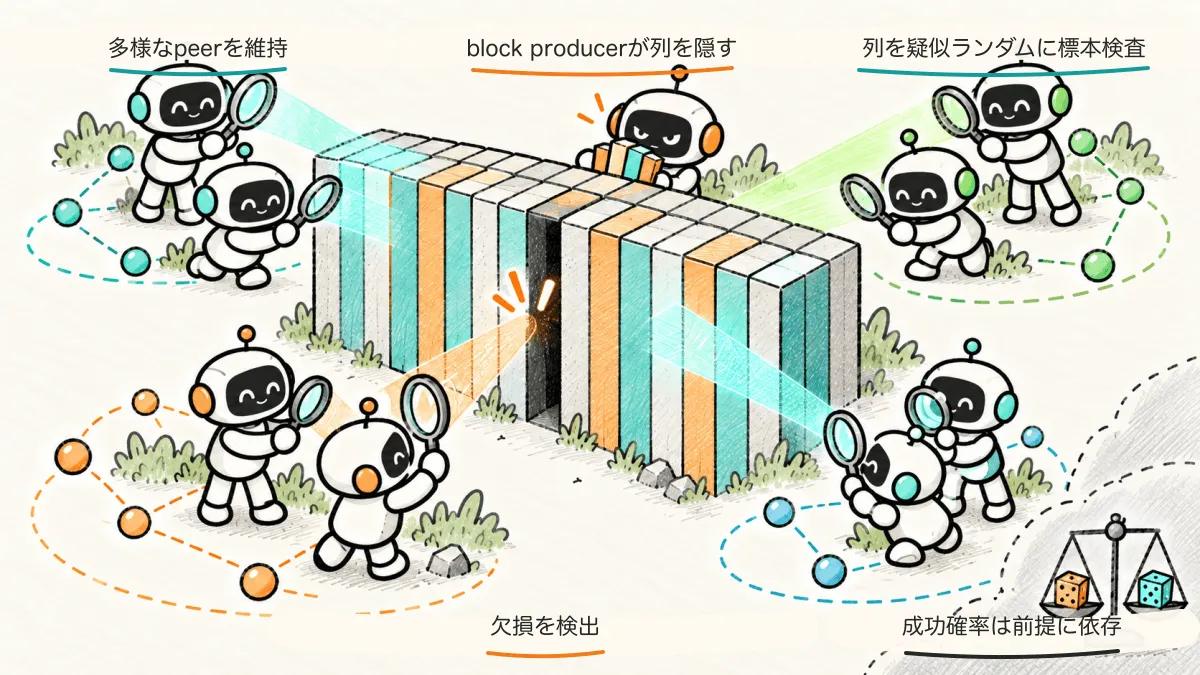
If a malicious block producer withholds some columns and can respond only with those requested during sampling, nodes may fail to detect missing data. Even a valid KZG proof for a retrieved cell does not prove that the columns the node did not retrieve have been published.
The attacker is not trying to make an invalid cell appear valid. The goal is to publish only a subset of columns with valid proofs while concealing the absence of the remaining columns.
The role of peer diversity and sampling
When nodes select different columns and query different peers, the attacker must respond correctly to a larger number of requests. Distributing queries across multiple peers based on responsiveness and custody assignments rather than relying on one peer reduces the attacker's ability to predict samples and selectively respond.
Nodes check columns they already store against their local data and retrieve the remaining columns from separate peers. Combining custody with sampling supports both column replication across the network and detection of missing data in each slot.
The limits of the probability table as a security guarantee
The proposal's attack success probability table assumes 10,000 sampling nodes. The upper bound on the probability of an attacker simultaneously deceiving at least 2% of the nodes decreases rapidly, whereas the upper bound for deceiving 100 nodes (1%) is 1.
This table does not mean PeerDAS guarantees data availability under all circumstances. The result depends on the actual node count, the number of sampled columns, the diversity of queried peers, and the combination of columns the attacker makes available. Clients perform sampling in conjunction with peer discovery, responsiveness checks, and distribution of requests across peers.
Conclusion
PeerDAS removes the requirement for every node to download all the data by converting blobs into erasure-coded columns and combining per-node custody with sampling. Three points must be kept distinct: availability is assessed using a set that includes custody columns; the entire dataset can be reconstructed from at least 64 columns; and the strength of the availability decision depends on assumptions about peers and probability.

