Introduction
Hi, I'm cardene, a software engineer and technical writer focused on blockchain and AI.
I've also authored Japanese technical books on specification-driven development with LLMs and decentralized application (DApp) development.

I also build and publish a variety of tools, libraries, and open-source projects.
Private Balances in v2
Suppose you receive 100 USDC from an exchange, pay 30 USDC to someone else, and keep the remainder.
With an ordinary wallet, anyone can trace the amount received and the subsequent recipient through public transaction history.
zERC20 v2 converts deposited assets into private records that only their owner can spend. Payments work by updating those records.
For example, depositing USDC gives you access to zUSDC, backed one-to-one by the underlying asset.
A z-token can be held as a public ERC20 balance or as a private balance without directly revealing its owner or amount.
For a private payment, a zero-knowledge proof establishes that old records have been consumed and new records created.
If the fee for the relayer submitting the transaction on the user's behalf is f, paying 30 out of a balance of 100 leaves change of 70−f.
The private amounts in the diagram are illustrative values used to explain this conservation of value.
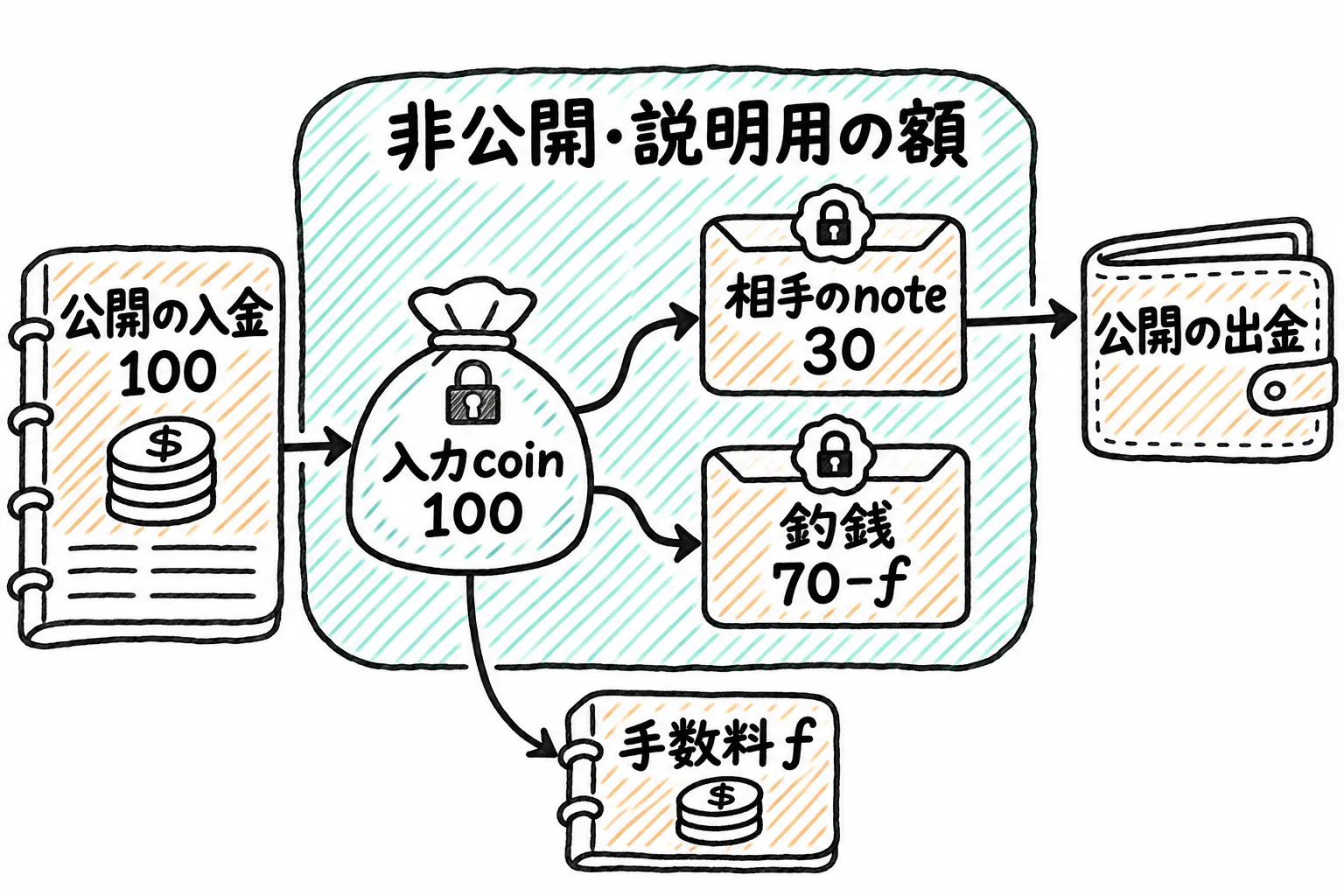
Deposits and withdrawals are public, and their amounts and timing may allow observers to infer a connection. However, who paid whom and how much within the private balance system is not directly recorded in public transaction history. Understanding the distinction between public data and the information accessible to keys and services helps establish the privacy guarantees.
v2 launched on mainnet on November 4, 2026.
It replaces the proof-based receiving mechanism of v1 with a model that consumes private balances and creates new ones.
The changes extend beyond wallet operations to receipt records, double-spend prevention, and the roles of supporting services.
Deposits Through One-Time Addresses
To deposit directly from an exchange, use a one-time address that accepts ordinary tokens.
The deposit contract associated with this address receives USDC, deducts the specified fee, and sends zUSDC to an address used to fund the private balance.
On the exchange, the user makes a conventional transfer using the specified network and asset.
The destination used to fund a private balance is the burn address.
It is derived from the owner's public key and transfer-specific values, among other data. Instead of making an ordinary transfer using that address's private key, the owner proves their authority to spend the deposit.
The one-time deposit contract and the burn address are two different addresses with distinct roles.
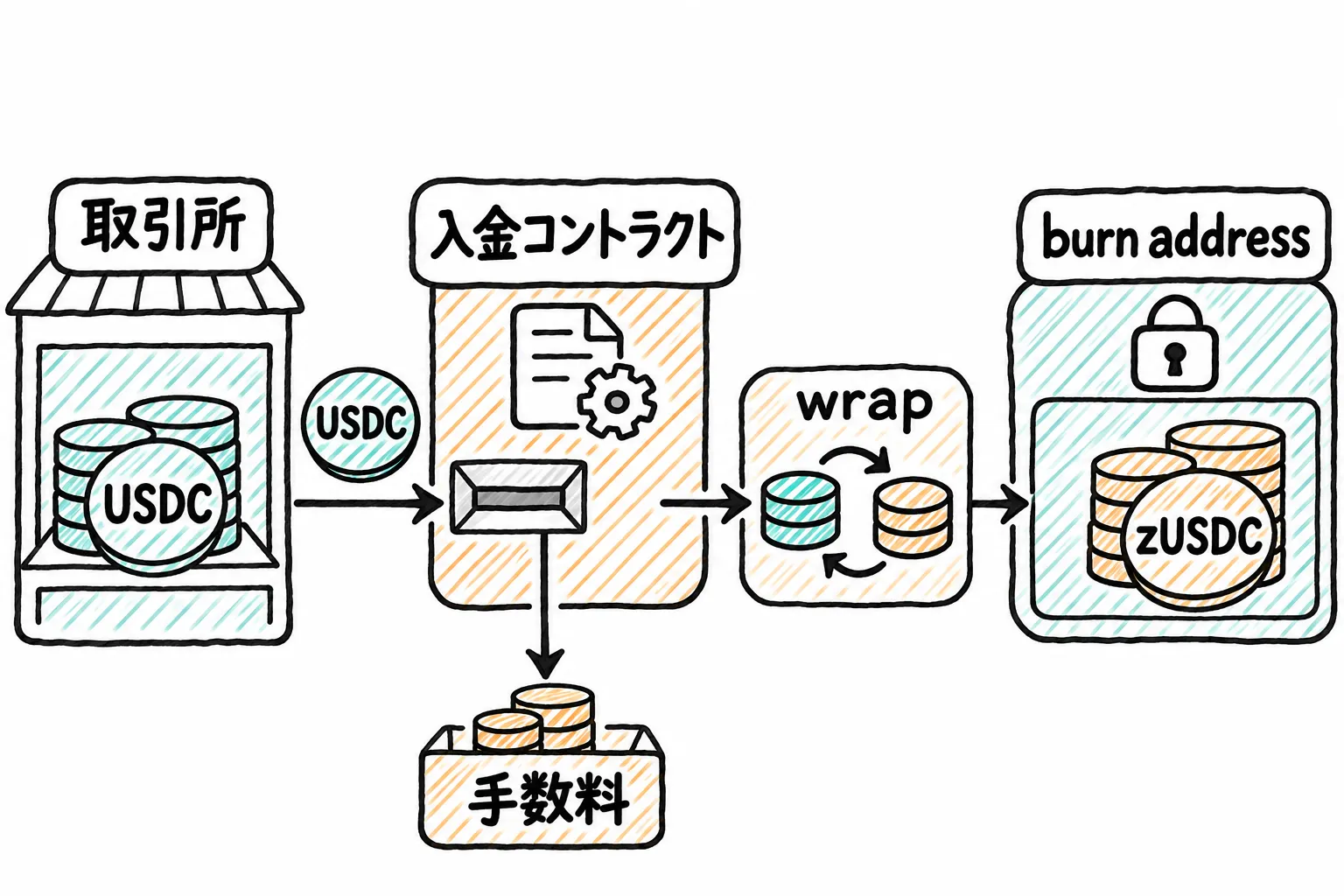
For one-time deposits, a relayer processes the funds held by the deposit contract. A relayer is a service that submits transactions on behalf of users. The processing fee is deducted from the deposit, so the deposited amount must exceed that fee.
The seven-day period shown in the interface is the period during which the relayer monitors the deposit address.
Funds remain after that period expires, and a late deposit can be detected by resuming monitoring.
There is also a recovery path that calls the deposit contract's flush function without relying on the service, independently of the monitoring period.
When depositing from a connected wallet, that wallet submits the approval and deposit transactions.
For example, depositing USDC requires approving the amount first, and the connected wallet pays the gas fees.
When a Deposit Becomes Spendable
A recorded deposit is not necessarily available for immediate spending.
It first undergoes sender verification in the Screening stage, followed by Settling, during which the system waits for a proof covering the deposit history.
After both conditions are met, it reaches the spendable Ready state.
Sender verification begins after 10 minutes have elapsed since the deposit and the deposit has been finalized on-chain.
The ASP responsible for the check publishes a set of approved deposits.
ASP stands for association set provider. It supplies the set used by subsequent payment proofs to establish that funds originate from approved deposits.
Even after approval, the deposit must wait until the root covering its history can be verified.
The total balance displayed in the interface may therefore include funds that have been received but cannot yet be spent.
A deposit rejected during sender verification becomes Blocked, and the Exit mechanism described below provides a path for returning it to the sender.
Passkeys and View Keys
A v2 wallet is created in the browser and unlocked using a passkey.
Both the authenticator and the browser must support the PRF feature to derive key material from the passkey.
Face or fingerprint authentication takes place on the device using the passkey.
The keys needed to spend funds are used on the user's device. If the passkey is unavailable, the account can be recovered using a 24-word recovery phrase. Anyone who knows this phrase can control both the public and private balances, so it must be distinguished from viewing-only information.
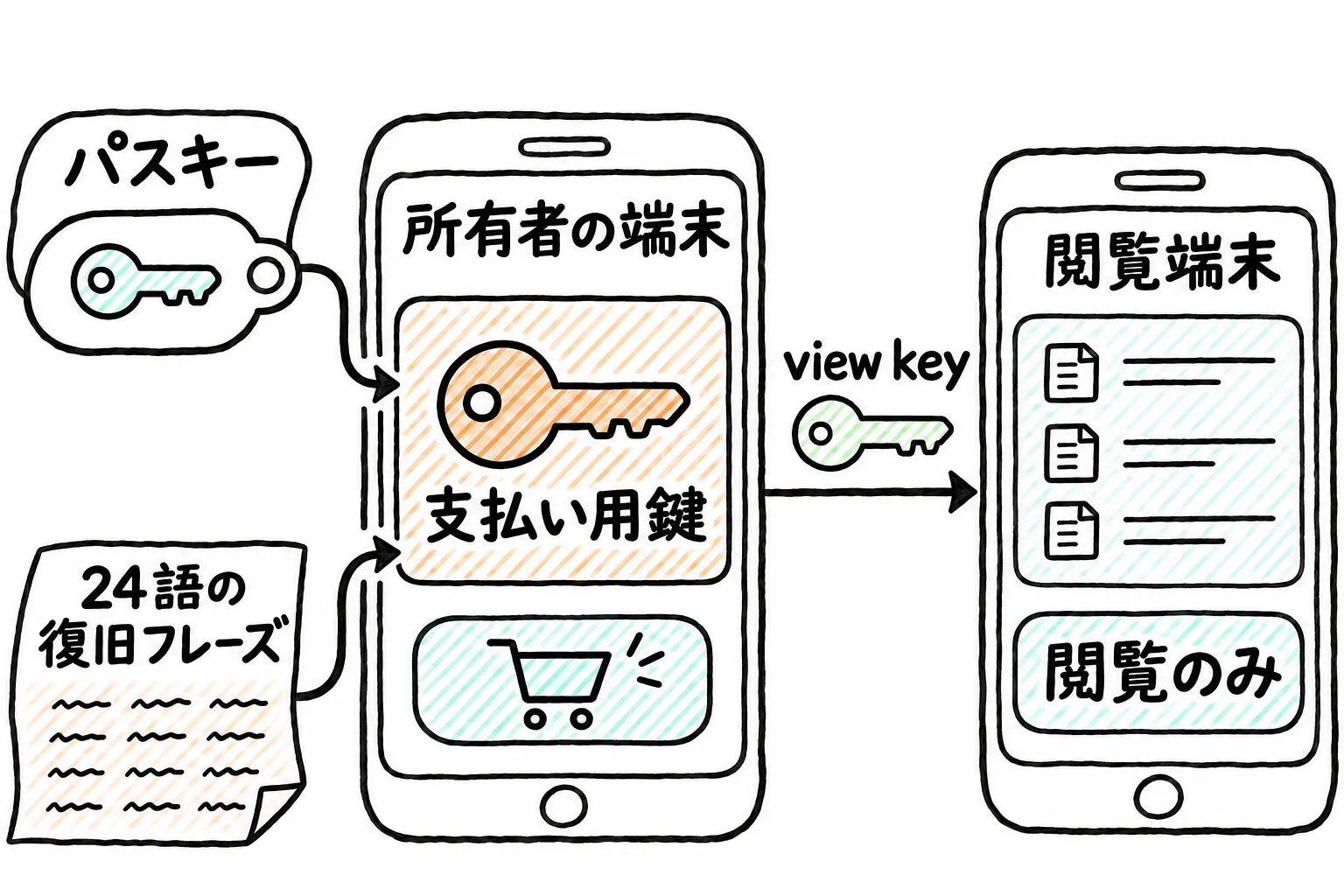
For example, a user can share a view key with an accountant to provide access to balances and transaction history.
This key alone cannot authorize payments.
However, private payments made to a receive code are not visible through ordinary view-key sharing, which limits the scope of what can be viewed.
Registration and Receive Codes
On first use, the account's address is publicly registered so other users can send it payments.
The zERC20 ID represents this payment destination in a format designed to prevent accidental transfers from ordinary wallets.
Making a public transfer to a normal address is different from making a private payment to a zERC20 ID.
To receive funds without giving the sender an ID, create a receive code containing the payment destination and share it as a link or QR code. However, payers who receive the same code may be able to see one another's payments. Using a separate code for each payer limits this shared visibility.
Receive codes are interpreted by compatible zERC20 wallets.
For senders using ordinary wallets or exchanges to transfer conventional tokens, a one-time deposit address provides a separate route.
Treating receive codes, IDs, and ordinary addresses as distinct inputs helps prevent unintended public transfers.
Updating Private Balances
A private balance is the sum of records called coins that only their owners can spend.
Deposits and incoming payments each create new coins.
A payment consumes existing records and creates new ones representing the recipient's payment and the sender's change.
There are two types of coin.
One represents a deposit originating from a transfer to a burn address; the other is a note created by a payment or aggregation.
A note binds information including the owner and amount to a hash. The chain records the hash rather than the owner and amount directly.
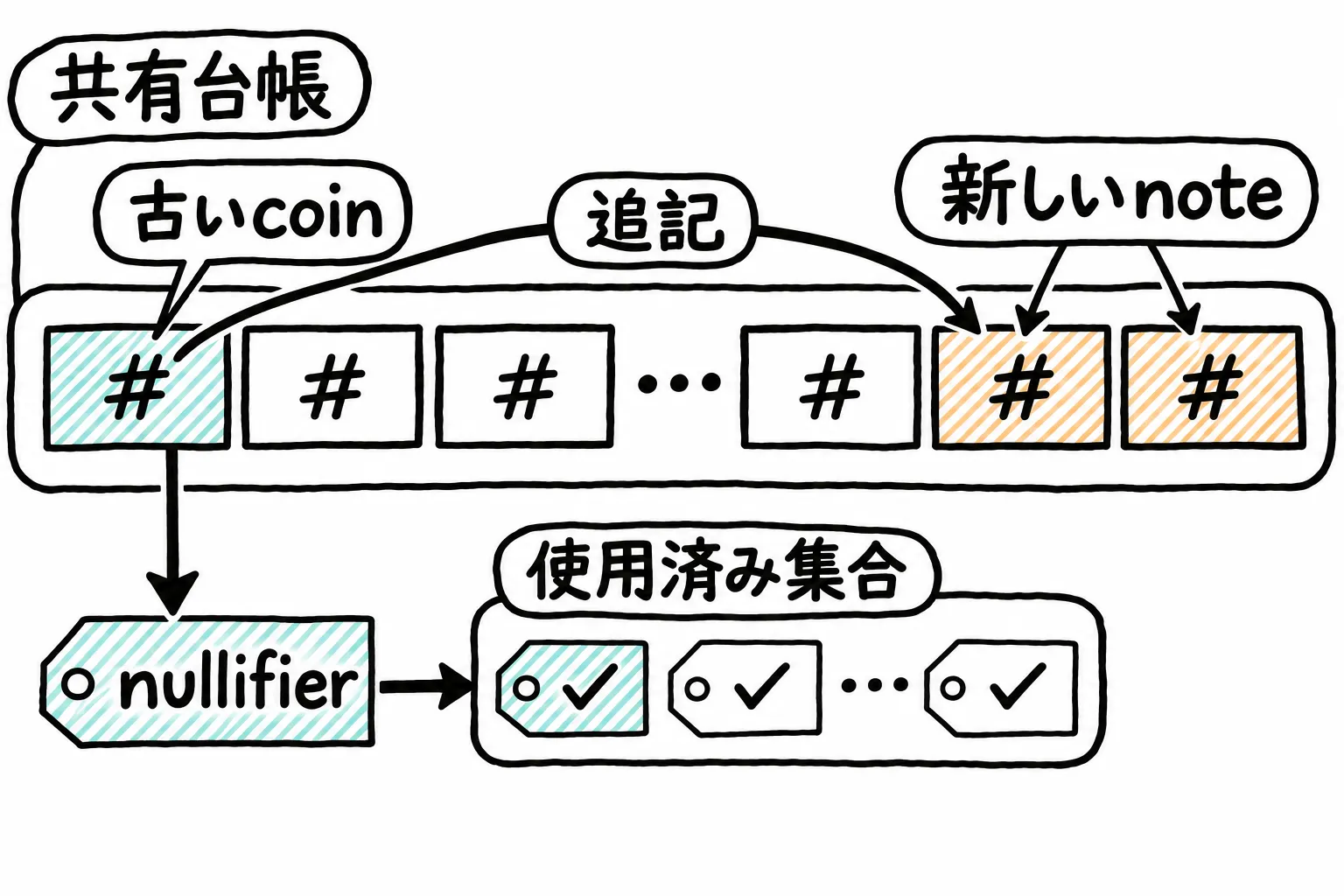
To prevent a coin from being spent twice, a spent tag known as a nullifier is made public when it is consumed.
This tag is bound to the record being consumed and its owner.
| Information | Role |
|---|---|
| Chain ID | Distinguishes tags from those on other chains |
| Position in the ledger | Uniquely identifies the record being consumed |
| Owner's secret value | Ensures only the owner can generate the corresponding tag |
Spending a coin at the same position again would produce the same tag, allowing the contract to reject duplicate use.
To spend a new note, its owner must be able to read its contents, and the note must exist in verified history.
Storing encrypted payment records and appending hashes to the public ledger are separate processes.
The two are reconciled before the record can be used as an input to a later payment.
A Ledger Shared by All Tokens
Z-tokens on the same chain share one transaction history in the CommitmentLedger contract.
Transfers of z-tokens between accounts and notes created by payments or aggregation are appended in order.
The data included in a leaf depends on the record type.
| Record | Information included in the leaf |
|---|---|
| Z-token transfer | TokenSenderRecipientAmount |
note |
TokenHash of the note |
Each time a leaf is added, the contract updates an accumulated value using SHA-256.
The Merkle tree itself is constructed off-chain, and a root prover proves that its root was derived from the same ordered history.
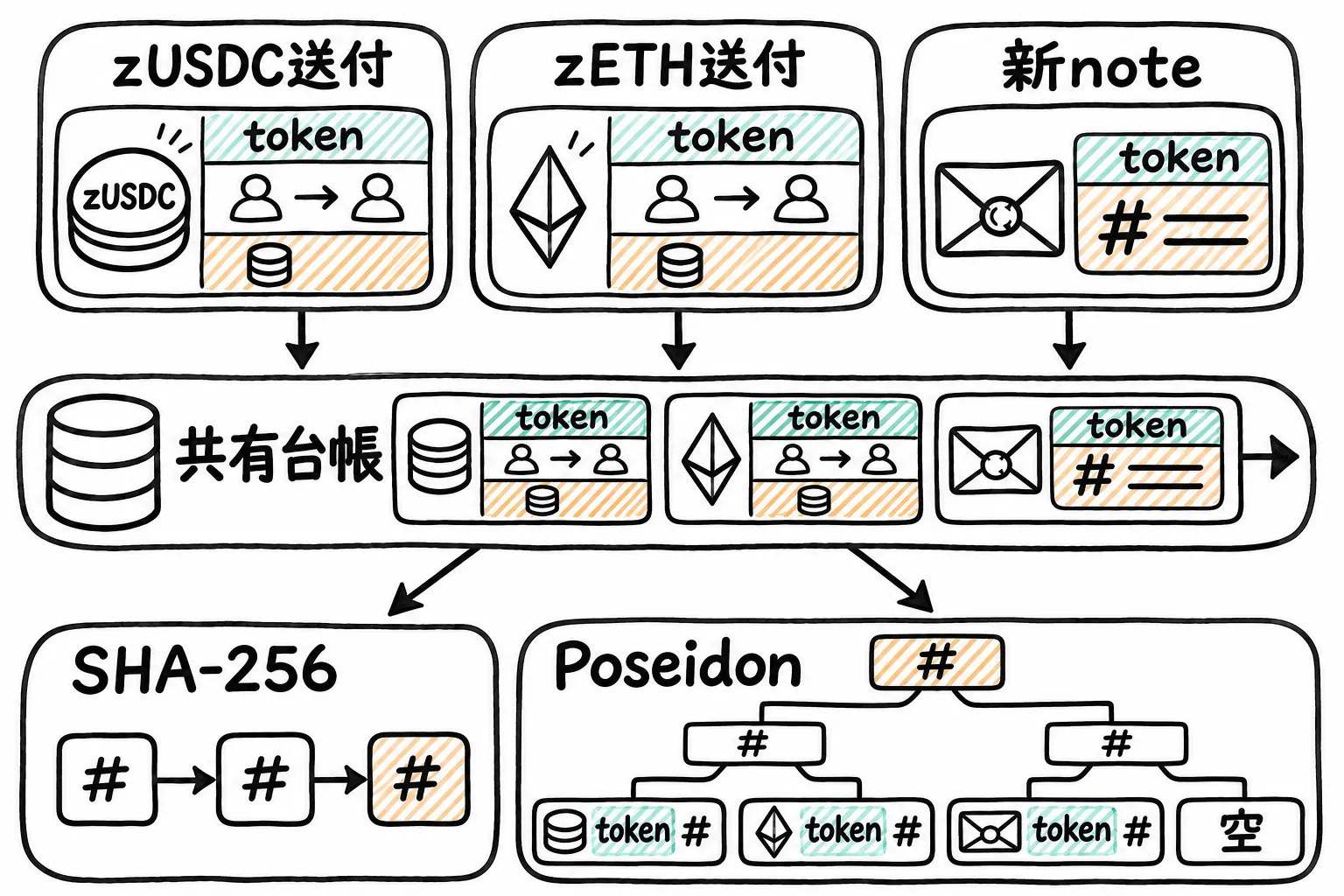
The Merkle tree uses Poseidon, a hash function suitable for computation within proof circuits.
Linking the contract's accumulated value to the off-chain Merkle tree through a proof reduces the work the contract would otherwise perform to update Merkle paths on each transfer.
Users check the history against a root whose proof has been accepted by the contract.
Issuing z-tokens and reducing their outstanding supply through a burn are not themselves recorded as account-to-account transfer leaves in the ledger.
The scope of the ledger also differs from v1, where each token maintains its own transfer history.
Moreover, the shared ledger is independent on each chain, so identical contract addresses on different chains do not imply shared balances.
The Root Circuit and Settlement
The Root circuit, which proves a root of the history, adds one leaf per step.
It verifies that the insertion position is empty, updates the Poseidon Merkle tree, and incorporates the leaf into a hash chain in the same order.
If the initial and final positions and accumulated values match the contract's history, the resulting root can be accepted as correctly covering the specified range.
Repeated updates are aggregated using Nova, which folds the individual computation steps together.
The result is ultimately compressed into a LegoGroth16 proof for verification by the contract.
New deposits or notes remain in Settling because a root covering them has not yet been proven.
The Merkle tree specified in the official documentation has depth 32. Its positions can be represented using 32 bits, so the structure can accommodate up to 2 to the power of 32 leaves. When a particular record becomes spendable depends on proof of the root and on-chain finalization.
Two guardians compare roots calculated using separate Indexers against accepted roots.
If they detect a mismatch, they halt new roots after the last correct root.
Coins included in earlier roots remain spendable, but later records await settlement. Resuming processing requires an administrative operation subject to a waiting period.
Payments With JoinSplit
The JoinSplit circuit produces proofs for payments and withdrawals.
It consumes up to two inputs and produces two new notes and one public withdrawal.
On the user's device, it proves that the owner is correct, that the inputs exist in the history, and that the sum of the outputs equals the original amount.
Consider paying someone 30 zUSDC from a deposit of 100 zUSDC, with a relayer fee of f.
The recipient's note is worth 30, the sender's change note is worth 70−f, and the public payment to the relayer is f.
To maintain a total of 100, the user must have sufficient funds for both the payment amount and the fee.
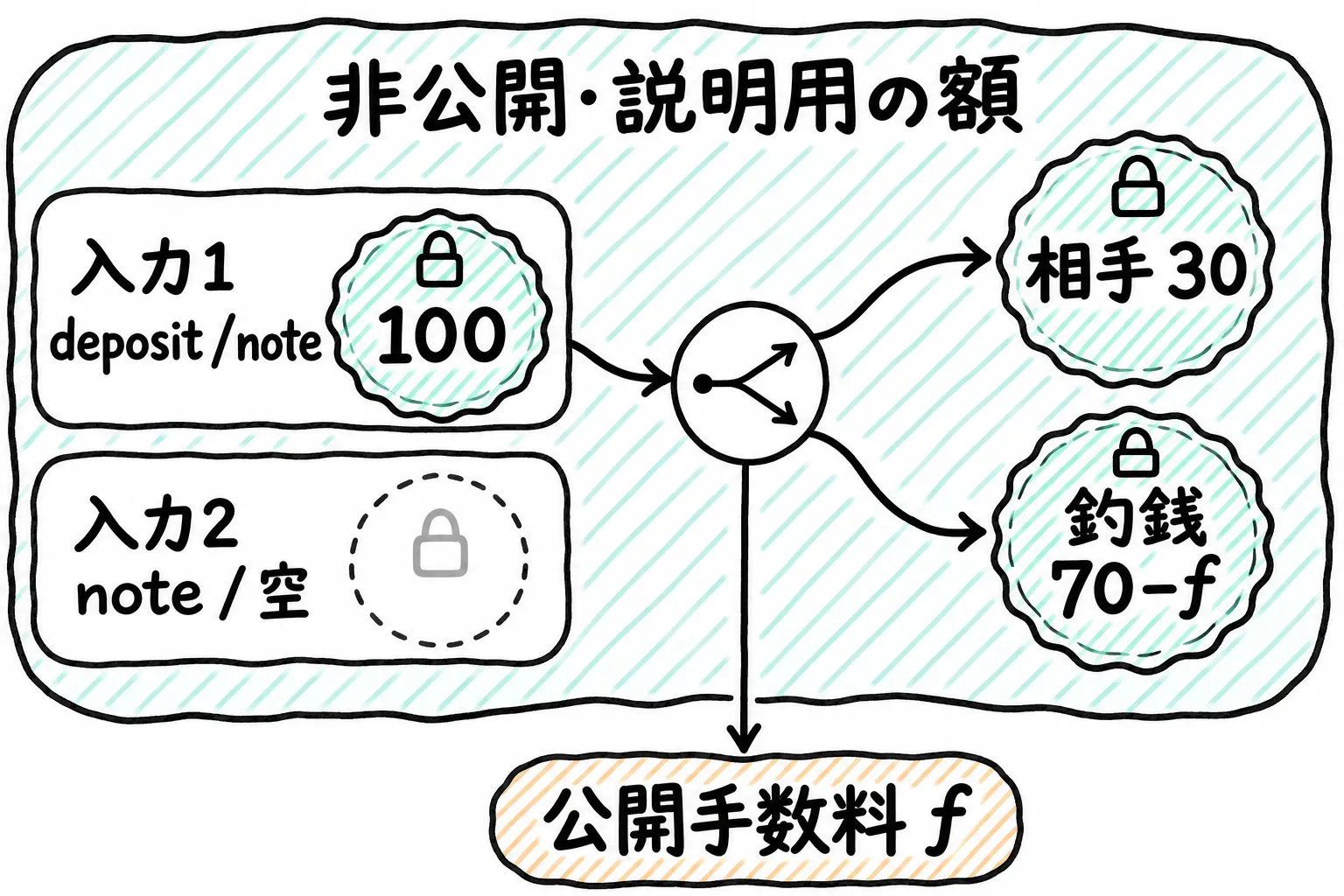
There are restrictions on the types of the two inputs.
The first can be a deposit or a note; the second can be a note or empty.
Consequently, two deposits of 40 and 60 cannot be consumed together directly. They must first be aggregated.
A deposit and a change note from a previous payment, on the other hand, can be combined as two inputs.
The operations required depend not only on the number of inputs but also on whether they are deposits or notes.
An empty second input still produces a random dummy nullifier, so the actual number of inputs consumed cannot simply be inferred from the number of published tags.
Public and Private Values
The proof checks input ownership, inclusion in the ledger, and ASP approval of deposits.
It also verifies that the correct nullifier values were generated and that the input amount equals the sum of the withdrawal and the two notes.
The contract verifies the proof, checks that the tags have not been used, and checks the attester's signature described below before recording the spent tags and appending new notes.
The public inputs bind the conditions for using the proof and the public withdrawal.
| Public value | Verification role |
|---|---|
| Token | Identifies the asset |
| Chain ID | Binds the proof to the chain on which it is used |
commitment root |
Identifies the verified history containing the inputs |
ASP root |
Identifies the set of approved deposits |
| Spent tags | Prevent duplicate use of inputs |
| Withdrawal recipient | Binds the public withdrawal destination |
| Withdrawal amount | Binds the amount withdrawn publicly |
| Withdrawal type | Determines whether the underlying asset or z-token is delivered |
Hashes of the two notes |
Bind the contents of the new records |
Which private coin was selected, and the owners and amounts of the notes, are not directly included in the public inputs.
The earlier values of 100, 30, and 70−f illustrate the calculation of private amounts.
The paying wallet saves an encrypted payment record, and a note store on ICP holds encrypted records and registration information.
ICP is a separate execution platform that hosts programs and records. The note store allows recipients to discover incoming payments.
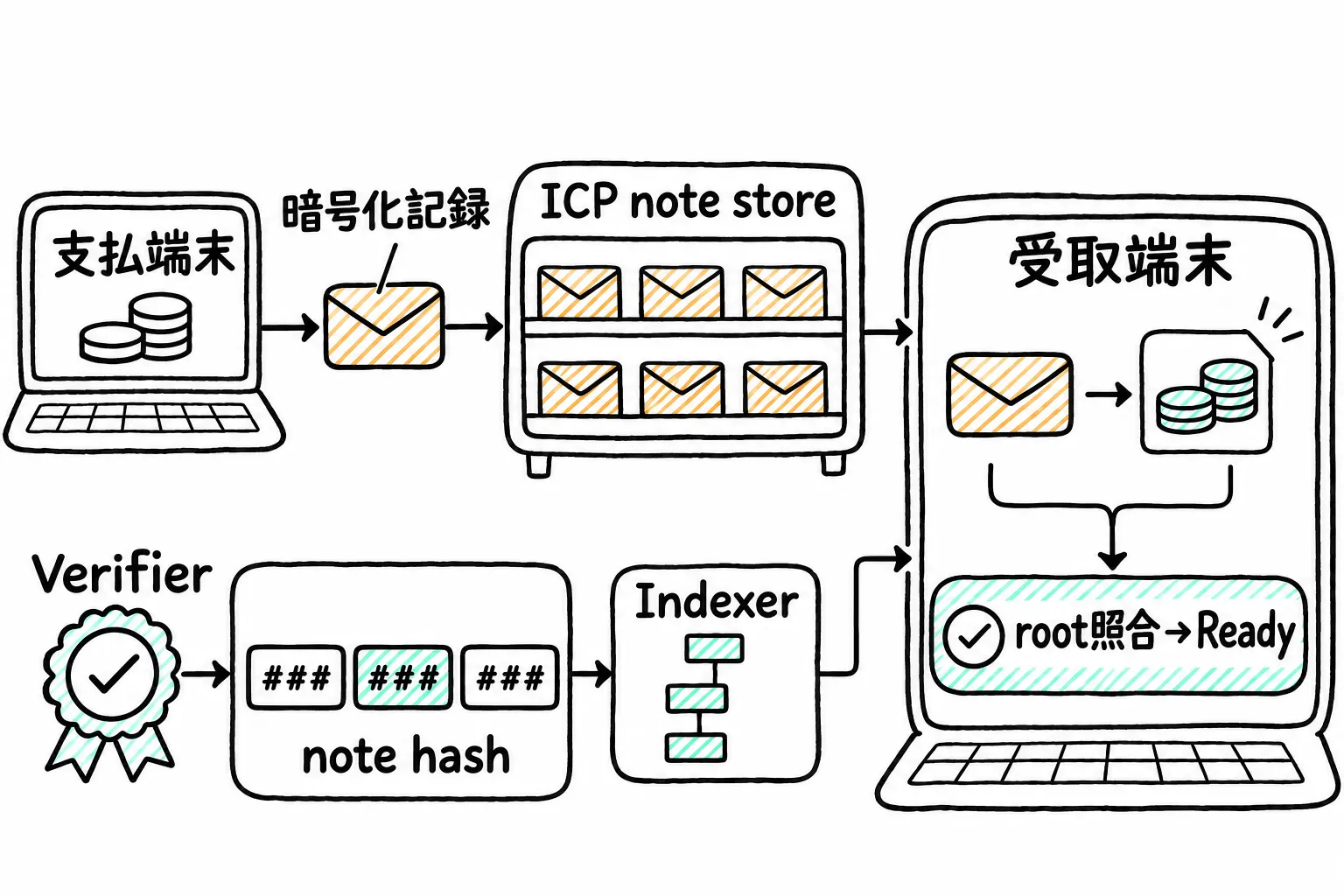
Recipients cannot reconstruct the amount or secret information of a new note from the on-chain hash alone.
The recipient's SDK discovers new payments through synchronization and matches records that can be decrypted with local keys to ledger positions and inclusion data.
This correspondence is checked against a root accepted by the contract. Once the relevant note becomes spendable, it can be used in a subsequent payment.
Both the ability to read the encrypted record and the presence of its hash in the verified ledger are required.
The old version's announcement and key retrieval mechanism using VetKD cannot simply be assumed to describe the encryption scheme in v2.
Withdrawals and Resuming Transfers
To send funds to an ordinary address, use the public withdrawal operation, Withdraw.
The recipient can receive either the underlying asset, USDC, or a public balance of zUSDC.
In both cases, the withdrawal recipient and amount are public.
Transfers and withdrawals proceed through preparation, proof generation on the device, verification by an attester, and submission by a relayer. An attester independently recalculates the payment outside the proof circuit and returns a signature. Generating a proof is therefore not sufficient to complete a payment until this verification is finished.
The wallet saves intermediate operations so that processing can resume when the page is reopened.
A payment can be canceled before submission, but from the Relay stage onward, it has already been submitted to the network and must be allowed to succeed or fail.
Retrying after a connection error is distinct from creating a new operation for one that has already been submitted.
Balance Aggregation With Merge
When deposits are fragmented, the total balance may be sufficient even though the inputs available for a single JoinSplit are not.
Two deposits also cannot be combined directly.
The Merge operation first aggregates multiple coins into a single note.
One aggregation operation supports up to 100 coins.
Nova repeatedly checks the following spending conditions for each coin.
| Check | What is verified |
|---|---|
| Ownership | The user has authority to consume the coin |
| Inclusion in history | The coin exists in the ledger |
| Deposit approval | If the input is a deposit, it belongs to the set approved by the ASP |
| Spent tag | The corresponding nullifier is generated correctly |
The verified amounts are summed, and a single note is created after deducting the fee.
The aggregated result can be spent in a later payment once a root covering it has been proven.
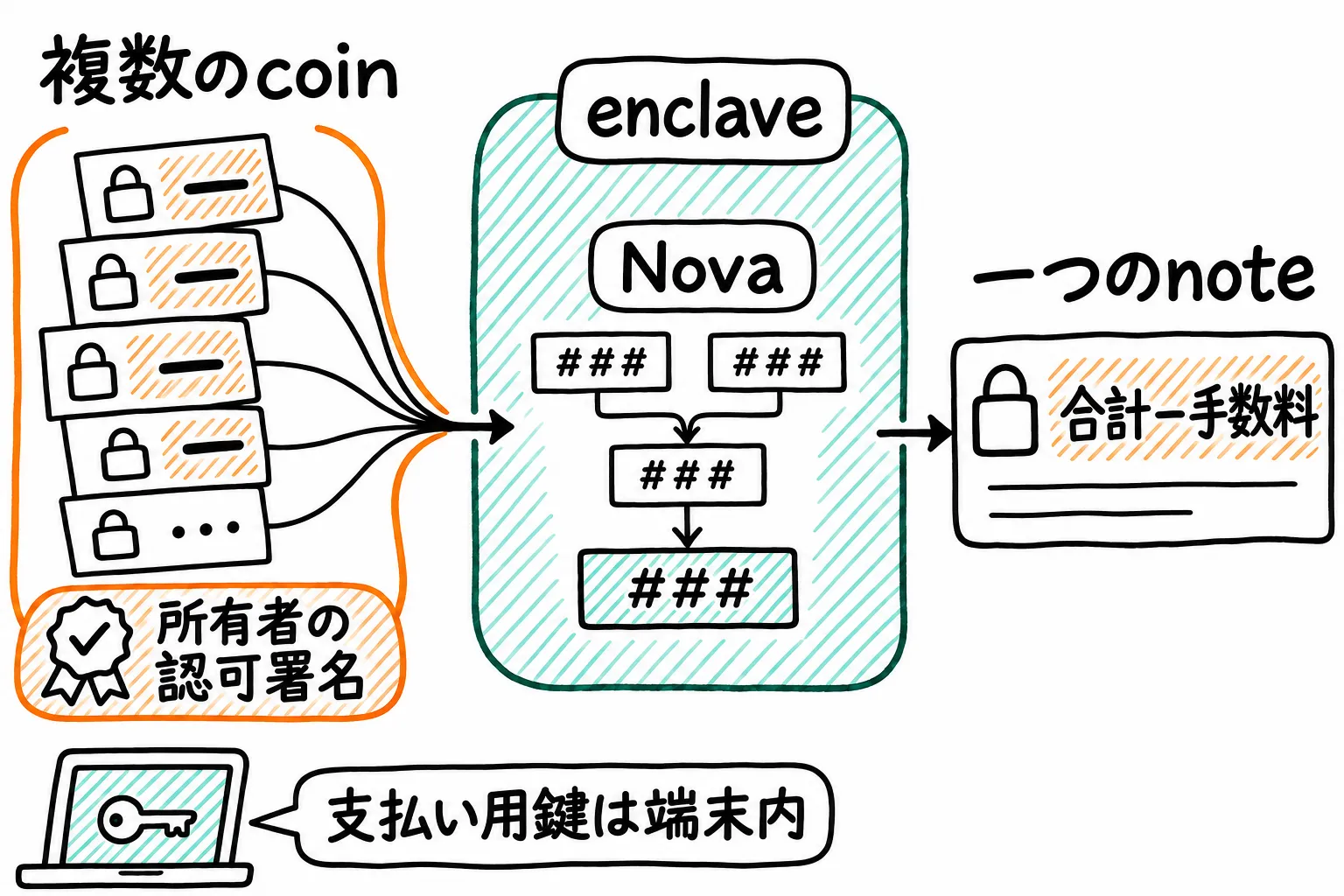
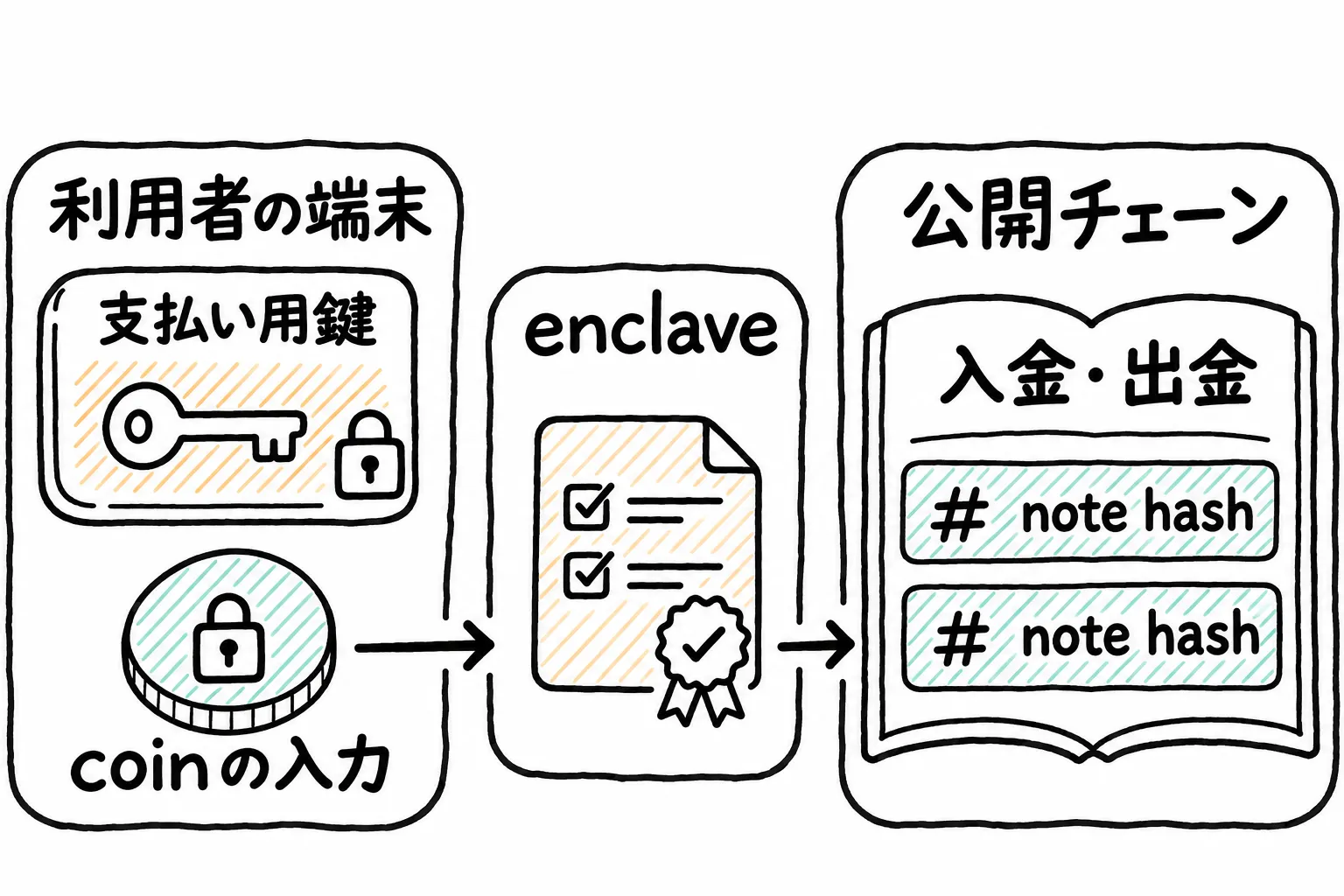
The proving key used for aggregation is large. Unlike ordinary transfer proofs, aggregation is computed by a merge prover running in an AWS Nitro enclave.
An enclave is an isolated environment for verification and computation, separated from its surrounding execution environment.
The wallet checks the destination's attestation against the release measurements before sending encrypted inputs to it.
The private key used to spend funds remains on the user's device. The owner's signature binds the inputs consumed by aggregation and the conditions on its output.
| Authorized information | What the signature constrains |
|---|---|
| Set of tags to spend | The coins consumed |
| New owner | Who can spend the output note |
| Adjustment value | The computation that creates the output record |
| Fee | The amount deducted from aggregation |
The prover can create an aggregation satisfying that authorization, but it cannot change the operation into a payment to an arbitrary recipient.
However, the coins used by the prover are visible within the isolated environment.
Whether that visibility is acceptable depends on what the user needs to keep confidential.
Privacy and the Roles of Services
The services in v2 can observe information or delay processing even without holding the keys used to spend funds.
The public chain exposes deposits and withdrawals, the relayer sees submitted transactions and their connection origins, and isolated environments see the coins supplied for independent verification or aggregation.
Key custody, data confidentiality, and availability must therefore be evaluated separately.
An Indexer or note store can observe the pages and encrypted records being retrieved.
Because the wallet checks the retrieved results against a root accepted by the contract, a lookup service cannot simply substitute incorrect data as a spendable balance.
However, it may still delay responses or withhold necessary data.
Deposit and Withdrawal Screening and Attesters
For deposits, the ASP screens the sender using the external screening service Chainalysis.
Approval applies to each individual deposit position. Approval of the first deposit from an address does not automatically approve later deposits from the same address.
A payment proof establishes that the deposits being used belong to this approved set.
Private payments are checked to establish that they originate from approved deposits, but the system does not query Chainalysis for every private recipient on every payment.
For withdrawals to an external address, however, the attester screens the withdrawal destination.
Sender screening and withdrawal recipient screening occur at different stages.
Private inputs used for the attester's independent calculation are sent into the isolated environment. These inputs are separate from the payment proof submitted to the contract.
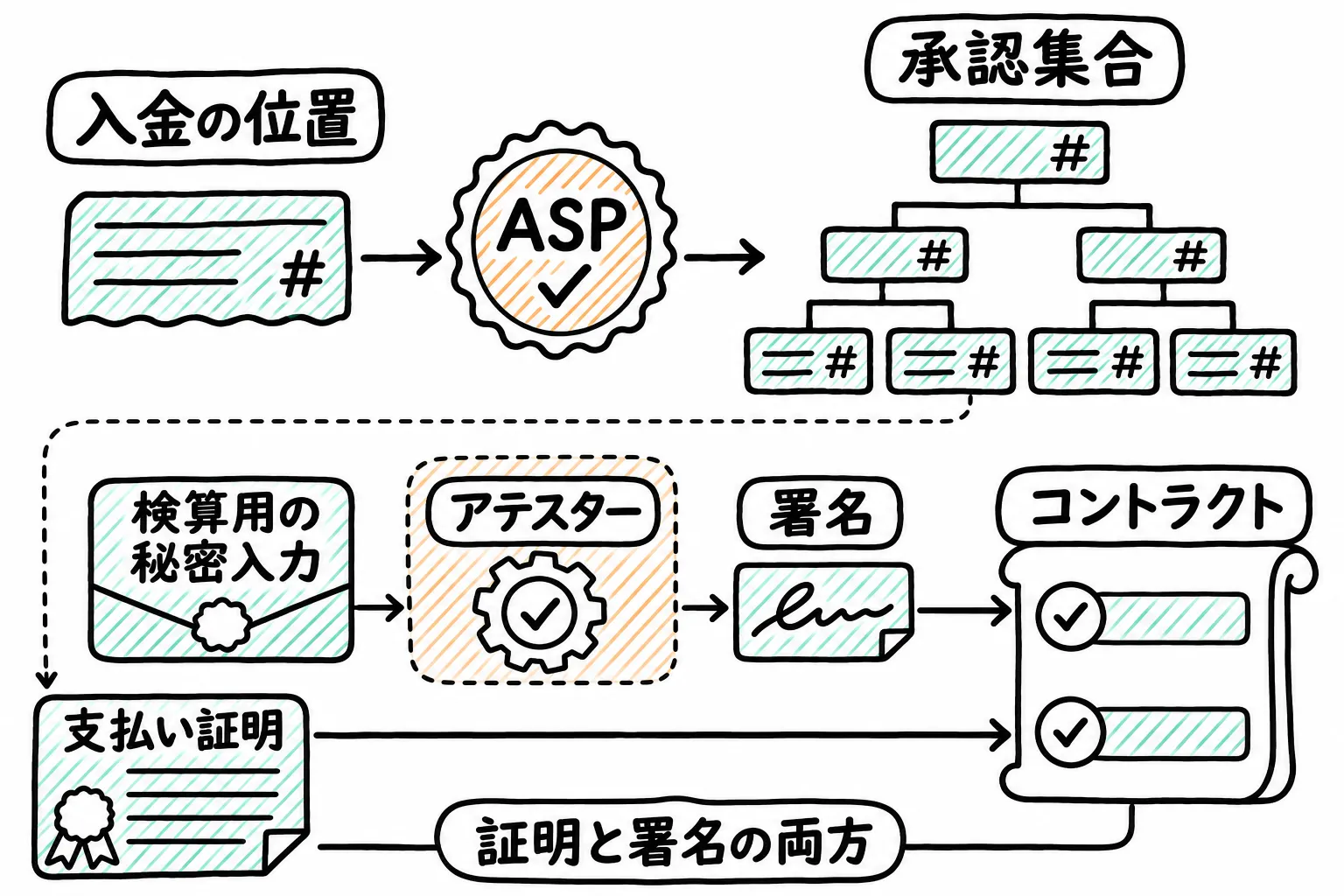
The attester independently recalculates transfers, withdrawals, and Merge operations according to their definitions without relying on the proving circuits.
Because the contract requires both a valid proof and an attester signature, this adds a condition intended to prevent an invalid payment from succeeding solely because of a circuit defect.
Conversely, if the attester stops operating, ordinary transfers, withdrawals, and aggregation must wait.
Behavior is also defined for situations where the external screening service fails to respond.
After repeated failures, deposit screening falls back to the on-chain blocklist. Withdrawal screening likewise switches to blocklist-only checks if no response is received for five minutes.
Consequently, there is no guarantee that the same external screening query succeeds for every operation.
Viewing and Audit Permissions
In addition to user-controlled view-key sharing, a designated auditor can inspect an account's history. The official documentation describes a mechanism that records disclosure requests in a public audit history before unlocking the keys, allowing the auditor to read the history, including replaced view keys. Auditors do not obtain payment keys, so viewing permission remains separate from authority to spend funds.
This mechanism also involves trust in the storage and key management on ICP.
The official documentation acknowledges that canister administrators or a sufficient number of participating nodes could unlock view keys while bypassing the audit log.
Privacy from public blockchain observers does not guarantee that transaction history is hidden from every party, including operators.
Service Outages and Exit
If a deposit is rejected or root finalization halts, Exit can return an unspent deposit to its original sender.
This path does not require an accepted root, the ASP, an attester, or a relayer.
It applies only to unspent deposits, not private notes.
The Exit proof demonstrates information establishing ownership of the relevant burn address and the spent tag corresponding to that deposit.
The contract calculates the history starting from the accumulated value immediately before the deposit and checks that the result matches a recorded accumulated value.
This authenticates the deposit and its position without waiting for a root proof, and prevents duplicate use through the same tag used by ordinary payments.
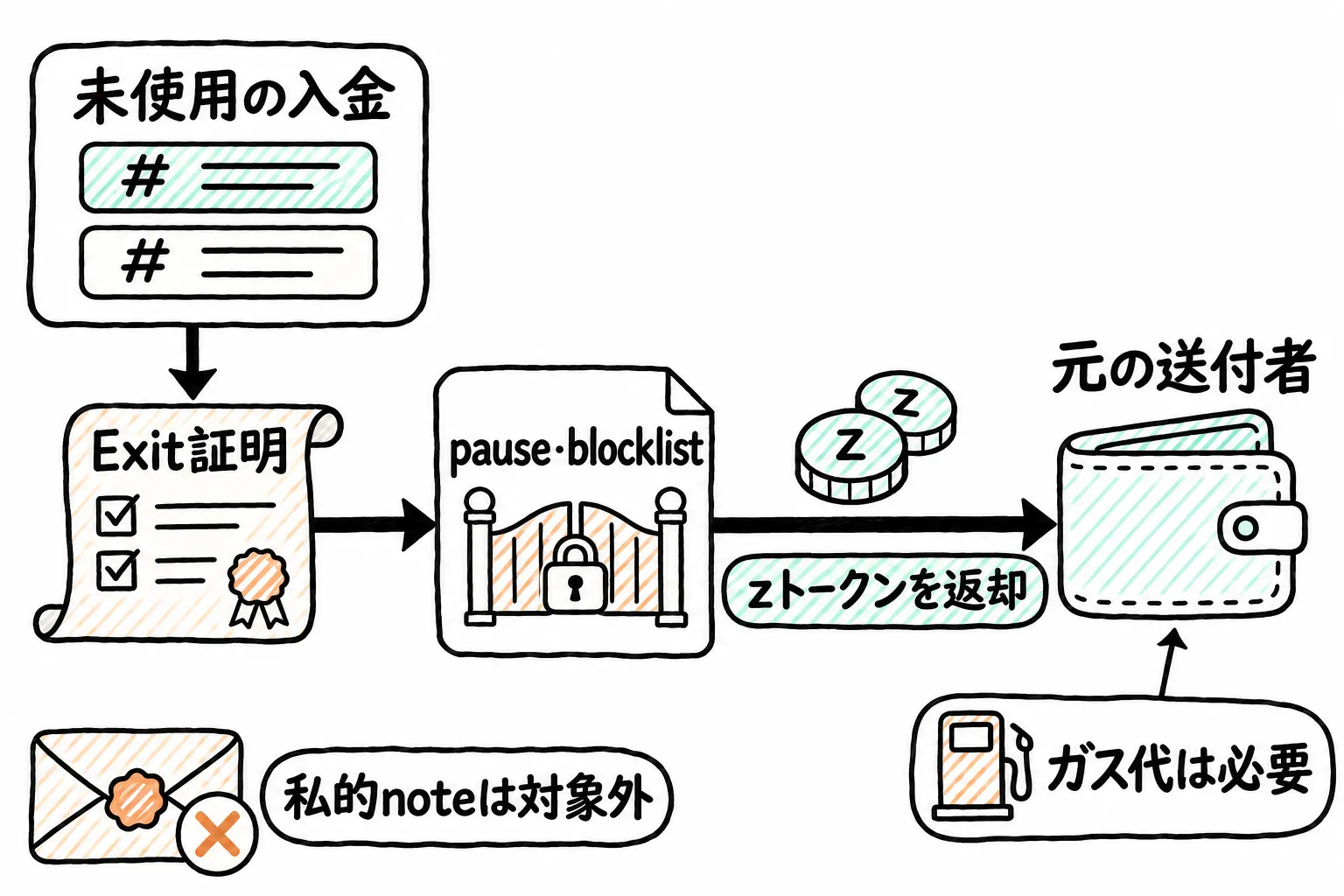
The returned asset is a z-token.
Receiving zUSDC back, for example, is distinct from an unwrap operation that delivers the underlying USDC directly.
The connected wallet submits the transaction and pays gas.
For deposits made through a one-time deposit contract, that contract is the original sender on-chain. It subsequently returns the funds according to a predefined refund recipient or a signature from the key authorized to specify the refund recipient. The wallet used by the intended recipient is not necessarily the party that originally sent the deposit, so the return destination must be checked.
Exit is also unavailable if the protocol or relevant token is paused, or if the sender is on the blocklist.
Furthermore, Exit has no attester signature and depends directly on the assumptions of the circuit and proof system.
Independence from supporting services does not mean that it bypasses every possible pause or cryptographic defect.
Administrative Permissions and Formal Verification
Operational permissions are separated by the actions they authorize.
| Role | Authorized operations |
|---|---|
| Administrator | Implementation upgrades |
operator |
Fee configurationSupported-token configurationblocklist updates |
pauser |
Pausing operations |
On mainnet, a multisignature Safe holds the permissions, and administrative operations require a one-day waiting period after scheduling on-chain.
However, emergency pauses can be executed without waiting, and the authority to pause is separate from the authority to resume operations.
The proof systems also have assumptions.
Groth16 and LegoGroth16 require a trusted setup to prepare the verification keys.
The two-phase multiparty setup described in the official documentation assumes that at least one participant in each phase discarded their secret material.
By contrast, the folding keys for Nova are generated from a public seed and are separate from this secret-destruction assumption.
Although used within the same proof process, Nova and the final compression proof cannot be treated as one assumption-free construction.
The correctness of the circuit and setup is a direct requirement for Exit, in particular, because it does not use an attester.
The official documentation describes modeling contracts and circuits in Lean and verifying properties that rule out spending by non-owners, double spending, and insufficient backing.
These guarantees depend on cryptographic assumptions and the fidelity of the model to the implementation.
Implementation upgrades, gas, and front-running are outside the scope of that proof.
Verification of the model in Lean, independent recalculation of payments by attesters, and root comparison by guardians address different concerns.
Published formal verification is not equivalent to a guarantee that all deployed implementations are defect-free, nor to an independent reproduction of the verification results.
The conditions for spending funds must also account for pause and upgrade permissions.
Differences From v1 and Migration
v1 associated the amount eligible to be received and the cumulative minted amount with a value bound to the final recipient.
v2 consumes a coin associated with its owner's key and creates a new note.
Double-spend prevention also changes from cumulative issuance per receiving record to recording a nullifier associated with a position in the ledger.
In addition, v1 provides a path for sharing roots across chains through a Hub contract, whereas v2 does not bridge assets.
Even holdings of the same USDC asset on different chains are separate balances.
A coin on one chain cannot be consumed directly for a payment on another.
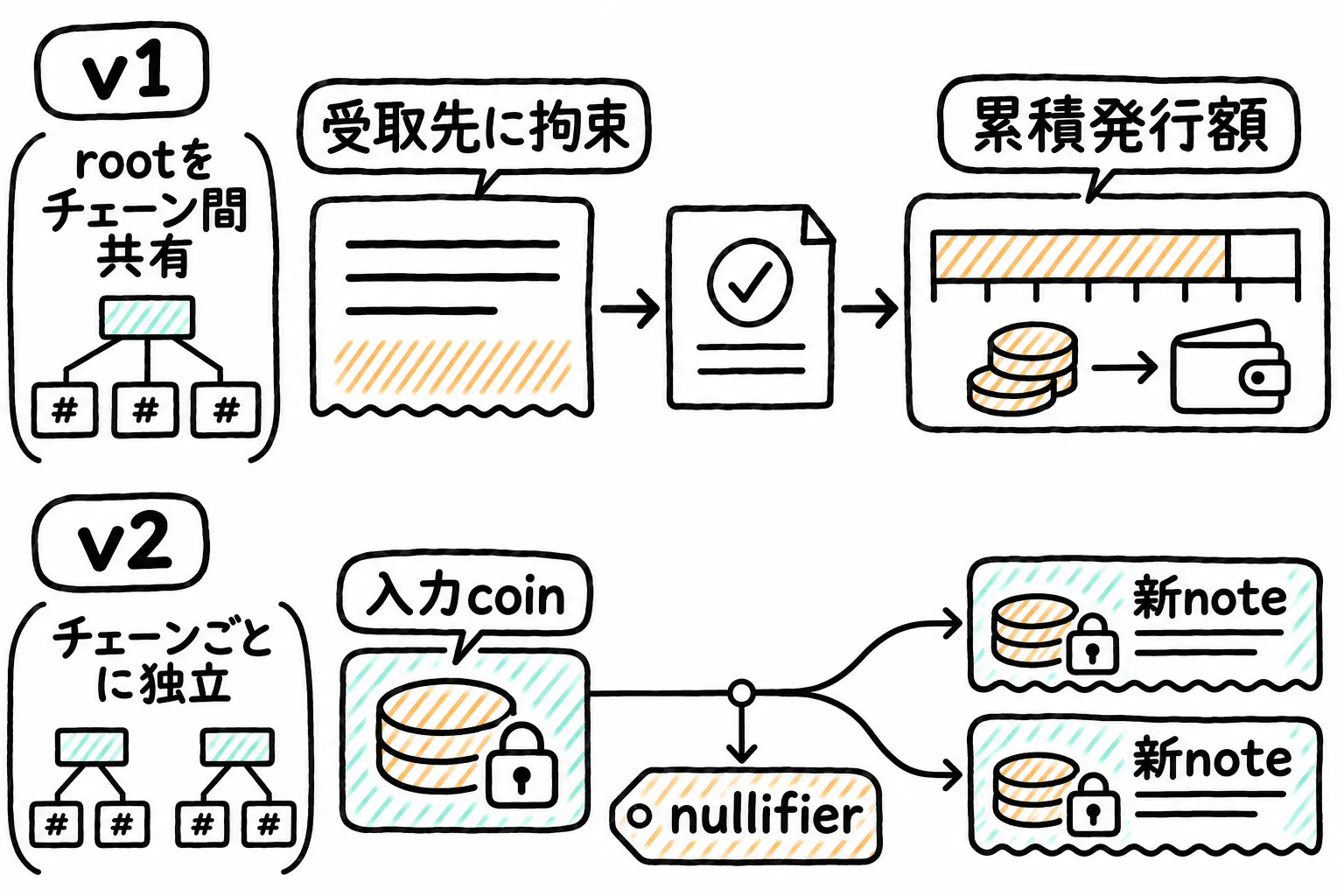
| Aspect | v1 | v2 |
|---|---|---|
| Primary records | Transfer history and receiving information | Deposits and private notes |
| Receipt and payment | Verify a proof and mint to the final recipient | Consume input coins and create outputs |
| Double-spend prevention | Cumulative issuance associated with receiving information | nullifier associated with a ledger position |
| Cross-chain history | Hub aggregates and distributes roots |
Independent on each chain |
Both versions allow ordinary transfers to fund the system and aim to conceal on-chain relationships.
Applying only the old version's Verifier and shared-root architecture to the current interface overlooks these differences.
Supported Networks and Fees
The following are the networks and z-tokens listed for mainnet.
Because zUSDC wraps native USDC on each chain, it does not treat the separate bridged variant, USDC.e, as the same input asset.
| Network | Supported z-tokens |
|---|---|
Ethereum |
zETHzUSDC |
Base |
zETHzUSDC |
Arbitrum One |
zETHzUSDC |
BNB Smart Chain |
zBNB |
Polygon |
zPOLzUSDCzJPYC |
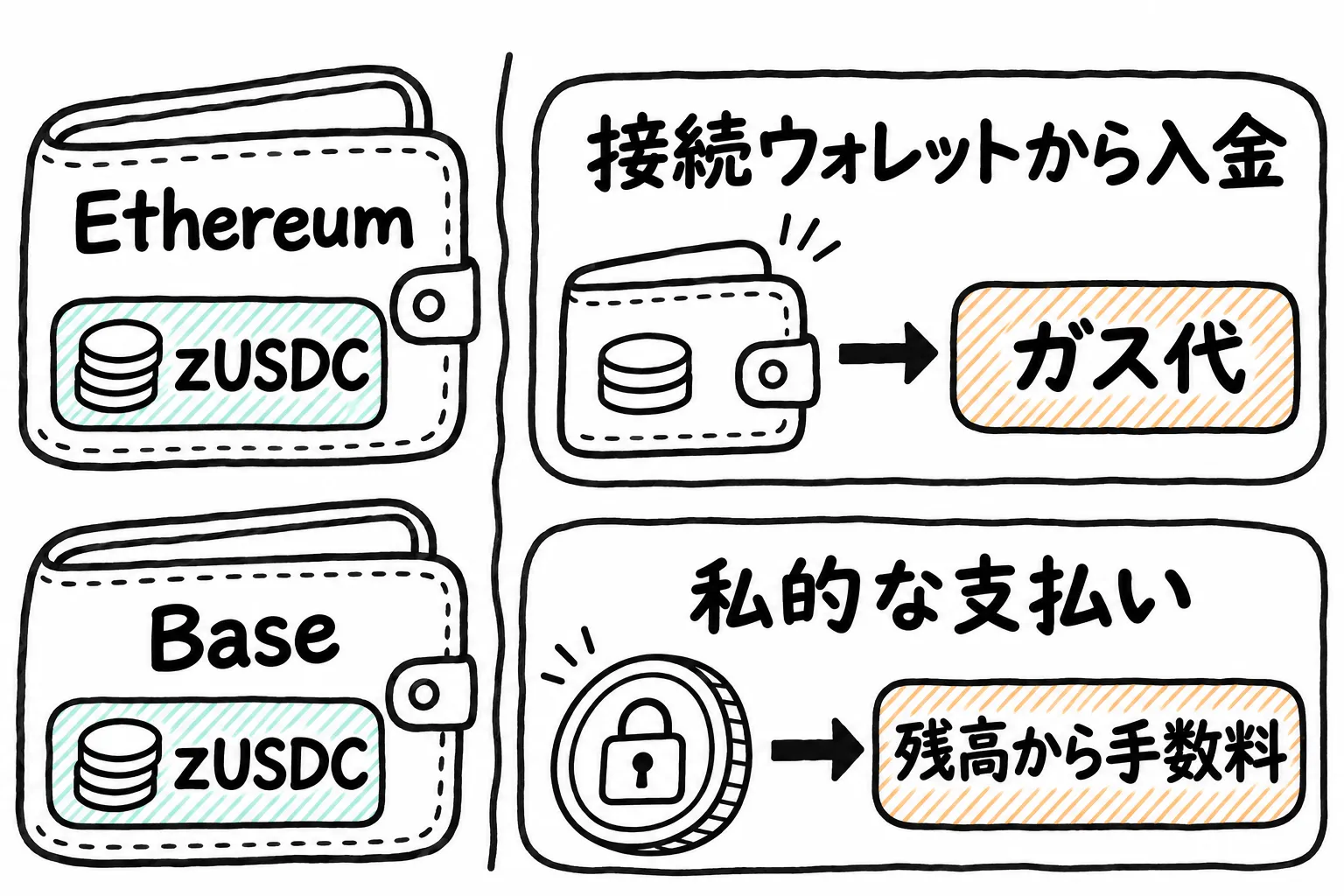
Private transfers incur a relayer fee, and withdrawals incur an additional protocol fee. Both are paid from the private balance.
Each Merge operation incurs a relayer fee.
Deposits from a connected wallet and Exit require gas assets in that wallet.
The withdrawal fee rates for USDC listed in the official documentation follow a tiered schedule based on the withdrawal amount.
| Withdrawal amount | Rate applied to the entire amount |
|---|---|
| Below 10,000 USDC | 0.35% |
| 10,000 to below 100,000 USDC | 0.25% |
| 100,000 to below 1,000,000 USDC | 0.18% |
| 1,000,000 to below 10,000,000 USDC | 0.12% |
| 10,000,000 USDC or more | 0.08% |
For example, a withdrawal of 20,000 USDC is charged 0.25% on the entire amount. This is separate from the relayer fee, so check the estimate on the confirmation screen for the total cost.
Because fees can change through operational parameters, check the quote for each transfer.
The SDK can also pass the quote confirmed by the user as an upper limit and require reconfirmation if fees increase.
The supported assets and fees listed here are based on the official documentation consulted on November 16, 2026.
Withdrawing From v1 and Depositing Again
v1 and v2 operate on separate contracts.
Holding 100 zUSDC in the old version does not increase the balance when opening a v2 wallet.
The official migration path consists of withdrawing from the old version and depositing the assets into the new wallet.
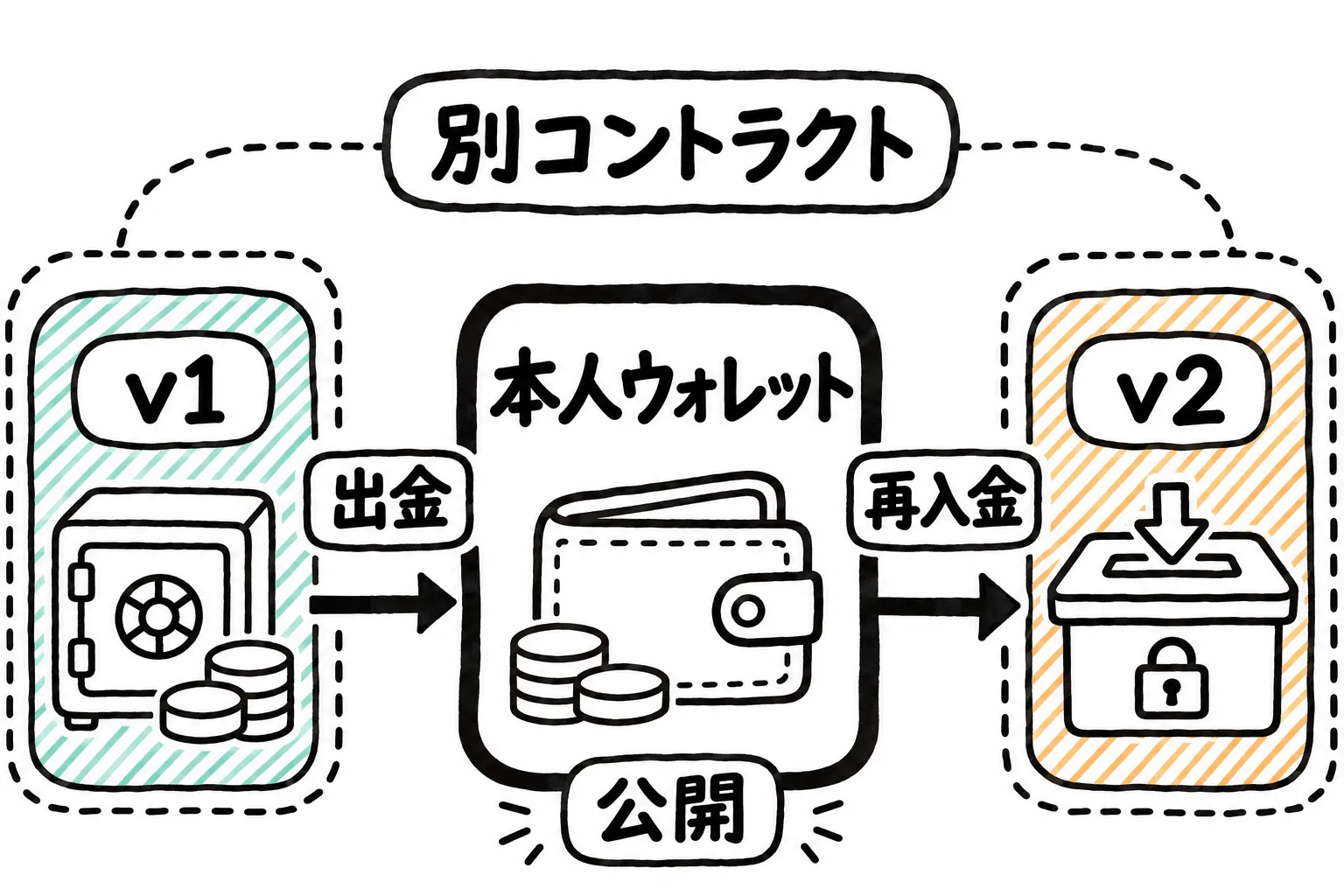
Return the funds to your own wallet using the old application at app.v1.zerc20.io, then open a v2 account using a passkey.
Check that the recovered assets are on a network and in a token supported by v2, then deposit from a connected wallet or via a one-time address.
The announced withdrawal deadline for the old version is April 30, 2027.
For example, zJPYC on Kaia in the old version does not automatically move to zJPYC on Polygon in the current version.
Because the chains differ even when the token name is the same, distinguish moving the underlying asset to another chain from depositing it into v2.
The official migration guide also instructs users to finish withdrawing from the old version before depositing into the new account.
Conclusion
zERC20 v2 converts deposits into coins spendable only by their owners, uses JoinSplit to create payments and change, and uses nullifier values to prevent duplicate spending.
Passkeys and relayers support wallet operations, while the ASP, attesters, and root proofs verify different conditions.
By distinguishing public deposits and withdrawals, service visibility, administrative permissions, and the scope of Exit, users can assess which information is hidden and from whom.
The official documentation describes the current mechanism, circuits, trust model, and wallet operation.

Information about the shutdown of the previous version and migration is available on the official site.
