Introduction
Hi, I'm cardene, a software engineer and technical writer focused on blockchain and AI.
I've also authored Japanese technical books on specification-driven development with LLMs and decentralized application (DApp) development.

I also build and publish a variety of tools, libraries, and open-source projects.
This article explores ERC6065, which extends ERC721 with an interface for managing real estate NFTs.
This article translates, summarizes, and expands on the following proposal.

As of September 10, 2023, ERC6065 was at the Review stage.
Overview
The proposal defines a structure for representing real estate and properties on a blockchain. This allows real estate to be treated as a digital token. It builds on ERC721, adding functionality needed to manage real-world assets such as real estate on a blockchain.
The proposal has three main goals.
-
Universal transferability of NFTs NFTs (non-fungible tokens) should be readily transferable to other people. In other words, the mechanism should allow property holders to sell or gift their property to someone else.
-
Private property rights associated with NFTs An NFT should carry property rights associated with its particular owner. For example, when real estate is held as an NFT, the NFT represents the holder's legal rights and ownership.
-
Atomic transfer of NFTs and property rights When an NFT is transferred, its associated property rights should transfer with it. In other words, a property transfer should also transfer the associated rights and agreements.
The token also contains detailed information about the property. This includes the operating agreement (legal rules), property identifiers, the amount of debt, foreclosure status, and the address of the property manager. These features make it possible to conduct real estate transactions transparently and efficiently on a blockchain.
Motivation
Real estate is one of the world's most valuable asset classes. However, real estate transactions typically involve numerous procedures, substantial costs, information asymmetry, and cumbersome ownership transfers. The proposal explores representing real estate as digital tokens on a blockchain. This could lower barriers to entry, reduce transaction costs, improve information transparency, enable more flexible forms of ownership, and foster innovation.
However, real estate exists in the physical world, whereas blockchain tokens are digital. The two operate under different rules. Blockchain tokens rely on consensus in a decentralized network and cryptographic assurances of ownership. Real estate ownership, by contrast, is established through legal agreements, legislation, and court judgments.
The proposal seeks to establish a standard for handling physical real estate seamlessly on a blockchain. Its goal is to make real estate NFTs as easy to handle on-chain as purely digital NFTs.
Specification
The proposal introduces a token structure for representing ownership of real estate on a blockchain. It builds on ERC721, the widely used standard for non-fungible tokens (NFTs). The token includes the following components to manage real estate ownership and related information efficiently.
Token components
-
ERC721 inheritance The token is compatible with the existing NFT standard. It can therefore be handled like other NFTs.
-
operatingAgreementHashOf An immutable hash representing the details of the property's legal agreement. It associates the token with legal information such as ownership rights and terms of use.
-
Property Unique Identifiers The token contains information that uniquely identifies the property. This includes the legal description on the physical deed, street address, GIS coordinates, parcel or tax ID, and the legal ownership entity listed on the deed. These details identify the property represented by the token.
-
debtOf The token contains information about its associated debt. Recording the debt amount, currency, and foreclosure status improves transparency.
-
managerOf The token contains the Ethereum address responsible for managing the property. This makes the property manager identifiable from the token.
This structure enables the digitization of real estate and efficient on-chain management of ownership and related information.
Interface
This EIP builds on ERC721, a standard used here to tokenize real estate on a blockchain. ERC721 is a widely used standard for creating non-fungible tokens (NFTs). The proposal inherits the ERC721 transfer and approval rules without modification. The basic methods for transferring and approving real estate tokens therefore remain those defined by ERC721.
The proposal also inherits the ERC721 Metadata standard. This provides standard methods for retrieving the token's name, symbol, and metadata URI (the location of its metadata). These features facilitate integration with existing NFT marketplaces and services. However, integrations also require some precautions.
pragma solidity ^0.8.13;

import "forge-std/interfaces/IERC721.sol";

interface IERC6065 is IERC721 {

	// This event MUST emit if the asset is ever foreclosed.
	event Foreclosed(uint256 id);

	/*
	Next getter functions return immutable data for NFT.
	*/
	function legalDescriptionOf(uint256 _id) external view returns (string memory);
	function addressOf(uint256 _id) external view returns (string memory);
	function geoJsonOf(uint256 _id) external view returns (string memory);
	function parcelIdOf(uint256 _id) external view returns (string memory);
	function legalOwnerOf(uint256 _id) external view returns (string memory);
	function operatingAgreementHashOf(uint256 _id) external view returns (bytes32);

	/*
	Next getter function returns the debt denomination token of the NFT, the amount of debt (negative debt == credit), and if the underlying
	asset backing the NFT has been foreclosed on. This should be utilized specifically for off-chain debt and required payments on the RWA asset.
	It's recommended that administrators only use a single token type to denominate the debt. It's unrealistic to require integrating smart
	contracts to implement possibly unbounded tokens denominating the off-chain debt of an asset.

	If the foreclosed status == true, then the RWA can be seen as severed from the NFT. The NFT is now "unbacked" by the RWA.
	*/
	function debtOf(uint256 _id) external view returns (address debtToken, int256 debtAmt, bool foreclosed);

	// Get the managerOf an NFT. The manager can have additional rights to the NFT or RWA on or off-chain.
	function managerOf(uint256 _id) external view returns (address);
}
Additional explanation
Introduction
Real-world assets operate in complex and unpredictable circumstances. Ascertaining their actual state can therefore be ambiguous, costly, or time-consuming. For example, in the United States, changes to real estate ownership are typically recorded at a county recorder's office, sometimes by hand. Updating such manual records every time an NFT is traded on a blockchain is impractical. Moreover, real-world property rights are enforced in court, so ownership must be documented in a form that courts can interpret and enforce when necessary.
A trusted third party is therefore needed to ensure that the state of a real estate NFT accurately matches its physical counterpart. By issuing a legally binding digital representation of physical real estate, a property manager can enable the simultaneous transfer of the NFT and property rights and facilitate ownership-related procedures such as payments and filings. This avoids changing the legal title each time the NFT is transferred. The reference implementation provides an example of a proposed administrator legal structure for tokenizing real estate in the United States. Tokens implementing this standard do not necessarily need to adopt the same legal structure.
Guiding objectives
This EIP was designed around three main objectives for creating an NFT representation of physical real estate.
-
Real estate NFTs should be universally transferable Real estate held as private property should be freely transferable to individuals or legal entities capable of holding title. An NFT representing physical real estate must therefore preserve this universal freedom to transfer ownership.
-
All rights associated with property ownership should be preserved and guaranteed through the NFT Property ownership includes the rights to possess, occupy, lease, modify, resell, and transfer the property. The NFT representation must also preserve and guarantee these rights. Holding the NFT should therefore secure these ownership rights and make them enforceable when necessary.
-
Property rights should transfer atomically with the NFT Ownership of blockchain tokens transfers when the digital tokens are transferred. For a digital representation of physical real estate to make full use of blockchain technology, associated property rights must also transfer in a single operation with the digital token. This facilitates real estate transactions and effective management of ownership changes.
Operating agreement hash
The NFT contains an immutable hash (a fixed, unique identifier) representing a legal document concerning a particular property. The document specifies the rights, conditions, provisions, and other details relating to the physical property. The hash of the document must remain immutable. This ensures that the rights and conditions established in the document remain legally valid and enforceable for subsequent NFT recipients and other parties.
When the NFT is transferred, the new owner can immediately exercise the rights granted by the legal document. If the property's legal structure, rights, or conditions change, the original NFT must be invalidated and a new NFT issued with a new hash. The new NFT is based on the revised legal document.
Property unique identifiers
The NFT contains important information that uniquely identifies the property. This information is immutable and includes the following items.
-
legalDescriptionOf (legal description of the property) Contains the precise legal description taken from the property's deed. This allows the property to be reliably identified from its documentation.
-
addressOf (property address) Contains the property's street address, identifying its physical location.
-
geoJsonOf (property GeoJSON): Provides the property's geospatial coordinates in GeoJSON format, identifying its location on a map.
-
parcelIdOf (property identification number) Contains the unique property identifier used by the local government.
-
legalOwnerOf (legal owner) Identifies the legal entity (individual or organization) that officially holds title to the property.
These unique identifiers must be immutable to identify the property and establish its legitimacy.
They provide a reliable source of information for the NFT owner should a property dispute arise in the future.
In particular, legalOwnerOf is important for verifying ownership and the validity of agreements off-chain. Services such as Chainlink may eventually make this easier to verify.
debtOf
This information indicates the property's debt and its denominating currency. A positive balance represents outstanding debt on the property; a negative balance represents credit that the NFT owner can claim. This allows the property manager to request payments from the NFT owner for real-world expenses such as property taxes, essential repairs, and maintenance. Similarly, the owner may receive credit if the manager and the NFT owner have agreed to a property management or revenue-sharing arrangement.
The debtOf function also indicates whether the asset represented by the NFT has been foreclosed on.
If the value is true, the associated property no longer backs the NFT. If it is false, the property still backs the NFT.
The manager may foreclose on the asset for reasons specified in the Operating Agreement.
Smart contracts can call this function to check the foreclosure status.
If the asset has been foreclosed on, the RWA backing the NFT has been removed.
Smart contracts must therefore account for this status in valuations and other calculations.
There are no specific standard requirements governing how these values are updated. Implementation details are left to the implementer, while the EIP standardizes how the values are represented and read to facilitate integration.
managerOf
This feature separates ownership of an NFT (non-fungible token) from management rights. Specifically, while the Ethereum address holding the NFT is its owner, certain rights can be assigned to another Ethereum address.
For example, a lending protocol's smart contract may hold a real estate NFT without being the actual owner of the property, and it may grant another Ethereum address, such as the depositor, permission to perform particular operations. This allows protocols and smart contracts to carry out actions related to real estate NFTs more flexibly.
Separating ownership from operational authority lets different addresses take on different roles and permissions, extending the range of scenarios in which real estate NFTs can be used.
Backwards compatibility
This EIP builds on the ERC721 NFT standard but introduces new functionality and mechanisms. It can operate in the same manner as ERC721 while providing additional features. However, smart contract integrations must consider several factors before using these new features.
When using this EIP, pay attention to security and compatibility issues in smart contract design and implementation. Understand the added functionality and take care when integrating it. There are also specific security considerations. Take sufficient precautions to minimize smart contract vulnerabilities and security risks.
Reference implementation
The implementation is available in the following GitHub repository.
Source: https://eips.ethereum.org/EIPS/eip-6065
Klasma Labs provides a reference implementation that is still under development. This technical implementation includes the following additional components. They are provided for reference and are not mandatory.
Implementation summary
- NFT burning and minting
- Supports invalidating (burning) NFTs and minting new ones.
- Immutable NFT data (unique identifiers and operating agreement hash)
- Important NFT data, particularly unique identifiers and the agreement hash, is stored immutably.
- This protects the NFT's data and ensures that it cannot be changed.
- Simple debt tracking by the administrator
- Provides a mechanism for the administrator to monitor and track debts owed by NFT owners.
- Blocklist for freezing assets held by malicious addresses (planned for the future)
- A future implementation is expected to allow the freezing of assets held by malicious addresses.
- Simple administrator-initiated foreclosure logic
- Implements straightforward logic for the administrator to foreclose on real estate assets.
- An implementation of
managerOfthat chains the call to other supported smart contracts- The function supports chaining calls to other smart contracts.
Implementation walkthrough
ADMINISTRATOR
address public ADMINISTRATOR;Overview The token administrator's address.
COUNTER
uint256 public COUNTER;Overview A value used to identify unique tokens.
URIBASE
string public URIBASE;Overview Base URI (Uniform Resource Identifier). Used to access token metadata.
EIP6065Immutable
struct EIP6065Immutable {
    string legal_description_of_property;
    string street_address;
    string geo_json;
    string parcel_id;
    string legal_owner;
    bytes32 operating_agreement_hash;
}
Overview A struct that stores real estate metadata.
Parameters
legal_description_of_property- A string containing the property's legal description.
street_address- A string containing the property's address.
geo_json- A string containing the property's GeoJSON data.
parcel_id- A string containing the property's parcel ID.
legal_owner- A string identifying the property's legal owner.
operating_agreement_hash- The hash of the operating agreement.
EIP6065Mutable
struct EIP6065Mutable {
    address debt_token;
    int256 debt_amt;
    bool foreclosed;
}
Overview A struct that stores mutable token metadata.
Parameters
debt_token- Address of the debt token.
debt_amt- Integer representing the debt amount.
foreclosed- Boolean indicating foreclosure status.
DebtTokenChanged
event DebtTokenChanged(uint256 id, address newToken);Overview Event emitted when the debt token changes.
Parameters
id- ID of the affected token.
newToken- Address of the new debt token.
DebtBalanceChanged
event DebtBalanceChanged(uint256 id, int256 changedBy, int256 newAmt);Overview Event emitted when the debt balance changes.
Parameters
id- ID of the affected token.
changedBy- Integer representing the change in balance.
newAmt- Integer representing the new balance.
DebtPaid
event DebtPaid(uint256 id, uint256 paidAmt, int256 remainingAmt);Overview Event emitted when debt is paid.
Parameters
id- ID of the relevant token.
paidAmt- Integer representing the amount paid.
remainingAmt- Integer representing the remaining debt.
CreditClaimed
event CreditClaimed(uint256 id, uint256 claimedAmt);Overview Event emitted when credit is claimed.
Parameters
id- ID of the token whose credit was claimed.
claimedAmt- Integer representing the amount of credit claimed.
Foreclosed
event Foreclosed(uint256 id);Overview Event emitted when foreclosure occurs.
Parameters
id- ID of the foreclosed token.
setAdmin
function setAdmin(address _new) external onlyAdmin {
    ADMINISTRATOR = _new;
}
Overview Sets a new administrator address.
Arguments
_new- New administrator address.
setUriBase
function setUriBase(string calldata _new) external onlyAdmin {
    URIBASE = _new;
}
Overview Sets a new base URI.
Arguments
_new- String representing the new base URI.
tokenURI
function tokenURI(uint256 _id) public view override tokenExists(_id) returns (string memory){
    return string(abi.encodePacked(URIBASE, _id.toString()));
}
Overview Generates and returns the URI of the specified token.
Details
The URI is generated by concatenating URIBASE and the token ID.
Arguments
_id- Token ID.
Return value
- String representing the token URI.
legalDescriptionOf
function legalDescriptionOf(uint256 _id) external view tokenExists(_id) returns (string memory){
    return EIP6065ImmutableMetadata[_id].legal_description_of_property;
}
Overview Retrieves the legal description of the specified token.
Arguments
_id- Token ID.
Return value
- String containing the token's legal description.
addressOf
function addressOf(uint256 _id) external view tokenExists(_id) returns (string memory){
    return EIP6065ImmutableMetadata[_id].street_address;
}
Overview Retrieves the address associated with the specified token.
Arguments
_id- Token ID.
Return value
- String containing the token's property address.
geoJsonOf
function geoJsonOf(uint256 _id) external view tokenExists(_id) returns (string memory){
    return EIP6065ImmutableMetadata[_id].geo_json;
}
Overview Retrieves the GeoJSON data of the specified token.
Arguments
_id- Token ID.
Return value
- String containing the token's GeoJSON data.
parcelIdOf
function parcelIdOf(uint256 _id) external view tokenExists(_id) returns (string memory){
    return EIP6065ImmutableMetadata[_id].parcel_id;
}
Overview Retrieves the parcel ID of the specified token.
Arguments
_id- Token ID.
Return value
- String containing the token's parcel ID.
legalOwnerOf
function legalOwnerOf(uint256 _id) external view tokenExists(_id) returns (string memory){
    return EIP6065ImmutableMetadata[_id].legal_owner;
}
Overview Retrieves the legal owner associated with the specified token.
Arguments
_id- Token ID.
Return value
- String identifying the token's legal owner.
operatingAgreementHashOf
function operatingAgreementHashOf(uint256 _id) external view tokenExists(_id) returns (bytes32){
    return EIP6065ImmutableMetadata[_id].operating_agreement_hash;
}
Overview Retrieves the operating agreement hash of the specified token.
Arguments
_id- Token ID.
Return value
- The operating agreement hash as a bytes32 value.
debtOf
function debtOf(uint256 _id) external view tokenExists(_id) returns (address, int256, bool){
    EIP6065Mutable memory _data = EIP6065MutableMetadata[_id];
    return (_data.debt_token, _data.debt_amt, _data.foreclosed);
}
Overview Retrieves the debt information of the specified token.
Details
- The return values include the debt token address, debt amount, and foreclosure status.
Arguments
_id- Token ID.
Return value
- Debt token address, debt amount (integer), and foreclosure status (boolean).
managerOf
function managerOf(uint256 _id) external view returns (address){ // note: modifier removed, implement in code for efficiency tokenExists(_id)
    address _owner = ownerOf(_id);
    require(_owner != address(0), "NOT_MINTED");

    uint256 _codeSize;
    assembly {
        _codeSize := extcodesize(_owner)
    }
    if (_codeSize == 0){
        return _owner;
    }
    else {
        try IERC165(_owner).supportsInterface(0x01ffc9a7) returns (bool _check1) { // 0x01ffc9a7 is EIP165 interface
            if (_check1){
                try IERC165(_owner).supportsInterface(0xffffffff) returns (bool _check2){ // 0xffffffff is required false check, see: https://eips.ethereum.org/EIPS/eip-165
                    if (!_check2){
                        bool _check3 = IERC165(_owner).supportsInterface(0x9325945c); // 0x9325945c is bytes4(keccak256(bytes("managerOf(address,uint256)"))) ie: IManager interface
                        if (_check3){
                            return IManager(_owner).managerOf(address(this), _id); // chain managerOf(nftContract, id) call if smart contract supports this interface
                        } else {
                            return _owner;
                        }
                    } else {
                        return _owner;
                    }
                } catch {
                    return _owner;
                }
            } else {
                return _owner;
            }
        } catch {
            return _owner;
        }
    }
}
Overview Retrieves the manager address of the specified token. It provides the logic for determining the manager's address.
Details
- By default, the token owner is also its manager.
Arguments
_id- Token ID.
Return value
- Address of the token's manager.
changeDebtToken
function changeDebtToken(uint256 _id, address _new) public onlyAdmin tokenExists(_id) {
    require(EIP6065MutableMetadata[_id].debt_amt == 0, "DEBT_AMT_NOT_ZERO");
    EIP6065MutableMetadata[_id].debt_token = _new;
    emit DebtTokenChanged(_id, _new);
}
Overview Changes the token's debt token. The debt token can be changed to a new address.
Details
- Changes the debt token associated with the ID specified by
_idto the new address_new. - Verifies that the token has no outstanding debt or credit.
Arguments
_id- Token ID.
_new- Address of the new debt token.
balanceChange
function balanceChange(uint256 _id, int256 _amt) public onlyAdmin tokenExists(_id) {
    require(_amt != 0, "NO_AMT");
    EIP6065Mutable memory _data = EIP6065MutableMetadata[_id];
    int256 _oldAmt = _data.debt_amt;
    _data.debt_amt += _amt;

    if (_amt > 0){ // debt added to token
        if (_oldAmt < 0){
            if (_data.debt_amt < 0){
                IERC20(_data.debt_token).transfer(ADMINISTRATOR, uint256(_amt)); // return entire _amt as it's all prior credit
            }
            else {
                IERC20(_data.debt_token).transfer(ADMINISTRATOR, uint256(-1 * _oldAmt)); // return _oldAmt, as this credit has been zeroed, and debt added
            }
        }
    }
    else { // (_amt < 0) ie: credit added to token
        if (_data.debt_amt < 0){
            if (_oldAmt < 0){
                IERC20(_data.debt_token).transferFrom(ADMINISTRATOR, address(this), uint256(-1 * _amt)); // admin owes entire amt as credit
            }
            else {
                IERC20(_data.debt_token).transferFrom(ADMINISTRATOR, address(this), uint256(-1 * _data.debt_amt));
            }
        }
    }

    EIP6065MutableMetadata[_id].debt_amt = _data.debt_amt;
    emit DebtBalanceChanged(_id, _amt, _data.debt_amt);
}
Overview Changes the token's debt or credit. The debt or credit of the specified token can be adjusted.
Details
- Changes the debt or credit associated with the token ID specified by
_id. - Adds or subtracts the amount specified by
_amtfrom the token's debt or credit. - If debt is added, it redeems existing credit and performs a transaction to add debt.
- If the change does not add outstanding debt, it performs a credit transaction.
- If credit is added, it offsets existing debt and performs a transaction to add credit.
- If the change does not create a credit balance, it performs a debt transaction.
Arguments
_id- Token ID.
_amt- Amount by which to change the debt or credit.
- Positive values add debt, while negative values add credit.
payDebt
function payDebt(uint256 _id, uint256 _amt) public tokenExists(_id) {
    EIP6065Mutable memory _data = EIP6065MutableMetadata[_id];
    require(_data.debt_amt > 0, "NO_DEBT");
    require(!_data.foreclosed, "FORECLOSED");
    if (_amt > uint256(_data.debt_amt)) _amt = uint256(_data.debt_amt);

    IERC20(_data.debt_token).transferFrom(msg.sender, ADMINISTRATOR, _amt);

    _data.debt_amt -= int256(_amt);

    EIP6065MutableMetadata[_id].debt_amt = _data.debt_amt;
    emit DebtPaid(_id, _amt, _data.debt_amt);
}
Overview Pays the token's debt. The debt of the specified token can be paid.
Details
- Pays the debt associated with the token ID specified by
_id. - Uses the amount specified by
_amtto pay part or all of the debt. - If the requested amount exceeds the outstanding debt, payment is capped at the amount owed.
Arguments
_id- Token ID.
_amt- Amount of debt to pay.
claimCredit
function claimCredit(uint256 _id) public {
    require(msg.sender == ownerOf(_id), "NOT_OWNER");

    EIP6065Mutable memory _data = EIP6065MutableMetadata[_id];
    require(_data.debt_amt < 0, "NO_CREDIT");

    EIP6065MutableMetadata[_id].debt_amt = 0;
    uint256 _transferAmt = uint256(-1 * _data.debt_amt);
    IERC20(_data.debt_token).transfer(msg.sender, _transferAmt);
    emit CreditClaimed(_id, _transferAmt);
}
Overview Claims the token's credit.
Details
- The caller must own the token.
- If the token has credit, the function claims it and resets the credit balance to zero.
Arguments
_id- Token ID.
foreclose
function foreclose(uint256 _id) public onlyAdmin tokenExists(_id) {
    require(!EIP6065MutableMetadata[_id].foreclosed, "FORECLOSED");
    EIP6065MutableMetadata[_id].foreclosed = true;
    emit Foreclosed(_id);
}
Overview Forecloses on the asset represented by the token.
Details
- Verifies that the token specified by
_idhas not already been foreclosed on. - Marks the token as foreclosed and emits the
Foreclosedevent.
Arguments
_id- ID of the token to foreclose on.
mint
function mint(address _to, EIP6065Immutable calldata _immutableData, EIP6065Mutable calldata _mutableData) public onlyAdmin {
    uint256 _counter = COUNTER;
    _mint(_to, _counter);

    EIP6065ImmutableMetadata[_counter] = _immutableData;
    EIP6065MutableMetadata[_counter] = _mutableData;

    // not reasonable to overflow
    unchecked {
        COUNTER = _counter + 1;
    }
}
Overview Mints a new token. The function creates a new token and sets its metadata.
Details
- Mints a new token to the address specified by
_to. - The
_immutableDataparameter contains the token's immutable metadata. - The
_mutableDataparameter contains the token's mutable metadata. - The token ID is generated using the value of
COUNTER, assigning a unique value.
Arguments
_to- Address that receives the new token.
_immutableData- Immutable token metadata.
_mutableData- Mutable token metadata.
burn
function burn(uint256 _id) public onlyAdmin {
    require(ownerOf(_id) == ADMINISTRATOR, "ADMIN_NOT_OWNER");

    // recommend to clear data and info about NFT here too
    delete EIP6065ImmutableMetadata[_id];
    delete EIP6065MutableMetadata[_id];

    _burn(_id);
}
Overview Burns a token. The specified token and its associated metadata can be deleted.
Details
- Verifies that the address owning the token specified by
_idisADMINISTRATOR. - Deletes the token's immutable and mutable metadata and burns the token.
Arguments
_id- ID of the token to burn.
Legal structure implementation
This section describes a legal structure and implementation that a company could adopt as the token's administrator. The structure below concerns real estate tokenization in the United States in 2023 and is specific to that implementation.
More specifically, the section describes a legal framework for tokenizing US real estate under the regulatory environment of 2022.
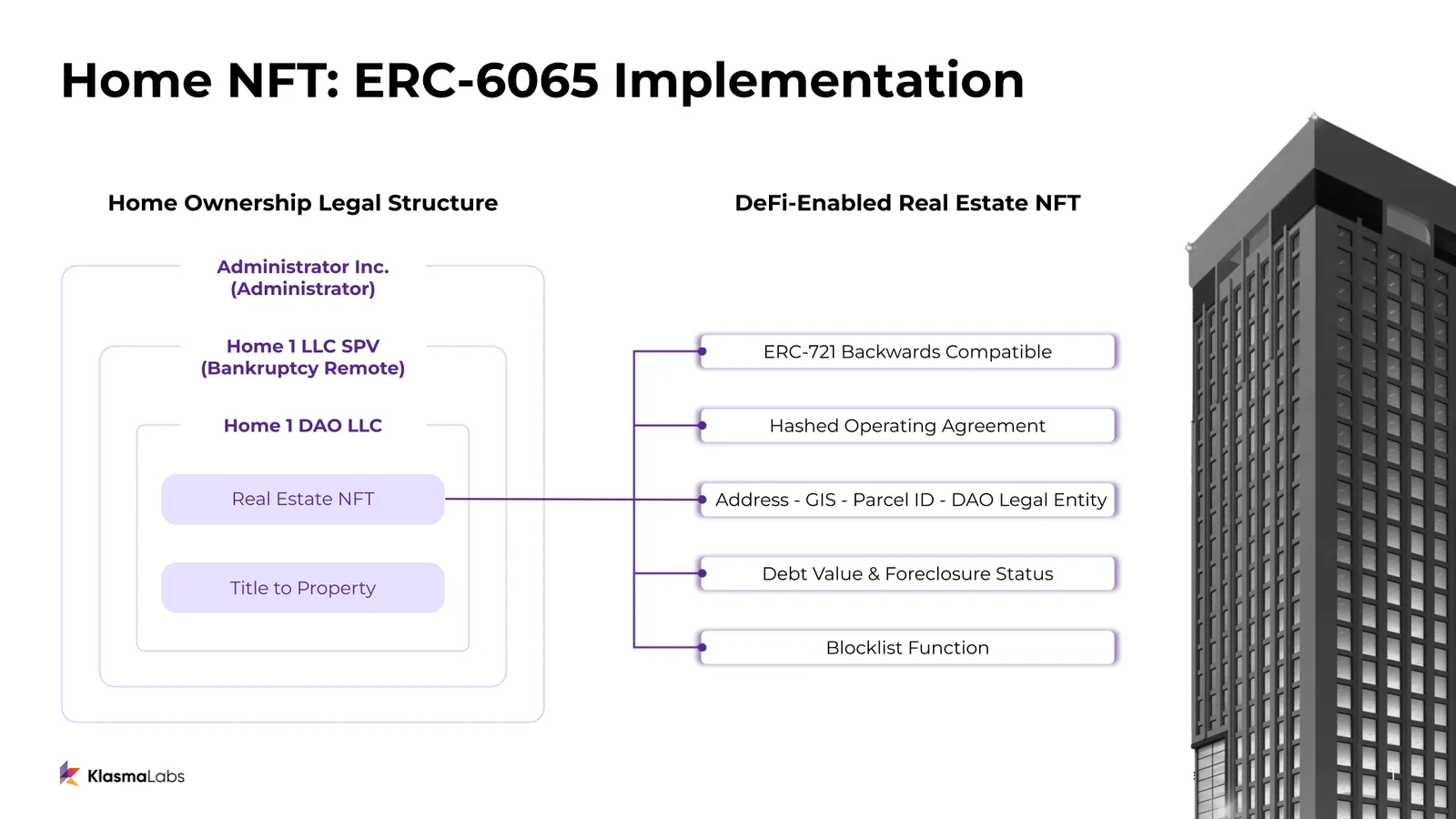
Source: https://eips.ethereum.org/EIPS/eip-6065
The token's legal structure consists of the following elements.
-
The parent company and property manager maintain a bankruptcy-remote LLC (limited liability company) for each property, a structure designed to isolate assets in bankruptcy and provide independent legal protection.
-
The bankruptcy-remote LLC holds the physical property's title and deed and owns and manages a DAO LLC (a decentralized autonomous organization organized as an LLC), which issues the real estate NFT and operating agreement.
The legal structure is intended to achieve two things.
-
Homeowners are protected even if the property manager encounters financial difficulties or bankruptcy. If the manager goes bankrupt or dissolves, the NFT owner is entitled to receive the DAO LLC or have the property sold and receive the proceeds.
-
Property rights transfer simultaneously with the NFT. The NFT represents a claim to rights in the physical property, including the right to have its deed transferred to the NFT owner. This enables property rights to transfer digitally with the NFT, avoiding cumbersome procedures for updating the property's legal owner.
Security note If a private key is compromised, the company generally cannot reissue the home NFT. Home NFT owners should therefore consider security options such as multisignature wallets or trusts if they cannot safely custody the NFT themselves. In the event of a major protocol compromise, the company may use a Blocklist to freeze the asset and reissue the NFT to the original home NFT owner. The Blocklist is planned for a future version of the reference implementation above.
Security considerations
The following checks and recommendations apply to protocols integrating NFTs under this standard. They are particularly relevant to applications that use these assets as collateral for loans.
-
Protocol integrators should verify that the property unique identifiers and operating agreement hash of a particular NFT are immutable before integrating it. The immutability of these values is important to ensure legitimacy for future transferees. The property's identifying characteristics and associated agreements must therefore remain unchanged.
-
Protocol integrators should check the values returned by
debtOfto accurately reflect the token's value. This allows the NFT to represent its current debt status correctly. -
Protocol integrators should check the foreclosure status to ensure that the token is still backed by the underlying asset. This verifies that the NFT retains its connection to the underlying asset.
-
To mitigate risk, protocol integrators may consider introducing a time delay before performing irreversible actions. This provides time for an asset to be frozen if a compromised NFT is deposited into the protocol. Freezing assets is not mandatory and depends on the asset manager's implementation.
References
Alex (@Alex-Klasma), Ben Fusek (@bfusek), Daniel Fallon-Cyr (@dfalloncyr), "ERC-6065: Real Estate Token [DRAFT]," Ethereum Improvement Proposals, no. 6065, November 2022. [Online serial]. Available: https://eips.ethereum.org/EIPS/eip-6065.
Conclusion
This article examined ERC6065, an interface extending ERC721 to manage real estate NFTs. I hope this explanation was useful.
If you have questions, feel free to contact me via a direct message on Twitter.
I also share information on other platforms. Feel free to explore them.

