Introduction
Hi, I'm cardene, a software engineer and technical writer focused on blockchain and AI.
I've also authored Japanese technical books on specification-driven development with LLMs and decentralized application (DApp) development.

I also build and publish a variety of tools, libraries, and open-source projects.
This article covers ERC8056, an extension that scales the displayed quantity of ERC20 tokens without changing their actual balances.
ERC8056 proposes a way to change the quantities shown to users in wallets and exchanges by applying a multiplier, while leaving the amounts used by balanceOf and transfer unchanged. For events such as stock splits, where every holder's displayed quantity changes by the same ratio, this avoids minting additional tokens for every holder or transferring tokens individually.
This article walks through the proposal linked below.

Overview
ERC8056 adds a display multiplier to ERC20. The proposal calls this mechanism the Scaled UI Amount Extension.
Actual token balances, total supply, transfer amounts, and accounting within DeFi contracts use the raw amount. Wallets and exchanges display the raw amount multiplied by uiMultiplier.
ERC20 standardizes balance queries, transfers, and approvals. ERC8056 does not replace that standard; it adds functions and events for display purposes.
For more on ERC20, see the following article.
[ERC20] A Beginner's Guide to ERC20
The central idea of ERC8056 is to separate actual balances from displayed quantities.
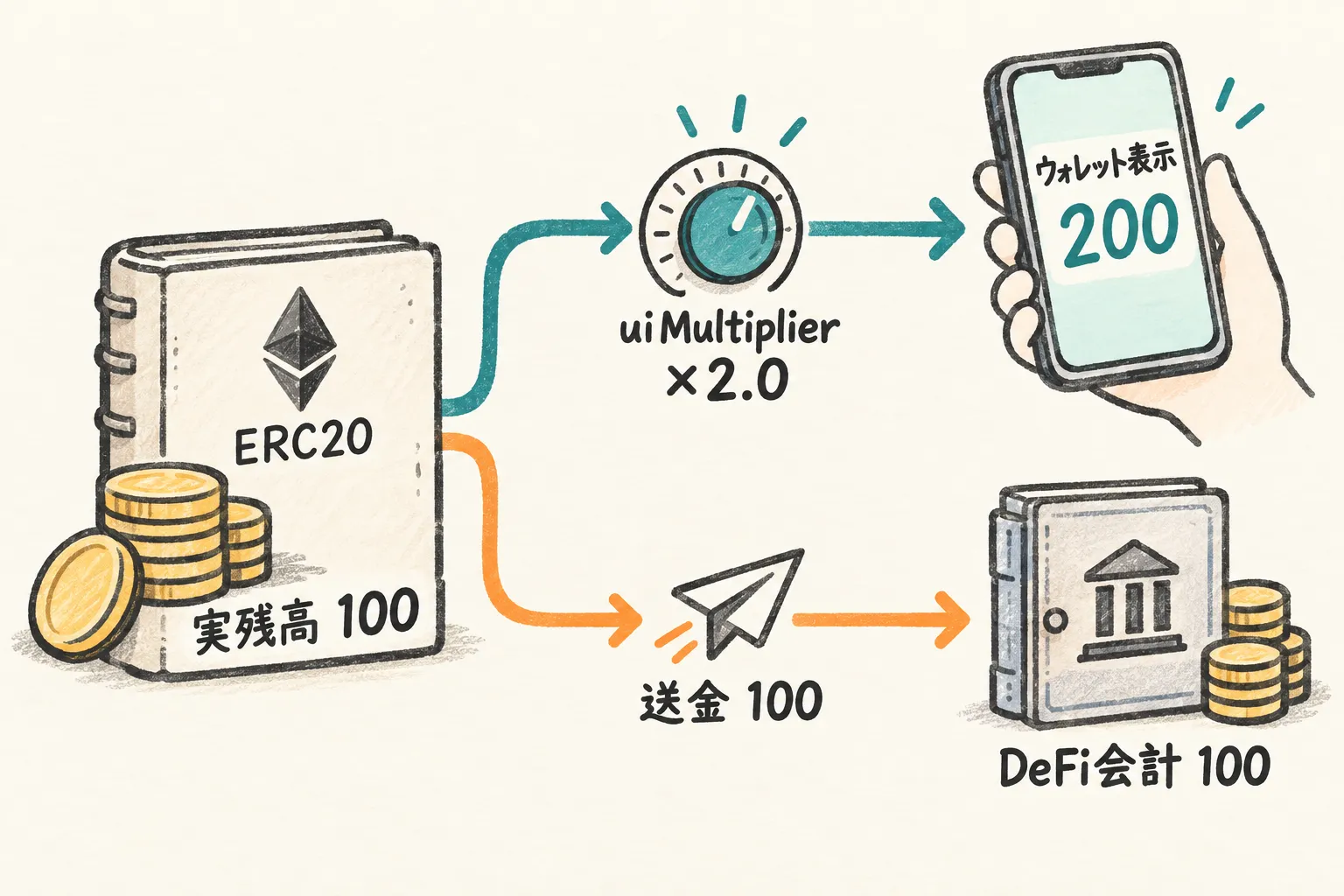
The original figures are retained and contain Japanese labels.
With a multiplier of 2.0, a wallet can display an actual balance of 100 as 200. Transfers and balance accounting still use 100, so existing ERC20 integrations can continue processing amounts as before.
Motivation
When tokenizing real-world assets, an issuer may want to represent events such as stock splits on-chain. In a two-for-one stock split, for example, the number of shares a shareholder holds doubles, but the shareholder's economic interest does not suddenly double.
Achieving the same presentation using ERC20 alone would require minting additional tokens for every holder or adjusting individual balances. As the number of holders grows, so do gas costs and operational overhead. Such changes may also conflict with the internal accounting of exchanges, lending protocols, and AMMs.
ERC8056 addresses this by changing the display multiplier rather than actual balances. The issuer updates uiMultiplier, and integrators apply it only when displaying quantities. This preserves token accounting while aligning the quantities users see with the post-split quantities.
Comparison with existing approaches
Stock splits can also be represented using rebasing tokens, wrapper tokens, exchange-rate-based tokens, or purely off-chain presentation. Each approach has drawbacks.
| Approach | Drawback |
|---|---|
| Rebasing tokens | Balances themselves change, potentially conflicting with assumptions made by DeFi contracts |
| Wrapper tokens | Each split introduces additional tokens or conversion processes, increasing operational complexity |
| Exchange-rate-based tokens | Presentation requires additional calculations and can be difficult for users to interpret |
| Off-chain presentation | Without a standard, wallets and exchanges may handle the same token differently |
ERC8056 exposes the multiplier on-chain so interfaces can convert quantities according to a common rule. Because the multiplier is confined to the presentation layer, it does not disrupt existing systems that rely on actual ERC20 balances.
Specification
Contracts conforming to ERC8056 implement the core IScaledUIAmount interface and IScaledUIAmountNewUIMultiplier, which exposes a scheduled display multiplier. Conversion helpers and display balance queries are defined as optional extensions.
IScaledUIAmount
IScaledUIAmount is the core interface that returns the currently effective display multiplier.
interface IScaledUIAmount {
    event UIMultiplierUpdated(
        uint256 oldMultiplier,
        uint256 newMultiplier,
        uint256 effectiveAtTimestamp
    );

    event TransferWithUIAmount(
        address indexed from,
        address indexed to,
        uint256 amount,
        uint256 uiAmount
    );

    function uiMultiplier() external view returns (uint256);
}
uiMultiplier is represented with 18 decimal places of precision. 1e18 represents 1.0, and 2e18 represents 2.0.
uiMultiplier
function uiMultiplier() external view returns (uint256);Returns the currently effective display multiplier. Even when an implementation has scheduled a future multiplier, it returns the old multiplier until the activation time and the new multiplier thereafter.
- Return value
| Type | Description |
|---|---|
uint256 |
Display multiplier with 18 decimal places of precision. 1e18 represents 1.0 |
The display amount is calculated from the actual balance and the multiplier.
uiAmount = (rawAmount * uiMultiplier) / 1e18This formula only converts the actual balance to a display amount. The quantities used by ERC20's balanceOf, transfer, and transferFrom remain unchanged.
UIMultiplierUpdated
event UIMultiplierUpdated(
    uint256 oldMultiplier,
    uint256 newMultiplier,
    uint256 effectiveAtTimestamp
);
This event is emitted when the display multiplier changes. Wallets, exchanges, and indexers can use it to update presentation caches and user notifications.
| Field | Description |
|---|---|
oldMultiplier |
Display multiplier before the change |
newMultiplier |
Display multiplier to use after the change |
effectiveAtTimestamp |
Unix timestamp at which the new multiplier becomes effective |
TransferWithUIAmount
event TransferWithUIAmount(
    address indexed from,
    address indexed to,
    uint256 amount,
    uint256 uiAmount
);
Implementations can use this event to report the display amount alongside an ERC20 transfer. Emitting it is optional and does not affect the interface ID.
| Field | Description |
|---|---|
from |
Sender address |
to |
Recipient address |
amount |
Actual amount used in the ERC20 transfer |
uiAmount |
Display amount calculated using the multiplier effective at the time of transfer |
This event does not change the meaning of the ERC20 Transfer event. The authoritative transfer amount is amount; uiAmount is supplemental information for interfaces and transaction histories.
IScaledUIAmountNewUIMultiplier
IScaledUIAmountNewUIMultiplier is a mandatory extension that exposes the scheduled multiplier and its activation time.
interface IScaledUIAmountNewUIMultiplier {
    function newUIMultiplier() external view returns (uint256);
    function effectiveAt() external view returns (uint256);
}
Sudden changes to the display multiplier can be difficult for wallets, exchanges, and indexers to track. Conforming contracts therefore allow external callers to read the scheduled multiplier and its activation time.
The following figure shows how a multiplier is scheduled and activated.
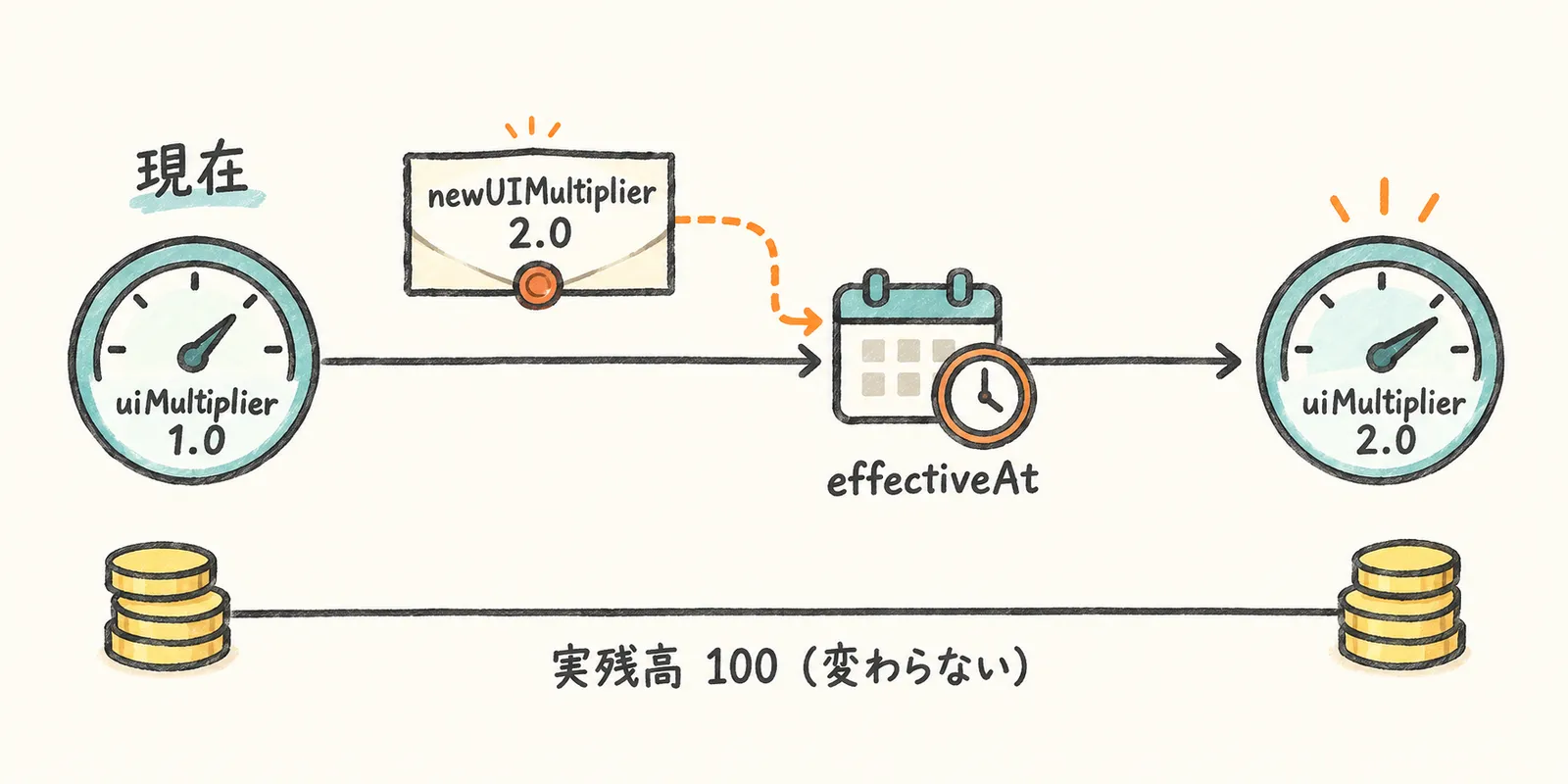
Until effectiveAt is reached, uiMultiplier returns the current multiplier. After that time, the scheduled newUIMultiplier becomes the effective display multiplier. Actual ERC20 balances remain unchanged throughout this process.
newUIMultiplier
function newUIMultiplier() external view returns (uint256);Returns the new display multiplier awaiting activation. Once it has been activated, the implementation returns the same value as the currently effective multiplier.
- Return value
| Type | Description |
|---|---|
uint256 |
Scheduled display multiplier with 18 decimal places of precision |
effectiveAt
function effectiveAt() external view returns (uint256);Returns the Unix timestamp at which newUIMultiplier becomes effective. Wallets and exchanges can use this value to tell users in advance when displayed quantities will change.
- Return value
| Type | Description |
|---|---|
uint256 |
Unix timestamp at which the new multiplier becomes effective |
IScaledUIAmountConversion
IScaledUIAmountConversion is an optional extension for converting between raw amounts and display amounts on-chain.
interface IScaledUIAmountConversion {
    function toUIAmount(uint256 rawAmount) external view returns (uint256);
    function fromUIAmount(uint256 uiAmount) external view returns (uint256);
}
With this extension, wallets and other contracts can query the token contract for conversion results rather than implementing the formula themselves.
toUIAmount
function toUIAmount(uint256 rawAmount) external view returns (uint256);Converts a raw amount to a display amount.
- Parameters
| Name | Type | Description |
|---|---|---|
rawAmount |
uint256 |
Raw ERC20 amount |
- Return value
| Type | Description |
|---|---|
uint256 |
Display amount adjusted by the multiplier |
fromUIAmount
function fromUIAmount(uint256 uiAmount) external view returns (uint256);Converts a display amount back to a raw amount. For example, if a user enters 200 in an interface, this function can calculate the amount to pass to transfer.
- Parameters
| Name | Type | Description |
|---|---|---|
uiAmount |
uint256 |
Amount displayed to the user |
- Return value
| Type | Description |
|---|---|
uint256 |
Raw amount to pass to ERC20's transfer |
IScaledUIAmountBalances
IScaledUIAmountBalances is an optional extension that returns balances and total supply adjusted by the display multiplier.
interface IScaledUIAmountBalances {
    function balanceOfUI(address account) external view returns (uint256);
    function totalSupplyUI() external view returns (uint256);
}
balanceOfUI
function balanceOfUI(address account) external view returns (uint256);Returns the display balance for a specified account. Internally, it multiplies balanceOf(account) by the display multiplier.
- Parameters
| Name | Type | Description |
|---|---|---|
account |
address |
Address whose display balance is being queried |
- Return value
| Type | Description |
|---|---|
uint256 |
Balance adjusted by the display multiplier |
totalSupplyUI
function totalSupplyUI() external view returns (uint256);Returns the total supply adjusted by the display multiplier. The actual ERC20 total supply is the return value of totalSupply(); totalSupplyUI() is for presentation.
- Return value
| Type | Description |
|---|---|
uint256 |
Total supply adjusted by the display multiplier |
Interface detection
Contracts conforming to ERC8056 implement interface detection using ERC165. If they support IScaledUIAmount, supportsInterface returns true for the corresponding interface ID.
For more on ERC165, see the following article.
[ERC165] Checking Whether a Contract Supports a Given Interface
The interface IDs listed in the proposal are as follows.
| Interface | ID |
|---|---|
IScaledUIAmount |
0xa60bf13d |
IScaledUIAmountNewUIMultiplier |
0xTBD |
IScaledUIAmountConversion |
0xTBD |
IScaledUIAmountBalances |
0xd890fd71 |
0xTBD denotes a value that had not yet been finalized in the proposal. Implementers and integrators should check whether subsequent revisions have finalized these IDs.
Implementation requirements
Conforming contracts must satisfy the following requirements.
| Requirement | Details |
|---|---|
| ERC165 support | Supported interfaces can be detected through supportsInterface |
| Multiplier precision | uiMultiplier uses 18 decimal places of precision |
| ERC20 compatibility | balanceOf, transfer, and transferFrom continue to use raw amounts |
| Event emission | The UIMultiplierUpdated event is emitted when the display multiplier changes |
The proposal does not prescribe how the multiplier is updated. Implementations can assign that authority to an issuer administrator, a role-based permission system, governance, or an oracle integration. Allowing anyone to change the multiplier, however, would let them freely manipulate the balances shown to users.
Additional considerations
Design rationale
ERC8056 leaves the core ERC20 functions unchanged and introduces separate functions for display purposes. Changing the meaning of balanceOf or transfer could cause existing wallets, exchanges, and DeFi contracts to interpret the same token as different quantities. The extension therefore keeps raw ERC20 amounts authoritative and exposes only the display multiplier through separate interfaces.
The multiplier uses 18 decimal places of precision, following a common Ethereum fixed-point convention in which 1e18 represents 1.0. By making conversion helpers and display balance queries optional extensions, the minimal implementation can focus on uiMultiplier and the scheduled multiplier.
Test cases
The proposal describes two checks: the initial multiplier and a stock split. In the initial state, verify that uiMultiplier is 1e18 and that balanceOf and balanceOfUI return the same quantity.
For the stock split case, set the multiplier to 2e18 to represent a two-for-one split. The display balance should be twice the actual balance, and toUIAmount and fromUIAmount should convert the corresponding quantities in both directions. Actual ERC20 balances, transfer amounts, and total supply should remain unchanged by the multiplier update alone.
The boundary between presentation and accounting
The most important rule for integrators is not to confuse display amounts with raw amounts. Wallets, portfolios, and price displays can show uiAmount. Transfers, balance accounting, and interactions with DeFi contracts use the raw amount.
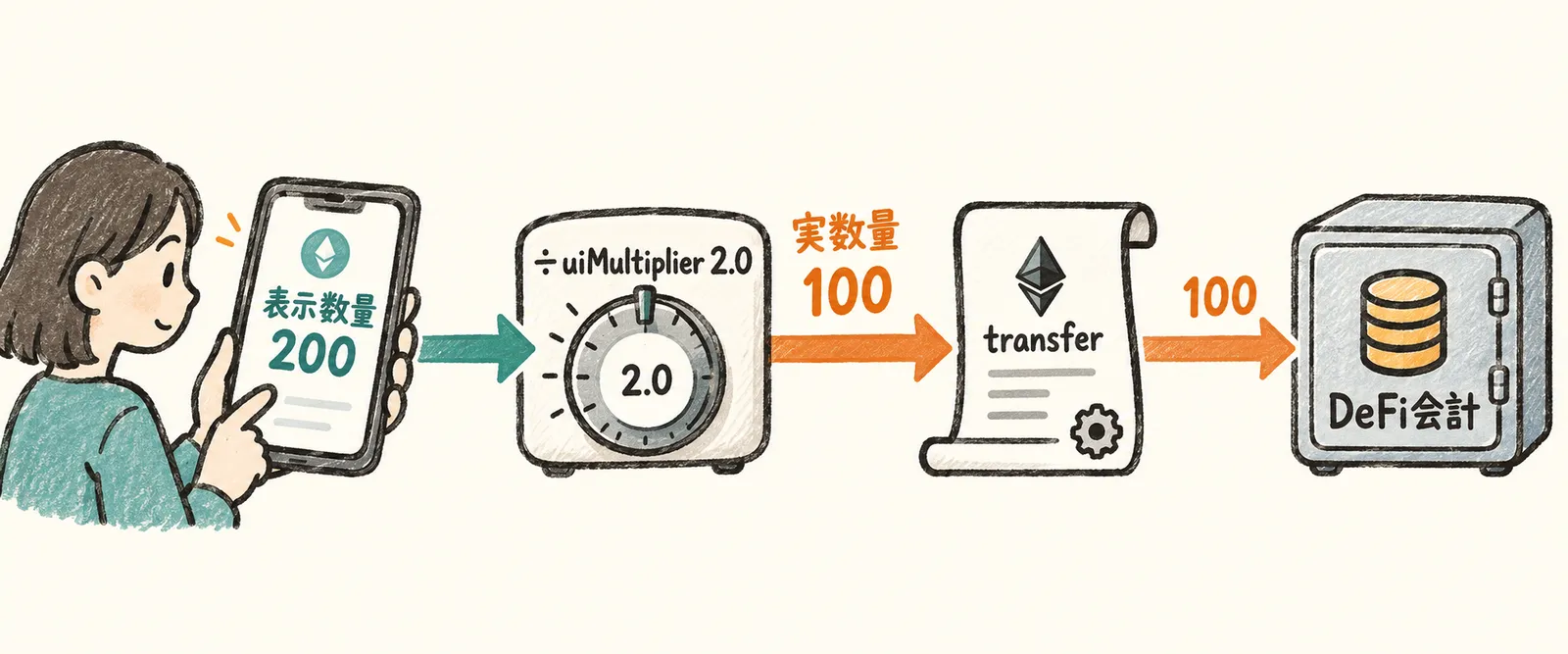
Even when users see 200 in an interface, the raw amount passed to transfer may be 100. Transfer interfaces should make the relationship between displayed and raw amounts clear, while internal processing consistently uses raw ERC20 amounts.
Wallet integration
Wallets first check supportsInterface for support for IScaledUIAmount. Tokens that do not support it are displayed as ordinary ERC20 tokens.
For supporting tokens, wallets can calculate the display balance using balanceOf and uiMultiplier. When IScaledUIAmountBalances is supported, they can obtain the display balance directly through balanceOfUI.
A wallet can follow these steps.
- Check support using
supportsInterface(0xa60bf13d)If unsupported, display the ordinary ERC20 balance. - Retrieve the actual balance using
balanceOf(account)Treat this value as authoritative for transfers and internal processing. - Obtain the display balance using
uiMultiplier()orbalanceOfUI(account)Show the display amount in the interface and include the raw amount when needed. - Check
newUIMultiplier()andeffectiveAt()If a multiplier change is scheduled, show its activation time to the user.
Exchange integration
Exchanges record deposits, withdrawals, and internal ledger entries in raw amounts. Storing display amounts in the ledger would break the consistency between historical deposits and withdrawals and current balances whenever the multiplier changes.
For presentation, exchanges multiply raw ledger amounts by the current uiMultiplier. If users enter orders or withdrawal amounts in display units, convert those values back into raw amounts using the same calculation as fromUIAmount before processing them.
DeFi contract integration
DeFi contracts continue to use ERC20's balanceOf, transfer, and transferFrom as usual. Interest calculations, collateral ratios, LP balances, and pool balances must use raw amounts.
Mixing the display multiplier into DeFi contract accounting can produce different results for different integrators of the same token. ERC8056 is a presentation extension, not a mechanism for rescaling on-chain accounting.
Compatibility
ERC8056 is compatible with ERC20. Existing ERC20 functions continue to operate on raw amounts, and the display multiplier is provided through additional functions.
Wallets and DeFi contracts that do not support ERC8056 can therefore still handle the token as a normal ERC20. However, unsupported interfaces will not display the post-split quantities. Issuers and exchanges should inform users that a display multiplier exists, and supporting interfaces should clearly distinguish display amounts from raw amounts.
Reference implementation
The proposal includes a reference ScaledUIToken contract that combines ERC20, ERC165, owner permissions, and the four interfaces. Its central logic compares the current time with effectiveAt to determine whether to return the current multiplier or the scheduled multiplier.
uint256 private constant MULTIPLIER_DECIMALS = 1e18;
uint256 private _uiMultiplier = MULTIPLIER_DECIMALS;
uint256 private _newUIMultiplier = MULTIPLIER_DECIMALS;
uint256 private _effectiveAt = 0;

function uiMultiplier() public view returns (uint256) {
    if (block.timestamp >= _effectiveAt) {
        return _newUIMultiplier;
    }

    return _uiMultiplier;
}
This implementation returns the scheduled multiplier only after the activation time has been reached. Separating _uiMultiplier and _newUIMultiplier lets integrators check both the current and scheduled multipliers.
To convert a raw amount to a display amount, multiply it by the multiplier and divide by the 18-decimal scaling factor.
function toUIAmount(uint256 rawAmount) public view returns (uint256) {
    return (rawAmount * uiMultiplier()) / MULTIPLIER_DECIMALS;
}

function fromUIAmount(uint256 uiAmount) public view returns (uint256) {
    return (uiAmount * MULTIPLIER_DECIMALS) / uiMultiplier();
}
toUIAmount calculates a display amount from a raw amount. fromUIAmount calculates a raw amount from a display amount. Neither changes actual ERC20 balances.
The function that updates the multiplier must be restricted to addresses with issuer or governance authority. In the reference implementation, the update specifies a future time and then emits the UIMultiplierUpdated event.
Security
Authority to change the multiplier
Unauthorized changes to the display multiplier can mislead users about their holdings. For example, a malicious administrator could set the multiplier to 10.0, causing the displayed quantity to appear ten times larger even though the actual balance has not changed.
Implementations must restrict multiplier updates to trusted parties, such as owners, authorized roles, or governance. Scheduling activation in the future is also important because it gives wallets and exchanges time to notify users in advance.
Overflow
The display amount is calculated using rawAmount * uiMultiplier. If rawAmount or the multiplier is large, the multiplication may overflow.
Use the overflow checks available in Solidity 0.8 and later or a library that handles multiplication and division safely. In particular, exchanges and indexers performing off-chain calculations should use arbitrary-precision integers rather than JavaScript's ordinary number type.
Misleading users
Because display and raw amounts differ, users may confuse the quantity shown in their wallet with the amount transferred by ERC20. Wallets and exchanges should make the raw amount and multiplier available when necessary alongside the displayed quantity.
Deposit and withdrawal interfaces, execution histories, and CSV exports for tax and accounting purposes should clearly distinguish raw amounts from display amounts.
Oracle dependency
Implementations that automate multiplier updates depend on external data or oracles. If an oracle stops operating or returns an incorrect multiplier, users will see incorrect displayed quantities.
Even with automated updates, setting upper and lower multiplier bounds, an activation delay, and an administrator-controlled way to pause updates can limit the impact of erroneous changes.
Conclusion
This article examined ERC8056, the display amount scaling extension that adjusts only the displayed quantity of ERC20 tokens without changing actual balances.
ERC8056 is a proposal for representing changes in displayed quantities, such as stock splits in real-world asset tokens, without changing raw ERC20 balances. Standardizing the display multiplier helps wallets, exchanges, and DeFi contracts keep presentation separate from accounting. However, poorly managed update permissions or misleading interfaces can cause users to misunderstand their holdings, making integration rules equally important.
You can also find my other articles at the following links.




