Introduction
Hi, I'm cardene, a software engineer and technical writer focused on blockchain and AI.
I've also authored Japanese technical books on specification-driven development with LLMs and decentralized application (DApp) development.

I also build and publish a variety of tools, libraries, and open-source projects.
This article examines ERC7984, a pointer-based confidential fungible token standard that enables transfers without exposing balances or transfer amounts.
This article explains the proposal below.

I have also covered a range of other EIPs, BIPs, SLIPs, CAIPs, ENSIPs, RFCs, and ACPs.

Overview
ERC7984 defines a standard interface for transferring tokens while keeping balances and transfer amounts confidential.
With conventional ERC20 tokens, the blockchain publicly records who sent how much to whom.
ERC7984 replaces amounts with bytes32 values called pointers, preventing outside observers from directly seeing the amounts.
For more on ERC20, see the following article.
[ERC20] An introduction to ERC20
The following diagram illustrates the difference in amount representation between conventional ERC20 and ERC7984.
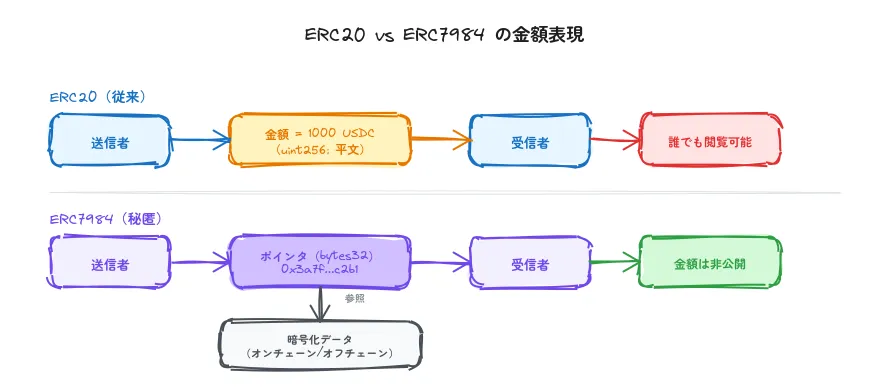
ERC20 exposes amounts directly, whereas ERC7984 references encrypted data through pointers so that outside observers cannot see the amounts.
A pointer is a reference to encrypted data stored on-chain or off-chain. Pointer resolution (how the actual amount is obtained) and arithmetic depend on the implementation. The proposal is therefore not tied to a specific technology, such as fully homomorphic encryption (FHE), zero-knowledge proofs, or secure enclaves (trusted execution environments).
Motivation
Why token confidentiality matters
On public blockchains such as Ethereum, all transactions are public. This provides transparency but poses problems in many business contexts.
For example, if a company pays its employees on-chain, anyone can see their salaries. In decentralized finance (DeFi), publicly visible amounts for large trades can expose them to front-running. In institutional settlements, observers may also be able to infer trading strategies.
What the proposal addresses
ERC7984 addresses these problems by standardizing a pointer-based representation of amounts.
Amounts are represented as bytes32 pointers, while the actual values are stored separately in encrypted form.
A standard interface allows applications such as privacy-focused wallets and decentralized exchanges (DEXs) to handle confidential tokens in a consistent way.
Specification
How pointers work
All amounts in ERC7984 are represented by bytes32 pointers.
Conventional ERC20 uses uint256 values directly for balances and transfer amounts, whereas ERC7984 uses pointers in place of those values.
A pointer is a reference to encrypted data. For example, in an FHE-based implementation, a pointer may be a handle to a ciphertext; in a zero-knowledge proof-based implementation, it may represent a commitment. The specification does not define how pointers are resolved or how arithmetic is performed, since these are implementation-specific.
This design allows ERC7984-compliant tokens to remain independent of any particular cryptographic technology and accommodate future developments.
Interface definition
ERC7984-compliant tokens must implement ERC165.
The supportsInterface function returns true for interface ID 0x4958f2a4.
For more on ERC165, see the following article.
[ERC165] How to check whether a contract supports a specific interface
The complete ERC7984 interface is shown below.
interface IERC7984 {
    event ConfidentialTransfer(address indexed from, address indexed to, bytes32 indexed amount);
    event OperatorSet(address indexed holder, address indexed operator, uint48 until);
    event AmountDisclosed(bytes32 indexed handle, uint256 amount);

    function name() external view returns (string memory);
    function symbol() external view returns (string memory);
    function decimals() external view returns (uint8);
    function contractURI() external view returns (string memory);

    function confidentialTotalSupply() external view returns (bytes32);
    function confidentialBalanceOf(address account) external view returns (bytes32);

    function isOperator(address holder, address spender) external view returns (bool);
    function setOperator(address operator, uint48 until) external;

    function confidentialTransfer(address to, bytes32 amount) external returns (bytes32);
    function confidentialTransfer(address to, bytes32 amount, bytes calldata data) external returns (bytes32);

    function confidentialTransferFrom(address from, address to, bytes32 amount) external returns (bytes32);
    function confidentialTransferFrom(address from, address to, bytes32 amount, bytes calldata data) external returns (bytes32);

    function confidentialTransferAndCall(address to, bytes32 amount, bytes calldata callData) external returns (bytes32);
    function confidentialTransferAndCall(address to, bytes32 amount, bytes calldata data, bytes calldata callData) external returns (bytes32);

    function confidentialTransferFromAndCall(address from, address to, bytes32 amount, bytes calldata callData) external returns (bytes32);
    function confidentialTransferFromAndCall(address from, address to, bytes32 amount, bytes calldata data, bytes calldata callData) external returns (bytes32);
}
This interface can be divided into four broad categories.
These are metadata functions (name, symbol, decimals, and contractURI), balance query functions (confidentialTotalSupply and confidentialBalanceOf), operator management functions (setOperator and isOperator), and transfer functions.
The following sections examine each category in detail.
Metadata functions
name
function name() external view returns (string memory);Returns the token name.
For example, it may return a string such as "MyConfidentialToken".
It serves the same purpose as the ERC20 name function.
symbol
function symbol() external view returns (string memory);Returns the token symbol (abbreviation).
For example, it may return a string such as "MCT".
decimals
function decimals() external view returns (uint8);Returns the number of decimal places as a plaintext uint8.
For example, if it returns 6, one token is represented by 1000000 base units.
Importantly, this value is returned in plaintext rather than as a pointer.
Decimal precision is shared information required for token unit conversion and does not need to be confidential.
contractURI
function contractURI() external view returns (string memory);Returns the token metadata URI. Following the schema defined by ERC7572 is recommended.
For more on ERC7572, see the proposal below.
Balance query functions
confidentialTotalSupply
function confidentialTotalSupply() external view returns (bytes32);Returns the total token supply as a pointer.
Conventional ERC20 returns a uint256 value from totalSupply, whereas ERC7984 returns a pointer, allowing the total supply to remain confidential.
confidentialBalanceOf
function confidentialBalanceOf(address account) external view returns (bytes32);Returns the specified account's balance as a pointer. Because the return value is a pointer, simply calling this function does not reveal the actual balance. Determining the balance requires the appropriate permissions or keys to resolve the pointer.
Operator management functions
ERC7984 uses an operator model instead of the ERC20 approve/allowance model.
An operator is an address authorized to transfer tokens on behalf of a token holder.
setOperator
function setOperator(address operator, uint48 until) external;Authorizes the specified address as an operator.
Unlike confidential amount parameters, until is a plaintext uint48 specifying when the operator authorization expires (a Unix timestamp).
| Parameter | Type | Description |
|---|---|---|
operator |
address |
The address to authorize as an operator, such as the contract address of a DeFi protocol. |
until |
uint48 |
The expiration time of the operator authorization (Unix timestamp). Authorization automatically expires after this time. |
Calling this function emits an OperatorSet event.
An account can authorize multiple operators at the same time.
The main difference from ERC20's approve is that ERC20 grants amount-based permission (how much may be spent), whereas ERC7984 grants time-based permission (until when tokens may be spent).
Because amounts are kept confidential through pointers, maintaining an amount-based allowance is technically challenging.
An authorized operator is therefore permitted to transfer any amount within the authorization period, subject to the holder's balance and other applicable restrictions.
isOperator
function isOperator(address holder, address spender) external view returns (bool);Returns whether the specified address is currently an authorized operator.
| Parameter | Type | Description |
|---|---|---|
holder |
address |
The address of the token holder. |
spender |
address |
The address to check for operator authorization. |
- Return value
bool: Returns true if spender is currently authorized as an operator for holder, or false otherwise.
Transfer functions
ERC7984 provides basic transfers, transfers on behalf of another account (with the From suffix), and transfers with a callback (with the AndCall suffix). Each function has two overloads, with and without a data parameter.
confidentialTransfer
function confidentialTransfer(address to, bytes32 amount) external returns (bytes32);
function confidentialTransfer(address to, bytes32 amount, bytes calldata data) external returns (bytes32);
Transfers tokens from the caller's account to a specified address.
Because amount is specified as a pointer, outside observers cannot determine the actual transfer amount simply by inspecting the transaction.
| Parameter | Type | Description |
|---|---|---|
to |
address |
The recipient address. |
amount |
bytes32 |
A pointer representing the transfer amount. The actual amount is referenced in encrypted form. |
data |
bytes |
Implementation-specific additional information, such as cryptographic proofs or access permissions. It may contain encryption parameters for FHE or proof data for zero-knowledge proofs. |
- Return value
bytes32: A pointer representing the amount actually transferred.
The function may revert if the caller has an insufficient balance.
A successful transfer emits a ConfidentialTransfer event.
confidentialTransferFrom
function confidentialTransferFrom(address from, address to, bytes32 amount) external returns (bytes32);
function confidentialTransferFrom(address from, address to, bytes32 amount, bytes calldata data) external returns (bytes32);
Allows an operator to transfer tokens on behalf of a holder. This function is used when third-party contracts, such as DeFi protocols, manage a user's tokens.
| Parameter | Type | Description |
|---|---|---|
from |
address |
The sender address (the token holder). |
to |
address |
The recipient address. |
amount |
bytes32 |
A pointer representing the transfer amount. |
data |
bytes |
Implementation-specific additional information, such as cryptographic proofs. |
- Return value
bytes32: A pointer representing the amount actually transferred.
The function reverts if the caller is not an operator for from.
confidentialTransferAndCall
function confidentialTransferAndCall(address to, bytes32 amount, bytes calldata callData) external returns (bytes32);
function confidentialTransferAndCall(address to, bytes32 amount, bytes calldata data, bytes calldata callData) external returns (bytes32);
Transfers tokens and then invokes a callback on the recipient contract. Combining the transfer and contract notification in one transaction can streamline workflows such as depositing into a DEX or providing collateral to a lending protocol.
| Parameter | Type | Description |
|---|---|---|
to |
address |
The recipient address (a contract). |
amount |
bytes32 |
A pointer representing the transfer amount. |
data |
bytes |
Implementation-specific additional information, such as cryptographic proofs. |
callData |
bytes |
Data passed to the recipient contract during the callback. |
- Return value
bytes32: A pointer representing the amount actually transferred.
The callback mechanism is explained in a later section.
confidentialTransferFromAndCall
function confidentialTransferFromAndCall(address from, address to, bytes32 amount, bytes calldata callData) external returns (bytes32);
function confidentialTransferFromAndCall(address from, address to, bytes32 amount, bytes calldata data, bytes calldata callData) external returns (bytes32);
Allows an operator to transfer tokens on behalf of a holder and then invoke a callback on the recipient contract.
It combines the functionality of confidentialTransferFrom and confidentialTransferAndCall.
| Parameter | Type | Description |
|---|---|---|
from |
address |
The sender address (the token holder). |
to |
address |
The recipient address (a contract). |
amount |
bytes32 |
A pointer representing the transfer amount. |
data |
bytes |
Implementation-specific additional information, such as cryptographic proofs. |
callData |
bytes |
Data passed to the recipient contract during the callback. |
- Return value
bytes32: A pointer representing the amount actually transferred.
The function reverts if the caller is not an operator for from.
Events
ConfidentialTransfer
event ConfidentialTransfer(address indexed from, address indexed to, bytes32 indexed amount);Emitted when confidential tokens are transferred. It is emitted for all transfers, including zero-value transfers.
| Parameter | Type | indexed | Description |
|---|---|---|---|
from |
address |
yes | The sender address. For newly minted tokens, using 0x0 is recommended. |
to |
address |
yes | The recipient address. |
amount |
bytes32 |
yes | A pointer representing the transfer amount. It is recorded in the logs, but the actual amount remains unknown without a means of resolving the pointer. |
A from value of 0x0 indicates newly minted tokens.
A to value of 0x0 typically indicates that tokens have been burned, following the ERC20 convention.
OperatorSet
event OperatorSet(address indexed holder, address indexed operator, uint48 until);Emitted when setOperator is called successfully.
| Parameter | Type | indexed | Description |
|---|---|---|---|
holder |
address |
yes | The address of the token holder. |
operator |
address |
yes | The address designated as an operator. |
until |
uint48 |
no | The expiration time of the operator authorization (Unix timestamp). |
AmountDisclosed
event AmountDisclosed(bytes32 indexed handle, uint256 amount);Emitted when an amount represented by a pointer is disclosed. Emitting this event is optional. It is used when a pointer's value is disclosed through an implementation-specific mechanism.
| Parameter | Type | indexed | Description |
|---|---|---|---|
handle |
bytes32 |
yes | The disclosed pointer. |
amount |
uint256 |
no | The actual amount to which the pointer referred. |
For example, this event may be used when an amount for a particular transaction needs to be disclosed for auditing.
Callback mechanism
Transfer functions with the AndCall suffix invoke a callback on the recipient contract after completing the transfer.
The operation follows the sequence below.
sequenceDiagram
    participant Sender as 送信者
    participant Token as トークンコントラクト
    participant Receiver as 受信コントラクト

    Sender->>Token: confidentialTransferAndCall
    Token->>Token: Transfer処理を実行
    Token->>Receiver: onConfidentialTransferReceived
    alt 成功(true)
        Receiver-->>Token: trueのポインタを返す
        Token-->>Sender: Transfer額のポインタを返す
    else 失敗(false)
        Receiver-->>Token: falseのポインタを返す
        Token->>Token: トークンを送信者に戻す
        Token-->>Sender: 戻り値を返す
    else リバート
        Receiver-->>Token: revert
        Token-->>Sender: revert
    end
The callback behaves as follows.
- If the recipient is an externally owned account (EOA), rather than a contract, no callback is invoked and the operation succeeds without one.
- If the recipient is a contract, its
onConfidentialTransferReceivedfunction is called. - If the callback reverts, the entire transfer reverts.
- If the callback returns a pointer representing
false, the token contract attempts to return the tokens to their original holder.
onConfidentialTransferReceived
function onConfidentialTransferReceived(
    address operator,
    address from,
    bytes32 amount,
    bytes calldata data
) external returns (bytes32 success);
This function is implemented by contracts that receive transfers with callbacks.
| Parameter | Type | Description |
|---|---|---|
operator |
address |
The address that initiated the transfer (an operator or the sender). |
from |
address |
The address of the original token holder. |
amount |
bytes32 |
A pointer representing the amount transferred. |
data |
bytes |
Data supplied through the transfer function's callData parameter. |
- Return value
bytes32: A pointer representing true on success, or a pointer representing false on failure. The callback may also revert.
If the callback indicates failure without reverting, the token contract attempts to return the tokens from the recipient contract to the sender. However, if the recipient contract has already spent the tokens during the callback, returning them may fail.
Additional considerations
Technology-independent design
A defining feature of ERC7984 is its use of bytes32 pointers to represent amounts, allowing the interface to remain independent of specific cryptographic technologies.
| Cryptographic technology | What the pointer references | Characteristics |
|---|---|---|
| Fully homomorphic encryption (FHE) | A ciphertext handle | Supports computation on encrypted data. |
| Zero-knowledge proofs | A commitment | Enables proving conditions without disclosing values. |
| Secure enclaves | A reference to data in a protected environment | Provides hardware-level confidentiality. |
Regardless of the technology used, the externally visible interface exposes the same bytes32 pointers.
Applications such as wallets and DEXs can therefore use a common interface for confidential tokens without needing to handle the underlying cryptographic technology directly.
Comparison with ERC20 approve/allowance
In ERC20, when authorizing a third party to transfer tokens, the approve function specifies an amount that the third party may spend.
In ERC7984, however, amounts are kept confidential through pointers, making amount-based allowances difficult to manage.
ERC7984 therefore adopts a time-based operator model. The following diagram shows the differences between the two models.
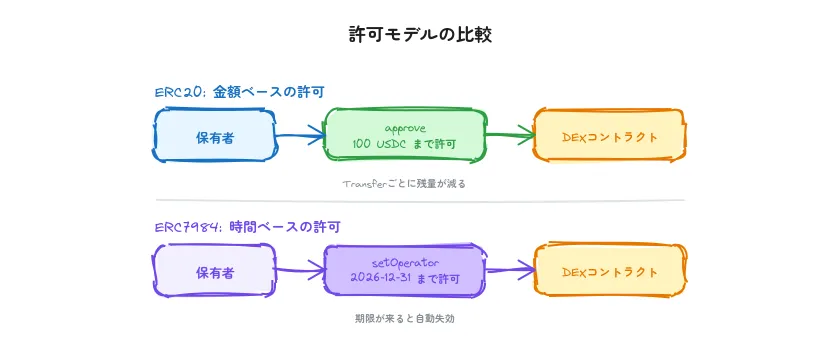
| Feature | ERC20 (approve/allowance) | ERC7984 (operator) |
|---|---|---|
| Basis of authorization | Amount (how many tokens) | Time (until when) |
| Scope of authorization | Up to the specified amount | No amount-based allowance limit during the authorization period |
| Authorization management | Remaining allowance decreases with transfers | Authorization automatically expires at the deadline |
| Multiple authorized addresses | A separate allowance for each address | A separate expiration time for each address |
One advantage of the operator model is that it eliminates the need to track a remaining allowance represented by an encrypted pointer. It can reduce the burden on external systems while supporting security through automatic expiration.
The role of the data parameter
The bytes calldata data parameter in transfer functions is used to pass implementation-specific information.
For example, an FHE-based implementation may use it for encryption parameters, while a zero-knowledge proof-based implementation may use it for proof data establishing validity or for access permission information.
This parameter is simply a byte sequence at the interface level, but its meaning varies by implementation.
Overloads without data are also provided, so implementations that do not require additional information can omit it.
Security considerations
Dependence on cryptographic mechanisms
The security of ERC7984 depends heavily on the underlying pointer-based cryptographic mechanism. If the encryption protecting the referenced data is insufficient, amounts may be disclosed. Implementations need to address side-channel attacks (attacks that infer information from processing times or memory access patterns) and manage keys properly during off-chain operations.
Callback risks
Transfer functions with the AndCall suffix invoke a callback on the recipient contract.
This introduces risks such as reentrancy (calling the transfer function again during a callback) and gas griefing (disrupting execution by consuming excessive gas).
When using callbacks, consider appropriate reentrancy guards and gas limits.
References

Conclusion
This article covered the confidential fungible token mechanism proposed by ERC7984. I hope you found it useful.
If you have any questions, feel free to contact me via Twitter DM.
I also publish on other platforms, which you can find below.


