Introduction
Hi, I'm cardene, a software engineer and technical writer focused on blockchain and AI.
I've also authored Japanese technical books on specification-driven development with LLMs and decentralized application (DApp) development.

I also build and publish a variety of tools, libraries, and open-source projects.
This article examines ERC7484, which proposes a registry mechanism that allows smart accounts to select trusted modules.
The following explanation translates, summarizes, and expands on the original specification.

I also cover various EIPs, BIPs, SLIPs, CAIPs, ENSIPs, RFCs, and ACPs.

Overview
ERC4337 standardizes the execution flow of contract accounts, while ERC7579 standardizes how the modules that make up those accounts can be combined. Together, they allow developers to build independent modules for modular smart accounts.
For more on ERC4337, see the following article.
[ERC4337] Account abstraction without protocol changes
For more on ERC7579, see the following article.
[ERC7579] Minimal modular smart accounts
Installing third-party modules without assessing their security expands the attack surface of a smart account. ERC7484 therefore standardizes a Module Registry that stores security-related attestations and assessments and allows smart accounts to check them before using a module.
Rather than accessing the Module Registry directly, a smart account queries it through a Registry Adapter. The adapter connects the account to the registry and provides a consistent, secure way to query different registry implementations.
ERC7484 also provides an ownerless Singleton Module Registry as a reference implementation, available to any smart account. Widespread adoption of this singleton could make security checks more consistent, but its use is optional. A smart account can use any registry that implements the standard interface.
Motivation
ERC4337 and ERC7579 make smart accounts extensible and flexible. ERC7579 in particular allows functionality to be added through modules, including modules built by external developers.
The ability for anyone to create modules, however, raises a security concern. Installing an untrusted module increases the risk of unauthorized operations or loss of assets. Smart accounts therefore need a way to check security attestations for modules.
The Module Registry addresses this problem by storing security information for individual modules and making it available to smart accounts before use. If registries differ in their behavior or design, however, account developers would need to support each registry individually. Standardizing the following aspects addresses that burden.
What the standard covers
| Component | Description |
|---|---|
| Module Registry interface and required functionality | Allows smart accounts to query security information in the same way regardless of the registry implementation. |
| Registry Adapter behavior | Provides consistent access to registries despite differences in account architecture and execution flow. |
Smart accounts can thus check module security consistently across registries, reducing the risks associated with module use.
The standard also provides an ownerless Singleton Module Registry as a reference implementation. If many accounts use this registry, they can share security assessments across the ecosystem.
Use of the singleton is not mandatory. Accounts can use any registry that conforms to the standardized interface, preserving flexibility and interoperability.
Module registries help smart accounts manage the risks of installing modules and improve security and usability across the ecosystem.
Specification
Terminology
The following terms are used throughout the specification.
| Term | Description |
|---|---|
| Smart Account | An ERC7579-compliant modular smart account. |
| Module | An independent component that adds functionality to a smart account. |
| Attestation | An on-chain statement about a module, such as an assessment of its security. |
| Attester | An entity that issues attestations. |
| Registry | A contract that stores attestations about modules. |
| Adapter | The component responsible for querying a registry on behalf of a smart account. |
Before using a module, a smart account queries the Registry to determine whether third parties (attesters) have assessed the module's security.
Sequence diagram
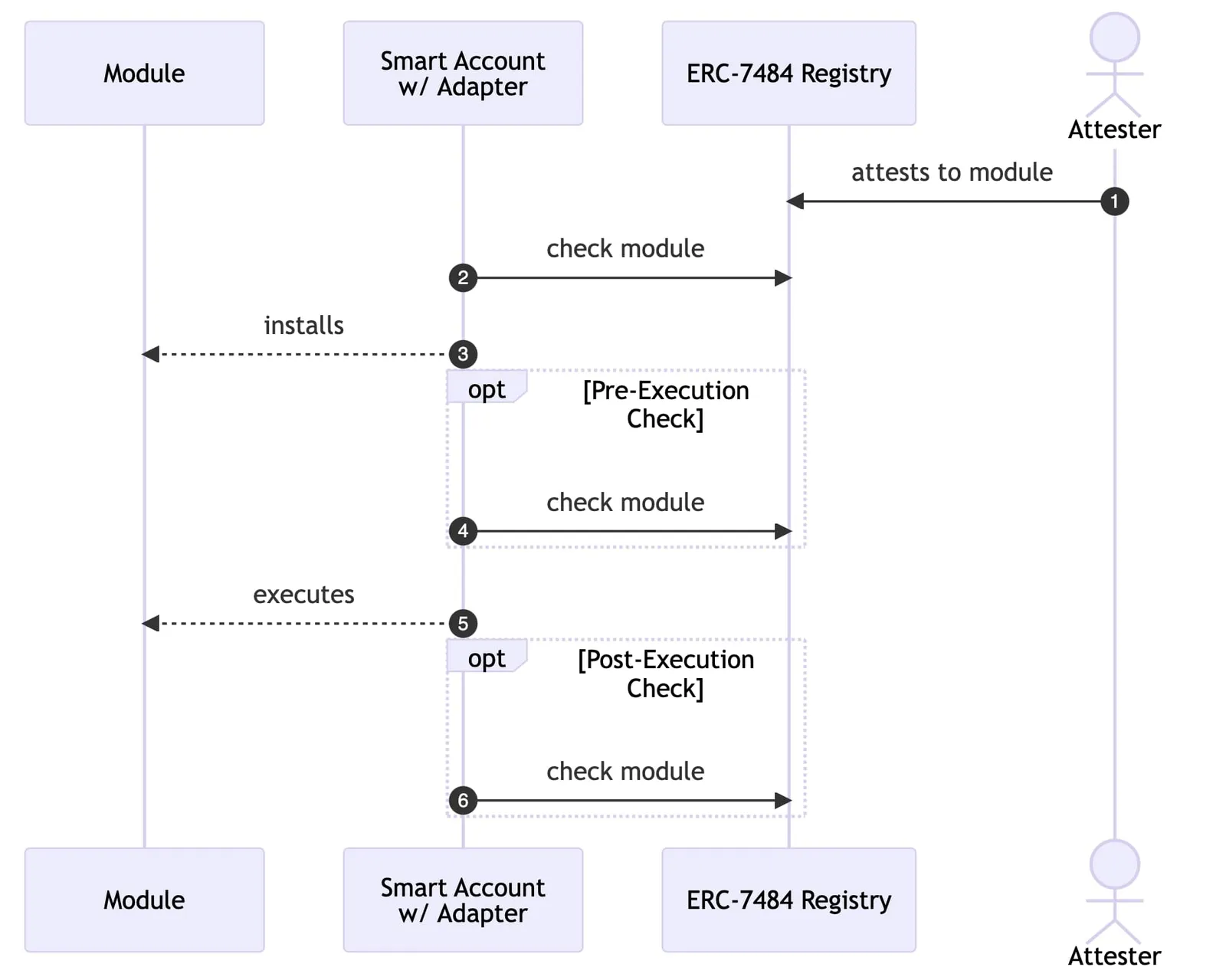
The diagram illustrates how a smart account checks module security during installation and execution.
There are six main steps.
- An attester issues an attestation about a module's security to the registry The Registry stores this information.
- The smart account, which incorporates an adapter, checks module security with the registry This check takes place before module installation.
- The smart account installs the module The pre-installation check is optional but generally recommended.
- The smart account queries the registry again before executing the module This checks the latest security status immediately before use.
- The smart account executes the module An additional check can be performed after execution.
- The smart account checks again after module execution Since an attester may subsequently revoke an attestation, a post-execution security check is also available as an option.
If the Registry reverts, the smart account should treat the module as unsafe and abort the transaction.
Registry requirements
Smart accounts use the Registry to assess module security. The specification distinguishes mandatory registry functionality from recommended functionality.
Required functionality
- Verify that an Attester is the actual creator of an attestation.
Examples include checking
msg.senderor verifying a signature. - Allow an Attester to revoke an attestation they previously created.
- Store attestation data or a reference to where that data is stored.
Recommended additional functionality
- Allow attestations to have an expiration date. The check should revert when an attestation has expired.
- Provide
viewfunctions through which adapters and external clients can retrieve specific attestation data.
Requirements for check functions
The check functions are central to the registry.
The Registry must revert in the following cases.
| Condition | Explanation |
|---|---|
| The number of attesters is below the threshold | The module cannot be used because the required security criteria are not satisfied. |
| An attester has revoked an attestation | The corresponding security attestation is no longer valid. |
| Attesters are duplicated or not sorted | Rejects invalid input data. |
Requirements for check functions with moduleType
The Registry must also revert if its stored moduleType differs from the value supplied in the call.
Check functions using stored attesters
The registry must have attester information stored for the relevant smart account or msg.sender.
- Revert if no such information is stored.
- If no smart account is specified, use the attester configuration for
msg.sender.
Requirements for trustAttesters
A smart account or user can register trusted attesters and a threshold with the registry.
- The supplied attester list must be sorted and contain no duplicates.
- Store the threshold and attester list in the Registry.
Adapter behavior
A smart account needs an Adapter to interact correctly with the registry.
Required functionality
- Query the Registry before or during the first invocation of module A.
- Treat a registry revert as an indication that the module is unsafe.
Recommendations
- Revert the entire transaction if the registry reverts.
- Query the registry when installing a module.
- Query the registry when executing a module.
Interface
interface IERC7484Registry {
    /*´:°•.°+.*•´.*:˚.°*.˚•´.°:°•.°•.*•´.*:˚.°*.˚•´.°:°•.°+.*•´.*:*/
    /*               Check with internal attester(s)              */
    /*.•°:°.´+˚.*°.˚:*.´•*.+°.•°:´*.´•*.•°.•°:°.´:•˚°.*°.˚:*.´+°.•*/
    function check(address module) external view;

    function checkForAccount(address smartAccount, address module) external view;

    function check(address module, uint256 moduleType) external view;

    function checkForAccount(
        address smartAccount,
        address module,
        uint256 moduleType
    )
        external
        view;

    /*´:°•.°+.*•´.*:˚.°*.˚•´.°:°•.°•.*•´.*:˚.°*.˚•´.°:°•.°+.*•´.*:*/
    /*                   Set internal attester(s)                 */
    /*.•°:°.´+˚.*°.˚:*.´•*.+°.•°:´*.´•*.•°.•°:°.´:•˚°.*°.˚:*.´+°.•*/

    function trustAttesters(uint8 threshold, address[] calldata attesters) external;


    /*´:°•.°+.*•´.*:˚.°*.˚•´.°:°•.°•.*•´.*:˚.°*.˚•´.°:°•.°+.*•´.*:*/
    /*              Check with external attester(s)               */
    /*.•°:°.´+˚.*°.˚:*.´•*.+°.•°:´*.´•*.•°.•°:°.´:•˚°.*°.˚:*.´+°.•*/

    function check(
        address module,
        address[] calldata attesters,
        uint256 threshold
    )
        external
        view;

    function check(
        address module,
        uint256 moduleType,
        address[] calldata attesters,
        uint256 threshold
    )
        external
        view;
}
Functions
check
function check(address module) external view;Checks module security using the stored attester configuration. The function uses attester information already registered with the Registry to determine whether the specified module satisfies the required security criteria.
Arguments
module- Address of the module to check.
checkForAccount
function checkForAccount(address smartAccount, address module) external view;Checks module security using attesters stored for a specific smart account.
The Registry verifies the module against the attester configuration associated with smartAccount.
Arguments
smartAccount- Address of the smart account whose attester configuration is used.
module- Module to check.
check (module + moduleType)
function check(address module, uint256 moduleType) external view;Checks module security and whether the registered module type matches the requested type.
The Registry reverts if the stored moduleType differs from the value supplied in the call.
Arguments
module- Module to check.
moduleType- Numeric identifier representing the module type.
checkForAccount (module + moduleType)
function checkForAccount(
    address smartAccount,
    address module,
    uint256 moduleType
) external view;
Checks module security, including the module type, using attesters configured for a specific smart account. Verification uses the account's stored attester configuration and the module type information.
Arguments
smartAccount- Account whose attester configuration is used.
module- Module to check.
moduleType- Module type.
trustAttesters
function trustAttesters(uint8 threshold, address[] calldata attesters) external;Registers the attesters trusted by msg.sender and the required threshold with the Registry.
The function verifies that the attester list is sorted and contains no duplicates before storing it.
Arguments
threshold- Required number of attesters.
attesters- Array of trusted attesters.
check (externally supplied attesters)
function check(
    address module,
    address[] calldata attesters,
    uint256 threshold
) external view;
Checks module security using an attester list and threshold supplied directly by the caller. The caller specifies both values. The Registry verifies whether the specified attesters have actually issued attestations.
Arguments
module- Module to check.
attesters- Attester list used for verification.
threshold- Required number of attestations.
check (moduleType + external attester)
function check(
    address module,
    uint256 moduleType,
    address[] calldata attesters,
    uint256 threshold
) external view;
Uses externally supplied attesters and also verifies that the module type matches.
The Registry checks the supplied moduleType against the stored value and reverts if they differ.
Arguments
module- Module to check.
moduleType- Module type.
attesters- Attester list to use.
threshold- Required number of attestations.
Additional considerations
Attestations
An attestation is an on-chain statement about a module. It may make claims about security, standards compliance, or other properties and helps a smart account decide whether to use the module.
Representing information that cannot be verified on-chain
Many claims are difficult to verify using on-chain information alone. Consider the following example.
- Determining whether a module accesses only specific storage slots.
In particular, when an operation such as
DELEGATECALLcan affect smart account storage, knowing which locations may be written to is important.
It is nearly impossible to verify this property completely on-chain. An attester can instead investigate the module off-chain and record the findings on-chain as an attestation.
A smart account can then access the results of off-chain verification from the blockchain.
Flexibility of attestation data
ERC7484 does not prescribe a specific attestation data format. An implementation can store either the data itself or a reference to it.
This supports a wide range of cases.
| Type | Content |
|---|---|
| Simple flag | A simple value such as a boolean indicating that the module is considered safe. |
| Detailed evidence | Analysis results or references to external verification reports. |
| Complex data describing execution behavior | Advanced data formats recording runtime behavior. |
This flexibility accommodates different auditing methods.
Singleton Registry
Attestations need to be recorded in a contract so they can be checked on-chain. ERC7484 provides an ownerless Singleton Registry as a reference implementation.
It serves as a single source of information aggregating attestations for modules, which smart accounts can consult when assessing security.
Why use a Singleton Registry?
Improved security
Aggregating attestations in one registry offers the following advantages.
- Many attesters can issue statements in the same place, increasing the availability of attestations for individual modules.
- Smart accounts do not need to compare and verify the trustworthiness of multiple registries.
- On-chain statements from multiple attesters can be retrieved together, potentially reducing gas costs.
From a security perspective, consolidating trust information makes it more convenient to access.
Improved interoperability
A Singleton Registry improves module liquidity and compatibility.
- Developers only need to register modules with one registry, preventing fragmentation of attestations.
- Attesters can more easily reuse previous audit results and create attestations that follow dependencies.
- Version management and historical attestation tracking become easier.
These benefits make it easier to use modules throughout the ecosystem.
Singleton trade-offs
Despite its advantages, a singleton also has limitations.
Single point of failure
An attack against the sole registry could have serious consequences for smart accounts.
A worst-case scenario would involve an attacker impersonating a trusted attester and issuing attestations for malicious modules.
Multiple registries also have advantages
Using several registries can offer the following benefit.
- Changes in one registry do not immediately propagate to others. Although this delays information propagation, it may also buy time before an attacker focuses on other registries.
However, that delay may also increase the opportunity to exploit a vulnerability, so it is not necessarily beneficial.
A singleton requires a flexible design
A Singleton Registry tends to have a complex structure because it must accommodate a broad range of use cases.
- This can increase computational overhead and gas costs.
- When handling many attestations together, however, it can be more consistent and efficient than querying multiple registries.
The ERC7484 reference implementation also considers gas optimization and is described as having limited room for substantial further improvement.
Module Types
Modules can be assigned a type. This helps a smart account check that a module provides the expected functionality.
Consider installing a module responsible for signature verification.
- Whether the module actually verifies signatures affects the fundamental security of the account.
- If an attester checks that the module has the appropriate type and records that information in the registry, the smart account can reduce the risk of selecting the wrong module.
The registry does not need to interpret moduleType
The registry itself does not need to understand what a type means.
- Attesters interpret the type.
- The registry only needs to store the value in a form that smart accounts can use for checks.
This separation keeps the registry design generic.
Related Work
The reference implementation draws heavily on the Ethereum Attestation Service (EAS). However, ERC7484 addresses a specialized use case for which EAS alone was insufficient.
The following additional functionality was required.
| Requirement | Reason |
|---|---|
| Checks specific to the relationship between smart accounts and modules | A generic attestation mechanism alone is insufficient. |
Handling moduleType |
Module-specific requirements must be represented. |
| Operations designed for adapter integration | How smart accounts interact with registries needs to be defined clearly. |
A separate implementation based on EAS was therefore necessary.
Reference implementation
Adapter.sol
contract Adapter {
    IRegistry registry;

    function checkModule(address module) internal {
        // Check module attestation on Registry
        registry.check(module);
    }

    function checkModuleWithModuleTypeAndAttesters(address module, address[] memory attesters, uint256 threshold,  uint16 moduleType) internal {
        // Check list of module attestations on Registry
        registry.check(module, attesters, threshold, moduleType);
    }

}
Account.sol
contract Account is Adapter {
    ...

    // installs a module
    function installModule(
        uint256 moduleTypeId,
        address module,
        bytes calldata initData
    )
        external
        payable
    {
        checkModule(module);
        ...
    }

    // executes a module
    function executeFromExecutor(
        ModeCode mode,
        bytes calldata executionCalldata
    )
        external
        payable
        returns (bytes[] memory returnData)
    {
        checkModule(module);
        ...
    }

    ...
}
Registry
/**
* @dev this implementation is unoptimized in order to make the reference implementation shorter to read
* @dev some function implementations are missing for brevity
*/
contract Registry is IERC7484Registry {
    ...

    /*´:°•.°+.*•´.*:˚.°*.˚•´.°:°•.°•.*•´.*:˚.°*.˚•´.°:°•.°+.*•´.*:*/
    /*               Check with internal attester(s)              */
    /*.•°:°.´+˚.*°.˚:*.´•*.+°.•°:´*.´•*.•°.•°:°.´:•˚°.*°.˚:*.´+°.•*/
    function check(address module) external view {
        (address[] calldata attesters, uint256 threshold) = _getAttesters(msg.sender);

        uint256 validCount = 0;
        for (uint256 i = 0; i < attesters.length; i++) {
            bool isValid = _check(module, attesters[i]);
            if (isValid) validCount++;
        }
        if (validCount < threshold) revert AttestationThresholdNotMet();
    }

    function checkForAccount(address smartAccount, address module) external view {
        (address[] calldata attesters, uint256 threshold) = _getAttesters(smartAccount);

        ...
    }

    function check(address module, uint256 moduleType) external view {
        (address[] calldata attesters, uint256 threshold) = _getAttesters(msg.sender);

        uint256 validCount = 0;
        for (uint256 i = 0; i < attesters.length; i++) {
            bool isValid = _check(module, attesters[i]);
            if (isValid) validCount++;

            AttestationRecord storage attestation = _getAttestation(module, attester);
            if (attestation.moduleType != moduleType) revert ModuleTypeMismatch();
        }
        if (validCount < threshold) revert AttestationThresholdNotMet();
    }

    function checkForAccount(
        address smartAccount,
        address module,
        uint256 moduleType
    )
        external
        view {
        (address[] calldata attesters, uint256 threshold) = _getAttesters(smartAccount);

        ...
    }

    /*´:°•.°+.*•´.*:˚.°*.˚•´.°:°•.°•.*•´.*:˚.°*.˚•´.°:°•.°+.*•´.*:*/
    /*                   Set internal attester(s)                 */
    /*.•°:°.´+˚.*°.˚:*.´•*.+°.•°:´*.´•*.•°.•°:°.´:•˚°.*°.˚:*.´+°.•*/

    function trustAttesters(uint8 threshold, address[] calldata attesters) external {
        ...
    }

    /*´:°•.°+.*•´.*:˚.°*.˚•´.°:°•.°•.*•´.*:˚.°*.˚•´.°:°•.°+.*•´.*:*/
    /*              Check with external attester(s)               */
    /*.•°:°.´+˚.*°.˚:*.´•*.+°.•°:´*.´•*.•°.•°:°.´:•˚°.*°.˚:*.´+°.•*/

    function check(
        address module,
        address[] calldata attesters,
        uint256 threshold
    )
        external
        view
    {
        uint256 validCount = 0;
        for (uint256 i = 0; i < attesters.length; i++) {
            bool isValid = _check(module, attesters[i]);
            if (isValid) validCount++;
        }
        if (validCount < threshold) revert AttestationThresholdNotMet();
    }

    function check(
        address module,
        uint256 moduleType,
        address[] calldata attesters,
        uint256 threshold
    )
        external
        view
    {
        uint256 validCount = 0;
        for (uint256 i = 0; i < attesters.length; i++) {
            bool isValid = _check(module, attesters[i]);
            if (isValid) validCount++;

            AttestationRecord storage attestation = _getAttestation(module, attester);
            if (attestation.moduleType != moduleType) revert ModuleTypeMismatch();
        }
        if (validCount < threshold) revert AttestationThresholdNotMet();
    }

    /*´:°•.°+.*•´.*:˚.°*.˚•´.°:°•.°•.*•´.*:˚.°*.˚•´.°:°•.°+.*•´.*:*/
    /*                         Internal                           */
    /*.•°:°.´+˚.*°.˚:*.´•*.+°.•°:´*.´•*.•°.•°:°.´:•˚°.*°.˚:*.´+°.•*/

    function _check(address module, address attester) external view returns (bool isValid){
        AttestationRecord storage attestation = _getAttestation(module, attester);

        uint48 expirationTime = attestation.expirationTime;
        uint48 attestedAt =
            expirationTime != 0 && expirationTime < block.timestamp ? 0 : attestation.time;
        if (attestedAt == 0) return;

        uint48 revokedAt = attestation.revocationTime;
        if (revokedAt != 0) return;

        isValid = true;
    }

    function _getAttestation(
        address module,
        address attester
    )
        internal
        view
        virtual
        returns (AttestationRecord storage)
    {
        return _moduleToAttesterToAttestations[module][attester];
    }

    function _getAttesters(
        address account
    )
        internal
        view
        virtual
        returns (address[] calldata attesters, uint256 threshold)
    {
        ...
    }

    ...
}
Citation
Konrad Kopp (@kopy-kat), zeroknots (@zeroknots), "ERC-7484: Registry Extension for ERC-7579 [DRAFT]," Ethereum Improvement Proposals, no. 7484, August 2023. [Online serial]. Available: https://eips.ethereum.org/EIPS/eip-7484.
Conclusion
This article covered ERC7484, which proposes a registry mechanism for smart accounts to select trusted modules. I hope you found it useful.
If you have questions, feel free to contact me via Twitter.
I also publish articles on other platforms.


