Introduction
Hi, I'm cardene, a software engineer and technical writer focused on blockchain and AI.
I've also authored Japanese technical books on specification-driven development with LLMs and decentralized application (DApp) development.

I also build and publish a variety of tools, libraries, and open-source projects.
ERC7955 proposes a way to use EIP7702 code delegation to deploy a CREATE2 factory contract deterministically and without permission across EVM-compatible chains.
This article walks through the proposal linked below.

I have also covered various EIPs, BIPs, SLIPs, CAIPs, ENSIPs, RFCs, and ACPs.

Overview
ERC7955 standardizes a method of deploying a CREATE2 factory contract at the same address (0xC0DEb853af168215879d284cc8B4d0A645fA9b0E) across EVM-compatible chains using the code delegation mechanism of EIP7702.
For more on EIP7702, see the following article.
[EIP7702] How EOAs Become Contract Accounts
What is a CREATE2 factory?
A CREATE2 factory is a contract that uses the CREATE2 opcode to deploy other contracts at deterministic addresses.
With the same factory address, initialization code, and salt (a chosen value), a contract can be deployed at the same address on different chains.
Consistent addresses across chains are particularly important for multichain protocols.
The difficulty is deploying the CREATE2 factory itself at the same address on every chain. This is the bootstrap problem. ERC7955 addresses it without requiring private key custody, preinstallation, or chain-specific infrastructure. Anyone can deploy the factory without permission on any chain that supports the required mechanism.
Motivation
The Multichain Contract Deployment Problem
Deploying identical contract code at the same address on multiple chains is difficult. Projects such as DeFi protocols, wallets, and bridges want consistent addresses across chains to provide a consistent user experience.
A common approach is to deploy contracts through a CREATE2 factory at a particular address. However, there is no standardized method of deploying that factory itself at the same address across chains.
Three Existing Approaches and Their Limitations
There are three existing approaches to this problem, each with significant limitations.
Nick's Method
This method generates a random signature for a transaction without EIP155 replay protection.
Deployment originates from an account for which no private key is known, so the resulting address is deterministic across chains.
The Deterministic Deployment Proxy (0x4e59b44847b379578588920ca78fbf26c0b4956c) uses this approach.
It does not work on chains that require EIP155 replay protection. The gas parameters of the deployment transaction are also fixed by the signature, so deployment fails on chains where those parameters are unsuitable. A revert caused by a different gas schedule, for example, can make it impossible to deploy at that address again.
Private Key Approach
This approach signs deployment transactions with a carefully managed private key.
Safe Singleton Factory (0x914d7Fec6aaC8cd542e72Bca78B30650d45643d7) and CreateX (0xba5Ed099633D3B313e4D5F7bdc1305d3c28ba5Ed) use this approach.
Unlike Nick's Method, it allows gas parameters to be adjusted for each deployment.
Deployment on a new chain requires permission from the private key holder. If the key is compromised or lost, deployment on new chains is no longer guaranteed. If a transaction at the designated nonce is not the CREATE2 factory deployment transaction, for example because of human error, the factory can no longer be deployed at its intended address.
Preinstallation
This approach installs the CREATE2 factory when the chain launches. L2 networks such as OP Stack and ZKsync use this approach.
It is not standardized across all chains. Chain operators can choose not to install a particular CREATE2 factory, so the approach is permissioned. The attempt to standardize it through RIP-7740 has not succeeded.
The Proposed Solution
The following diagram compares the limitations of existing approaches with the solution proposed by ERC7955. The original diagrams, including the sequence diagram below, retain their Japanese labels.
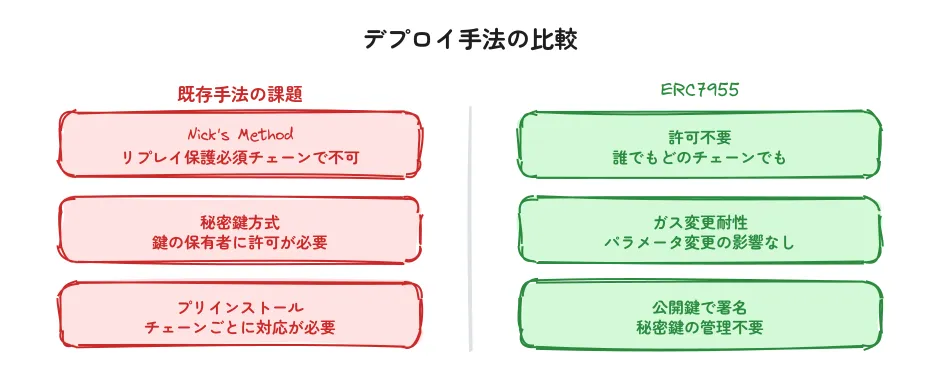
ERC7955 proposes a fourth approach that addresses the limitations of all three methods. It offers the following advantages.
- Universality: anyone can execute the process on any compatible chain, ensuring deterministic smart contract deployment.
- Fault tolerance: deployment can be retried after errors such as out-of-gas failures or reverts.
- Permissionlessness: no permission is required to deploy the CREATE2 factory.
| Criterion | Nick's Method | Private key approach | Preinstallation | ERC7955 |
|---|---|---|---|---|
| Permissionless | ✅ | ❌ | ❌ | ✅ |
| Resilient to gas changes | ❌ | ✅ | ✅ | ✅ |
| Cross-chain support | ❌ | ❌ | ❌ | ✅ |
| No private key custody required | ✅ | ❌ | ✅ | ✅ |
| Fault tolerance | ❌ | ❌ | ✅ | ✅ |
Specification
Terminology
The proposal uses the following key terms.
| Term | Description |
|---|---|
| Deployer | The account corresponding to DEPLOYER_PRIVATE_KEY (DEPLOYER_ADDRESS). Its private key is public. |
| CREATE2 factory contract | A contract that uses the CREATE2 opcode to deploy other contracts at deterministic addresses. |
| Bootstrap contract | The contract to which the deployer delegates through EIP7702. It performs the CREATE2 factory deployment. |
| Bootstrapping code | The core part of the bootstrap contract that executes the CREATE2 deployment. |
Parameters
ERC7955 defines the following parameters.
| Parameter | Value | Description |
|---|---|---|
DEPLOYER_PRIVATE_KEY |
0x942ba6... |
The deployer's private key, which is public. |
CREATE2_FACTORY_INIT_CODE |
0x7c6020... |
Initialization code for the CREATE2 factory. |
CREATE2_FACTORY_SALT |
0x0000...01bec5 |
Salt used for CREATE2 deployment. |
The following values are derived from these parameters.
| Derived parameter | Value | Description |
|---|---|---|
DEPLOYER_ADDRESS |
0x962560A0... |
The deployer's address, derived from the private key. |
CREATE2_FACTORY_ADDRESS |
0xC0DEb853... |
The address at which the CREATE2 factory is deployed. |
CREATE2_FACTORY_RUNTIME_CODE |
0x60203d3d... |
Factory runtime code (29 bytes). |
CREATE2_FACTORY_CODE_HASH |
0x2ad75e1e... |
The Keccak-256 hash of the runtime code. |
Bootstrap Contract
The bootstrap contract is central to the deployment process. It is the contract to which the deployer account delegates through EIP7702, and it executes the following bootstrapping code.
bytes memory initCode = CREATE2_FACTORY_INIT_CODE;
bytes32 salt = CREATE2_FACTORY_SALT;
assembly ("memory-safe") {
    create2(0, add(initCode, 32), mload(initCode), salt)
}
This code executes the CREATE2 opcode and deploys the CREATE2 factory using the specified initialization code and salt.
The bootstrap contract can also implement additional functionality.
- Check whether the CREATE2 factory is already deployed and whether the deployer's delegation is set correctly, returning early where appropriate.
- Perform additional checks to verify that deployment succeeded as expected.
- Emit events to track deployment of the bootstrap contract or CREATE2 factory.
Deployment Process
The following diagram shows the full deployment flow.
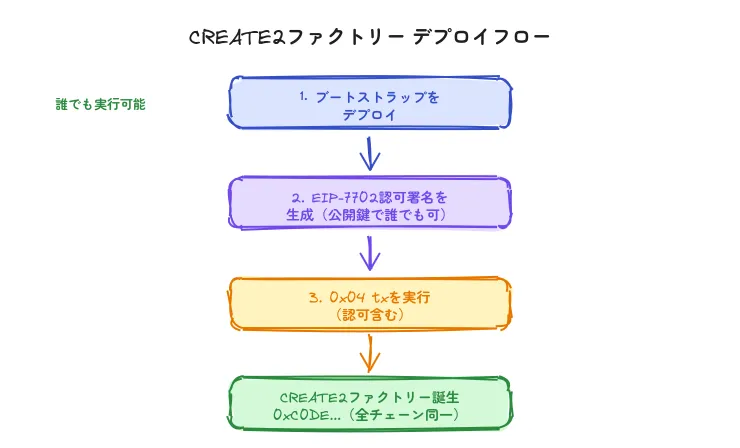
The CREATE2 factory is deployed in three steps.
- Deploy the bootstrap contract Deploy a contract containing the bootstrapping code described above.
- Sign the EIP7702 authorization
Use
DEPLOYER_PRIVATE_KEYto generate an EIP7702 signature authorizing delegation to the bootstrap contract. - Execute the EIP7702 transaction
Execute a type
0x04transaction containing the authorization from step 2. The transaction callsDEPLOYER_ADDRESSdirectly or indirectly, executingCREATE2in the context of the account delegated to the bootstrap contract. The reference implementation calls the deployer indirectly through the bootstrap contract as an entry point, allowing preliminary checks to mitigate gas griefing.
sequenceDiagram
    participant Anyone as 誰でも
    participant Bootstrap as ブートストラップ
    participant Deployer as デプロイヤー<br/>(0x9625...)
    participant Factory as CREATE2ファクトリー<br/>(0xC0DE...)

    Anyone->>Bootstrap: 1. ブートストラップをデプロイ
    Anyone->>Deployer: 2. EIP-7702 認可署名を生成
    Anyone->>Bootstrap: 3. 0x04 tx実行(認可含む)
    Bootstrap->>Deployer: deploy()を呼び出し
    Deployer->>Factory: CREATE2で生成
    Note over Factory: 固定アドレスに<br/>ファクトリーが誕生
Once the bootstrapping code executes successfully, the CREATE2 factory is deployed at CREATE2_FACTORY_ADDRESS.
How the CREATE2 Factory Works
The deployed CREATE2 factory accepts salt || init_code (a 32-byte salt concatenated with initialization code) as calldata.
It executes CREATE2 with the specified salt and initialization code, deploying the contract at keccak256(0xff || CREATE2_FACTORY_ADDRESS || salt || keccak256(init_code))[12:].
On success, it returns the deployed contract's address padded to 32 bytes. If execution of the initialization code fails, the revert data is propagated to the caller unchanged.
For compatibility, the CREATE2 factory's runtime code uses RETURNDATASIZE (0x3d) to push zero onto the stack instead of PUSH0 (0x5f).
This ensures compatibility with chains that support EIP7702 but do not support EIP3855 (the EIP that introduced PUSH0).
Additional Considerations
Why Use a Public Private Key?
In the ERC7955 deployment mechanism, DEPLOYER_PRIVATE_KEY is public.
This is intentional: anyone can use the key to generate an EIP7702 authorization signature for the deployer account and deploy the CREATE2 factory on any compatible chain.
With Nick's Method, no private key is known, so new signatures cannot be generated. However, the keccak(MAGIC || rlp([chain_id, address, nonce])) EIP7702 authorization message requires a fixed address.
Fixing the address would require a contract containing specific code to exist at the same address across chains, which is precisely the bootstrap problem the CREATE2 factory is meant to solve.
This chicken-and-egg problem makes Nick's Method unsuitable for generating EIP7702 authorization signatures.
Frontrunning Considerations
Because DEPLOYER_PRIVATE_KEY is public, a malicious third party could sign a different delegation or transaction and frontrun the legitimate CREATE2 factory deployment.
Frontrunning increments the deployer account's nonce and invalidates the EIP7702 authorization.
The proposal does not consider this a severe problem for the following reasons.
- An attacker can delay deployment but cannot prevent it permanently without continuing the attack. Sustaining an attack incurs gas costs.
- The harm is limited to gas consumption by the account attempting deployment (gas griefing). The reference implementation is designed to minimize the impact of gas griefing.
- Persistent attacks can be mitigated using private transactions or direct coordination with block builders.
Why This Salt Was Chosen
CREATE2_FACTORY_SALT was selected by starting from 0 and choosing the first value for which the CREATE2 factory's ERC55 checksummed address begins with 0xC0DE....
Making the vanity address mining procedure verifiable rules out the possibility of the ERC authors exploiting a hash collision in the CREATE2 factory address, according to the proposal.
How the Deployer's Private Key Was Chosen
DEPLOYER_PRIVATE_KEY is derived from the mnemonic make code code code code code code code code code code coconut using the derivation path m/44'/60'/0'/0/0.
Why Multiple Transactions Are Required
An EIP7702 type 0x04 transaction does not allow the to field to be null.
It is therefore impossible to deploy the bootstrap contract and delegate to it in a single transaction.
The process requires two stages: deploy the bootstrap contract first, then send the EIP7702 transaction.
Why Use an Intermediate CREATE2 Factory?
The deployer account can execute arbitrary CREATE2 deployments, so it could deploy contracts directly without an intermediate CREATE2 factory.
However, direct deployment has two problems.
- Every deployment is exposed to frontrunning risk.
- EIP7702 authorizations increment the nonce, so concurrent deployments can encounter nonce conflicts.
Using an intermediate CREATE2 factory confines the frontrunning risk associated with the public deployer key to the factory's initial deployment. Subsequent deployments can then be performed through the factory.
Compatibility
The proposal has several compatibility considerations.
- It can only be used on chains where EIP7702 is enabled. Chains that do not support EIP7702 cannot use this deployment method.
- Because it deploys a different contract from existing CREATE2 factories, tooling must support the new factory.
- Some existing CREATE2 factories return created contract addresses as unpadded 20-byte values, whereas the proposed factory pads them to 32 bytes.
- Some existing CREATE2 factories revert with empty data when initialization code fails, whereas the proposed factory propagates the revert data unchanged.
Reference Implementation
The following is a reference implementation of the bootstrap contract.
Calling deploy() with the EIP7702 authorization deploys the CREATE2 factory.
contract Bootstrap {
    address private constant _DEPLOYER_ADDRESS = 0x962560A0333190D57009A0aAAB7Bfa088f58461C;
    address private constant _CREATE2_FACTORY_ADDRESS = 0xC0DEb853af168215879d284cc8B4d0A645fA9b0E;
    bytes32 private constant _CREATE2_FACTORY_CODE_HASH =
        hex"2ad75e1e9642e6fce7d293d52fa5a8f62a79a2079abb7402256add02d6e8bc30";
    bytes private constant _CREATE2_FACTORY_INIT_CODE =
        hex"7c60203d3d3582360380843d373d34f5806019573d813d933efd5b3d52f33d52601d6003f3";
    bytes32 private constant _CREATE2_FACTORY_SALT =
        hex"000000000000000000000000000000000000000000000000000000000001bec5";

    error InvalidDelegation();
    error CreationFailed();

    function deploy() external {
        if (_CREATE2_FACTORY_ADDRESS.codehash == _CREATE2_FACTORY_CODE_HASH) {
            return;
        }

        bytes32 delegation = keccak256(abi.encodePacked(hex"ef0100", this));
        require(_DEPLOYER_ADDRESS.codehash == delegation, InvalidDelegation());

        Bootstrap(_DEPLOYER_ADDRESS).bootstrap();
    }

    function bootstrap() external {
        bytes memory initCode = _CREATE2_FACTORY_INIT_CODE;
        bytes32 salt = _CREATE2_FACTORY_SALT;

        address factory;
        assembly ("memory-safe") {
            factory := create2(0, add(initCode, 32), mload(initCode), salt)
        }

        require(factory == _CREATE2_FACTORY_ADDRESS, CreationFailed());
    }
}
The deploy() function first checks whether the CREATE2 factory is already deployed and returns early if it is.
It then verifies that the deployer account has delegated correctly to the bootstrap contract.
If verification succeeds, it calls bootstrap() and deploys the factory using CREATE2.
These preliminary checks minimize unnecessary gas consumption when the factory is already deployed or the deployer's delegation is incorrect, reducing the impact of frontrunning-related gas griefing.
Minimal Bootstrap
A minimal bootstrap contract that omits the preliminary checks can also be implemented.
This approach calls DEPLOYER_ADDRESS directly, but carries a higher risk of gas griefing.
contract MiniBootstrap {
    bytes private constant _CREATE2_FACTORY_INIT_CODE =
        hex"7c60203d3d3582360380843d373d34f5806019573d813d933efd5b3d52f33d52601d6003f3";
    bytes32 private constant _CREATE2_FACTORY_SALT =
        hex"000000000000000000000000000000000000000000000000000000000001bec5";

    fallback() external {
        bytes memory initCode = _CREATE2_FACTORY_INIT_CODE;
        assembly ("memory-safe") {
            pop(create2(0, add(initCode, 32), mload(initCode), _CREATE2_FACTORY_SALT))
        }
    }
}
The fallback() function simply executes CREATE2 directly.
Unlike the full Bootstrap implementation, it has no existing-deployment check or delegation verification, so gas can be consumed even when deployment is unnecessary.
Security
Frontrunning Attacks
Because DEPLOYER_PRIVATE_KEY is public, an attacker can frontrun a deployment with a transaction that invalidates the deployer's EIP7702 delegation and causes deployment to fail.
However, the attacker's only benefit is a delay in deployment relative to the gas cost they incur, so the incentive is limited.
Persistent attacks can be mitigated by using private transaction queues or working directly with block builders to prevent the EIP7702 bootstrapping transaction from being frontrun.
Effects of Future Network Upgrades
If a future network upgrade introduces an opcode or transaction type that permanently sets account code, this method might stop working.
Since DEPLOYER_PRIVATE_KEY is public, a malicious third party could permanently set the deployer account's code to something that does not contain the bootstrapping code.
However, if ERC7955 is widely adopted, deployment on Ethereum mainnet will already be complete and the private key will no longer be useful for that purpose.
For other chains, adopting an RIP can ensure that the correct code is preinstalled at CREATE2_FACTORY_ADDRESS.
References

Conclusion
This article covered permissionless CREATE2 factory deployment under ERC7955.
As multichain development becomes more common, so does the need to deploy contracts at the same address across chains. By combining a public private key with EIP7702, ERC7955 addresses the limitations of existing approaches and allows anyone to deploy the CREATE2 factory on compatible chains.
If you have questions, feel free to reach out via Twitter DM.
You can also find my work on the following platforms.


