Introduction
Hi, I'm cardene, a software engineer and technical writer focused on blockchain and AI.
I've also authored Japanese technical books on specification-driven development with LLMs and decentralized application (DApp) development.

I also build and publish a variety of tools, libraries, and open-source projects.
This article explores ACP, a protocol that supports purchasing products through AI agents.
Using a running-shoe purchase as an example, we will follow how the buyer, agent, merchant, and payment processor work together from product selection to order placement.
The original illustrations and interactive example retain Japanese labels.
What Is ACP?
ACP is a protocol that lets AI agents and merchants exchange purchase information and purchasing operations in a common format.
Its full name is Agentic Commerce Protocol.
It defines the data and operations for selecting product candidates, reviewing purchase terms, obtaining buyer approval, and proceeding to an order.
When merchants expose purchase APIs in different formats, agents must adapt how they read product information and amounts and update purchase details for each integration. ACP standardizes purchase information exchanged with agents, allowing merchants to receive purchase requests while retaining their own inventory management and payment infrastructure. It enables an additional purchasing channel alongside an existing online store, where buyers tell an agent what they want, select products, and make purchases.
The price displayed when a product is discovered does not determine the actual amount payable. Shipping and tax may vary by delivery address, and a product may go out of stock during the search. The merchant therefore calculates the latest sales terms, and the AI agent presents the returned details to the buyer.
The official repository publishes the specification as a beta.
The Four Parties and Their Roles
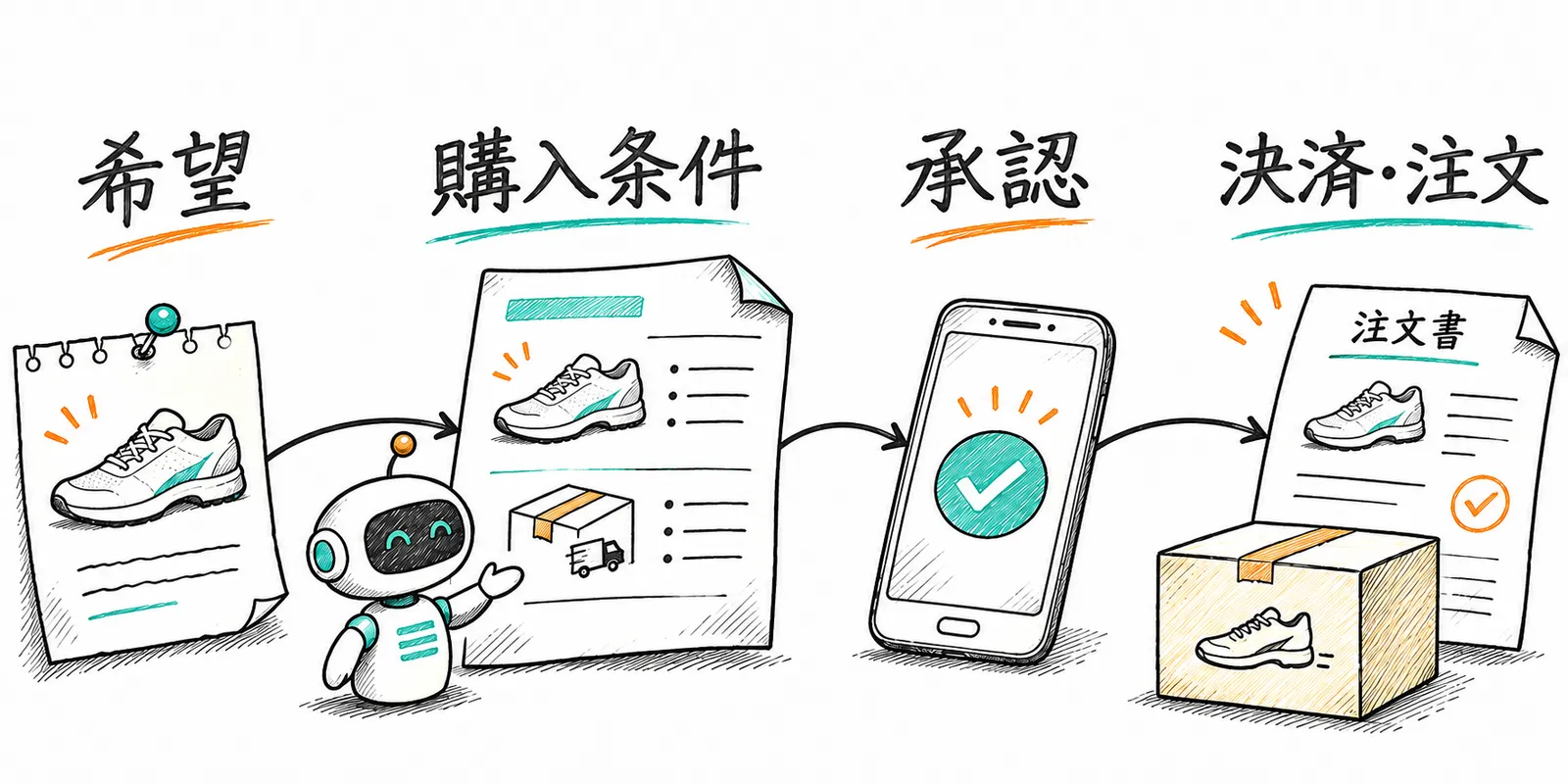
A purchase starts with the buyer's preferences and approval. The AI agent searches for products based on those preferences and sends the intended quantity and delivery address to the merchant. When the merchant returns the purchase terms, the agent displays the total and delivery method for the buyer to review.
Even after the buyer approves payment, the merchant remains responsible for setting product prices and determining stock availability. The merchant requests a charge from the payment processor, creates an order when payment succeeds, and ships the product. The payment processor handles the payment method and validates restrictions on delegated payment, such as the amount and expiration.
This division of responsibilities allows the agent to carry out purchasing operations while obtaining sales terms from the merchant and payment restrictions from the payment processor. The buyer selects and approves the purchase based on the information collected by the agent.
What ACP Standardizes
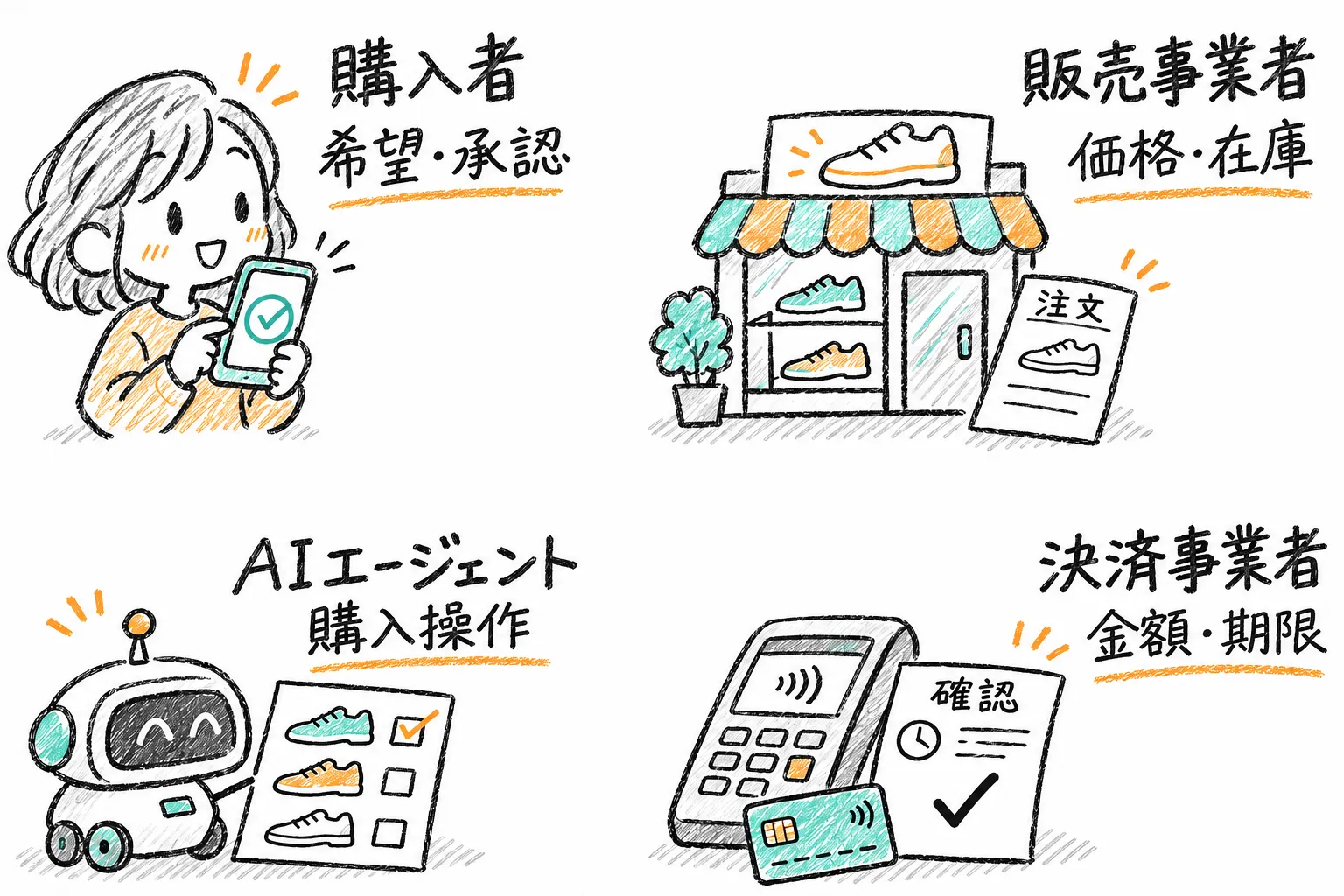
For a merchant and an agent to work together, they must exchange product identifiers, requests to update purchase details, and responses indicating that an order has been placed in a format both can understand.
ACP standardizes these purchasing interactions.
The merchant's own systems, however, remain responsible for the product database, inventory allocation, and tax calculation.
For example, the AI agent does not directly operate the process by which a merchant checks remaining stock in its inventory system. The agent sends the desired product and quantity, and the merchant checks inventory and returns the available purchase details. The existing commerce infrastructure is retained while interactions with the agent use a common format.
Following a Single Purchase
The recipient verifies notification signatures to authenticate the sender and check whether the notification contents have been altered.
The data that the merchant returns to describe the products being purchased, amounts, and processing state is called a checkout session. One payment path uses a token that combines payment credentials with restrictions on the amount and permitted scope of use. The example below follows that path, using a checkout session and a payment token to place an order.
Suppose a buyer asks an agent to purchase white running shoes for no more than ¥20,000, including shipping. After a suitable product is found, the merchant calculates the purchase details, and the buyer reviews and approves the terms. In this example, payment uses a delegation path to obtain a token with usage restrictions. Assume the merchant offers express shipping, standard shipping, and in-store pickup, and that all amounts include tax. In the interactive diagram, you can change the quantity, delivery method, and budget, approve the latest terms returned by the merchant, and try completing the purchase. Changing the purchase terms after approval invalidates the previous approval. You can also switch between payment declines and lost responses to see the difference between the merchant's order state and the agent's knowledge of that state.
- 注文フロー
配送や数量を変えて最新の購入条件を承認してみてください。
Selecting a Product
The agent checks colors, sizes, and price ranges in the product information and presents candidates to the buyer. When the buyer makes a selection, the agent adds the merchant's product ID and quantity to the purchase candidates. Even if the displayed price is within budget at this stage, the total including shipping has not been finalized.
Finalizing Purchase Terms
The agent sends the product and quantity to the merchant to create a checkout session. When a delivery address or shipping method is added, the merchant checks inventory again and returns complete purchase details, including shipping and tax. The agent retains the session ID and presents the response to the buyer.
If the total exceeds ¥20,000, the agent does not immediately send a completion request. It asks the buyer whether to change the delivery method or product, or cancel the purchase. If the product is out of stock, the process also returns to the decision about selecting another product.
Separating and Delegating Permissions
If access to the buyer's account is needed, the agent uses authorization for the permitted operations. For payment, it separately obtains a token restricted to the purchase in question and a maximum amount. The association between the checkout session and the merchant that will receive the token is also checked here.
Completing Payment and Creating the Order
When the buyer approves the latest purchase terms, the agent sends the merchant a completion request with the payment token. The merchant requests payment from the payment processor, which validates the restrictions and processes the charge. If payment succeeds, the merchant creates the order, and the agent returns order information to the buyer.
If payment fails and the session returns to a state where payment can be attempted, the agent and buyer decide whether to change the payment method or stop. If the response is lost, the agent checks the latest checkout state rather than immediately assuming that no order was created. To avoid completing the same purchase twice, retries use a key identifying the same request.
Receiving Post-Order Updates
When the shoes are shipped, the merchant sends an order update notification. The recipient verifies the signature and updates the order information, allowing the agent to report delivery status in the conversation where the purchase was made. If a cancellation or refund occurs, the result is also associated with the order and communicated to the buyer.
From Product Discovery to Order Tracking
Completing a purchase requires both a mechanism for updating purchase details and a way to pay within the approved scope.
The official ACP architecture separates these into two specifications: Agentic Checkout and Delegate Payment.
The former defines checkout interactions between agents and merchants, while the latter defines how to obtain restricted payment tokens.
Stripe's explanation, on the other hand, describes the entire purchase journey using five components, including product discovery and post-order updates. The two specifications and five components cover different scopes.
Cart & Feed
When agents search for products matching a buyer's preferences, they receive product information from merchants. Separating information used to discover candidates from information recording the selected candidates lets the process move from search results to confirmation of purchase terms.
Product Feed
A Product Feed is structured data that merchants provide for product discovery.
Agents use descriptions and images to find suitable products, narrowing down candidates based on price and inventory information.
However, listed prices and availability are information for selecting candidates; they must be checked again with the merchant at checkout.
Cart
After a product is selected, the agent sends the product ID and quantity to the merchant.
A Cart is data maintained by the merchant to hold candidates before checkout.
The April 17, 2026 version of the Cart API provides create, retrieve, update, and cancel operations, and the merchant returns information such as the cart identifier and estimated amounts.
When buyers change quantities, they can update the saved cart and review their selected items. Formal purchase terms reflecting the delivery address and shipping costs are confirmed during checkout.
Agentic Checkout
After receiving the purchase candidates, the merchant checks the products and quantities and returns the amounts based on the delivery address and selected shipping method.
If the buyer changes the shipping method, the agent sends the change to the merchant and receives recalculated details.
The operations taking a purchase from its initial creation to order placement are called Agentic Checkout.
Checkout Session
The data that the merchant returns to describe purchase details and processing state is called a Checkout Session.
It includes products and amounts, as well as shipping methods and payment requirements.
To continue updating the same purchase, the agent uses the session ID issued by the merchant.
Responses contain the complete current session rather than only the changed fields, and the agent uses that information for display and decision-making.
For example, if changing the delivery address increases shipping costs, the agent does not complete the purchase using an outdated total. It presents the merchant's latest total to the buyer and proceeds with payment under those terms.
Five Operations
The operations an agent requests from a merchant differ depending on whether it is starting, changing, or ending checkout. Each operation is associated with a session ID and updates the state of the same purchase.
| Operation | Agent request | Merchant processing |
|---|---|---|
| Create | Send products and quantities | Create purchase details and return an ID |
| Retrieve | Specify the session ID | Return the latest purchase details |
| Update | Send changes to the delivery address or quantities | Recalculate the sales terms |
| Complete | Send payment information | Process payment and create an order |
| Cancel | Specify the session to end | Cancel the checkout process |
These operations allow agents to supply missing information during checkout, review the revised terms, and then request completion.
In the April 17, 2026 Checkout API definition, the create example uses items, while the request schema uses line_items; the example and schema are inconsistent.
When implementing an integration, compare the request schema of the chosen version with the integration contract rather than simply copying and sending the example.
Capability Negotiation
Even when a merchant requires cardholder verification, the agent's interface may not be able to display the required interaction.
The agent therefore sends the verification methods it supports in capabilities.
The merchant returns the capabilities supported by both parties and identifies the verification methods required for that purchase.
If the agent can display cardholder verification, it might specify the supported method in the request's capabilities as follows.
{
  "interventions": {
    "supported": ["3ds"]
  }
}
interventions describes support for interactions requiring the buyer's involvement.
Each element in supported specifies a verification method the agent can present, and 3ds represents cardholder authentication.
The merchant compares this declaration with the methods it supports and includes the verification methods required for the purchase in its response.
For example, if the merchant requires 3D Secure cardholder authentication, the agent must be able to present that interaction to the buyer.
If it cannot, the agent does not send a completion request and instead informs the buyer that the required authentication is unsupported.
A self-declared capability alone is not proof of authentication; the merchant also validates the authentication and payment requirements.
Checkout Session States
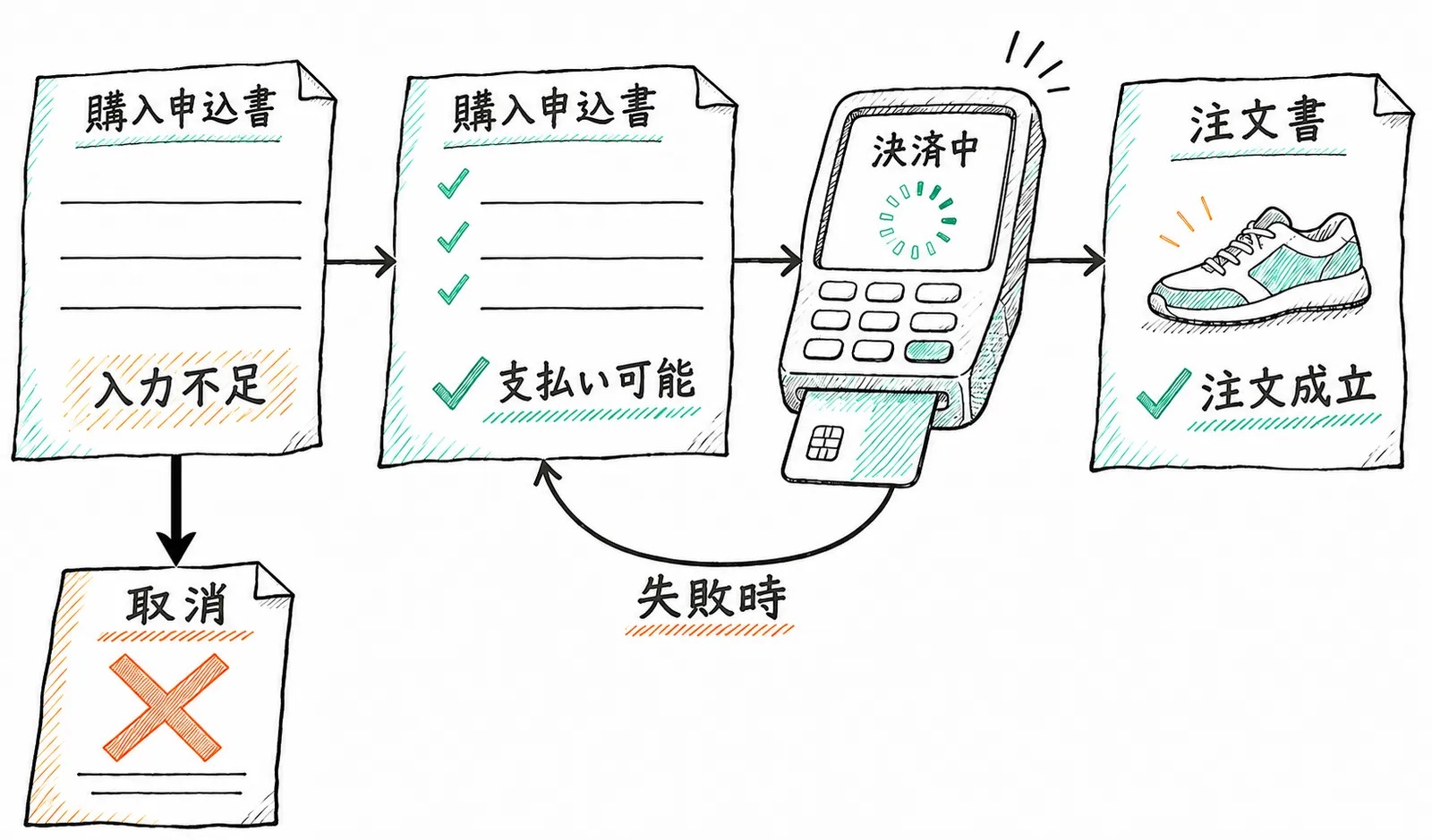
The merchant returns named states indicating whether the required input is complete, payment is being processed, or an order has been placed. The agent uses these values to decide whether to request missing information or proceed with payment.
| State | Meaning | Agent decision |
|---|---|---|
not_ready_for_payment |
Required input is missing | Read the messages and supply the missing information |
ready_for_payment |
Payment can proceed | Confirm purchase terms and obtain approval |
in_progress |
Payment is being processed | Check the processing result |
completed |
Payment succeeded and an order was created | Show order information to the buyer |
canceled |
The session ended due to cancellation or expiration | Do not resume the purchase in the same session |
Details about missing input are communicated through messages rather than by introducing additional state names for each missing field.
If payment fails, the session may return from the processing state to ready_for_payment.
By contrast, completed and canceled are terminal states.
A refund after purchase is tracked separately from an operation that would move a completed session back to a canceled state.
This table presents the five basic states in the official lifecycle explanation.
The April 17, 2026 API definition also includes additional states such as authentication_required and pending_approval.
Do not reduce every response from an integration to these five basic states; implement handling for responses that require authentication or approval.
Delegate Authentication
When accessing a buyer's account, the agent operates within the scope authorized by the buyer.
Stripe's ACP overview identifies OAuth 2.0 as a mechanism for delegating that authorization.
It allows users to authorize another application to perform permitted operations.
Meanwhile, the April 17, 2026 Delegate Authentication API defines an API for delegating cardholder authentication to an authentication provider specified by the merchant.
It provides operations to create an authentication session, request authentication, and retrieve its result, with 3D Secure as the cardholder authentication mechanism.
Read the OAuth authorization delegation in Stripe's overview separately from the cardholder authentication defined by this API, because their scope and operations differ.
Permission to access a buyer's account, the result of cardholder authentication, and permission to pay a particular amount are distinct things to verify. Authentication and authorization results and the payment token's usage restrictions are validated in their respective processes.
Delegate Payment
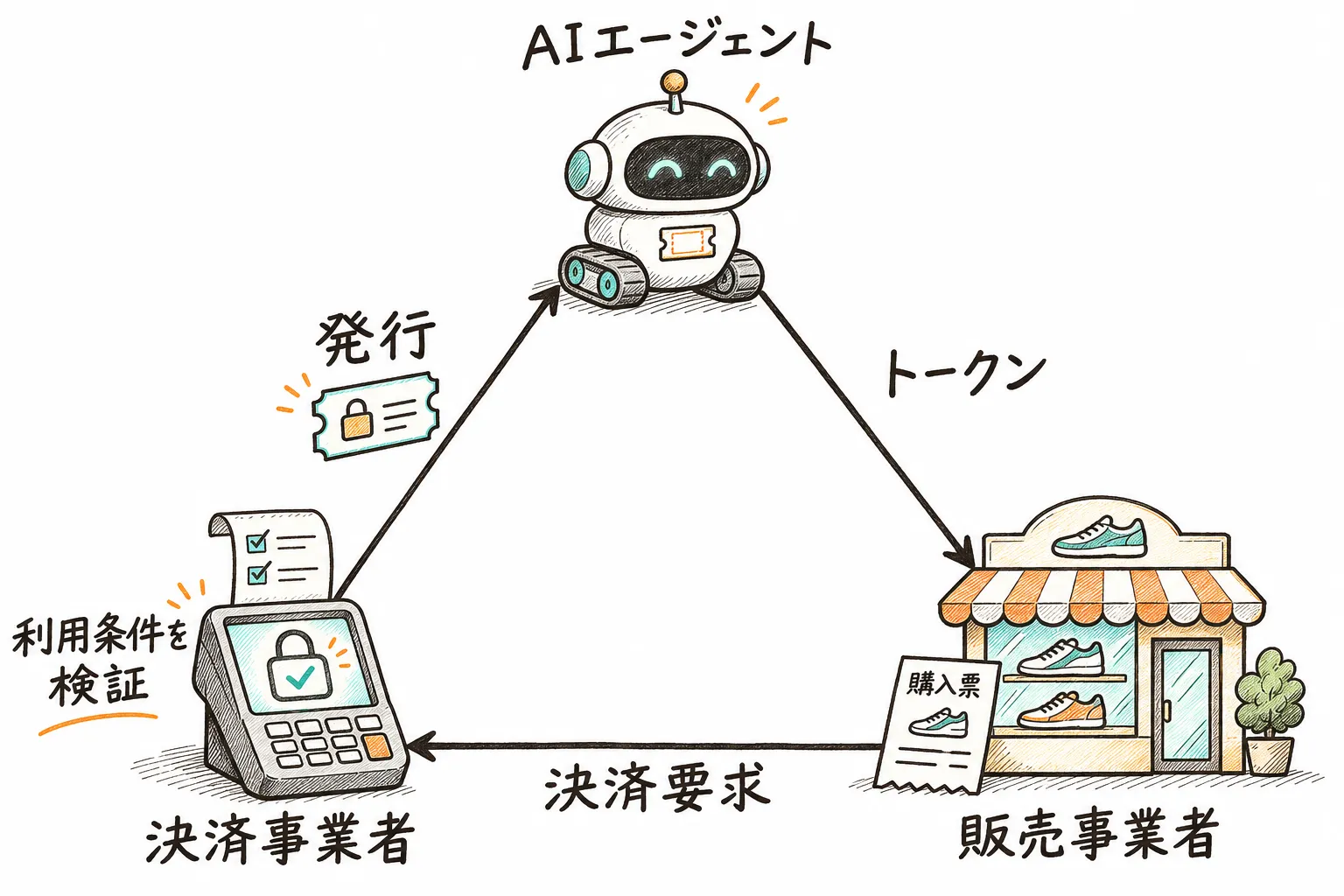
To complete a purchase, the agent supplies payment information that the merchant can process.
Delegate Payment is the mechanism for converting payment credentials into a token with usage restrictions.
When issuing the token, the applicable purchase and maximum amount are specified.
Whether this payment delegation path is used depends on the payment processing method indicated by the checkout session.
The agent checks requires_delegate_payment in the payment processing method definition, which indicates whether delegation is required.
It prepares payment information according to the method specified by the merchant.
Usage Restrictions (Allowance)
An Allowance is the data describing restrictions on the use of a payment token.
By constraining the available amount and scope, the buyer-approved limits can be verified when processing payment.
| Field | Restriction |
|---|---|
max_amount |
Maximum amount that can be paid |
currency |
Payment currency |
checkout_session_id |
Applicable checkout session |
merchant_id |
Applicable merchant |
expires_at |
Token expiration |
reason |
Purpose of delegation |
Amounts are expressed in the currency's smallest unit. The payment processor checks whether a charge complies with these conditions. In addition to the agent remembering the budget in the conversation, the party processing payment retains restrictions on the amount and scope.
Even if an amount is within budget, the token cannot be used for payment to a different merchant or after expiration. The budget communicated by the buyer in the conversation is also distinct from the maximum payment amount enforced by the token.
Risk screening
In payment delegation, information used for fraud assessment is passed in an array called risk_signals.
Each element contains risk assessment information, separate from the Allowance that specifies the merchant and maximum amount.
This makes it possible to evaluate the permitted scope of token use separately from the decision to reject a request as fraudulent.
The April 17, 2026 API definition requires risk_signals, but does not specify a minimum number of array elements.
The reference documentation current at the time of the original article, however, requires at least one entry.
Given this difference, do not assume that an integration accepts an empty array; check the chosen version and the integration's requirements.
Shared Payment Token
Stripe's Shared Payment Token provides access to a stored payment method under restrictions such as an amount and expiration.
The merchant uses the received token to process a payment through Stripe.
It is an implementation that maps ACP's payment delegation model to Stripe's concrete token and payment APIs.
Orders & Webhooks
When a purchase is completed, the merchant creates an order.
The data representing the placed order is called an Order and is associated with the checkout session ID.
After checkout operations finish, the order is used to track shipment and refunds.
A Webhook is the mechanism by which a merchant notifies an agent-side recipient of order creation and updates.
Notifications include an HMAC signature in the Merchant-Signature header, and the recipient uses a shared secret to authenticate the sender and verify the contents.
The notification's data contains the complete order data rather than only the changed fields.
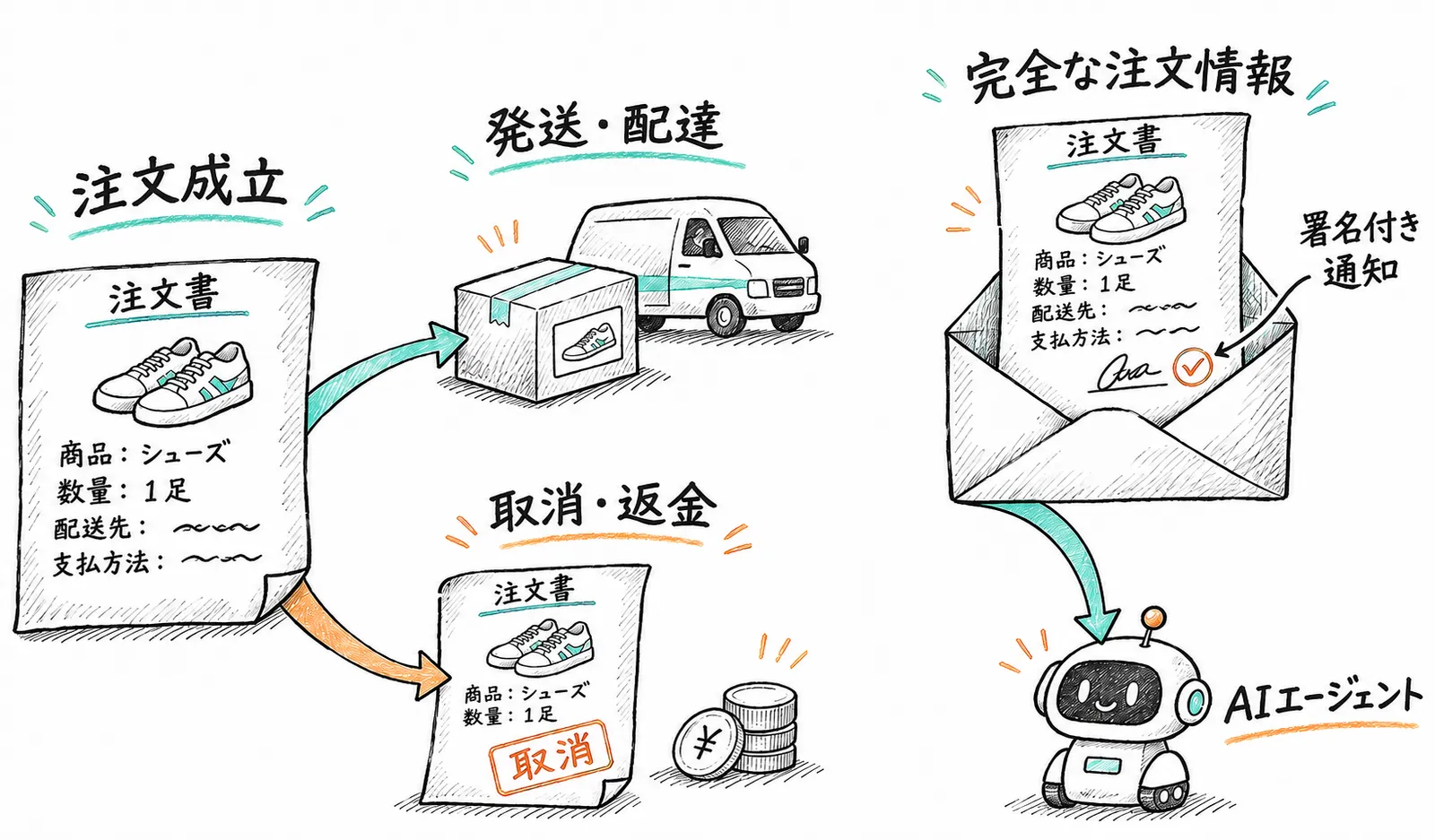
However, receiving a complete order does not by itself resolve duplicate notifications or older notifications arriving late. In addition to verifying signatures, the recipient must design duplicate and ordering handling according to the integration contract. Do not assume that notifications are received in the same order in which the order was updated.
Boundaries Between ACP and Related Technologies
Building a purchasing channel for agents involves combining commerce APIs, payment APIs, and integration protocols for AI. Which processes remain with existing infrastructure and which conform to ACP can be distinguished by the data exchanged and the results each process establishes.
Conventional E-Commerce APIs
Conventional e-commerce APIs can also implement product search, cart updates, and order creation. Their formats and operations are determined by each merchant's integration contract. With ACP, checkout sessions, capability negotiation, and payment delegation for agent integrations can follow a common model.
However, implementing a common format does not make inventory checks or shipping terms identical across merchants. The agent proceeds with the purchase based on the sales terms and supported capabilities returned by each integration.
Stripe API
In ACP, the agent sends purchase details and payment information to the merchant.
A merchant using Stripe as its payment processor uses that information to process the charge through the Stripe API.
The interactions that establish purchase terms with the buyer are thus connected to the charge request sent to the payment infrastructure.
Agentic Commerce Suite
Stripe's Agentic Commerce Suite is a set of products and services connecting agent-driven product discovery and purchasing to Stripe's infrastructure.
ACP is a protocol defining the purchase information and operations exchanged between parties.
When adopting ACP, distinguish an implementation that directly supports the protocol from the scope of integration assistance offered by the product.
MCP
The integration protocol that enables AI applications to use external tools and data is the Model Context Protocol, or MCP.
For example, it can be used to expose product search and purchase updates as tools to AI applications.
The commerce-specific data and operations, such as what to include in a checkout session and when to create an order, are implemented according to the ACP contract.
How ACP Could Change E-Commerce
Alongside the conventional path in which buyers navigate a merchant's website, another path is possible: buyers communicate their preferences to an agent and delegate comparisons and confirmation of purchase terms. If merchants provide product information and purchase APIs, agents can use that information to present candidates to buyers. In addition to product pages viewed by people, updates to machine-readable product information can affect purchasing decisions.
These are potential design changes arising from standardized product information and purchasing operations. ACP does not guarantee how much sales volume will come through agents or how visits to commerce websites will change. Merchants incorporate decisions about which information to provide and what must be reconfirmed before purchase into their own commerce infrastructure.
Design Considerations for Adoption
When implementing checkout interactions, prevent completion at outdated prices, excessive payment permissions, and duplicate purchases after communication failures. Purchase terms, authorization, retries, and post-order updates are checked in their respective processes.
Maintain a Single Authoritative State
Use the merchant's response containing recalculated prices and inventory information for both display and purchase decisions. Even if the agent retains information from product discovery, do not overwrite updated purchase details with outdated values. If the terms change, present the updated details to the buyer.
Separate Authorization From Payment
Credentials for invoking an API, buyer authentication, and payment token usage restrictions are distinct things to verify. Access to the purchase API alone does not imply that authentication or maximum payment amount checks have been completed. The merchant and payment processor each validate the conditions required for their own operations.
Make Retries Safe
If communication is interrupted after a checkout completion request is sent, the agent may not receive the processing result.
When resending the same request, use an Idempotency-Key to identify it as the same operation.
Idempotency is the property that repeating the same request does not duplicate side effects such as creating an order or executing a payment.
Reuse the key when resending the same JSON body to the same endpoint.
Do not submit a request with modified products or amounts using the old key.
The April 17, 2026 Checkout API definition requires this key for POST requests, which differs from the optional-header notation in the documentation current at the time of the original article. Follow the requirements of the version you adopt.
Separate Post-Order States
Completion of a checkout session means that an order has been created. Subsequent shipment, delivery, and refunds are tracked on the order side. Do not display delivery as completed merely because checkout has been completed.
The Essence of ACP
ACP allows an agent acting on a buyer's preferences to place an order using the merchant's purchase API and a supported payment method. After discovering products, the agent checks the sales terms, obtains buyer approval, and provides payment information the merchant can process. Once the order is placed, the agent communicates updates from the merchant to the buyer.
Throughout this process, the merchant checks prices and inventory, and the payment processor validates payment restrictions. As the range of purchasing operations performed by agents expands, implementation decisions increasingly revolve around which response represents the authoritative purchase details and under which conditions a completion request can be sent.
Conclusion
With ACP, an AI agent updates purchase details with the merchant and places an order after buyer approval and payment through a method supported by the merchant. Tracking the checkout session and the order separately makes it possible to identify who returns which information, from changes before purchase through shipment and refunds.
The official ACP documentation describes operations for checkout, payment delegation, and order updates.
The specifications in the official repository describe the required fields and state values for the version being adopted.

Stripe's agentic commerce documentation describes its products and tokens.
The official documentation describes MCP, the protocol responsible for connecting external tools.