Introduction
Hi, I'm cardene, a software engineer and technical writer focused on blockchain and AI.
I've also authored Japanese technical books on specification-driven development with LLMs and decentralized application (DApp) development.

I also build and publish a variety of tools, libraries, and open-source projects.
This article examines ERC7588, a proposal to store JSON metadata in the data field of EIP4844 blob transactions so that information about blob contents and their originators can be managed consistently.
This article explains the proposal linked below.

I also cover other EIPs, BIPs, SLIPs, CAIPs, ENSIPs, RFCs, and ACPs.

Overview
ERC7588 defines a standard JSON Schema for attaching metadata to EIP4844 blob transactions.
For background on EIP4844, see the following article.
https://qiita.com/cardene/items/f40df7c30a3ad5e20a71
By storing structured metadata in a blob transaction's data field, applications can represent information about blob contents, originators, and MIME types in a consistent format. The data field has typically gone unused in blob transactions, and ERC7588 standardizes a way to use that space to record important information about the blobs themselves.
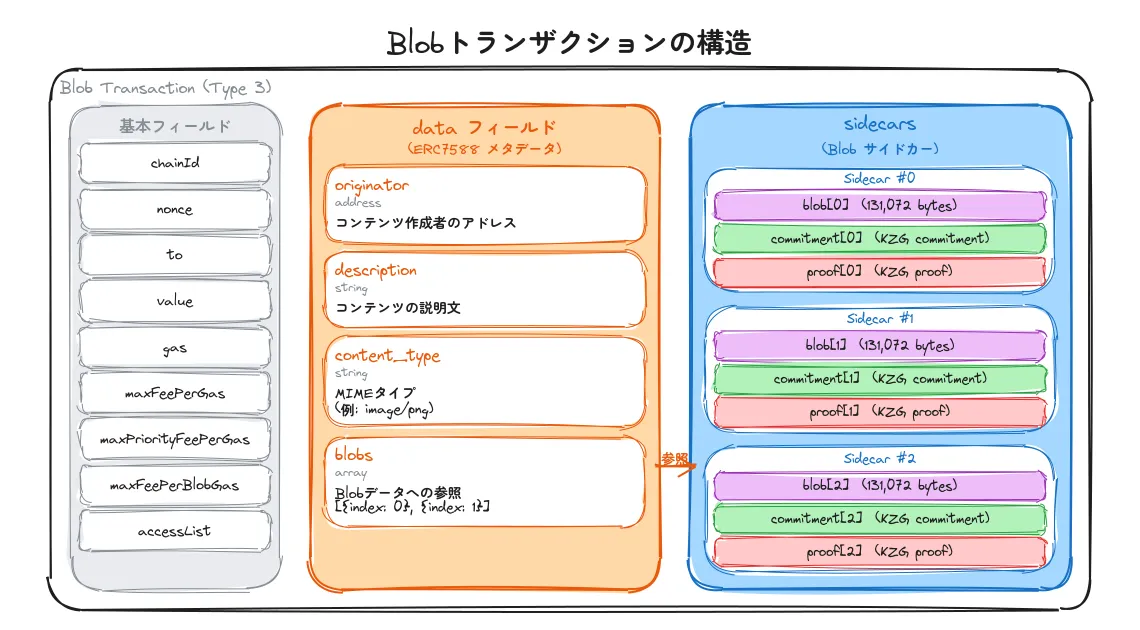
The original illustration is retained and may contain Japanese labels.
Motivation
Several problems motivated the proposal.
Blob transactions defined by EIP4844 allow rollups to post layer-2 transaction data to Ethereum layer 1. These transactions carry blobs together with KZG commitments and proofs. Rollups generally manage the blob transactions they submit themselves, but third-party services such as Portal Network and Blobscan may also index blobs posted to Ethereum and offer query services.
Limited visibility and auditability
Although the blob transactions introduced by EIP4844 include KZG commitments and proofs, they lack information about the contents and originators of the blobs. When third-party services such as Portal Network and Blobscan index blobs and provide query services, the absence of metadata such as originator information, descriptions, and content types limits visibility and auditability.
Challenges for decentralized storage applications
When decentralized storage applications use blob transactions to post user data to Ethereum and synchronize and store it off-chain, there is no standard way to identify the contents of a blob. This makes subsequent discovery and management difficult.
Limitations for inscriptions and creative use cases
Without standardized metadata, compatibility and interoperability are limited when blobs are used for NFT inscriptions or other creative applications. Attaching metadata opens up new possibilities for inscriptions and other creative use cases.
Specification
Metadata JSON Schema
Metadata is represented as a JSON object conforming to the following JSON Schema.
{
    "title": "Blobs Metadata",
    "type": "object",
    "properties": {
        "originator": {
            "type": "string",
            "description": "Identifies the originator of the carried blobs"
        },
        "description": {
            "type": "string",
            "description": "Describes the contents of the blobs"
        },
        "content_type": {
            "type": "string",
            "description": "Describes the MIME type of the blobs. The MIME type should be defined in RFC 2046 (https://www.rfc-editor.org/rfc/rfc2046)"
        },
        "extras": {
            "type": "string",
            "description": "Dynamic extra information related to the blobs"
        },
        "blobs": {
            "type": "array",
            "description": "Metadata of the i'th blob. This is optional and overlays the upper level properties if provided",
            "items": {
                "description": {
                    "type": "string",
                    "description": "Describes the content of the i'th blob"
                },
                "content_type": {
                    "type": "string",
                    "description": "Describes the MIME type of the i'th blob. The MIME type should be defined in RFC 2046 (https://www.rfc-editor.org/rfc/rfc2046)"
                },
                "extras": {
                    "type": "string",
                    "description": "Dynamic extra information related to the i'th blob"
                },
            }
        }
    }
}
Property details
The following table describes each property in the metadata JSON object.
| Property | Type | Description |
|---|---|---|
originator |
string |
A string identifying the originator of the blobs. It can record the name of an individual, organization, or service. |
description |
string |
A string describing the overall contents of the blobs. It can freely describe their purpose or provide an overview. |
content_type |
string |
The MIME type of the blobs. Use a standard MIME type defined in RFC 2046 (such as text/plain or image/png). |
extras |
string |
Dynamic additional information relating to the blobs, used to store application-specific metadata. |
blobs |
array |
An array of individual blob metadata. It is optional and overrides the top-level properties when provided. |
Individual entries in the blobs array
| Property | Type | Description |
|---|---|---|
description |
string |
A string describing the contents of the ith blob. It overrides the top-level description for that individual blob. |
content_type |
string |
The MIME type of the ith blob. Use a value defined in RFC 2046 (such as text/plain or image/png). |
extras |
string |
Additional information relating to the ith blob. It can store arbitrary application-specific metadata. |
Implementation example
Suppose Vitalik submits a transaction containing two blobs about data availability sampling. If the first blob contains an explanatory text paragraph and the second contains an illustration, the metadata would look like this.
{
    "originator": "Vitalik Buterin",
    "description": "An illustration of data availability sampling",
    "blobs": [
      {
        "content_type": "text/plain",
        "description": "This blob contains a description text of the illustration."
      },
      {
        "content_type": "image/png",
        "description": "This blob contains the illustration image data in base64 format. It's a RFC 2397 (https://www.rfc-editor.org/rfc/rfc2397) data URL."
      }
    ]
}
Complete blob transaction example
A complete blob transaction containing the preceding metadata has the following structure.
{
  "blobVersionedHashes": ["0x...", "0x..."],
  "chainId": 11155111, // Supposing the blob transaction is posted to Sepolia
  "type": "eip4844",
  "to": "0x0000000000000000000000000000000000000000",
  "gas": 28236,
  "data": "0x..", // String representation of the above metadata JSON object
  "nonce": 18,
  "maxFeePerBlobGas": 1073677089,
  "maxFeePerGas": 1213388073,
  "maxPriorityFeePerGas": 1165808679,
  "sidecars": [
    { "blob": "0x...", "commitment": "0x...", "proof": "0x..." },
    { "blob": "0x...", "commitment": "0x...", "proof": "0x..." }
  ]
}
In this example, the string representation of the metadata JSON object above is UTF-8 encoded and stored in the data field.
Blob transaction envelope
The calldata (data field) of the blob transaction must be set to the UTF-8 encoded string representation of the metadata JSON object.
Encoding steps
The following steps provide some additional context.
-
Build the JSON Construct the metadata JSON according to the schema above.
-
Serialize Convert the JSON object into a string.
-
UTF-8 encoding Encode the JSON string as UTF-8 to produce a byte array.
-
Set the data field Set the transaction's data field to the encoded byte array.
Rationale
The core idea is to use the normally unused data field to store blob metadata. This approach improves the auditability and usability of blob transactions.
How the data field is used
In the Ethereum ecosystem, the data field serves different purposes depending on the transaction type.
| Transaction type | Purpose of the data field |
|---|---|
| Ordinary value transfer | Typically unused. Can optionally contain arbitrary data. |
| Smart contract deployment | Stores contract bytecode and constructor arguments. |
| Smart contract function call | Stores function call data containing the function signature and parameters. |
| Blob transaction | Typically unused. ERC7588 uses it to store metadata. |
Combining metadata with smart contract calls
Blob transactions were designed for posting blobs, and their data field is typically unused. ERC7588 proposes using this field to attach metadata to blobs, improving their auditability and usability.
An important caveat is that a blob transaction may also need to call a smart contract function. For example, a decentralized storage application might use a smart contract to track blob versioned hashes or metadata.
In such a case, the user can submit a transaction containing blobs and use the data field to call a smart contract function that stores the versioned hashes and MIME types.
ERC7588 does not address these specific use cases; it defines a standard dedicated to metadata storage.
Impact on gas costs
Including metadata in the data field may increase the gas cost of a blob transaction. This is because the data field contains more data.
Users and applications should balance the benefits of metadata against its cost and optimize its size and format to reduce gas expenses.
Practical use cases
ERC7588 enables several concrete use cases.
- Improved blob search services: Services such as Blobscan and Portal Network can search blobs by originator name or content type.
- Decentralized storage management: When integrating with IPFS or Arweave, applications can identify blob contents and formats in advance.
- NFT inscriptions: NFT data can be stored in blobs, with information about the artwork recorded in metadata.
- Data archiving: Large amounts of data, such as academic papers, images, and videos, can be stored in blobs and associated with searchable metadata.
Compatibility
Relationship with existing standards
ERC7588 is backward compatible with EIP4844. It does not change the structure or functionality of blob transactions; it only adds optional metadata. Blob transactions without metadata continue to be processed normally.
Security
The proposal concerns informational data that does not affect the execution or validity of blob transactions and therefore does not itself introduce new security risks or vulnerabilities. Nevertheless, users and applications should consider the following points.
Metadata reliability
Metadata is neither verified nor enforced by the consensus layer, so its accuracy and reliability are not guaranteed.
Users and applications should not rely on metadata for critical or sensitive operations and should always verify the contents and source of the blobs themselves. Metadata should be treated as supplementary information; the actual blob contents should be verified directly during processing.
Malicious data
Metadata may contain malicious or harmful data, including spam, phishing material, or malware.
Users and applications should not blindly trust or execute metadata and should always scan and sanitize it before use.
In particular, because the extras field can store arbitrary data, appropriate validation and sanitization must be implemented.
Increased gas costs
Metadata adds more data to the data field and may therefore increase the gas costs of blob transactions.
Users and applications should balance the benefits of metadata against its costs and optimize its size and format to reduce gas expenses.
Privacy considerations
Metadata is stored permanently on-chain with the blob transaction, so it should not contain private or confidential information.
When recording personally identifiable information in the originator field, carefully consider the privacy implications.
References


Conclusion
This article covered the standardization of blob transaction metadata through ERC7588.
The proposal uses normally unused space in EIP4844 blob transactions to store structured metadata, significantly improving blob visibility and manageability. Potential applications include better search functionality in services such as Portal Network and Blobscan, data management in decentralized storage applications, and NFT inscriptions.
I also write articles elsewhere. Feel free to explore them.



