Introduction
Hi, I'm cardene, a software engineer and technical writer focused on blockchain and AI.
I've also authored Japanese technical books on specification-driven development with LLMs and decentralized application (DApp) development.

I also build and publish a variety of tools, libraries, and open-source projects.
This article examines ACP-75, which proposes a mechanism for verifying that P-Chain blocks referenced by Subnets have actually been accepted, using proofs obtained from other peers.
This article translates, summarizes, and supplements the material linked below.
I have also covered other EIPs, BIPs, SLIPs, CAIPs, ENSIPs, RFCs, and ACPs.

Overview
ACP-75 proposes making AcceptanceProofs a protocol-level mechanism for verifying that a block has been accepted by consensus.
Peers can cryptographically verify acceptance evidence and retrieve the relevant blocks to advance their local state when necessary.
The intended result is to reduce the impact of delayed P-Chain synchronization on Subnet block verification and liveness.
Motivation
The Problem
Avalanche Subnets can use Warp Messaging to communicate proofs of events between chains.
Standardizing proofs of acceptance for particular blocks at the protocol layer would improve Subnet reliability and flexibility.
An important objective is stronger fault isolation between the Primary Network, including the P-Chain, and individual Subnets.
Fault isolation in this context means reducing the extent to which delays in P-Chain block acceptance disrupt block production and verification on Subnets.
ProposerVM and P-Chain Block Heights
Subnets use ProposerVM, a virtual machine wrapper supporting soft leader selection. It determines the ordering of block producers using a randomized ordering of validators at a specified P-Chain block height.
To verify a proposed Subnet block, a validator requires the accepted P-Chain state corresponding to the height referenced by that block's header.
If the validator has not accepted the referenced P-Chain block, it cannot establish whether the Subnet block's proposer is eligible according to the relevant proposer ordering.
- When the referenced P-Chain block has not yet been accepted locally, the Subnet block cannot pass verification under the existing approach.
- If the Subnet block is otherwise virtuous, the validator may eventually accept the referenced P-Chain block as synchronization advances and subsequently accept the Subnet block.
Risk of Stagnation
Different validators may have different views of the latest accepted P-Chain block height.
In an extreme case, these differences can prevent further block production on the Subnet.
In practice, many nodes propose Subnet blocks referencing an earlier P-Chain block height, increasing the likelihood that the relevant block is already accepted by their peers.
However, this approach relies on P-Chain acceptance progressing sufficiently well. If nodes experience different synchronization delays, Subnet block verification may still stall.
AcceptanceProofs
AcceptanceProofs are introduced to address this problem.
They allow a node to verify evidence supplied by other peers that the target P-Chain block has already been accepted through consensus.
The intended flow is as follows.
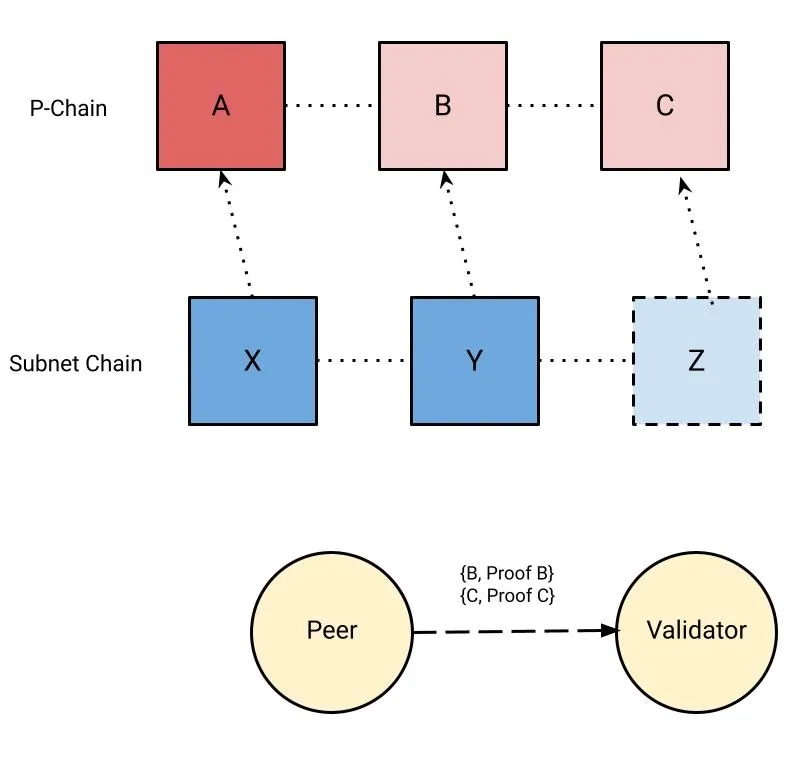
- While verifying a Subnet block, a validator discovers that it has not yet accepted the referenced P-Chain block. It requests the necessary P-Chain block data and acceptance proof from a peer. The peer supplying the proof does not necessarily need to participate in P-Chain consensus.
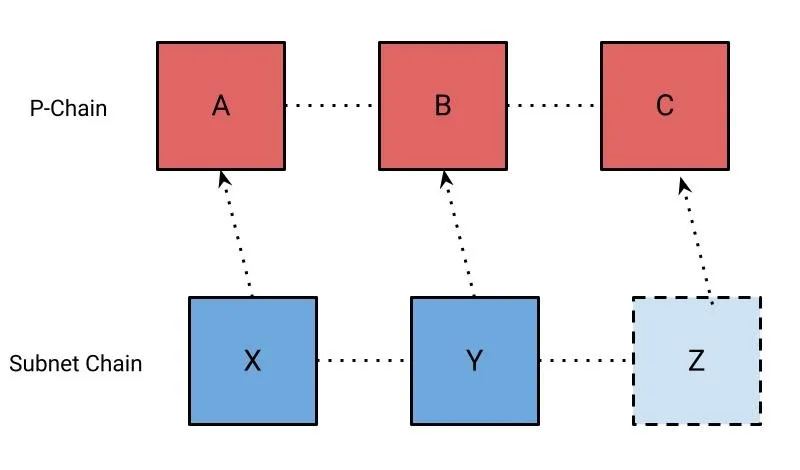
- If the acceptance proof satisfies the applicable verification rules, the validator can apply the relevant P-Chain blocks locally, advance synchronization, and continue verifying the Subnet block.
- The mechanism avoids requiring the synchronizing node to participate directly in P-Chain consensus or establish a direct connection with the P-Chain validators providing the underlying acceptance evidence. This can reduce connection and messaging overhead.
A validator has accepted P-Chain blocks A and B, but cannot verify the proposed Subnet block because it does not yet know the referenced P-Chain block C.
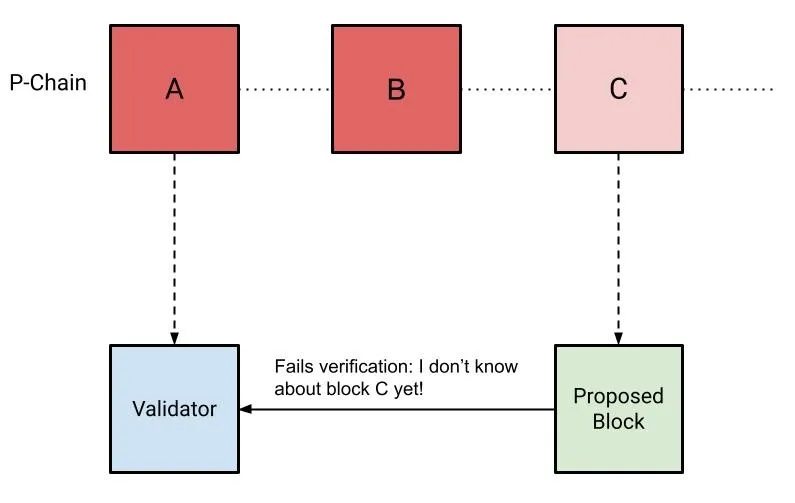
Subnet block Z references the unknown P-Chain block C, preventing verification from proceeding.
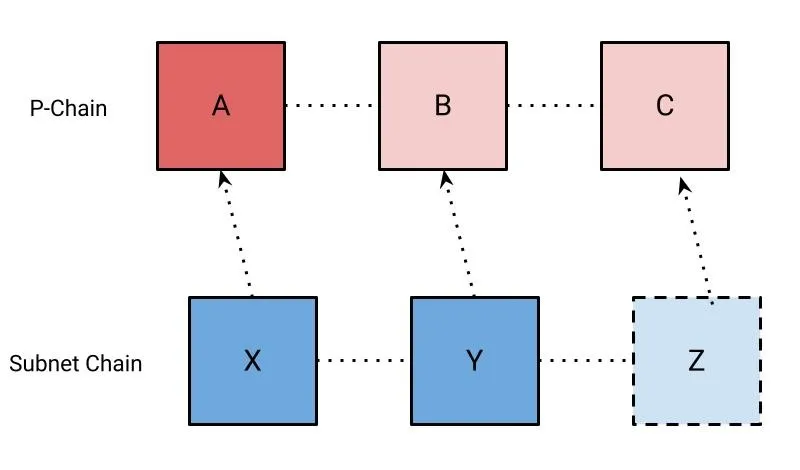
The validator requests the relevant P-Chain blocks B and C and their acceptance evidence from a peer.
After verifying the proof and advancing its accepted P-Chain state through B and C as illustrated, the validator can complete verification of Subnet block Z.
The original diagrams are retained, including their original labels.
Specification
GetAcceptanceSignatureRequest
The following message requests a peer's acceptance signature for a particular block.
+ message GetAcceptanceSignatureRequest {
+   bytes chain_id = 1;
+   uint32 request_id = 2;
+   bytes block_id = 3;
+ }
The request asks the peer to return a signature attesting that it has accepted the specified block ID.
| Field | Type | Description |
|---|---|---|
chain_id |
bytes | Identifies the chain to which the requested block belongs, such as a Subnet blockchain or the P-Chain. |
request_id |
uint32 | Identifier used to associate a response with its corresponding outstanding request. |
block_id |
bytes | ID of the block for which an acceptance signature is requested. |
GetAcceptanceSignatureResponse
The response to the request is a GetAcceptanceSignatureResponse message.
+ message GetAcceptanceSignatureResponse {
+   bytes chain_id = 1;
+   uint32 request_id = 2;
+   bytes bls_signature = 3;
+ }
When the peer has accepted the specified block, it returns a BLS signature attesting to acceptance. Otherwise, the signature field is empty.
| Field | Type | Description |
|---|---|---|
chain_id |
bytes | Chain ID from the request, identifying the chain to which the response relates. |
request_id |
uint32 | Request ID echoed from the request so the response can be correlated with it. |
bls_signature |
bytes | A signature for the requested block ID generated using the peer's BLS staking key registered on the Primary Network. The field is empty if the peer has not accepted the block. |
Why Use BLS Signatures?
BLS signatures support aggregation of multiple signatures into a single aggregate signature.
This allows acceptance evidence from multiple validators to be represented compactly and can improve communication and verification efficiency.
A single peer's signature is only that peer's attestation. Establishing network-level acceptance requires validating the relevant proof against the required validator set and acceptance threshold.
Processing Flow
- While verifying a Subnet block, a validator discovers that it has not accepted the referenced P-Chain block. It sends a
GetAcceptanceSignatureRequestfor that block ID. - A peer that has accepted the block generates a signature using its BLS staking key registered on the Primary Network and returns it in a
GetAcceptanceSignatureResponse. - A peer that has not accepted the block returns a response with an empty signature field.
- The requesting node verifies the acceptance evidence under the applicable proof rules and can advance its local state once the required proof and block ancestry are available.
Security
Missing History Due to State Sync
State Sync allows nodes to start from a recent state without downloading every historical block. Although this accelerates synchronization, a node that uses State Sync may lack complete P-Chain history.
If a proposed Subnet block references a P-Chain block that falls within the unavailable historical range, such a node may be unable to supply the required ancestry.
A node attempting to fast-forward its P-Chain state needs the complete chain of relevant blocks between its current accepted tip and the target block.
A peer that started through State Sync may not retain all of those blocks and therefore may be unable to satisfy the request.
Minimum History Retention and Retries
The proposed approach assumes that nodes retain at least some recent history.
Even if a particular peer does not maintain the required ancestry, the requesting node can retry against other peers until it reaches a peer with the necessary sequence.
If at least one reachable peer retains the required ancestry and the requester can retrieve it, the requester can potentially catch up.
This does not guarantee liveness under all network conditions, but the design seeks to preserve functionality without requiring every node to maintain the complete history.
Alternative: Using a Stale Validator Set
An alternative approach is to verify acceptance proofs using an older validator set.
This could allow proofs to be processed using validator information from an earlier point in time, even when more recent history is unavailable.
However, using stale validator information introduces security concerns. Outdated validator membership or keys may no longer represent the correct consensus authority and could enable invalid proofs to be accepted under inappropriate verification rules.
The approach simplifies some aspects of synchronization but introduces additional risks.
Conclusion
ACP-75 proposes protocol-level acceptance proofs so nodes can verify acceptance of P-Chain blocks referenced by Subnets and advance local synchronization using evidence obtained from peers.
If you have questions, feel free to contact me on Twitter.
I also publish articles on the following platforms.





