Introduction
Hi, I'm cardene, a software engineer and technical writer focused on blockchain and AI.
I've also authored Japanese technical books on specification-driven development with LLMs and decentralized application (DApp) development.

I also build and publish a variety of tools, libraries, and open-source projects.
When an agent moves assets on-chain, knowing that the agent exists is not enough. For transfers and swaps, the application needs to determine whether the agent is authorized to carry out each specific action.
ERC-8273 defines an interface that uses an evaluation by a trusted attestor to authorize an agent's action for the duration of a single transaction. This article explains where that authorization is stored, what gets checked during execution, and which calls a DApp uses to verify it.
The specification is available here.

Overview
How the proposal works
In ERC-8273, an Attestor evaluates an agent's action in advance. If the action passes the evaluation, the Attestor calls attestAndCall on the registry contract. The registry saves an audit record and writes an authorization valid only for the current transaction to transient storage. The DApp is then called from the agent's wallet.
The DApp queries the registry with the calling wallet and the permitted action. If authorization exists, execution continues. Otherwise, the transaction reverts. At the end of the transaction, the EVM clears transient storage. Only the audit record remains on-chain.
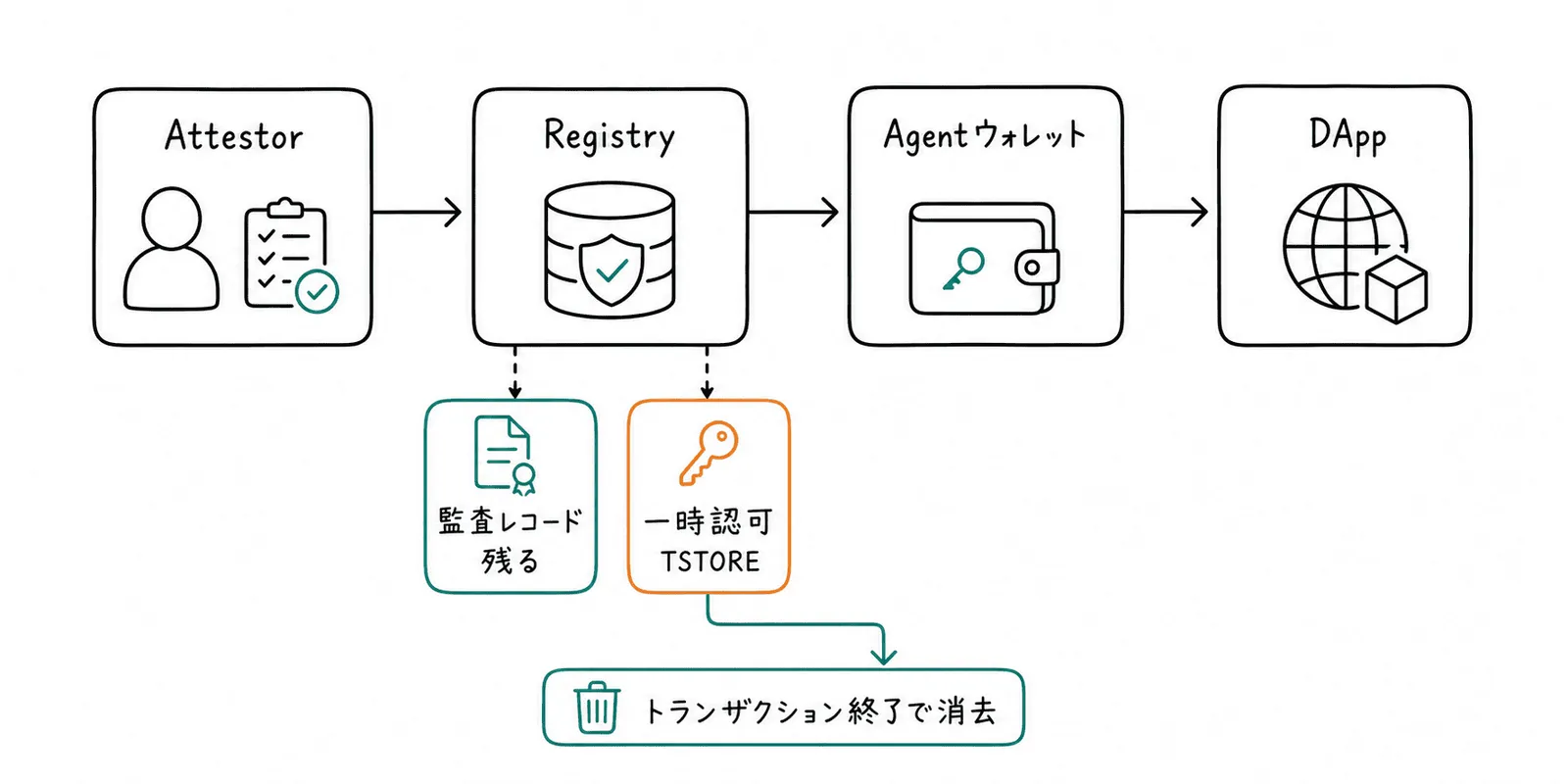
The mechanism does not grant long-lived permissions. It authorizes the operation that was evaluated for the current transaction.
Attestation versus authorization
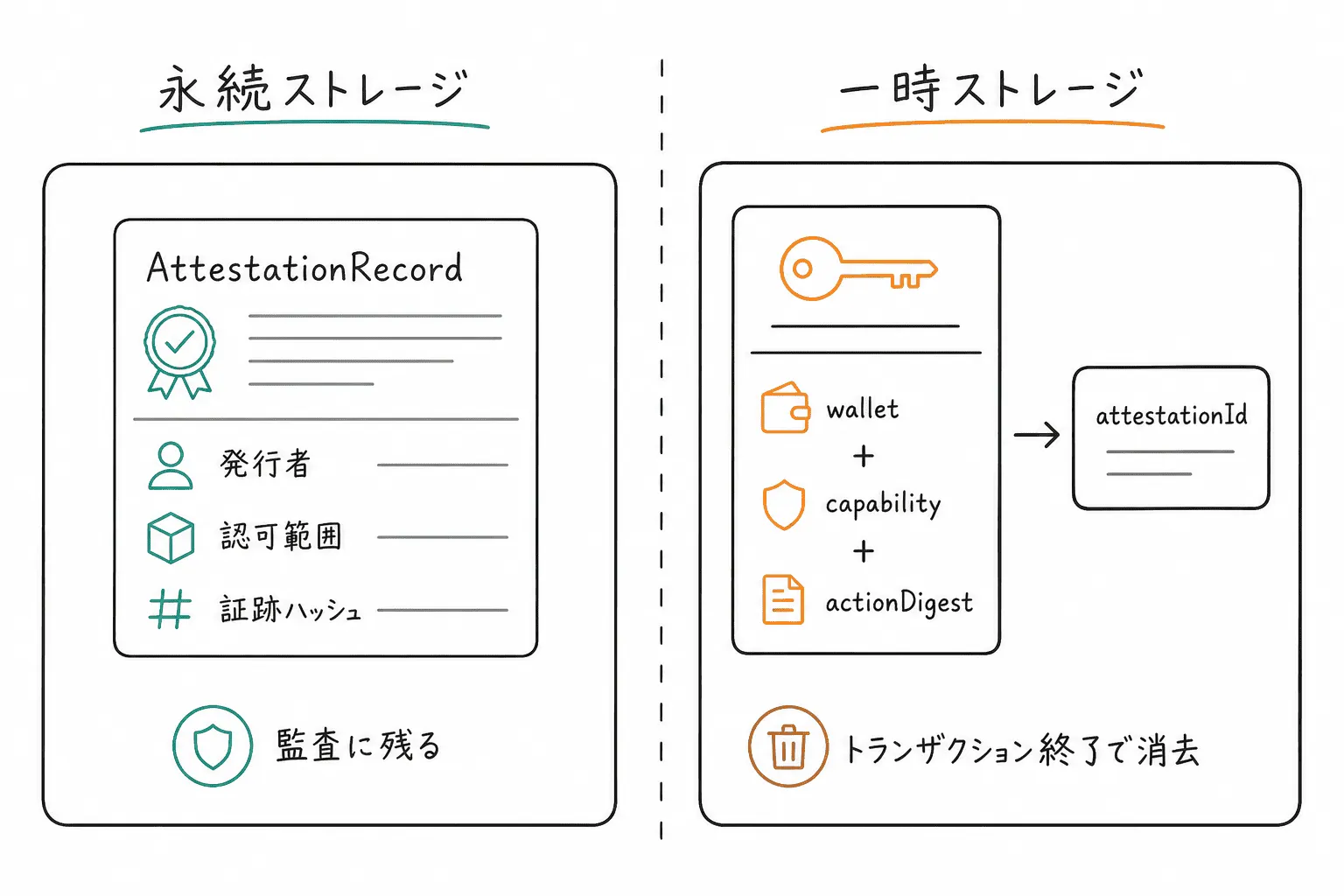
An attestation is on-chain evidence that an attestor has determined that a subject meets certain conditions. The ERC-8273 AttestationRecord stores who was evaluated, who evaluated them, and what was authorized in persistent storage.
A DApp does not decide whether to allow an operation now solely from that persistent record. It checks the transient authorization established for the current transaction.
flowchart LR
  A[Attestorの評価] --> B[監査レコードを保存]
  B --> C[一時認可をTSTORE]
  C --> D[DAppが認可を照会]
  D --> E[操作を実行]
  E --> F[トランザクション終了]
  F --> G[一時認可を自動消去]
  B --> H[監査レコードは残る]
Motivation
An agent ID identifies a particular agent. The ID alone cannot establish whether the agent should be allowed to perform a particular swap, mint, or administrative action.
ERC-8273 separates subject identity from per-action authorization. A capability represents a broad permission category, such as permission to perform DeFi operations. An actionDigest is a hash that binds a particular contract, function, and set of arguments.
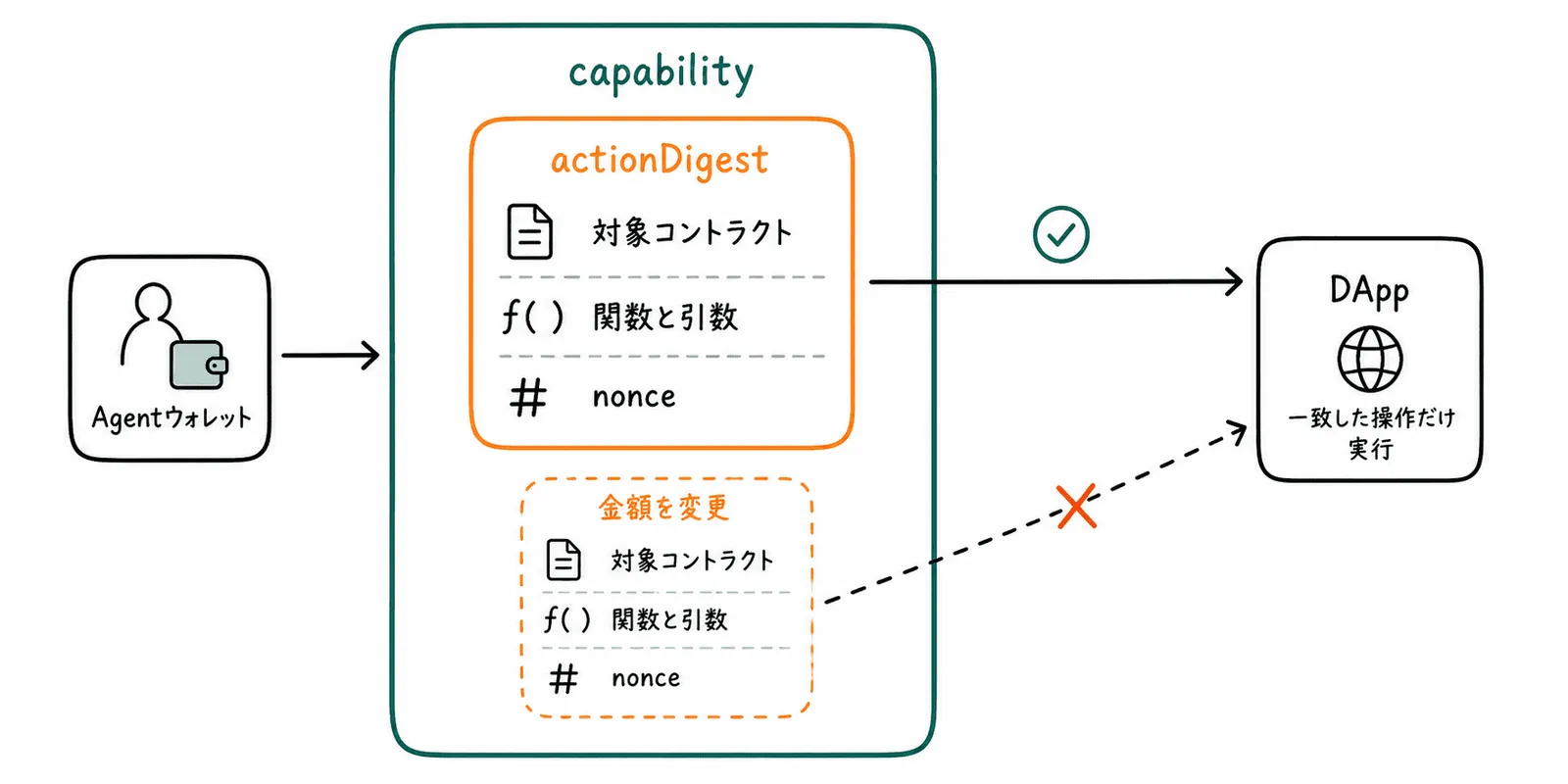
For example, when authorizing a swap of up to 1,000 USDC for WETH, the actionDigest can include the target contract, function selector, swap amount, recipient, and nonce. Changing the amount or recipient changes the hash, allowing the DApp to reject it as a different action.
An actionDigest of 0 indicates authorization that is not bound to a specific call. This form can be used for a coarse check, such as determining whether an agent has been attested. It must not be used for transfers, privileged state changes, or financial operations susceptible to reentrancy within the transaction.
Specification
Authorization data
The authorization scope is determined by the combination of the subject, capability, and actionDigest. The registry and the DApp use the same combination when writing and querying authorization.
// 交換を1回だけ認可する時の値
subjectId: 42
subjectType: keccak256("ERC8004_AGENT")
capability: keccak256("DEFI_SWAP_V1")
actionDigest: keccak256(abi.encode(<交換コントラクト>, <呼び出しデータ>, <nonce>))
wallet: <Agentウォレット>
The subjectId and subjectType are used to compute a subjectHash for lookups. The wallet is the wallet that the DApp checks as msg.sender. The evidenceHash can contain a hash of the evaluation report or signed evidence consulted by the Attestor.
AttestationStatus
enum AttestationStatus { None, Recorded }None is the default value when reading a nonexistent record. Standard records have the status Recorded. This status does not indicate whether the current action is authorized. Active authorization is checked in transient storage.
SubjectRef
struct SubjectRef {
    uint256 subjectId;
    bytes32 subjectType;
}
SubjectRef identifies the subject being evaluated. Since subjectId alone does not identify the namespace that issued the ID, subjectType specifies that namespace.
- Fields
| Field | Description |
|---|---|
subjectId |
Numeric identifier of the subject being evaluated. |
subjectType |
Hash distinguishing the type of ID. |
ExecutionRequest
struct ExecutionRequest {
    bytes32 profileId;
    bytes32 actionDigest;
    bytes data;
}
ExecutionRequest specifies how the registry calls a DApp from the agent wallet and which action to execute. The format of data depends on profileId.
- Fields
| Field | Description |
|---|---|
profileId |
Identifier selecting the execution profile. |
actionDigest |
Hash binding the specific action. A value of 0 uses only the capability. |
data |
Call data decoded by the execution profile. |
AttestationRecord
struct AttestationRecord {
    uint256 subjectId;
    bytes32 subjectType;
    address attestor;
    bytes32 capability;
    bytes32 actionDigest;
    uint64 issuedAt;
    AttestationStatus status;
    bytes32 evidenceHash;
    address wallet;
}
AttestationRecord is a persistent record used to audit issued attestations. It is not where currently active authorization is stored.
- Fields
| Field | Description |
|---|---|
subjectId, subjectType |
The evaluated subject and its ID type. |
attestor |
The attestor that issued the record. |
capability, actionDigest |
The permitted capability and, where applicable, the specific action. |
issuedAt |
The issuance timestamp. |
status |
Status of the persistent record. Standard records are Recorded. |
evidenceHash |
Hash identifying the off-chain evidence used in the evaluation. |
wallet |
The agent wallet the DApp queries as the subject of authorization. |
IERC165
supportsInterface
function supportsInterface(bytes4 interfaceId) external view returns (bool);supportsInterface checks which ERC-8273 interfaces the registry implements. A DApp checks whether the required interface is supported before querying authorization.
-
Provide the interface ID
Pass the ID of the interface required by the DApp, such as
IERC8273WalletAttestation. -
Receive the support status
The registry returns
trueif it implements the interface.
- Parameters
| Parameter | Description |
|---|---|
interfaceId |
Four-byte identifier of the interface to check. |
- Return value
| Return value | Description |
|---|---|
bool |
true if the interface is implemented. |
-
Execution conditions
-
Caller
A DApp that queries authorization or an application that displays interface support.
IERC8273
IERC8273 is the core interface for audit records, event logs, and read operations.
Attested
event Attested(
    uint256 indexed attestationId,
    address indexed wallet,
    bytes32 indexed capability,
    bytes32 actionDigest,
    bytes32 subjectHash,
    address attestor,
    uint256 subjectId,
    bytes32 subjectType,
    bytes32 evidenceHash
);
The Attested event is emitted when an attestation is issued. An indexer can query logs by wallet or capability and update an audit interface.
- Fields
| Field | Description |
|---|---|
attestationId |
Incrementing record ID within the registry. |
wallet |
Agent wallet associated with the authorization. |
capability |
Authorized capability. |
actionDigest |
Hash binding the specific action. |
subjectHash |
Lookup hash computed from subjectId and subjectType. |
attestor |
The attestor that issued the record. |
subjectId, subjectType |
The evaluated subject and its ID type. |
evidenceHash |
Hash identifying off-chain evidence. |
An attestationId is not unique across chains or registry contracts. An indexer records the combination of chainId, registry address, and attestationId.
isAttested
function isAttested(
    SubjectRef calldata subject,
    bytes32 capability,
    bytes32 actionDigest
) external view returns (bool);
isAttested uses the subject as a key and returns a bool indicating whether transient authorization exists in the current transaction. It can be used for display or off-chain checks in a simulation that establishes authorization in the same transaction.
-
Compute the subject key
Determine the transient storage key from
subject,capability, andactionDigest. -
Read transient authorization
Return
trueif a value exists, orfalseotherwise.
- Parameters
| Parameter | Description |
|---|---|
subject |
SubjectRef identifying the subject being evaluated. |
capability |
Permission category. |
actionDigest |
Hash of the specific action, or 0. |
- Return value
| Return value | Description |
|---|---|
bool |
true if authorization exists in the current transaction. |
Do not use this function as the authorization check for critical on-chain actions. Use getActiveAttestation, which reverts when authorization is absent.
latestAttestationId
function latestAttestationId(
    SubjectRef calldata subject,
    bytes32 capability,
    bytes32 actionDigest
) external view returns (uint256);
latestAttestationId returns the ID of the most recently issued audit record for the same subject and authorization scope. It does not return currently active authorization.
-
Look up the persistent record
Find the record with the same subject, capability, and action hash.
-
Return the latest ID
Return
0if no record exists.
- Parameters
| Parameter | Description |
|---|---|
subject |
Subject being evaluated. |
capability |
Permission category. |
actionDigest |
Action hash, or 0. |
- Return value
| Return value | Description |
|---|---|
uint256 |
ID of the latest audit record. |
getAttestation
function getAttestation(uint256 attestationId)
    external view returns (AttestationRecord memory record);
This call retrieves an entire audit record by ID.
-
Read persistent storage by ID
Retrieve the
AttestationRecordcorresponding toattestationId.
- Parameters
| Parameter | Description |
|---|---|
attestationId |
ID of the audit record to retrieve. |
- Return value
| Return value | Description |
|---|---|
record |
Audit record containing the issuer, subject, authorization scope, evidence hash, and wallet. |
IERC8273ActiveAttestation
getActiveAttestation
function getActiveAttestation(
    SubjectRef calldata subject,
    bytes32 capability,
    bytes32 actionDigest
) external view returns (AttestationRecord memory record);
getActiveAttestation retrieves authorization for the current transaction using the subject as the key. It reverts if authorization is absent, making it suitable for DApp authorization checks.
-
Query transient storage
Read the authorization corresponding to the subject, capability, and action hash.
-
Return the record or revert
If an authorization ID exists, return the persistent record. Otherwise, revert the call.
- Parameters
| Parameter | Description |
|---|---|
subject |
Subject being evaluated. |
capability |
Permission category. |
actionDigest |
Action hash, or 0. |
- Return value
| Return value | Description |
|---|---|
record |
Audit record corresponding to currently active authorization. |
IERC8273WalletAttestation
isAttestedAddress
function isAttestedAddress(
    address wallet,
    bytes32 capability,
    bytes32 actionDigest
) external view returns (bool);
isAttestedAddress is a boolean query keyed by wallet. It can be used for display or indexer processing of simulated execution, but a DApp should not rely solely on this return value to enforce authorization for critical actions.
-
Read the wallet's transient authorization
Read the slot corresponding to
wallet,capability, andactionDigest. -
Return whether it exists
Return
trueif the slot contains an authorization ID.
- Parameters
| Parameter | Description |
|---|---|
wallet |
Agent wallet. |
capability |
Permission category. |
actionDigest |
Action hash, or 0. |
- Return value
| Return value | Description |
|---|---|
bool |
true if authorization exists in the current transaction. |
getActiveAttestationByWallet
function getActiveAttestationByWallet(
    address wallet,
    bytes32 capability,
    bytes32 actionDigest
) external view returns (AttestationRecord memory record);
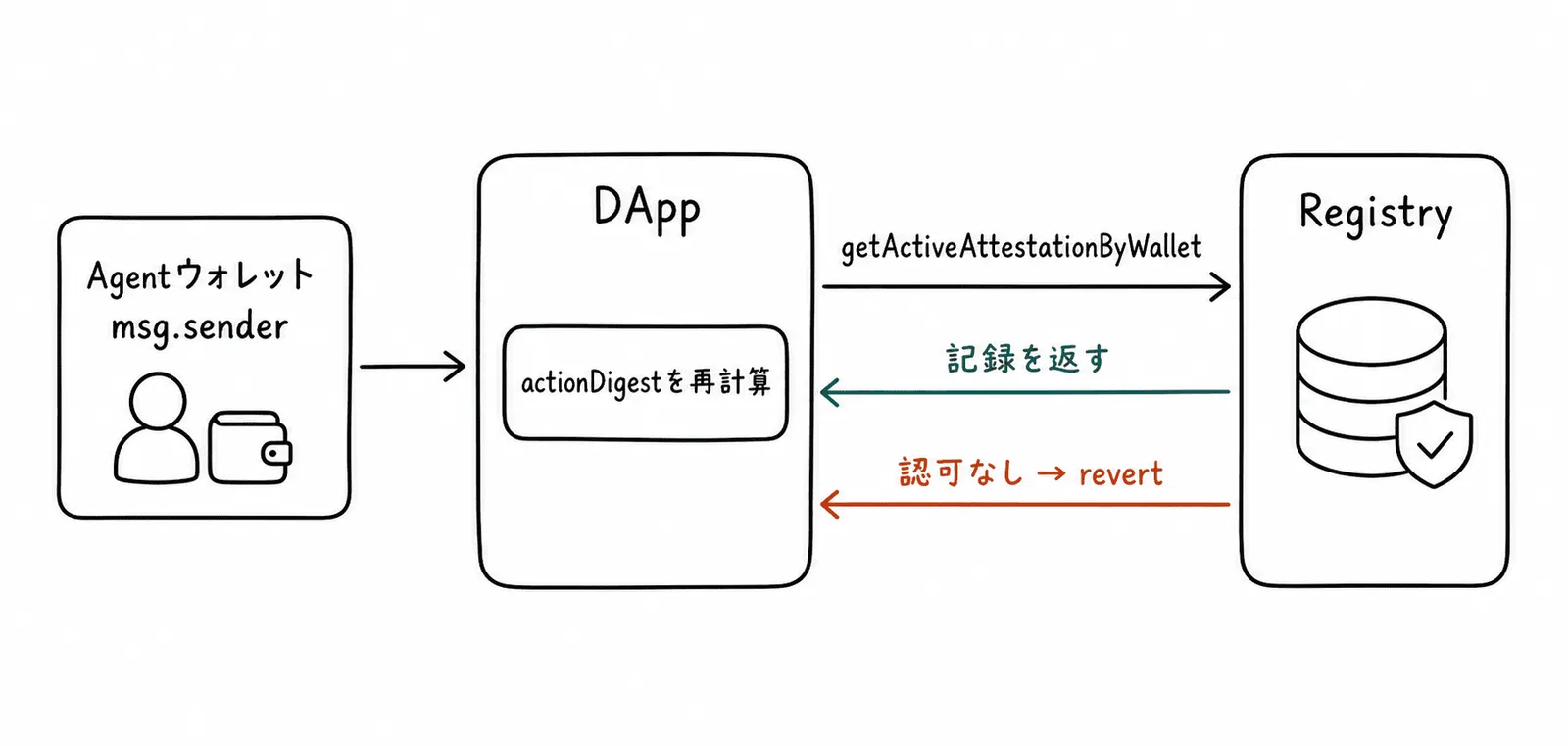
getActiveAttestationByWallet is the authorization check a DApp uses when identifying the agent wallet as msg.sender. It reverts if authorization is absent.
-
Hash the action in the DApp
In action-bound mode, the DApp recomputes the same
actionDigestfrom the call target, function, arguments, and nonce. -
Query using the wallet as the key
Query the registry with
msg.sender,capability, and the recomputed hash. -
Stop execution if authorization is absent
Revert if the slot is empty.
- Parameters
| Parameter | Description |
|---|---|
wallet |
Wallet the DApp checks as msg.sender. |
capability |
Permission category. |
actionDigest |
Action hash recomputed by the DApp. |
- Return value
| Return value | Description |
|---|---|
record |
Audit record for the currently active authorization. |
IERC8273AtomicAttestation
attestAndCall
function attestAndCall(
    SubjectRef calldata subject,
    bytes32 capability,
    bytes32 evidenceHash,
    address wallet,
    ExecutionRequest calldata exec
) external payable returns (uint256 attestationId, bytes memory result);
attestAndCall is the sole issuance entry point, combining attestation issuance, transient authorization, and a DApp call. Only an authorized Attestor can call it.
-
Validate inputs and permissions
Confirm that the caller is an
Attestorand thatwallet,capability, andprofileIdare nonzero. -
Create an audit record
Save the
AttestationRecordin persistent storage and emit theAttestedevent. -
Authorize only the current transaction
Write
attestationIdto transient storage for both the subject and the wallet. -
Call the DApp from the agent wallet
Execute using the profile corresponding to
profileIdso that the DApp seeswalletasmsg.sender. -
Propagate failures to the entire transaction
If execution, profile validation, or the success check fails, revert the whole transaction, including the audit record and transient authorization.
- Parameters
| Parameter | Description |
|---|---|
subject |
Subject being evaluated. |
capability |
Permission category. |
evidenceHash |
Hash identifying the evaluation evidence. |
wallet |
Agent wallet associated with the authorization and DApp call. |
exec |
Execution profile, action hash, and execution data. |
- Return values
| Return value | Description |
|---|---|
attestationId |
ID of the newly created audit record. |
result |
Result returned by the execution profile. |
-
Execution conditions
-
Caller
An
Attestorauthorized by the registry. -
Action hash
When sending
msg.value,actionDigestmust be nonzero to bind the amount.
IAgentExecute
AgentCall
struct AgentCall {
    address target;
    uint256 value;
    bytes data;
}
AgentCall represents a DApp action invoked by the agent wallet. Multiple calls can be passed to executeFromRelayer as an array.
- Fields
| Field | Description |
|---|---|
target |
DApp contract to call. |
value |
Amount of native tokens sent with the call. |
data |
Call data containing the function selector and arguments. |
executeFromRelayer
function executeFromRelayer(
    AgentCall[] calldata calls,
    bytes calldata authData
) external payable returns (bytes[] memory results);
executeFromRelayer is the agent wallet entry point called by the registry in the direct execution profile. Because the wallet itself calls target, the DApp receives the wallet as msg.sender.
-
Validate the authorization data
The wallet checks the chain, wallet, registry, profile, action hash, nonce, and validity period using
authData. -
Execute the array of calls
The wallet calls each
targetwith its correspondingvalueanddata. -
Return the results
Return an array containing the return data from each call.
- Parameters
| Parameter | Description |
|---|---|
calls |
Array of DApp calls executed from the wallet. |
authData |
Signature or session information authorizing the calls. |
- Return value
| Return value | Description |
|---|---|
results |
Return data from each call. |
-
Execution conditions
-
Authorization data
The wallet validates
authData, binding the caller, action hash, nonce, and validity period. -
Caller
The registry contract that selected the corresponding execution profile.
Execution profiles
An execution profile defines how the registry invokes a DApp from the agent wallet. Both profiles have the same authorization lifetime.
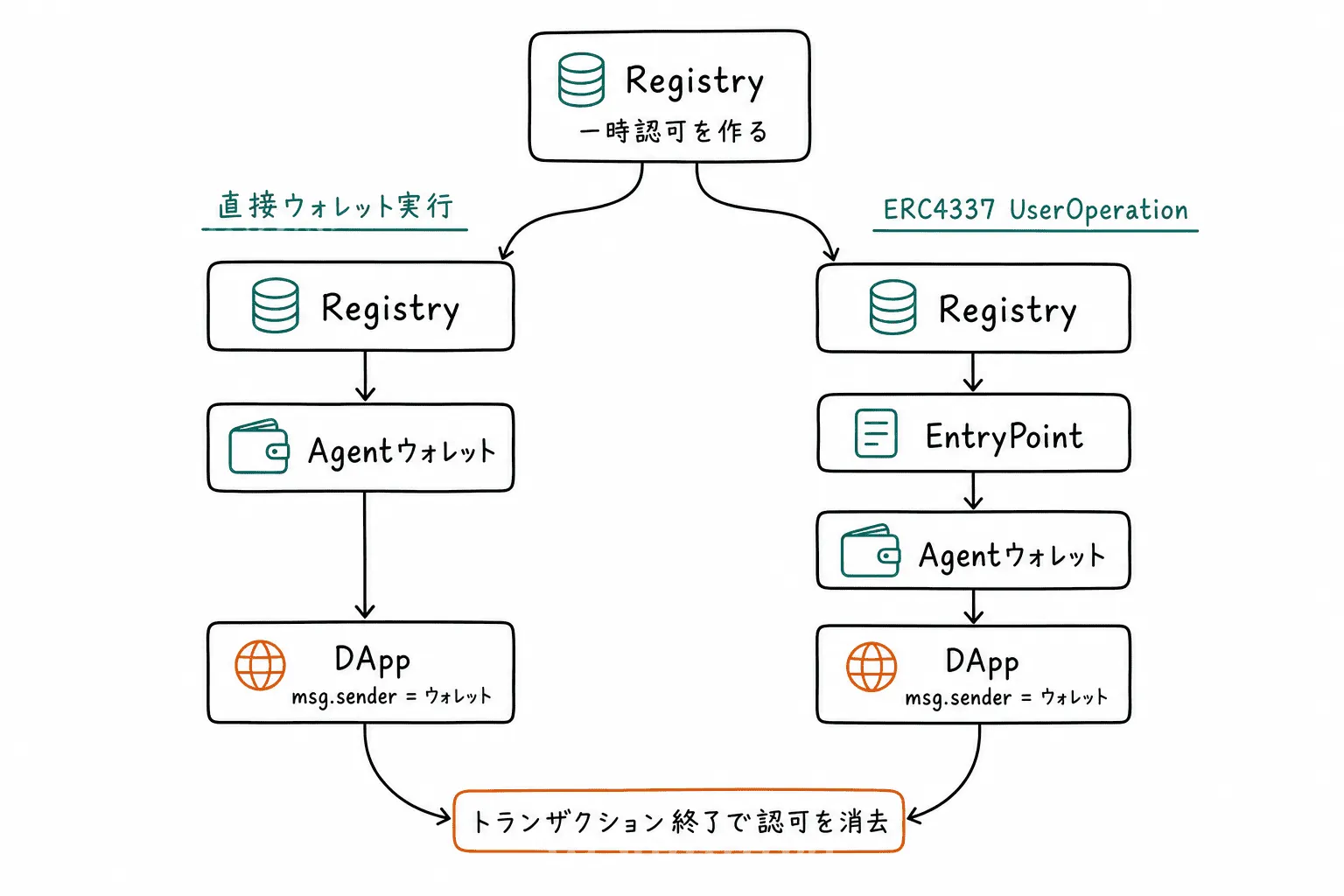
Direct wallet execution
AGENT_EXECUTE_V1 is used with smart wallets implementing IAgentExecute or wallets using EIP-7702. The registry calls executeFromRelayer, and the wallet calls the DApp.
When actionDigest is nonzero, its calculation includes at least the array of calls and attestationId. The authData binds the chain ID, wallet, registry, profile, action hash, nonce, and validity period.
ERC-4337 UserOperation execution
ERC4337_USEROP_V1 is an execution profile for existing ERC-4337 wallets. The registry passes a UserOperation to the EntryPoint. The EntryPoint runs validateUserOp and execute.
The profile checks that the UserOperation's sender matches wallet. It also verifies that the intended action succeeded, for example through a DApp receipt or event proof, rather than treating the absence of a revert from the low-level handleOps call as proof of success.
sequenceDiagram
  participant A as Attestor
  participant R as Registry
  participant W as Agentウォレット
  participant D as DApp
  A->>R: attestAndCall
  R->>R: 監査レコードを保存
  R->>R: 一時認可をTSTORE
  R->>W: 実行を依頼
  W->>D: 操作を呼び出す
  D->>R: getActiveAttestationByWallet
  R-->>D: レコードを返す
  D-->>W: 操作結果
  Note over R: トランザクション終了時に一時認可を消去
Additional considerations
Why persistent audit records and transient authorization are separate
Persistent records allow auditors to determine who evaluated what after the fact. Transient authorization is cleared at the end of the transaction to prevent the same grant from being reused in a later transaction.
Why authorization failures revert
getActiveAttestation and getActiveAttestationByWallet revert when authorization is absent. This reduces the risk that a DApp receives a boolean result but forgets to check it before performing a critical action.
Why the registry must be trusted
ERC-8273 does not guarantee that every registry contract is equally trustworthy. Alongside interface support, a DApp explicitly selects a trusted registry address, a set of attestors, and an authorization policy.
Compatibility
How the proposal complements existing standards
ERC-8273 does not change how existing identity, token, or account standards work. A DApp uses ERC-165 to check support for the required interface before calling the appropriate authorization query.
ERC-8004 covers agent identity registration and asynchronous verification results. ERC-8273 complements it with synchronous authorization that can block a single on-chain operation.
For more on ERC-8004, see the following article.
https://qiita.com/cardene/items/6a280877dca6e1fc87af
EIP-1153 provides transient storage that is cleared at the end of a transaction. ERC-8273 uses it to hold authorization for the current transaction only.
Reference implementation
Combining issuance and execution
The reference implementation saves the audit record, then writes the same attestationId to transient slots for both the subject and the wallet. It then selects an execution profile.
function attestAndCall(...) external payable returns (uint256 attestationId, bytes memory result) {
    attestationId = _nextId++;
    _records[attestationId] = AttestationRecord(...);
    emit Attested(...);
    _attestTransient(...);
    result = _executeProfile(...);
}
If execution fails, the whole transaction reverts. This prevents the authorization or audit record from surviving when the intended operation fails.
Security
Include the action and nonce in actionDigest
A nonzero actionDigest includes the target contract, function selector, arguments, and a unique value such as a nonce. If native tokens are transferred, it also includes the amount. The DApp recomputes the hash according to the same rules and rejects authorization if the value differs.
Prevent reentrancy separately
Transient authorization remains available for the transaction's duration. In particular, when actionDigest == 0, authorization checks alone cannot prevent reentrancy within the same transaction. DApp contracts that perform critical operations use a reentrancy guard.
Monitor for compromised attestors
A compromised Attestor can issue new authorizations repeatedly within its permissions. Preventing an individual authorization from surviving into a later transaction is separate from limiting total losses while an attestor is compromised. Operators monitor Attested events, restrict the attestor's privileges, and prepare suspension and removal procedures.
Keep IDs on different chains distinct
An attestationId increments only within a particular registry contract on a particular chain. Audit tools and bridges record chainId, registry address, and attestationId as a single composite identifier.
Keep evidence references immutable
An evidenceHash identifies off-chain evaluation evidence. Do not use a mutable HTTP URL as the sole reference to evidence. Use content-addressed storage such as IPFS or signed evidence.
Conclusion
ERC-8273 is an interface for determining whether a particular on-chain action should be allowed, rather than merely identifying the agent. An Attestor evaluates the action, the registry creates transient authorization, and the agent wallet calls the DApp, all within one transaction.
The central idea is to avoid granting long-lived permissions and instead use authorization tied to the operation.