Introduction
Hi, I'm cardene, a software engineer and technical writer focused on blockchain and AI.
I've also authored Japanese technical books on specification-driven development with LLMs and decentralized application (DApp) development.

I also build and publish a variety of tools, libraries, and open-source projects.
ERC-7694 proposes a mechanism that lets Ethereum smart contracts treat Solana as external storage and perform cross-chain writes and reads securely.
This article translates, summarizes, and expands on the proposal linked below, as discussed in the original article published on December 30, 2025. The original diagrams are retained, including any Japanese labels.

I also cover a range of EIPs, BIPs, SLIPs, CAIPs, ENSIPs, RFCs, and ACPs in other articles.

Overview
ERC-7694 extends Ethereum's cross-chain storage routing mechanism so that the Solana blockchain can be used as a storage destination.
Ethereum smart contracts could previously delegate operations to external storage such as the following.
- Ethereum L1 contracts
- Ethereum L2 (layer 2)
- Off-chain databases
ERC-7694 adds another L1 blockchain, Solana, to these storage destinations.
What does delegation from Ethereum to Solana mean?
Under ERC-7694, a smart contract on Ethereum L1 can defer a write to Solana as part of its own application logic.
Three points are important here.
- The Ethereum contract does not execute anything on Solana directly.
- The client, such as a wallet or execution environment, must be able to handle Solana transactions.
- Ethereum merely specifies the routing of an operation whose data should be stored on Solana.
In other words, the Ethereum contract treats Solana as both external storage and an execution environment.
Relationship to EIP-3668 (Offchain Lookup)
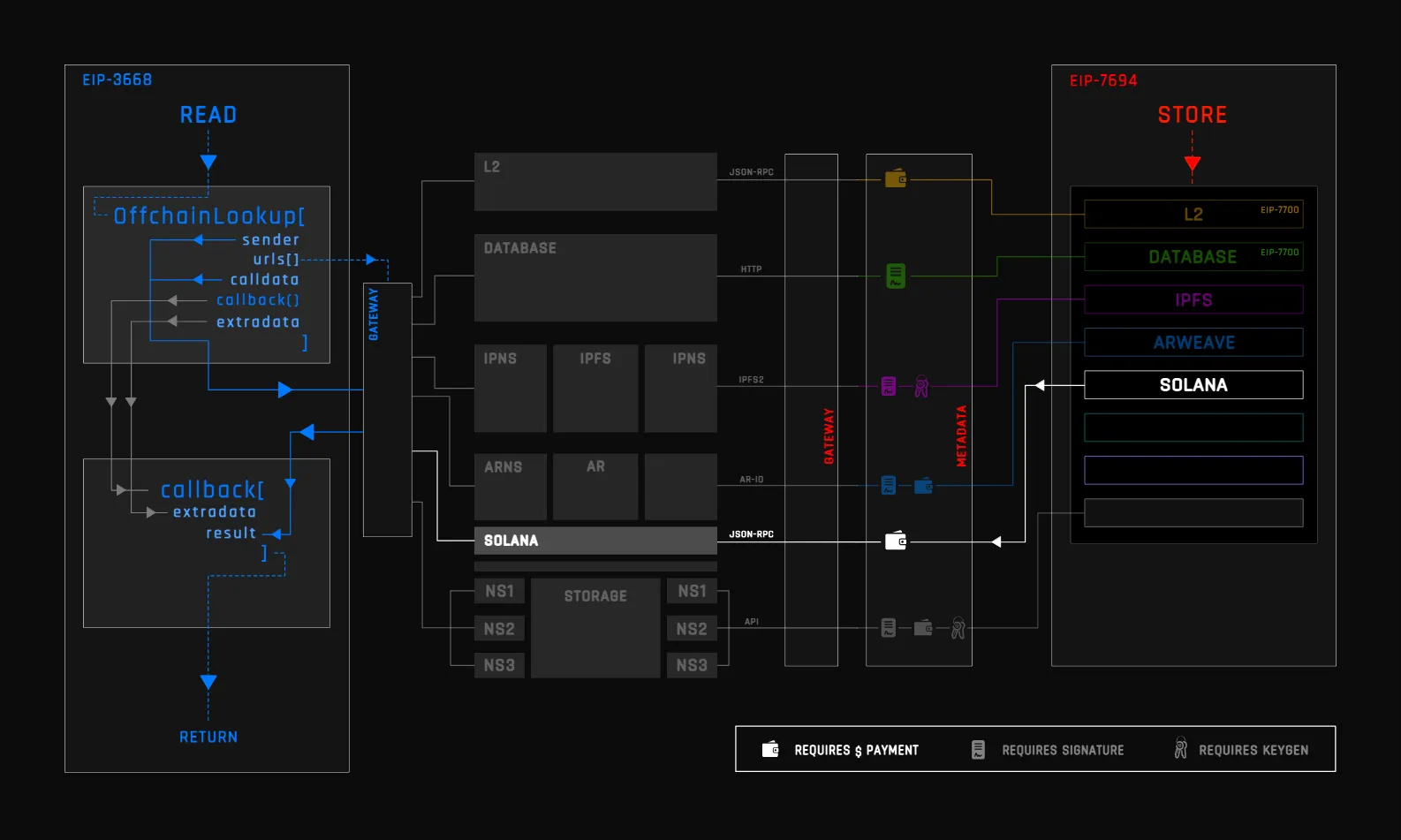
Data stored on Solana cannot be accessed directly by an Ethereum contract. This is where ERC-3668 (Offchain Lookup) comes in.
See the following article for more on ERC-3668.
[ERC3668] Understanding Off-Chain Data Lookup
ERC-3668 defines a mechanism for retrieving data from an off-chain HTTP service during contract execution and passing the result back through a callback with verification.
Under ERC-7694, the flow is as follows.
- Write data to Solana.
- An HTTP gateway retrieves the data from Solana.
- The gateway converts the data to an ERC-3668-compatible format.
- The Ethereum contract accesses the data through Offchain Lookup.
This allows Ethereum contracts to retrieve data through a standardized mechanism without being aware of Solana itself.
What ERC-7694 aims to achieve
ERC-7694 aims to extend the blockspace available to Ethereum for computation and storage beyond the Ethereum ecosystem.
While keeping Ethereum at the center, the standard allows contracts to incorporate properties of other chains directly into their design, such as the following.
- Lower execution costs
- Distinct design philosophies
- Different user bases
Motivation
Limitations of the existing Cross-Chain Storage Router Protocol
The Cross-Chain Storage Router Protocol (CCIP-Store) defined in EIP-7700 specified three types of external storage routers.
| Storage destination | Characteristics |
|---|---|
| Ethereum L1 | Fully on-chain but expensive |
| Ethereum L2 | Less expensive but dependent on Ethereum |
| Database | Flexible but centralized |
ERC-7694 adds a fourth storage router for Solana.
Centralization risks
L2 networks and databases offer scalability advantages, but both have sources of centralization risk.
Sources of centralization in L2 networks
- Shared security with Ethereum mainnet
- Dependence on sequencer and bridge designs
An L2 is an extension of Ethereum rather than a fully independent system.
Sources of centralization in databases
- One or a small number of physical servers
- The need to trust the operator
This conflicts with the decentralization principles behind blockchains.
The need for storage with independent consensus
These considerations motivate the use of a blockchain with its own consensus algorithm as a storage destination.
Solana has the following characteristics.
- An L1 blockchain independent of Ethereum
- High throughput and low costs
- An established ecosystem operating in production
ERC-7694 defines rules for formally supporting Solana as external storage for Ethereum.
Expected client behavior
ERC-7694 assumes that Ethereum clients and wallets can perform the following operations.
- Construct Solana transactions
- Sign and submit them
- Manage keys as needed
This allows Ethereum users to interact with Solana without additional specialized tools.
Use case: chain-agnostic protocols such as ENS
A chain-agnostic protocol such as ENS (Ethereum Name Service) could adopt the following architecture.
- Manage name resolution logic on Ethereum.
- Store the underlying data on Solana.
- Provide native support for Solana users as well.
This offers the following benefits.
- Reach both Ethereum and Solana users.
- Reduce the use of expensive Ethereum storage.
- Retain verifiability.
Specification
ERC-7694 defines implementation rules for Ethereum contracts to delegate storage writes to Solana. The specification covers four main areas.
- How Ethereum declares that storage should be routed to Solana
- Data type conversion rules between the EVM and SVM
- Requirements for writes on Solana
- How Ethereum reads data stored on Solana
Basic structure of the Solana storage router
The StorageRoutedToSolana error
In ERC-7694, a storage write to Solana is expressed through error-based routing. This follows the storage routing design defined in EIP-7700.
StorageRoutedToSolana
error StorageRoutedToSolana(
    bytes32 programId,
    bytes32 account
);
This error notifies the client that a storage write should take place on Solana.
The Ethereum contract does not write to Solana directly.
Instead, it uses revert with this error to communicate its intent to have the client perform the write on Solana.
The programId identifies the Solana program (the equivalent of an Ethereum contract), while account identifies the administrative wallet authorized to perform the write.
Parameters
programId- A Solana program ID represented as
bytes32.
- A Solana program ID represented as
account- The administrative account responsible for writing on Solana, represented as
bytes32.
- The administrative account responsible for writing on Solana, represented as
Example Ethereum contract implementation
setValue
function setValue(
    bytes32 node,
    bytes32 key,
    bytes32 value
) external {
    (
        bytes32 programId,
        bytes32 account
    ) = getMetadata(node);

    revert StorageRoutedToSolana(
        programId,
        account
    );
}
This function requests a storage write to Solana.
It does not perform the actual write on Ethereum.
It uses getMetadata to retrieve the target Solana program ID and administrative account, then communicates that information through the StorageRoutedToSolana error using revert.
The client detects this revert and executes a Solana transaction.
Arguments
node- An identifier representing a storage namespace or target node.
key- An identifier representing the key within the node.
value- An identifier representing the value to store.
Encoding differences between the EVM and SVM
The Solana Virtual Machine (SVM) uses base58 encoding for addresses and identifiers.
The EVM, by contrast, conventionally uses hex encoding.
ERC-7694 therefore requires the following conversions.
- Represent the value as
bytes32on Ethereum. - Represent it as
PubKeyon Solana. - Have the client convert between the two representations.
Pseudocode for writing to Solana
setValue (Solana-side call)
const [programId, account, node, key, value] = E2SVM(
  [programId, account, node, key, value],
  ["bytes32", "bytes32", "bytes32", "bytes32", "bytes32"]
);

const program = new program(programId, rpcProvider);
const wallet = useWallet();

if (wallet.publicKey === account) {
  await program(wallet).setValue(node, key, value);
}
This operation writes data received from Ethereum to a Solana program.
All EVM values of type bytes32 are converted to the SVM type PubKey.
Only the designated administrative account may execute the Solana program call.
This prevents unauthorized writes by arbitrary users.
Example Solana program implementation
setValue (Solana program)
pub fn setValue(
    ctx: Context,
    node: PubKey,
    key: PubKey,
    value: PubKey
) -> ProgramResult {
    ...
}
This function writes data on Solana.
It verifies the program ID and checks rent exemption (the balance required to maintain an account).
It then deserializes the account data and stores a value using the combination of node and key.
The stored data is intended for later retrieval from Ethereum.
EVM-to-SVM data type mappings
ERC-7694 precisely defines type conversions between the EVM and SVM.
| EVM | SVM |
|---|---|
| uint8 | u8 |
| uint16 | u16 |
| uint32 | u32 |
| uint64 | u64 |
| uint128 | u128 |
| uint256 | u256 |
| bytes1 | [u8; 1] |
| bytes2 | [u8; 2] |
| bytes4 | [u8; 4] |
| bytes8 | [u8; 8] |
| bytes16 | [u8; 16] |
| bytes32 | PubKey |
| bytes | Vec |
| string | String |
| address | [u8; 20] |
Note that u256 is not a native SVM type, but support is commonly available through Rust crates.
Reading from Solana on Ethereum
Data stored on Solana cannot be accessed directly by an Ethereum contract. An ERC-3668-compatible HTTP gateway is used instead.
ERC-3668-compatible HTTP gateway
Reading data from Solana
const [programId, node, key] = parseQuery(path);

const [programId, node, key] = E2SVM(
  [programId, node, key],
  ["bytes32", "bytes32", "bytes32"]
);

const program = new program(programId, rpcProvider);
const value = await program.getValue(node, key);

const data = abi.encode(["bytes"], [value]);
emitERC3668(data);
This operation converts Solana data for use on Ethereum and returns it.
The gateway extracts arguments from the URL path and calls the Solana program.
The retrieved value is converted from its SVM type to the EVM type bytes32 and returned to Ethereum in the ERC-3668 format.
If the data does not exist, a value equivalent to null is returned.
Solana-side read function
getValue
pub fn getValue<'a>(
    ctx: Context,
    node: Pubkey,
    key: Pubkey,
    account: &AccountInfo<'a>,
) -> Result<Pubkey, ProgramError> {
    ...
}
This function retrieves a value stored on Solana.
It verifies that the specified account belongs to the correct program and retrieves the value corresponding to node and key from the serialized data.
If the value does not exist, it returns an error.
Additional details
The design of StorageRoutedToSolana() in ERC-7694 closely follows the approach of StorageRoutedToL2() in CCIP-Store, as defined by EIP-7700.
The important point is that the Ethereum contract does not directly call another blockchain. Ethereum only declares the intent, leaving execution to the client.
Routing through revert
Ethereum smart contracts cannot directly call a different execution environment such as Solana's SVM.
ERC-7694 therefore adopts the following approach.
- Do not attempt to complete the write within the Ethereum contract.
- Use
revertinstead. - Include information about where the operation should take place and what should be executed in the
revert.
This revert serves as the trigger for cross-chain execution.
The sequence below follows the flow of the original diagram.
sequenceDiagram
    participant Client
    participant L1 as Ethereum L1 Contract
    participant SOL as Solana Program

    Client->>L1: setValue(calldata)
    L1-->>Client: revert StorageRoutedToSolana(programId, account)
    Client->>SOL: Execute on Solana(programId, account, calldata)
    SOL-->>Client: response
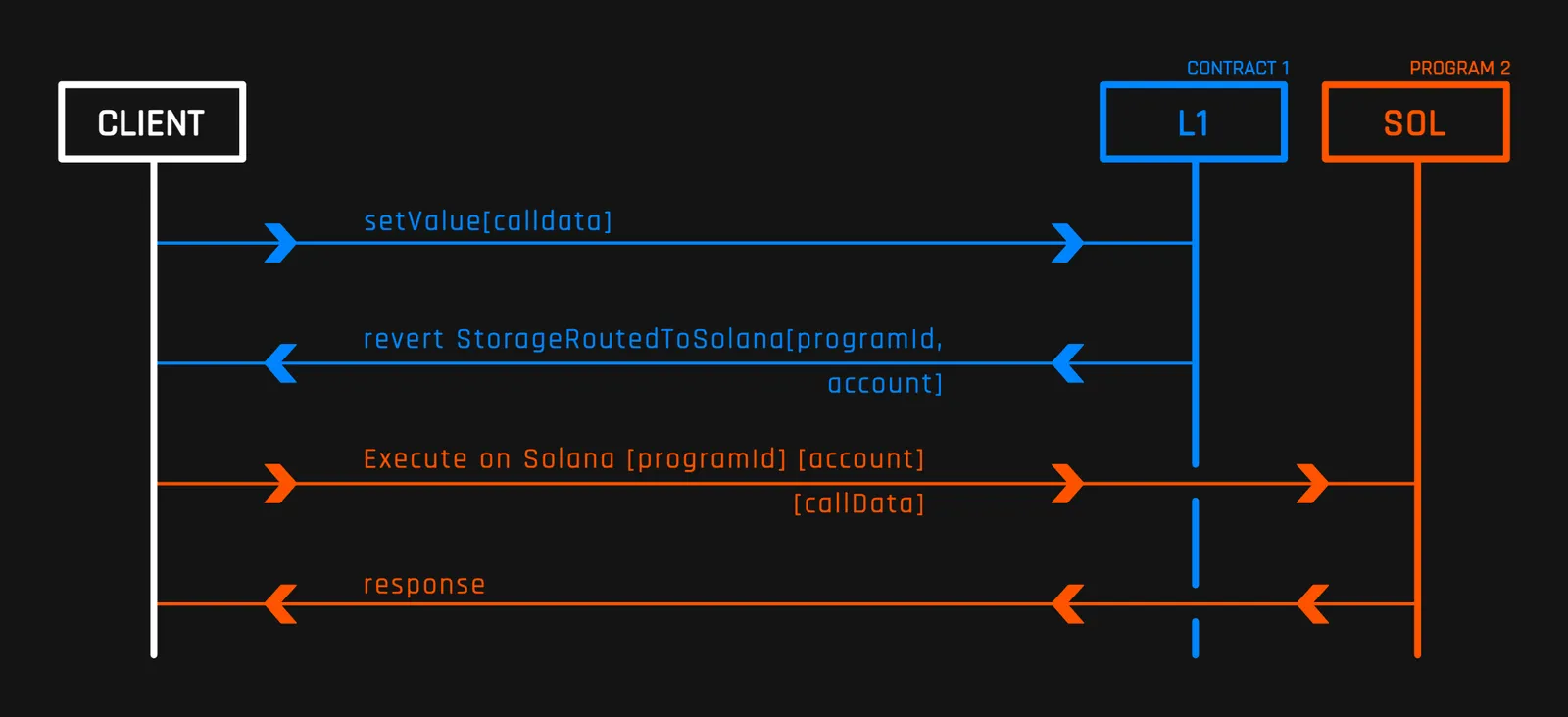
1. The client calls the Ethereum contract
A user or application calls a function such as setValue on an Ethereum L1 contract in the usual way.
At this point, the caller does not need to know that Solana is involved.
2. The Ethereum contract declares the route using revert
The Ethereum contract stops execution and raises StorageRoutedToSolana(programId, account) through revert.
Although this revert is an error, it signals a routing instruction rather than a failure of the intended cross-chain operation.
It communicates two pieces of information.
| Field | Meaning |
|---|---|
programId |
The program to call on Solana |
account |
The administrative account authorized to execute the operation |
This tells the client exactly which program and account to use when executing the operation on Solana.
3. The client executes the operation on Solana
The client parses the revert data, performs the following operations, and calls the Solana program.
- Convert EVM
calldatafor use in the SVM. - Decode
programIdto itsbase58representation. - Sign using the designated
account.
The actual storage write takes place at this point.
4. Solana returns the execution result to the client
The Solana program's execution result is returned to the client. Ethereum may subsequently access the result through ERC-3668.
Similarities to StorageRoutedToL2
In ERC-7694, StorageRoutedToSolana() shares the following properties with StorageRoutedToL2() in EIP-7700.
- Use
revertto specify the execution destination. - Leave execution to the client.
- Keep the Ethereum contract independent of the execution environment.
Both use the same underlying design philosophy.
The sole technical distinction
The difference stems from the different execution environments.
| Property | L2 | Solana |
|---|---|---|
| Virtual machine | EVM | SVM |
| Address format | hex | base58 |
| Fundamental types | uint256, bytes32 | u64, PubKey |
ERC-7694 therefore explicitly defines data type casts between the EVM and SVM. The rest of the design extends CCIP-Store.
Why this design matters
The design gives ERC-7694 the following properties.
- Ethereum contracts are not forced to change.
- Client implementations can accommodate different execution environments flexibly.
- The same pattern can be used to add other L1 networks in the future.
Rather than a special mechanism unique to Solana, it provides a general cross-chain execution model.
Citation
Avneet Singh (@sshmatrix), 0xc0de4c0ffee (@0xc0de4c0ffee), "ERC-7694: Solana Storage Router [DRAFT]," Ethereum Improvement Proposals, no. 7694, April 2024. [Online serial]. Available: https://eips.ethereum.org/EIPS/eip-7694.
Conclusion
This article covered ERC-7694, which proposes a mechanism for Ethereum smart contracts to treat Solana as external storage and perform cross-chain writes and reads securely. I hope it helped clarify the proposal.
If you have questions, feel free to reach out via Twitter DMs.
I also share my work on the following sites.


