Introduction
Hi, I'm cardene, a software engineer and technical writer focused on blockchain and AI.
I've also authored Japanese technical books on specification-driven development with LLMs and decentralized application (DApp) development.

I also build and publish a variety of tools, libraries, and open-source projects.
Overview
The original diagrams are retained; labels within them may be in Japanese.
A business accepting tokenized receivables needs to establish their value, the documents supporting them, and how long that information remains valid. When issuers publish information only through PDFs or proprietary APIs, however, consumers cannot use a consistent process to determine who produced the documents, whether they have been validated, or whether they are outdated.
Addressing this problem requires a record that preserves an asset description alongside its signature, version, validation state, and reference, as well as a contract that stores records for multiple assets.
ERC8320 standardizes the former as a claim and the latter as a registry.
Detailed documentation stays offchain, while its hash and retrieval location are recorded onchain.

Claims shared about an asset
Asset descriptions take several forms.
An issuer might describe the identity of an asset, an administrator might provide its valuation, and an auditor might report its backing.
ERC8320 divides these into topic-specific claim records and associates each with the identifier of the underlying asset.
New versions can be added for the same topic. Because older records are retained rather than overwritten, consumers can trace who created the information and which version it represents.
Validation and publication through three roles
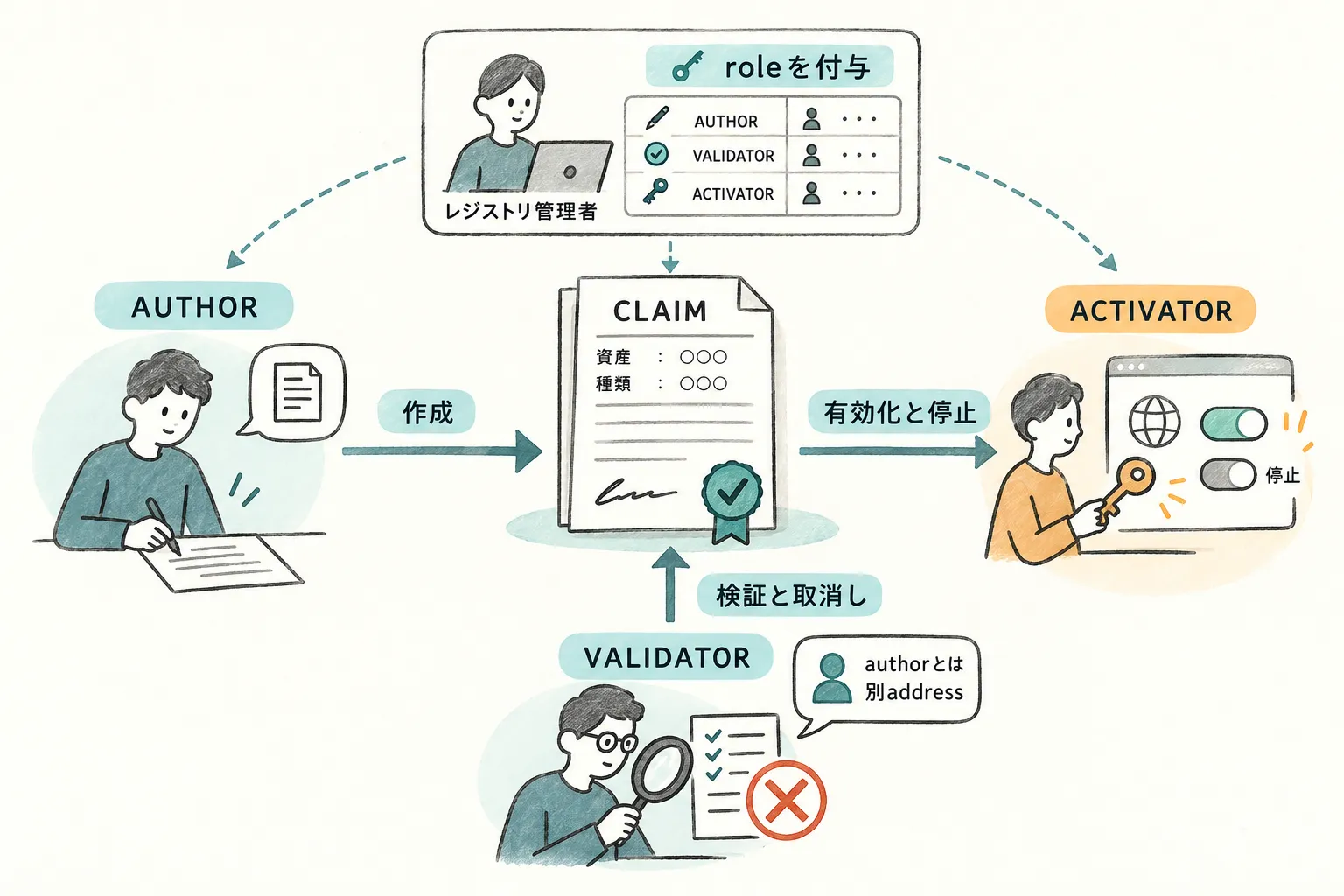
Each claim passes through three stages: creation, validation, and publication.
The author submits the content and a signature, and the validator verifies it using an address different from the author's.
The activator then moves the claim into a state where it can be used.
These three roles do not necessarily have to be held by three separate people. The standard requires address separation only between the author and validator. A single address may hold multiple roles, so any further separation of duties is an operational decision.
Scope of the guarantees
Signatures provide evidence of who authorized which operation. The schema and content hashes help consumers detect whether the retrieved material has been substituted. Reading the state and validity period helps determine whether a particular version is a current candidate.
Passing these checks does not, however, establish that the asset valuation, legal rights, or underlying evidence are correct. Consumers evaluate the author's trustworthiness, external evidence, and required ratios or conditions according to their own policies.
Motivation
Unlike ownership or balances, asset valuations and backing information are updated over time. An auditor may add new evidence, or an administrator may publish a valuation for a different reference date. A mechanism is needed that preserves both old and new records while allowing consumers to select only the versions relevant now.
Asset descriptions that machines cannot interpret consistently
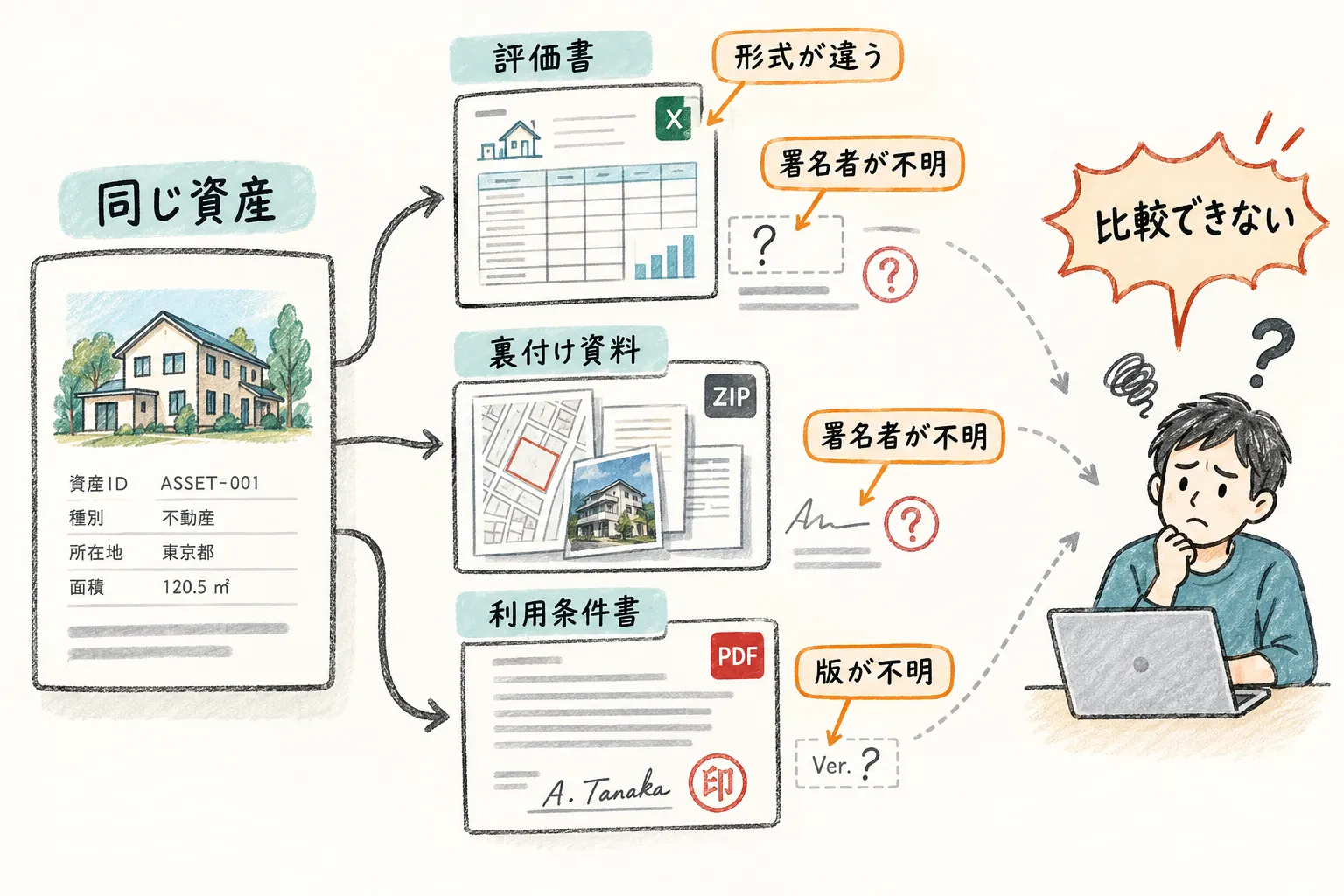
With PDFs, web pages, and issuer-specific APIs, document formats and update mechanisms vary from issuer to issuer. Consumers must interpret the signer, underlying asset, version, validity period, and content retrieval location individually, and adapt their processing to each issuer. When several descriptions concern the same asset, there is no common basis for deciding which one to use.
ERC8320 therefore separates common fields verified onchain from detailed content read offchain. Consumers can narrow down candidates using the common fields, verify the hash, and then evaluate the detailed documentation.
Relationship to existing asset standards
ERC4626 standardizes deposits, withdrawals, and share conversions for single-asset vaults. Users can inspect the assets they deposit and the shares they receive through common functions. ERC8320 does not replace such a vault; it adds a layer through which external parties can publish valuations and backing for assets held by the vault.
For more on ERC4626, see the following article.
ERC7575 defines a vault architecture that maps multiple assets to a single share token.
Consumers can read which vault corresponds to which share token and asset.
With ERC8320, valuations and backing for each asset can be tracked as separate claim records.
For more on ERC7575, see the following article.
ERC7540 defines asynchronous processing from request to finalization for vaults whose deposits or withdrawals cannot complete immediately. Users can check request progress and the assets or shares available once the request is finalized. ERC8320 records the provenance and versions of asset descriptions separately from asynchronous processing.
For more on ERC7540, see the following article.
Relationship to regulated tokens
ERC7943 defines a minimum set of functions for token transfer eligibility, freezing, and forced transfers. Consumers can query a contract to determine whether a transfer is permitted. ERC8320 does not authorize or reject transfers; it records asset information that can inform such decisions.
For more on ERC7943, see the following article.
ERC3643 defines a framework for security tokens that may only be held and transferred by verified investors. ERC8320 does not replace identity verification or transfer restrictions; it adds a separate history of descriptions such as valuations, conditions, and backing.
For more on ERC3643, see the following article.
Specification
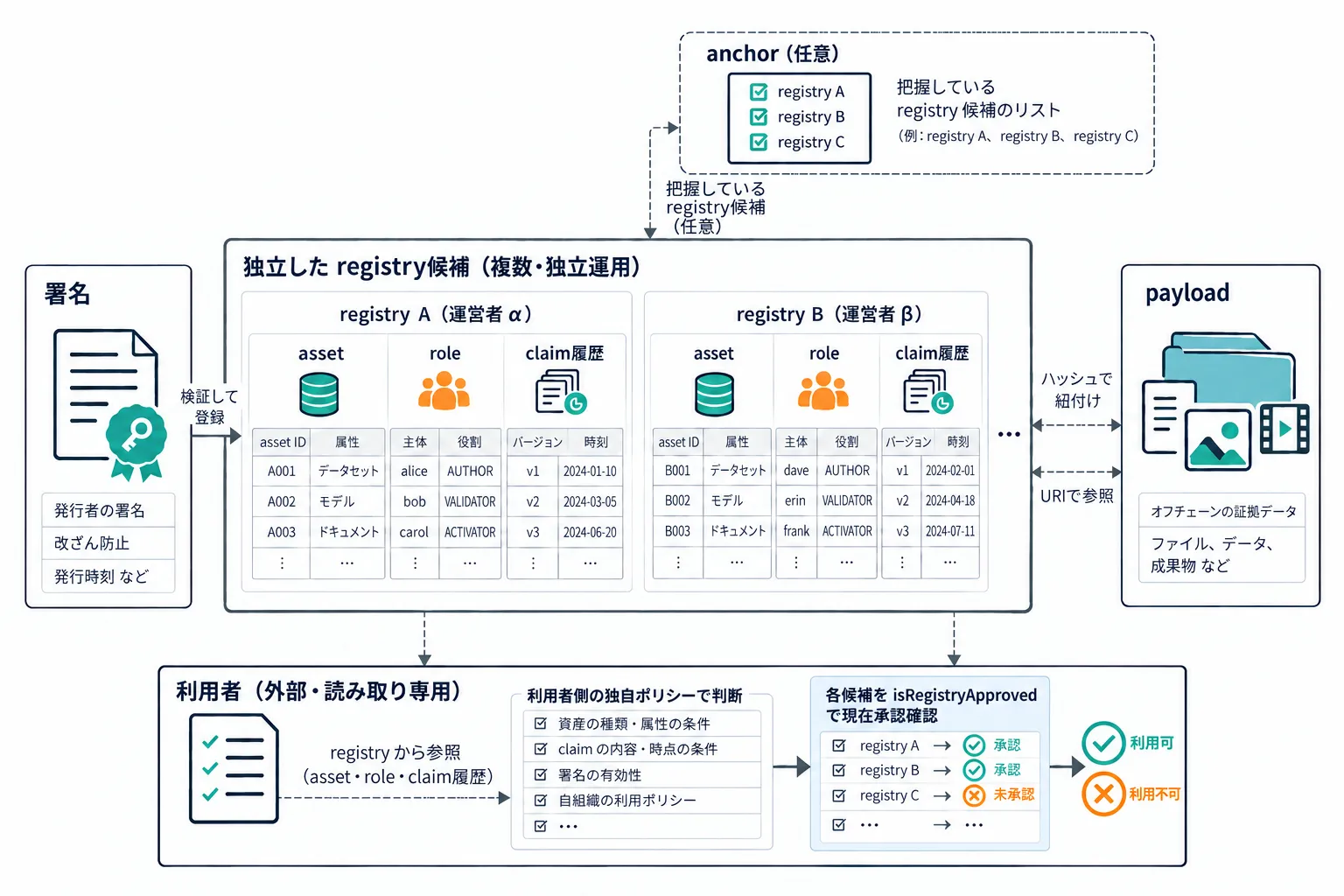
ERC8320 stores assets, roles, and claim histories in a registry.
State changes use signatures, while detailed documents are linked to onchain records through hashes and URIs.
If the asset contract can be modified, an optional interface allows the asset itself to indicate which registry it trusts.
Types and states
ClaimType
ClaimType is an enum that distinguishes who is making a claim and what it concerns.
Even for the same asset, the author, update frequency, and consumer checks vary by topic, so the enum defines eight distinct values.
enum ClaimType { IDENTITY, VALUATION, MANDATE, TERMS, COMPLIANCE, BACKING, EVENT, RISK }| Value | Subject of the claim | Typical author | Consumer decision |
|---|---|---|---|
IDENTITY |
Asset identity and issuer | Issuer | Verify the underlying asset and issuing entity |
VALUATION |
Price or net asset value as of a reference date | Administrator | Verify the valuation date and calculating entity |
MANDATE |
Investment policy | Manager | Verify permitted investments |
TERMS |
Subscription, redemption, and fee terms | Manager | Verify transaction terms |
COMPLIANCE |
Holding or trading conditions | Compliance provider | Check whether the applicable conditions are met |
BACKING |
Reserve assets or collateral | Auditor | Assess evidence and required ratios |
EVENT |
Distributions, notices, and corporate actions | Issuer or manager | Determine what happened and when |
RISK |
Risk assessment framework or results | Risk manager | Verify the assessment criteria |
ClaimState
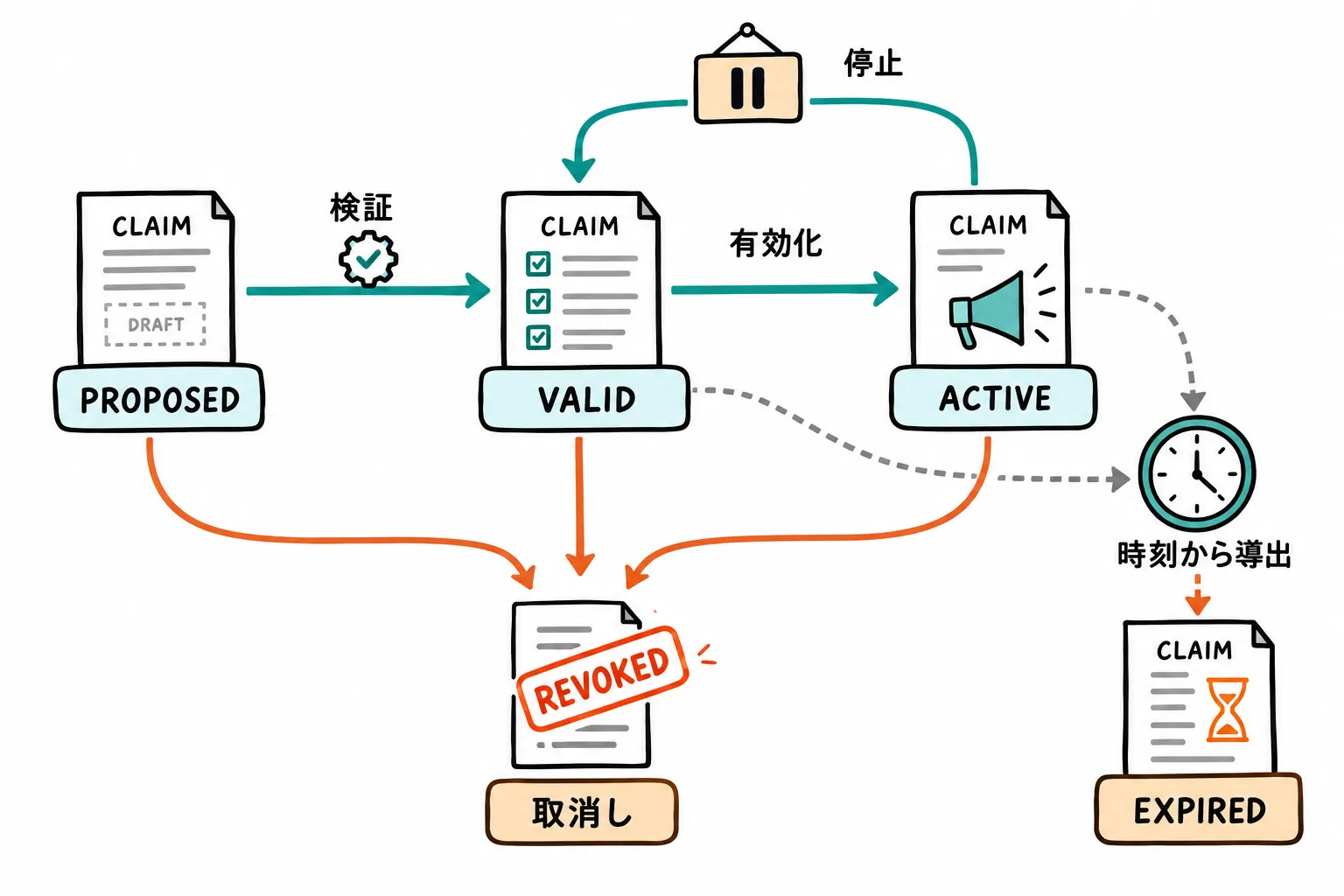
ClaimState is an enum indicating how far a claim has progressed through validation since its creation.
Consumers should check the validity period and asset registration status as well as the state name when deciding whether a claim is usable.
enum ClaimState { PROPOSED, VALID, ACTIVE, EXPIRED, REVOKED }| Value | Condition for entering this state | Consumer treatment |
|---|---|---|
PROPOSED |
The author has proposed a new version | Do not use it before validation |
VALID |
A validator other than the author has verified it | Do not use it before activation or while suspended |
ACTIVE |
The activator has activated it | Include it as a candidate within its validity period |
EXPIRED |
The end time of a VALID or ACTIVE version has passed |
Exclude it from current candidates |
REVOKED |
A validator has revoked it | Never reactivate it |
EXPIRED is not a state written by a transaction.
It is derived from the stored state and validUntil when reading through functions such as getClaim.
RoleKind
RoleKind is an enum distinguishing the permitted operations for each asset and claim type.
An administrator grants roles to addresses, and each state change checks whether the signer holds the required role.
enum RoleKind { AUTHOR, VALIDATOR, ACTIVATOR }| Value | Permitted operations | Reason for separation |
|---|---|---|
AUTHOR |
Propose a new claim |
Record the author of the content |
VALIDATOR |
Validate proposals and revoke them when needed | Verify content from an address separate from the author |
ACTIVATOR |
Activate and suspend validated versions | Separate publication timing from content validation |
The standard checks that the VALIDATOR signer differs from the stored author.
There is no requirement, however, that the ACTIVATOR must be a third address.
A configuration granting multiple roles to one address is also permitted.
RegulatedAssetClaim
RegulatedAssetClaim is a struct combining the subject, topic, version, validity period, validation state, author, and link to offchain documentation for a single asset description.
The author provides it when proposing a claim, the registry stores it as history, and consumers retrieve it.
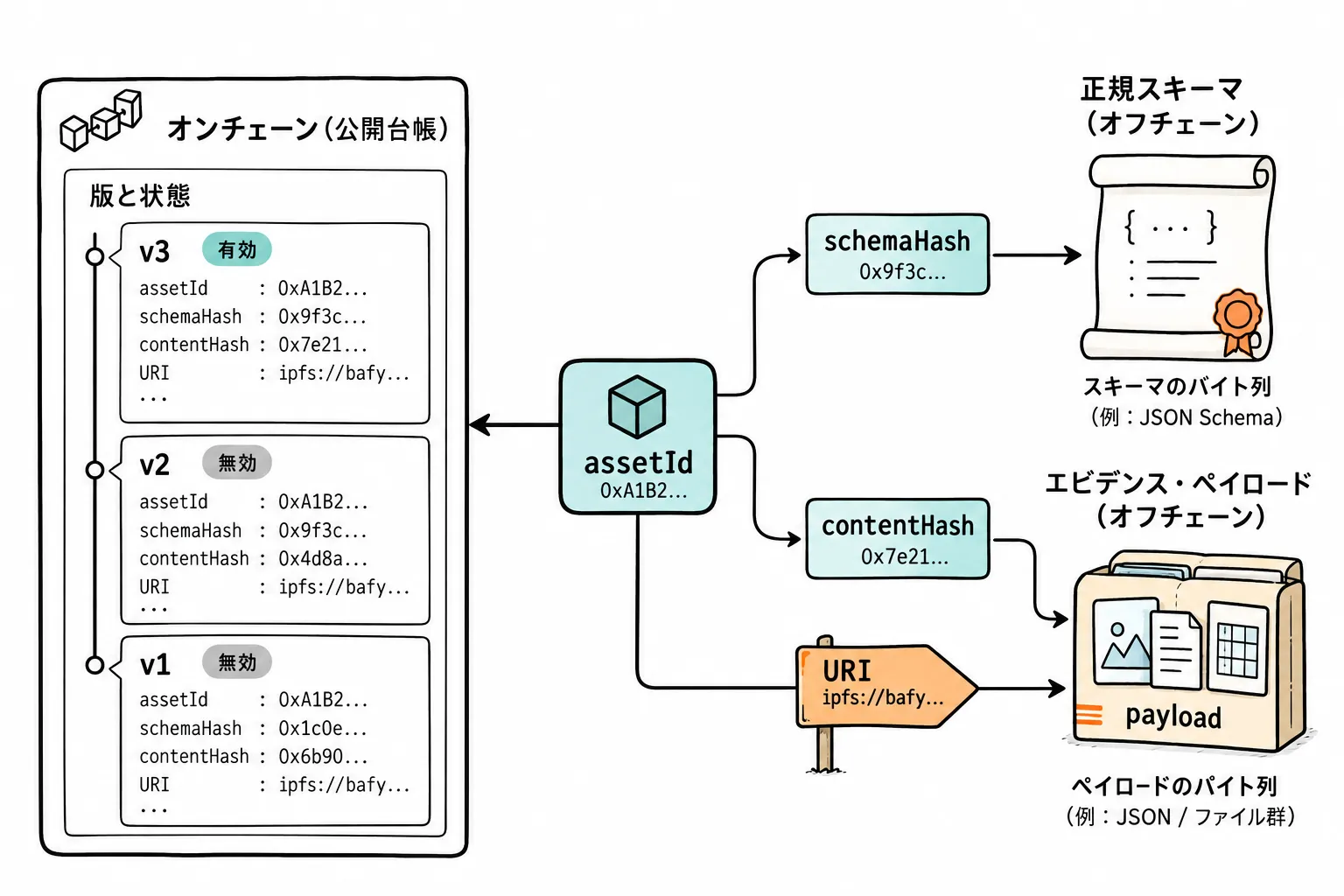
struct RegulatedAssetClaim {
    bytes32    assetId;
    ClaimType  claimType;
    bytes32    schemaId;
    bytes32    schemaHash;
    uint64     version;
    uint64     validFrom;
    uint64     validUntil;
    ClaimState claimState;
    bytes32[]  tags;
    bytes32    contentHash;
    address    author;
    string     uri;
}| Field | Stored information |
|---|---|
assetId |
Identifier of the underlying asset |
claimType |
Type of claim, such as valuation or backing |
schemaId |
Identifier of the schema followed by the offchain document |
schemaHash |
Hash of the selected schema file |
version |
Version number for the same asset and claim type |
validFrom |
Start of the validity period |
validUntil |
End of the validity period |
claimState |
Stored state of proposal, validation, activation, or revocation |
tags |
Public labels for searching and indexing |
contentHash |
Hash of the offchain document |
author |
Author's address |
uri |
Location from which the offchain document can be retrieved |
assetId
assetId is an identifier calculated from the chain ID, asset contract address, and asset number within the contract.
Consumers check whether the onchain record and offchain documentation refer to the same asset.
claimType
claimType selects one of eight topics, including valuations, terms, and backing.
Role assignments and version increments are managed separately for each pair of assetId and claimType.
schemaId
schemaId identifies the schema followed by the offchain document.
However, neither the standard nor the official reference implementation automatically rejects a zero value, so consumers must define the schema IDs they accept.
ERC8320 does not define a registry, URI, or retrieval API that resolves a schemaId to the distribution location of the authoritative schema.
Consumers obtain the exact schema bytes through a trusted channel and stop considering a claim if the schema cannot be obtained.
schemaHash
schemaHash is the hash of the exact bytes of the selected schema file.
It allows consumers to detect substituted content that uses the same schemaId.
version
version is the version number for a pair of assetId and claimType.
A new claim uses a number greater than the previous maximum and extends the history without deleting older versions.
validFrom
validFrom marks the beginning of the validity period.
Even if the stored state is ACTIVE, versions before this time are excluded from the results of getActiveClaims.
validUntil
validUntil marks the end of the validity period.
Zero means no expiration; when a nonzero timestamp has passed, the claim is treated as EXPIRED on reads.
Neither the standard nor the official reference implementation checks at proposal time whether validUntil is later than validFrom.
claimState
claimState stores how far a claim has progressed through proposal, validation, activation, and revocation.
Because expiration is derived from time, the stored value and the result returned on a read may differ.
tags
tags are public labels for search and indexing.
They are not binding conditions, so consumers do not rely on tags alone to determine whether to use a claim.
contentHash
contentHash is a hash of the exact contents of the entire offchain document.
Consumers hash the bytes retrieved from the uri and check that the hash matches the stored value.
author
author is the address of the EOA or contract signer that created the claim.
Validation checks that the validator is different from this address.
uri
uri is the location from which the offchain document can be retrieved.
The registry guarantees neither retrievability nor access control, and it does not automatically reject an empty string.
Consumers check retention requirements and access methods separately.
IRegulatedAssetClaimRegistry
IRegulatedAssetClaimRegistry is an interface standardizing asset registration, role assignment, claim state changes, and historical reads.
State-change event logs help discover candidates, but current usability is determined by read functions together with timestamps.
ClaimProposed
event ClaimProposed(bytes32 indexed assetId, ClaimType indexed claimType, uint64 version, address indexed author);This event is emitted when a new version is proposed.
Candidates can be searched by indexed asset, topic, and author.
Because the event does not contain the document hash, URI, validity period, or current state, use getClaim after locating a candidate.
- Fields
| Field | Details |
|---|---|
assetId |
Identifier of the underlying asset. |
claimType |
Topic of the claim. |
version |
Newly added version. |
author |
Author who signed the content. |
ClaimValidated
event ClaimValidated(bytes32 indexed assetId, ClaimType indexed claimType, uint64 version, address indexed validator);This event is emitted when a validator verifies a proposed version. It allows consumers to trace who validated it independently of the author. Because activation, suspension, or revocation may follow, the log alone does not establish the current state.
- Fields
| Field | Details |
|---|---|
assetId |
Identifier of the underlying asset. |
claimType |
Validated topic. |
version |
Validated version. |
validator |
Address that signed the validation. |
ClaimActivated
event ClaimActivated(bytes32 indexed assetId, ClaimType indexed claimType, uint64 version, address indexed activator);This event is emitted when a validated version is moved into a usable state. Consumers must still check its validity period. Because later suspension or revocation is possible, read the stored state and current time again before accepting the claim.
- Fields
| Field | Details |
|---|---|
assetId |
Identifier of the underlying asset. |
claimType |
Activated topic. |
version |
Activated version. |
activator |
Address that signed the activation. |
ClaimSuspended
event ClaimSuspended(bytes32 indexed assetId, ClaimType indexed claimType, uint64 version, address indexed activator);This event is emitted when a published version moves from ACTIVE back to VALID.
Unlike revocation, suspension allows the same version to be reactivated later.
The log alone does not reveal subsequent reactivation or revocation, so consumers read the current state again.
- Fields
| Field | Details |
|---|---|
assetId |
Identifier of the underlying asset. |
claimType |
Suspended topic. |
version |
Suspended version. |
activator |
Address that signed the suspension. |
ClaimRevoked
event ClaimRevoked(bytes32 indexed assetId, ClaimType indexed claimType, uint64 version, address indexed revoker);This event is emitted when a validator revokes a version.
A version that moves to REVOKED cannot be reactivated.
Because the log contains neither the document contents nor the reason for revocation, inspect the version's stored values and operational records separately.
- Fields
| Field | Details |
|---|---|
assetId |
Identifier of the underlying asset. |
claimType |
Revoked topic. |
version |
Revoked version. |
revoker |
Validator who signed the revocation. |
RoleGrantedToClaimType
event RoleGrantedToClaimType(bytes32 indexed assetId, ClaimType claimType, RoleKind kind, address indexed who);This event is emitted when an administrator grants a role to an address for a particular asset and topic.
Roles are not granted across all assets at once.
Because roles may subsequently be revoked, check the current result of isAuthorized to determine whether an operation is permitted.
- Fields
| Field | Details |
|---|---|
assetId |
Asset for which the role is granted. |
claimType |
Topic for which the role applies. |
kind |
Indicates whether the role is author, validator, or activator. |
who |
Address receiving the role. |
RoleRevokedFromClaimType
event RoleRevokedFromClaimType(bytes32 indexed assetId, ClaimType claimType, RoleKind kind, address indexed who);This event is emitted when an administrator revokes a role.
Signed operations after the revocation are rejected, but existing claim states do not change automatically.
Because the same role can be granted again later, this log alone does not establish the current authorization state.
- Fields
| Field | Details |
|---|---|
assetId |
Asset from which the role is removed. |
claimType |
Topic from which the role is removed. |
kind |
Role being removed. |
who |
Address losing the role. |
AssetRegistered
event AssetRegistered(bytes32 indexed assetId, address indexed contractAddr, uint256 subAssetId, uint256 chainId, address indexed registrant);This event is emitted when an administrator registers an asset reference.
It allows consumers to trace the chain, contract, and asset number used to derive the assetId.
Because the asset may later be deactivated, check its current registration status using isAssetActive.
- Fields
| Field | Details |
|---|---|
assetId |
Computed asset identifier. |
contractAddr |
Asset contract. The zero address can also be used for offchain assets. |
subAssetId |
Number distinguishing tranches, share classes, or similar subdivisions. |
chainId |
Chain ID to which the asset reference belongs. |
registrant |
Administrator who performed the registration. |
AssetRemoved
event AssetRemoved(bytes32 indexed assetId, address indexed admin);This event is emitted when an administrator deactivates an asset.
The asset reference and historical claim records are not deleted.
Because the log alone does not provide historical claims or reference values, use read functions to inspect both.
- Fields
| Field | Details |
|---|---|
assetId |
Asset that was deactivated. |
admin |
Administrator who performed the operation. |
grantRoleToClaimType
function grantRoleToClaimType(bytes32 assetId, ClaimType t, RoleKind kind, address who) external;Allows an administrator to grant a role scoped to a particular asset and topic.
-
Check that the caller is a registry administrator
Calls from non-administrators revert.
-
Store the address for the asset, topic, and role combination
Whether the same address holds other roles or roles for other topics is recorded separately.
-
Emit a role grant event
Record the relevant identifiers in the
RoleGrantedToClaimTypeevent.
- Parameters
| Parameter | Details |
|---|---|
assetId |
Asset for which the role is granted. |
t |
Topic for which the role applies. |
kind |
Role to grant. |
who |
Address receiving the role. |
-
Execution conditions
-
The caller is a
registryadministrator
revokeRoleToClaimType
function revokeRoleToClaimType(bytes32 assetId, ClaimType t, RoleKind kind, address who) external;Allows an administrator to revoke a role for a particular asset and topic.
-
Check that the caller is a registry administrator
Calls from non-administrators revert.
-
Disable the specified role
The states of previously created
claimrecords are not changed. -
Emit a role revocation event
Record the relevant identifiers in the
RoleRevokedFromClaimTypeevent.
- Parameters
| Parameter | Details |
|---|---|
assetId |
Asset for which the role is revoked. |
t |
Topic for which the role is revoked. |
kind |
Role to revoke. |
who |
Address losing the role. |
-
Execution conditions
-
The caller is a
registryadministrator
isAuthorized
function isAuthorized(bytes32 assetId, ClaimType t, RoleKind kind, address who) external view returns (bool);Returns whether the specified address holds a role for the given asset and topic.
-
Look up the role table using four inputs
Read the record that exactly matches the asset, topic, role, and address.
-
Return the grant status
Return
trueif the grant is stored, orfalseotherwise.
- Parameters
| Parameter | Details |
|---|---|
assetId |
Asset to check. |
t |
Topic to check. |
kind |
Role to check. |
who |
Address to check. |
- Return value
| Return value | Details |
|---|---|
bool |
Returns true if the specified role is held. |
-
Execution conditions
-
Read-only operation; no state changes
proposeClaim
function proposeClaim(RegulatedAssetClaim calldata claim, uint256 nonce, uint64 deadline, bytes calldata signature) external;Adds a new version signed by the author in the PROPOSED state.
-
Check the asset and author authorization
Verify that the asset is active and that the relevant
AUTHORrole is granted toclaim.author. -
Check the state and version
Verify that the input state is
PROPOSEDand that the version exceeds the previous maximum. -
Check the signature and nonce
Verify the deadline, the author's
nonce, and the EIP712 signature. -
Append the claim to the history
Increment the
nonceand emitClaimProposedonly on success.
- Parameters
| Parameter | Details |
|---|---|
claim |
Struct to store. |
nonce |
Expected unused number for the author. |
deadline |
Latest time at which the signature is accepted. |
signature |
Signature produced by claim.author. |
-
Execution conditions
-
The asset is active
-
The author holds the
AUTHORrole -
The state is
PROPOSEDand the version increases monotonically -
The signature,
nonce, and deadline are valid
validateClaim
function validateClaim(bytes32 assetId, ClaimType t, uint64 version, address signer, uint256 nonce, uint64 deadline, bytes calldata signature) external;Allows a validator other than the author to advance a proposed version to VALID.
-
Locate the target claim
Read the record that exactly matches the asset, topic, and version.
-
Check the asset, state, and role
Verify that the asset is active, the state is
PROPOSED, and the signer is aVALIDATOR. -
Check separation from the author
Revert if the
signeris the same as the storedauthor. -
Verify the signature and update the state
Advance to
VALID, increment thenonce, and emitClaimValidatedonly on success.
- Parameters
| Parameter | Details |
|---|---|
assetId |
Underlying asset. |
t |
Target topic. |
version |
Version to validate. |
signer |
Validator's address. |
nonce |
Expected number for the validator. |
deadline |
Signature deadline. |
signature |
Validator's signature. |
-
Execution conditions
-
The asset is active and the target version is
PROPOSED -
The
signerholds theVALIDATORrole -
The
signerdiffers from the storedauthor -
The signature,
nonce, and deadline are valid
activateClaim
function activateClaim(bytes32 assetId, ClaimType t, uint64 version, address signer, uint256 nonce, uint64 deadline, bytes calldata signature) external;Allows the activator to advance a validated version to ACTIVE.
-
Check the target and its state
Verify that the asset is active and the target version is
VALID. -
Check activation authorization and the signature
Verify the
signer'sACTIVATORrole,nonce, deadline, and signature. -
Update the state to ACTIVE
Update the state and
nonceand emitClaimActivatedonly on success.
- Parameters
| Parameter | Details |
|---|---|
assetId |
Underlying asset. |
t |
Target topic. |
version |
Version to activate. |
signer |
Activator. |
nonce |
Expected number for the activator. |
deadline |
Signature deadline. |
signature |
Activator's signature. |
-
Execution conditions
-
The asset is active and the target version is
VALID -
The
signerholds theACTIVATORrole -
The signature,
nonce, and deadline are valid
suspendClaim
function suspendClaim(bytes32 assetId, ClaimType t, uint64 version, address signer, uint256 nonce, uint64 deadline, bytes calldata signature) external;Allows the activator to return an ACTIVE version to VALID.
-
Check the target version and state
Verify that the target version exists and that its state on reads is
ACTIVE. -
Check activation authorization and the signature
Verify the
ACTIVATORrole,nonce, deadline, and signature. -
Return to VALID
Update the state and
nonceand emitClaimSuspendedonly on success.
- Parameters
| Parameter | Details |
|---|---|
assetId |
Underlying asset. |
t |
Target topic. |
version |
Version to suspend. |
signer |
Activator. |
nonce |
Expected number for the activator. |
deadline |
Signature deadline. |
signature |
Activator's signature. |
-
Execution conditions
-
The target version is
ACTIVE -
The
signerholds theACTIVATORrole -
The signature,
nonce, and deadline are valid
revokeClaim
function revokeClaim(bytes32 assetId, ClaimType t, uint64 version, address signer, uint256 nonce, uint64 deadline, bytes calldata signature) external;Allows a validator to move a version to REVOKED.
-
Check the current state of the target version
Verify that it is
PROPOSED,VALID, orACTIVE. -
Verify validation authorization and the signature
Check the
VALIDATORrole,nonce, deadline, and signature. -
Update the state to REVOKED
Update the state and
nonceand emitClaimRevokedonly on success.
- Parameters
| Parameter | Details |
|---|---|
assetId |
Underlying asset. |
t |
Target topic. |
version |
Version to revoke. |
signer |
Validator. |
nonce |
Expected number for the validator. |
deadline |
Signature deadline. |
signature |
Validator's signature. |
-
Execution conditions
-
The target version is
PROPOSED,VALID, orACTIVE -
The
signerholds theVALIDATORrole -
The signature,
nonce, and deadline are valid
getActiveClaims
function getActiveClaims(bytes32 assetId, ClaimType t) external view returns (RegulatedAssetClaim[] memory activeClaims);Returns all currently usable versions for the specified asset and topic.
-
Read the relevant history
Examine all versions matching
assetIdandt. -
Filter by state and validity period
Retain only versions whose stored state is
ACTIVE, whose start time has passed, and whose end time has not been reached. -
Return the matching array
If multiple versions satisfy the conditions simultaneously, return all of them.
- Parameters
| Parameter | Details |
|---|---|
assetId |
Underlying asset. |
t |
Topic to read. |
- Return value
| Return value | Details |
|---|---|
activeClaims |
Array of claim records that are currently ACTIVE and within their validity period. |
-
Execution conditions
-
Read-only operation; no state changes
-
The consumer selects which version to use from the returned records
getClaim
function getClaim(bytes32 assetId, ClaimType t, uint64 version) external view returns (RegulatedAssetClaim memory);Returns the record that exactly matches the asset, topic, and version.
-
Locate the specified version
Search the history for
assetIdandtfor a record matchingversion. -
Derive expiration
If the stored state is
VALIDorACTIVEand the deadline has passed, return the state asEXPIRED. -
Return the claim
Revert if no matching version exists.
- Parameters
| Parameter | Details |
|---|---|
assetId |
Underlying asset. |
t |
Target topic. |
version |
Version to read. |
- Return value
| Return value | Details |
|---|---|
RegulatedAssetClaim |
Struct for the specified version. |
-
Execution conditions
-
The specified version exists
nonces
function nonces(address signer) external view returns (uint256);Returns the unused number to include in a state-change signature for a signer.
-
Read the signer's nonce
Look up the stored value corresponding to the number of successful signed operations.
-
Return the next expected number
A reused signature can be rejected because its number no longer matches the stored value.
- Parameters
| Parameter | Details |
|---|---|
signer |
Signer whose number is being checked. |
- Return value
| Return value | Details |
|---|---|
uint256 |
Number to include in an unused signature. |
-
Execution conditions
-
Read-only operation; no state changes
registerAsset
function registerAsset(address contractAddr, uint256 subAssetId, uint256 chainId) external returns (bytes32 assetId);Allows an administrator to register an asset reference in the registry and activate it.
-
Check the caller
Reject calls from anyone other than the
registryadministrator. -
Compute the assetId
Derive the identifier from the chain ID, contract address, and asset number.
-
Check for duplicates and store the reference
Store the reference and mark it active only if a reference with the same identifier does not exist.
-
Emit an event and return the identifier
Emit
AssetRegisteredand return the computedassetId.
- Parameters
| Parameter | Details |
|---|---|
contractAddr |
Asset contract. The zero address can also be used for offchain assets. |
subAssetId |
Number distinguishing assets within a single contract. |
chainId |
Chain ID to which the asset reference belongs. |
- Return value
| Return value | Details |
|---|---|
assetId |
Identifier computed from the three inputs. |
-
Execution conditions
-
The caller is a
registryadministrator -
No asset reference with the same
assetIdis registered
removeAsset
function removeAsset(bytes32 assetId) external;Allows an administrator to deactivate an asset and stop new claim changes.
-
Check the administrator and registered reference
Reject calls from non-administrators and reject unknown assets.
-
Set only active to false
Retain the asset reference and historical
claimrecords. -
Emit the AssetRemoved event
Record the affected asset and administrator in the event log.
- Parameters
| Parameter | Details |
|---|---|
assetId |
Asset to deactivate. |
-
Execution conditions
-
The caller is a
registryadministrator -
The asset reference is registered
Because the reference for the same assetId remains stored, attempting to register it again through registerAsset is rejected as a duplicate asset.
The normative interface also provides no function to return an inactive asset to the active state.
Consequently, under the standard interface, removeAsset should be treated as ending operations for an asset rather than temporarily suspending them.
isAssetActive
function isAssetActive(bytes32 assetId) external view returns (bool);Returns whether the registry accepts new claim changes for the asset.
It does not represent the asset's commercial or redemption status.
-
Read the asset's active flag
Look up the value that is
trueupon registration andfalseafter removal. -
Return whether changes are accepted
Only assets whose flag is
truecan proceed through proposal, validation, and activation.
- Parameters
| Parameter | Details |
|---|---|
assetId |
Asset to check. |
- Return value
| Return value | Details |
|---|---|
bool |
Returns true if new changes are accepted. |
-
Execution conditions
-
Read-only operation; no state changes
getAssetId
function getAssetId(address contractAddr, uint256 subAssetId, uint256 chainId) external pure returns (bytes32);Computes the assetId from the three components of an asset reference.
-
Encode the three values in the same order
Use the chain ID, contract address, and asset number as inputs to the identifier.
-
Return the keccak256 result
The same identifier can be computed before registration in the
registry.
- Parameters
| Parameter | Details |
|---|---|
contractAddr |
Asset contract. |
subAssetId |
Asset number within the contract. |
chainId |
Chain ID to which the asset belongs. |
- Return value
| Return value | Details |
|---|---|
bytes32 |
Computed asset identifier. |
-
Execution conditions
-
No state reads or writes
getAssetReference
function getAssetReference(bytes32 assetId) external view returns (address contractAddr, uint256 subAssetId, uint256 chainId);Returns the original asset reference for a registered assetId.
-
Locate the stored reference
Read the contract, asset number, and chain ID corresponding to the specified identifier.
-
Return the three values
Revert if the reference does not exist.
- Parameters
| Parameter | Details |
|---|---|
assetId |
Asset identifier whose reference is to be recovered. |
- Return values
| Return value | Details |
|---|---|
contractAddr |
Asset contract. |
subAssetId |
Asset number within the contract. |
chainId |
Chain ID of the asset reference. |
-
Execution conditions
-
The specified asset reference is registered
IRegistryAnchor
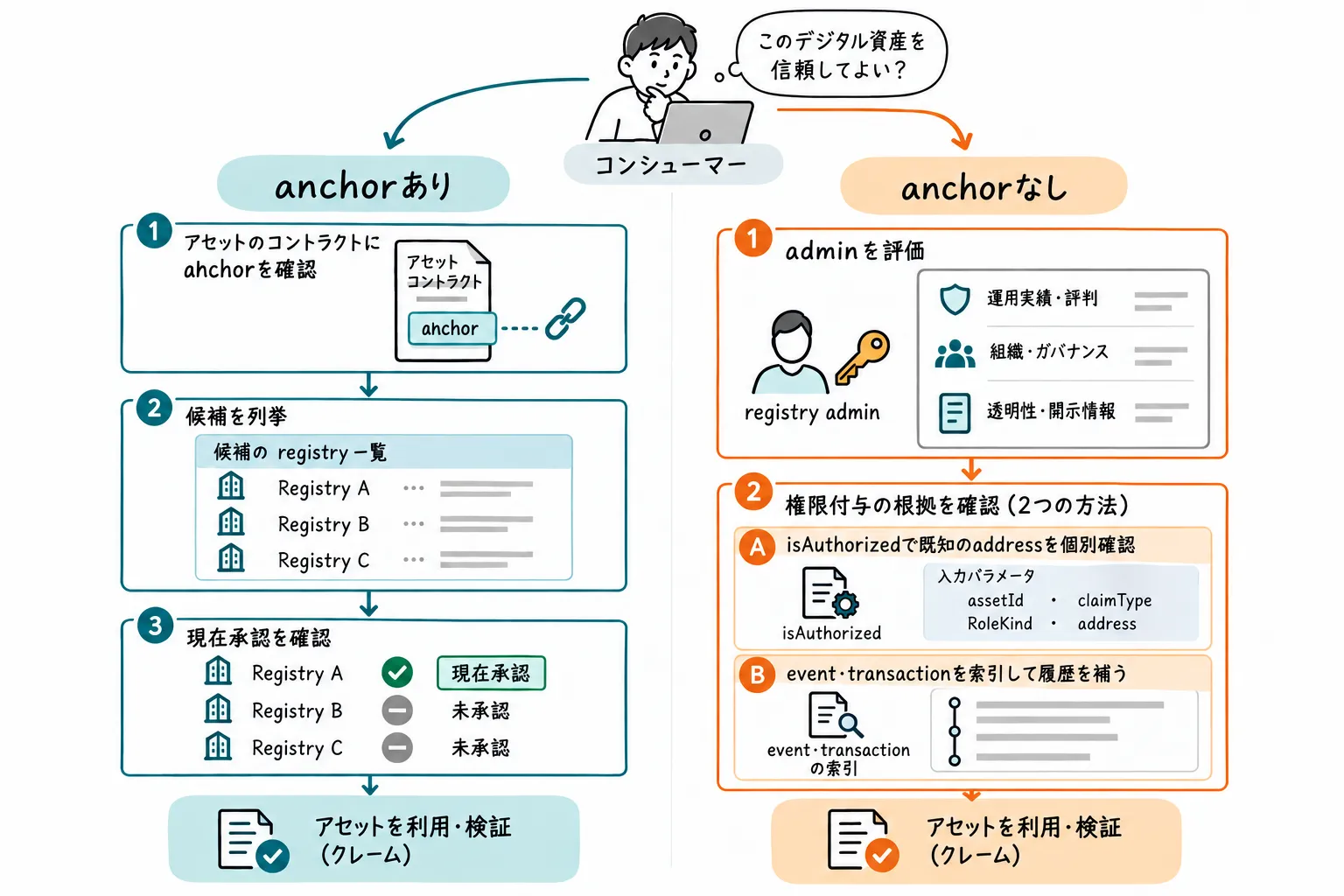
IRegistryAnchor is an optional interface through which an asset contract publishes the registry addresses it recognizes.
After retrieving a list of candidates, consumers check individually whether each is still approved.
RegistrySet
event RegistrySet(address indexed registry, address indexed asset, bool approved);This event is emitted when the asset changes the approval status of a registry.
- Fields
| Field | Details |
|---|---|
registry |
The registry whose approval status changed. |
asset |
Asset contract managing the approval. |
approved |
Approval status after the change. |
setRegistry
function setRegistry(address registry, bool approved) external;Allows the asset-side administrator to change the approval status of a single registry.
-
Check caller authorization
The asset contract implementation determines who may make changes.
-
Update the approval status
Approve if
approvedistrue; withdraw approval if it isfalse. -
Emit the RegistrySet event
Record the target and result of the change in the event log.
- Parameters
| Parameter | Details |
|---|---|
registry |
The registry whose approval status is being changed. |
approved |
Approval status after the change. |
-
Execution conditions
-
Only entities authorized by the asset contract may call this function
getRegistries
function getRegistries() external view returns (address[] memory);Returns the candidate registry addresses known to the asset.
Inclusion in this array does not by itself establish current approval.
-
Read the set of registry candidates
Enumerate the addresses recorded by the asset contract.
-
Return the array
Consumers check each address using
isRegistryApproved.
- Return value
| Return value | Details |
|---|---|
address[] |
Candidate registry addresses known to the asset. |
-
Execution conditions
-
Read-only operation; no state changes
isRegistryApproved
function isRegistryApproved(address registry) external view returns (bool);Returns whether a particular registry is currently approved.
-
Read the specified registry's approval flag
Look up the current value stored by the asset contract.
-
Return whether it is approved
If
true, theclaimrecords from thatregistrycan be evaluated; iffalse, ignore them.
- Parameters
| Parameter | Details |
|---|---|
registry |
Address whose current approval is being checked. |
- Return value
| Return value | Details |
|---|---|
bool |
Returns true if currently approved. |
-
Execution conditions
-
Read-only operation; no state changes
Signatures and replay protection
State-change signatures are bound to an EIP712 domain that includes the chain ID and registry address to prevent unintended reuse of a signer's authorization on another chain or in another registry.
Consumers can verify the signed fields and signer using the same types.
For more on EIP712, see the following article.
Each signature includes the asset, topic, version, and expected state of the operation, as well as a per-signer nonce and deadline.
A successful signature increments the nonce; resubmitting the same signature then reverts because it no longer matches the current value.
If the state transition fails, the entire transaction reverts and the nonce does not increment.
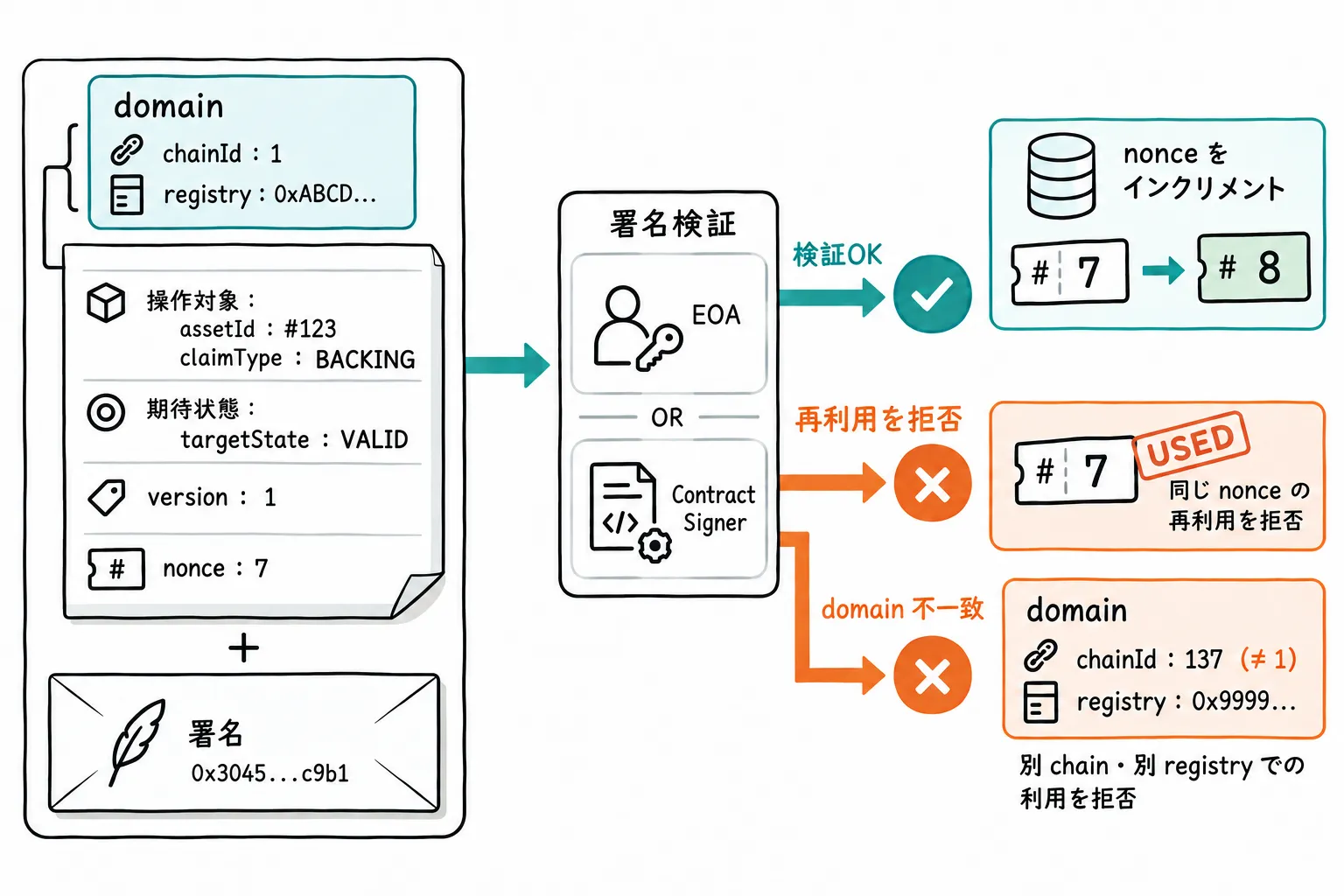
EOA signatures are verified using ECDSA. When a contract is the signer, ERC1271 is used to ask that contract whether the signature is valid. This allows multisigs and organizational accounts to serve as validators or activators.
For more on ERC1271, see the following article.
Checking interface support with ERC165
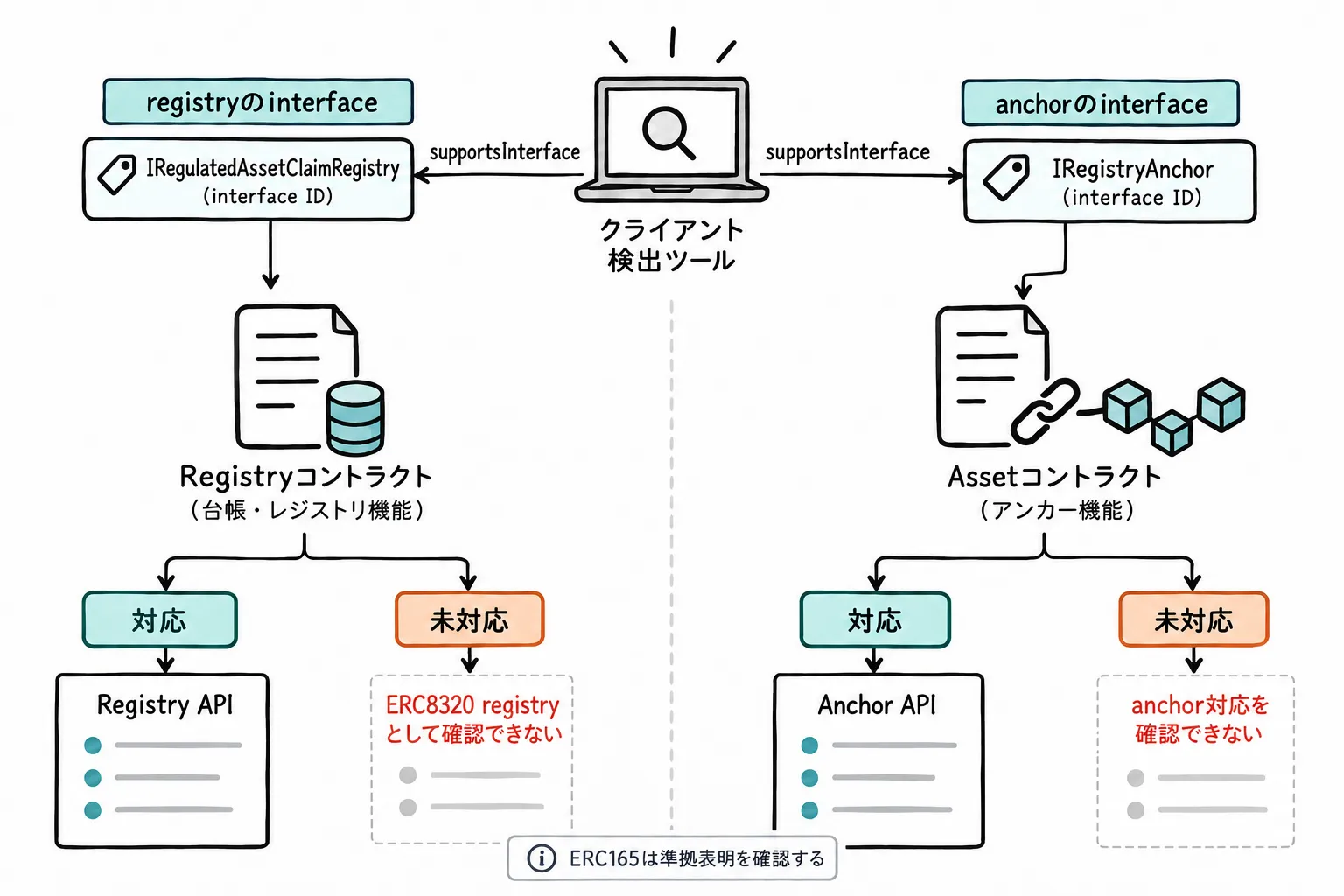
Consumers pass an interface ID to a contract to query whether it is supported.
ERC165 provides this common detection mechanism.
Query the ID of IRegulatedAssetClaimRegistry on the registry and that of IRegistryAnchor separately for the optional asset-side functionality.
For more on ERC165, see the following article.
A true result from supportsInterface is a declaration that the contract implements the function entry points.
It does not guarantee the contents of stored claim records or the operational quality of the registry.
Additional details
Reading the APIs individually makes it easy to conflate onchain records with offchain documentation, stored state with current usability, and candidate discovery with selection decisions. The following example of publishing receivables backing illustrates how these steps fit together.
Asset and claim granularity
A single registry can store multiple assets.
Assets are distinguished by an assetId derived from the chain ID, contract address, and asset number within the contract.
If tranches or share classes are represented by the same contract, they can be registered as separate assets using different subAssetId values.
Assets without an onchain contract can use a zero contract address. However, the official reference implementation also uses the zero address to detect whether an asset has been registered, so it cannot handle this type of asset correctly. Adopting that implementation requires a change such as storing the registration status in a separate Boolean flag.
Deactivating an asset prevents new proposals, validations, and activations.
Historical records, reads, suspensions, and revocations remain available, making post-operation audits possible.
However, re-registration with the same assetId is rejected, and the normative interface has no reactivation function.
ERC8320 provides no standard recovery procedure for accidental deactivation.
Payloads and schemas
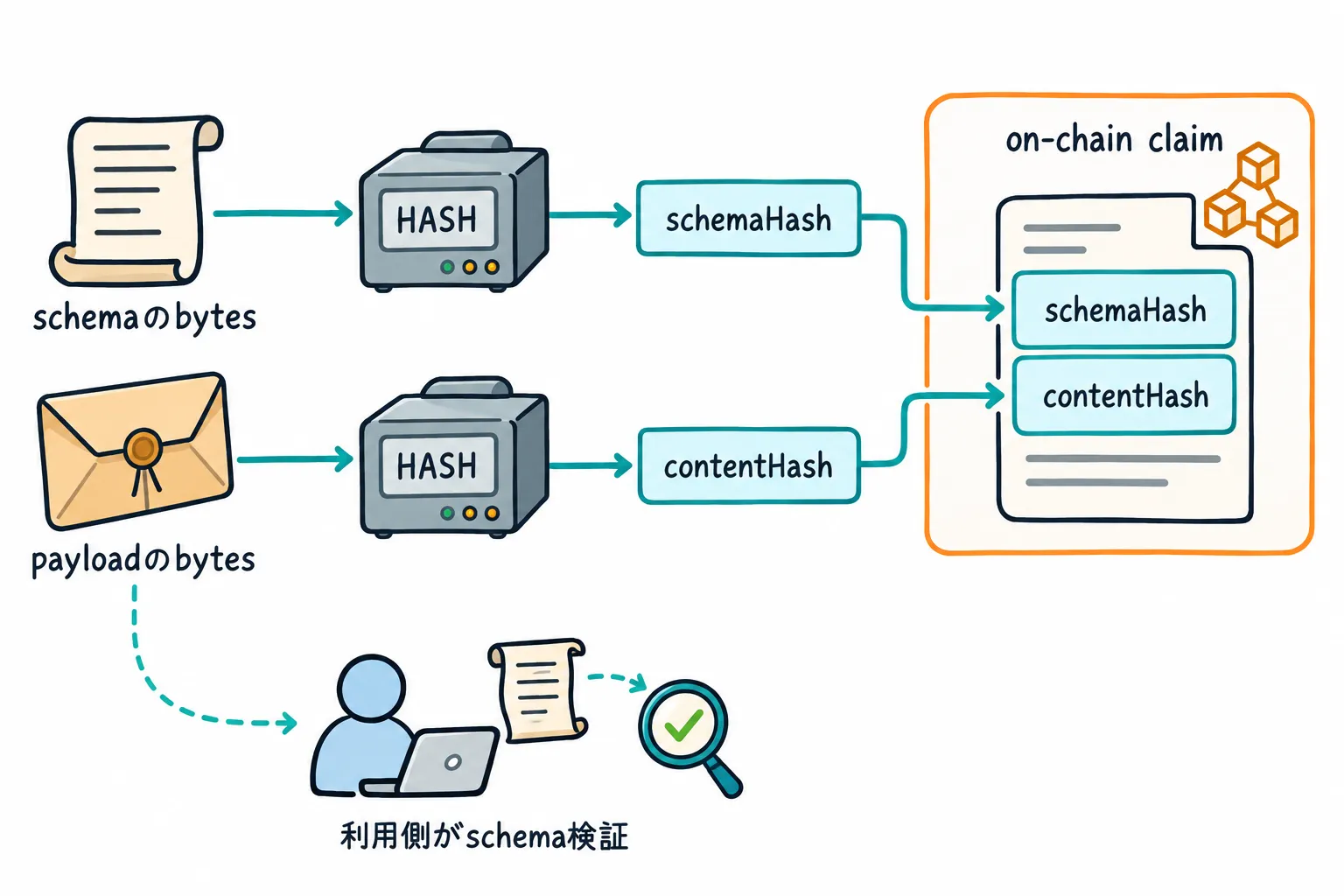
An onchain claim stores the schema ID, schema hash, document hash, and URI.
Detailed valuation and backing data reside in the offchain payload referenced by the URI.
Consumers perform checks in the following order.
-
Retrieve the payload from the URI
Obtain the public document or a document for which access has been granted.
-
Verify the contentHash
Hash the exact bytes retrieved and compare the result with the onchain value.
-
Verify the identifiers in the envelope
Check that
assetId,schemaId, andclaimVersionmatch the onchain record. -
Validate against the canonical schema
Validate the document structure using the schema committed to by
schemaHash. -
Determine whether the information meets business requirements
Evaluate evidence, ratios, legal rights, and the author according to the consumer's policy.
The registry performs onchain state updates.
Retrieving the URI, parsing JSON, validating the schema, and evaluating the contents are performed by offchain consumers.
ERC8320 does not specify how to resolve the canonical schema's distribution location from a schemaId.
Consumers obtain the schema through a separate trusted channel and check it against schemaHash; processing stops if it cannot be retrieved or its source cannot be trusted.
The attestorProfile and accessClassification fields also describe the document and do not modify onchain roles or access controls.
Claim lifecycle
A new version is added as PROPOSED, advances to VALID after validation, and becomes ACTIVE after publication.
An activator can suspend an ACTIVE version by returning it to VALID, and a validator can move a PROPOSED, VALID, or ACTIVE version to REVOKED.
Expiration is determined from the current timestamp.
Even when the stored state is ACTIVE, versions outside their validity period are excluded from the results of getActiveClaims.
The official reference implementation derives expiration first, so passing an EXPIRED version to revokeClaim reverts because it does not meet the state requirements.
Revoking a role does not automatically suspend existing ACTIVE claims.
Incident response therefore requires not only role revocation but also suspension by an activator who retains authorization or revocation by a validator.
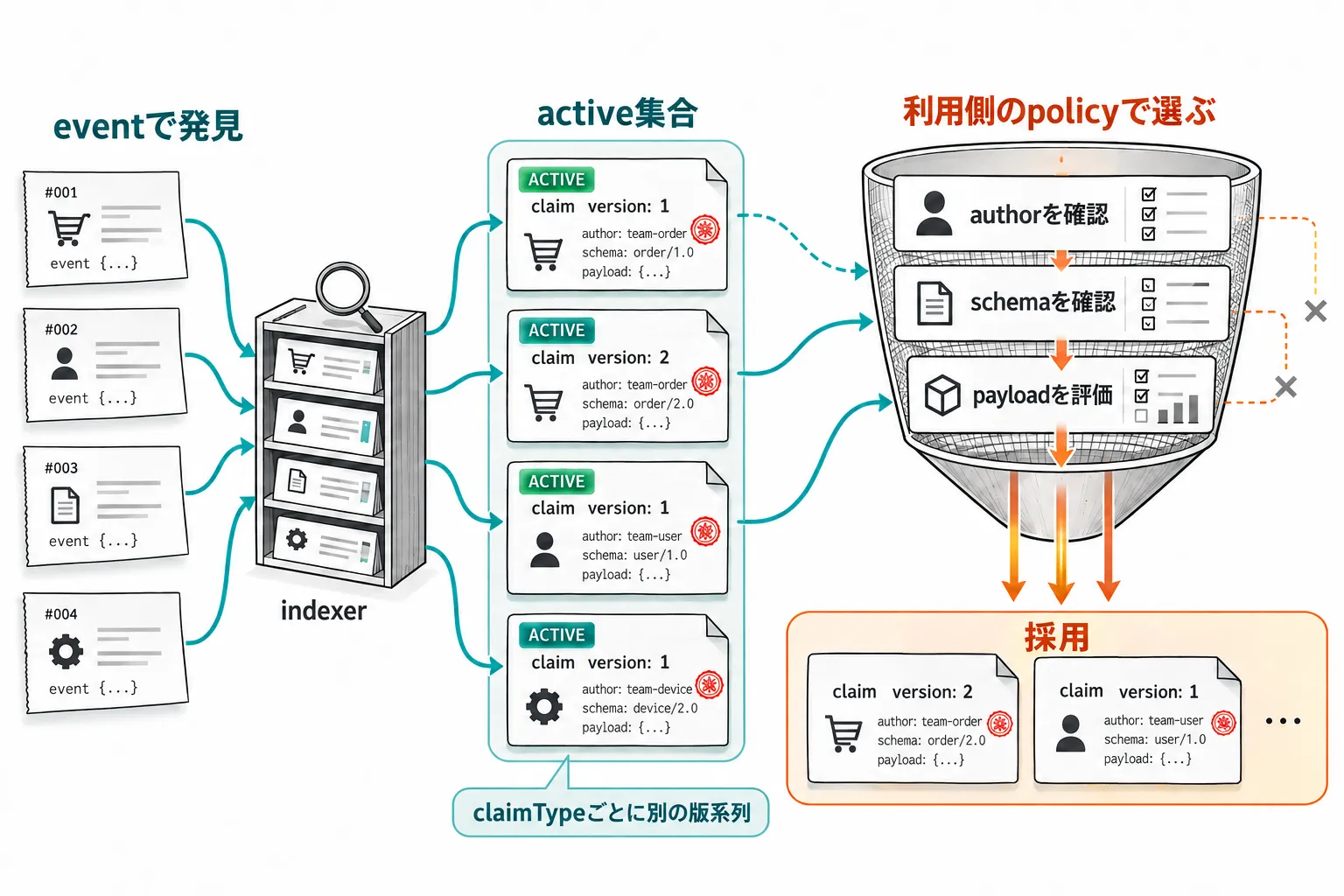
Discovery and selection
Indexing services can collect candidates from event logs such as ClaimProposed and ClaimActivated.
To establish the current state, however, they must also account for suspension, revocation, and asset removal events and consult getClaim or getActiveClaims along with the current time.
ERC8320 does not specify how to handle chain reorganizations or how many confirmations to wait for. Indexing services must be able to roll back event logs and resynchronize according to the finality properties of the chain they use.
If multiple ACTIVE versions exist for the same asset and topic, the first entry should not be accepted automatically.
Consumers select one or more of these valid claims according to their criteria for the author, schema, version, reference date, and document contents.
Asset-side registry approval
If an asset contract implements IRegistryAnchor, consumers enumerate candidates using getRegistries and check each candidate using isRegistryApproved.
Consumers ignore claim records from an unapproved registry.
Withdrawing approval does not delete the history stored in the affected registry.
What changes is the asset's current approval status, so consumers read the current value rather than relying on a historical list.
An anchor cannot be used when the asset contract cannot be modified or the asset is offchain.
In that case, consumers evaluate who administers the registry, who has been granted roles, and which authors they accept.
A concrete BACKING example
The official assets directory contains an example schema representing the BACKING of credit assets.
This reference schema illustrates how offchain documentation can be structured.
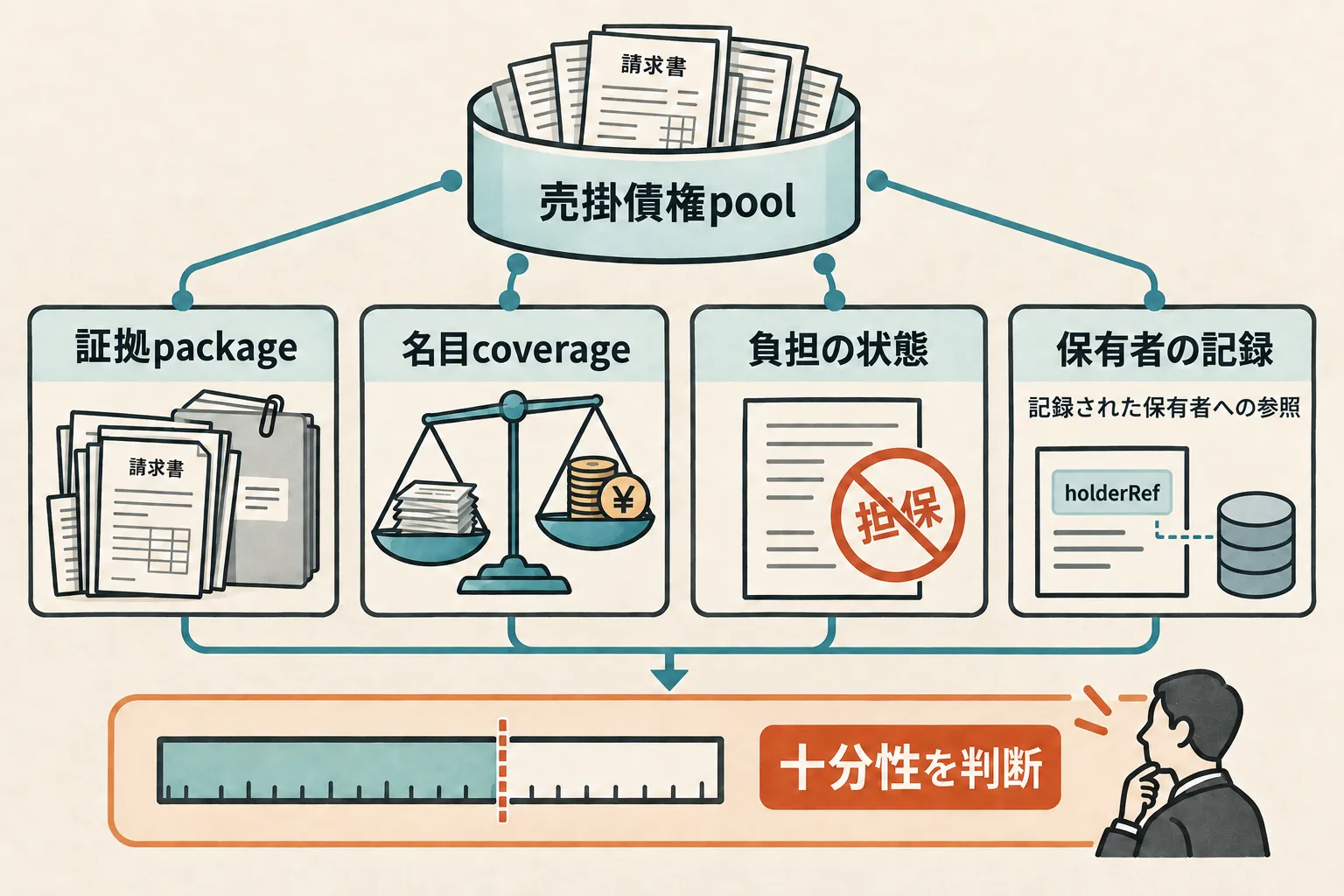
In the receivables pool example, a single data record combines nominal outstanding balances and backing amounts denominated in the same currency, supporting evidence, encumbrances such as security interests, and references to holders recorded in a registry. Consumers determine whether the ratio meets their own requirements, whether the evidence is recent, and whether legal encumbrances are acceptable. Conformance to the schema alone does not establish that the backing is sufficient.
| Field | Information illustrated by the example | Consumer checks |
|---|---|---|
coverage |
Nominal backing relative to the outstanding receivables balance | Whether the currency and ratio meet the requirements |
evidence |
References to invoice lists or audit documents | Issuer, reference date, and whether the evidence has been modified |
encumbrance |
Existence of security interests or priority rights | Whether other rights holders can recover funds first |
holderRef |
Reference to a holder recorded in a registry using a salted commitment | Management of the reference location and salt; this is not proof of ownership or identity |
Another official example references a collateral valuation and a VALUATION type of claim.
Expiration or revocation of the referenced claim does not automatically update the original BACKING.
Consumers also read the current state of each related claim again.
Compatibility
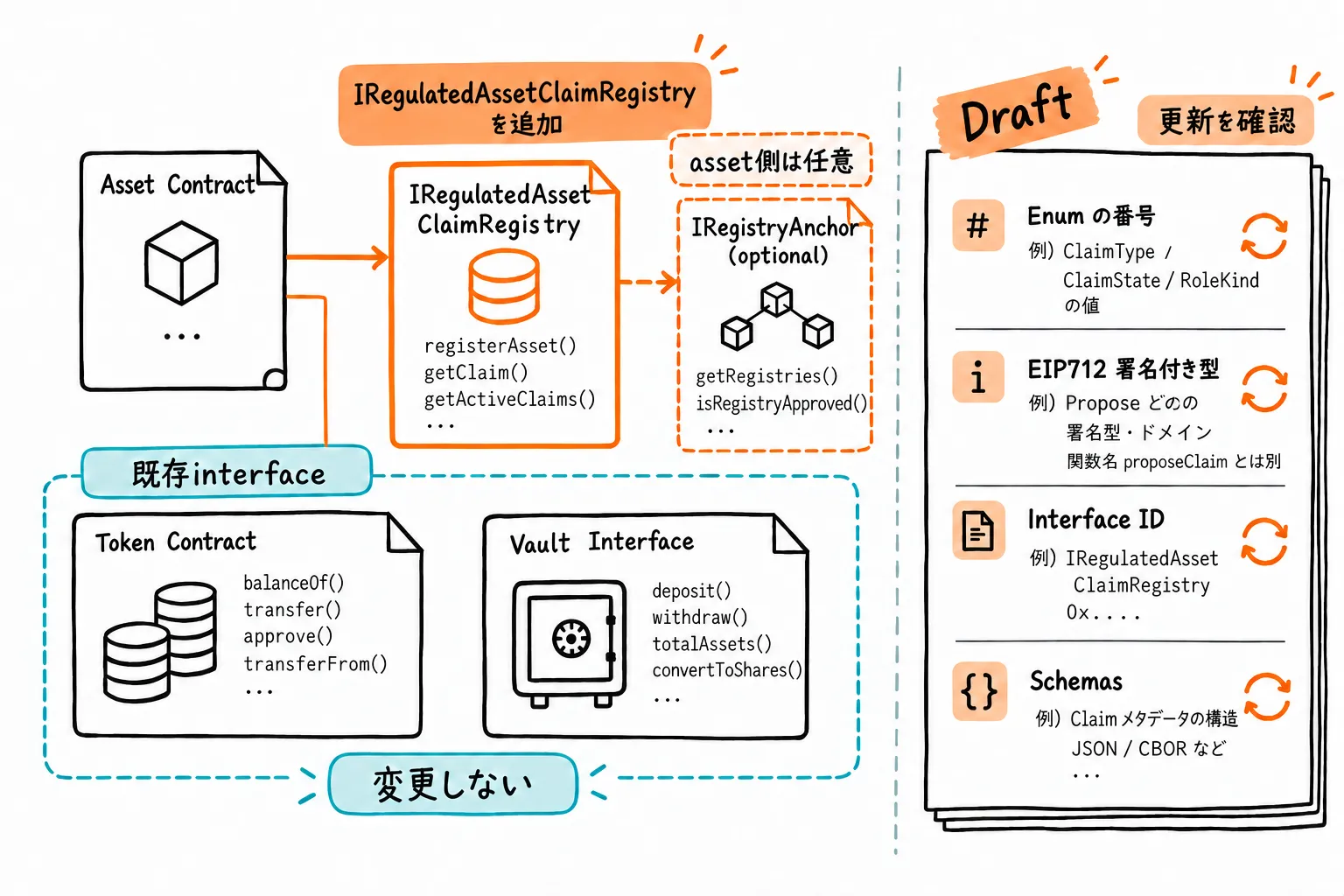
ERC8320 adds new interfaces and does not change the functions of existing tokens or vaults.
Because the asset-side anchor is optional, a registry alone can be added for asset contracts that cannot be modified.
Adding to existing interfaces
An asset contract implementing IRegistryAnchor can publish the registry addresses it trusts.
A claim can still be registered and read without that implementation, but asset-side approval cannot be verified.
Existing asset standards continue to handle holding, transfers, deposits, and redemptions. ERC8320 records externally asserted valuations, conditions, and backing for those assets in a separate layer.
Aspects that may change while the proposal is a draft
ERC8320 was in Draft status at the time of review. Following the initial version in July 2026, the official reference implementation was added in October. Before committing to an implementation, track changes to enum values, signed types, interface IDs, and reference schemas.
Reference implementation
The official assets directory contains two interfaces, two contracts, and two Foundry tests. Distinguish the results required by the standard from implementation-specific choices such as OpenZeppelin components and mapping structures.
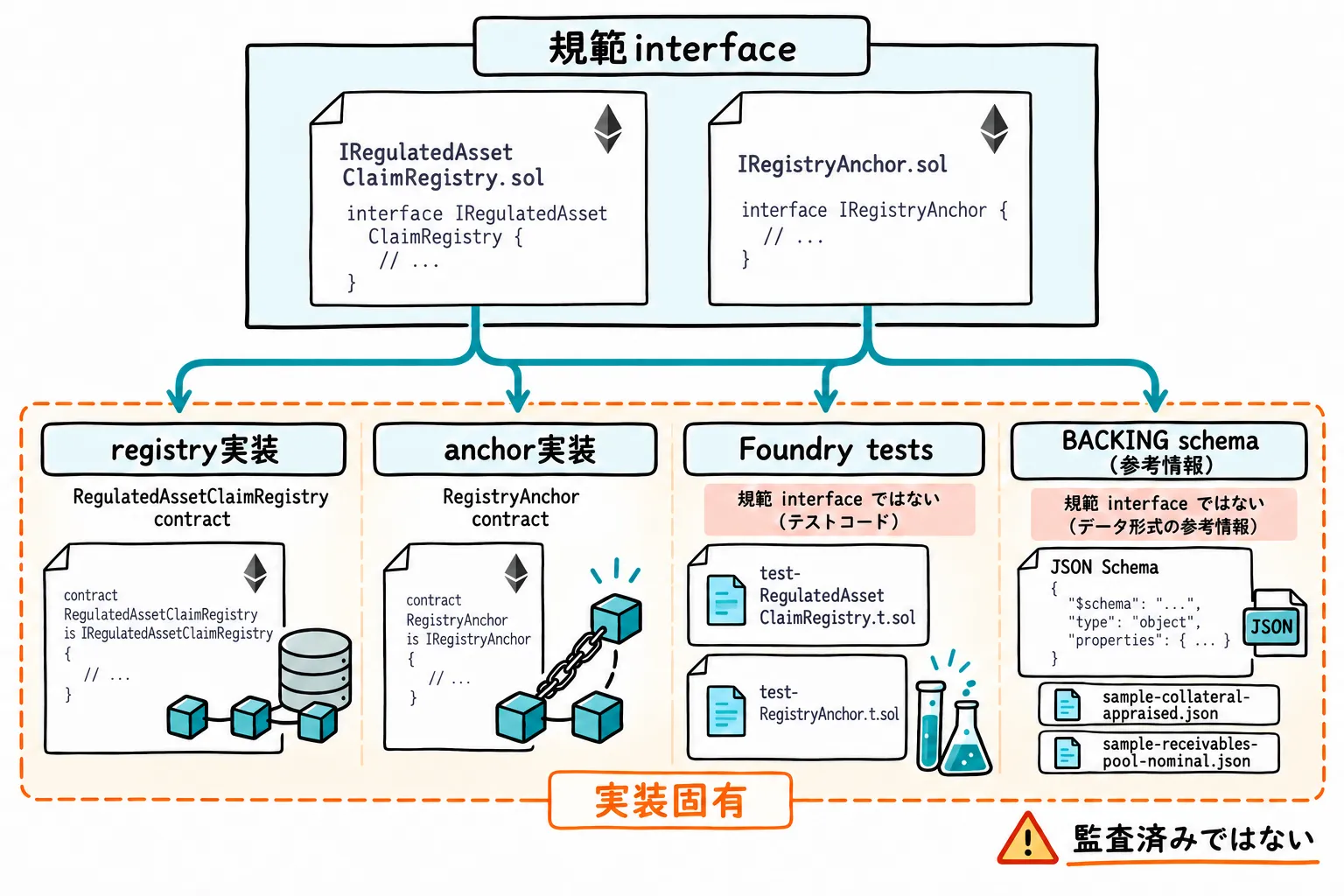
RegulatedAssetClaimRegistry
RegulatedAssetClaimRegistry stores asset references, roles, claim histories, and per-signer nonce values separately.
State changes check all conditions before updating stored values, so a revert during execution rolls back both the state and the nonce.
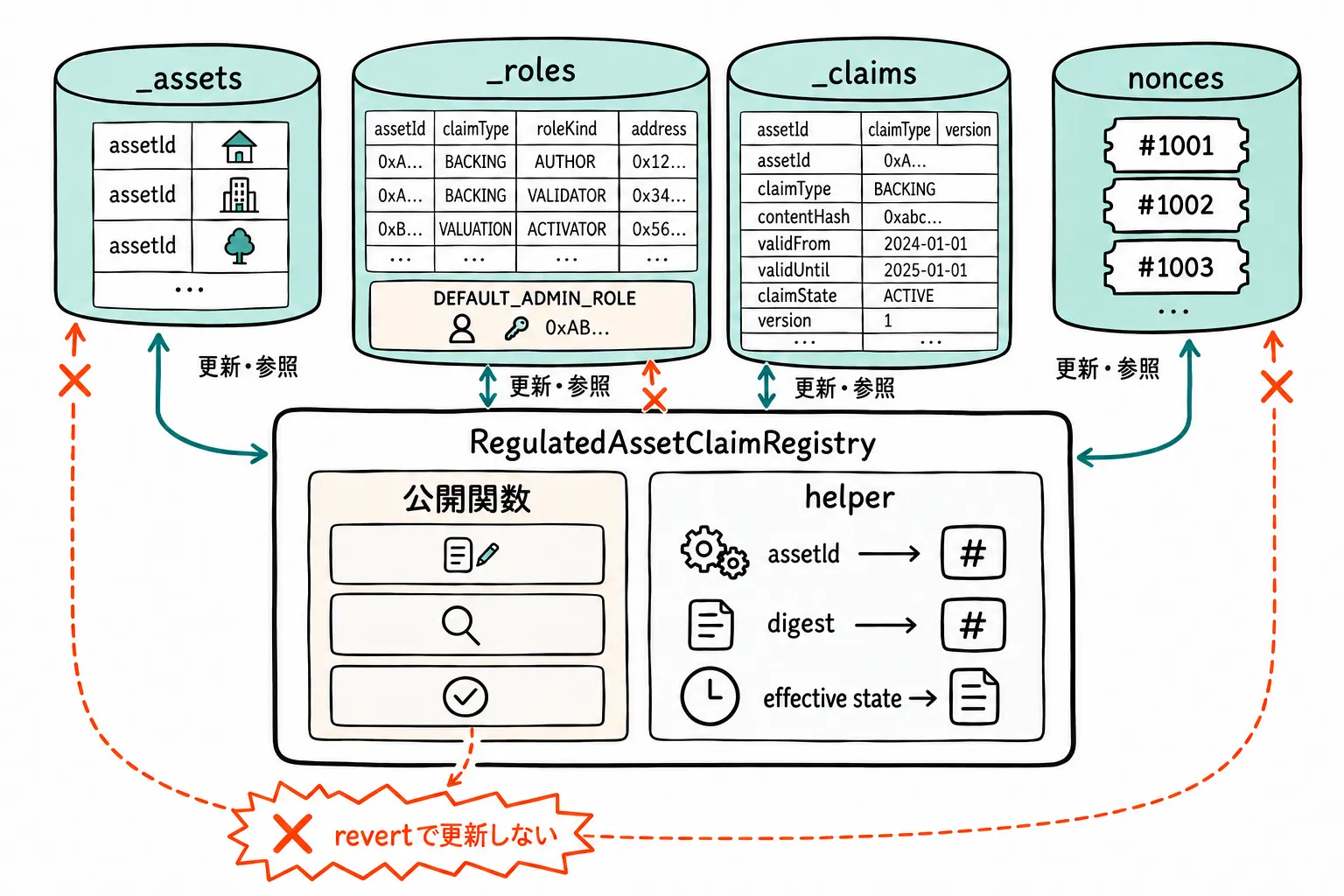
Initial administrator and storage structure
The constructor grants OpenZeppelin's DEFAULT_ADMIN_ROLE to the address provided at deployment.
This method of selecting the initial administrator is a reference implementation choice; the standard does not define how administrators are assigned or replaced.
constructor(address admin) EIP712("RegulatedAssetClaimRegistry", "1") {
    _grantRole(DEFAULT_ADMIN_ROLE, admin);
}
The reference implementation divides storage into four areas.
| Storage area | Key | Stored information |
|---|---|---|
_assets |
assetId |
Contract, asset number, chain ID, and active status |
_roles |
Asset, topic, role, and address | Role grant status |
_claims |
Asset and topic | claim array to which new versions are appended |
nonces |
Signer | Number to include in an unused signature |
Managing roles and assets
Role grants and revocations check OpenZeppelin administrator authorization before updating Boolean values in _roles.
isAuthorized reads the same key without changing state.
On asset registration, the _assetId helper hashes the three reference values, and an AssetRef is stored in _assets.
On removal, the struct is retained and only active is set to false.
There is an important difference from the normative specification here.
The standard permits the zero address as the contractAddr of offchain assets, but the reference implementation also uses contractAddr != address(0) to determine whether an asset is registered.
As a result, it cannot prevent re-registration of assets with the zero address, and neither removeAsset nor getAssetReference recognizes them as registered.
Changing claim states
proposeClaim checks the asset, role, state, and version before creating the structured hash for the proposal and passing it to _verifySig.
On success, it appends the struct to _claims and emits ClaimProposed.
Validation, activation, suspension, and revocation follow the same sequence.
First, _claimRef locates the target version, and _effectiveState derives the current state taking expiration into account.
Next, the role and signature are checked, the state is changed, and an event is emitted.
This order prevents state changes from persisting when authorization or signature verification reverts.
However, because expiration is treated as EXPIRED first, revokeClaim also reverts with InvalidClaimState after expiration in the reference implementation.
Reading claims
getActiveClaims scans the target array once to count the matches, allocates the return array, then scans again to populate it with matching versions.
Only versions whose stored state is ACTIVE and whose validity period includes the current time are returned.
getClaim searches the array from the end.
This allows newer versions to be checked first, but the amount of scanning required to find a specified version grows with the history.
Neither the standard nor the reference implementation defines limits on the number of claim records or tags, response size, or gas usage benchmarks.
Helpers for generating signature hashes
DOMAIN_SEPARATOR returns the EIP712 domain separator.
_proposeStructHash hashes the dynamic tags array and the uri string separately before generating the structured hash for the entire proposal.
_verifySig checks the deadline and nonce, then passes the domain-bound digest to OpenZeppelin's SignatureChecker.
It verifies EOAs and ERC1271 contract signers through the same entry point and increments the nonce only on success.
_assetId derives the identifier from the chain ID, contract address, and asset number.
The result of this calculation is defined by the standard, but the organization of helper functions is implementation-specific.
Helpers for determining states and locating versions
_claimRef reads the relevant history from the end and returns a storage reference to the matching version.
If no match exists, it reverts with ClaimNotFound.
_effectiveState returns EXPIRED if the stored state is VALID or ACTIVE and the deadline has passed.
_isLiveActive selects only versions whose stored state is ACTIVE, whose start time has passed, and which have not expired or have no expiration.
Separating these two functions distinguishes stored values from the set of currently usable claims.
Errors distinguishing failure reasons
The reference implementation uses 11 custom errors to categorize failures.
| Category | Errors | Rejected conditions |
|---|---|---|
| Asset | AssetAlreadyRegistered, AssetNotFound, AssetNotActive |
Duplicate registration, unknown assets, or inactive assets |
| Authorization | NotAuthorized, AuthorCannotValidate |
Missing required role or an author validating their own claim |
| State and version | InvalidClaimState, VersionNotIncreasing, ClaimNotFound |
Invalid transition, older version, or unknown version |
| Signature | SignatureExpired, InvalidNonce, InvalidSignature |
Expired signature, nonce mismatch, or invalid signature |
Because the entire transaction reverts at the first failure, the claim state and the nonce cannot be updated independently of each other.
RegistryAnchor
RegistryAnchor is a reference implementation that manages the set of registry addresses approved by the asset-side owner.
It uses OpenZeppelin's Ownable and EnumerableSet.
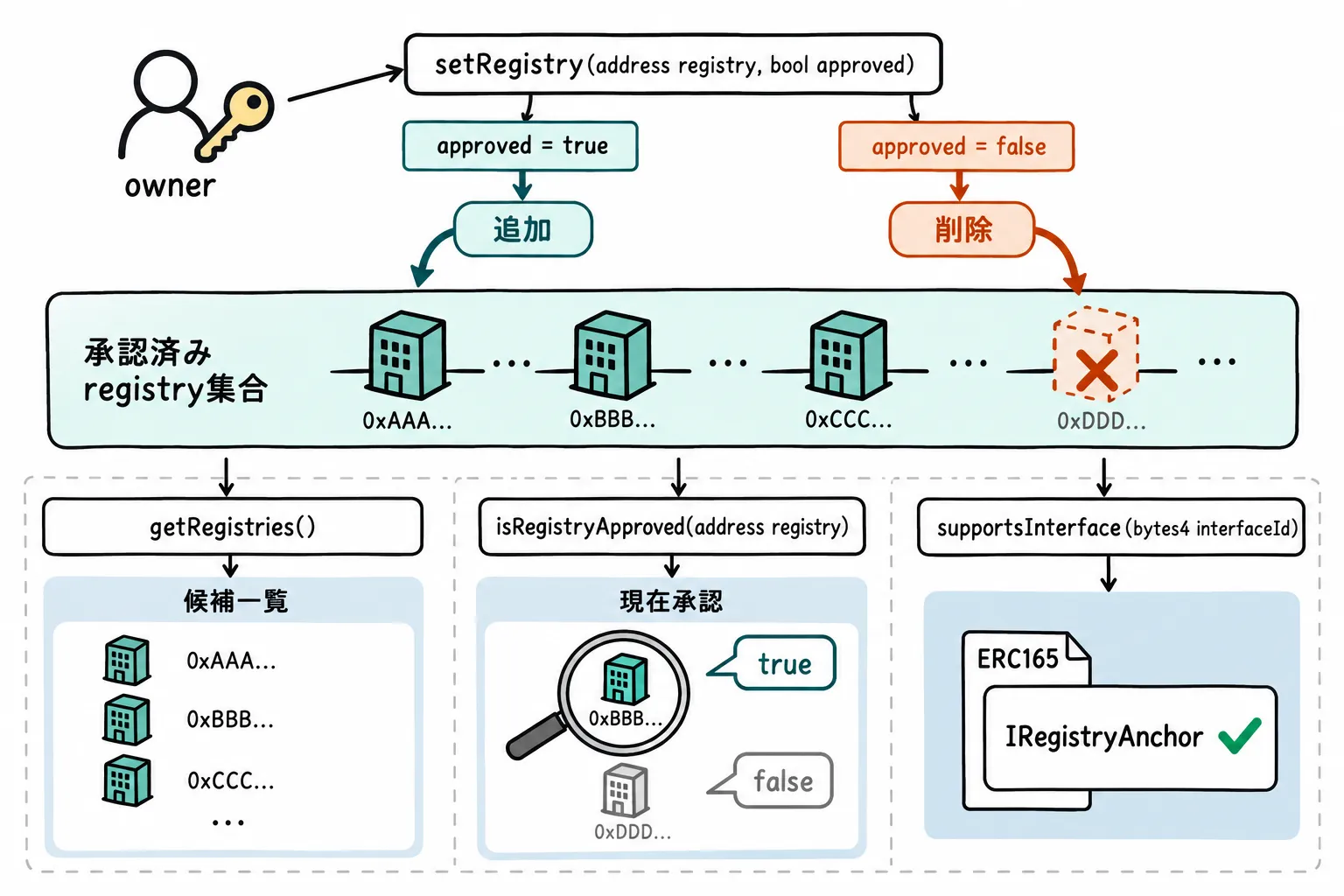
The owner and the set of approved registries
The constructor accepts the initial owner, and setRegistry is protected by onlyOwner.
If approved is true, the registry is added to the set; if false, it is removed. A RegistrySet event is emitted.
Removing entries from the set is specific to the reference implementation. The normative interface requires the ability to read the candidate list and current approval status.
Enumeration and verification of current approval
getRegistries returns the values in the EnumerableSet as an array.
isRegistryApproved returns whether a given address belongs to the set.
In the reference implementation, removed addresses disappear from the list, so the list and current approvals coincide.
Consumers should nevertheless treat enumeration and individual verification as separate operations to match the semantics of the normative interface.
supportsInterface supports the interface IDs of IRegistryAnchor and ERC165.
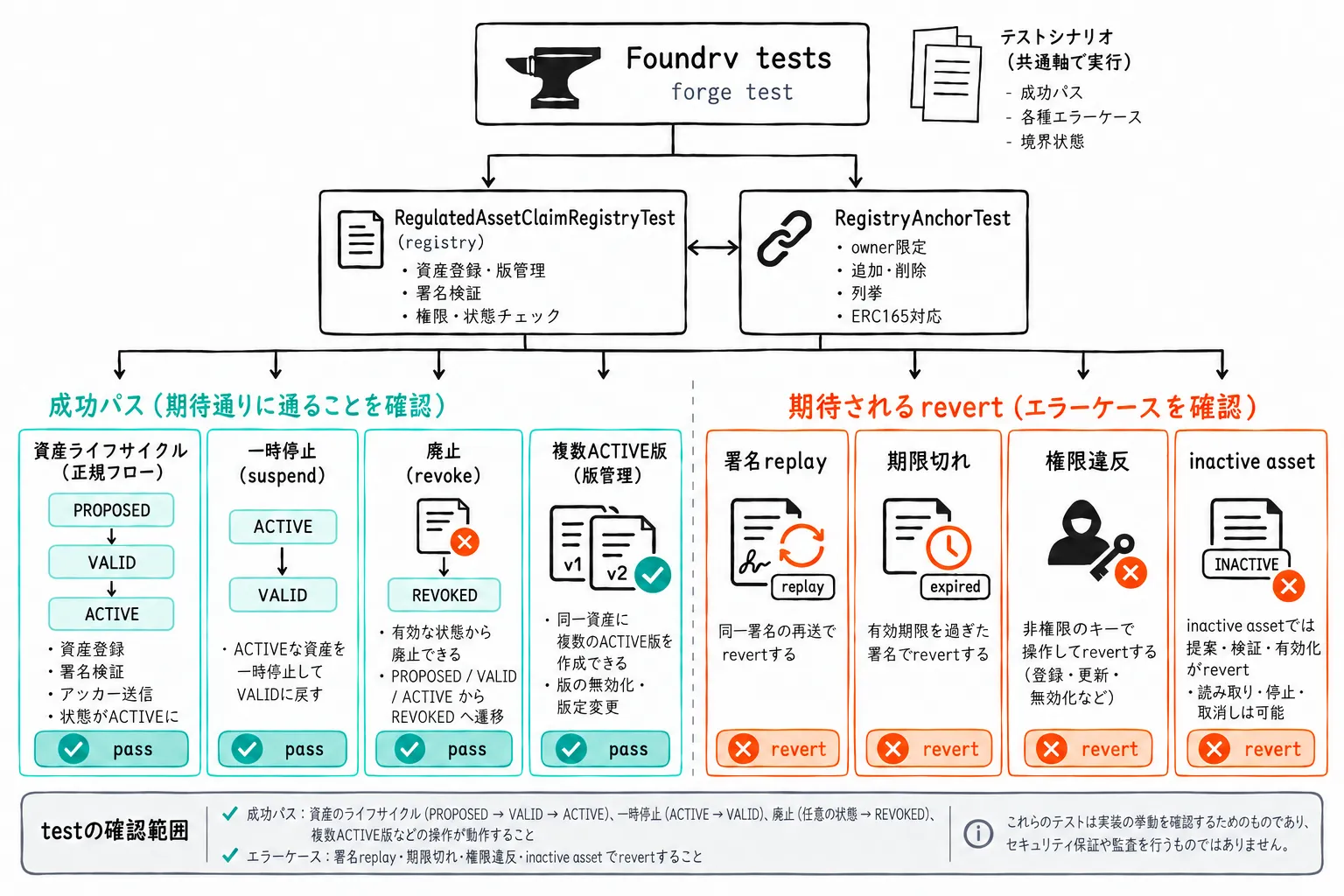
Foundry tests
The official tests cover state transitions, role violations, validation by the author, signature replay, expiration, multiple valid versions, and inactive assets. On the anchor side, they cover owner-only access, addition and removal, enumeration, and ERC165 support.
These tests provide evidence that the reference implementation returns its intended results. They do not guarantee economic soundness, legal rights, gas bounds, completion of an audit, or production safety.
BACKING schema examples
The JSON Schema and two samples in the official assets directory are examples of offchain documentation for use with the reference implementation.
The receivables pool and appraised collateral use different claimVariant values, and their conditionally required fields can be validated using JSON Schema.
This schema is an informative example, not a normative requirement that every BACKING claim contain the same fields.
Bind the exact bytes of the selected schema to schemaHash and have consumers validate conformance to that version.
Security
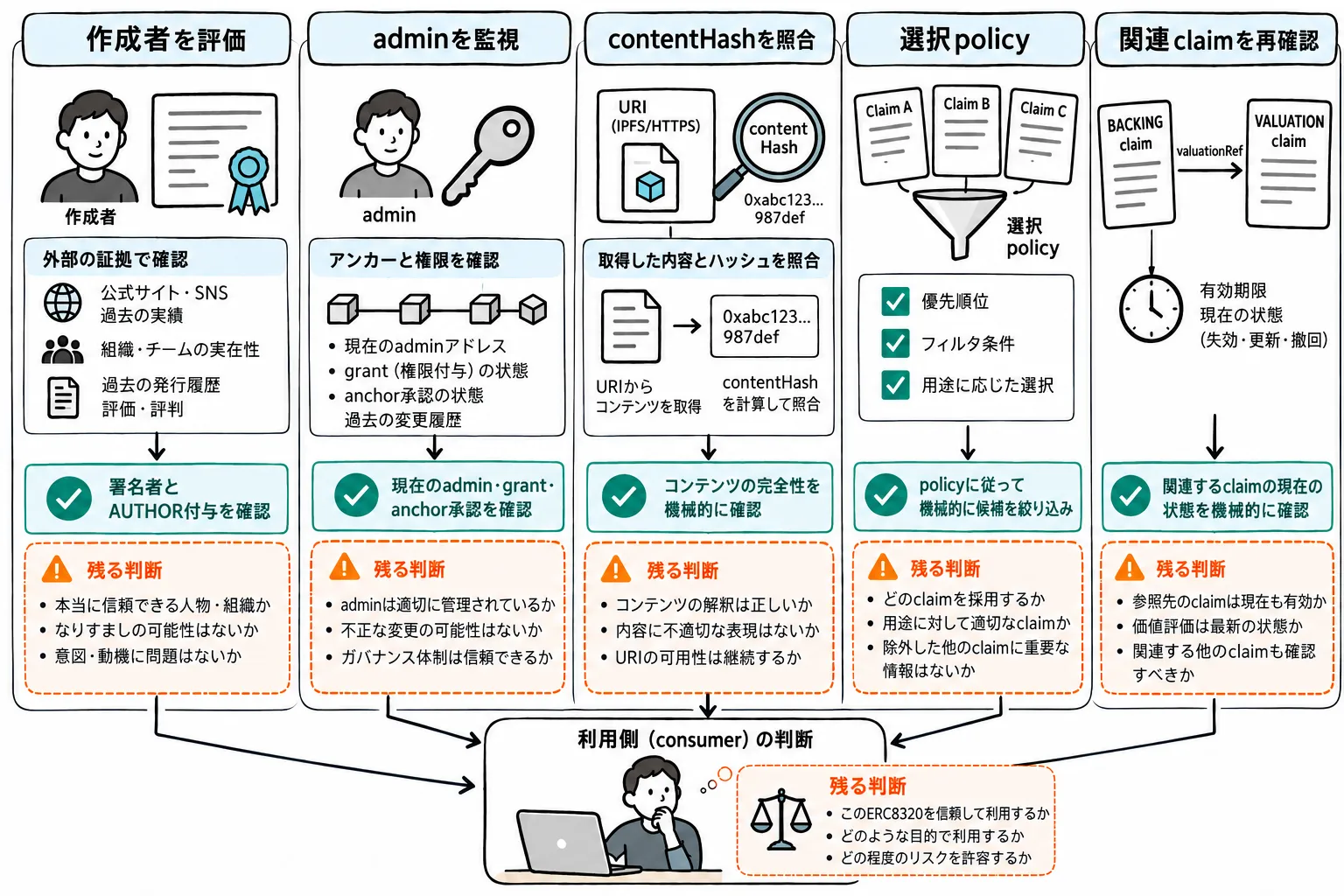
ERC8320 makes it easier to trace who signed each version and in which role they changed its state. The consumer remains responsible for selecting trusted authors, ensuring document availability, and assessing the validity of the content.
Overestimating the guarantees of signed claims
A valid signature shows that the corresponding private key or contract signer authorized an operation. It does not prove that the signer's valuation method or stated value is correct.
Consumers verify the author's qualifications, independence, external evidence, and reference date.
For high-value assets, compare multiple independent claim records rather than relying on a single self-reported assertion.
Also check that the payload specifies the valuation method and scope required for the intended use.
Even if the signer is an authorized author, reject the claim if its valuation conditions do not meet the transaction's decision criteria.
Compromise of the registry administrator key
If an administrator key is compromised, an attacker can register assets and grant roles to unauthorized addresses.
When an asset-side anchor exists, consumers can ignore any registry that is not approved.
Even after an administrator revokes an unauthorized role, existing ACTIVE claims are not automatically suspended.
Incident response requires suspension or revocation in addition to role removal, and checking event logs to identify affected assets and versions.
ERC8320 provides the asset-side anchor, current role values, and role grant events as verification inputs.
In particular, monitor the RoleGrantedToClaimType event to detect unexpected grants for assets, claim types, or addresses early.
Placing administrator authorization behind a multisig or delayed execution mechanism is an operational safeguard rather than an ERC8320 requirement.
Even with an asset-side anchor, the owner key that can change approvals must be managed and the history of changes monitored.
URI and payload substitution
The same URI may return different content at different times.
Consumers verify contentHash on every retrieval and reject the claim if the hash differs.
Even when the hash matches, the content cannot be read if the retrieval location becomes unavailable.
Provide content-addressed storage or multiple retrieval paths according to the required retention period, and design key management for access-restricted documents separately.
Availability cannot be guaranteed by contentHash alone.
Consumers verify storage redundancy, retention periods, and access revocation procedures as operational conditions.
Selecting the wrong claim from multiple candidates
Multiple versions of the same asset and topic may be usable simultaneously. Selecting based solely on the number of records or the highest version number may lead to accepting documents from untrusted authors or using a different schema.
Consumer selection policies include accepted authors, schema IDs, schema hashes, reference dates, validity periods, and conditions stated in the documentation. Use event logs for candidate discovery and read functions to check current state before accepting a claim. Decide for each use case whether to prioritize only the latest version from the same author or compare several independent authors. The standard does not define a common selection order, so implementations without a selection policy may let retrieval or array order determine their decisions.
Invalidation of related claims
If one BACKING claim references another VALUATION claim, state changes in the referenced claim are not automatically reflected in the original claim.
Consumers read the asset, topic, and version indicated by valuationRef and check that the referenced claim is within its validity period and has not been revoked.
If the related version expires or is revoked, a policy is needed to stop accepting the original claim even if its document still matches its hash.
Verify the referenced contentHash as well to ensure that the valuation document has not been substituted since it was recorded.
Without this revalidation, an outdated valuation may be used to assess backing even while the original BACKING remains ACTIVE.
Conclusion
ERC8320 makes it possible to trace who created each version, who validated it, and which documentation it is associated with. Consumers determine whether the asset valuation and backing are correct by evaluating external evidence. Consumers check asset-side approval, the author, schema, document hash, and current state, then determine whether the contents are sufficient under their own policies.
The official specification and discussion are available below.