Introduction
Hi, I'm cardene, a software engineer and technical writer focused on blockchain and AI.
I've also authored Japanese technical books on specification-driven development with LLMs and decentralized application (DApp) development.

I also build and publish a variety of tools, libraries, and open-source projects.
This article revisits blockchain bridges and how they work.
The following article also covers bridges and provides additional background.

What is a bridge?
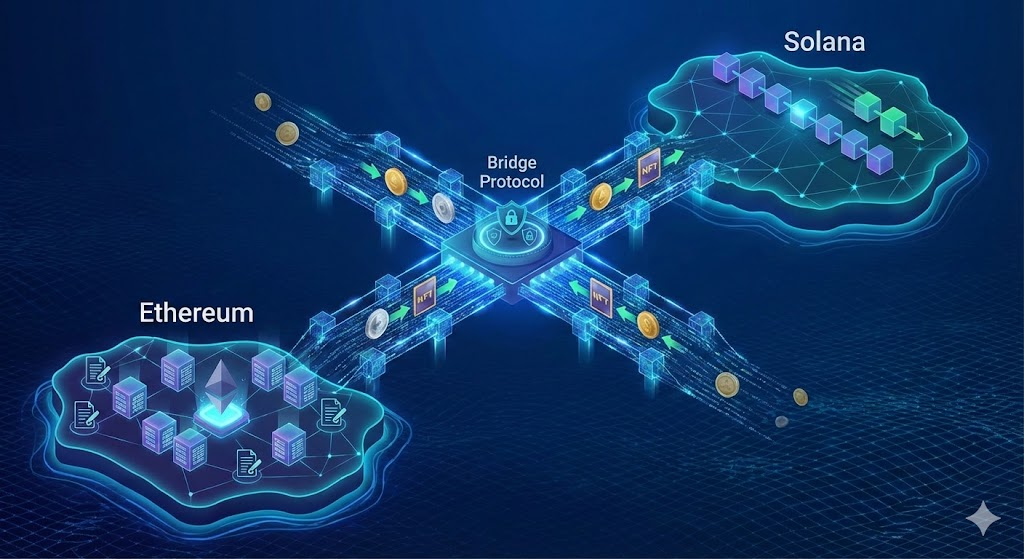
A blockchain bridge enables assets (tokens) and data to be transferred or shared across different blockchains. Blockchains such as Bitcoin, Ethereum, Solana, Base, and Avalanche operate as independent networks and are not inherently interoperable. Bridges therefore act as intermediaries for assets (tokens) and data, enabling cross-chain liquidity and application integration.
Bridges can broadly be divided into two patterns.
Sending a message
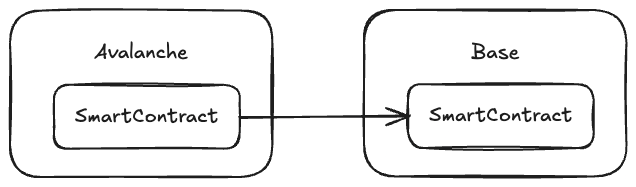
The first pattern simply sends a string to another blockchain.
For example, a smart contract on Avalanche might send a string such as Hello to a smart contract on Base.
Because the payload is just a string, the receiving smart contract on the destination blockchain executes logic based on the received string.
Sending execution data
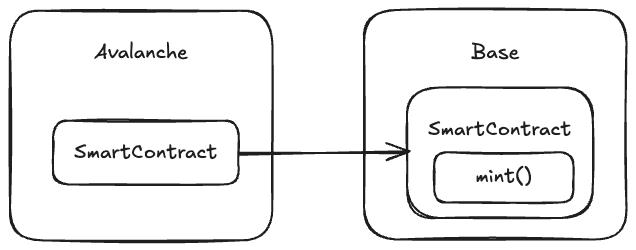
The second pattern sends the data required to execute a function in a smart contract. For example, a smart contract on Avalanche sends the execution data for a function implemented in a smart contract on Base.
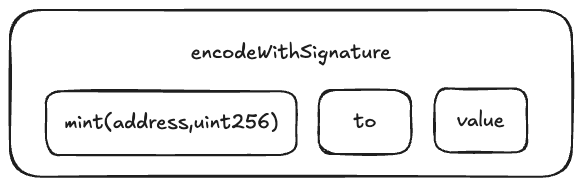
Solidity allows the function signature and arguments to be ABI-encoded, as shown above. The resulting function execution data can also be executed as follows.
// SPDX-License-Identifier: MIT
pragma solidity ^0.8.0;

contract Caller {
    function callMint(address target, address to, uint256 value) external returns (bool) {
        // 関数シグネチャ + 引数を ABI エンコードして calldata を作成
        bytes memory data = abi.encodeWithSignature("mint(address,uint256)", to, value);

        // low-level call で外部コントラクトを呼び出す
        (bool success, ) = target.call(data);
        require(success, "call to target contract failed");

        return success;
    }
}
To send the data to another blockchain, call the function responsible for that final step (here, sendCrossChainMessage()).
// SPDX-License-Identifier: MIT
pragma solidity ^0.8.0;

contract Caller {
    function callMint(address target, address to, uint256 value) external returns (bool) {
        // 関数シグネチャ + 引数を ABI エンコードして calldata を作成
        bytes memory data = abi.encodeWithSignature("mint(address,uint256)", to, value);

        // 他のブロックチェーン上に関数実行情報を送付
        sendCrossChainMessage(data);
    }
}
The following articles provide more detail. https://www.saxenism.com/blog/solidity-encodings https://rareskills.io/post/abi-encoding
Although these are presented as two patterns, both are actually message sending operations. Function execution simply involves sending a message containing instructions for that execution.
Bridge workflows
The preceding section introduced the two bridge patterns. This section walks through actual bridge workflows using concrete examples. These examples illustrate how bridges operate in practice.
Waiting for a message to be processed
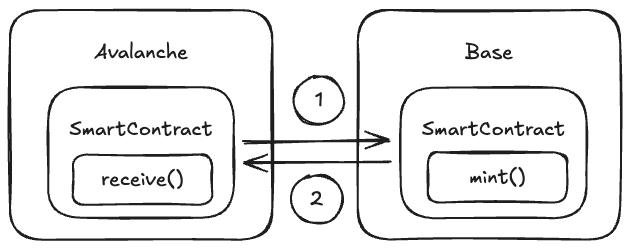
- Send a message to execute the
mintfunction. - Notify the calling contract that
mintsucceeded by executing itsreceivefunction.
A contract on Avalanche sends a message to invoke the mint function in a contract on Base.
At the end of the mint function, add logic to send a message back to the originating contract on Avalanche.
Only when mint completes is a completion message sent to the originating contract on Avalanche, allowing that contract to determine that minting succeeded.
- Example source contract
contract NFT {
    function mint(address to, uint256 tokenId) public {
        _mint(to, tokenId);

        // Request 側の onMessage(bytes) で受け取る想定
        bytes memory data = abi.encodeWithSignature(
            "onMessage(bytes)",
            abi.encode(
                "Mint Success!",
                to,
                tokenId
            )
        );

        Bridge.sendMessage(data);
    }
}- Example destination contract
contract Request {
    function request(address to, uint256 tokenId) public {
        bytes memory data = abi.encodeWithSignature(
            "mint(address,uint256)",
            to,
            tokenId
        );

        Bridge.sendMessage(data);
    }

    // Bridge から bytes をそのまま受け取る
    function onMessage(bytes calldata message) public {
        (
            string memory result,
            address to,
            uint256 tokenId
        ) = abi.decode(
            message,
            (string, address, uint256)
        );

        // ここで result / to / tokenId を使った処理を書く
    }
}
This allows the contract on the requesting chain to determine whether the message was executed and record the result.
Burn & Mint
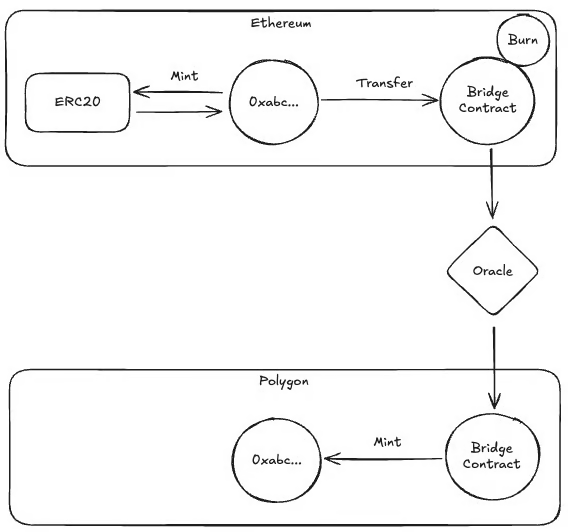
The following article explains this pattern in detail.
In brief, the token to be transferred is burned on the source chain and a new token is issued on the destination chain. This keeps the aggregate token supply across multiple blockchains constant.
Lock & Mint
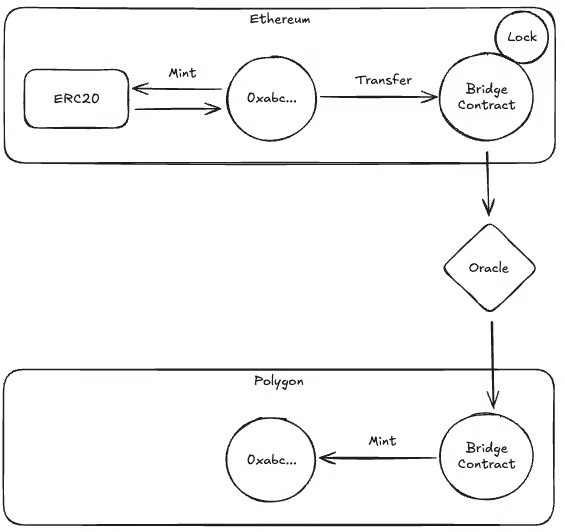
The following article explains this pattern in detail.
In brief, the token to be transferred is locked and held in a contract on the source chain, and a new token is issued on the destination chain. This allows the token supply on each blockchain to be kept constant.
Relayer
To simplify the preceding examples, we have not yet covered the off-chain message forwarding and verification performed by the bridge services introduced in the following sections. An entity that forwards messages is specifically called a relayer.
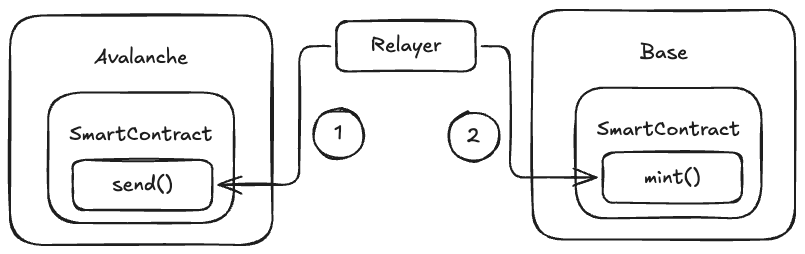
As illustrated above, the relayer sits between two blockchains, retrieves request data emitted by the source chain, and sends a message to the destination chain by submitting a transaction. Typically, request data is emitted through events, which the relayer monitors.
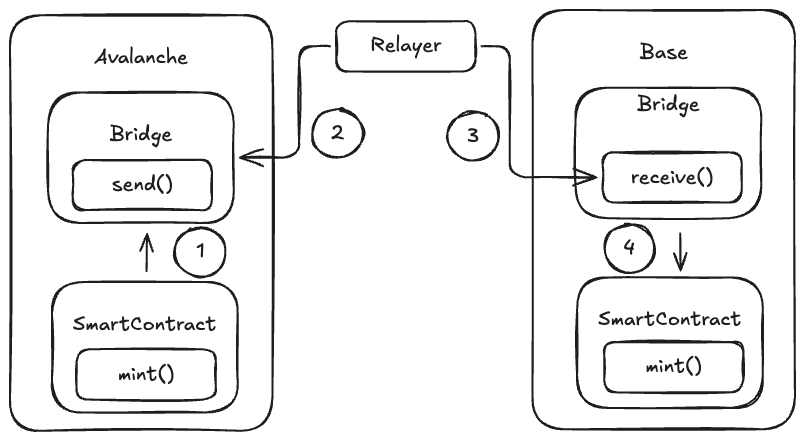
In most implementations, application contracts call a bridge contract. The relayer monitors events emitted by that bridge contract. Verification then takes place in a bridge contract on the destination blockchain.
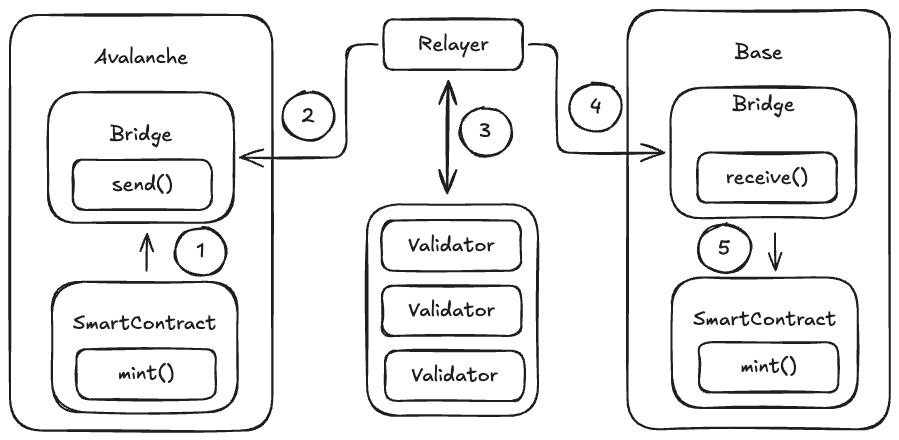
The relayer passes the request to a validator or another verification entity to establish that the request is legitimate. A signature or other information attesting to successful verification is passed to the bridge contract on the destination chain. The bridge contract checks it and ultimately delivers the message to the destination contract.
This is the general architecture.
Overview of bridge services
This section briefly introduces major bridge services.
This section was initially compiled from official documentation using the following resources and then edited by the author.

Layer Zero
First, consider LayerZero. LayerZero is a protocol that enables smart contracts across multiple blockchains to send and receive messages containing arbitrary data, function calls, and similar payloads.
LayerZero's five-layer architecture
LayerZero consists of five layers, each with a distinct role. Each layer is independent and can be combined flexibly.
| Layer | Name | Role |
|---|---|---|
| Layer 1 | OApp (Business Logic Interface) | Application-level interface for sending and receiving messages |
| Layer 2 | Endpoint (Protocol Interface) | Entry and exit point for cross-chain messages |
| Layer 3 | Message Libraries | Define message processing and verification rules |
| Layer 4 | DVN (Decentralized Verifier Networks) | Services that verify message validity |
| Layer 5 | Executors | Services that deliver verified messages |
Architecture overview
LayerZero's five-layer architecture is illustrated below.
graph TB
    subgraph "Source Chain"
        OApp1[OApp<br/>Business Logic]
        Endpoint1[Endpoint<br/>Protocol Interface]
        MessageLib1[Message Library<br/>Verification Rules]
    end

    subgraph "Verification Layer"
        DVN1[DVN 1]
        DVN2[DVN 2]
        DVN3[DVN N]
    end

    subgraph "Execution Layer"
        Executor[Executor<br/>Message Delivery]
    end

    subgraph "Destination Chain"
        MessageLib2[Message Library<br/>Verification Rules]
        Endpoint2[Endpoint<br/>Protocol Interface]
        OApp2[OApp<br/>Business Logic]
    end

    OApp1 -->|_lzSend| Endpoint1
    Endpoint1 -->|Generate Packet| MessageLib1
    MessageLib1 -.->|Request Verification| DVN1
    MessageLib1 -.->|Request Verification| DVN2
    MessageLib1 -.->|Request Verification| DVN3
    DVN1 -.->|Verify| MessageLib2
    DVN2 -.->|Verify| MessageLib2
    DVN3 -.->|Verify| MessageLib2
    Executor -->|Deliver Verified Message| Endpoint2
    Endpoint2 -->|_lzReceive| OApp2
Each layer is independent, allowing developers to adjust configurations to their use case.
Layer 1: OApp(Business Logic Interface)
OApp is the developer-facing smart contract API layer.
Omnichain Applications (OApps) are LayerZero's definition for smart contracts that use LayerZero to send and receive cross-chain messages."
It converts application operations, such as token issuance, NFT minting, and specific function calls, into a form that LayerZero can send and receive.
Main functions
_lzSend()Sends messages through LayerZero._lzReceive()Performs the logic executed when a message is received.
OApp allows developers to focus on application logic and state changes rather than the protocol's internal complexity.
Layer 2: Endpoint(Protocol Interface)
The Endpoint acts as the entry and exit point for all cross-chain messaging. Outgoing messages leave through it, and incoming messages enter through it.
Endpoint characteristics
- Universal interface Provides a common interface across all supported chains.
- Immutable Its immutable design prevents future upgrades.
- Permissionless Anyone can access it without authorization from a central administrator.
- Chain-agnostic Operates across chains such as EVM chains, Solana, and Aptos.
Each Endpoint stores a sequence number (nonce) to manage message ordering and assigns a unique identifier (GUID) to each message.
This ensures that messages are processed in the correct order.
Layer 3: Message Libraries
Message Libraries are collections of rules defining how messages are handled. These rules cover the sequence of operations, including how messages are verified and sent. Libraries can be configured differently for each communication pathway (channel).
Configuration options
- Finality requirements Specify how many blocks are required before a message is considered final.
- Verification rules Define which DVNs (verifiers) must perform verification.
- Execution parameters Configure the service that delivers messages.
X-of-Y-of-N verification pattern
Libraries adjust verification requirements using an X-of-Y-of-N pattern.
- X Indicates the number of mandatory verifiers.
- Y Indicates the total number of verifications required.
- N Indicates the pool of available DVNs.
This pattern balances security and flexibility.
Layer 4: DVN(Decentralized Verifier Networks)
DVNs are independent services that verify message validity. Different DVNs use different verification methods to establish trustworthiness.
Example verification methods
- ZK proofs Perform verification using zero-knowledge proofs.
- Consensus committees Perform verification through consensus committees.
- Light clients Perform verification using light clients.
Configurations can be adjusted independently for each pathway, supporting a range of security strategies. For example, a high-security pathway may require multiple DVNs, while a lower-risk pathway may use a single DVN.
Layer 5: Executors
Executors are services that deliver verified messages to the destination chain. Anyone can operate an Executor without permission, so multiple Executors can compete to deliver messages. This helps prevent message censorship (deliberate obstruction) by a particular operator.
An Executor receives a message verified by DVNs and delivers it in a form that the destination OApp's _lzReceive() can process.
End-to-end message flow
LayerZero's message flow can broadly be divided into a sending-side process and a receiving-side process.
Sending-side process (sending messages and requesting verification)
This is the flow from creating a message on the source chain to requesting verification from DVNs.
sequenceDiagram
    participant OApp1 as OApp<br/>(送信元)
    participant Endpoint1 as Endpoint<br/>(送信元)
    participant MessageLib1 as Message Library<br/>(送信元)
    participant DVN1 as DVN 1
    participant DVN2 as DVN 2
    participant DVNN as DVN N

    Note over OApp1,DVNN: 送信側プロセス開始

    OApp1->>Endpoint1: 1. _lzSend(message)
    Note right of OApp1: アプリケーションから<br/>メッセージ送信

    Endpoint1->>Endpoint1: 2. パケット生成<br/>(nonce, GUID)
    Note right of Endpoint1: 順序番号と<br/>識別番号を付与

    Endpoint1->>MessageLib1: 3. パケット処理
    Note right of MessageLib1: 設定された<br/>検証ルールを適用

    par DVNsへ検証リクエスト
        MessageLib1->>DVN1: 4a. 検証リクエスト
        MessageLib1->>DVN2: 4b. 検証リクエスト
        MessageLib1->>DVNN: 4c. 検証リクエスト
    end

    Note over DVN1,DVNN: 各DVNが独立して<br/>メッセージの正しさを検証

    Note over OApp1,DVNN: 送信側プロセス完了<br/>検証結果を待機
Receiving-side process (verification and message delivery)
This is the flow from completion of DVN verification to delivery of the message on the receiving chain.
sequenceDiagram
    participant DVN1 as DVN 1
    participant DVN2 as DVN 2
    participant DVNN as DVN N
    participant MessageLib2 as Message Library<br/>(受信先)
    participant Executor as Executor
    participant Endpoint2 as Endpoint<br/>(受信先)
    participant OApp2 as OApp<br/>(受信先)

    Note over DVN1,OApp2: 受信側プロセス開始

    par 検証結果を受信先に送信
        DVN1-->>MessageLib2: 5a. 検証完了(証明)
        DVN2-->>MessageLib2: 5b. 検証完了(証明)
        DVNN-->>MessageLib2: 5c. 検証完了(証明)
    end

    MessageLib2->>MessageLib2: 6. 検証数チェック<br/>(X-of-Y-of-N)
    Note right of MessageLib2: 必要な検証数が<br/>揃ったか確認

    MessageLib2->>Executor: 7. メッセージ配送準備完了
    Note right of Executor: 検証済みメッセージを<br/>受け取り

    Executor->>Endpoint2: 8. 検証済みメッセージ配送
    Note right of Executor: 受信先チェーンに<br/>メッセージを届ける

    Endpoint2->>OApp2: 9. _lzReceive(message)
    Note right of OApp2: アプリケーションで<br/>メッセージ処理

    Note over DVN1,OApp2: 受信側プロセス完了<br/>クロスチェーンメッセージング完了
Workflow summary
- Processing on the source chain
The source OApp calls
_lzSend(), and the Endpoint assigns a sequence number and identifier to the message. The Message Library processes the packet according to the configured rules and requests verification from multiple DVNs. - Verification by DVNs Each DVN independently verifies the message and sends its verification result (proof) to the destination Message Library.
- Processing on the destination chain
The destination Message Library confirms that the required number of verifications has been collected, and an Executor delivers the message to the destination chain.
Finally, the destination OApp processes the message through
_lzReceive().
X-of-Y-of-N verification pattern in detail
The X-of-Y-of-N verification pattern is central to LayerZero's security model.
Meaning of the pattern
- N (pool) The total number of available DVNs.
- Y (required verifications) The total number of verifications required for a message to be considered valid.
- X (mandatory verifiers) The number of DVNs that must perform verification.
Example
Consider a pool of five DVNs (N=5), where three verifications are required (Y=3) and two particular DVNs must verify (X=2). The configuration is illustrated below.
graph LR
    subgraph "DVN Pool (N=5)"
        DVN1[DVN 1<br/>Required]
        DVN2[DVN 2<br/>Required]
        DVN3[DVN 3<br/>Optional]
        DVN4[DVN 4<br/>Optional]
        DVN5[DVN 5<br/>Optional]
    end

    subgraph "Verification (Y=3)"
        V1[Verification 1]
        V2[Verification 2]
        V3[Verification 3]
    end

    DVN1 -.->|Must Verify| V1
    DVN2 -.->|Must Verify| V2
    DVN3 -.->|Optional| V3
    DVN4 -.->|Optional| V3
    DVN5 -.->|Optional| V3

    style DVN1 fill:#f96,stroke:#333
    style DVN2 fill:#f96,stroke:#333
    style DVN3 fill:#9cf,stroke:#333
    style DVN4 fill:#9cf,stroke:#333
    style DVN5 fill:#9cf,stroke:#333
With this configuration, DVN 1 and DVN 2 must verify the message, together with one of the remaining three DVNs. This allows highly trusted DVNs to be mandatory while additional verification remains flexible.
Channel architecture
A channel is uniquely identified by four components.
- Sender OApp Identifies the source OApp.
- Source Endpoint Identifies the source Endpoint.
- Destination Endpoint Identifies the destination Endpoint.
- Receiver OApp Identifies the destination OApp.
Each channel has an independent sequence number (nonce) and its own library configuration.
This prevents message ordering from becoming intermingled even when messages are sent and received simultaneously across different pathways.
Chainlink CCIP
The next protocol is Chainlink CCIP (Cross-Chain Interoperability Protocol). Chainlink CCIP is a secure cross-chain interoperability protocol for token transfers, messaging, and programmable token transfers.
Overview
Chainlink CCIP enables applications to communicate and transfer assets across different blockchains.
Main features
- Arbitrary Messaging Smart contracts can send custom data and instructions across chains. This enables complex cross-chain logic and communication between decentralized applications.
- Token Transfer Tokens can be moved directly between different blockchain networks. This supports standardized asset transfers across the ecosystem.
- Programmable Token Transfer This feature combines messaging with token transfers. Tokens are sent together with executable instructions, enabling more sophisticated cross-chain interactions.
CCIP's two-layer architecture
Chainlink CCIP consists of an on-chain layer and an off-chain layer.
| Layer | Name | Role |
|---|---|---|
| On-chain layer | Router, OnRamp, OffRamp | Sending and receiving messages, estimating fees, and handling tokens |
| Off-chain layer | Committing DON, Executing DON, RMN | Message verification, execution, and security monitoring |
Architecture overview
Chainlink CCIP's two-layer architecture is illustrated below.
graph TB
    subgraph "Source Chain"
        User1[User/dApp]
        Router1[Router Contract]
        OnRamp[OnRamp Contract]
        TokenPool1[Token Pool]
    end

    subgraph "Offchain Layer"
        CommitDON[Committing DON<br/>合意形成]
        RMN[Risk Management Network<br/>リスク管理]
        ExecDON[Executing DON<br/>実行]
    end

    subgraph "Destination Chain"
        OffRamp[OffRamp Contract]
        Router2[Router Contract]
        TokenPool2[Token Pool]
        Receiver[Receiver Contract]
    end

    User1 -->|1. メッセージ送信| Router1
    Router1 -->|2. 処理| OnRamp
    OnRamp -->|3. トークンロック/バーン| TokenPool1
    OnRamp -.->|4. イベント検知| CommitDON
    CommitDON -.->|5. 検証| RMN
    CommitDON -->|6. Merkle Root| OffRamp
    ExecDON -.->|7. メッセージ実行| OffRamp
    OffRamp -->|8. トークン解放/ミント| TokenPool2
    OffRamp -->|9. メッセージ配送| Router2
    Router2 -->|10. 受信処理| Receiver
Each layer is independent, combining security with flexibility.
On-chain layer: core components
The on-chain layer consists of smart contracts deployed on each blockchain.
Router Contract
Each blockchain has a single immutable Router contract that acts as a unified interface for users and decentralized applications (dApps). The Router sends and receives messages, estimates fees, and routes messages to the appropriate OnRamp or OffRamp.
OnRamp Contract
It acts as the message exit point on the source chain. The OnRamp performs the following operations.
- Message validation Checks the format and parameters of outgoing messages.
- Fee collection Collects fees required for sending cross-chain messages.
- Token handling Works with the Token Pool to lock or burn tokens.
- Event emission Emits events that the off-chain layer can detect.
OffRamp Contract
It acts as the message entry point on the destination chain. The OffRamp performs the following operations.
- Report verification Verifies consensus reports received from the Committing DON.
- Token release or minting Works with the Token Pool to deliver tokens to the recipient.
- Message delivery Delivers verified messages to recipients through the Router.
Token Pool
It implements the specific token transfer mechanisms. Multiple transfer models are supported.
- Burn & Mint Burns tokens on the source chain and mints new tokens on the destination chain.
- Lock & Mint Locks tokens on the source chain and mints tokens on the destination chain.
- Lock & Release Locks tokens on the source chain and releases existing tokens on the destination chain.
Off-chain layer: Decentralized Oracle Networks (DONs)
The off-chain layer consists of decentralized oracle networks (DONs) responsible for message verification and execution.
Committing DON (consensus network)
Monitors events on the source chain and produces consensus-based reports.
- Event monitoring Monitors events emitted by the OnRamp contract on the source chain.
- Verification and consensus Multiple nodes independently verify messages and reach consensus.
- Merkle root generation Generates a Merkle root from a batch of verified messages and sends it to the destination chain.
Executing DON (execution network)
Optimizes verified messages and handles execution on the destination chain.
- Message verification Re-verifies reports produced by the Committing DON.
- Execution optimization Optimizes the execution order of messages with gas efficiency in mind.
- Submission to OffRamp Sends verified messages to the OffRamp on the destination chain.
Risk Management Network(RMN)
Monitors critical operations as an additional security layer.
- Anomaly detection Detects unusual patterns and potential threats.
- Emergency pause Pauses the system when necessary to protect assets.
- Additional verification Verifies message legitimacy independently of the Committing DON.
End-to-end message flow
Chainlink CCIP's message flow is divided into a sending-side process and a receiving-side process.
Sending-side process (sending messages and reaching consensus)
This is the flow from creating a message on the source chain to the Committing DON reaching consensus.
sequenceDiagram
    participant User as User/dApp
    participant Router1 as Router<br/>(送信元)
    participant OnRamp as OnRamp
    participant Pool1 as Token Pool<br/>(送信元)
    participant CommitDON as Committing DON
    participant RMN as Risk Management<br/>Network

    Note over User,RMN: 送信側プロセス開始

    User->>Router1: 1. ccipSend(message)
    Note right of User: メッセージとトークンを<br/>送信リクエスト

    Router1->>Router1: 2. 手数料見積もり
    Note right of Router1: 必要な手数料を計算

    Router1->>OnRamp: 3. メッセージ転送
    Note right of OnRamp: OnRampに<br/>メッセージを渡す

    OnRamp->>Pool1: 4. トークン処理
    Note right of Pool1: Lock/Burn処理

    OnRamp->>OnRamp: 5. イベント発行
    Note right of OnRamp: CCIPSendRequestedイベント

    Note over CommitDON: イベントを監視・検知

    CommitDON->>CommitDON: 6. 合意形成
    Note right of CommitDON: 複数ノードで<br/>メッセージを検証

    CommitDON->>RMN: 7. セキュリティチェック
    Note right of RMN: 追加の<br/>セキュリティ検証

    CommitDON->>CommitDON: 8. Merkle Root生成
    Note right of CommitDON: メッセージバッチの<br/>Merkle Rootを作成

    Note over User,RMN: 送信側プロセス完了<br/>受信側での処理を待機
Receiving-side process (execution and delivery)
This is the flow from execution by the Executing DON to delivery to the recipient.
sequenceDiagram
    participant CommitDON as Committing DON
    participant ExecDON as Executing DON
    participant OffRamp as OffRamp
    participant Pool2 as Token Pool<br/>(受信先)
    participant Router2 as Router<br/>(受信先)
    participant Receiver as Receiver<br/>Contract

    Note over CommitDON,Receiver: 受信側プロセス開始

    CommitDON->>OffRamp: 1. Merkle Root送信
    Note right of OffRamp: 合意レポートを<br/>受信先チェーンに送信

    OffRamp->>OffRamp: 2. レポート検証
    Note right of OffRamp: Merkle Rootと<br/>署名を検証

    ExecDON->>ExecDON: 3. メッセージ取得
    Note right of ExecDON: 実行待ちメッセージを<br/>取得・最適化

    ExecDON->>OffRamp: 4. メッセージ実行リクエスト
    Note right of OffRamp: 検証済みメッセージの<br/>実行を依頼

    OffRamp->>Pool2: 5. トークン解放/ミント
    Note right of Pool2: Release/Mint処理

    OffRamp->>Router2: 6. メッセージ配送
    Note right of Router2: 検証済みメッセージを<br/>Routerに渡す

    Router2->>Receiver: 7. ccipReceive(message)
    Note right of Receiver: 受信者コントラクトで<br/>メッセージ処理

    Note over CommitDON,Receiver: 受信側プロセス完了<br/>クロスチェーンメッセージング完了
Workflow summary
- Processing on the source chain
The user calls the Router's
ccipSend(), and the OnRamp processes the message and tokens. The OnRamp emits an event, and the Committing DON reaches consensus across multiple nodes. The RMN performs additional security checks and a Merkle root is generated. - Processing in the off-chain layer The Committing DON sends a consensus report to the destination chain. The Executing DON retrieves messages and optimizes their execution order.
- Processing on the destination chain
The OffRamp verifies the Merkle root, and the Token Pool releases or mints tokens.
The message is processed through the Router by the recipient contract's
ccipReceive().
What is a lane?
In CCIP, a source-chain and destination-chain pair is called a lane. Each lane has an independent configuration and can apply different security parameters and rate limits.
Lane characteristics
- Independent configuration Each lane can be configured with different DONs, RMNs, and Token Pools.
- Directionality Chain A → Chain B and Chain B → Chain A are treated as separate lanes.
- Flexibility Additional security layers can be configured for critical lanes.
Security features
Chainlink CCIP adopts a multi-layered security approach known as defense in depth.
Rate Limiter
Limits message and token transfers to prevent abuse and attacks. If a large volume of transfers occurs within a short period, transfers stop automatically.
Manual Execution
Messages can be executed manually in exceptional circumstances. This improves system flexibility and resilience.
Upgradability
The protocol provides a mechanism to apply improvements and security patches. Governance processes allow the system to evolve safely.
Token transfer mechanisms in detail
CCIP supports multiple token transfer models.
- Burn & Mint
Tokens are burned on the source chain and newly issued on the destination chain. The total supply remains constant.
- Lock & Mint
Tokens are locked on the source chain and newly issued on the destination chain. The original tokens are held in custody and can be withdrawn later.
- Lock & Release
Tokens are locked on the source chain, and existing tokens are released on the destination chain. Liquidity pools are required on both chains.
- Role of Token Pools
Token Pools are smart contracts that implement these transfer mechanisms. Each token is associated with an appropriate Token Pool, which is invoked automatically during transfers.
Axelar
https://axelar.network/ https://docs.axelar.dev/
The next platform is Axelar. Axelar is an interoperability platform for securely transferring tokens and communicating across different blockchains.
Axelar's three-layer architecture
Axelar is built around an independent proof-of-stake (PoS) blockchain. Each layer is clearly separated, enabling permissionless cross-chain applications.
| Layer | Name | Role |
|---|---|---|
| Messaging layer | Gateway Contracts | Entry and exit points for sending and receiving messages and handling tokens |
| Verification layer | Validators, Verifier Contract | Proof-of-stake consensus and cross-chain verification |
| Delivery layer | Relayers | Message delivery and transaction data forwarding |
Architecture overview
Axelar's architecture is illustrated below.
graph TB
    subgraph "Source Chain"
        User1[User/dApp]
        Gateway1[Gateway Contract]
        GasService[Gas Service]
    end

    subgraph "Axelar Network"
        Validators[Validators<br/>PoS Consensus]
        Verifier[Verifier Contract]
        Router[Message Router]
    end

    subgraph "Relayer Service"
        Relayer[Relayer]
    end

    subgraph "Destination Chain"
        Gateway2[Gateway Contract]
        Receiver[Receiver Contract]
    end

    User1 -->|1. callContract/callContractWithToken| Gateway1
    User1 -->|2. ガス代支払い| GasService
    Gateway1 -.->|3. イベント検知| Relayer
    Relayer -->|4. トランザクションデータ送信| Verifier
    Verifier -->|5. 検証リクエスト| Validators
    Validators -->|6. 投票・合意| Verifier
    Verifier -->|7. 承認データ| Router
    Router -.->|8. 承認済みメッセージ| Relayer
    Relayer -->|9. バリデーター署名送信| Gateway2
    Gateway2 -->|10. _execute 実行| Receiver
Each component is independent, combining security with flexibility.
Messaging layer: Gateway Contracts
Gateway Contracts are Axelar's foundational contracts deployed on each blockchain. They emit messages on the source chain and verify validator approval and execute messages on the destination chain.
Role of gateways
- Processing on the source chain
When an application calls callContract() or callContractWithToken(), the gateway emits an event.
Relayers detect this event, initiating the messaging process with the Axelar network.
- Processing on the destination chain
When a relayer submits validator approval data, the gateway verifies the validators' signatures.
If verification succeeds, the destination application's _execute() function is called to deliver the message.
- Security model
Gateway security relies on threshold cryptography and validator voting. Critical operations such as token minting and message forwarding require approval through validator voting.
Verification layer: Axelar Network and Validators
The Axelar Network is an independent proof-of-stake (PoS) blockchain. Validators serve two roles: producing blocks on the Axelar Network and monitoring external chains.
The two roles of validators
- Consensus on the Axelar Network
Validators participate in standard PoS consensus, producing blocks and verifying transactions on the Axelar Network itself. As with other PoS chains, they maintain network integrity.
- Cross-chain transaction verification
Validators monitor activity on external chains such as Ethereum and Avalanche. When a gateway emits an event on the source chain, validators verify the transaction's legitimacy and vote on it.
Verification through the Verifier Contract
The Verifier Contract on the Axelar Network manages verification of source-chain transactions. The primary model is the Voting Verifier, in which validators vote to reach consensus.
- A relayer submits transaction data to the verifier.
- The verifier requests verification from validators.
- Each validator independently checks the external chain and votes.
- Once sufficient votes are collected, the verifier produces signed approval data.
Delivery layer: Relayers
Relayers are non-custodial services that detect events on the source chain and forward data to the Axelar Network. They also deliver approved messages to the gateway on the destination chain.
Role of relayers
- Event detection and data forwarding
Monitors events emitted by the gateway on the source chain and sends transaction data to the Verifier Contract on the Axelar Network. This initiates the validator verification process.
- Delivery of approved messages
Once validator verification is complete, the relayer submits signed approval data to the gateway on the destination chain. Relaying is permissionless, so anyone can operate a relayer.
General Message Passing (GMP): cross-chain messaging
Axelar's General Message Passing (GMP) enables function calls between smart contracts on different blockchains. There are two patterns.
- Simple calls
Sends arbitrary messages to a contract on the destination chain. For example, a contract on Avalanche can invoke a function in a contract on Base.
- Calls with tokens
Sends messages together with token transfers. A transfer to the destination chain can include instructions to execute a specific function.
End-to-end message flow
Axelar's GMP workflow is divided into three stages.
Stage 1: Source Chain
This is the flow from creating a message on the source chain to paying gas fees.
sequenceDiagram
    participant User as User/dApp
    participant Gateway1 as Gateway<br/>(送信元)
    participant GasService as Gas Service

    Note over User,GasService: Stage 1: 送信元チェーンでの処理

    User->>GasService: 1. ガス代事前支払い
    Note right of GasService: バリデーター合意と<br/>受信先実行のための手数料

    User->>Gateway1: 2. callContract() / callContractWithToken()
    Note right of Gateway1: クロスチェーン呼び出しを<br/>Gatewayに送信

    Gateway1->>Gateway1: 3. イベント発行
    Note right of Gateway1: ContractCallイベントまたは<br/>ContractCallWithTokenイベント

    Note over User,GasService: Stage 1 完了<br/>Axelarネットワークでの処理を待機
Stage 2: Axelar Network
This is the flow through which validators reach consensus on the Axelar Network.
sequenceDiagram
    participant Relayer as Relayer
    participant Verifier as Verifier Contract
    participant Validators as Validators
    participant Router as Message Router

    Note over Relayer,Router: Stage 2: Axelarネットワークでの処理

    Relayer->>Verifier: 1. トランザクションデータ送信
    Note right of Verifier: 送信元チェーンの<br/>イベント情報を転送

    Verifier->>Validators: 2. 検証リクエスト
    Note right of Validators: バリデーターに<br/>投票を依頼

    Validators->>Validators: 3. 投票・合意形成
    Note right of Validators: 複数のバリデーターが<br/>トランザクションを確認

    Validators->>Verifier: 4. 投票結果
    Note right of Verifier: 署名付き承認データを<br/>作成

    Verifier->>Router: 5. 承認データ準備
    Note right of Router: リレイヤーサービスが<br/>取得できるように準備

    Note over Relayer,Router: Stage 2 完了<br/>受信先チェーンでの実行を待機
Stage 3: Destination Chain
This is the flow through which the message is executed on the destination chain.
sequenceDiagram
    participant Relayer as Relayer
    participant Gateway2 as Gateway<br/>(受信先)
    participant Receiver as Receiver Contract

    Note over Relayer,Receiver: Stage 3: 受信先チェーンでの処理

    Relayer->>Gateway2: 1. バリデーター署名送信
    Note right of Gateway2: 承認データを<br/>受信先Gatewayに送信

    Gateway2->>Gateway2: 2. 署名検証
    Note right of Gateway2: バリデーターの署名を<br/>確認

    Gateway2->>Receiver: 3. _execute() 実行
    Note right of Receiver: 受信者コントラクトの<br/>_execute()関数を呼び出し

    Receiver->>Receiver: 4. ビジネスロジック実行
    Note right of Receiver: アプリケーションの<br/>処理を実行

    Note over Relayer,Receiver: Stage 3 完了<br/>クロスチェーンメッセージング完了
Workflow summary
- Processing on the source chain (Stage 1)
The user prepays gas fees to the Gas Service and calls the gateway's
callContract()orcallContractWithToken(). The gateway emits an event, which the relayer detects. - Processing on the Axelar network (Stage 2) The relayer submits transaction data to the Verifier Contract. Validators vote to reach consensus and produce signed approval data. The Message Router makes the approval data available to the relayer service.
- Processing on the destination chain (Stage 3)
The relayer submits the validator signatures to the destination gateway.
The gateway verifies the signatures and executes the recipient contract's
_execute()function.
Token transfers: Interchain Token Service (ITS)
Axelar provides token transfers through the Interchain Token Service (ITS). ITS enables the creation and transfer of tokens that maintain a consistent identity across multiple blockchains.
ITS characteristics
With ITS, canonical versions of a token can exist across multiple blockchains and share a single address. The token retains its native characteristics while operating seamlessly on each chain.
Token transfer mechanism
Token transfers are executed using GMP's callContractWithToken().
Tokens are burned or locked on the source chain and minted or released on the destination chain.
ITS supports both issuing new tokens and integrating existing tokens, allowing developers to select the appropriate approach for their use case.
Wormhole
https://wormhole.com/ https://wormhole.com/docs/
The next protocol is Wormhole. Wormhole is a general-purpose message-passing protocol that enables secure and efficient communication across different blockchains.
Wormhole's three-layer architecture
Wormhole separates messaging responsibilities into three independent layers. This separation allows verification and message delivery to operate independently.
| Layer | Name | Role |
|---|---|---|
| Messaging layer | Core Contract, VAA | Message publication, verification, and execution |
| Verification layer | Guardians (19 nodes) | Message validation and VAA signing |
| Delivery layer | Relayers | Delivery of VAAs to the destination chain |
Architecture overview
Wormhole's architecture is illustrated below.
graph TB
    subgraph "Source Chain"
        Emitter[Emitter Contract<br/>メッセージ発行元]
        CoreContract1[Core Contract<br/>メッセージ発行]
        TxLogs[Transaction Logs<br/>ブロックチェーン記録]
    end

    subgraph "Guardian Network"
        Guardian1[Guardian 1]
        Guardian2[Guardian 2]
        GuardianN[Guardian 19]
        Consensus[Consensus<br/>13/19 署名]
    end

    subgraph "Infrastructure Layer"
        Spy[Spy Daemon<br/>メッセージ監視]
        Relayer[Relayers<br/>メッセージ配送]
    end

    subgraph "Destination Chain"
        CoreContract2[Core Contract<br/>VAA検証]
        Receiver[Receiver Contract<br/>メッセージ処理]
    end

    Emitter -->|1. publishMessage| CoreContract1
    CoreContract1 -->|2. Emit Event| TxLogs
    TxLogs -.->|3. Observe| Guardian1
    TxLogs -.->|3. Observe| Guardian2
    TxLogs -.->|3. Observe| GuardianN
    Guardian1 -->|4. Sign| Consensus
    Guardian2 -->|4. Sign| Consensus
    GuardianN -->|4. Sign| Consensus
    Consensus -.->|5. Broadcast VAA| Spy
    Spy -->|6. Distribute| Relayer
    Relayer -->|7. Submit VAA| CoreContract2
    CoreContract2 -->|8. Verify & Execute| Receiver
The components are independent, with clear separation between verification (Guardians), delivery (Relayers), and execution (Core Contracts).
Messaging layer: Core Contract and VAA
Role of the Core Contract
The Core Contract is Wormhole's foundational contract deployed on each blockchain.
On the source chain, it publishes messages through publishMessage(). On the destination chain, it verifies signatures on received VAAs.
- Processing on the source chain
When an application calls publishMessage(), the Core Contract records the message in the transaction log.
Guardians monitor this log and begin verifying the message.
- Processing on the destination chain
When a relayer submits a VAA, the Core Contract verifies the Guardian signatures. If at least 13 of the 19 signatures are valid, the message is delivered to the destination application.
VAA: Wormhole's message format
A VAA (Verifiable Action Approval) is a verified message signed by Guardians. All cross-chain communication in Wormhole's bridge mechanism is carried out through VAAs.
- VAA components
A VAA consists of two parts: a Header (signature information) and a Body (message contents).
The Header contains a collection of Guardian signatures. Each signature consists of a Guardian index and 65 bytes of ECDSA signature data. At least 13 signatures are required (a 13-of-19 threshold).
The Body contains the actual message contents. The main fields are as follows.
- Source chain identifier (e.g., Ethereum = 2)
- Emitter contract address (the origin of the message)
- Sequence number (the sequential message identifier used to maintain ordering)
- Payload (token transfer information, function call data, etc.)
A VAA is uniquely identified by the combination of (source chain, emitter address, sequence).
- VAA verification process
When the destination chain's Core Contract receives a VAA, it performs the following checks.
- Confirm that at least 13 of 19 Guardian signatures are present.
- Verify that each signature belongs to a legitimate Guardian.
- Confirm that the message contents (Body) have not been tampered with.
This verification ensures that only messages genuinely published on the source chain are executed on the destination chain.
Verification layer: Guardians
Guardians are 19 independent nodes responsible for Wormhole's verification. Each Guardian monitors transaction logs on the source chain, verifies messages, and signs VAAs.
How Guardian verification works
- Independent observation
Each Guardian observes messages independently of the other Guardians. When the source chain's Core Contract records a message in a transaction log, all Guardians detect it.
- Message verification and signing
After verifying that a message is legitimate, each Guardian signs a digest computed by hashing the message contents twice with keccak256. This signing process protects messages against tampering.
- Signature aggregation and VAA generation
Once at least 13 Guardians sign, their signatures are aggregated to produce a VAA. The VAA serves as verifiable evidence on the destination chain.
Proof-of-authority model
Wormhole uses proof of authority (PoA) rather than proof of stake. The 19 Guardians are established, trusted operators rather than anonymous participants.
Verification requires 13 of 19 signatures (a threshold of at least two thirds). This design preserves system security even if multiple Guardians are attacked simultaneously.
Delivery layer: Relayers
Relayers deliver VAAs to the destination chain after Guardians generate them. Relayers can influence delivery timing, but because VAAs are protected by Guardian signatures, they cannot alter the message contents or its validity.
Role of relayers
- Automated VAA delivery
Once Guardians generate a VAA, relayers detect it and submit it to the destination chain's Core Contract. Users therefore do not need to forward VAAs manually.
- Trustless design
Because relayers cannot alter VAA signatures, even malicious relayers cannot tamper with message contents. At worst, a relayer can delay message delivery, which can be addressed by using another relayer or delivering the message manually.
Types of relayers
Wormhole adopts a permissionless model in which anyone can operate a relayer. There are two main types.
- Executor Framework (shared relayer network) Multiple relayer providers compete to deliver messages. Application developers can use this network without building their own infrastructure.
- Custom Relayers Applications build and operate their own backend services. This supports specialized requirements such as batch processing and conditional logic.
End-to-end message flow
Wormhole's message flow is divided into a sending-side process and a receiving-side process.
Sending-side process (message publication and Guardian verification)
This is the flow from publishing a message on the source chain to Guardians signing the VAA.
sequenceDiagram
    participant Emitter as Emitter<br/>Contract
    participant Core1 as Core Contract<br/>(送信元)
    participant TxLogs as Transaction<br/>Logs
    participant G1 as Guardian 1
    participant G2 as Guardian 2
    participant GN as Guardian 19
    participant Consensus as Guardian<br/>Consensus

    Note over Emitter,Consensus: 送信側プロセス開始

    Emitter->>Core1: 1. publishMessage()
    Note right of Emitter: メッセージを<br/>Core Contractに送信

    Core1->>TxLogs: 2. Emit Event
    Note right of Core1: トランザクションログに<br/>イベントを記録

    par Guardians による独立した観察
        TxLogs-.->G1: 3a. Observe
        TxLogs-.->G2: 3b. Observe
        TxLogs-.->GN: 3c. Observe
    end

    Note over G1,GN: 各Guardianが<br/>独立してメッセージを検証

    par 署名の生成
        G1->>Consensus: 4a. Sign message
        G2->>Consensus: 4b. Sign message
        GN->>Consensus: 4c. Sign message
    end

    Consensus->>Consensus: 5. 署名を集約(13/19)
    Note right of Consensus: 2/3の閾値で<br/>VAA生成

    Note over Emitter,Consensus: 送信側プロセス完了<br/>VAA生成済み
Receiving-side process (VAA delivery and execution)
This is the flow from Guardian VAA generation to execution on the receiving chain.
sequenceDiagram
    participant Consensus as Guardian<br/>Consensus
    participant Spy as Spy Daemon
    participant Relayer as Relayer
    participant Core2 as Core Contract<br/>(受信先)
    participant Receiver as Receiver<br/>Contract

    Note over Consensus,Receiver: 受信側プロセス開始

    Consensus-.->Spy: 1. Broadcast VAA
    Note right of Spy: VAAsをネットワークに<br/>ブロードキャスト

    Spy->>Spy: 2. VAA監視・配布
    Note right of Spy: リアルタイムで<br/>VAAsを追跡

    Spy->>Relayer: 3. VAA取得
    Note right of Relayer: Relayerが<br/>VAAsを取得

    Relayer->>Core2: 4. Submit VAA
    Note right of Core2: 受信先チェーンに<br/>VAA送信

    Core2->>Core2: 5. Guardian署名検証
    Note right of Core2: 13/19署名を<br/>確認

    Core2->>Receiver: 6. Execute message
    Note right of Receiver: 検証済みメッセージを<br/>実行

    Receiver->>Receiver: 7. ビジネスロジック実行
    Note right of Receiver: アプリケーションの<br/>処理を実行

    Note over Consensus,Receiver: 受信側プロセス完了<br/>クロスチェーンメッセージング完了
Workflow summary
- Processing on the source chain
The emitter contract calls the Core Contract's
publishMessage(). The Core Contract records an event in the transaction log, and 19 Guardians observe it independently. Each Guardian signs the message, and a VAA is generated when 13 of 19 signatures are collected. - VAA delivery Guardian Consensus broadcasts the VAA to the network. The Spy Daemon monitors and distributes VAAs, which relayers retrieve.
- Processing on the destination chain The relayer submits the VAA to the Core Contract on the destination chain. The Core Contract verifies the Guardian signatures, and the verified message is executed by the receiver contract.
Token transfer mechanisms
Wormhole enables token transfers by including token information in the VAA's payload. There are two main methods: Native Token Transfers (NTT) and Wrapped Token Transfers (WTT).
Native Token Transfers(NTT)
Tokens are burned on the source chain and new tokens are minted on the destination chain. Users retain ownership of their tokens, which function as native tokens on each chain. This is suitable when preserving control over a token is important, such as for DeFi governance tokens or stablecoins.
Wrapped Token Transfers(WTT)
Tokens are locked on the source chain, and wrapped tokens are minted on the destination chain. The original tokens are held in a Wormhole contract and used in wrapped form on the destination chain. Portal Bridge is a representative implementation of this approach, widely used in consumer applications and games.
In both methods, the VAA's payload includes token information, such as the token address, transfer amount, and recipient address. The Core Contract on the destination chain interprets the payload to execute the token transfer.
IBC
The following article provides an accessible explanation of IBC.

ICM
The next protocol is ICM. ICM is a cross-chain communication protocol provided by Avalanche.
The following article covers ICM in more detail.
ICTT
The next mechanism is ICTT. ICTT uses ICM to enable native tokens and ERC20 tokens to be transferred between L1 chains created on Avalanche.
The following article covers ICTT in more detail.
Challenges of blockchain bridges
The preceding section introduced major bridge services. They use different mechanisms to bridge tokens and messages. However, bridges face several challenges. This section examines those challenges.
A bridge cannot complete in a single transaction
Because a message is being sent across multiple blockchains, at least two transactions are required.
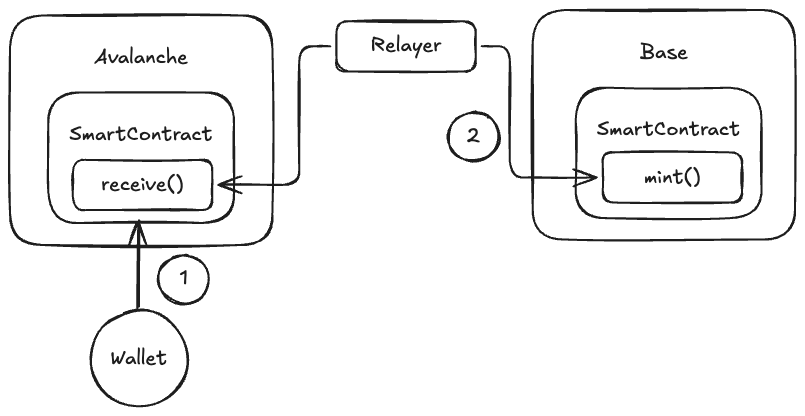
To send a message between two blockchains, a transaction must first submit a request on the source chain. A relayer then monitors the request and submits another transaction delivering the message to the destination chain. If the operation could complete in a single transaction, the requesting contract on the source chain could send a message to another blockchain, confirm that it arrived and was processed, and then continue executing subsequent logic. There are three main reasons this is not possible.
Different consensus algorithms
Each blockchain has an independent consensus algorithm. As a result, chain B cannot independently determine when, under what conditions, and at what point a transaction on chain A can be considered final.
Even if both use the same consensus algorithm, consensus is established only within each individual chain.
Different validators
Even when chains use the same consensus algorithm, each chain has a separate validator set. A block that chain A's validators agree is valid therefore has no binding authority over chain B.
Inability to wait for another chain's finality
Suppose it were possible to wait for processing on chain B to complete while executing a transaction on chain A. This would be detrimental to blockchain operation. Block production relies on the following assumptions.
- Completion within a bounded period of time
- Use of locally verifiable information only
- No dependence on responses from external networks
If block production had to wait for block production or finality on another chain, it would become dependent on that chain's block intervals and finality. This would undermine block production on the requesting chain. It would also expose the chain to attacks involving deliberate delays.
Longer processing times
For an ordinary transaction on a single blockchain, applications can check its completion and update the frontend accordingly. When sending a message to another blockchain, however, the application must wait for block production and finality on that blockchain. If processing continues before finality, a reorganization on the destination chain could roll back the chain. Subsequent processing therefore needs to wait until finality is reached.
As a result, operations often take hours or days. In particular, Ethereum L2 chains with a seven-day challenge period (during which a transaction can be disputed) require waiting for that period to conclude.
Additional information for function calls
Sending a message to another blockchain typically requires the following information.
- Which blockchain to send it to
- Which contract the message is addressed to
- A unique identifier (to prevent duplicate message delivery)
- Which blockchain the message originates from
- Which contract the message originates from
For example, sending an NFT or an ERC20 token requires specifying at least which blockchain to send it to and which contract the message is addressed to. The remaining information can be assigned automatically by the contract when sending the message. However, unless the requesting user specifies these two values, the contract cannot determine where to send it.
This breaks full compatibility with ordinary NFT and ERC20 token interfaces.
For example, to send an NFT or ERC20 token to a contract on another blockchain, the standard safeTransferFrom(from, to, tokenId) function would need additional arguments specifying which blockchain to send it to and which contract the message is addressed to.
Other contracts and dApps that need bridge functionality must therefore implement additional logic.
Security risks
Bridges are exposed to attacks, and funds have been stolen in previous incidents. Funds have been lost due to inadequate management of administrator private keys, vulnerabilities in bridge contracts, and insufficient message verification.
The ideal bridge
Having examined the challenges of bridges, consider whether an ideal bridge could resolve them.
HTTP requests from within a contract
Engineers who have written smart contracts have likely wondered whether a contract could make an HTTP request. If contracts could make HTTP requests, they could retrieve processing results from another chain, potentially completing a bridge operation in one transaction. Unfortunately, this is not possible.
One reason is that contract execution must be deterministic. The same transaction must produce exactly the same result on every node. For example, if nodes made an HTTP request from within a contract when validating a transaction, each node would issue its own request. The server could become unavailable for some reason, or its responses could differ between requests. Validation might then succeed on some nodes and fail on others, causing the same transaction to produce divergent execution results. There are other limitations as well, but determinism is a major reason.
Reducing processing time
This appears difficult to achieve. One possibility would be to accelerate blockchain finality. However, accelerating finality is not straightforward, so improvements are likely to arrive incrementally as chains are upgraded.
Avoiding additional function arguments
This is possible, for example, when communication is restricted to a predetermined contract on a predetermined chain. Since which blockchain to send to and which contract to address are fixed, that information can be stored in the contract itself. This may work between private chains, but applying the same design to public chains would require separate bridge contracts for each chain-and-contract combination. For instance, one contract would handle contract A on blockchain A, and another would handle contract B on blockchain A. Contract addresses would need to be managed for each combination. A routing contract could help, but management costs would increase.
Summary
An ideal bridge that solves all these challenges appears infeasible, but the preceding sections explain why bridges work the way they do. Future bridges may find ways to address these problems, making this an area worth following. Chain abstraction is another related topic worth exploring in future articles.
The following article also covers blockchain bridges.
Conclusion
This article has revisited blockchain bridges and the challenges involved in cross-chain communication.