Introduction
Hi, I'm cardene, a software engineer and technical writer focused on blockchain and AI.
I've also authored Japanese technical books on specification-driven development with LLMs and decentralized application (DApp) development.

I also build and publish a variety of tools, libraries, and open-source projects.
Overview of privacy technologies
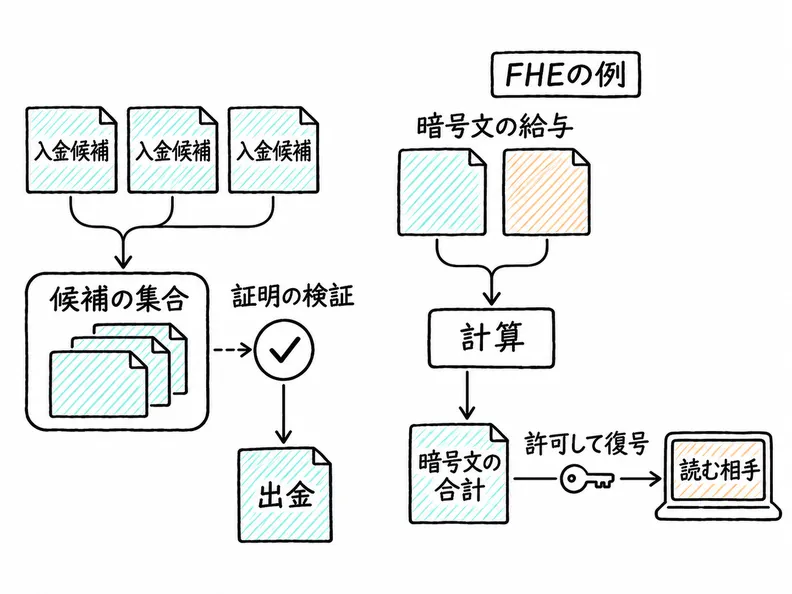
Suppose someone receives their salary on a blockchain and wants to make subsequent purchases without their employer or counterparties tracking them. On a ledger where balances and transfer histories are visible for each public address, linking an address to a person can reveal their income and the recipients of their payments. One approach is to demonstrate to the party accepting a transfer that the sender has permission to spend the assets and that the amounts are correct, without revealing the link between transfers to people reading the ledger.
When a company totals its employees' salaries, on the other hand, it needs to use individual amounts in a calculation and return the aggregate to its accounting staff. In that case, the relevant questions include not only which deposits correspond to which withdrawals but also whether the machine performing the calculation or its operator can read salaries in plaintext. Privacy technologies let applications verify conditions necessary for payments and computations while controlling who can see this information.
To conceal the relationship between deposits and withdrawals, a system proves that withdrawal conditions are satisfied without revealing which of several deposits was used. With FHE, which supports operations on ciphertext, a service can calculate the sum without receiving individual salaries in plaintext, and an authorized party can decrypt the total.
What is concealed, and from whom?
Even if a salary amount is concealed, calling a contract from the recipient's public address leaves a record of that address performing the operation. Conversely, a design may conceal the identity of the person requesting a swap while disclosing the assets and quantities being exchanged. Anonymity, which makes it harder to link senders and recipients, and confidentiality, which prevents amounts or inputs from being read, protect different information.
What each party can see also varies among ledger readers, computation services, parties to a transfer, and auditors examining its history. For example, accounting staff can be given visibility into salary inflows and outflows while only the recipient holds the key needed to spend the assets. Defining what to conceal from whom allows us to compare viewing rights separately from spending rights.
Verification conditions and trusted parties
Someone who holds a secret can demonstrate that input and output quantities match without revealing those amounts. A zero-knowledge proof lets a verifier establish that a condition holds without receiving the secret value itself. The conditions whose correctness can be verified are determined by the selected circuit: the computation encoded in the proof.
Systems that compute over ciphertext, or that process plaintext inside protected hardware, differ in where the secret is used. In business-to-business transactions, selected participants may read the contents and commit only the agreed outcome to a shared ledger. Proofs, ciphertext computation, hardware isolation, and participant approval each rely on different verification materials and trusted parties.
Transfers using private notes
One approach represents assets as private records and creates new records when transferring them. These private records are called notes. The public system registers a commitment bound to the contents of each note, and the sender proves that the conditions for spending a note are met without revealing its contents.
A commitment is a public value that makes it difficult to substitute different contents later. Combining a secret amount and ownership information with randomness makes it difficult to infer from two public commitments that their underlying notes contain the same amount. The public value alone does not recover the original secret data, so the owner retains the note contents needed to generate a proof.
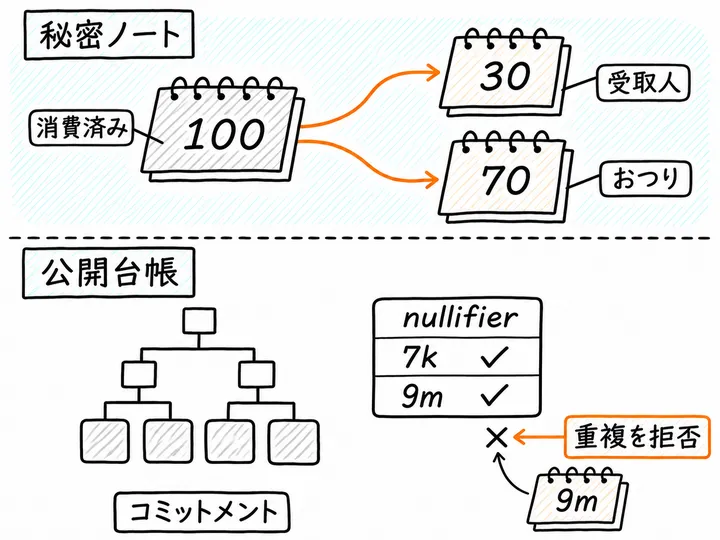
7k and 9m are illustrative labels used to distinguish duplicate values. An attempt to register the same value as an already registered 9m is rejected rather than added to the registered set.
Spending notes and creating a new balance
For example, a sender holding 100 who pays 30 uses a note worth 100 as the input and creates output notes representing 30 for the recipient and 70 in change for the sender. If the fee is paid separately, the input quantity of 100 equals the output quantities of 30 + 70. Spending an old note and replacing it with new ones differs from updating a public address's balance field from 100 to 70.
Knowing the contents of the note worth 30 allows the recipient to use it for later payments. The system therefore needs a channel for delivering the note contents to the recipient, in addition to registering its output commitment. Aztec provides both a mechanism for delivering encrypted notes through on-chain logs and a mechanism for delivering them directly to the recipient. Even if plaintext is not disclosed, ciphertext intended for the recipient may be placed on the ledger.
Viewing rights versus spending rights
The key used to read a note's contents can be separate from the key needed to spend its assets. The full viewing key in Zcash Sapling (a key for viewing inputs and outputs) allows another party to inspect information without receiving the secret spending key. Giving accounting staff visibility into inflows and outflows does not automatically give them the key needed to authorize payments.
However, what a viewing key reveals depends on the system. A key that provides continuing access to transaction history has a different disclosure scope from information revealing a single transfer. When disclosing information, consider both whether the recipient can spend assets and how far the disclosure extends into past or future activity.
Proving membership and checking for double spending
The public system adds registered commitments to a Merkle Tree, a structure that allows a set of records to be verified against its root hash. The sender proves that the commitment corresponding to their note belongs to the registered set. The proof also encodes spending authority and conservation of amounts, allowing the transfer to proceed without directly revealing which note was used to the verifier.
Checking membership alone would allow the same 100 to be spent repeatedly. The system therefore publishes a value corresponding to the note's consumption and rejects subsequent registrations of that same value. This value is called a nullifier.
The verifier must be able to check whether a nullifier is a duplicate without being able to easily identify the spent note from it. The original commitment remains in the Merkle Tree, while spent status is checked in a separate record. Spending a note does not mean deleting its leaf from the ledger.
Fixed-denomination pools and private balances
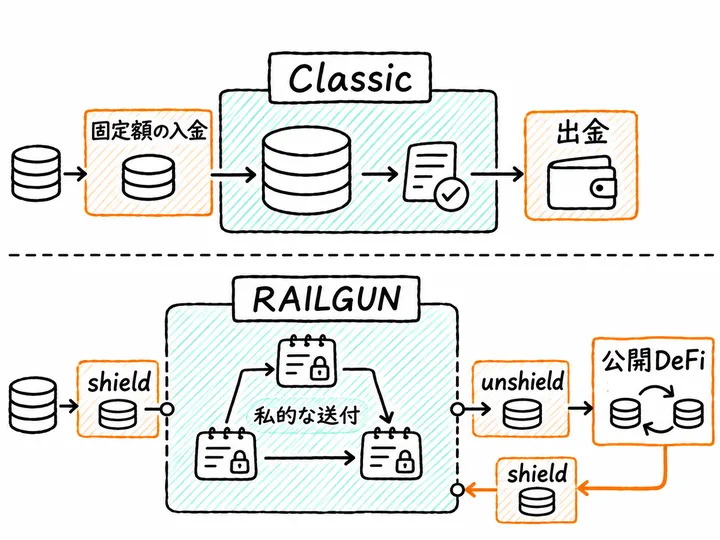
Systems using notes and proofs may either withdraw deposited assets to another public address or maintain a private balance for subsequent transfers. Their use differs accordingly. Tornado Cash Classic supports fixed-denomination deposits and withdrawals, while RAILGUN lets users transfer assets privately after depositing them into a pool and later withdraw them.
Fixed-denomination pools in Tornado Cash Classic
Tornado Cash Classic fixes the deposit denomination for each pool contract. In a one-unit pool, for example, a depositor deposits one unit and registers a commitment derived from secret values. By making deposits of the same denomination candidates for a withdrawal, this design reduces the ability to narrow down the relationship using differences in deposit and withdrawal amounts.
A person withdrawing funds proves knowledge of the secret corresponding to a registered commitment and specifies a withdrawal recipient. The contract checks that the proof uses a known Merkle Tree root, that the nullifier has not been used, and that the proof is valid. The proof is also bound to the withdrawal recipient and relayer. Because the fee is bound to the proof as well, a request that substitutes these values without authorization is not accepted.
If these checks pass, the contract marks the nullifier as spent and withdraws to the specified recipient. A withdrawal with an already used value or an invalid proof does not succeed. However, information such as nearby deposit and withdrawal times, a small set of candidate deposits, or reuse of a public address can still narrow down their possible relationship.
Private balances and external calls in RAILGUN
In RAILGUN, depositing assets into a pool is called shield. Users can then transfer assets to other parties within their private balance using private note commitments and spent values. In an unshield operation that withdraws assets to a public address, the assets delivered externally and the scope of disclosure need to be considered again.
A Broadcaster is a relayer that pays the gas for submitting transactions. Users can pay fees in supported tokens while the Broadcaster submits the transaction. If a user directly pays gas and submits from their own public wallet, a record of that public address performing the operation remains.
When calling external DeFi (financial services) from a private balance, Relay Adapt temporarily unshields assets, invokes public contracts, and shields the returned assets again. Concealing the link to the pool balance does not also make the external swap operation and its quantities private. The design reverts the whole transaction if the bundled calls fail.
Proof generation times also vary with the device and transaction complexity. If a Broadcaster fee quote expires during proof generation, the fee quote and proof may need to be regenerated. A duration reported for a particular device cannot be treated as a fixed time for every user.
Multi-asset pools and swaps
When private balances contain several assets, users may exchange them for different assets or move assets between chains. The information disclosed differs among transfers within the pool, swaps, and movements across its boundary. Namada provides a multi-asset pool, while Penumbra has a disclosure model that varies for swaps as well.
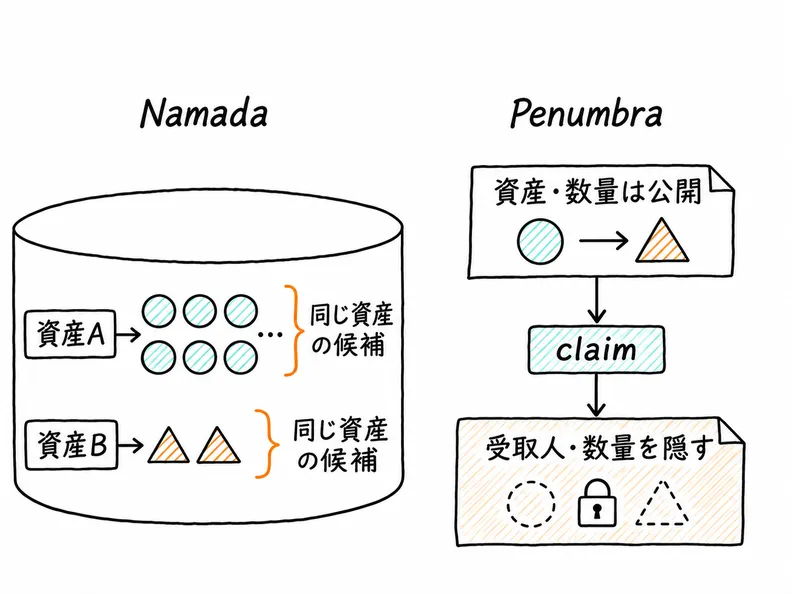
Namada's MASP and per-asset anonymity sets
Namada provides a multi-asset shielded pool called MASP. It extends the Zcash Sapling circuits to multiple assets and conceals the relationship between parties to transfers within the pool. A wallet synchronizes pool records, reads notes using its keys, and determines which assets it can spend.
Supporting multiple assets in the same pool does not mean all deposits of every asset automatically belong to the same anonymity set. If only one person deposits a given asset and that asset is later withdrawn, the relationship may be inferred even if many deposits of other assets exist. Consider the number of candidates for the same asset and how much deposit and withdrawal amounts or timing can narrow them down.
Swaps and shielded outputs in Penumbra
Transfers within the Penumbra pool conceal asset types, amounts, and sender and recipient identities. A swap intent, by contrast, conceals the swapper's identity while disclosing the assets and amounts involved in the swap. Concealing a transfer and determining a price from swap conditions require different public information.
Swap requests are grouped by trading pair and processed as a batch at the end of a block. Users later perform a claim to receive the results as shielded outputs, which are new notes with concealed contents. Ledger readers can observe that outputs for a particular trading pair were created, but their amounts and recipient identities are concealed.
Operations other than swaps also reveal information. In staking, the validator and delegated amount are public. In delegator voting, the vote and voting power are public. Assuming that the privacy of ordinary transfers extends to delegation or voting overlooks the information those operations disclose.
IBC transfers and selective disclosure
When using IBC for cross-chain asset transfers, consider what is disclosed when assets enter and leave the pool. A transfer into Penumbra reveals the source chain, asset and amount, and deposit address. Reusing the same deposit address reveals that different deposits were directed to the same destination.
Withdrawals reveal the destination chain's address as well as the address on Penumbra used if assets need to be returned. Reusing the same transparent return address can link multiple withdrawals. Even when transfers within the pool are concealed, external addresses, amounts, and timing can still be public.
When a party needs access to transaction history, users can choose the granularity of disclosure. The Penumbra full viewing key grants visibility into past and future activity, but there is also a way to selectively disclose information about a single transaction. This avoids granting a spending key or continuing viewing rights just to request verification of one transaction.
Execution and storage of private data
Applications that do more than transfer balances and need to execute using secret conditions must also choose where computation takes place. Aztec generates proofs on the user's device, INTMAX has senders and recipients retain their balance state, and Paladin shares private data among participating nodes. They differ in where private data resides and what verification materials they send to the public system.
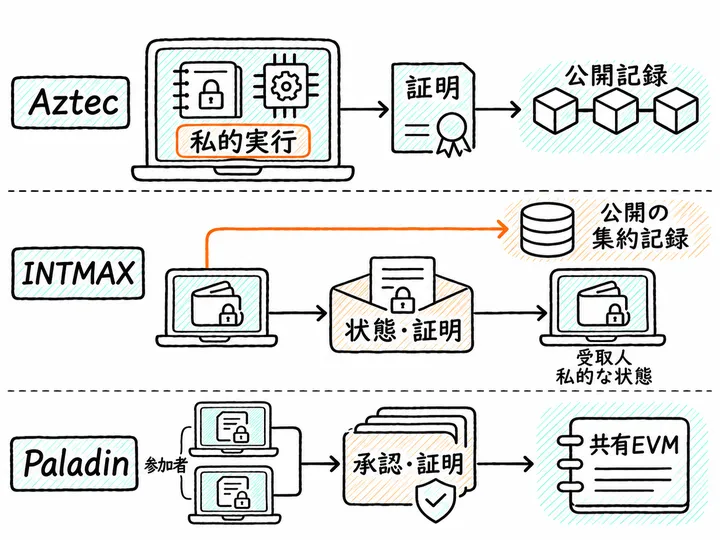
Client-side execution in Aztec
In Aztec, the user's device executes private functions and generates a proof that the computation satisfies its conditions. The environment responsible for this execution and for key and note management is the PXE. Proofs and necessary public inputs are submitted to the shared system, while public functions are executed by the sequencer. This allows applications to process private inputs without distributing those inputs to every verifier.
When private execution needs to update public state, it enqueues a public function call. Because that function executes later, its return value cannot be supplied back into the earlier private execution. Applications that connect private and public functions need to account for this execution order.
The chain also continues to advance while the device generates proofs. Private execution reads state relative to a finalized block called the anchor block. The system separates proving that a note existed in the past from checking that it is not double-spent at inclusion, so it can account for another transfer being finalized in the meantime.
Proof generation failures and public execution failures
If the device cannot generate a proof, the request does not reach the stage of submission to the network. No network gas fee is incurred for that request. After submission, however, the consequences of failure depend on which phase's updates are reverted.
Transactions in Aztec Tierra v6.0.0 separate the setup phase, which prepares fee payment, from the app phase, which executes the application. If public execution in the app phase fails, revertible updates in that phase are discarded, but fee payment finalized during setup remains. An optional teardown phase can process refunds based on the final fee, although some payment methods charge a fixed quoted amount without refunds.
When examining a failure, distinguish whether a proof was generated, whether the transaction was submitted, which application updates were reverted, and whether a fee was paid. Combining private and public execution does not imply that every record and cost will be restored on failure.
Client-side state in INTMAX
In the INTMAX design, users retain transfer details and their own balance state and submit aggregated records to the public system. A sender sends a batch hash to an aggregator, checks that it is included in the Merkle Tree, and signs the root. The materials that the aggregator submits to the contract include the root and aggregate signature.
Separately, the sender delivers the original transfer data, membership path, and proof concerning the balance to the recipient. The recipient verifies the proof and updates their client-side state. Because the public ledger does not contain all balance information, obtaining and retaining the necessary data on the recipient's side is part of the transfer process.
Store Vault is a service for storing encrypted transaction data needed for recovery. It stores the data required to generate balance proofs, separately from private key storage. Deposits and withdrawals on the underlying chain, L1, also disclose information and do not have the same disclosure scope as private transfers within the L2 that processes transfers on top of it.
Status of normal services and the exit path
As of the check on November 17, 2026, the official INTMAX application announced temporary unavailability due to a technical issue with the zero-knowledge proof protocol, along with suspension of deposits and withdrawals. It also provided directions to an Exit path. That should be assessed separately from the availability of the normal service. The fact that design documents describe transfers and backups is not enough to establish that service has resumed, an exit will succeed, or assets are safe.
Execution among participants in Paladin
Paladin distributes private data to nodes belonging to selected participants and coordinates checks, signatures, and proof preparation. It submits the prepared verification materials to a contract on a shared EVM, connecting them to a public state update. Parties able to read private data are distinct from parties able to read public records.
In Noto, a trusted notary verifies transfer contents, while Zeto uses zero-knowledge proofs. In Pente, a restricted group of participants performs private EVM execution and endorses its state transitions. The selected mechanism determines who can read the business conditions and who is trusted with verification.
For example, combining the bond and payment operations in a final shared EVM transaction allows both legs to succeed or fail together within that scope. However, locks or approvals already finalized before that transaction, and data received by participants, are not automatically erased. The concrete preparation and cancellation flows are described in the Paladin article.
Zeto also has prerequisites for proof generation. Proving keys initialized by the official implementation for local tests alone do not meet the trust assumptions for production proofs.
Production proving keys are generated by multiple participants through a recorded distributed ceremony, or by a trusted entity. Verification uses verification keys corresponding to the circuit and proving keys. This is a condition to check when adopting Zeto; the same key generation procedure does not necessarily apply to every zero-knowledge proof system.
Ciphertext computation with FHE
When a company totals salaries, it can also calculate the total without passing individual salary amounts to the computation service in plaintext. FHE, or fully homomorphic encryption, is a cryptographic technique that enables operations such as addition and comparison on encrypted values. Using Zama's FHEVM as an example, computation on ciphertext can be separated from decryption that allows an authorized party to read the result.
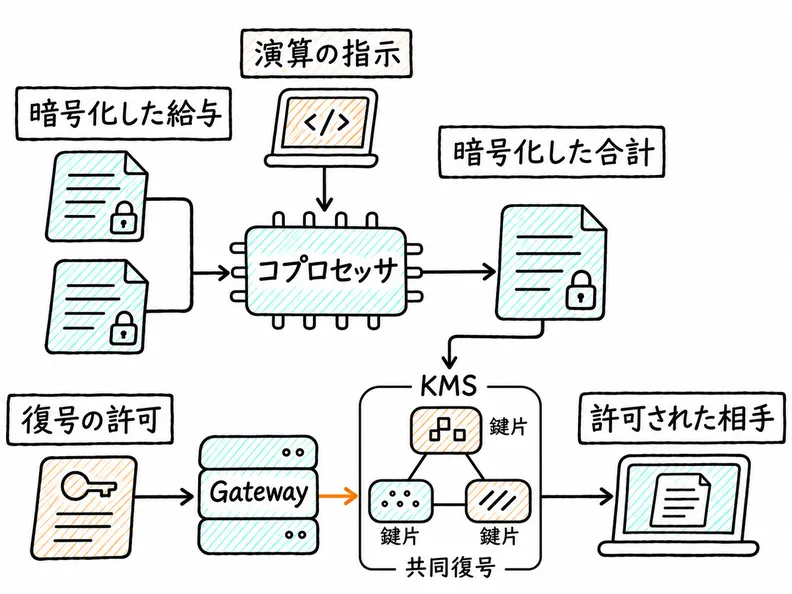
Host-side instructions and ciphertext computation
A user submits encrypted salary amounts, and the contract specifies addition on encrypted types. The host chain where the application contract resides records references to ciphertext and computation instructions. Computationally intensive FHE operations are performed by coprocessors that receive these on-chain instructions.
Coprocessors perform operations on ciphertext rather than decrypting salaries before adding them. The sum is also ciphertext, so it can be passed into subsequent encrypted computations. Where ciphertext is computed and who can read the final sum can be decided separately.
Even conditional logic can leak secrets if a public branch reveals whether a condition is true or false. An operation that selects a result according to an encrypted condition can be used instead. Since contract calls and computation instructions are not all private, the design distinguishes observable operations from values that need to remain concealed.
Parties authorized to decrypt and the KMS
To return the encrypted total only to accounting staff, the contract's access control specifies who may use the ciphertext and who may request its decryption. The Gateway coordinates requests and checks permissions, and participants in the KMS (key management service) cooperate to decrypt. Instead of a single participant holding the entire secret key, the KMS uses MPC, which distributes the key among participants for computation.
User-specific decryption returns results in a form that the specified user can read. By contrast, once public decryption is authorized, anyone can obtain the disclosed plaintext result. Even when individual salaries remain concealed, the scope of disclosure depends on which aggregate results are made public.
Accepting a computation result has its own assumptions. For coprocessor results, the Gateway collects responses and accepts the output based on majority agreement. Correctness therefore depends on a majority of coprocessors processing honestly.
For KMS decryption, on the other hand, enough participants must participate to meet the configured threshold. The KMS assumes that malicious participants constitute no more than one-third of the total for its fault tolerance. This is distinct from the majority vote used to accept computation results.
If the required participants cannot respond, the decrypted result cannot be returned even after ciphertext computation is complete. Check the participant counts and thresholds for the selected configuration instead of treating examples from documentation as fixed values common to all deployments.
Isolated execution with a TEE
Instead of performing operations on ciphertext, some systems process plaintext inside protected hardware. A TEE is an area within a machine that isolates code and data from the outside environment. Oasis Sapphire processes encrypted inputs and state within such an area and stores encrypted state outside it.
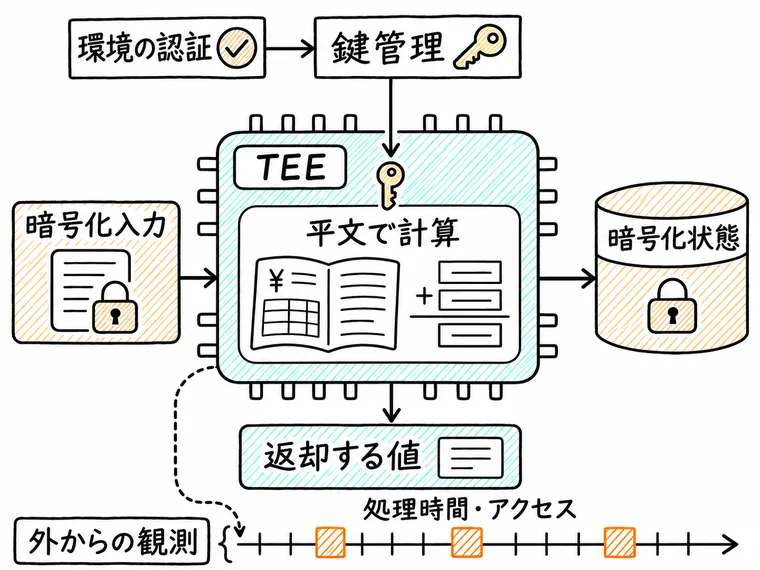
Attested execution environments and state keys
In Sapphire, isolated environments on attested execution nodes read and write contract state. The key management service releases state keys to execution environments meeting the required conditions. The mechanism for remotely verifying the environment and the program it runs is called remote attestation.
Inside the isolated environment, ordinary computation proceeds using decrypted plaintext. Confidentiality therefore depends on hardware, attestation, and key distribution working as intended. Verifying that code runs in an attested environment and verifying arbitrary business computations with zero-knowledge proofs establish different properties.
Sapphire provides EVM-compatible contract execution. Another implementation, Secret Network, combines SGX isolated execution technology with CosmWasm-based contract execution. Even systems in the same TEE category do not necessarily share the same development environment or key management. Oasis's ROFL connects off-chain applications running inside isolated environments; these applications execute in a different location from contracts on Sapphire.
Leakage through return values and execution traces
Even when inputs are encrypted, a contract that returns a secret allows the recipient of the response to read it. Conditions can also sometimes be inferred from state size, access patterns, execution timing, or gas consumption. Consider not only what is encrypted but also what is returned and what operations can be observed externally.
For example, consider an application that returns a secret to someone who has paid. If an unfinalized simulation satisfies the payment condition and returns the secret, someone may obtain it before the actual payment is finalized. A design that requires a finalized block before returning the secret links disclosure to execution finalization. Even with protected hardware, the application determines what to disclose and when.
Comparing approaches and recovery requirements
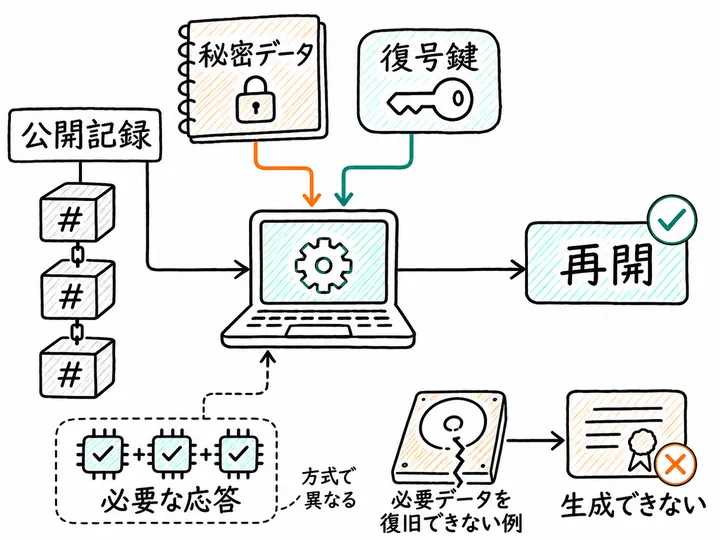
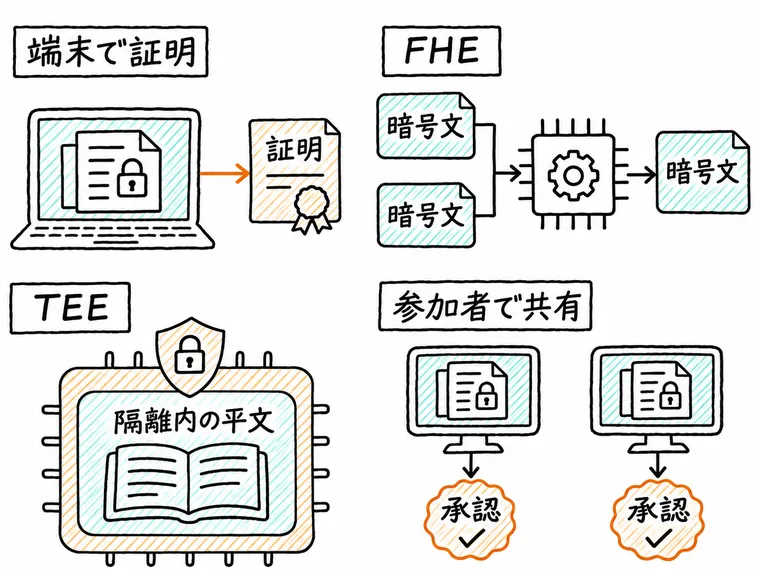
Proofs that conceal transfer relationships, ciphertext computation, plaintext execution in isolated environments, and data sharing among participants differ in where secrets are used. Choose the processing location based on the information that needs to be concealed, and check the public records and trusted parties. The materials needed to resume operations also differ when keys or data are lost and when a processing service stops.
Public information and trust assumptions
For systems that conceal relationships between transfers, also consider deposit and withdrawal amounts, timing, and the public address performing the operation. For systems that compute on secret values, the questions include whether the computation service can read plaintext, who verifies the result, and who decrypts it.
| System | Concealed information | Public information | Where secret data is used | Additional trust assumptions to check |
|---|---|---|---|---|
Tornado Cash Classic |
Relationship between deposits and withdrawals in a fixed-denomination pool | • Deposit and withdrawal addresses• Fixed denomination• Timing | Proofs generated on the user's device | • Circuit and keys• Candidate deposits• Communication channel |
RAILGUN |
Private balances and relationships between transfers within the pool | • shield and unshield• External DeFi operations and values |
Proofs generated on the user's device | • Circuit and keys• Connections to the Broadcaster and RPC |
Namada MASP |
Relationship between senders and recipients within the pool | Assets and quantities at deposit and withdrawal boundaries | Proofs generated on the user's device | • Candidate set for the same asset• Synchronization endpoints and communication channels |
Penumbra |
• Assets and amounts transferred• Transfer participant identities• Swapper identity | • Swap assets and amounts• Delegated validator and amount• Votes and voting power | Proofs generated on the user's device | • Disclosure scope for each operation• IBC address reuse |
Aztec |
Private function inputs and note contents | • Public functions and proofs• Commitments• Encrypted logs | • Private execution in the PXE• Verification and public execution on the shared system |
• Circuits and verification• Device-side key and note management |
INTMAX design |
Transfer details and balance state within L2 |
• Aggregated records• L1 deposits and withdrawals |
Senders and recipients update state and proofs | • Retention of necessary state data• Availability of aggregation and delivery |
Paladin |
Private data concealed from everyone outside selected participants | Verification and finalization records on the shared EVM |
Nodes of business participants | • Noto notary• Zeto proving keys• Pente endorsers |
Zama FHE architecture |
Computed values remain encrypted | • Calls and computation instructions• Authorized public decryption results | Coprocessors compute on ciphertext | • Majority vote for accepting results• KMS secret sharing and threshold• KMS availability |
TEE systems such as Sapphire |
Plaintext inputs and state concealed from outside the isolated environment | • State size and access patterns• Authorized responses | Plaintext processing within attested isolated environments | • Hardware and attestation• Key management• Application response controls |
The INTMAX row compares its design; the availability of its normal service is a separate matter from the outage notice displayed by the official application. Do not assume that approaches with the same name have the same disclosure scope. Compare the actual operations and implementations being used.
When connecting to a public RPC endpoint to query state or submit transactions, the endpoint operator can observe the source of the connection and the requests. A proof that conceals transfer relationships on the ledger does not also conceal connection records. Check what logs and identifiers each service retains separately instead of assuming that every implementation collects the same information.
RAILGUN's Private POI is an additional mechanism for demonstrating that the sources of deposited assets and their subsequent transfers are not included in a specified list of transactions and addresses. The scope of what the proof verifies depends on who prepared the list and what is checked against it. The mere existence of an additional proof does not guarantee every legal assessment or every user's conduct.
Data retention and resuming operations after an outage
Possessing a private key does not necessarily make it possible to recover note contents from public ledger hashes alone. Information recoverable from encrypted logs, data delivered only between participants, and client-side balance state have different retention and synchronization requirements. During recovery, identify where the secret data needed for proofs can be obtained in addition to the decryption key.
For example, a Namada wallet can synchronize on-chain records and read notes using its keys. By contrast, when details are not stored publicly or notes are delivered directly, data storage and backups become prerequisites for resuming operations. Retention of data in INTMAX's Store Vault and of private data on Paladin participant nodes should also be considered separately from public ledger records.
Generating a proof on a local device and receiving responses from external decryption services or transaction endorsers are separate concerns. If the required number of KMS participants cannot respond, or if business endorsers are unavailable, processing cannot finish even when keys and ciphertext are available locally. If a submission outcome is unknown, check finalized records and spent values before deciding whether to resubmit.
Conclusion
Notes conceal ownership information while allowing amounts and double spending to be checked; FHE performs computations on ciphertext; and a TEE processes plaintext inside a protected environment. Systems that share private data among participants choose who receives the contents and whose approvals finalize the transaction. Comparing public information, trusted parties, viewing and spending permissions, and key and data retention covers both privacy during normal operations and the requirements for recovery after an outage.
The following official sources informed the explanation of these approaches.