Introduction
Hi, I'm cardene, a software engineer and technical writer focused on blockchain and AI.
I've also authored Japanese technical books on specification-driven development with LLMs and decentralized application (DApp) development.

I also build and publish a variety of tools, libraries, and open-source projects.
EIP-7976 proposes raising the calldata floor cost (minimum gas cost) to limit the impact of data-heavy transactions on block size and create room for further increases in the gas limit.
This article explains the proposal linked below.

I also cover various EIPs, BIPs, SLIPs, CAIPs, ENSIPs, RFCs, and ACPs.

Overview
EIP-7976 proposes raising the calldata floor cost (minimum gas cost) from 10/40 gas per byte to 64/64 gas per byte. The change reduces the maximum block space that data-heavy transactions can occupy by approximately 37%.
Calldata
Calldata is the data portion of a transaction. It is used to pass arguments when calling contract functions and to allow L2 rollups to post data to L1.
The proposal builds on EIP-7623, strengthening the floor cost mechanism introduced by EIP-7623.
For more on EIP-7623, see the following article.
[ERC4337] Implementing Account Abstraction Without Protocol Changes
The important point is that transactions dominated by EVM computation, such as DeFi operations and token transfers, are unaffected. The affected transactions are those that pack large amounts of data into calldata, primarily L2 data posting. Based on historical data from September 2024 to September 2025, only 1.5% of all transactions would be affected.
The figures and network parameters in this article reflect the original Japanese article published on March 23, 2026.
Motivation
The problem of growing block sizes
Ethereum blocks have an upper bound called the gas limit, which in the original article is approximately 45 million gas (45M gas). The combined gas consumption of transactions in a block cannot exceed this limit.
The cost of calldata is important here. When calldata is inexpensive, a single transaction can contain a large amount of data, increasing the total data size of the block. Larger blocks take longer for network nodes to download and validate, negatively affecting the performance of the chain as a whole.
What EIP-7623 achieved and what remains unresolved
EIP-7623 addressed this problem by introducing a floor cost. The floor cost is a minimum gas cost applied to data-heavy transactions that perform little EVM computation.
EIP-7623 set the floor cost at 10/40 gas per byte (10 gas for zero bytes and 40 gas for nonzero bytes), limiting the maximum block size to approximately 1.07MB (45,000,000 ÷ 40).
There is, however, interest in raising Ethereum's gas limit further. A higher gas limit allows more transactions to be processed, but if the floor cost remains unchanged, block size will also grow proportionally. Raising the floor cost further and reducing the maximum block size creates room for future gas limit increases.
The proposed solution
EIP-7976 raises the floor cost to 64/64 gas per byte.
This brings the maximum payload size that data-heavy transactions can occupy down to approximately 0.67MB (45,000,000 ÷ 64).
That is a reduction of approximately 37% from the 1.07MB under EIP-7623.
| Approach | Zero byte | Nonzero byte | Maximum payload |
|---|---|---|---|
| Previous pricing (before EIP-7623) | 4 gas | 16 gas | Approx. 2.81MB |
| EIP-7623 | 10 gas | 40 gas | Approx. 1.07MB |
| EIP-7976 | 64 gas | 64 gas | Approx. 0.67MB |
Higher calldata costs also give L2s a stronger incentive to post data using blobs (the dedicated data space introduced by EIP-4844) instead of calldata, encouraging migration to a more suitable data availability mechanism.
Specification
Parameter definitions
EIP-7976 defines the following two parameters.
| Parameter | Value | Description |
|---|---|---|
STANDARD_TOKEN_COST |
4 | Standard cost per calldata token. Applies to transactions with substantial EVM computation. |
TOTAL_COST_FLOOR_PER_TOKEN |
16 | Floor gas cost per token. Applies to data-heavy transactions and is multiplied by floor_tokens_in_calldata to calculate the minimum gas cost. |
The number of bytes in calldata is converted into units called tokens. The conversion rules are as follows.
| Variable | Formula | Description |
|---|---|---|
tokens_in_calldata |
ゼロバイト数 + 非ゼロバイト数 × 4 |
Token count for standard cost calculation. Nonzero bytes carry four times the weight. |
floor_tokens_in_calldata |
(ゼロバイト数 + 非ゼロバイト数) × 4 |
Token count for floor cost calculation. All bytes carry the same weight of four. |
In the original formulas above, ゼロバイト数 means the number of zero bytes, and 非ゼロバイト数 means the number of nonzero bytes.
For the standard cost calculation (tokens_in_calldata), zero bytes have a weight of one and nonzero bytes a weight of four. For the floor cost calculation (floor_tokens_in_calldata), both zero and nonzero bytes have a weight of four.
This ensures that even transactions containing many zero bytes incur a high floor cost.
Gas calculation formula
Transaction gas consumption is determined by the following pseudocode, written using Python-style syntax.
tx.gasUsed = (
    21000
    +
    max(
        STANDARD_TOKEN_COST * tokens_in_calldata
        + execution_gas_used
        + isContractCreation * (32000 + INITCODE_WORD_COST * words(calldata)),
        TOTAL_COST_FLOOR_PER_TOKEN * floor_tokens_in_calldata
    )
)
The variables in the formula have the following meanings.
execution_gas_usedGas consumed by EVM execution, minus the gas refund.isContractCreationA flag indicating whether the transaction creates a contract (true=1, false=0).INITCODE_WORD_COSTThe cost per word of contract initialization code (2 gas), defined by EIP-3860.
The key to this formula is the max() function.
It compares two values and selects the larger one.
Compute-heavy transactions continue to use the standard cost (4 gas per zero byte and 16 gas per nonzero byte), while the floor cost (64 gas for every byte) applies to data-heavy transactions.
flowchart TD
    A[トランザクション実行] --> B{ガスコスト計算}
    B --> C["標準コスト\n= STANDARD_TOKEN_COST × tokens\n+ EVM実行ガス\n+ コントラクト作成コスト"]
    B --> D["フロアコスト\n= TOTAL_COST_FLOOR_PER_TOKEN\n× floor_tokens"]
    C --> E{max で比較}
    D --> E
    E --> F["大きい方 + 21000\n= 最終ガス消費量"]
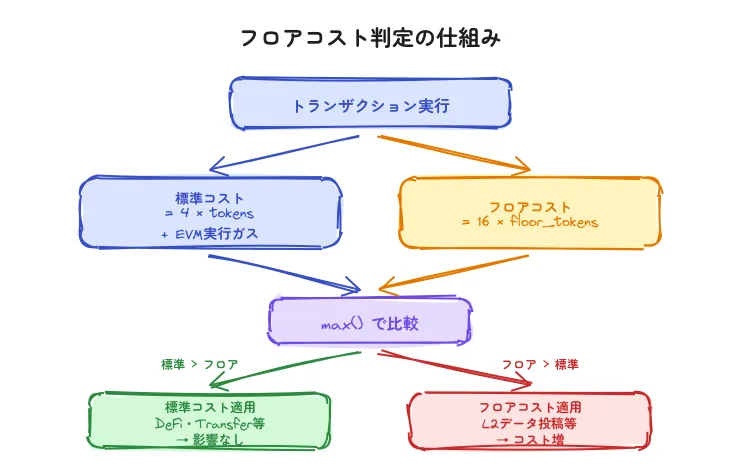
The following flowchart illustrates how the floor cost is determined.
The original diagrams retain their Japanese labels.
Transactions with substantial EVM computation, such as DeFi operations and transfers, are unaffected when the standard cost is higher. Data-heavy transactions, such as L2 data posting, are subject to the floor cost and therefore become more expensive.
Gas calculation examples
Consider a concrete example. Suppose a transaction contains 100 nonzero bytes of calldata.
tokens_in_calldata= 0 + 100 × 4 = 400floor_tokens_in_calldata= (0 + 100) × 4 = 400
Compute-heavy transaction
For a DeFi operation consuming 50,000 gas during EVM execution, the standard cost is 4 × 400 + 50,000 = 51,600.
The floor cost is 16 × 400 = 6,400.
Because max(51,600, 6,400) = 51,600, the standard cost applies.
An ordinary DeFi transaction of this kind is unaffected by the change.
Data-heavy transaction
If EVM execution consumes almost no gas, as when an L2 simply posts data in calldata, the standard cost is 4 × 400 + 0 = 1,600.
The floor cost is 16 × 400 = 6,400.
Because max(1,600, 6,400) = 6,400, the floor cost applies.
The data-heavy transaction pays four times the standard calldata cost in this example.
Transaction invalidation rule
If a transaction's gasLimit is below 21000 + TOTAL_COST_FLOOR_PER_TOKEN × floor_tokens_in_calldata or below its intrinsic gas cost, the transaction is rejected as invalid.
The larger of the two calculated values determines the threshold.
This restriction ensures that the transaction can cover the calldata floor cost before execution begins.
Although execution may produce a gasUsed value below the floor cost in some cases, the gasLimit must reserve enough gas to cover the floor.
Additional considerations
Comparing the evolution of calldata pricing
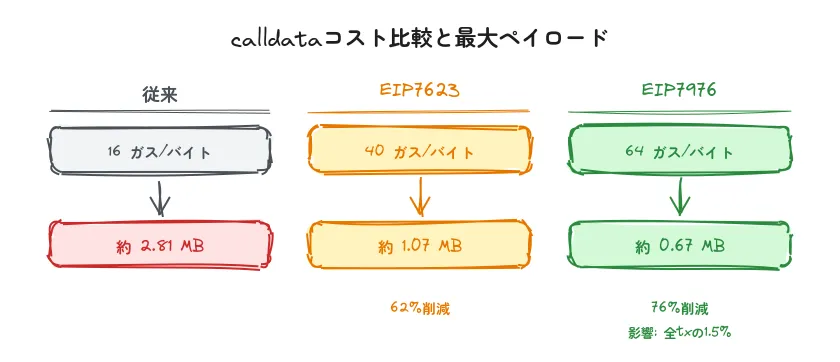
Calldata prices have been raised in stages. The following diagram and table compare the maximum payload size under each pricing model, assuming a 45M gas limit.
| Approach | Nonzero byte cost | Maximum payload | Gas required to send 10MiB |
|---|---|---|---|
| Previous pricing | 16 gas/byte | Approx. 2.81MB | Approx. 168M gas |
| EIP-7623 | 40 gas/byte (floor) | Approx. 1.07MB | Approx. 420M gas |
| EIP-7976 | 64 gas/byte (floor) | Approx. 0.67MB | Approx. 671M gas |
Sending 10MiB of uncompressed data (approximately 10.48 million bytes) requires about 420M gas (10,485,760 × 40) under the 10/40 pricing of EIP-7623, compared with approximately 671M gas (10,485,760 × 64) under the 64/64 pricing of EIP-7976.
Both values substantially exceed the 45M gas limit, effectively making it impossible to send that amount of data in a single block.
The design creates room to increase the gas limit in the future while limiting growth in block size.
Why 64/64?
The choice of 64/64 as the floor cost in EIP-7976 reflects a balance between reducing block size and limiting the impact on users.
From the perspective of block size, reducing the maximum payload from approximately 1.07MB under EIP-7623 to approximately 0.67MB allows block sizes to remain within a reasonable range even if the gas limit increases in the future.
As for the impact on users, an analysis of historical data from September 2024 to September 2025, covering blocks 20644414 through 23272414, found that only 1.5% of all transactions would be affected. Transactions dominated by EVM computation, such as DeFi operations, token transfers, and NFT operations, are not affected by the floor cost.
Encouraging migration to blobs
Blobs (Binary Large Objects), introduced by EIP-4844 (Proto-Danksharding), provide dedicated data space optimized for L2 data posting. They cost less than calldata and do not contribute to execution block size in the same way.
Raising the calldata floor cost makes posting data through calldata more expensive for L2s. This improves the economic case for blobs and encourages their adoption as a data availability mechanism.
Compatibility
Because the proposal involves gas repricing, it requires a hard fork (a planned network upgrade). The change is not backward compatible with the existing specification and requires the following updates.
Wallet updates
Wallets using eth_estimateGas must be updated to account for the new TOTAL_COST_FLOOR_PER_TOKEN parameter (16).
Otherwise, gas estimates may be too low and transactions may fail.
Node software updates
RPC methods such as eth_estimateGas must reflect the new floor cost calculation.
With appropriate updates to wallets and nodes, users can retain their existing workflows.
Test cases
The following cases should be tested to verify that the implementation works correctly.
| Test case | What to verify |
|---|---|
| Data-heavy transaction | The floor cost (64 gas/byte) applies to transactions with little EVM execution. |
| Compute-heavy transaction | The standard cost (4/16 gas/byte) continues to apply to transactions with substantial computation. |
| Boundary cases | The handling of transactions where EVM execution gas equals or exceeds the floor cost. |
| Gas estimation | eth_estimateGas correctly reflects the new TOTAL_COST_FLOOR_PER_TOKEN value. |
| Invalid transactions | Transactions with insufficient gasLimit are correctly rejected. |
Security
Improving security by reducing block size
Because the maximum block size is reduced further relative to EIP-7623, the proposal introduces no new risks beyond the security concerns already addressed by EIP-7623. Smaller blocks reduce the processing burden on nodes and improve overall network stability.
Transaction bundling considerations
As under EIP-7623, bundling multiple transactions into one remains possible. However, bundling does not undermine the block size reduction for the following reasons.
- Bundling was already possible before EIP-7623 and does not represent a new risk.
- Practical bundling requires trust and coordination, making large-scale abuse difficult.
Raising the floor cost strengthens the incentives to choose an appropriate data availability mechanism.
References

Conclusion
This article covered EIP-7976, which proposes raising the calldata floor cost to limit block size. I hope this explanation was helpful.
In Ethereum scaling, increasing the gas limit and limiting block size are competing objectives. EIP-7976 raises the floor cost to 64/64 to prepare for future gas limit increases while minimizing the impact on users.
If you have questions, feel free to contact me via Twitter DM.
I also publish content on the following platforms.


