Introduction
Hi, I'm cardene, a software engineer and technical writer focused on blockchain and AI.
I've also authored Japanese technical books on specification-driven development with LLMs and decentralized application (DApp) development.

I also build and publish a variety of tools, libraries, and open-source projects.
Background
ERC-8290 provides a way to prove that an asset record has been made unspendable in one privacy pool and have another pool accept the corresponding asset value. Instead of withdrawing through a public address and depositing again, it uses a zero-knowledge proof to bind the source record, destination, recipient, and asset type.
The ERC-8290 specification is available here.

Overview
The proposal in brief
ERC-8290 is an Ethereum proposal for moving assets between services without publicly linking users to their assets and transactions.
Previously, a user had to withdraw to a public address and deposit the assets into the destination service. Observers could potentially link the withdrawal with the new deposit.
Under ERC-8290, the destination checks and accepts only assets made unspendable at the source. The two pools can use different internal data formats as long as they perform the required checks.
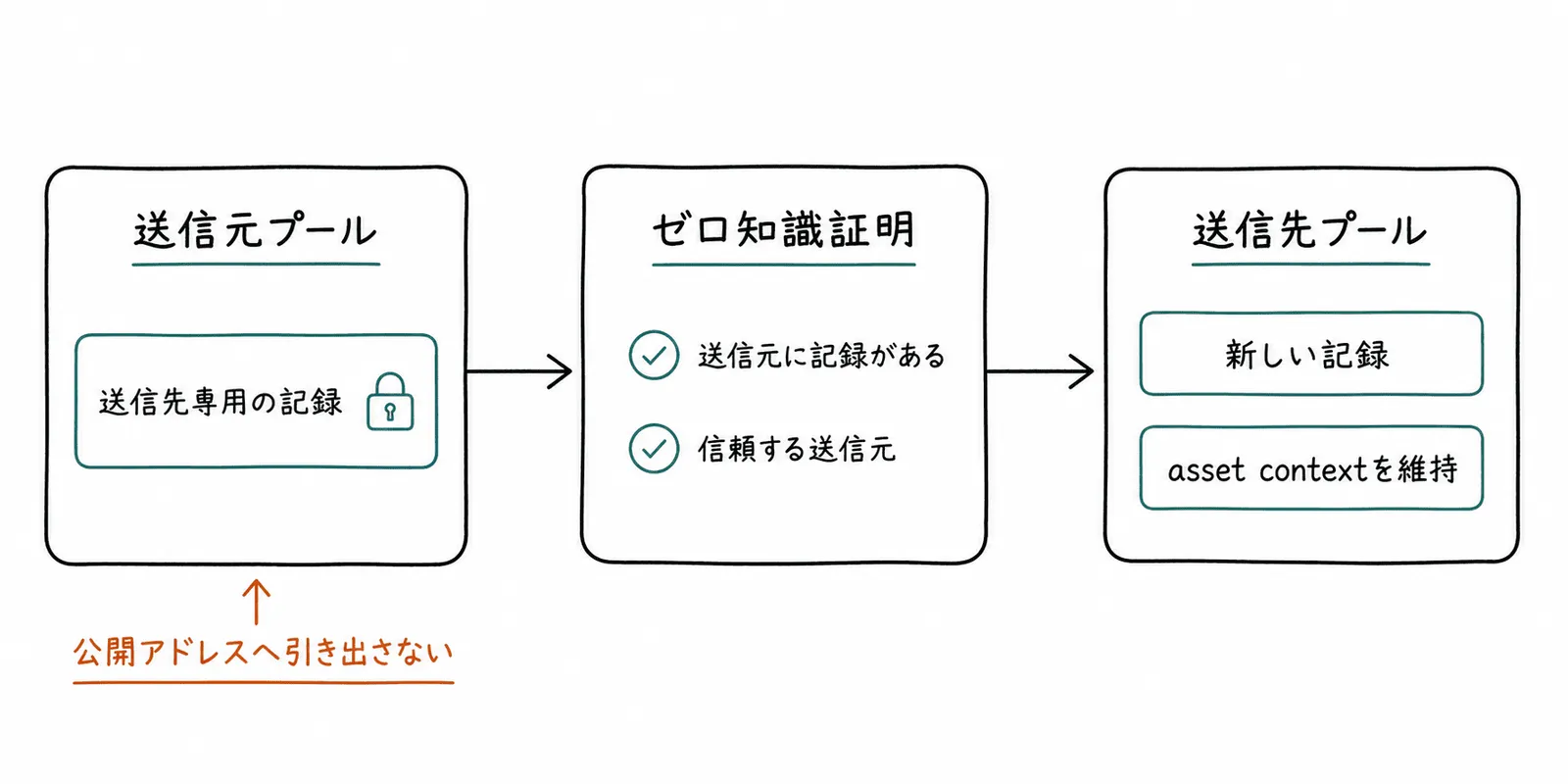
The process has three steps. The source creates an asset record tied to the destination and recipient and makes it unspendable in the source pool. The destination checks that the record existed at the source, that the source is approved, and that the record has not already been used. If the checks pass, the destination creates a new asset record for the recipient.
The diagrams retain their Japanese labels.
flowchart LR
    A[移動元で使えない状態にする] --> B[移動先が3つの条件を確認する]
    B --> C[受取人のための新しい記録を作る]
A privacy pool holds assets and lets users spend them without revealing who owns which assets. When a user deposits assets, the pool provides a private asset record and adds only a public value derived from that record on-chain.
A zero-knowledge proof shows that a condition holds without revealing the underlying secret. A user can show the contract that they are entitled to spend assets recorded in the pool while keeping the asset record private.
How privacy pools record assets
A note records the asset type, amount, and private values that identify who can spend it. The user keeps the note locally. The pool records a commitment derived from it on-chain and does not store the note contents.
For a deposit of 100 USDC, a note contains values like these.
note = {
  token: "USDC",
  amount: "100",
  ownerSecret: "0x8f…c2",
  blinding: "0xa4…19"
}
The token and amount fields describe what was deposited and how much. The ownerSecret is known only to the party that can spend the note. The blinding value is secret randomness that prevents matching public values for deposits of the same asset and amount.
flowchart LR
    A[利用者が保管するnote] -->|秘密の値を含めて計算する| B[コミットメント]
    B -->|オンチェーンへ記録する| C[プライバシープール]
    A -.->|中身は公開しない| D[ownerSecretとblinding]
A commitment is a short public value computed from the private record that allows changes to be detected. To spend a note, the user proves using the private values that the commitment came from their note.
The public value derived from the 100 USDC note might look like this.
commitment = "0x5a…e9"Only the commitment is added on-chain. The contents of token, amount, ownerSecret, and blinding remain private. Two notes for 100 USDC yield different commitments if their blinding values differ.
The pool collects commitments in a Merkle tree, a tree structure that represents many records with one hash. The pool records the root representing the whole tree on-chain. The user includes the path from their commitment to the root in the proof, and the contract verifies the path.
For example, if the pool has three commitments, it can record the tree's root on-chain instead of the contents of all three records.
commitments = ["0x5a…e9", "0x24…71", "0xb8…0c"]
root = "0x67…af"
The user supplies only the path from commitment: "0x5a…e9" to root: "0x67…af" in the proof. They can do this without knowing the other two private notes.
flowchart BT
    C1[commitment<br/>0x5a…e9] --> H1[中間ハッシュ]
    C2[commitment<br/>0x24…71] --> H1
    C3[commitment<br/>0xb8…0c] --> H2[中間ハッシュ]
    H1 --> R[root<br/>0x67…af]
    H2 --> R
The user needs only the hashes connecting commitment: "0x5a…e9" to the root. The destination verifies the path to confirm that the record was in the tree.
What is a zero-knowledge proof?
The user generates a proof using their private note. The contract receives the proof, the public root, and a value that identifies whether the note has been spent. It can check that an asset record exists and is unspent without learning which note it was or who owns it.
What are commitments and Merkle trees?
A commitment is the public value corresponding to one private record. A Merkle tree groups many commitments and is managed by the pool. The user proves a path from their commitment into the tree, and the contract checks it against the public root.
What ERC-8290 does
To move assets to another privacy pool, users commonly withdraw from the source to a public address and deposit into the destination. Comparing these two transactions can make it easier to trace the asset, amount, timing, and pair of pools involved.
Under ERC-8290, the source creates a note for a particular destination. The destination checks that the note existed at the source, that it trusts the source, and that the record has not already been used. It then creates a corresponding note or processes a withdrawal under its own rules.
flowchart LR
    A[送信元プール] -->|送信先専用の記録を作る| B[ゼロ知識証明]
    B -->|送信元の記録と信頼する送信元を確認する| C[送信先プール]
    C -->|新しい記録を作る または 引き出しを処理する| D[受取人]
The source does not directly send the underlying asset to the destination as part of this mechanism. The destination first verifies that the source record was created for it and was properly made unspendable, then recognizes the value.
Motivation
Privacy pools can differ in how they create notes, calculate commitments, build Merkle trees, and mark notes as spent. Passing a note from one pool to another therefore does not give the destination enough information to verify it.
Requiring a common format would make it harder for existing pools to participate. ERC-8290 uses adapters to handle differences among source pools and a separate mechanism for destinations to choose which sources they accept.
A destination that accepts a note still spendable at the source could allow the same value to be used twice. ERC-8290 checks that normal spending is disabled at the source, that the record existed there, and that the destination trusts the source.
Specification
Create a destination-specific note
The source creates a note using a burn address in place of an ordinary recipient. The burn address is derived from the destination chain ID, destination pool, recipient, and a secret specific to the transfer.
burnAddress = H(
    chainId,
    dstPoolAddress,
    receiver,
    burnSecret,
    "ZKTELEPORT"
)
H is the hash function used by the pool's circuit. burnSecret is secret randomness used only for the current transfer. The specification recommends using a secret of at least 128 bits.
Suppose the destination is a pool on Avalanche and the recipient is 0x9b…71. The burn address takes the following inputs.
destination = {
  chainId: "43114",
  pool: "0x6e…24",
  receiver: "0x9b…71",
  burnSecret: "0x3d…8a"
}
Changing any of these four values changes the computed burn address. The same record therefore cannot be used with a different destination chain, pool, or recipient.
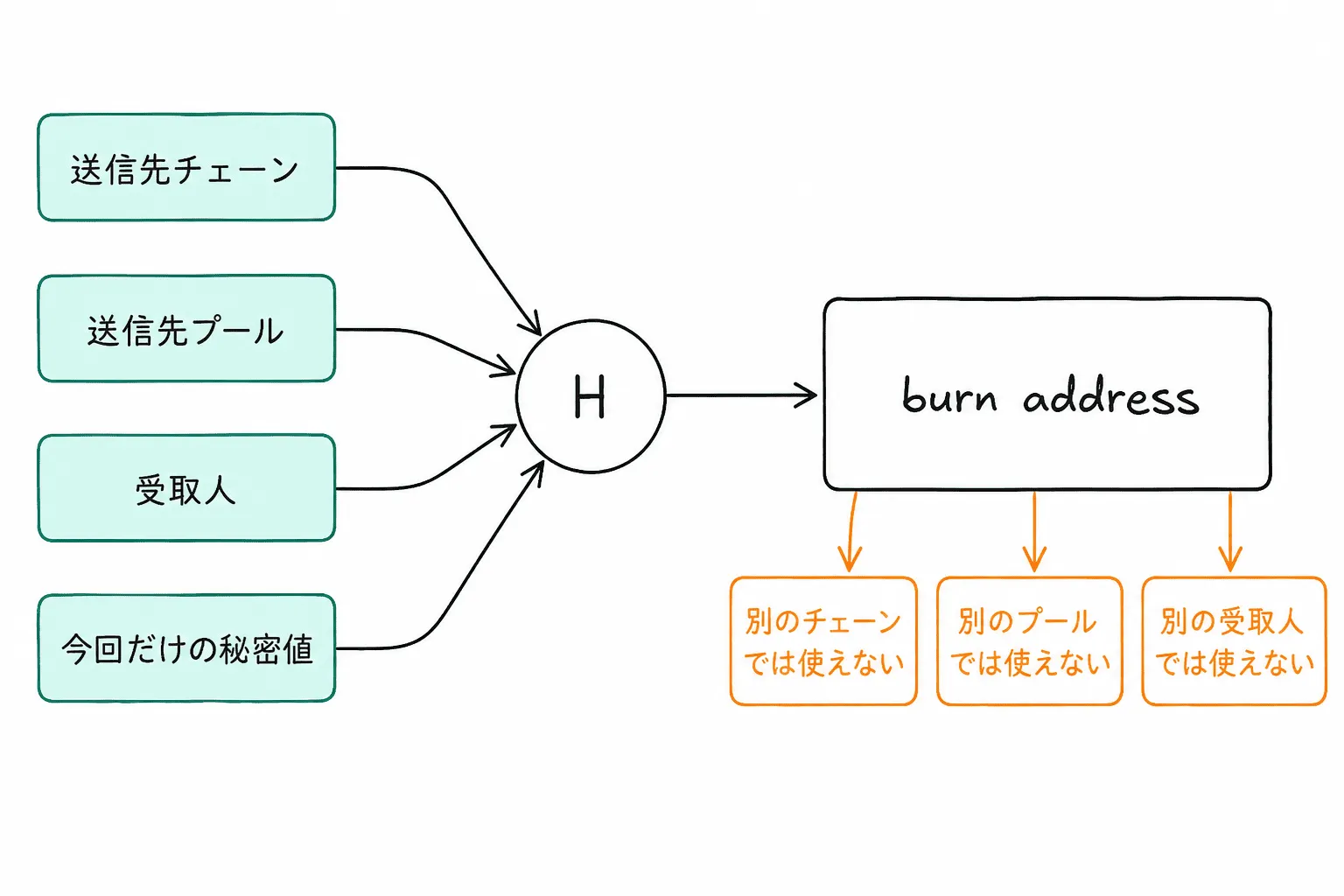
Because the destination chain, destination pool, and recipient are included in the burn address, the same proof cannot be used on a different chain, in a different pool, or for a different recipient. The source commitment includes that address, so only the intended destination can import the record.
In a typical source pool, the commitment derives from a blinded recipient value and asset data. ERC-8290 uses the burn address as the recipient.
blindedOwner = H(ownerAddress, blinding)
commitment = H(blindedOwner, data)

// ERC8290の送信元では ownerAddress = burnAddress
Each implementation must use consistent circuit hash functions, number formats, and byte encodings. Public inputs use 32-byte representations when passed to the verifier contract. Short values are zero-padded on the left. Longer values must be converted to a single representation or hashed as specified by the adapter or destination.
How the source makes a note unusable in ordinary transfers varies by pool. Options include assigning an unspendable owner, proving that the source's spent marker was consumed, or demonstrating a source-specific lock condition. The destination accepts only sources whose adapters define how to prove this.
For a source pool that uses a lock, the state transitions are as follows.
stateDiagram-v2
    [*] --> 通常のnote
    通常のnote --> 送信先専用のnote: burn addressで作る
    送信先専用のnote --> 送信元で使えない: lockを確認する
    送信元で使えない --> teleport proofを作る
The destination accepts only the final state. It does not import a note that can still be transferred normally.
Verify the source record and the trusted source
A teleport proof is a zero-knowledge proof of two membership relationships that keeps the source note private. First, the commitment formed with the burn address belonged to the source pool's records. Second, the destination accepts the source root for those records.
The destination sees the following public values.
teleportInput = {
  burnCommitment: "0x5a…e9",
  sourceRoot: "0x67…af",
  canonicalRoot: "0x9d…31",
  destinationPool: "0x6e…24"
}
The user retains the note, burnSecret, and tree paths used to generate the proof. The destination verifies the proof against the public values and checks both membership relationships without seeing the underlying record.
flowchart LR
    A[burn commitment] -->|送信元の記録ツリーに含まれる| B[source root]
    B -->|信頼する送信元ツリーに含まれる| C[canonical root]
    C -->|送信先が受け入れる| D[teleport proofを検証]
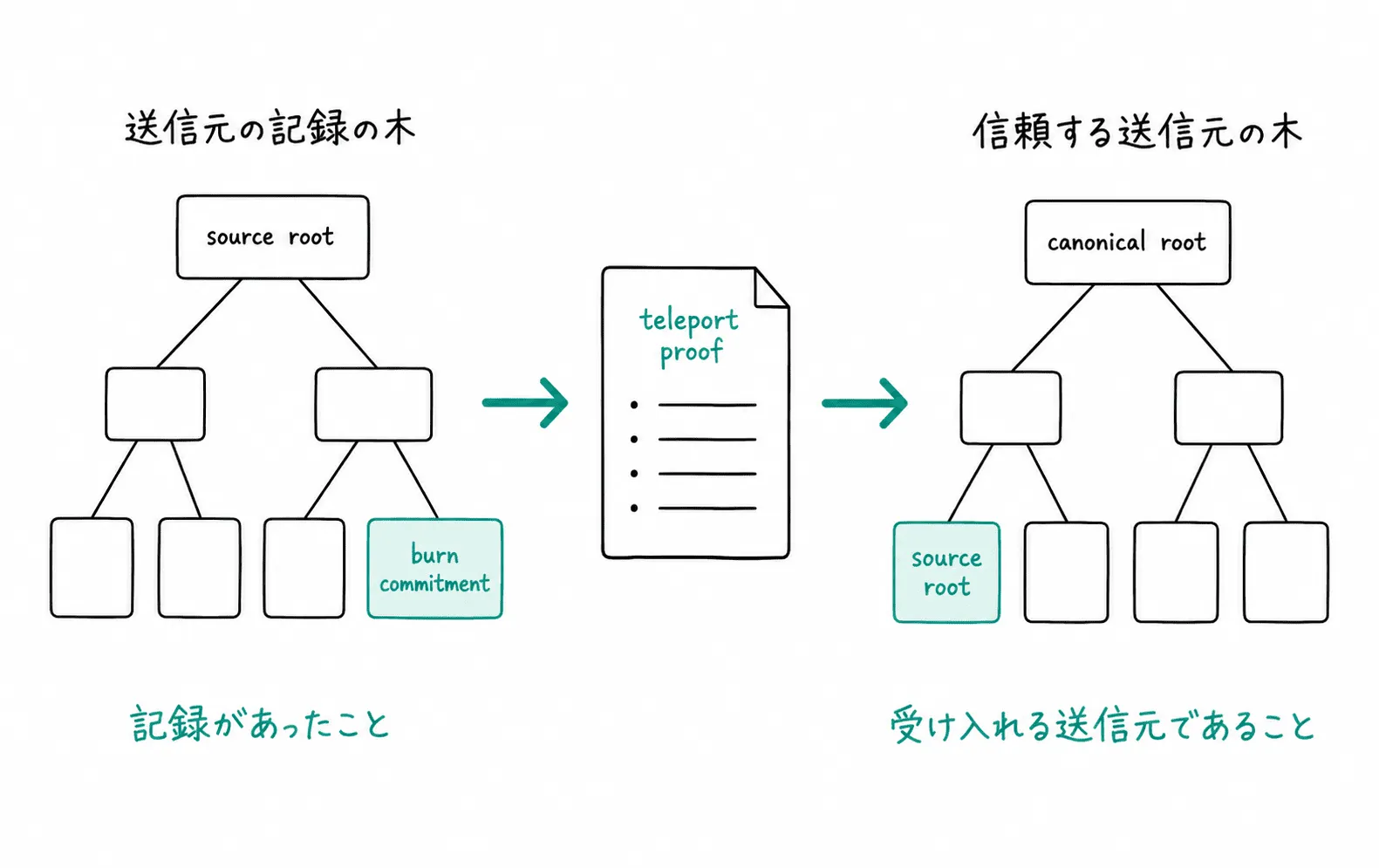
The source pool adds commitments to a Merkle tree and has a source root representing that tree. The user includes the path from the burn commitment to that root in the proof. The destination verifies the path to confirm that the source contained the record.
A canonical tree collects the source roots the destination may accept. The destination pool verifies that the source root in the proof belongs to the canonical tree it trusts.
A canonical tree can contain entries that bind the source chain ID, source pool address, block number, asset information, and source root. This lets the destination decide which pool's records to accept and at which point in time.
For example, the destination can register the following information as a single trusted source entry.
trustedSource = {
  sourceChainId: "1",
  sourcePool: "0x47…a0",
  blockNumber: "20800000",
  asset: "USDC",
  sourceRoot: "0x6c…ef"
}
It accepts a proof containing that sourceRoot only if the corresponding entry is registered.
The destination may store the canonical root itself or query a contract for approved roots. The specification gives this example.
function isValidRoot(bytes32 root) external view returns (bool);Finalize the import at the destination
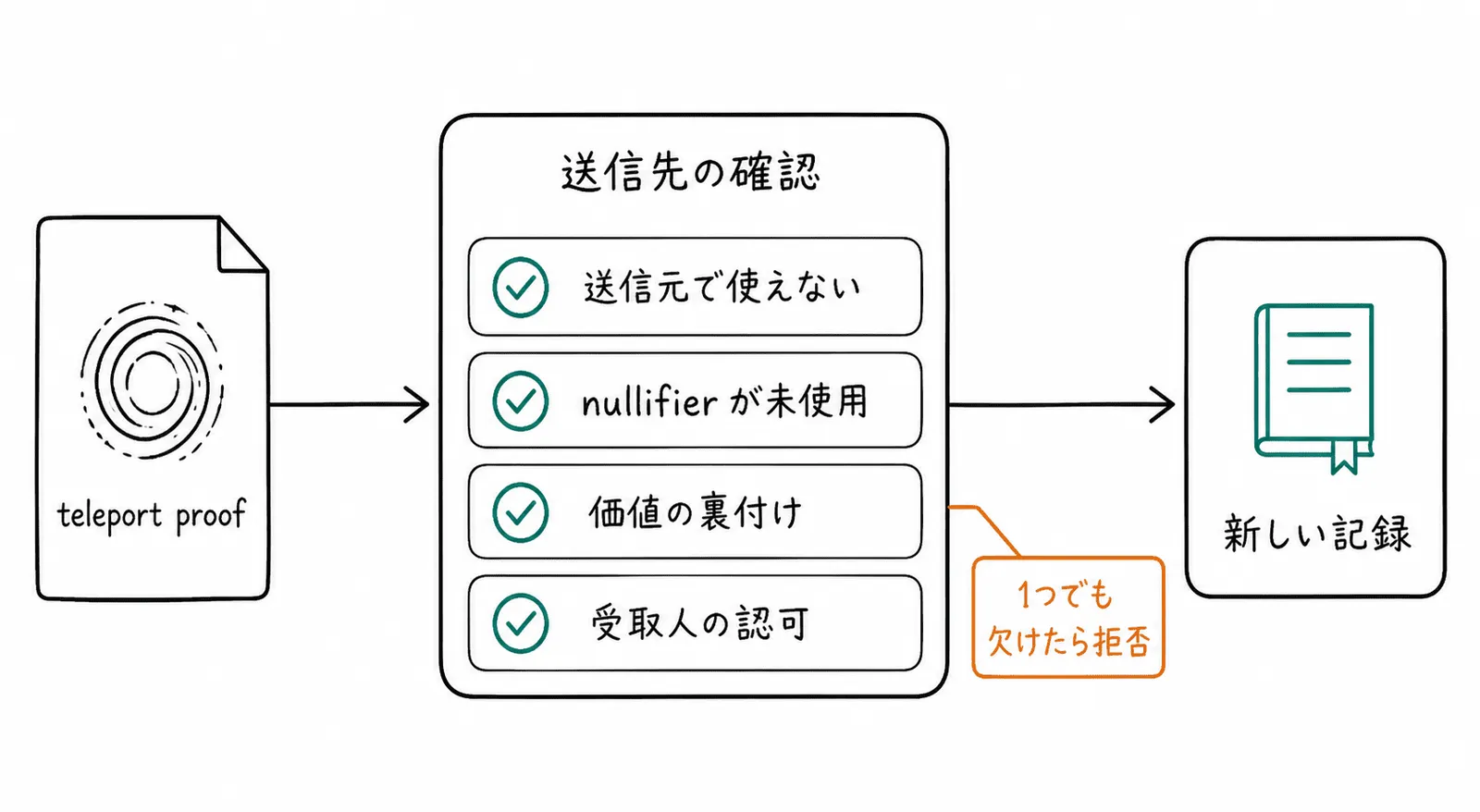
A valid teleport proof on its own does not authorize creating assets at the destination. The destination finalizes the import only after checking replay protection, asset backing, and recipient authorization.
-
Ordinary spending is disabled at the source.
Importing a
notethat is still spendable at the source would allow the same value to be spent twice. The adapter includes evidence in the proof that the note was burned or locked at the source. -
The
nullifieris unused.A
nullifieris a unique value that marks a private note as spent. The destination records it as spent before or when the import completes. It rejects a repeat occurrence, which prevents a source record from being imported multiple times.If the first import records
nullifier: "0x91…d4", a second import containing the same value is rejected. -
The value is backed.
The destination defines how it backs the incoming asset value, for example with escrow funds, burn-and-mint accounting, protocol-owned inventory, or bridge settlement. It does not create assets based on the proof alone.
-
The recipient authorized this import.
The destination can verify the recipient's authorization with a signature. When using an EIP-712 signature, the circuit verifies that the recipient bound into the burn address matches the signer. The contract checks that the operation digest in the proof matches the digest of the operation it received.
For more about EIP-712, see the article below.
[EIP-712] How typed structured data is hashed and signed
The destination output preserves the source's asset context, which identifies the asset using data such as the token address, token ID, denomination, amount, source pool address, and source chain ID. The proof binds that context to the destination output, so an attempt to change the token or amount fails verification.
For an import of 100 USDC, the asset context could look like this.
assetContext = {
  token: "USDC",
  amount: "100",
  sourceChainId: "1",
  sourcePool: "0x47…a0"
}
If the destination output instead specifies amount: "1000" or a different token, the import cannot complete because the values no longer match those bound by the proof.
Connect pools with different formats through adapters
Existing pools use different note formats. ERC-8290 adapters translate source-specific record formats into conditions that the destination can verify.
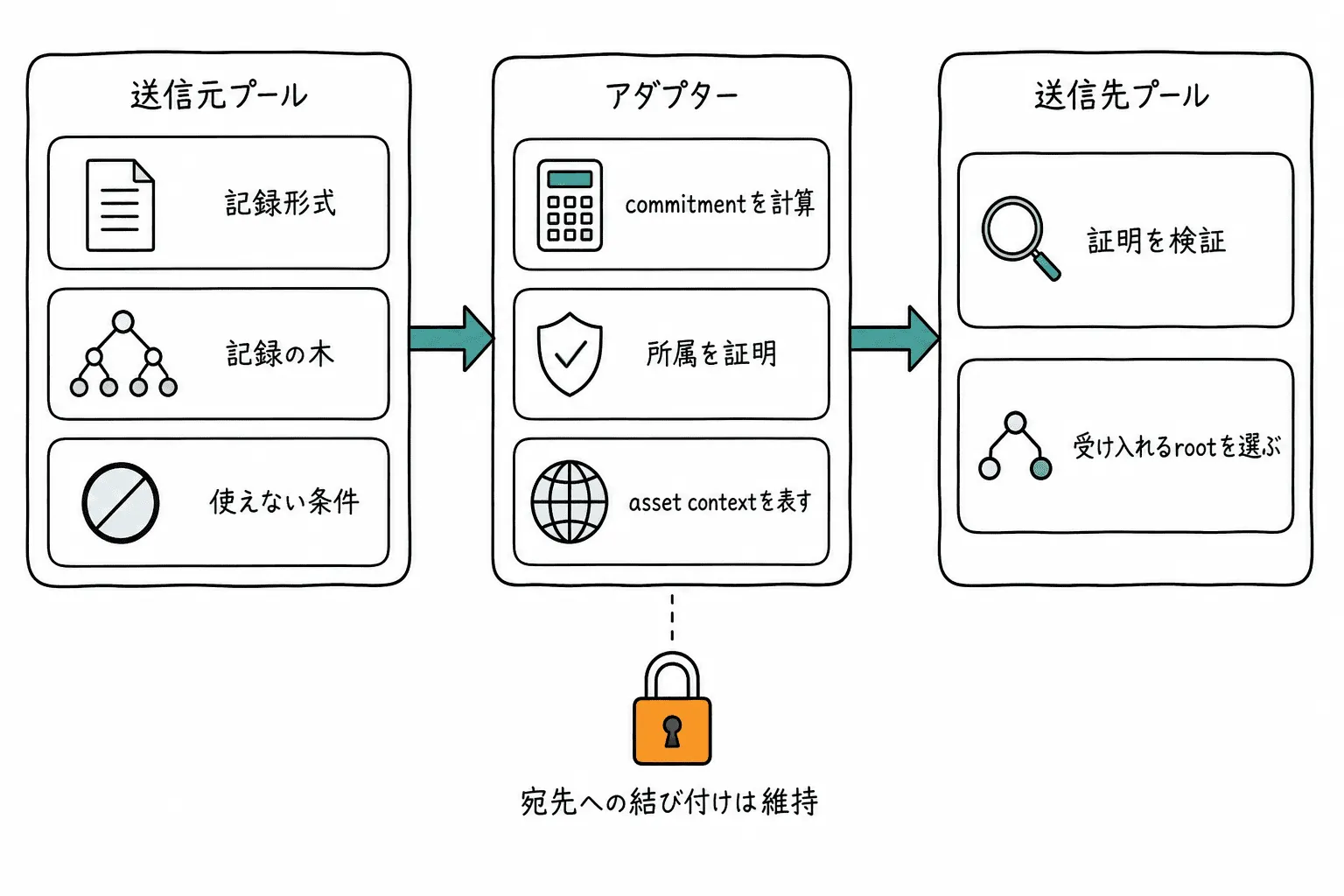
An adapter defines at least the source chain ID, source commitment hash, source Merkle tree hash function and depth, canonical tree proof format, asset context encoding, and burn or lock conditions.
For example, if the source uses sourceLeaf = H(burnAddress, noteSecret), the adapter incorporates that calculation and the source tree membership check into the circuit. Differences in source note formats cannot weaken binding to the destination chain, pool, and recipient, proof of membership under the source root, or preservation of the asset context.
Rationale
Bind the destination from the start
Including the destination chain, pool, and recipient in the burn address prevents the source record from being reused elsewhere. The destination accepts records created specifically for it.
Manage trusted sources outside the circuit
Updating the canonical tree outside the circuit allows the set of trusted sources to change without rebuilding the circuit. A destination can accept pools that use the same note format or different note formats supported by adapters.
Make asset backing the destination's responsibility
Pools use different custody, accounting, and settlement arrangements, so the specification does not impose one backing policy. The destination issues a new note or processes a withdrawal only when the backing policy is explicit and its requirements have been verified.
Compatibility
Use existing pools as sources
ERC-8290 leaves existing pool deposits, transfers, and withdrawals intact. To participate as a source, an existing pool needs an adapter for its commitment format and its root membership check. Its root must also be added to a canonical tree the destination trusts.
Add import handling to the destination
An upgradeable destination pool can add import handling for teleport proofs alongside its existing operations.
Reference Implementation
Checks performed by the proof circuit
The reference implementation illustrates a circuit that produces one destination output from one source note. The circuit computes the burn address and burn commitment, then verifies membership under the source root and the canonical root.
let burn_address = hash([
    chain_id as Field,
    dst_pool_address,
    receiver,
    burn_secret,
    Field::from_be_bytes("ZKTELEPORT".as_bytes()),
]);

assert_merkle_leaf_membership(
    src_pool_root,
    burn_commitment,
    note.index,
    note.siblings,
);

assert_merkle_leaf_membership(
    canonical_root,
    canonical_leaf,
    canonical_index,
    canonical_siblings,
);
Checks performed by the destination contract
The destination contract checks that it accepts the canonical root before verifying the proof. It then marks nullifiers as spent, verifies asset backing, and processes destination commitments or withdrawals.
function teleport(Joinsplit calldata joinsplit) external {
    require(canonicalRootRegistry.isValidRoot(joinsplit.root), "invalid canonical root");
    _verifyTeleportProof(joinsplit);
    _spendNullifiers(joinsplit.nullifiers);
    _enforceBackingPolicy(joinsplit);
    _insertCommitments(joinsplit.commitments);
    _executeWithdrawals(joinsplit.withdrawals);
}
This pseudocode illustrates the order of operations. ERC-8290 does not prescribe actual contract names, types, or public function signatures.
Security Considerations
Accept only records that cannot be spent at the source
The destination must verify that a source note is no longer spendable through ordinary source operations before importing it. A record that can be spent in both places would allow the same value to be used twice.
Keep burnSecret unique
Keep burnSecret private during proof generation. Reusing it across transfers can make records linkable.
Prevent repeat imports with nullifiers and destination binding
The destination records each nullifier and rejects repeated values. The burn address and authorization message bind the destination chain and pool to prevent reuse at a different destination.
Verify adapter and anonymity assumptions
A mismatch between the source and adapter in hash functions, byte order, field element conversion, token representation, or Merkle tree depth can prevent valid imports or invalidate the assumptions behind verification. The destination treats the adapter as a separate component that needs to be trusted and checked.
Observers may narrow down the possible sources and destinations by looking at transfer timing, small anonymity sets, and when canonical roots are updated. The specification recommends batching root updates and imports.
Conclusion
ERC-8290 replaces transfers through a public address with a proof of an asset record that has been made unspendable in the source pool. Before importing the record, the destination verifies destination binding, the source record and trusted source, the nullifier, asset backing, and authorization. Adapters and canonical trees let existing pools participate using different note formats when they meet the required conditions.
Find more of my writing and resources here.




