Introduction
Hi, I'm cardene, a software engineer and technical writer focused on blockchain and AI.
I've also authored Japanese technical books on specification-driven development with LLMs and decentralized application (DApp) development.

I also build and publish a variety of tools, libraries, and open-source projects.
The original figures are retained; some labels may remain in Japanese.
Overview
When asking an AI to swap tokens, users need to check not only the swap amount but also who is authorized to spend their tokens. A short summary can omit such approvals or the operations that will actually be executed. The wallet holding the signing key therefore retrieves the complete plan, including operation destinations, amounts, and ordering, directly from the preparation service and examines it. The AI passes a reference identifying where the document is stored and how to verify its integrity.
ERC8410 specifies this handoff.
It reduces the need for the AI to regenerate long data payloads, while keeping document verification and user approval separate at the wallet.

Swap preparation and user approval
For example, before swapping one token for another, a user may authorize a swap contract to spend tokens. The preparation service orders the approval, swap, and revocation of any remaining allowance, then stores a document the wallet can read. The AI selects a candidate and passes its reference; the wallet retrieves every operation from the storage location.
Even if the retrieved document matches its reference, the wallet must separately establish whether it represents the swap the user requested. The wallet reads the actual operations to determine what each party is authorized to do, then decides whether to execute based on user confirmation or its configured authorization policy. Neither the preparation service’s description nor the AI’s summary replaces that approval.
Execution plans and signing requests
Depending on how a swap is performed, the wallet may deliver only a signed order to the counterparty rather than submit a transaction itself. A signing request is used in this case: a document requesting a signature over a specific message that the counterparty can use later. Separating execution plans from signing requests distinguishes immediate operations from signatures that the user authorizes for delivery to another party.
An interaction that ends with signature delivery may not involve any transaction submission by the wallet. Alternatively, the service receiving the signature may return a new execution plan that uses it. The wallet verifies each document as it arrives; a previous approval does not authorize subsequent operations.
Motivation
Returning a long operation payload from a preparation service to an AI and having the AI reproduce it for a wallet adds processing both when reading and when generating the data. With a reference, the document reaches the wallet directly from the service. This reduces the information passing through the AI without reducing the number or content of operations the wallet must inspect.
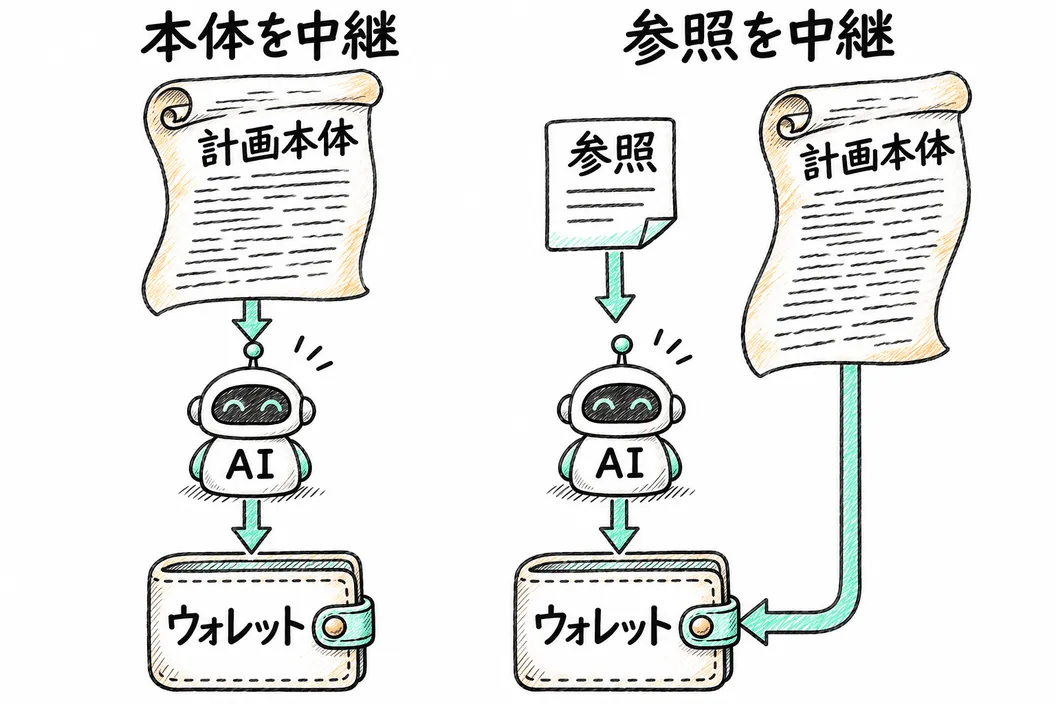
Handing off long transaction payloads
A sequence of approval, swap, and allowance revocation carries the destination and call data for each operation. When an AI reads the complete document as input and regenerates it as output, model processing grows with the size of the operations. Parts may also be omitted during handoff, or the end may be truncated by length limits.
If the preparation service stores the document, the AI only needs to pass its location and verification criteria. The wallet verifies the retrieved document to avoid executing an incomplete payload. However, embedding the full document in a reference string passed through the AI sends that document through the AI again. Direct retrieval of an externally stored document reduces the need to send long data through the model in both directions.
The mechanism still requires network transfer of the document and wallet-side verification. The specification provides no reproducible benchmarks showing how much processing time or cost changes.
Some execution environments also allow an AI to generate a program that passes a preparation tool’s return value directly to a wallet tool. Passing the document as a value within the same program without exposing it to the model avoids the tokens and time required to read and regenerate it. Even in this case, the intermediary program is AI-generated code. The wallet cannot establish from this alone that the document was not modified after leaving the preparation service.
With a reference, the wallet can inspect the source it retrieved from and verify the exact bytes itself. When user confirmation separates stages across programs or conversations, the reference can be passed instead of retaining the entire document. The wallet applies its own size limits to documents retrieved directly, avoiding truncation by intermediary execution environments.
Confusing summaries with actual operations
A description that merely says "swap tokens" does not identify who may spend which amount. When the wallet receives the complete sequence of operations, it can also inspect approvals before and after the swap itself. This lets the wallet verify that the explanation shown to the user corresponds to the operations to be executed.
Connecting directly to the document source also lets the wallet verify the actual party from which it retrieved the data, independently of the service name supplied by the AI. Verifying the source, however, is not the same as verifying that it prepared safe operations. Even after checking the source and document integrity, the wallet inspects actual destinations and allowance amounts to determine whether they match the user’s intent.
Specification
The preparation service passes either a reference to the document or the document itself to the wallet. For a reference, retrieval and integrity verification come first. For an execution plan, the wallet verifies the operation sequence; for a signing request, it verifies the specific message. After approval, the wallet executes the plan or returns a signature. If acceptance of a directly delivered signature is uncertain, it queries the same request.
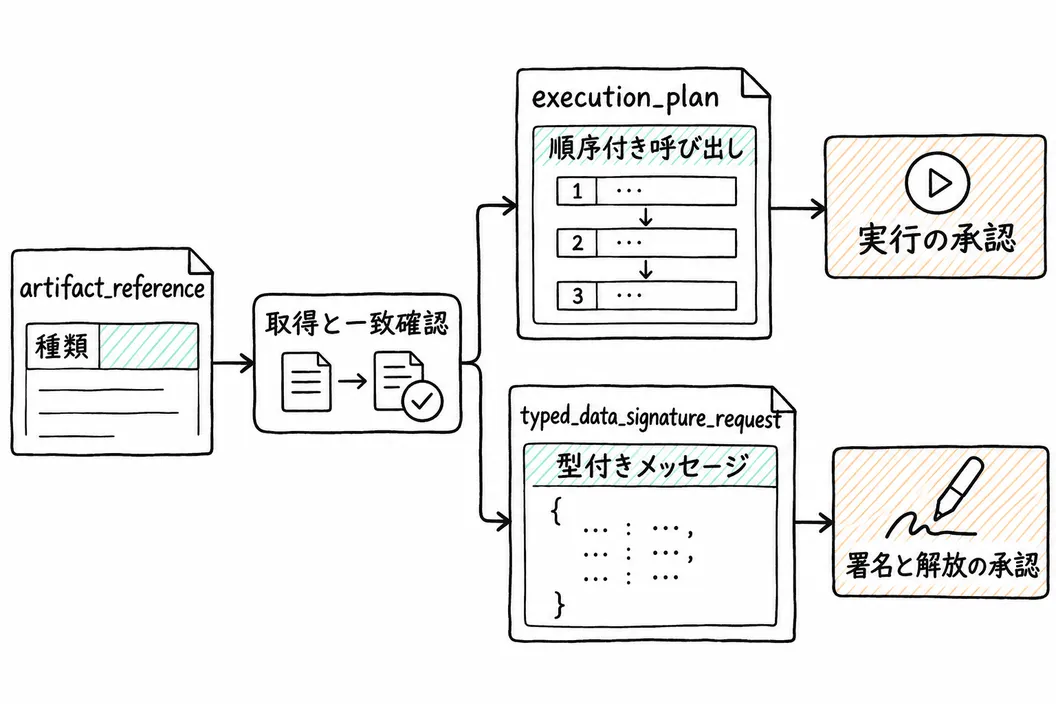
Reference handoff
The wallet checks the size of the received reference and the document type before retrieving the document. After retrieval, it checks the actual length and integrity of every byte before parsing the document. This ordering allows oversized inputs or substituted documents to be rejected before operation validation.
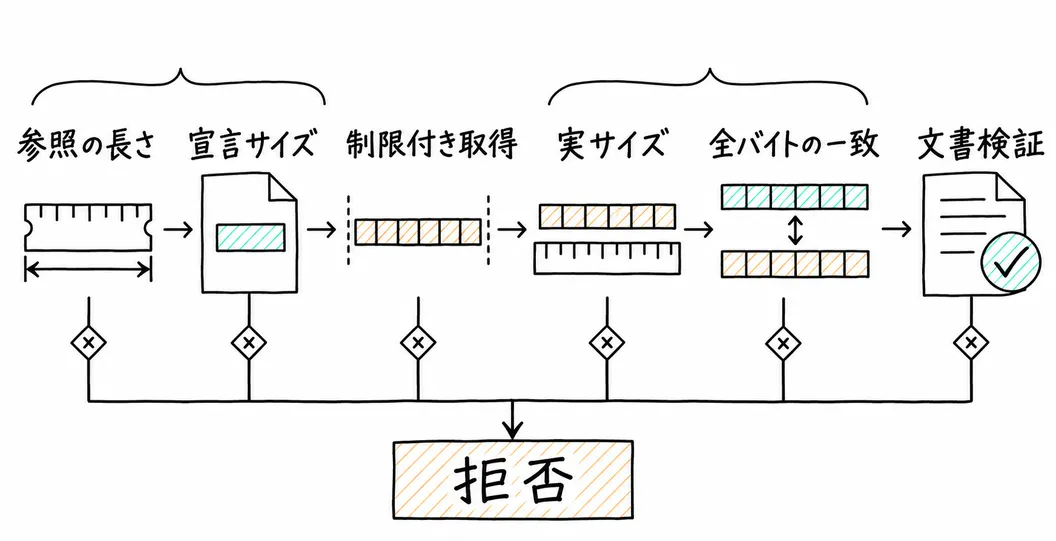
Document types and pre-retrieval checks
A reference created by the preparation service is an outer document containing the document location and post-retrieval verification criteria.
The wallet reads these conditions before connecting and after retrieval, rejecting unexpected document types and size mismatches.
This document is called an artifact_reference.
| Field | Value supplied by the preparation service | Wallet check |
|---|---|---|
kind |
artifact_reference |
Whether the document is a reference |
artifact_type |
Type of document to retrieve | Whether it matches the expected type and is supported |
url |
Document retrieval location | Whether the retrieval method and connection conditions are permitted |
integrity |
Algorithm and value for verifying the exact bytes | Whether the result calculated with an allowed algorithm matches |
bytes |
Exact document size in bytes | Whether it meets the pre-retrieval limit and matches the actual size |
instruction |
Creator-supplied display text | Display only, not a basis for approval |
The artifact_type field identifies one of two document types: an execution plan or a signing request.
A signing request reference supplied where an execution plan is expected is rejected.
A wallet that does not support signing requests cannot skip the type check and proceed to execution.
Integrity verification uses keccak256, which computes a 32-byte value from a byte sequence.
integrity contains only the algorithm and computed value fields.
This version permits keccak256, with a value encoded as 64 hexadecimal digits following 0x.
Unknown fields in the outer reference are ignored, but unknown fields inside integrity are rejected because they may specify unsupported verification conditions.
For example, if the single-operation plan discussed below is stored as a 324-byte document with no intervening line breaks or spaces, its reference looks like this.
{
  "kind": "artifact_reference",
  "artifact_type": "execution_plan",
  "url": "https://producer.example/plans/minimal",
  "integrity": {
    "algorithm": "keccak256",
    "value": "0xcc3d15039a19158096b52b14957f2c12a873fb379a459ac519a712ca2c9def1c"
  },
  "bytes": 324
}
This retrieval location is illustrative.
The wallet reads the document as 324 bytes and checks that the hash of the complete document matches integrity.value.
Adding a line break changes both the length and hash, so the reference must correspond to the exact stored byte sequence.
Retrieval proceeds in the following order.
-
Limit the total reference size
Check that the serialized reference fits within the limit before parsing the location string.
-
Check the document type and declared size
Verify the expected type and support for it. Do not initiate a connection or file read if
bytesexceeds the limit for that document type. -
Read the document under the retrieval method’s constraints
Enforce size limits during reading and reject unsupported retrieval methods.
-
Verify actual size and the hash of the complete byte sequence
Check the specified
bytesandintegrityin order. Do not proceed to parsing if either differs. -
Parse and validate according to document type
Apply the same rules as when receiving that document inline.
If the transport uses a compressed encoding, measure the length and verify the integrity of the decompressed bytes. Even a document that passes integrity verification must subsequently undergo validation and approval of its operations or signing content.
Sources and retrieval methods
The document identified by a reference can be stored on the network, inside the reference itself, or on the device running the wallet. Because the provenance that can be established depends on where the document was read, the wallet distinguishes retrieval methods in its display.
Creation services are encouraged to return an https reference rather than only the document itself.
This recommendation also applies when an AI-generated program can pass the document directly.
An inline document does not establish the creation service’s provenance, regardless of whether it passed through a model or was transferred as a value in code.
| Retrieval method | How it is read | Length and integrity requirements | What can be established about provenance |
|---|---|---|---|
https |
Connect to a public endpoint on the default port 443 | Both required | Host of the source actually contacted |
data: |
Decode data embedded in the reference | Optional; verify if provided | Creation service provenance is unknown |
file |
A supporting wallet reads from the local device | Both required | The document was read locally |
For https, verify that every destination resolved from the hostname is a public unicast IP address.
Do not connect to the device itself, the local network, or internal addresses, and do not follow redirects that change the destination.
The URL must not contain credentials or fragments; stored Cookie data and implicit credentials must not be attached.
Set time limits for connection and overall retrieval, and limit concurrent retrievals and the received size after decompression.
For data:, which embeds the document in the reference, use the media type application/json, optionally with ;base64.
Do not connect to the network, and check the size both before and after decoding.
If the decoded size limit is N bytes, padded base64 contains at most 4 × ceil(N / 3) characters.
Percent encoding can expand one byte into three characters, so the pre-decoding limit must account for the encoding method and prefix.
Support for local file retrieval is optional.
If supported, allow only absolute paths with an empty host or localhost, and require the mandatory length and integrity values before reading.
Read the document only once with a size limit, then verify its length and hash before parsing.
Restricting reads to a user-configured directory is also recommended.
Return indistinguishable errors for missing, unreadable, oversized, or mismatched files. Do not include file contents or network response bodies in errors. Do not display a caller-supplied local path as evidence of a verified external creator.
Representing quantities and sizes
Parsing large integers such as transfer amounts as ordinary numbers can introduce rounding in some implementations.
Quantities in execution plans are nonnegative decimal integer strings without leading zeros and must fit in an unsigned 256-bit integer.
Zero is represented only as "0"; reject "01" and "1e18".
Addresses represent 20 bytes in hexadecimal, while call data represents byte sequences of arbitrary length.
Both use an even number of hexadecimal digits after 0x, and creators use lowercase.
Recipients normalize to lowercase before computing hashes and may reject uppercase input as a matter of policy.
Distinguish decimal strings representing quantities from hexadecimal strings representing bytes.
| Restricted item | Limit | Status in the specification |
|---|---|---|
| Number of operations in a plan | 1–4096 operations | Mandatory |
| Total call data across operations | 8 MiB | Recommended |
| Serialized plan document | 16 MiB | Recommended |
| Implementation-defined size limits and rejection on overflow | Configured by implementation | Mandatory |
Reject oversized plans instead of truncating them. Removing the last operations could discard allowance revocation or subsequent processing. Signing requests have a separate document limit; do not reuse the 16 MiB limit merely because they use the same reference format.
Execution plans
An execution plan describes operations performed by the same account on the same chain in one ordered document. The wallet validates spending approval, swap, and allowance revocation together, including any requirement for atomic execution. When operations are submitted separately, a later operation can fail while earlier successes remain, changing the resulting state.
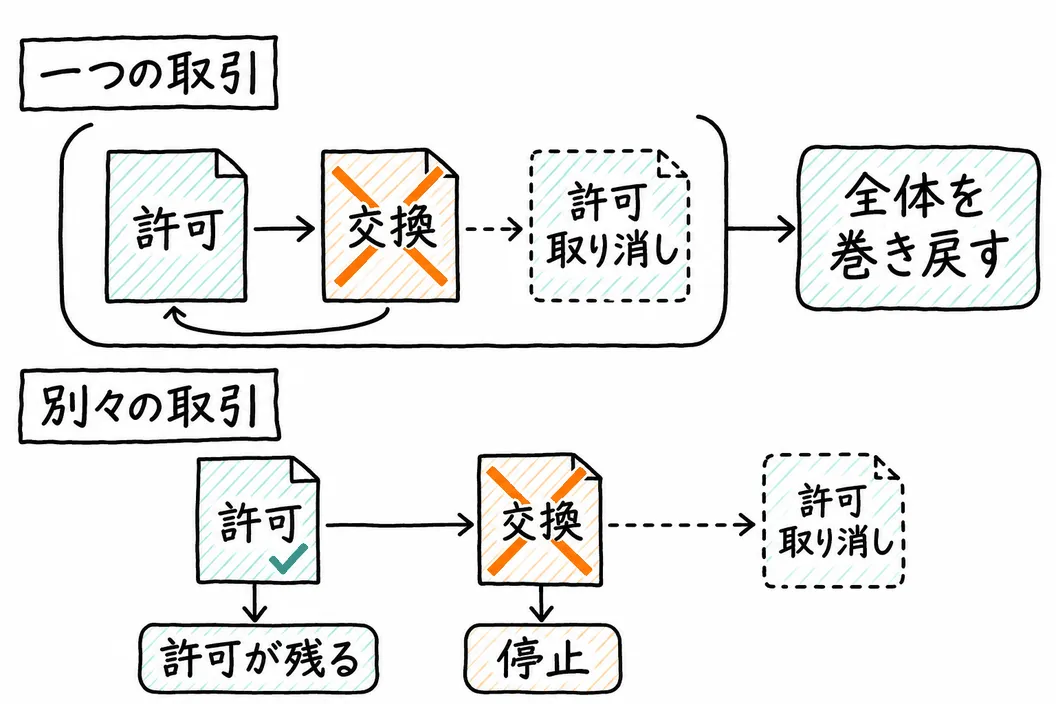
Account, chain, and operation order
The preparation service specifies one sending account and destination chain for each plan. The wallet checks these values across every operation and rejects the entire plan if it mixes different accounts or chains. This prevents selective execution from producing a result inconsistent with the sequence the user reviewed.
Read the chain identifier defined by EIP155 and compare the plan’s chain_id with that of each operation.
Even for the same account address, assets and contracts differ across chains.
Reject the entire plan if the account or chain differs.
See the following article for details on EIP155.
[EIP155] Understanding replay protection across Ethereum networks
The following is a single-operation execution plan from the official test vectors.
{
  "schema_version": "1",
  "chain_id": "1",
  "caip2_chain_id": "eip155:1",
  "sender": "0x1111111111111111111111111111111111111111",
  "ordered_steps": [
    {
      "step": 1,
      "kind": "execution",
      "transaction": {
        "chain_id": "1",
        "from": "0x1111111111111111111111111111111111111111",
        "to": "0x2222222222222222222222222222222222222222",
        "data": "0x",
        "value": "0"
      }
    }
  ]
}
The wallet checks that schema_version is the string "1".
The namespaced chain identifier caip2_chain_id must consist of eip155: followed by chain_id.
In this example, "1" and "eip155:1" denote the same chain.
| Plan field | Value checked in each operation | Result on mismatch |
|---|---|---|
sender |
transaction.from |
Reject the entire plan |
chain_id |
transaction.chain_id |
Reject the entire plan |
Position in ordered_steps |
Consecutive step values starting at 1 |
Reject inconsistent internal ordering |
In the ordered_steps array, the first element has step: 1 and the second has step: 2.
This check establishes the order within the received document.
Sequential numbering cannot detect a different, valid plan in which someone removed an operation and renumbered the rest.
Each transaction also requires the destination to, call data data, and native token amount value in the smallest unit, wei.
In the example, data: "0x" indicates empty data, while value: "0" means no native tokens are sent.
This illustrates document validation and hash computation, not a successful swap.
Reject unknown fields in the document, operations, and transactions.
Contract creation with no destination cannot be represented directly in this format.
Optional gas is a creator-supplied estimate; the wallet must not submit using it without performing its own estimation.
Operation roles and failure display
A swap plan contains both the requested swap and approvals needed before and after it.
Creators attach display labels describing why each operation is included; wallets inspect actual destinations and call data independently of those labels.
The operation’s kind identifies this role.
| Role in the plan | kind value |
What the user checks |
|---|---|---|
| Requested operation itself | execution |
Actual execution, such as the swap |
| Spending approval for a later operation | approval |
Approved spender and amount |
| Revocation of an earlier approval | allowance_cleanup |
Allowance to revoke and execution order |
| Execution using a previously approved signature | signature_dependent_execution |
Signature used and associated operation |
| Operation not covered above | other |
Concrete effects of the operation |
Reject unknown values.
Even if labeled approval, inspect the call data to distinguish an approval for the required amount from an unlimited approval.
Do not infer correctness or execution authorization from an accurate label.
The creator may attach revert_decode to help interpret data returned on execution failure.
Set kind to error_result and include ABI fragments (definitions used to interpret contract functions and errors) declaring at least one error in the abi array.
The optional boolean required indicates that the creator considers decoding necessary for explanation; its default is false.
The recipient may ignore required; any decoded strings are for display only.
The schema permits up to 128 entries, and the reference implementation additionally limits them to 65536 bytes.
Isolate decoding failures from other processing, and do not interpret decoded results as instructions when displaying them.
Atomic execution and intermediate failures
Submitting spending approval, swap, and revocation separately may leave the first approval in place if the swap fails.
To require either complete success or rollback on any failure, the creator specifies mandatory execution capabilities for the wallet.
These are specified in required_capabilities.
The atomic_batch capability defined in this version requires all operations to execute in one transaction, reverting everything if any operation fails.
A wallet that cannot satisfy this requirement rejects the plan rather than silently switching to separate execution.
Likewise, reject the plan if the requirements contain even one unknown or unsupported capability.
| Plan requirement | Recipient behavior | Can an earlier approval survive a failed swap? |
|---|---|---|
atomic_batch present |
All operations succeed or revert within one transaction | Approval created in that transaction also reverts |
| No requirement, separate execution | Submit sequentially and wait for earlier operations to be mined successfully | An earlier successful approval may remain |
| Unsupported requirement present | Reject the plan | Execution does not begin |
Even without an explicit requirement, a wallet capable of atomic execution can choose it. When submitting separately, do not start the next operation until the previous transaction has been mined successfully; stop at the first failure. Even if the array contains a revocation operation, an earlier successful approval remains if a failed swap prevents execution from reaching that operation.
Capability names must contain 1–64 characters, limited to printable non-space ASCII from 0x21 to 0x7e.
The list contains at most 32 entries.
In addition to these format limits, verify whether the capabilities can actually be satisfied.
Simulation failures and additional information
When simulating a plan before submission, a temporary communication failure and a failed contract call do not warrant the same retry behavior.
For each failure category, the creator can suggest retrying the same plan, preparing a new plan, or requesting human review.
This optional guidance is simulation_failure_policy.
| Failure category | Field name | Can guidance recommend retrying the same plan? |
|---|---|---|
| Communication with a node | rpc_error |
Yes |
| Call execution | execution_reverted |
No |
| Simulation setup | simulation_setup_error |
No |
If guidance is included, all three categories must be specified.
Each action is one of retry_same_plan (retry the same document), reprepare_plan (create a new document), or user_review (show it to a human without automatically retrying).
Include an explanation of 1–2000 characters in instruction.
Reject a plan that specifies retry_same_plan for an execution or setup failure even if its format is valid.
The guidance is advisory and the wallet may ignore it. A recommendation to retry the same plan does not constitute approval to submit it. Evaluate simulation results separately from user authorization.
Additional data used solely by the creator may be included in optional extensions.
The wallet ignores its contents and limits its serialized size.
The recommended limit is 65536 bytes; information that changes execution or the reviewer’s decision must not be placed here.
Plan identification
The hash that verifies an entire retrieved file and the hash identifying its execution sequence cover different data. The whole-file hash detects changes to whitespace and additional information, while the operation hash compares only specified execution fields. Even identical operation sequences may have different atomic execution requirements, so approval considers both the identifier and execution conditions.
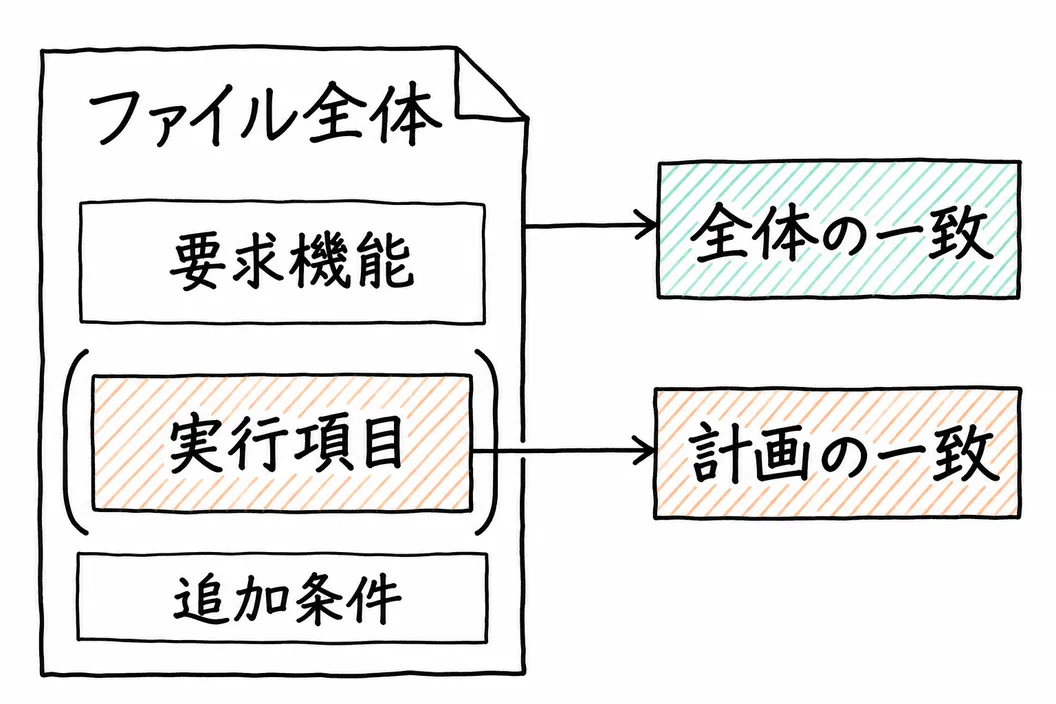
Whole-file integrity versus plan identity
The wallet computes the integrity value in the reference over the received file, including whitespace and additional information.
To trace an operation sequence approved by the user, however, it is useful to have an identifier that remains the same when a gas estimate changes.
The plan digest identifies a plan using only its execution fields and display roles.
| Data compared | Included in the hash | Example of a detected change |
|---|---|---|
| Entire file | Exact retrieved bytes | Changing whitespace or a gas estimate |
plan digest |
Execution fields and roles specified by the standard | Changing the destination or call data |
Plan hashing uses the version, chain ID, sending account, and ordered operation sequence. Extract the number and role from each operation and the chain ID, sender, destination, data, and transfer amount from each transaction. The subset of fields selected for hashing is called a projection.
The redundant chain notation can be derived and is excluded from the hash.
Gas estimates, error display definitions, simulation failure guidance, capability requirements, and extensions are also excluded.
For example, removing atomic_batch from required_capabilities leaves the plan digest unchanged, but changes whether separate execution is allowed.
Therefore, do not reuse an approval merely because the plan identifier matches. Continue to verify whole-file integrity, execution conditions, the selected account, and the retrieval source separately. Neither hash is a signature proving the creator’s identity or the user’s consent.
Fixed-order serialization and approval records
Obtaining the same identifier from the same operation sequence requires agreement on both the selected fields and their serialization order.
The outer order is schema_version, chain_id, sender, ordered_steps.
Within an operation, use step, kind, transaction; within a transaction, use chain_id, from, to, data, value.
The following string is the projection for hashing the earlier single-operation plan.
{"schema_version":"1","chain_id":"1","sender":"0x1111111111111111111111111111111111111111","ordered_steps":[{"step":1,"kind":"execution","transaction":{"chain_id":"1","from":"0x1111111111111111111111111111111111111111","to":"0x2222222222222222222222222222222222222222","data":"0x","value":"0"}}]}Only step is a number without a fractional or exponent part; the other scalar values are strings.
Normalize addresses and data to lowercase, and omit whitespace between fields and optional escape sequences.
Computing keccak256 over the UTF-8 bytes of this string yields the official expected value 0x93aeec006e55dfe0f54041d53c94387e08c504d4f3b3826cd3426dbc7da38ea5.
Generic canonicalization that sorts field names lexicographically would put chain_id first in the outer object, producing different bytes.
Construct the order specified by this standard directly.
Wallets are encouraged to show the plan identifier on the approval screen and associate it with approval records and transaction hashes after submission.
The recorded value lets the wallet correlate the sequence reviewed by the user with submission results.
Signing requests
When producing a signature for a counterparty to use later, without submitting a transaction from the wallet, use a document separate from an execution plan. The wallet verifies the specific message and signing account, and binds approval to both the signing content and the signature recipient. Authorization to execute transactions does not automatically extend to signing this message.
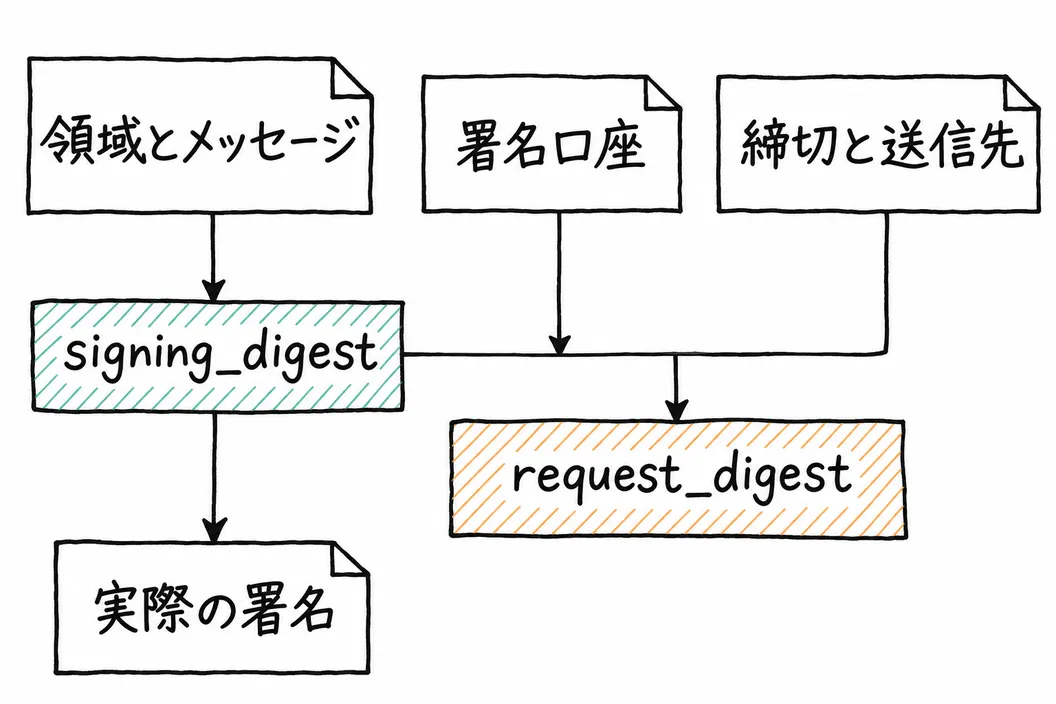
Signing content and account
When conveying an order or spending approval by signature, the user signs one specific message with named, typed fields.
The recipient reads the type definitions, a message conforming to them, and the domain that distinguishes its purpose and verifier.
These bind what is displayed and approved to the signing target.
This uses EIP712, which defines the structure and signature hashing method.
See the following article for details on EIP712.
[EIP712] Understanding hashing and signing of typed structured data
The preparation service packages one specific message and the expected signing account in a typed_data_signature_request document.
When passing a reference, use the same value for artifact_type; the wallet follows validation rules separate from execution plans.
| Document field | Value supplied by the creator | Recipient’s check |
|---|---|---|
schema_version |
"1" |
Whether the document version is supported |
kind |
typed_data_signature_request |
Whether this is a signing request document |
signer |
Account expected to sign | Whether it matches the selected account |
typed_data |
Specific typed message | Whether types and values match, and what it authorizes |
In the typed message, types defines fields and types, while primaryType names the message type to sign.
domain identifies the domain of use or verifier; message contains concrete values.
Pass typed_data as an object with these fields, not as a string containing a separate document.
For a contract signing account, the recipient uses that account’s verification method to validate the account, signing target, and signature bytes together.
With ERC1271, query the account for signature validity and determine acceptance from the returned verification result.
Do not substitute the contract account with its owner’s personal address or assume a 65-byte signature.
See the following article for details on ERC1271.
[ERC1271] Understanding contract-based signature verification
Reject the request if the wallet or intended verifier cannot support the account or signature format.
Do not convert a signing request into an operation within an execution plan or hide it in ignored extensions.
Prepare one finalized message per signature and pass distinct authorizations as separate signing requests.
Validating types, values, and deadlines
Even a typed document can cause signing of a value different from what was reviewed if duplicate fields or integer rounding are accepted.
Reject duplicate JSON keys before converting the document into an object.
Then check for missing and extra declared fields, duplicate member names, unresolved types, and unused types.
The following official test data represents a spending approval for a fictional token.
{
  "schema_version": "1",
  "kind": "typed_data_signature_request",
  "signer": "0xabcdef0123456789abcdef0123456789abcdef01",
  "typed_data": {
    "types": {
      "EIP712Domain": [
        {"name": "name", "type": "string"},
        {"name": "version", "type": "string"},
        {"name": "chainId", "type": "uint256"},
        {"name": "verifyingContract", "type": "address"}
      ],
      "Permit": [
        {"name": "owner", "type": "address"},
        {"name": "spender", "type": "address"},
        {"name": "value", "type": "uint256"},
        {"name": "nonce", "type": "uint256"},
        {"name": "deadline", "type": "uint256"}
      ]
    },
    "primaryType": "Permit",
    "domain": {
      "name": "Example Token",
      "version": "1",
      "chainId": "1",
      "verifyingContract": "0x2222222222222222222222222222222222222222"
    },
    "message": {
      "owner": "0xabcdef0123456789abcdef0123456789abcdef01",
      "spender": "0x3333333333333333333333333333333333333333",
      "value": "1000000",
      "nonce": "7",
      "deadline": "1800000100"
    }
  },
  "valid_until": "1800000000"
}
The message signed in this example is a Permit granting approval from owner to spender.
value is the approved amount in the fictional token’s smallest unit, while nonce is the number identifying the approval for replay checks.
Because the domain’s verifyingContract and chainId are included in the signing target, changing the verifier or chain changes what is signed.
The wallet validates included values according to their declared types.
| Value type | Accepted representation | Rejected example and reason |
|---|---|---|
| Integer | Canonical decimal string within the type’s range | Do not use the number 1000000 |
| Signed integer | Leading - allowed only for nonzero negative values |
"-0" is noncanonical |
| Nonnegative integer | "0" or digits without leading zeros |
"+1", "01", and "1e3" are noncanonical |
| Boolean | true or false |
"true" is a string |
| Ordinary string | Valid Unicode scalar values |
Reject malformed strings; do not alter content through normalization |
| Address or byte sequence | An even number of hexadecimal digits prefixed by 0x, matching the declared type length |
Reject lengths inconsistent with the type |
Hexadecimal lowercase normalization also follows the declared type.
Ordinary strings are case-sensitive, so "Example Token" must not be indiscriminately lowercased.
Apply the same checks recursively to arrays and nested structs.
Type references may be recursive, but concrete values must be finite and fit within implementation limits.
In EIP712Domain, which defines the domain type, declare the domain fields that are present in the standard order.
Permitted fields are name, version, chainId, verifyingContract, and salt, with their prescribed types.
primaryType must identify a declared message type and cannot be EIP712Domain itself.
The optional deadline valid_until limits when the wallet may create a new signature and release it to a recipient.
It is expressed in Unix time seconds as a canonical decimal string fitting an unsigned 64-bit integer.
In the example, reject both signing and release once 1800000000 seconds is reached. Recheck the deadline if it is reached while awaiting user approval.
The message’s deadline is an acceptance condition enforced by the verifier, distinct from this wallet-side deadline.
A document may contain at most 128 types, each with at most 128 members, and type expressions of at most 128 characters.
Recommended additional limits are 256 KiB per request, 64 levels of nested values, and 4096 total array elements.
Reject unknown document fields and explicit null values in optional fields.
If the signing domain lacks a chain ID, selecting a chain externally does not add signed replay protection.
Signing target and whole-request identifiers
Even if the user signs the same message, specifying a different account or destination changes what the wallet authorizes.
To track this distinction, separate the hash of the actual signing target from the hash of the entire request, including the account and release conditions.
These are signing_digest for the signing target and request_digest for the entire request.
The signing target is derived from domainSeparator, the domain hash, and hashStruct(message), the message hash.
Concatenate 0x1901, the domain hash, and the message hash in that order, then compute keccak256.
Signing only the message hash omits the domain, so use this complete signing target.
The whole-request hash combines the signing target with the account and optional deadline and delivery destination. For the preceding signing request, the hashing projection is as follows.
{"kind":"typed_data_signature_request","schema_version":"1","signer":"0xabcdef0123456789abcdef0123456789abcdef01","signing_digest":"0xe7f18db2b4d1fcc298da816d44dc9358d62866803fb92dd0aecf70106dc87c3f","valid_until":"1800000000","delivery":null}Serializing in this order without whitespace into UTF-8 yields the request_digest 0x52966f5b3b68cc7c68070316bbf3155d902e6cc27b163174bae549b1d9e3e90d.
The signed value is the example’s signing_digest, not the identifier for the entire request.
If the deadline and destination are omitted, use null only in the hashing projection.
This does not mean optional fields in the input document may explicitly contain null.
When including a destination, serialize its url first, followed by the correlation identifier request_id.
The typed message is incorporated as the signing target computed after validation, so its JSON keys do not need to be in identical order.
However, changing the account, message, domain, deadline, destination, or correlation identifier changes the request identifier.
The wallet binds this identifier and the actual selected account to approval. Include the actual source and caller context used in the decision in the policy record, and recheck the deadline and policy immediately before signing and release. A matching stored identifier alone does not justify skipping source or account verification.
Delivery of signing results
The wallet returns its signature to the caller or delivers it directly to the same origin specified by the request. If the response is lost after direct delivery, query the acceptance status of that same request. Distinguishing acceptance from order execution or settlement completion prevents duplicate orders following communication failures.
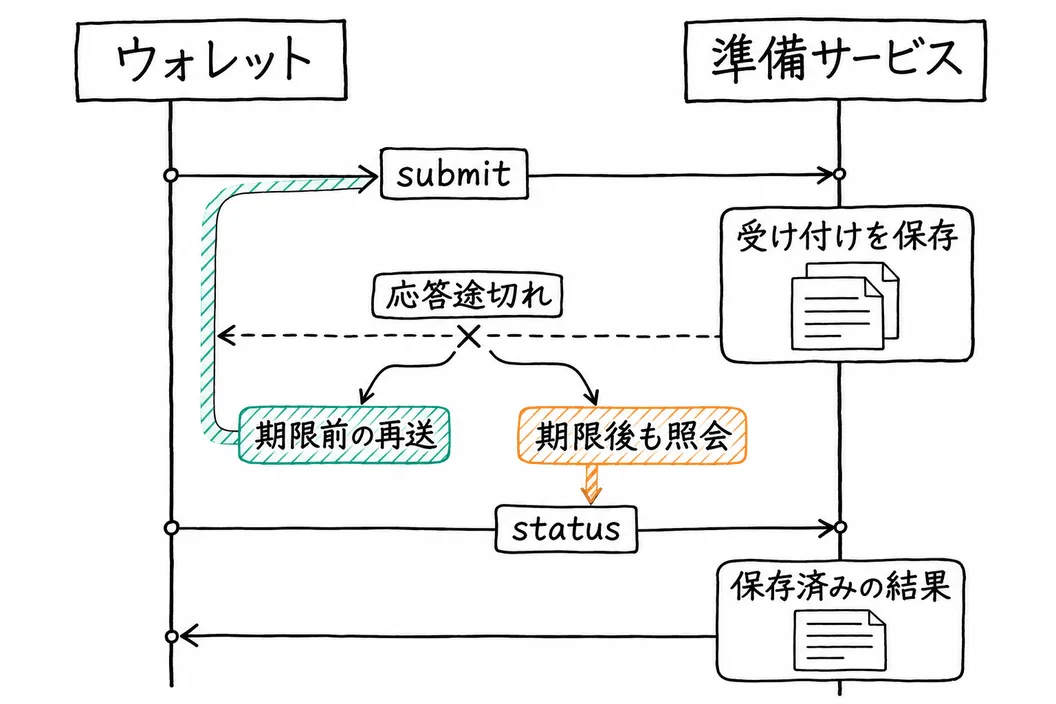
Returning results and restricting destinations
The wallet returns a result correlating the request, signing account, and signed content.
This result document is typed_data_result, containing the request and signing-target identifiers, the signer, and signature bytes.
The recipient recomputes both identifiers from the stored request, verifies the account, and validates the signature using the agreed method.
Signature bytes are a nonempty hexadecimal sequence, but their format is not fixed at 65 bytes and the generic document does not split the signature into three components. The valid format depends on the account and verification method.
If no destination is specified, the signing result is returned to the caller.
Even if the creation service says "deliver only to our service" in a description, it cannot constrain where the caller forwards the result afterward.
To restrict the initial recipient of the signature, include optional delivery in the request.
For example, add the following delivery conditions to the preceding request.
{
  "url": "https://producer.example/signature-results",
  "request_id": "quote-123-permit-1"
}
url is the destination to which the wallet directly sends the result; request_id correlates it with the service’s stored request.
In the official example adding these conditions as delivery, the signing target remains unchanged but the request identifier becomes 0xda8a7dc203d45cd0926e32913552de435982798bab6d241f0c4126946c6bbb48.
Changing the destination alone must invalidate approval of the original request.
Direct delivery is available only for requests the wallet itself actually retrieved and verified over HTTPS.
The destination must have the same origin as that retrieval source; do not infer origin from document names or aliases supplied by the AI.
This method cannot be used for inline, data:, or file requests.
| Delivery condition | Restriction |
|---|---|
| Host | Lowercase ASCII DNS name with at least two labels |
| Each label | 1–63 characters; alphanumeric characters or hyphens, beginning and ending with an alphanumeric character |
| Entire host | Up to 253 characters |
| Path | Absolute path; each segment contains alphanumeric characters, underscores, or hyphens |
Entire URL |
Up to 2048 characters |
request_id |
1–128 alphanumeric characters, underscores, or hyphens |
The root / is allowed, but other trailing slashes and consecutive slashes are not.
Explicit ports, literal IP addresses, credentials, queries, fragments, percent encoding, and relative dot segments are also prohibited.
These restrictions make destination representations easier to compare unambiguously; they do not require a fixed path name.
Immediately before delivery, reapply public IP, encrypted TLS, no-redirect, time and size limits, and no-implicit-authentication requirements.
Pin the connection to the validated address, and do not accept caller-specified HTTP methods, headers, or body templates.
The wallet authorizes signing and release to that recipient independently.
A single user confirmation or explicit policy may authorize both signing and release.
Reject the request if direct delivery is unsupported. Do not fall back to returning the raw signature to the caller. Any returned value is limited to a wallet-local identifier scoped to the caller, account, and request from which the signature cannot be extracted, or an acceptance result. Even for trusted origins, check whether arbitrary attackers can host request documents there; do not authorize release merely because the host matches.
Acceptance receipts and retransmission
For direct signature delivery, the wallet sends a fixed POST with application/json to the destination and identifies the operation as submit.
The signature bytes below illustrate the document format and must not be submitted as a valid authorization.
{
  "action": "submit",
  "request_id": "quote-123-permit-1",
  "result": {
    "kind": "typed_data_result",
    "schema_version": "1",
    "request_digest": "0xda8a7dc203d45cd0926e32913552de435982798bab6d241f0c4126946c6bbb48",
    "signing_digest": "0xe7f18db2b4d1fcc298da816d44dc9358d62866803fb92dd0aecf70106dc87c3f",
    "signer": "0xabcdef0123456789abcdef0123456789abcdef01",
    "signature": "0x1234"
  }
}
The recipient correlates request_id and the request identifier with the stored request and checks the stored delivery destination.
It then revalidates the signing target and account, confirms signature validity, and only then updates state.
Retransmission of the same request must not create duplicate orders or other effects.
Deduplication is based on request_digest, not the signature bytes.
Even if a different byte representation of a valid signature over the same content arrives, accept it as one request.
For as long as replay could cause another effect, retain the deduplication record durably or prevent that effect through the verifier’s mechanism.
The response reporting whether the signature was accepted is typed_data_receipt.
It represents acceptance of the stored request, not order execution or settlement success.
| Acceptance state | status |
operation_id |
What the wallet can establish |
|---|---|---|---|
| Service accepted durably | accepted |
Required | A stable acceptance identifier exists for the same request |
| Service rejected | rejected |
Omit | The service declined acceptance |
| Acceptance cannot be established | unknown |
Omit | Continue checking the same request |
For an accepted request, return a stable identifier for that same request in the following format.
{
  "kind": "typed_data_receipt",
  "schema_version": "1",
  "request_id": "quote-123-permit-1",
  "request_digest": "0xda8a7dc203d45cd0926e32913552de435982798bab6d241f0c4126946c6bbb48",
  "status": "accepted",
  "operation_id": "op-123"
}
operation_id identifies acceptance of this request and follows the same character and length restrictions as request_id.
Do not return the signature or private order details in the response.
Whether actual order processing or settlement completed after acceptance is tracked separately through service-specific result queries.
If communication is interrupted, the response cannot be parsed, or the status is unknown, preserve the possibility that the recipient already accepted the request.
The wallet durably records the request and its uncertain state, recovering by querying or retransmitting that same request.
Before the deadline, the signature result can be retransmitted for the same request, but retransmission is prohibited once valid_until is reached.
The signature-free status operation remains available after expiry.
Send the following via POST to the same destination.
{
  "action": "status",
  "request_id": "quote-123-permit-1",
  "request_digest": "0xda8a7dc203d45cd0926e32913552de435982798bab6d241f0c4126946c6bbb48"
}
Because this query does not release a signature, it can continue after the wallet-side deadline. Do not assume an uncertain result means nothing happened and sign a different order; look up the stored outcome of the original request. If the pair of correlation identifiers is unknown or mismatched, the service does not return information about another request. If the existence of an order is itself confidential, use hard-to-guess identifiers and rate-limit queries.
Multiple signatures and residual authorizations
A preparation service may create two spending approvals, receive their signatures, and then create an order incorporating those signatures. In that case, the order’s signing request is prepared as a concrete message once the preceding results are finalized. Do not evaluate an unresolved template inside the wallet and sign values the user has not yet seen.
Validate the types, values, account, deadline, and destination for every document and approve each independently. An interaction identifier or earlier signing result establishes which workflow is being continued; it does not authorize subsequent signatures. If the workflow submits transactions first, wait for the required successful confirmations before preparing the subsequent concrete document.
If an execution plan is returned after signing, its call data already contains the signature to be used.
Even when the operation is labeled signature_dependent_execution, plan validation, simulation, and approval cannot be skipped.
An execution plan is unnecessary if the interaction ends with signing.
Multiple signatures cannot be rolled back like an atomic transaction. Even if the user declines to sign the final order, earlier spending approval signatures may remain valid. The wallet does not authorize an earlier signature on the assumption that later operations will succeed; it evaluates the authority granted by each release independently. The workflow coordinator is also encouraged to limit the number of steps, waiting time, and retries.
Additional considerations
The service preparing a plan, the AI selecting a candidate, and the wallet authorizing signing or execution make distinct decisions. Adopting a common document format does not standardize the AI’s orchestration or the wallet’s authorization policies. Choose the required document types and retrieval methods and provide the account capabilities needed to satisfy the requirements.
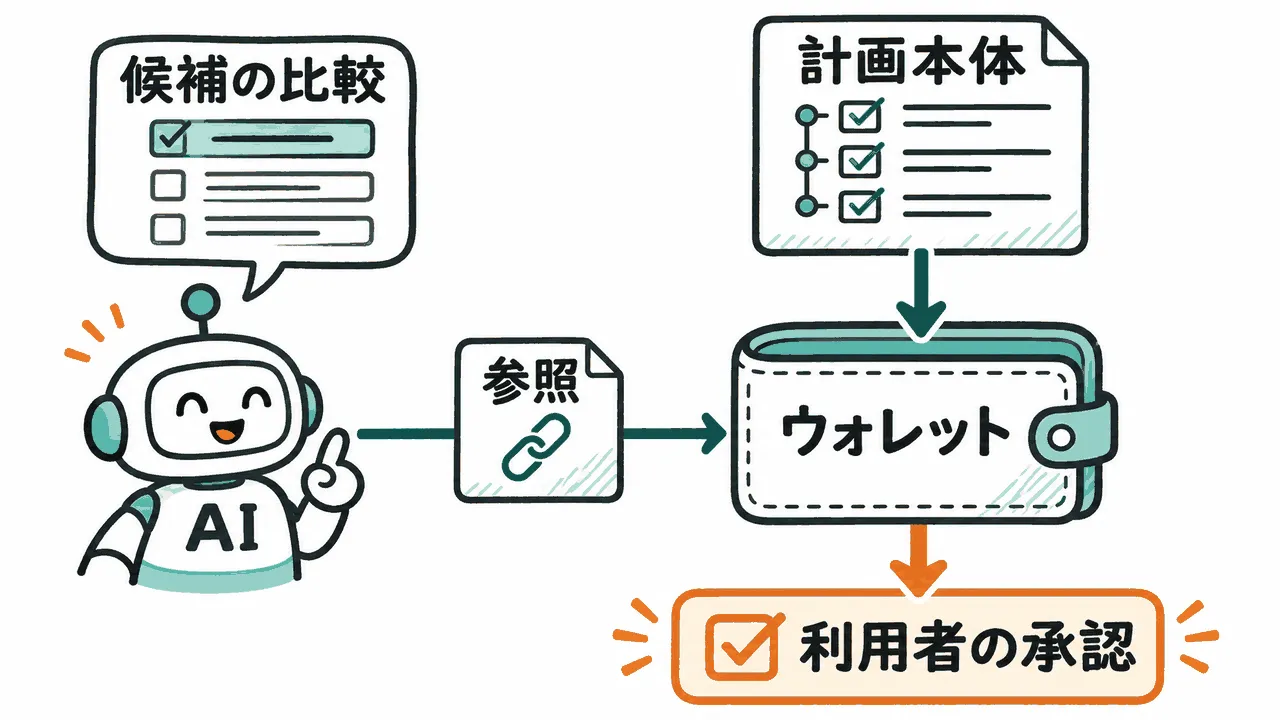
Document format and agent responsibilities
The AI can compare swap candidates or explain them to the user using summaries returned by preparation services. Once a candidate is selected, the wallet reads the operations from the document and applies its own validation and authorization policies. This handoff separates the AI’s selection from authorization to execute using the key.
The documents are independent of specific agent frameworks or tool communication protocols and can also be used by applications without AI. Restricting each plan to one account and one chain allows that account’s wallet to validate all operations together. Workflows spanning multiple accounts or chains coordinate multiple plans externally.
The service API that determines which operations to prepare, the AI’s invocation sequence, and the conditions for unattended approval are outside the specification.
Integrations must align on supported document types and validation and approval capabilities in addition to the common reference format.
Explicitly reject unsupported requirements rather than substituting weaker behavior.
Account capabilities for atomic execution
Executing all operations in one transaction requires an account mechanism that can perform multiple calls and revert everything on failure.
The wallet inspects the account’s configured execution target and code to establish whether the plan’s atomic requirement can be satisfied.
For example, EIP7702, which delegates execution from an existing account to other code, allows selection of a delegate implementing atomic execution.
See the following article for details on EIP7702.
[EIP7702] Understanding how an EOA can behave as a contract account
Another approach is an account abstraction account capable of executing multiple calls together.
Adoption of EIP7702 is optional; whatever mechanism is used, verify that it satisfies single-transaction execution and complete rollback.
Delegation settings may also persist beyond the transaction establishing them. Do not assume successful execution of a plan removes delegation authority. Review the permissions used for this atomic execution separately from the authority the delegated code retains afterward.
Compatibility
When passing calls from an execution plan to an existing wallet interface, check not only destinations and amounts but also information lost and execution conditions. Even if the calls can be mapped, operation roles, failure guidance, and atomic execution guarantees may differ. Check document versions separately from optional features supported by an implementation.
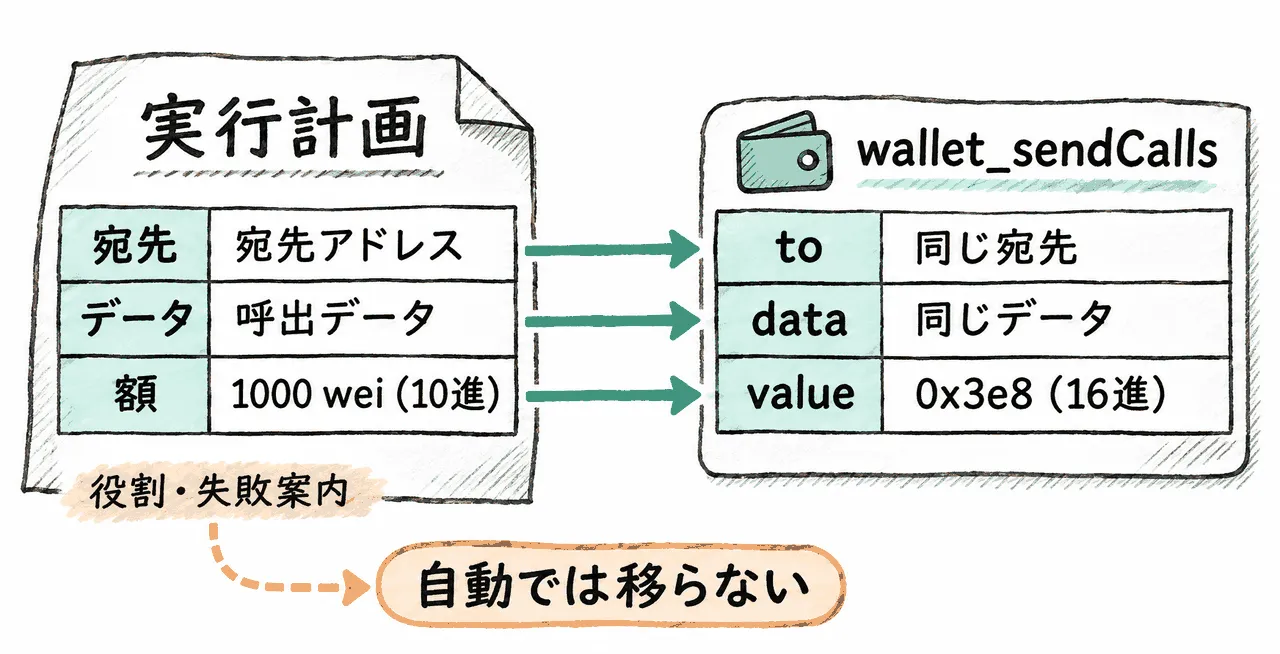
Mapping to existing wallet calls
To send multiple calls to a wallet, specify the sending account, chain, and ordered sequence of calls.
EIP5792, which requests multiple calls from a wallet and checks their results, defines the API for submission and result retrieval.
Plan fields map to wallet_sendCalls as follows.
See the following article for details on EIP5792.
[EIP5792] Understanding the Wallet Call API for submitting multiple onchain calls in batches
| Execution plan | Wallet call field | Conversion |
|---|---|---|
chain_id |
chainId |
Decimal string to hexadecimal quantity |
sender |
from |
Same sending account |
Each transaction.to |
Each calls.to |
Same destination |
Each transaction.data |
Each calls.data |
Same call data |
Each transaction.value |
Each calls.value |
Decimal string to hexadecimal quantity |
atomic_batch requirement |
atomicRequired |
Maps to true |
For example, chain ID "1" becomes "0x1" and transfer amount "1000000000000000000" becomes "0xde0b6b3a7640000".
Conversely, each operation’s kind, revert_decode, simulation_failure_policy, and extensions have no destination in this mapping.
Even when the submitted calls match, display information and failure explanations are not retained.
For conversion back to a plan, use the resolved from as the sender, derive the chain notation, and number operations consecutively.
Each operation receives the role execution; omitted data and value become "0x" and "0" respectively.
Calls without a destination cannot be represented, and the converted plan must undergo normal validation.
If an operation’s role changes from approval to execution on a round trip, the plan identifier also changes.
Moreover, atomic execution under EIP5792 does not itself require a single transaction, so mapping to atomicRequired: true alone may not satisfy the ERC8410 atomic requirement.
After conversion, verify either complete rollback within a single transaction or, for separate execution, waiting for successful confirmation and stopping at the first failure.
Versions and supported capabilities
ERC8410 has Draft status and does not modify existing chain consensus rules or deployed contracts.
Services and wallets adopt the document format and align their supported versions.
The document’s schema_version: "1" is a data format version, distinct from the standard’s review status.
Supporting execution plans does not imply support for signing requests. Even when signing requests are accepted, support for restricted direct delivery must be established separately. Local file retrieval is optional; reject references using it when unsupported.
Unknown fields are also handled differently. Execution plan and signing request documents reject unknown fields, while outer references ignore unknown additional information. However, integrity conditions are interpreted strictly; do not skip unsupported verification requirements. When adopting future capabilities, verify which documents, retrieval methods, and execution requirements are supported independently.
Tests
Official test vectors establish whether identical plans or signing requests produce identical identifiers. They also compare which hash changes when part of the input is modified: the whole-file hash, signing target, or whole-request hash. Validating document structure and cryptographic computations does not replace testing actual communication, approval, or settlement.
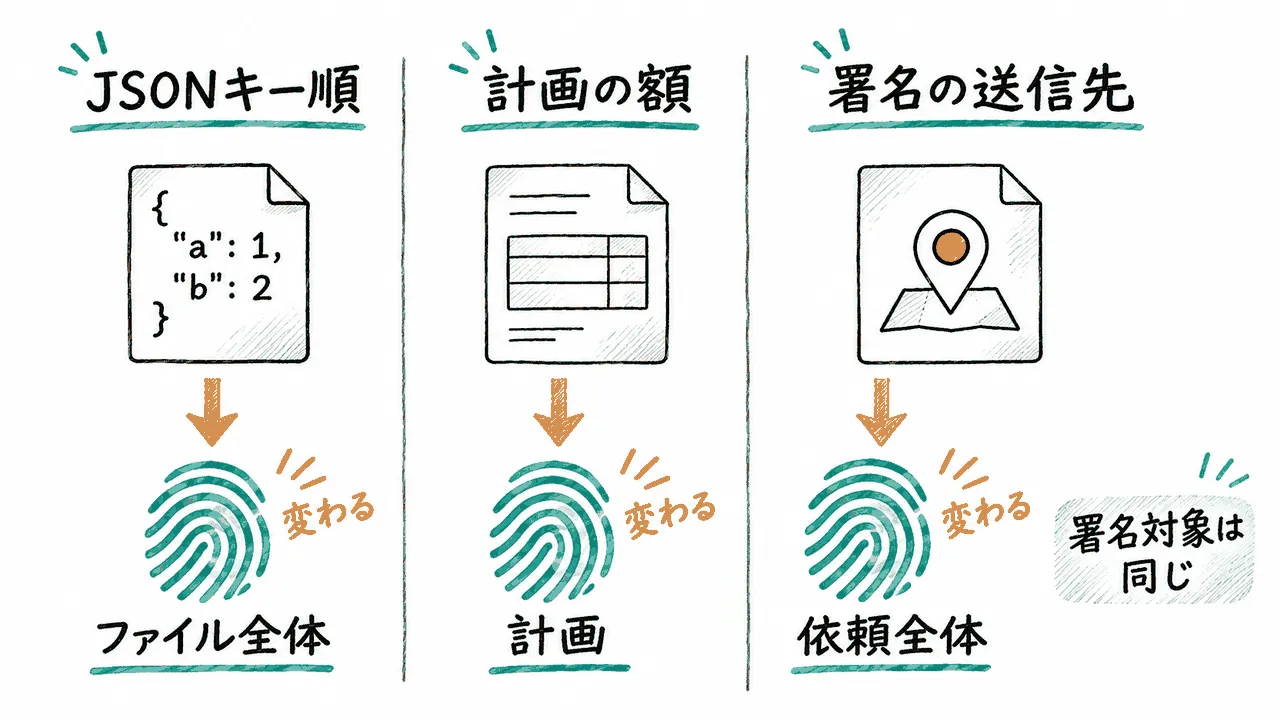
Test vectors for plans and signing requests
Execution plan examples include a minimal single-operation plan, a two-operation plan, a variant changing only fields excluded from hashing, and a variant changing one byte of call data. Each example includes the original document, exact hashing string, and expected identifier.
| Plan example | Expected identifier |
|---|---|
| Single operation with empty data | 0x93aeec006e55dfe0f54041d53c94387e08c504d4f3b3826cd3426dbc7da38ea5 |
| Two operations | 0x13c4b058741ee7bdfe5a51825c71bd205859b89436505a15adf60bd3f2281deb |
| Only gas, capability requirements, extensions, and descriptions changed | 0x13c4b058741ee7bdfe5a51825c71bd205859b89436505a15adf60bd3f2281deb |
| One byte changed in the second operation’s data | 0x5bf27f490fa44998b6386dfe1b0fae6df0c1b2a9604b69d83bbbbd7a6d285549 |
The two examples with two operations produce the same value because the changed fields are excluded from plan hashing. This does not mean that changes to capability requirements may be ignored merely because the value matches. Execution conditions are verified separately during document validation.
Signing request examples vary field ordering, hexadecimal case, domain, account, amount, deadline, and delivery destination.
Changing only JSON key order while retaining the same values changes the file bytes but not the signing target or request identifier.
Changing the amount changes both the signing target and request identifier; changing only the destination changes the request identifier without changing the signing target.
The official checks run with Node.js 20 or later from the test vector directory.
npm ci --ignore-scripts
npm test
They use pinned dependencies and compare independent computations by ethers and viem.
In addition to the original plan schema, they validate the structures of signing requests, signing results, delivery operations, and acceptance receipts.
This article describes running the official checks; it does not report an actual signing or submission demonstration involving a connected wallet.
The example order uses a fictional protocol, and the embedded signature bytes must not be used as real authorization.
Checks beyond structural validation
Conformance to a schema does not guarantee that the meanings of fields are consistent with each other. For example, even if both the plan chain and the second operation chain are valid quantities, reject the entire plan if their values differ. Similarly, a correctly formatted type name in a signing request does not guarantee that the type recursively matches the message.
Implementations check duplicate-key rejection, type and value consistency, capacity limits, the actual selected account, and the deadline. For network communication, verify DNS resolution against the actual connection destination and check that retrieval and delivery origins correspond. Also verify signature validity, user approval, and durable deduplication on retransmission independently.
Passing computations using the official test vectors does not prove that the wallet’s entire approval system works or that it withstands every malicious input. The test programs do not use keys or connect to actual nodes, nor do they connect to the example delivery endpoints. Do not infer success in real communication or settlement from passing structural checks.
Reference implementation
In the published Rust implementation of Ekubo Wallet, plan parsing and semantic validation follow reference retrieval and integrity verification.
The result contains the validated plan and source information; this loading process itself does not sign or transfer funds.
Reading types, validation, and identifier computation separately from destination, capacity, and time limits helps distinguish specification requirements from implementation choices.
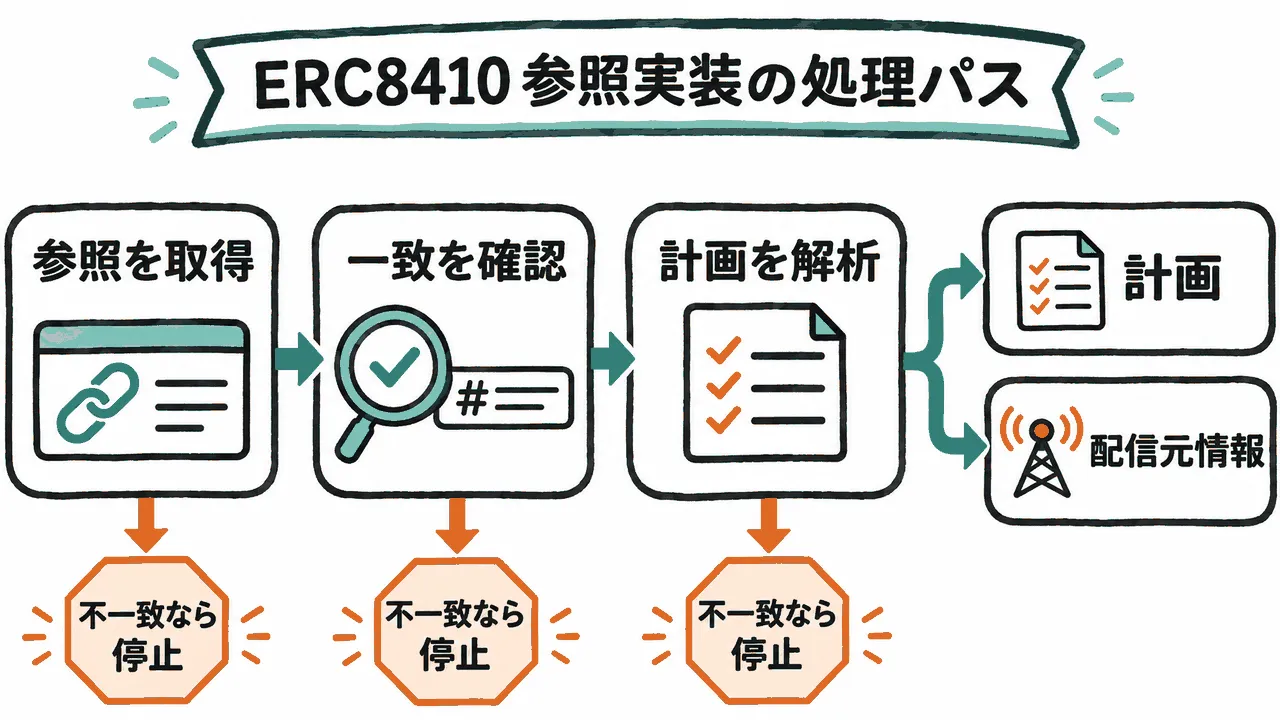
Loading and validating plans
The plan types and validation logic reside in crates/erc8410/src/lib.rs.
The crates/ekubo-wallet-core/src/core/execution_plan.rs file cited by the specification re-exports that implementation.
When loading from a retrieved string, ExecutionPlan::from_json first checks the original byte count.
pub fn from_json(input: &str) -> Result<Self> {
    ensure!(
        input.len() <= MAX_SERIALIZED_PLAN_BYTES,
        "execution plan exceeds {MAX_SERIALIZED_PLAN_BYTES} serialized bytes"
    );
    let plan: Self = serde_json::from_str(input).context("invalid execution plan")?;
    plan.validate()?;
    Ok(plan)
}
The function rejects strings exceeding 16 MiB before parsing.
After deserializing into the type, it calls ExecutionPlan::validate and returns the in-memory plan only on success.
When receiving a previously parsed value, ExecutionPlan::parse performs the same semantic validation after conversion through serde_json::from_value.
When constructing the quantity type, DecimalU256::new checks the string representation and 256-bit range.
Thus, a plan containing a malformed quantity fails to load before the value can reach the execution stage.
ExecutionPlan::validate first checks the version, operation count, and consistency of chain representations.
It then checks the number, names, and support status of required capabilities, the size of extensions, and simulation failure guidance.
Next it reads each operation in order, accumulates data size, checks its number, chain, sender, and optional error decoding definition, and finally checks the serialized size of the entire plan.
| Validation component | Input check | On failure |
|---|---|---|
DecimalU256::new |
Canonical quantity representation and 256-bit range | Return an error constructing the quantity |
ExecutionPlan::from_json |
Original string size and type conversion | Do not return a plan |
ExecutionPlan::parse |
Type conversion and semantic validation of an already parsed value | Do not return a plan |
ExecutionPlan::validate |
Overall limits and consistency of individual operations | Return the first mismatch as an error |
RevertDecodePlan::validate |
Definition count, size, and presence of an error declaration | Fail to load the plan containing that definition |
ensure_directive |
Whether guidance is 1–2000 characters | Fail to load the plan containing that guidance |
Data size accumulation is also checked for overflow; call data exceeding 8 MiB is rejected.
RevertDecodePlan::validate limits definitions to 128 entries and 65536 bytes, and checks that at least one error definition exists after parsing.
Alongside the character count check by ensure_directive, the implementation checks that execution and simulation setup failures do not recommend retrying the same plan.
These values and results are used to construct an in-memory plan.
In addition to mandatory validation requirements, this implementation adopts the recommended values and additional restrictions of 8 MiB, 16 MiB, and 65536 bytes as its limits.
When returning a failure as a Result error, no transaction has been submitted, so no onchain operations need to be rolled back.
The identifier of a validated plan is computed by ExecutionPlan::digest.
It constructs dedicated Canonical, DigestStep, and Transaction structs in the prescribed field order, normalizes addresses and data to lowercase, serializes them, and returns keccak256.
The resulting value identifies the plan projection, not its capability requirements, whole-file integrity, or user approval.
Resolving a reference into a document
Reference retrieval is handled by crates/ekubo-wallet-core/src/plan_fetch.rs.
resolve_execution_plan_reference retrieves verified bytes, parses them as JSON, and passes the result to plan validation.
pub async fn resolve_execution_plan_reference(
    reference: &ArtifactReference,
    policy: FetchPolicy,
) -> Result<(ExecutionPlan, ArtifactSource)> {
    let fetched = fetch_reference(reference, ArtifactType::ExecutionPlan, policy).await?;
    let value: serde_json::Value =
        serde_json::from_slice(&fetched.bytes).context("execution plan body is not valid JSON")?;
    let plan = ExecutionPlan::parse(value)?;
    Ok((plan, fetched.source))
}
The fetch_reference function receives a reference value, expected document type, and retrieval policy.
It checks the reference kind, location string length, expected document type, hash algorithm, and declared size before branching into embedded data or network retrieval.
After retrieval, it checks declared length and hash, returning only verified bytes and provenance information.
| Data transfer type | Information retained in this process | Relationship to the specification |
|---|---|---|
ArtifactReference |
Document location and integrity conditions | Allows unknown outer fields |
ArtifactIntegrity |
Hash algorithm and expected value | Rejects unknown fields |
ArtifactType |
Document types readable by this wallet | Includes execution plans and custom types |
FetchedArtifact |
Retrieved bytes and source | Verified result before plan parsing |
ArtifactSource |
Verified HTTPS host or embedded data |
Passes the source distinction to later display |
Before network retrieval, require_verifiable requires both integrity and bytes.
For embedded data, decode_data_uri validates the media type, parameters, and size before and after decoding, recovering bytes without using the network.
For network retrieval, fetch_remote acquires a concurrency slot, checks the location and destination, and reads the response under a size limit.
The retrieved bytes are compared by verify_digest, which calls digest_check.
digest_check checks the expected value’s length and hexadecimal representation and returns a boolean indicating whether it matches the hash of the actual data.
verify_digest turns a mismatch into an error and prevents plan parsing.
These retrieval results are passed in memory as FetchedArtifact and ultimately reach ExecutionPlan::parse.
The validated plan and source are returned to the caller; the function does not persist the document, sign, or transfer funds.
If integrity verification fails, there is no fallback path that uses the retrieved document for simulation or signing.
In this pinned version, ArtifactType includes the custom read_calls and token_list types in addition to execution plans.
However, signing requests defined by the standard are not included, and there is no file retrieval path.
Do not count custom types as additional standardized documents; consider the implementation’s coverage as an example of execution plan retrieval.
The decode_data_uri function also accepts an empty media type, and digest_check accepts a 64-digit expected hash without 0x.
The normative specification requires application/json and a 0x-prefixed value respectively, so these are two cases of more permissive acceptance.
Inputs accepted by the implementation should not automatically be treated as examples of standards-compliant input.
Destination pinning and implementation-specific limits
Even after establishing that a destination is a public address, resolving the hostname again when connecting could direct the connection to a different internal address. This implementation validates the host and all addresses resolved once, and uses that same address set for the connection. Pinning prevents an attack that substitutes DNS results between verification and connection.
vetted_host takes the host representation and rejects internal names and nonpublic IP addresses.
resolve_with_deadline reserves a resolution slot and resolves the name into addresses; is_public_ip checks each address against reserved and internal ranges.
If any address is disallowed, do not initiate the connection.
The client using the verified destinations is constructed by pinned_client.
The following short excerpt shows the connection configuration.
        .redirect(reqwest::redirect::Policy::none())
        .no_proxy()
        .connect_timeout(CONNECT_TIMEOUT)
        .timeout(TOTAL_TIMEOUT)
        .resolve_to_addrs(&key.host, &key.addrs)
It does not follow redirects or use environment-configured proxies, and pins connections to the validated addresses. Delegating DNS resolution to a proxy would break the correspondence with the verified destination. The response size after decompression is monitored during reading; timeouts and size limit violations are returned as retrieval failures.
The normal policy returned by FetchPolicy::production permits public HTTPS and restricted data: retrieval.
Debug builds have development relaxations, but release builds do not use that branch.
The specification requires setting limits; the particular values are this wallet’s implementation choices.
| Implementation limit | Value | Operation restricted |
|---|---|---|
| Concurrent retrievals | 2 | From DNS resolution through document reading |
| Connection time | 5 seconds | Establishing a network connection |
| Retrieval time | 15 seconds | Entire network client request |
| DNS resolution wait | 5 seconds | Time the caller waits for resolution |
| Outstanding concurrent resolutions | 16 | Includes resolutions still running after caller timeout |
| Destination client cache | 8 | Host, port, and validated address set combinations |
The underlying resolver may continue running after the DNS wait timeout.
Accordingly, resolve_with_deadline releases the slot when the resolution task actually finishes, not when the caller stops waiting.
This limits the accumulation of unfinished resolution tasks when requests repeatedly time out.
The pinned_client cache uses the validated address set as part of its key, in addition to host and port.
Resolve and validate the hostname for each retrieval, and reuse a client only when the result is identical.
Do not reuse a previously pinned destination for different results; evict the oldest entries when the cache exceeds 8 entries.
There are also differences in accepted sizes.
The pre-decoding limit for embedded data is based on the base64 expansion ratio, so percent-encoded data, which can expand threefold, may be rejected even when the document is smaller than the specification’s intended maximum.
Distinguish these additional restrictions from the more permissive media type and hash acceptance described earlier when reviewing connections and supported inputs.
The published code is licensed under FSL-1.1-MIT.
It permits uses such as education and research while restricting competitive uses; the future MIT license takes effect on the second anniversary of each version’s release.
Distinguish this from the specification’s CC0 terms; do not describe the code as unrestricted MIT code immediately upon release.
Security
Beyond verifying the retrieval destination and exact bytes, the wallet validates actual operations, signature release, and recovery from uncertain acceptance. It then determines which previously granted allowances, signatures, or delegations remain effective. Do not interpret a matching document as user approval or revocation of authority.
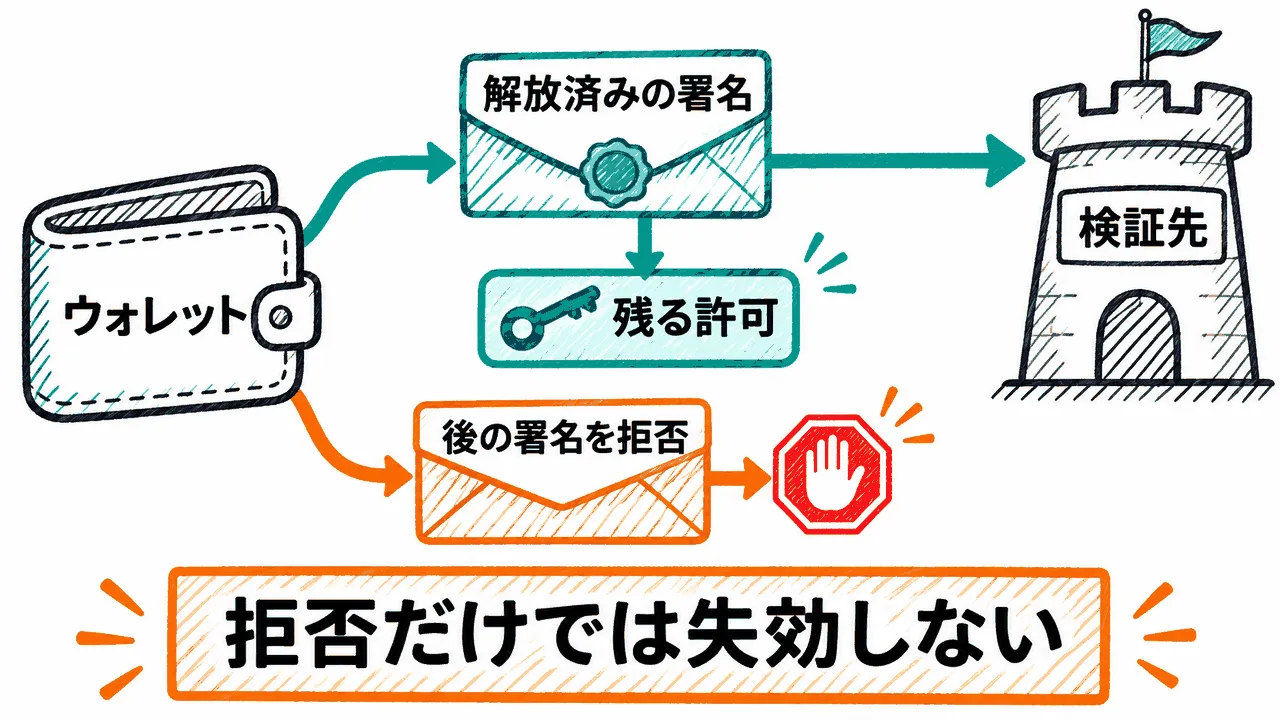
Source verification and user intent
An attacker who supplies both the document and its reference can create malicious operations with a correct integrity hash. Even verifying the source over an encrypted connection does not establish that its document matches the user’s intent. The wallet reads actual destinations, call data, transfer amounts, and operation ordering to determine the scope of approval.
When an AI generates code that invokes tools, externally retrieved content can also influence that code and cause the document or reference to be substituted. The wallet applies the same retrieval and content validation to inputs arriving through this route; it does not trust that the document is unchanged solely because of the execution environment. Because the reference itself can be replaced with another reference, integrity checking alone is insufficient; verify the actual retrieval source and approval of the operations.
Creator-supplied role names, descriptions, extensions, and error display strings are inputs for display. Do not turn descriptions saying "approved" or "safe" into execution instructions or authorization. Attackers can also create error decoding definitions and data, so limit parsing resources and sanitize text before display.
Even if simulation succeeds before submission, state changes before mining may cause the actual operation to fail or yield different results. Repeating simulation immediately before signing is recommended, but its result is not itself approval to submit. If separate execution leaves only an earlier approval in effect, separately identify the allowance remaining after failure.
Internal networks and local files
A party specifying a reference destination may attempt to make the wallet read internal services accessible only from its environment.
Do not permit a hostname based on its appearance alone; check that every resolution result is a public IP address.
Pinning the connection to verified addresses also prevents DNS rebinding, in which a subsequent resolution redirects the connection internally.
Do not follow redirects or attach credentials stored on the device, and limit both decompressed size and elapsed time. A single check of a public destination cannot protect subsequent connections by itself. Reapply the same network checks when sending a signature back.
A wallet supporting file retrieval reads local data using its own permissions, so restrict the directories it may read.
Require length and integrity values first, and make existence, oversize, mismatch, and parsing failures indistinguishable externally.
Even then, testing a known path and hash may reveal content through acceptance, so integrity checking alone does not necessarily protect local secrets.
Special files can also block during reading or cause side effects.
Limit read time, treat blocking as failure, and reject file outright if unsupported.
Limit reference length, received data, decoded data, concurrency, and definition parsing independently; never truncate oversized inputs.
Signature deadlines and replay
Examine separately the deadline for the wallet to sign, the deadline for the recipient to accept the signature, and the lifetime of authorization after acceptance.
valid_until specifies when new signing and release must stop; it does not revoke a signature already delivered.
If a verifier can later accept a signature satisfying its conditions, authority may remain after the wallet-side deadline.
For permit under ERC2612, which updates an allowance through a signature, separating the signature acceptance deadline from the resulting allowance clarifies what the deadline actually stops.
The wallet checks the signed deadline and replay-prevention nonce, and separately inspects any allowance already established in the contract.
Do not infer that an earlier established allowance has disappeared merely because a deadline has passed.
See the following article for details on ERC2612.
[ERC2612] Understanding how ERC20 approve and transferFrom can be performed in one transaction
The EIP712 computation itself does not prevent signature replay.
Bind the target chain and verifier to the domain and message, and have the verifier check the replay-prevention identifier and acceptance deadline.
If the domain lacks a chain ID, do not present an externally selected wallet chain as signed protection.
If a chain is selected separately for verifying a contract account, record that selection separately from the signed domain.
A policy considering only transaction spending amounts also overlooks authority granted by unused signatures and concurrent requests. When configuring unattended signing policies, bind authorization to the verified source, signing account, complete types and domain, concrete amounts, recipients, and other relevant values. Do not allow signatures over different content merely because the display name or type name is the same.
Signature release and uncertain delivery outcomes
A signature is information that its recipient can use according to its conditions.
Putting a signature in a URL, log, or error may disclose it to unintended parties.
The wallet keeps signatures out of these locations and enforces the fixed POST and destination revalidation for direct delivery.
The recipient must also verify the signing target, account, and delivery destination against the stored request.
Receiving the same request_digest again must not create additional effects; retain deduplication records for as long as replay could cause another effect.
If the verifier itself prevents another effect, verify that assumption as well.
When the wallet loses a response, persist the request and its uncertain state and query the same request’s status. The signature result can be retransmitted only before the deadline; signature-free queries can continue afterward. Creating another order before acceptance is established can grant duplicate authority if the earlier order was also accepted.
accepted means durable acceptance, not completed settlement.
rejected indicates rejection by that recipient; it does not revoke a signature usable elsewhere.
Even when release is restricted to the same origin, the recipient’s subsequent use or forwarding of the signature cannot be constrained by this mechanism. Usage conditions depend on the signed content checked by the verifier.
Conclusion
ERC8410 defines document formats that allow an AI to pass references and a wallet to retrieve and validate complete execution plans or signing requests.
Separating exact-byte integrity, execution operation consistency, and approval of the signing target and release conditions makes it possible to trace which checks preceded execution or signing.
It also distinguishes signature acceptance from settlement, and wallet deadlines from remaining authority, while recovering from communication failures through the same request’s status.
The official specification defines references and execution plans together with the normative signing supplement.

The published reference implementation implements plan validation and bounded retrieval.
