Introduction
Hi, I'm cardene, a software engineer and technical writer focused on blockchain and AI.
I've also authored Japanese technical books on specification-driven development with LLMs and decentralized application (DApp) development.

I also build and publish a variety of tools, libraries, and open-source projects.
ERC-8023 proposes three steps for transferring contract ownership: initiate, confirm, and accept. An optional waiting period and a separate confirmation step give the current owner time to respond to an incorrect recipient address or a compromised key before ownership changes.

Overview
ERC-8023 defines an interface that delays the transfer of a smart contract's owner to a new address. The current owner initiates the transfer and confirms the same recipient after a buffer period. The new owner then accepts it.
A conventional transferOwnership() call transfers ownership in one transaction even when the specified address is wrong. With ERC-8023, the current owner specifies the recipient address twice, and the recipient must accept the transfer. This creates an opportunity to verify and cancel the transfer if an address was entered incorrectly, including through address poisoning, or if someone tries to transfer ownership immediately after a key compromise.
ERC-173 defines the owner() getter and the OwnershipTransferred event for contract ownership management. ERC-8023 retains owner(), which lets it work with existing ownership checks.
For more on ERC-173, see the article below.
[ERC-173] How smart contract ownership works
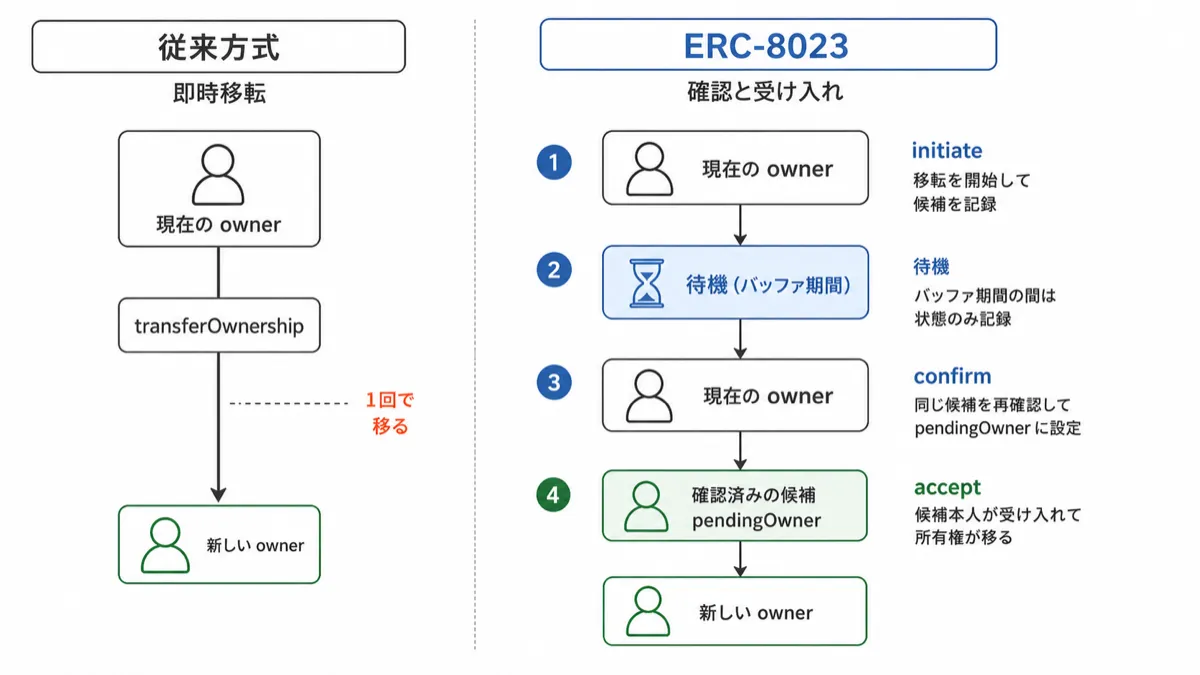
The diagrams retain their Japanese labels. On the left, one transferOwnership() call changes the owner. On the right, ERC-8023 records the recipient, waits, confirms the recipient, and requires the recipient to accept.
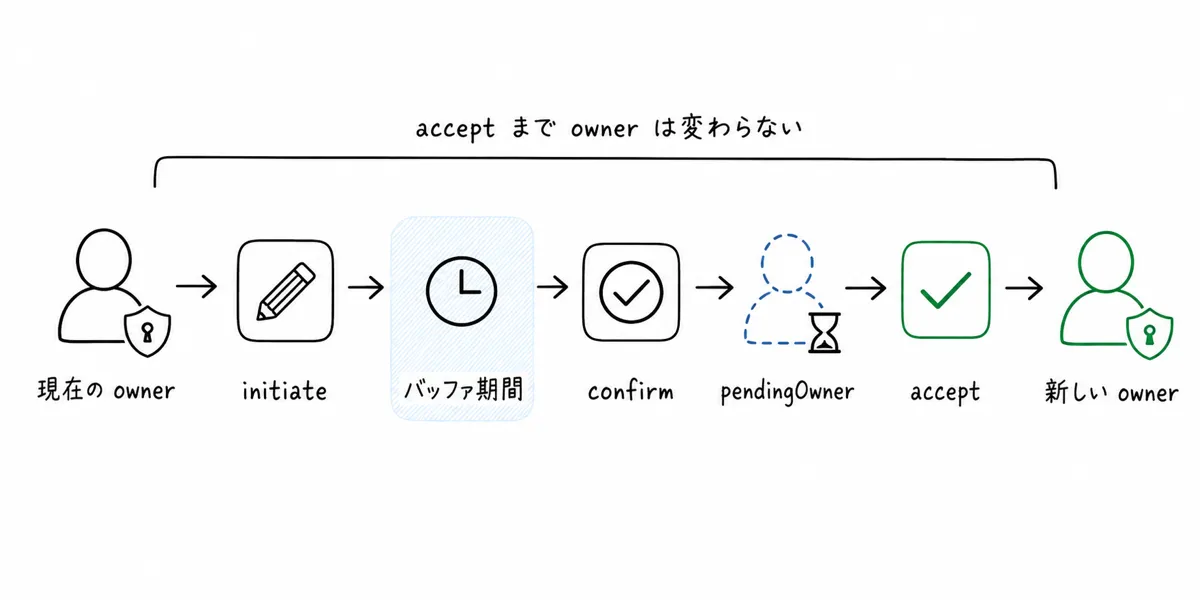
The address returned by owner() remains the same until acceptOwnershipTransfer() succeeds. The preConfirmedOwner() and pendingOwner() getters show the state of the transfer. Their addresses do not have administrative authority.
Motivation
A smart contract's owner often has extensive privileges, such as upgrading the contract, changing settings, moving funds, or pausing it in an emergency. In DeFi protocols, smart contract wallets, and on-chain utilities, the safety of the whole system can depend on who holds that authority.
A single-call transferOwnership() is easy to implement but vulnerable to operator error. One wrong address can send administrative control to an unintended recipient. If an attacker gains the owner private key and can transfer ownership immediately, defenders have little time to move funds to safety or change settings.
ERC-8023 adds confirmation to the transfer. The current owner initiates it and confirms the same newOwner after the buffer period. If the recipient is wrong, the owner can call cancelPendingOwnershipTransfer() and start again.
The proposal has four main objectives.
- Reduce the likelihood of operator error.
- Encourage operators to verify the recipient address on-chain.
- Allow cancellation while a transfer is in progress.
- Keep ownership management from becoming overly complicated.
The buffer period gives the legitimate owner time to respond after a key compromise. An attacker who calls initiateOwnershipTransfer() cannot immediately proceed to confirmOwnershipTransfer(). In that window, the legitimate owner can call initiateOwnershipTransfer() again to replace the recipient.
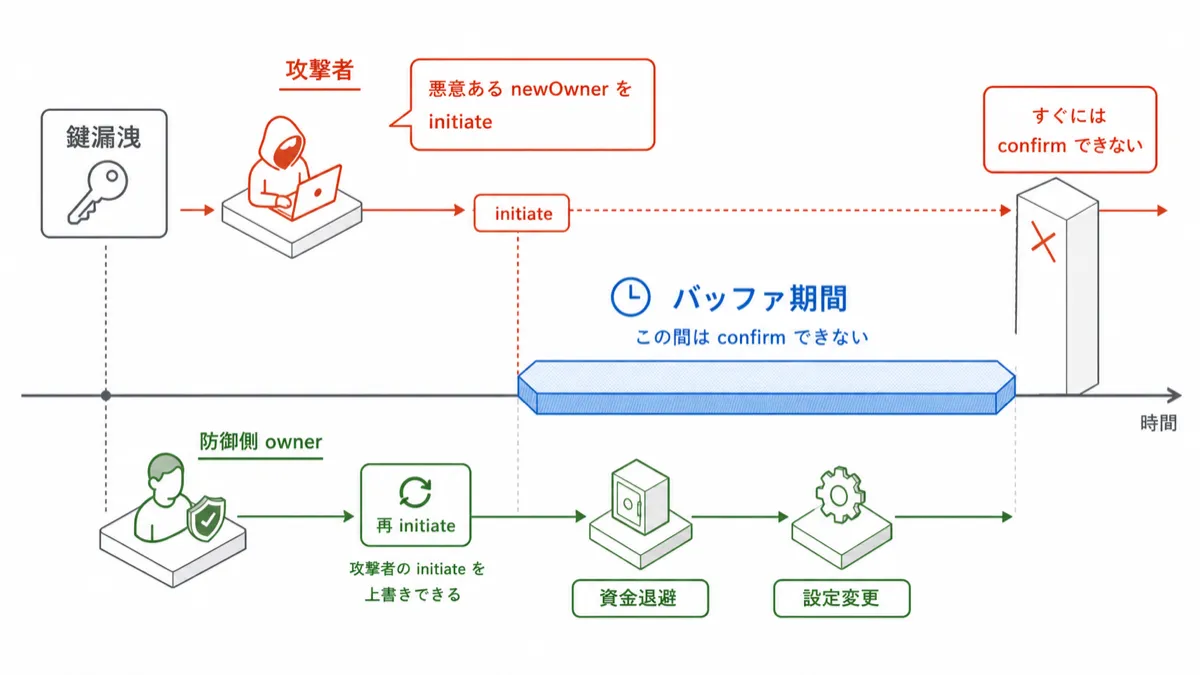
If an attacker specifies a malicious newOwner, the buffer period prevents immediate confirmation. While it runs, the legitimate owner can replace the recipient, move funds to safety, or change settings.
Specification
ERC-8023 defines a required MultiStepOwnable interface and an optional UpdateableOwnershipTransferBuffer extension. The current owner calls initiateOwnershipTransfer() and confirmOwnershipTransfer(). The confirmed pendingOwner then calls acceptOwnershipTransfer(), which changes the address returned by owner().
MultiStepOwnable
Contracts that support multi-step ownership transfers implement the following interface.
/// @title Multistep Ownership Standard
interface MultiStepOwnable {
    event OwnershipTransferInitiated(address indexed prevOwner, address indexed newOwner);
    event OwnershipTransferConfirmed(address indexed prevOwner, address indexed newOwner);
    event OwnershipTransferred(address indexed prevOwner, address indexed newOwner);

    function initiateOwnershipTransfer(address newOwner) external;
    function confirmOwnershipTransfer(address newOwner) external;
    function cancelPendingOwnershipTransfer() external;
    function acceptOwnershipTransfer() external;

    function owner() external view returns (address);
    function pendingOwner() external view returns (address);
    function preConfirmedOwner() external view returns (address);
    function getOwnershipTransferBuffer() external view returns (uint256);
}
The interface defines transfer and cancellation operations, getters, and events. The address returned by owner() is the only address with administrative authority.
Functions
initiateOwnershipTransfer
initiateOwnershipTransfer() is the first step. The current owner specifies a prospective new owner, whose address is recorded as preConfirmedOwner.
function initiateOwnershipTransfer(address newOwner) external;- Parameter
| Name | Type | Description |
|---|---|---|
newOwner |
address |
Address of the prospective new owner |
This call leaves ownership with the current owner, which owner() continues to return. To proceed with the same recipient, the current owner calls confirmOwnershipTransfer(newOwner) after the buffer period.
If the recipient is wrong or an attacker specified a different address, calling initiateOwnershipTransfer() again restarts the process. The proposal resets the waiting period on each initiation, so a sufficiently long buffer gives the legitimate owner time to respond.
A successful initiateOwnershipTransfer() call emits this event.
event OwnershipTransferInitiated(address indexed prevOwner, address indexed newOwner);- Parameters
| Name | Type | Description |
|---|---|---|
prevOwner |
address |
Current owner |
newOwner |
address |
Address recorded as the prospective owner |
confirmOwnershipTransfer
confirmOwnershipTransfer() is the second step. The current owner confirms the recipient by supplying the same newOwner again.
function confirmOwnershipTransfer(address newOwner) external;- Parameter
| Name | Type | Description |
|---|---|---|
newOwner |
address |
Address that must match preConfirmedOwner |
The call can be made after the buffer period measured from initiateOwnershipTransfer() has elapsed. The supplied newOwner must match the preConfirmedOwner recorded at initiation. To choose a different recipient, the current owner must restart with initiateOwnershipTransfer().
Successful confirmation makes newOwner the pendingOwner. The result of owner() stays the same, and the current owner retains administrative authority until acceptOwnershipTransfer() succeeds.
A successful confirmOwnershipTransfer() call emits this event.
event OwnershipTransferConfirmed(address indexed prevOwner, address indexed newOwner);- Parameters
| Name | Type | Description |
|---|---|---|
prevOwner |
address |
Current owner |
newOwner |
address |
Address confirmed as pendingOwner |
cancelPendingOwnershipTransfer
cancelPendingOwnershipTransfer() cancels a transfer before final acceptance. The proposal requires it to clear pendingOwner and cancel the transfer.
function cancelPendingOwnershipTransfer() external;To transfer ownership after cancellation, start over with initiateOwnershipTransfer().
This function is useful when the recipient address is wrong, an operator changes their decision, or the owner is responding to a key compromise. Under the proposal's security requirements, only the owner can call initiateOwnershipTransfer(), confirmOwnershipTransfer(), and cancelPendingOwnershipTransfer().
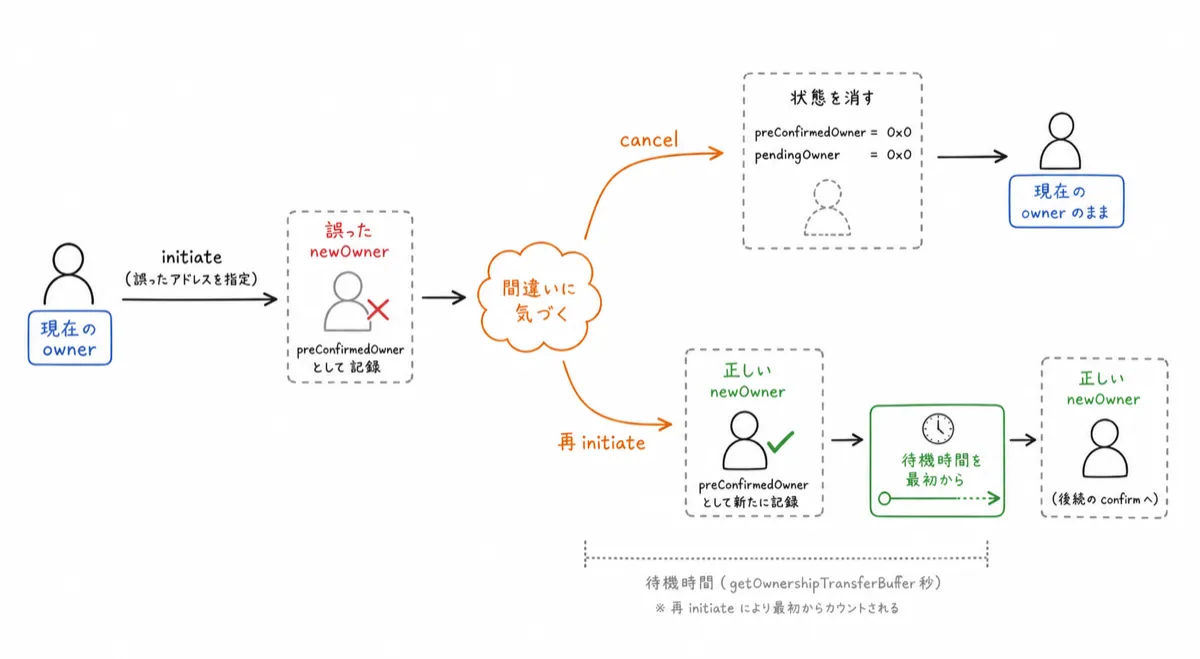
Calling cancelPendingOwnershipTransfer() clears pendingOwner and stops the transfer with the current owner still in control. To proceed with a different recipient, call initiateOwnershipTransfer() again and let the waiting period start over.
acceptOwnershipTransfer
acceptOwnershipTransfer() is the final step. Only the address confirmed as pendingOwner can call it.
function acceptOwnershipTransfer() external;An implementation can enforce this with an access check such as msg.sender == pendingOwner().
After a successful call, owner() returns the new owner's address. This is the point at which administrative authority changes hands.
A successful acceptOwnershipTransfer() call emits this event.
event OwnershipTransferred(address indexed prevOwner, address indexed newOwner);- Parameters
| Name | Type | Description |
|---|---|---|
prevOwner |
address |
Previous owner |
newOwner |
address |
New owner |
Getters
ERC-8023 defines three address getters and one buffer getter so external callers can read transfer state.
owner
owner() returns the address that currently holds administrative authority.
function owner() external view returns (address);- Return value
| Name | Type | Description |
|---|---|---|
owner |
address |
Current owner's address |
Only the address returned by owner() is authorized to administer the contract. A value returned by preConfirmedOwner() or pendingOwner() indicates transfer progress.
pendingOwner
pendingOwner() returns the address that has been confirmed and is awaiting acceptance.
function pendingOwner() external view returns (address);- Return value
| Name | Type | Description |
|---|---|---|
pendingOwner |
address |
Prospective new owner awaiting acceptance |
The pendingOwner can call acceptOwnershipTransfer() and gains administrative authority only after that call succeeds.
preConfirmedOwner
preConfirmedOwner() returns the prospective owner whose transfer has been initiated and is awaiting confirmation.
function preConfirmedOwner() external view returns (address);- Return value
| Name | Type | Description |
|---|---|---|
preConfirmedOwner |
address |
Prospective owner recorded at initiation |
The value is checked during confirmOwnershipTransfer(newOwner). This address has no administrative authority.
getOwnershipTransferBuffer
getOwnershipTransferBuffer() returns the minimum wait between initiateOwnershipTransfer() and confirmOwnershipTransfer(), in seconds.
function getOwnershipTransferBuffer() external view returns (uint256);- Return value
| Name | Type | Description |
|---|---|---|
buffer |
uint256 |
Required number of seconds from initiation to confirmation |
The proposal does not enforce a range but strongly recommends two to fourteen days. Too short a buffer leaves little time for verification or incident response. Too long a buffer makes legitimate transfers harder to manage.
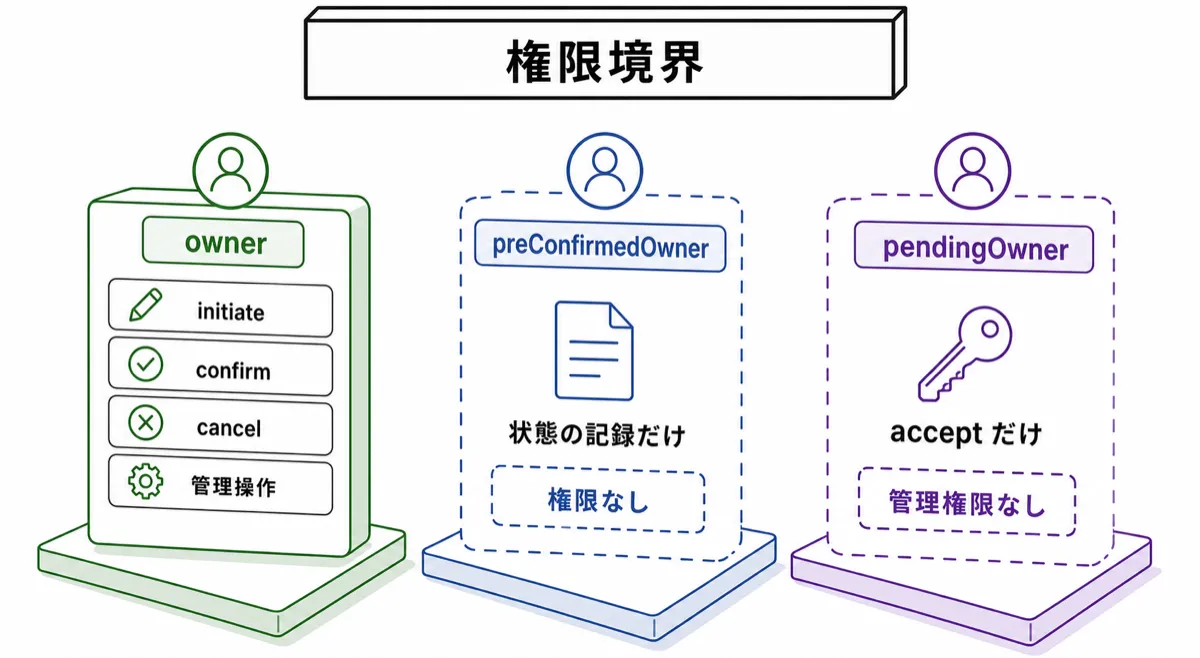
The owner, preConfirmedOwner, and pendingOwner have distinct privileges. Only the owner can administer the contract. The pendingOwner can only accept ownership.
UpdateableOwnershipTransferBuffer
A MultiStepOwnable contract can optionally implement UpdateableOwnershipTransferBuffer to let the ownership transfer buffer be changed later.
/// @title UpdateableOwnershipTransferBuffer. Extension of MultiStepOwnable.
interface UpdateableOwnershipTransferBuffer {
    function initiateOwnershipBufferUpdate(uint256 newBuffer) external;
    function confirmOwnershipBufferUpdate(uint256 newBuffer) external;
}
Changing the buffer also takes two steps: initiation and confirmation. Confirmation must wait for the existing buffer period to elapse. The proposal explains that implementations that omit this wait undermine the protection provided by ownershipTransferBuffer when the owner key is compromised.
Buffer update functions
initiateOwnershipBufferUpdate
initiateOwnershipBufferUpdate() begins a change to the buffer period.
function initiateOwnershipBufferUpdate(uint256 newBuffer) external;- Parameter
| Name | Type | Description |
|---|---|---|
newBuffer |
uint256 |
Proposed new buffer duration in seconds |
This call records the proposed duration and leaves the current buffer in effect while the waiting period runs.
confirmOwnershipBufferUpdate
confirmOwnershipBufferUpdate() finalizes the proposed buffer change.
function confirmOwnershipBufferUpdate(uint256 newBuffer) external;- Parameter
| Name | Type | Description |
|---|---|---|
newBuffer |
uint256 |
New buffer duration in seconds specified at initiation |
The proposal says the call should revert if the existing buffer period has yet to elapse. This prevents someone who has just obtained the owner key from shortening the buffer and immediately confirming an ownership transfer.
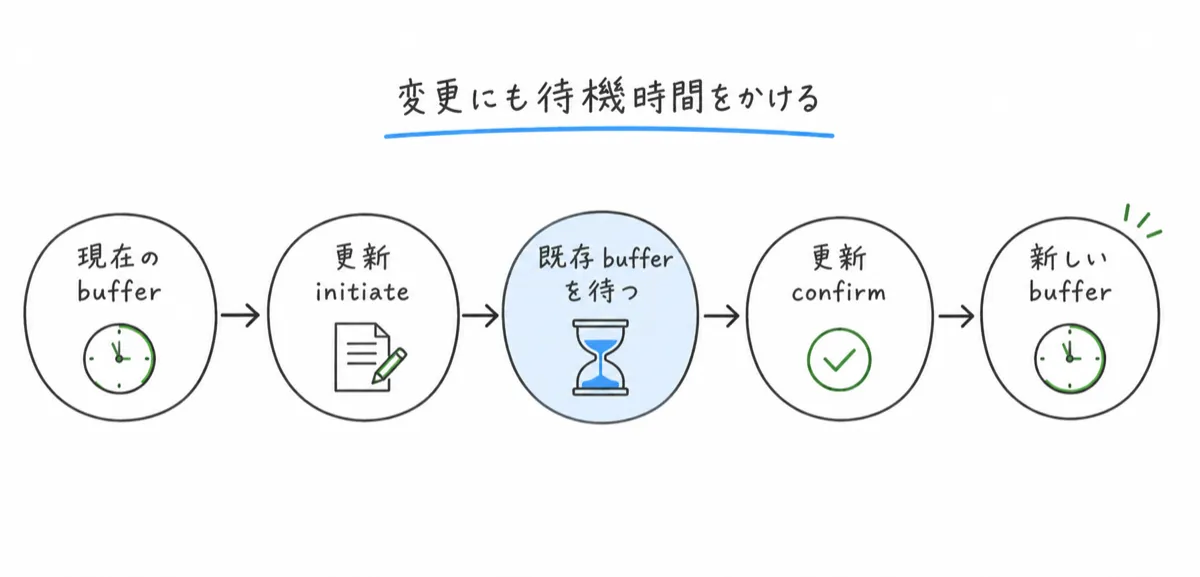
Both ownership transfers and changes to the waiting period are delayed. That constraint protects the three-step process from an attacker who would otherwise shorten the buffer itself.
Additional notes
Why the buffer period is configurable
ERC-8023 introduces a buffer period so the recipient address can be checked on-chain. The appropriate waiting period varies between a small personal contract, a major DAO-managed protocol, and a contract that needs to support emergency operations.
The proposal therefore leaves the buffer flexible. An implementation without a buffer resembles Ownable2Step with an additional confirmation step. A sufficiently long buffer gives defenders time to react after a key compromise.
owner compatibility
ERC-8023 uses owner() to expose the current owner, so existing ownership checks can still use it.
External tools and other contracts that read owner() continue to see the current administrator until acceptOwnershipTransfer() succeeds. Neither preConfirmedOwner nor pendingOwner can acquire privileges through those checks during the transfer.
Compatibility
The proposal's compatibility section is marked TBD. Its interface retains owner(), which makes it compatible with existing ownership lookups.
Admin interfaces, scripts, and monitoring systems designed around an immediate transferOwnership() need to account for initiation, confirmation, and acceptance. A displayed pendingOwner does not change owner(), so the UI should distinguish a transfer awaiting acceptance from a completed ownership change.
Security Considerations
Administrative authority stays with the current owner throughout an in-progress transfer. The getters preConfirmedOwner() and pendingOwner() report state. The only administrator is the address returned by owner().
Restrict initiateOwnershipTransfer(), confirmOwnershipTransfer(), and cancelPendingOwnershipTransfer() to the owner. Third parties that can call these functions could interfere with the transfer. In particular, broadening access to cancelPendingOwnershipTransfer() would let others disrupt legitimate transfers.
Set OwnershipTransferBuffer when setting owner. Failing to initialize it in the constructor or initialize() can produce an unexpectedly short delay, depending on the implementation. When using a buffer, enforce it between initiateOwnershipTransfer() and confirmOwnershipTransfer().
The current owner retains all administrative privileges until the new owner calls acceptOwnershipTransfer(). This keeps the contract under administrative control even if the recipient has yet to accept.
An implementation that allows buffer updates should delay those changes too. If someone with a compromised key could reduce the buffer close to zero, the ownership transfer confirmation window would disappear. For that reason, confirmOwnershipBufferUpdate() checks that the existing buffer period has elapsed.
Conclusion
ERC-8023 separates an ownership transfer into initiation, confirmation, and acceptance. It preserves owner() compatibility and combines recipient verification, cancellation, and a buffer period to reduce the harm caused by operator mistakes or compromised keys. Recording a pendingOwner leaves administrative authority with the current owner until acceptOwnershipTransfer() succeeds.
More of my writing and resources are available here.




