Introduction
Hi, I'm cardene, a software engineer and technical writer focused on blockchain and AI.
I've also authored Japanese technical books on specification-driven development with LLMs and decentralized application (DApp) development.

I also build and publish a variety of tools, libraries, and open-source projects.
This article examines ERC2615, a proposal that adds usage rights and liens to ERC721 as two additional roles to support a range of use cases.
This article translates, summarizes, and expands on the following proposal.

Overview
ERC2615 extends ERC721 with rental and mortgage functionality. These features allow NFTs to have properties similar to real-world real estate.
ERC2615 enables NFT-based use cases involving:
- Virtual items (in-game assets, digital art, and so on)
- Physical items (houses, cars, and so on)
- Intellectual property rights
- DAO membership tokens
ERC2615 introduces new roles. In addition to the Owner, it defines rights for a User, or tenant. An NFT can also serve as collateral by having a lien placed on it.
ERC2615 is designed to be fully backward-compatible with ERC721, so existing NFT developers can integrate these features easily.
An important distinction is that the User, rather than the Owner, holds the right to use the asset within an application. Application developers therefore need to account for the semantics of ERC2615 in their designs.
Motivation
Conventional ERC721 defines only an Owner role, making it difficult to support practical arrangements such as rentals and mortgages.
For example, a rental requires a security deposit to establish trust, while using an NFT as collateral requires temporarily locking its ownership in another contract.
Developers have had to implement these mechanisms individually outside the ERC721 standard, adding to their workload.
ERC2615 addresses these issues by defining tenancy rights and liens as standard NFT features. Applications can consequently integrate rental and mortgage functionality more easily.
Specification
ERC2615 extends the existing ERC721 NFT standard to support rentals and mortgages. NFTs can therefore be lent, borrowed, or used as collateral for loans, much like physical assets.
The standard defines three roles:
- Owner
- The owner of the NFT.
- User
- A party with temporary rights to use the NFT (a tenant).
- Lien Holder
- A party holding a lien on the NFT.
Each role has different permissions. For example, the Owner can transfer the User rights, while the Lien Holder can ultimately transfer ownership of the NFT.
ERC2615 maintains backward compatibility with ERC721, allowing existing ERC721 tools to remain in use.
Rental and mortgage mechanisms
Rental workflow
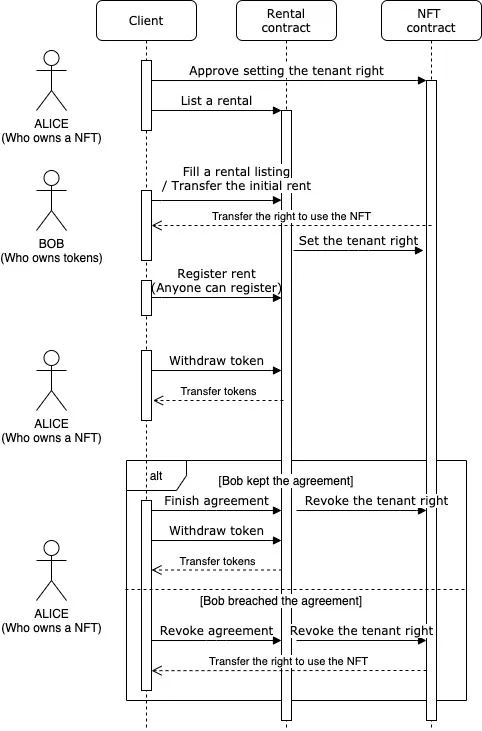
- Alice approves the creation of a tenant right for the NFT.
- Alice registers the NFT with the rental contract.
- Bob requests a rental and pays the initial rental fee.
- The usage rights are transferred to Bob.
- Bob or a third party records periodic rental payments.
- Alice can withdraw the rental fees.
- The usage rights are reset when the contract expires or the tenant defaults.
Mortgage workflow
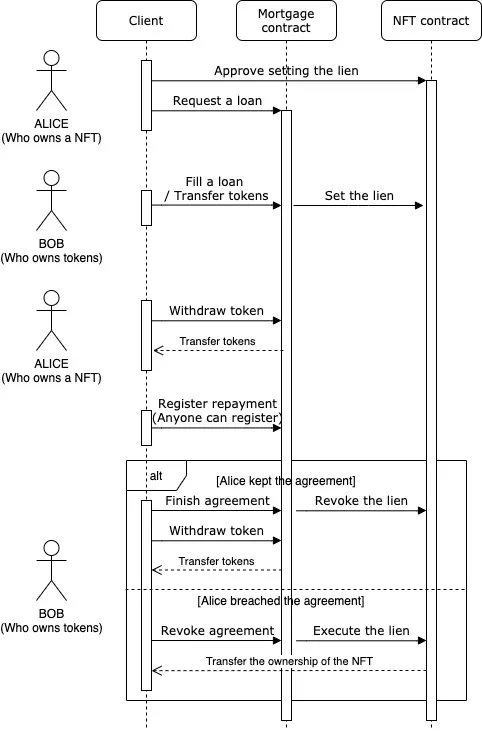
- Alice approves the creation of a lien on the NFT.
- Alice applies for a loan.
- Bob provides funds for the loan.
- A lien is placed on the NFT.
- Alice withdraws the funds.
- Repayment takes place.
- The lien is released after full repayment. If the loan is not repaid, ownership of the NFT is transferred.
Interfaces
event TransferUser(address indexed from, address indexed to, uint256 indexed itemId, address operator);
event ApprovalForUser(address indexed user, address indexed approved, uint256 itemId);
event TransferOwner(address indexed from, address indexed to, uint256 indexed itemId, address operator);
event ApprovalForOwner(address indexed owner, address indexed approved, uint256 itemId);
event ApprovalForAll(address indexed owner, address indexed operator, bool approved);
event LienApproval(address indexed to, uint256 indexed itemId);
event TenantRightApproval(address indexed to, uint256 indexed itemId);
event LienSet(address indexed to, uint256 indexed itemId, bool status);
event TenantRightSet(address indexed to, uint256 indexed itemId,bool status);

function balanceOfOwner(address owner) public view returns (uint256);
function balanceOfUser(address user) public view returns (uint256);
function userOf(uint256 itemId) public view returns (address);
function ownerOf(uint256 itemId) public view returns (address);

function safeTransferOwner(address from, address to, uint256 itemId) public;
function safeTransferOwner(address from, address to, uint256 itemId, bytes memory data) public;
function safeTransferUser(address from, address to, uint256 itemId) public;
function safeTransferUser(address from, address to, uint256 itemId, bytes memory data) public;

function approveForOwner(address to, uint256 itemId) public;
function getApprovedForOwner(uint256 itemId) public view returns (address);
function approveForUser(address to, uint256 itemId) public;
function getApprovedForUser(uint256 itemId) public view returns (address);
function setApprovalForAll(address operator, bool approved) public;
function isApprovedForAll(address requester, address operator) public view returns (bool);

function approveLien(address to, uint256 itemId) public;
function getApprovedLien(uint256 itemId) public view returns (address);
function setLien(uint256 itemId) public;
function getCurrentLien(uint256 itemId) public view returns (address);
function revokeLien(uint256 itemId) public;

function approveTenantRight(address to, uint256 itemId) public;
function getApprovedTenantRight(uint256 itemId) public view returns (address);
function setTenantRight(uint256 itemId) public;
function getCurrentTenantRight(uint256 itemId) public view returns (address);
function revokeTenantRight(uint256 itemId) public;
Events
TransferUser
event TransferUser(address indexed from, address indexed to, uint256 indexed itemId, address operator);Emitted when the User role is transferred to another address. It signals that the right to use the NFT has passed to another party.
Parameters
from- The address transferring the usage rights.
to- The address receiving the usage rights.
itemId- The ID of the NFT.
operator- The address that performed the operation.
ApprovalForUser
event ApprovalForUser(address indexed user, address indexed approved, uint256 itemId);Emitted when an address receives approval to manage the User role. It notifies observers that a particular address has been authorized to operate on that role.
Parameters
user- The current holder of the usage rights.
approved- The approved address.
itemId- The ID of the NFT.
TransferOwner
event TransferOwner(address indexed from, address indexed to, uint256 indexed itemId, address operator);Emitted when the Owner role of an NFT changes. It signals a transfer of ownership.
Parameters
from- The previous owner.
to- The new owner.
itemId- The ID of the NFT.
operator- The address that performed the operation.
ApprovalForOwner
event ApprovalForOwner(address indexed owner, address indexed approved, uint256 itemId);Emitted when another party is approved to operate on the ownership rights of an NFT. It identifies the address authorized to manage the Owner role.
Parameters
owner- The owner's address.
approved- The approved address.
itemId- The ID of the NFT.
ApprovalForAll
event ApprovalForAll(address indexed owner, address indexed operator, bool approved);Emitted when blanket approval for NFT operations is granted to or revoked from an address. It signals a change in operator-wide authorization.
Parameters
owner- The owner of the NFTs.
operator- The approved operator's address.
approved- Whether approval is granted (true/false).
LienApproval
event LienApproval(address indexed to, uint256 indexed itemId);Emitted when permission to place a lien on an NFT is granted. It signals that another party has been authorized to establish the lien.
Parameters
to- The address approved to place the lien.
itemId- The ID of the NFT.
TenantRightApproval
event TenantRightApproval(address indexed to, uint256 indexed itemId);Emitted when permission to establish a tenant right on an NFT is granted. It identifies the address authorized to set that right.
Parameters
to- The address approved to establish the tenant right.
itemId- The ID of the NFT.
LienSet
event LienSet(address indexed to, uint256 indexed itemId, bool status);Emitted when a lien is placed on or removed from an NFT. It signals that the lien has been established or revoked.
Parameters
to- The address for which the lien is established.
itemId- The ID of the NFT.
status- Whether the lien is active (true = established, false = revoked).
TenantRightSet
event TenantRightSet(address indexed to, uint256 indexed itemId, bool status);Emitted when a tenant right is established or revoked for an NFT. It signals the change in usage rights.
Parameters
to- The address for which the tenant right is established.
itemId- The ID of the NFT.
status- Whether the tenant right is active (true = established, false = revoked).
Functions
balanceOfOwner
function balanceOfOwner(address owner) public view returns (uint256);Returns the number of NFTs owned by the specified address, counting the NFTs it holds in the Owner role.
Parameters
owner- The owner's address.
Return value
uint256- The number of NFTs owned.
balanceOfUser
function balanceOfUser(address user) public view returns (uint256);Returns the number of NFTs that the specified address has the right to use, counting the NFTs it holds in the User role.
Parameters
user- The user's address.
Return value
uint256- The number of NFTs for which the address has usage rights.
userOf
function userOf(uint256 itemId) public view returns (address);Returns the address holding the usage rights to an NFT. It identifies the current User of the specified NFT.
Parameters
itemId- The ID of the NFT.
Return value
address- The current User's address.
ownerOf
function ownerOf(uint256 itemId) public view returns (address);Returns the NFT owner's address. As in standard ERC721, it identifies the address holding the Owner role for the specified NFT.
Parameters
itemId- The ID of the NFT.
Return value
address- The current Owner's address.
safeTransferOwner
function safeTransferOwner(address from, address to, uint256 itemId) public;
function safeTransferOwner(address from, address to, uint256 itemId, bytes memory data) public;
Safely transfers the ownership (Owner role) of an NFT from from to to. If no Tenant Right is established for the NFT, the User role is transferred as well.
Parameters
from- The current owner's address.
to- The new owner's address.
itemId- The ID of the NFT.
data(used in the second overload)- Optional additional data.
safeTransferUser
function safeTransferUser(address from, address to, uint256 itemId) public;
function safeTransferUser(address from, address to, uint256 itemId, bytes memory data) public;
Safely transfers the usage rights (User role) of an NFT without transferring the Owner role. In a rental arrangement, this allows usage rights to be granted or transferred.
Parameters
from- The current User's address.
to- The new User's address.
itemId- The ID of the NFT.
data(used in the second overload)- Optional additional data.
approveForOwner
function approveForOwner(address to, uint256 itemId) public;Grants another party permission to operate on the Owner role of an NFT. The specified address is authorized to manage that role for the NFT.
Parameters
to- The address receiving approval.
itemId- The ID of the NFT.
getApprovedForOwner
function getApprovedForOwner(uint256 itemId) public view returns (address);Returns the address approved to operate on the Owner role of a specified NFT. It retrieves the approval set through approveForOwner.
Parameters
itemId- The ID of the NFT.
Return value
address- The approved address.
approveForUser
function approveForUser(address to, uint256 itemId) public;Grants another party permission to operate on the User role of an NFT. The specified address receives permission to manage the usage rights to that NFT.
Parameters
to- The address receiving approval.
itemId- The ID of the NFT.
getApprovedForUser
function getApprovedForUser(uint256 itemId) public view returns (address);Returns the address approved to operate on the User role of an NFT. It retrieves the address approved through approveForUser.
Parameters
itemId- The ID of the NFT.
Return value
address- The approved address.
setApprovalForAll
function setApprovalForAll(address operator, bool approved) public;Grants or revokes blanket approval for an operator to perform operations on all NFTs.
Parameters
operator- The operator's address.
approved- Whether to grant or revoke approval (true/false).
isApprovedForAll
function isApprovedForAll(address requester, address operator) public view returns (bool);Checks whether blanket approval has been granted. It determines whether the specified requester has authorized the operator to operate on all NFTs.
Parameters
requester- The address granting approval.
operator- The operator's address.
Return value
booltrueif blanket approval is granted, orfalseotherwise.
approveLien
function approveLien(address to, uint256 itemId) public;Authorizes another party to place a lien on an NFT. The specified address receives permission to establish the lien.
Parameters
to- The address receiving permission to establish the lien.
itemId- The ID of the NFT.
getApprovedLien
function getApprovedLien(uint256 itemId) public view returns (address);Returns the address authorized to establish a lien on the specified NFT.
Parameters
itemId- The ID of the NFT.
Return value
address- The address approved to establish a lien.
setLien
function setLien(uint256 itemId) public;Places a lien on an NFT. Once approval has been granted, this function establishes the lien.
Parameters
itemId- The ID of the NFT.
getCurrentLien
function getCurrentLien(uint256 itemId) public view returns (address);Returns the current Lien Holder of an NFT. If a lien is established on the specified NFT, it returns the address of the Lien Holder.
Parameters
itemId- The ID of the NFT.
Return value
address- The address holding the lien.
revokeLien
function revokeLien(uint256 itemId) public;Releases an existing lien on an NFT, for example when the contractual conditions have been fulfilled.
Parameters
itemId- The ID of the NFT.
approveTenantRight
function approveTenantRight(address to, uint256 itemId) public;Authorizes another party to establish tenant rights on an NFT. The specified address receives permission to set the User role.
Parameters
to- The address authorized to establish tenant rights.
itemId- The ID of the NFT.
getApprovedTenantRight
function getApprovedTenantRight(uint256 itemId) public view returns (address);Returns the address authorized to establish tenant rights on an NFT. It retrieves the address previously approved through approveTenantRight.
Parameters
itemId- The ID of the NFT.
Return value
address- The address approved to establish tenant rights.
setTenantRight
function setTenantRight(uint256 itemId) public;Establishes tenant rights on an NFT. An address authorized to establish these rights uses this function to set the User role.
Parameters
itemId- The ID of the NFT.
getCurrentTenantRight
function getCurrentTenantRight(uint256 itemId) public view returns (address);Returns the current user of an NFT (the holder of the User role). If a User role is established for the NFT, this function returns that address.
Parameters
itemId- The ID of the NFT.
Return value
address- The user's address.
revokeTenantRight
function revokeTenantRight(uint256 itemId) public;Revokes the tenant rights established on an NFT, for example when a contract ends or a payment defaults.
Parameters
itemId- The ID of the NFT.
ERC-2615 Receiver
onERCXReceived
function onERCXReceived(address operator, address from, uint256 itemId, uint256 layer, bytes memory data) public returns(bytes4);Called when an ERCX-compatible contract receives an NFT. When an NFT is sent to another contract through safeTransferOwner or safeTransferUser, this function checks whether the receiving contract can accept it.
Parameters
operator- The address that initiated the call.
from- The address that sent the NFT.
itemId- The ID of the NFT.
layer- The layer identifying the Owner or User (0 = Owner, 1 = User).
data- Arbitrary data.
Return value
bytes4- The magic value indicating successful receipt.
ERC-2615 Extensions
ERC721Enumerable
This extension resembles ERC721Enumerable.
function totalNumberOfItems() public view returns (uint256);
function itemOfOwnerByIndex(address owner, uint256 index, uint256 layer)public view returns (uint256 itemId);
function itemByIndex(uint256 index) public view returns (uint256);
totalNumberOfItems
function totalNumberOfItems() public view returns (uint256);Returns the total number of NFTs in the contract, counting all issued NFT items.
Return value
uint256- The total number of issued NFTs.
itemOfOwnerByIndex
function itemOfOwnerByIndex(address owner, uint256 index, uint256 layer) public view returns (uint256 itemId);Retrieves an NFT held by an owner or user by index. As with ERC721Enumerable, the index identifies an NFT among those held by a specified address. The layer determines whether to enumerate the Owner or User role.
Parameters
owner- The target address.
index- The index of the held NFT.
layer- Indicates the Owner or User role (0 = Owner, 1 = User).
Return value
itemId- The NFT ID.
itemByIndex
function itemByIndex(uint256 index) public view returns (uint256);Retrieves an NFT ID by index. It returns the ID corresponding to the specified index among all NFTs.
Parameters
index- The global index.
Return value
uint256- The NFT ID.
Metadata
This extension resembles the ERC721 metadata extension.
function itemURI(uint256 itemId) public view returns (string memory);
function name() external view returns (string memory);
function symbol() external view returns (string memory);
itemURI
function itemURI(uint256 itemId) public view returns (string memory);Retrieves the metadata URI of the specified NFT. It corresponds to tokenURI in conventional ERC721 and returns the URI locating the metadata.
Parameters
itemId- The ID of the NFT.
Return value
string- The metadata URI.
name
function name() external view returns (string memory);Retrieves the name of the NFT contract. This is used as the contract name displayed in OpenSea and wallets.
Return value
string- The contract name.
symbol
function symbol() external view returns (string memory);Retrieves the NFT's ticker symbol, such as "ABC" or "ERCX".
Return value
string- The symbol.
Additional considerations
Rentals without security deposits
In conventional ERC721, lending an NFT in a trust-minimized manner required a security deposit to deter malicious behavior by the borrower. Because the lender could not reverse an ownership transfer unilaterally, the deposit served as a way to mitigate the lender's risk.
ERC2615 removes this need for a deposit by introducing a User (tenant) role separate from the Owner. The lender can retain ownership and lend only the usage rights.
Mortgages without transferring ownership into escrow
Traditionally, using an NFT as collateral for a loan required temporarily depositing the NFT itself into a smart contract (escrow), in case the borrower failed to repay.
This approach effectively locks the NFT, preventing its use in applications. Many NFT applications provide services to the owner, so NFTs held in escrow lose their utility.
ERC2615 allows a lien to be established while keeping the NFT usable, so it can serve as collateral without sacrificing its utility.
Ease of adoption
With conventional ERC721, developers had to implement rental and collateral functionality themselves, substantially increasing the implementation burden. ERC2615 makes integration easier through standardized interfaces and clearly defined roles.
Separation from payment logic
ERC2615 does not embed monetary transactions, rental fee collection, or payments in the NFT itself. This open design avoids dependence on a particular platform and gives developers flexibility to implement those mechanisms independently.
Compatibility
ERC2615 is designed as an extension that maintains compatibility with the existing ERC721 standard.
Specifically, in addition to familiar ERC721 functions such as balanceOf, ownerOf, approve, and safeTransferFrom, the newly introduced functions follow similar design principles. Existing developers and tools can therefore adopt the extension with relatively little integration effort.
Security
Importance and risks of external contracts
ERC2615 provides mechanisms for establishing a Lien or Tenant Right on an NFT. Actual business logic, however, such as creating a loan agreement or managing rental payments, is controlled by external smart contracts.
Bugs or vulnerabilities in these external contracts could undermine the intended behavior of ERC2615. For example, a lien might become impossible to release, or usage rights could be taken away without authorization.
Even if ERC2615 itself is robustly designed, the reliability of the overall system depends on the security of these external contracts. Implementations using ERC2615 therefore require thorough audits and security testing that include the external contracts.
References
Kohshi Shiba kohshi.shiba@gmail.com, "ERC-2615: Non-Fungible Token with mortgage and rental functions [DRAFT]," Ethereum Improvement Proposals, no. 2615, April 2020. [Online serial]. Available: https://eips.ethereum.org/EIPS/eip-2615.
Conclusion
This article examined ERC2615, a proposal that adds two roles to ERC721 for usage rights and liens to accommodate a range of use cases.
If you have questions, feel free to contact me via direct message on Twitter.
I also publish articles on other platforms:



