Introduction
Hi, I'm cardene, a software engineer and technical writer focused on blockchain and AI.
I've also authored Japanese technical books on specification-driven development with LLMs and decentralized application (DApp) development.

I also build and publish a variety of tools, libraries, and open-source projects.
EIP-7917 proposes calculating upcoming block proposer assignments in advance and storing the resulting schedule in the beacon state.
This article translates, summarizes, and expands on the following specification. The discussion reflects the proposal and its rationale as described in the original June 2025 article.

More EIP explainers:

Overview
Ethereum's beacon chain assigns block proposers to slots within epochs. An epoch contains 32 slots and lasts approximately 6.4 minutes under the timing parameters discussed here.
Previously, the proposer schedule for the next epoch could not be determined with certainty because effective balances used during proposer selection could still change.
EIP-7917 proposes precomputing assignments covering MIN_SEED_LOOKAHEAD + 1 epochs, including the current epoch, and storing them in BeaconState.
With MIN_SEED_LOOKAHEAD set to one, the vector covers the current and next epochs. Applications can obtain the upcoming schedule from the committed beacon state rather than attempting to reconstruct it from balances that may change before the target epoch.
Motivation
Existing problem
Although the relevant RANDAO seed is known in advance, the proposer schedule also depends on validator effective balances (EB). Changes to those balances can therefore change the results of proposer selection.
A validator's effective balance is the balance used for consensus weighting, including proposer selection and attestation-related calculations. It differs from the validator's actual balance.
Effective balances are maintained in discrete increments, typically 1 ETH, subject to hysteresis rules and the applicable maximum effective balance.
For example, a validator with an actual balance of 34.25 ETH might have an effective balance of 34 ETH if its withdrawal credential type and the balance-update rules permit that value. This is not a universal rounding rule.
The proposer selection algorithm uses effective balances as weights together with pseudorandomness.
Penalties and slashing can reduce effective balances. Rewards, deposits, and validator consolidation can increase them when the relevant balance-update conditions are met. These changes can affect proposer selection for an upcoming epoch under the previous mechanism.
For each slot, a proposer is selected from the active validator set using a pseudorandom selection algorithm and the relevant RANDAO-derived seed. Effective balance influences the selection probability.
Consequently, the same seed can produce different results if the effective balances used by the algorithm change.
Examples of circumstances that can change effective balance include:
- Penalties and slashing.
- Accumulated rewards or additional deposits.
- Validator consolidation.
Validator consolidation combines stake associated with multiple validators into a target validator, subject to protocol requirements.
It can reduce the number of validator keys and duties that staking operators need to manage, improving operational efficiency. It does not necessarily consolidate physical nodes or eliminate execution-layer gas costs.
The resulting changes to effective balances can affect proposer selection.
EIP-7251 increases the maximum effective balance for eligible compounding validators from 32 ETH to 2,048 ETH. The original article's expression of 2^32 - 1 ETH is incorrect.
This increase makes changes to effective balances above the historical 32 ETH cap more relevant to proposer selection.
Impact on based preconfirmation protocols
Based preconfirmation protocols benefit from knowing which validators are scheduled to propose upcoming blocks.
An explicitly committed proposer schedule simplifies the verification of future assignments. Applications can use an authenticated beacon block root and the appropriate Merkle proof to establish the proposer index committed to the beacon state.
Additional proof steps may be required to connect the beacon block root to the relevant state and field.
Security improvements
The proposal addresses a potential effective-balance grinding vector in which changes to effective balances after the relevant randomness is known can influence the resulting proposer schedule.
Grinding refers to attempts to bias outcomes that depend on random or pseudorandom selection.
In blockchain consensus systems, such manipulation can affect incentives associated with proposer assignments, voting weight, or access to maximal extractable value (MEV).
Fixing the relevant proposer assignments earlier removes the specific opportunity addressed by this proposal and simplifies analysis of the schedule.
Addressing a design limitation
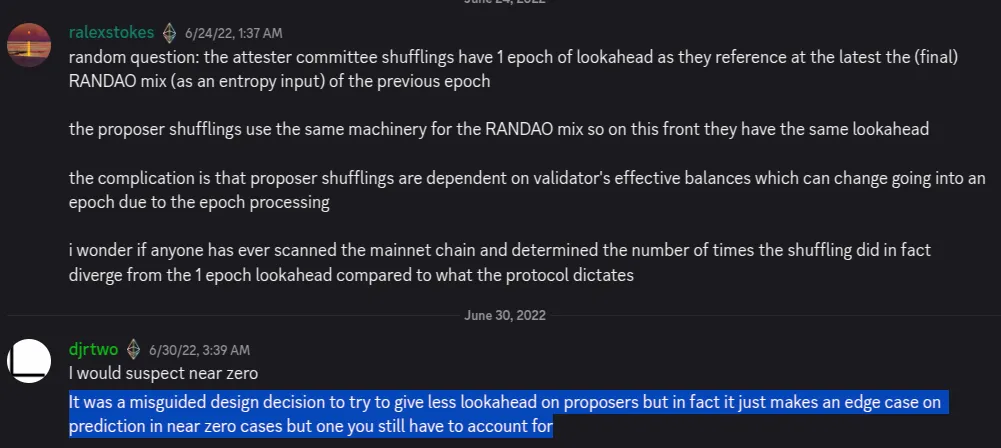
The proposal addresses a previously identified limitation concerning the nondeterministic nature of next-epoch proposer assignments.
Specification
Introducing proposer_lookahead
A new field, proposer_lookahead, is added to BeaconState to store precomputed proposer indices.
The vector starts at the first slot of the current epoch and extends through the configured lookahead period.
class BeaconState:
    ...
    proposer_lookahead: Vector[ValidatorIndex, (MIN_SEED_LOOKAHEAD + 1) * SLOTS_PER_EPOCH]
For example:
- proposer_lookahead[0] identifies the proposer assigned to the first slot of the current epoch.
- proposer_lookahead[SLOTS_PER_EPOCH + 4] identifies the proposer assigned to the fifth slot of the next epoch.
Retrieving the proposer
Instead of dynamically recalculating the proposer for the current slot, clients can retrieve the corresponding validator index from proposer_lookahead.
def get_beacon_proposer_index(state: BeaconState) -> ValidatorIndex:
    return state.proposer_lookahead[state.slot % SLOTS_PER_EPOCH]
The slot number modulo SLOTS_PER_EPOCH identifies the position within the current epoch's portion of the vector.
Updating proposer_lookahead
At each epoch transition, the schedule is advanced:
- Remove the assignments for the epoch that is ending by shifting the remaining entries forward.
- Compute and append the assignments needed to extend the lookahead window.
The update is integrated into epoch processing.
def process_epoch(state: BeaconState) -> None:
    ...
    process_proposer_lookahead(state)
The original article illustrates the update using the following pseudocode.
def process_proposer_lookahead(state: BeaconState) -> None:
    last_epoch_start = len(state.proposer_lookahead) - SLOTS_PER_EPOCH

    # 過去分(現在のエポック)を前に詰める
    state.proposer_lookahead[:last_epoch_start] = state.proposer_lookahead[SLOTS_PER_EPOCH:]

    # 新しい proposer を計算して末尾に追加
    last_epoch_proposers = compute_proposer_indices(
        state,
        Epoch(get_current_epoch(state) + MIN_SEED_LOOKAHEAD)
    )
    state.proposer_lookahead[last_epoch_start:] = last_epoch_proposers
This example preserves the original Japanese comments. It illustrates shifting the schedule and filling its final segment.
The excerpts are not a complete consensus-client implementation. In particular, the target epoch used when appending entries must be consistent with the point in epoch processing at which the function executes and the normative consensus specification. Implementers should use the applicable fork specification rather than relying on this abbreviated pseudocode.
Initialization at the fork
When the feature is activated, the state upgrade must initialize the proposer_lookahead vector for the required epochs.
This allows the new proposer lookup mechanism to operate immediately on the upgraded beacon state.
Implementation context
The change is part of the beacon chain's consensus specification and must be implemented consistently by consensus clients.
Storing the proposer schedule explicitly can simplify based protocols, block-proposal-related applications, and security analysis.
Rationale
Alternative design
One alternative considered caching the effective balances at the beginning of epoch N and using them to select proposers for epoch N + MIN_SEED_LOOKAHEAD.
This would also help make future assignments predictable, but it has disadvantages:
- Additional beacon-state storage would be required for cached effective balances.
- Applications would still need to reconstruct the proposer schedule from those balances rather than directly proving a stored proposer assignment.
The proposal instead stores the resulting proposer schedule itself.
Compatibility with single secret leader election (SSLE)
A future single secret leader election mechanism could conceal the identity of the proposer until an appropriate point in the slot. This is intended to help protect proposers against targeted denial-of-service attacks.
Some proposed SSLE designs involve an encrypted proposer schedule. Consequently, an explicit lookahead field does not necessarily prevent future adoption of SSLE.
Possible adaptations discussed in the original article include:
- Changing the field to a structure containing encrypted validator indices, such as List[EncryptedValidatorIndex].
- Removing or replacing the existing lookahead structure if a future design does not require it.
These would require corresponding consensus changes. The fixed-length vector introduced here cannot simply be assigned an empty list under its existing type definition.
The original discussion also considers whether future attester-proposer separation (APS) designs could reduce the need for SSLE.
Computational cost at epoch boundaries
Previously, a client could compute individual proposer assignments as needed for each slot.
Precomputing an epoch's assignments moves a batch of approximately 32 proposer calculations to an epoch transition.
Proposer selection involves pseudorandom sampling and effective-balance-based acceptance criteria. Although the work is relatively limited, client developers must evaluate its performance at epoch boundaries, especially under adverse conditions.
Security
Preventing schedule manipulation
A proposer-selection mechanism must account for attempts to bias assignments in a validator's favor.
EIP-7917 retains the existing seed lookahead relationship discussed in the proposal. The randomness relevant to epoch N is derived from the RANDAO mix associated with epoch N - MIN_SEED_LOOKAHEAD - 1.
The proposal changes the timing of the effective balances used alongside that randomness. It does not make RANDAO universally immune to manipulation or eliminate all possible proposer-selection grinding.
Timing of effective-balance snapshots
The essential difference is when effective balances are taken into account:
- Previous mechanism
- Proposer assignments for epoch N depend on the effective balances applicable at the beginning of epoch N.
- Proposed mechanism
- Assignments for epoch N are committed in advance using effective balances from the earlier lookahead epoch.
This prevents subsequent effective-balance changes from altering assignments that have already been committed to the proposer schedule.
Addressing a theoretical attack vector
The original proposal discusses effective-balance grinding as a theoretical concern rather than establishing that such an attack had already occurred.
By committing the schedule in advance, EIP-7917 removes the specific opportunity to change an already determined schedule through subsequent effective-balance updates.
The resulting schedule is deterministic relative to a particular valid beacon state. Chain reorganizations can still change which state is canonical, so applications must consider their confirmation and finality requirements.
Citation
Lin Oshitani (@linoscope) lin@nethermind.io, Justin Drake (@JustinDrake) justin@ethereum.org, "EIP-7917: Deterministic proposer lookahead [DRAFT]," Ethereum Improvement Proposals, no. 7917, March 2025. [Online serial]. Available: https://eips.ethereum.org/EIPS/eip-7917.
Conclusion
EIP-7917 introduces a precomputed proposer schedule in the beacon state, providing deterministic lookahead for upcoming proposer assignments and simplifying their use by consensus clients and application-layer protocols.
Questions are welcome via Twitter @cardene777.
Other publications:


