Introduction
Hi, I'm cardene, a software engineer and technical writer focused on blockchain and AI.
I've also authored Japanese technical books on specification-driven development with LLMs and decentralized application (DApp) development.

I also build and publish a variety of tools, libraries, and open-source projects.
In this article, I use Bunzz's new DeCipher feature to examine the UniswapV2Pair contract in Uniswap V2.
DeCipher is a service that automatically generates contract documentation using AI.
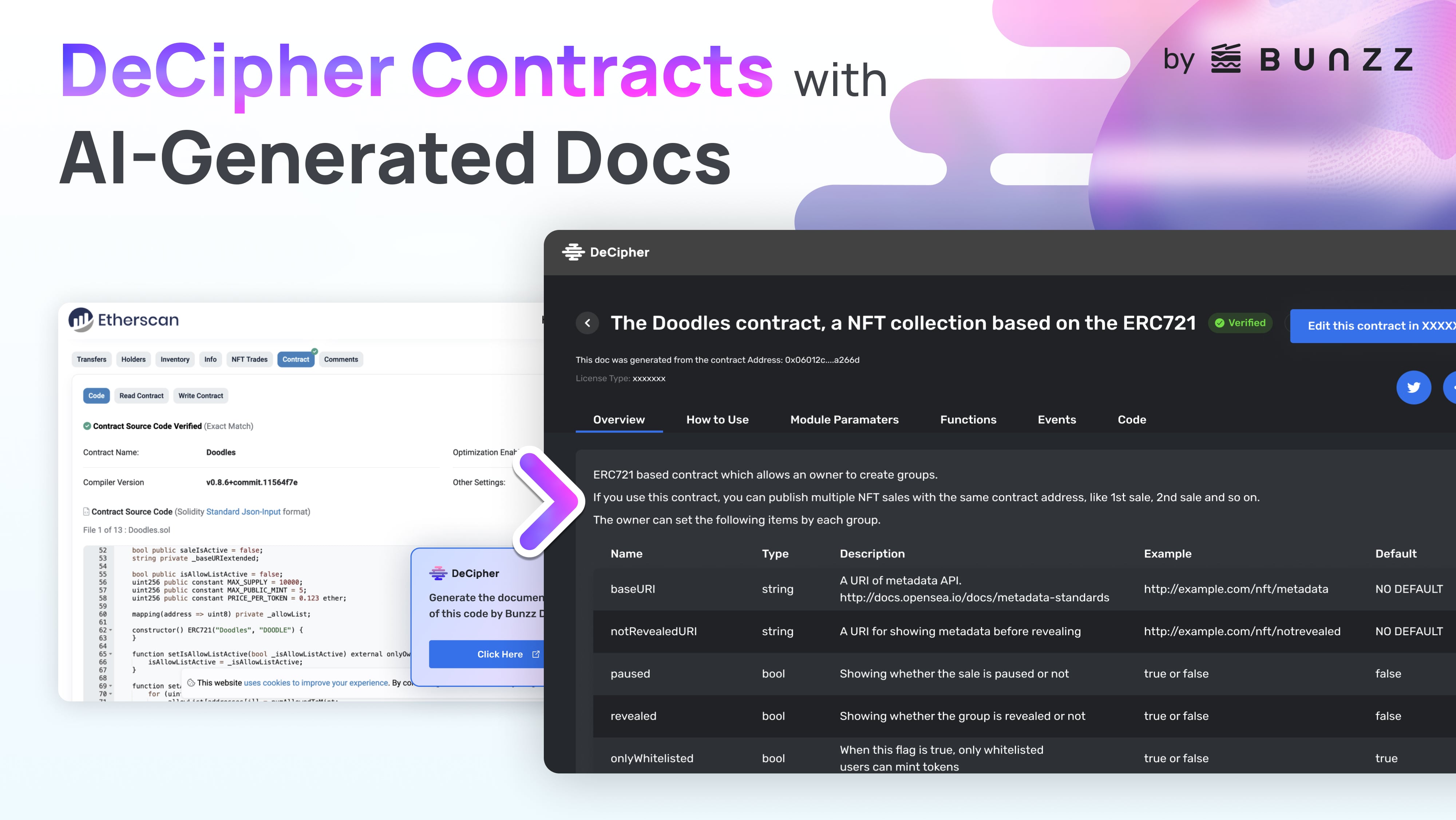
For detailed instructions on using it, see the following article.
This article reflects my personal experience using DeCipher. There may be inaccuracies, so please let me know in the comments if you find any.
Translation note: The original AI-generated analysis contains inaccuracies about liquidity operations, allowances,
skim, andsync. The English explanations of these operations have been corrected against the reproduced implementation; the code is unchanged.
Here is the link to the DeCipher analysis used in this article.
Overview
Summary
The UniswapV2Pair contract is a key component of Uniswap, a decentralized exchange protocol built on Ethereum. The contract manages and executes trades between a pair of ERC20 tokens. It forms the core of the Uniswap V2 protocol and allows any two ERC20 tokens to be traded without a common base currency.
Purpose
The main purpose of UniswapV2Pair is to manage a liquidity pool for a particular token pair. The contract handles adding and removing liquidity, as well as token swaps. It also tracks the reserves (amounts held) of each token to calculate swap prices.
Contract responsibilities
The UniswapV2Pair contract has several core responsibilities.
Token management
The contract manages two ERC20 tokens, known as token0 and token1.
These may be any ERC20 tokens on Ethereum.
Reserve management
The contract records the reserves of both tokens in the pair.
These reserves are used to execute trades and calculate prices.
The reserves are stored in the private variables reserve0 and reserve1.
Price calculation
The contract calculates token swap prices based on each token's reserves.
It also maintains cumulative price variables (price0CumulativeLast and price1CumulativeLast) for calculating the pair's time-weighted average price (TWAP).
Liquidity events
The contract tracks the kLast variable.
This represents the product of the token pair's reserves at the most recent liquidity event.
It is used to calculate liquidity provider fees.
Lock mechanism
The contract includes a locking mechanism to prevent reentrancy attacks.
It is implemented through the unlocked variable and the lock modifier.
Approvals and transfers
The contract includes functions for approving and transferring tokens.
These functions (approve, transfer, and transferFrom) are standard ERC20 token functionality and allow tokens to move between addresses.
Synchronization
The sync function is used to update reserves and prices after a trade or liquidity event.
Initialization
The initialize function sets the token pair's addresses when the contract is first created.
In summary, UniswapV2Pair is a fundamental component of the Uniswap protocol. It manages the token pair's reserves and prices and facilitates token trading and transfers. It is part of the complex smart contract system that makes the decentralized exchange work.
How to use the contract
UniswapV2Pair is a core part of Uniswap, a decentralized exchange protocol on Ethereum. The contract manages a liquidity pool for two different tokens and facilitates swaps between them.
The following steps explain how to interact with UniswapV2Pair.
1. Create the token pair
First, create a pair for the tokens you want to supply as liquidity or swap.
To do this, call createPair on the IUniswapV2Factory contract.
The function requires two arguments: the addresses of the tokens for which you want to create the pair.
2. Add liquidity
Once the pair exists, send the appropriate amounts of both tokens to the pair and call mint(to) to mint liquidity tokens. In practice, use a router or an atomic transaction rather than leaving tokens in the pair between separate transactions.
3. Approve the router when using a router
When interacting through a router that pulls your tokens via transferFrom, approve that router to spend the required amount. The pair's low-level functions themselves do not require an allowance to the pair.
Call approve on each token contract if the router needs an allowance.
Specify the router address and the amount to approve.
4. Swap tokens
For a low-level pair swap, supply the input tokens and call swap with the requested output amounts. Use the router for ordinary swaps.
The function requires four arguments.
- Requested output amount of
token0. - Requested output amount of
token1. - Address to receive the swapped tokens.
- Additional data.
5. Remove liquidity
To remove liquidity, send the liquidity tokens to the pair contract and call burn(to), preferably atomically or through a router.
The burn call burns those liquidity tokens and returns the corresponding amounts of the underlying assets.
6. Check balances and allowances
To check the balance of a particular address, call balanceOf.
Similarly, call allowance to check the allowance for a particular address.
Interacting with smart contracts requires an understanding of Ethereum and the Solidity programming language. Always test on a testnet before deploying to production.
Parameters
factory- Address of the UniswapV2Factory contract that deployed UniswapV2Pair.
token0- Address of one of the tokens in the pair represented by UniswapV2Pair.
token1- Address of the other token in the pair represented by UniswapV2Pair.
Functions
For common ERC20 token functions, see the following article.
READ
DOMAIN_SEPARATOR
function DOMAIN_SEPARATOR() external view returns (bytes32);Function that retrieves the domain separator used to verify signatures for permit.
A domain separator is a contract-specific identifier used to prevent replay attacks.
It is calculated by hashing the contract name, version, and chain ID using the keccak256 hash function.
The function returns the domain separator as a bytes32 value.
Users can compare the expected domain separator with the returned value when verifying a signature for a permit call.
This helps ensure the integrity and security of permit calls and provides a way to verify the validity of their signatures.
MINIMUM_LIQUIDITY
function MINIMUM_LIQUIDITY() external pure returns (uint);Function that retrieves the value of the MINIMUM_LIQUIDITY constant.
The MINIMUM_LIQUIDITY constant represents the minimum quantity of liquidity tokens generated for the liquidity pool.
When users provide liquidity, liquidity tokens are generated by depositing equal values of both token0 and token1.
MINIMUM_LIQUIDITY is a predefined value established when the liquidity pool is initialized.
MINIMUM_LIQUIDITY is typically a small, nonzero value intended to prevent division-by-zero errors and ensure the liquidity pool operates correctly.
Users can retrieve the minimum amount of liquidity tokens generated when liquidity is supplied to the pool.
PERMIT_TYPEHASH
function PERMIT_TYPEHASH() external pure returns (bytes32);Function that provides the type hash for permit.
The type hash is a unique identifier for the permit signature and is used in the EIP712 signature verification process.
The function returns the value of the PERMIT_TYPEHASH variable, of type bytes32.
It is used by permit itself and other functions in the contract that need its type hash, such as functions that verify or process permit signatures.
factory
function factory() external view returns (address);Function that retrieves the address of the Factory contract. The Factory contract creates new instances of this contract. Users can call this function to retrieve the factory contract's address. This is useful for various purposes, such as verifying the contract's authenticity and interacting with the factory directly.
See the following article for details about the Factory contract.
getReserves
function getReserves() public view returns (uint112 _reserve0, uint112 _reserve1, uint32 _blockTimestampLast) {
        _reserve0 = reserve0;
        _reserve1 = reserve1;
        _blockTimestampLast = blockTimestampLast;
}
Function that retrieves the contract's current reserves and the block timestamp at which they were last updated. It returns three values.
_reserve0- Current reserve of
token0.
- Current reserve of
_reserve1- Current reserve of
token1.
- Current reserve of
_blockTimestampLast- Timestamp of the last block in which the reserves were updated.
kLast
function kLast() external view returns (uint);Function that retrieves the value of the kLast variable.
kLast represents the product of the token0 and token1 reserves when liquidity was last added to the pool.
Users can retrieve the value of kLast using this function.
nonces
function nonces(address owner) external view returns (uint);Function that retrieves the nonce associated with a particular address.
A nonce is a unique number that increases with each submission from an address.
It is used to prevent replay attacks and ensure transaction integrity.
The function looks up the nonce in the nonces mapping using the specified address as the key.
The mapping stores each address's nonce.
Users can retrieve the nonce for their own address or for other addresses to which they have access.
price0CumulativeLast
function price0CumulativeLast() external view returns (uint);Function that retrieves price0CumulativeLast.
price0CumulativeLast represents the cumulative price between token0 and token1.
The cumulative price is the accumulated price of token0 over a given period.
It is an important indicator of historical price movements.
A cumulative price reflects price changes over a specified period.
It is calculated by multiplying the price of token0 by the time elapsed since the previous price update.
Accumulating these values over time produces the cumulative price.
This information can help track a token's historical price movements and inform investment decisions.
price1CumulativeLast
function price1CumulativeLast() external view returns (uint);Function that retrieves price1CumulativeLast.
price1CumulativeLast represents the cumulative price between token0 and token1.
The cumulative price is the accumulated price of token1 over a given period.
It is an important indicator of historical price movements.
token0
function token0() external view returns (address);Function that retrieves the value of token0.
Users can call this function to obtain the address of the first token in the pair.
token1
function token1() external view returns (address);Function that retrieves the value of token1.
Users can call this function to obtain the address of the second token in the pair.
WRITE
initialize
function initialize(address _token0, address _token1) external {
        require(msg.sender == factory, 'UniswapV2: FORBIDDEN'); // sufficient check
        token0 = _token0;
        token1 = _token1;
}
Function that initializes the contract using the addresses of the two tokens in the liquidity pool.
It takes two address parameters, _token0 and _token1.
In the workflow described here, this function is called when a new contract instance is deployed or a new liquidity pool is set up.
permit
function permit(address owner, address spender, uint value, uint deadline, uint8 v, bytes32 r, bytes32 s) external {
        require(deadline >= block.timestamp, 'UniswapV2: EXPIRED');
        bytes32 digest = keccak256(
            abi.encodePacked(
                '\x19\x01',
                DOMAIN_SEPARATOR,
                keccak256(abi.encode(PERMIT_TYPEHASH, owner, spender, value, nonces[owner]++, deadline))
            )
        );
        address recoveredAddress = ecrecover(digest, v, r, s);
        require(recoveredAddress != address(0) && recoveredAddress == owner, 'UniswapV2: INVALID_SIGNATURE');
        _approve(owner, spender, value);
}
Function allowing a user to approve token spending by another address without multiple transactions.
Before approving the spending, the function compares the current block timestamp with deadline to check whether the permit has expired.
If deadline has passed, the function reverts with 'UniswapV2: EXPIRED'.
It then computes a digest by hashing packed data including the domain separator, the permit type hash, owner, spender, value, nonce, and deadline.
The digest is used with ECDSA's recover operation to recover the address that signed the permit.
The function checks that the recovered address is nonzero and matches the owner's address.
If verification fails, the function reverts with 'UniswapV2: INVALID_SIGNATURE'.
If verification succeeds, the function calls the internal _approve function to set the spender's allowance over the owner's tokens to the specified value.
Parameters
owner- Address of the token owner.
spender- Address of the account authorized to spend the tokens.
value- Amount of tokens the
spendercan spend.
- Amount of tokens the
deadline- Timestamp at which the
permitexpires.
- Timestamp at which the
v,r, ands- ECDSA signature components used to verify the
permit.
- ECDSA signature components used to verify the
skim
function skim(address to) external lock {
        address _token0 = token0; // gas savings
        address _token1 = token1; // gas savings
        _safeTransfer(_token0, to, IERC20(_token0).balanceOf(address(this)).sub(reserve0));
        _safeTransfer(_token1, to, IERC20(_token1).balanceOf(address(this)).sub(reserve1));
}
Function that sends surplus tokens accumulated in the contract to a specified address.
The implementation does not explicitly check whether to is the zero address.
Instead, _safeTransfer calls each token contract, whose own transfer validation may cause the operation to revert.
Calling balanceOf on each token retrieves the contract's current balances of token0 and token1.
The balanceOf function returns the amount of tokens held by the contract.
The function transfers each token's excess balance over the corresponding stored reserve to the specified to address.
This function is useful for removing excess tokens from the contract and sending them to a specified address. Users can call it to recover tokens that may have been mistakenly sent to the contract or to distribute tokens to a particular address.
Any user can call this function at any time, provided they supply a valid to address.
There are no special prerequisites or restrictions on calling this function.
Parameters
to- Address to which the tokens should be sent.
swap
function swap(uint amount0Out, uint amount1Out, address to, bytes calldata data) external lock {
        require(amount0Out > 0 || amount1Out > 0, 'UniswapV2: INSUFFICIENT_OUTPUT_AMOUNT');
        (uint112 _reserve0, uint112 _reserve1,) = getReserves(); // gas savings
        require(amount0Out < _reserve0 && amount1Out < _reserve1, 'UniswapV2: INSUFFICIENT_LIQUIDITY');

        uint balance0;
        uint balance1;
        { // scope for _token{0,1}, avoids stack too deep errors
        address _token0 = token0;
        address _token1 = token1;
        require(to != _token0 && to != _token1, 'UniswapV2: INVALID_TO');
        if (amount0Out > 0) _safeTransfer(_token0, to, amount0Out); // optimistically transfer tokens
        if (amount1Out > 0) _safeTransfer(_token1, to, amount1Out); // optimistically transfer tokens
        if (data.length > 0) IUniswapV2Callee(to).uniswapV2Call(msg.sender, amount0Out, amount1Out, data);
        balance0 = IERC20(_token0).balanceOf(address(this));
        balance1 = IERC20(_token1).balanceOf(address(this));
        }
        uint amount0In = balance0 > _reserve0 - amount0Out ? balance0 - (_reserve0 - amount0Out) : 0;
        uint amount1In = balance1 > _reserve1 - amount1Out ? balance1 - (_reserve1 - amount1Out) : 0;
        require(amount0In > 0 || amount1In > 0, 'UniswapV2: INSUFFICIENT_INPUT_AMOUNT');
        { // scope for reserve{0,1}Adjusted, avoids stack too deep errors
        uint balance0Adjusted = balance0.mul(1000).sub(amount0In.mul(3));
        uint balance1Adjusted = balance1.mul(1000).sub(amount1In.mul(3));
        require(balance0Adjusted.mul(balance1Adjusted) >= uint(_reserve0).mul(_reserve1).mul(1000**2), 'UniswapV2: K');
        }

        _update(balance0, balance1, _reserve0, _reserve1);
        emit Swap(msg.sender, amount0In, amount1In, amount0Out, amount1Out, to);
}
Function allowing users to exchange tokens in the UniswapV2 contract.
Users can exchange tokens in the UniswapV2 contract using this function. Specifically, they specify the quantities of token 0 and token 1 to exchange, and the exchanged tokens are sent to the specified recipient's address.
Parameters
amount0Out- Amount of token 0 to exchange.
amount1Out- Amount of token 1 to exchange.
to- Recipient address for the tokens.
data- Byte array representing additional data.
sync
function sync() external lock {
        _update(IERC20(token0).balanceOf(address(this)), IERC20(token1).balanceOf(address(this)), reserve0, reserve1);
}
Function that updates token reserves and cumulative price values in a UniswapV2 pair contract.
The function is external and callable by any address, subject to its reentrancy lock.
It calls the internal _update function with the current token balances and previously stored reserves.
It retrieves the actual balances of token 0 and token 1 held by the pair contract.
When time has elapsed and both old reserves are nonzero, _update calculates the cumulative price increments from the ratio of those reserves and the elapsed time, without calling a separate oracle contract.
It updates the cumulative prices, stored reserves, and timestamp, then emits Sync.
This enables accurate price calculations and trading on the Uniswap platform.
Events
Swap
Event triggered whenever a swap between two tokens takes place on the decentralized exchange. The event has six parameters.
sender- Address of the sender initiating the swap.
amount0In- Amount of token 0 supplied as input to the swap.
amount1In- Amount of token 1 supplied as input to the swap.
amount0Out- Amount of token 0 output by the swap.
amount1Out- Amount of token 1 output by the swap.
to- Address receiving the output tokens.
The event indexes the sender and to parameters, allowing them to be used as filters when querying event logs for particular swaps.
In summary, the Swap event provides key information about token swaps on the decentralized exchange, including the sender, input and output token amounts, and recipient of the output tokens.
Sync
Event emitted whenever the reserves of a Uniswap token pair are adjusted. It provides information that allows users to track changes in liquidity and trading activity. The event has two parameters.
reserve0- Updated reserve of the first token.
reserve1- Updated reserve of the second token.
Code
IUniswapV2Pair
IUniswapV2Pair
// File: contracts/interfaces/IUniswapV2Pair.sol

pragma solidity >=0.5.0;

interface IUniswapV2Pair {
    event Approval(address indexed owner, address indexed spender, uint value);
    event Transfer(address indexed from, address indexed to, uint value);

    function name() external pure returns (string memory);
    function symbol() external pure returns (string memory);
    function decimals() external pure returns (uint8);
    function totalSupply() external view returns (uint);
    function balanceOf(address owner) external view returns (uint);
    function allowance(address owner, address spender) external view returns (uint);

    function approve(address spender, uint value) external returns (bool);
    function transfer(address to, uint value) external returns (bool);
    function transferFrom(address from, address to, uint value) external returns (bool);

    function DOMAIN_SEPARATOR() external view returns (bytes32);
    function PERMIT_TYPEHASH() external pure returns (bytes32);
    function nonces(address owner) external view returns (uint);

    function permit(address owner, address spender, uint value, uint deadline, uint8 v, bytes32 r, bytes32 s) external;

    event Mint(address indexed sender, uint amount0, uint amount1);
    event Burn(address indexed sender, uint amount0, uint amount1, address indexed to);
    event Swap(
        address indexed sender,
        uint amount0In,
        uint amount1In,
        uint amount0Out,
        uint amount1Out,
        address indexed to
    );
    event Sync(uint112 reserve0, uint112 reserve1);

    function MINIMUM_LIQUIDITY() external pure returns (uint);
    function factory() external view returns (address);
    function token0() external view returns (address);
    function token1() external view returns (address);
    function getReserves() external view returns (uint112 reserve0, uint112 reserve1, uint32 blockTimestampLast);
    function price0CumulativeLast() external view returns (uint);
    function price1CumulativeLast() external view returns (uint);
    function kLast() external view returns (uint);

    function mint(address to) external returns (uint liquidity);
    function burn(address to) external returns (uint amount0, uint amount1);
    function swap(uint amount0Out, uint amount1Out, address to, bytes calldata data) external;
    function skim(address to) external;
    function sync() external;

    function initialize(address, address) external;
}
IUniswapV2ERC20
IUniswapV2ERC20
// File: contracts/interfaces/IUniswapV2ERC20.sol

pragma solidity >=0.5.0;

interface IUniswapV2ERC20 {
    event Approval(address indexed owner, address indexed spender, uint value);
    event Transfer(address indexed from, address indexed to, uint value);

    function name() external pure returns (string memory);
    function symbol() external pure returns (string memory);
    function decimals() external pure returns (uint8);
    function totalSupply() external view returns (uint);
    function balanceOf(address owner) external view returns (uint);
    function allowance(address owner, address spender) external view returns (uint);

    function approve(address spender, uint value) external returns (bool);
    function transfer(address to, uint value) external returns (bool);
    function transferFrom(address from, address to, uint value) external returns (bool);

    function DOMAIN_SEPARATOR() external view returns (bytes32);
    function PERMIT_TYPEHASH() external pure returns (bytes32);
    function nonces(address owner) external view returns (uint);

    function permit(address owner, address spender, uint value, uint deadline, uint8 v, bytes32 r, bytes32 s) external;
}
SafeMath
SafeMath
// File: contracts/libraries/SafeMath.sol

pragma solidity =0.5.16;

// a library for performing overflow-safe math, courtesy of DappHub (https://github.com/dapphub/ds-math)

library SafeMath {
    function add(uint x, uint y) internal pure returns (uint z) {
        require((z = x + y) >= x, 'ds-math-add-overflow');
    }

    function sub(uint x, uint y) internal pure returns (uint z) {
        require((z = x - y) <= x, 'ds-math-sub-underflow');
    }

    function mul(uint x, uint y) internal pure returns (uint z) {
        require(y == 0 || (z = x * y) / y == x, 'ds-math-mul-overflow');
    }
}
UniswapV2ERC20
UniswapV2ERC20
// File: contracts/UniswapV2ERC20.sol

pragma solidity =0.5.16;


contract UniswapV2ERC20 is IUniswapV2ERC20 {
    using SafeMath for uint;

    string public constant name = 'Uniswap V2';
    string public constant symbol = 'UNI-V2';
    uint8 public constant decimals = 18;
    uint  public totalSupply;
    mapping(address => uint) public balanceOf;
    mapping(address => mapping(address => uint)) public allowance;

    bytes32 public DOMAIN_SEPARATOR;
    // keccak256("Permit(address owner,address spender,uint256 value,uint256 nonce,uint256 deadline)");
    bytes32 public constant PERMIT_TYPEHASH = 0x6e71edae12b1b97f4d1f60370fef10105fa2faae0126114a169c64845d6126c9;
    mapping(address => uint) public nonces;

    event Approval(address indexed owner, address indexed spender, uint value);
    event Transfer(address indexed from, address indexed to, uint value);

    constructor() public {
        uint chainId;
        assembly {
            chainId := chainid
        }
        DOMAIN_SEPARATOR = keccak256(
            abi.encode(
                keccak256('EIP712Domain(string name,string version,uint256 chainId,address verifyingContract)'),
                keccak256(bytes(name)),
                keccak256(bytes('1')),
                chainId,
                address(this)
            )
        );
    }

    function _mint(address to, uint value) internal {
        totalSupply = totalSupply.add(value);
        balanceOf[to] = balanceOf[to].add(value);
        emit Transfer(address(0), to, value);
    }

    function _burn(address from, uint value) internal {
        balanceOf[from] = balanceOf[from].sub(value);
        totalSupply = totalSupply.sub(value);
        emit Transfer(from, address(0), value);
    }

    function _approve(address owner, address spender, uint value) private {
        allowance[owner][spender] = value;
        emit Approval(owner, spender, value);
    }

    function _transfer(address from, address to, uint value) private {
        balanceOf[from] = balanceOf[from].sub(value);
        balanceOf[to] = balanceOf[to].add(value);
        emit Transfer(from, to, value);
    }

    function approve(address spender, uint value) external returns (bool) {
        _approve(msg.sender, spender, value);
        return true;
    }

    function transfer(address to, uint value) external returns (bool) {
        _transfer(msg.sender, to, value);
        return true;
    }

    function transferFrom(address from, address to, uint value) external returns (bool) {
        if (allowance[from][msg.sender] != uint(-1)) {
            allowance[from][msg.sender] = allowance[from][msg.sender].sub(value);
        }
        _transfer(from, to, value);
        return true;
    }

    function permit(address owner, address spender, uint value, uint deadline, uint8 v, bytes32 r, bytes32 s) external {
        require(deadline >= block.timestamp, 'UniswapV2: EXPIRED');
        bytes32 digest = keccak256(
            abi.encodePacked(
                '\x19\x01',
                DOMAIN_SEPARATOR,
                keccak256(abi.encode(PERMIT_TYPEHASH, owner, spender, value, nonces[owner]++, deadline))
            )
        );
        address recoveredAddress = ecrecover(digest, v, r, s);
        require(recoveredAddress != address(0) && recoveredAddress == owner, 'UniswapV2: INVALID_SIGNATURE');
        _approve(owner, spender, value);
    }
}
Math and UQ112x112
Math and UQ112x112
// File: contracts/libraries/Math.sol

pragma solidity =0.5.16;

// a library for performing various math operations

library Math {
    function min(uint x, uint y) internal pure returns (uint z) {
        z = x < y ? x : y;
    }

    // babylonian method (https://en.wikipedia.org/wiki/Methods_of_computing_square_roots#Babylonian_method)
    function sqrt(uint y) internal pure returns (uint z) {
        if (y > 3) {
            z = y;
            uint x = y / 2 + 1;
            while (x < z) {
                z = x;
                x = (y / x + x) / 2;
            }
        } else if (y != 0) {
            z = 1;
        }
    }
}

// File: contracts/libraries/UQ112x112.sol

pragma solidity =0.5.16;

// a library for handling binary fixed point numbers (https://en.wikipedia.org/wiki/Q_(number_format))

// range: [0, 2**112 - 1]
// resolution: 1 / 2**112

library UQ112x112 {
    uint224 constant Q112 = 2**112;

    // encode a uint112 as a UQ112x112
    function encode(uint112 y) internal pure returns (uint224 z) {
        z = uint224(y) * Q112; // never overflows
    }

    // divide a UQ112x112 by a uint112, returning a UQ112x112
    function uqdiv(uint224 x, uint112 y) internal pure returns (uint224 z) {
        z = x / uint224(y);
    }
}
IERC20
IERC20
// File: contracts/interfaces/IERC20.sol

pragma solidity >=0.5.0;

interface IERC20 {
    event Approval(address indexed owner, address indexed spender, uint value);
    event Transfer(address indexed from, address indexed to, uint value);

    function name() external view returns (string memory);
    function symbol() external view returns (string memory);
    function decimals() external view returns (uint8);
    function totalSupply() external view returns (uint);
    function balanceOf(address owner) external view returns (uint);
    function allowance(address owner, address spender) external view returns (uint);

    function approve(address spender, uint value) external returns (bool);
    function transfer(address to, uint value) external returns (bool);
    function transferFrom(address from, address to, uint value) external returns (bool);
}
IUniswapV2Factory
IUniswapV2Factory
// File: contracts/interfaces/IUniswapV2Factory.sol

pragma solidity >=0.5.0;

interface IUniswapV2Factory {
    event PairCreated(address indexed token0, address indexed token1, address pair, uint);

    function feeTo() external view returns (address);
    function feeToSetter() external view returns (address);

    function getPair(address tokenA, address tokenB) external view returns (address pair);
    function allPairs(uint) external view returns (address pair);
    function allPairsLength() external view returns (uint);

    function createPair(address tokenA, address tokenB) external returns (address pair);

    function setFeeTo(address) external;
    function setFeeToSetter(address) external;
}
IUniswapV2Callee
IUniswapV2Callee
// File: contracts/interfaces/IUniswapV2Callee.sol

pragma solidity >=0.5.0;

interface IUniswapV2Callee {
    function uniswapV2Call(address sender, uint amount0, uint amount1, bytes calldata data) external;
}
UniswapV2Pair
UniswapV2Pair
// File: contracts/interfaces/IUniswapV2Pair.sol

pragma solidity >=0.5.0;

interface IUniswapV2Pair {
    event Approval(address indexed owner, address indexed spender, uint value);
    event Transfer(address indexed from, address indexed to, uint value);

    function name() external pure returns (string memory);
    function symbol() external pure returns (string memory);
    function decimals() external pure returns (uint8);
    function totalSupply() external view returns (uint);
    function balanceOf(address owner) external view returns (uint);
    function allowance(address owner, address spender) external view returns (uint);

    function approve(address spender, uint value) external returns (bool);
    function transfer(address to, uint value) external returns (bool);
    function transferFrom(address from, address to, uint value) external returns (bool);

    function DOMAIN_SEPARATOR() external view returns (bytes32);
    function PERMIT_TYPEHASH() external pure returns (bytes32);
    function nonces(address owner) external view returns (uint);

    function permit(address owner, address spender, uint value, uint deadline, uint8 v, bytes32 r, bytes32 s) external;

    event Mint(address indexed sender, uint amount0, uint amount1);
    event Burn(address indexed sender, uint amount0, uint amount1, address indexed to);
    event Swap(
        address indexed sender,
        uint amount0In,
        uint amount1In,
        uint amount0Out,
        uint amount1Out,
        address indexed to
    );
    event Sync(uint112 reserve0, uint112 reserve1);

    function MINIMUM_LIQUIDITY() external pure returns (uint);
    function factory() external view returns (address);
    function token0() external view returns (address);
    function token1() external view returns (address);
    function getReserves() external view returns (uint112 reserve0, uint112 reserve1, uint32 blockTimestampLast);
    function price0CumulativeLast() external view returns (uint);
    function price1CumulativeLast() external view returns (uint);
    function kLast() external view returns (uint);

    function mint(address to) external returns (uint liquidity);
    function burn(address to) external returns (uint amount0, uint amount1);
    function swap(uint amount0Out, uint amount1Out, address to, bytes calldata data) external;
    function skim(address to) external;
    function sync() external;

    function initialize(address, address) external;
}

// File: contracts/interfaces/IUniswapV2ERC20.sol

pragma solidity >=0.5.0;

interface IUniswapV2ERC20 {
    event Approval(address indexed owner, address indexed spender, uint value);
    event Transfer(address indexed from, address indexed to, uint value);

    function name() external pure returns (string memory);
    function symbol() external pure returns (string memory);
    function decimals() external pure returns (uint8);
    function totalSupply() external view returns (uint);
    function balanceOf(address owner) external view returns (uint);
    function allowance(address owner, address spender) external view returns (uint);

    function approve(address spender, uint value) external returns (bool);
    function transfer(address to, uint value) external returns (bool);
    function transferFrom(address from, address to, uint value) external returns (bool);

    function DOMAIN_SEPARATOR() external view returns (bytes32);
    function PERMIT_TYPEHASH() external pure returns (bytes32);
    function nonces(address owner) external view returns (uint);

    function permit(address owner, address spender, uint value, uint deadline, uint8 v, bytes32 r, bytes32 s) external;
}

// File: contracts/libraries/SafeMath.sol

pragma solidity =0.5.16;

// a library for performing overflow-safe math, courtesy of DappHub (https://github.com/dapphub/ds-math)

library SafeMath {
    function add(uint x, uint y) internal pure returns (uint z) {
        require((z = x + y) >= x, 'ds-math-add-overflow');
    }

    function sub(uint x, uint y) internal pure returns (uint z) {
        require((z = x - y) <= x, 'ds-math-sub-underflow');
    }

    function mul(uint x, uint y) internal pure returns (uint z) {
        require(y == 0 || (z = x * y) / y == x, 'ds-math-mul-overflow');
    }
}

// File: contracts/UniswapV2ERC20.sol

pragma solidity =0.5.16;


contract UniswapV2ERC20 is IUniswapV2ERC20 {
    using SafeMath for uint;

    string public constant name = 'Uniswap V2';
    string public constant symbol = 'UNI-V2';
    uint8 public constant decimals = 18;
    uint  public totalSupply;
    mapping(address => uint) public balanceOf;
    mapping(address => mapping(address => uint)) public allowance;

    bytes32 public DOMAIN_SEPARATOR;
    // keccak256("Permit(address owner,address spender,uint256 value,uint256 nonce,uint256 deadline)");
    bytes32 public constant PERMIT_TYPEHASH = 0x6e71edae12b1b97f4d1f60370fef10105fa2faae0126114a169c64845d6126c9;
    mapping(address => uint) public nonces;

    event Approval(address indexed owner, address indexed spender, uint value);
    event Transfer(address indexed from, address indexed to, uint value);

    constructor() public {
        uint chainId;
        assembly {
            chainId := chainid
        }
        DOMAIN_SEPARATOR = keccak256(
            abi.encode(
                keccak256('EIP712Domain(string name,string version,uint256 chainId,address verifyingContract)'),
                keccak256(bytes(name)),
                keccak256(bytes('1')),
                chainId,
                address(this)
            )
        );
    }

    function _mint(address to, uint value) internal {
        totalSupply = totalSupply.add(value);
        balanceOf[to] = balanceOf[to].add(value);
        emit Transfer(address(0), to, value);
    }

    function _burn(address from, uint value) internal {
        balanceOf[from] = balanceOf[from].sub(value);
        totalSupply = totalSupply.sub(value);
        emit Transfer(from, address(0), value);
    }

    function _approve(address owner, address spender, uint value) private {
        allowance[owner][spender] = value;
        emit Approval(owner, spender, value);
    }

    function _transfer(address from, address to, uint value) private {
        balanceOf[from] = balanceOf[from].sub(value);
        balanceOf[to] = balanceOf[to].add(value);
        emit Transfer(from, to, value);
    }

    function approve(address spender, uint value) external returns (bool) {
        _approve(msg.sender, spender, value);
        return true;
    }

    function transfer(address to, uint value) external returns (bool) {
        _transfer(msg.sender, to, value);
        return true;
    }

    function transferFrom(address from, address to, uint value) external returns (bool) {
        if (allowance[from][msg.sender] != uint(-1)) {
            allowance[from][msg.sender] = allowance[from][msg.sender].sub(value);
        }
        _transfer(from, to, value);
        return true;
    }

    function permit(address owner, address spender, uint value, uint deadline, uint8 v, bytes32 r, bytes32 s) external {
        require(deadline >= block.timestamp, 'UniswapV2: EXPIRED');
        bytes32 digest = keccak256(
            abi.encodePacked(
                '\x19\x01',
                DOMAIN_SEPARATOR,
                keccak256(abi.encode(PERMIT_TYPEHASH, owner, spender, value, nonces[owner]++, deadline))
            )
        );
        address recoveredAddress = ecrecover(digest, v, r, s);
        require(recoveredAddress != address(0) && recoveredAddress == owner, 'UniswapV2: INVALID_SIGNATURE');
        _approve(owner, spender, value);
    }
}

// File: contracts/libraries/Math.sol

pragma solidity =0.5.16;

// a library for performing various math operations

library Math {
    function min(uint x, uint y) internal pure returns (uint z) {
        z = x < y ? x : y;
    }

    // babylonian method (https://en.wikipedia.org/wiki/Methods_of_computing_square_roots#Babylonian_method)
    function sqrt(uint y) internal pure returns (uint z) {
        if (y > 3) {
            z = y;
            uint x = y / 2 + 1;
            while (x < z) {
                z = x;
                x = (y / x + x) / 2;
            }
        } else if (y != 0) {
            z = 1;
        }
    }
}

// File: contracts/libraries/UQ112x112.sol

pragma solidity =0.5.16;

// a library for handling binary fixed point numbers (https://en.wikipedia.org/wiki/Q_(number_format))

// range: [0, 2**112 - 1]
// resolution: 1 / 2**112

library UQ112x112 {
    uint224 constant Q112 = 2**112;

    // encode a uint112 as a UQ112x112
    function encode(uint112 y) internal pure returns (uint224 z) {
        z = uint224(y) * Q112; // never overflows
    }

    // divide a UQ112x112 by a uint112, returning a UQ112x112
    function uqdiv(uint224 x, uint112 y) internal pure returns (uint224 z) {
        z = x / uint224(y);
    }
}

// File: contracts/interfaces/IERC20.sol

pragma solidity >=0.5.0;

interface IERC20 {
    event Approval(address indexed owner, address indexed spender, uint value);
    event Transfer(address indexed from, address indexed to, uint value);

    function name() external view returns (string memory);
    function symbol() external view returns (string memory);
    function decimals() external view returns (uint8);
    function totalSupply() external view returns (uint);
    function balanceOf(address owner) external view returns (uint);
    function allowance(address owner, address spender) external view returns (uint);

    function approve(address spender, uint value) external returns (bool);
    function transfer(address to, uint value) external returns (bool);
    function transferFrom(address from, address to, uint value) external returns (bool);
}

// File: contracts/interfaces/IUniswapV2Factory.sol

pragma solidity >=0.5.0;

interface IUniswapV2Factory {
    event PairCreated(address indexed token0, address indexed token1, address pair, uint);

    function feeTo() external view returns (address);
    function feeToSetter() external view returns (address);

    function getPair(address tokenA, address tokenB) external view returns (address pair);
    function allPairs(uint) external view returns (address pair);
    function allPairsLength() external view returns (uint);

    function createPair(address tokenA, address tokenB) external returns (address pair);

    function setFeeTo(address) external;
    function setFeeToSetter(address) external;
}

// File: contracts/interfaces/IUniswapV2Callee.sol

pragma solidity >=0.5.0;

interface IUniswapV2Callee {
    function uniswapV2Call(address sender, uint amount0, uint amount1, bytes calldata data) external;
}

// File: contracts/UniswapV2Pair.sol

pragma solidity =0.5.16;

contract UniswapV2Pair is IUniswapV2Pair, UniswapV2ERC20 {
    using SafeMath  for uint;
    using UQ112x112 for uint224;

    uint public constant MINIMUM_LIQUIDITY = 10**3;
    bytes4 private constant SELECTOR = bytes4(keccak256(bytes('transfer(address,uint256)')));

    address public factory;
    address public token0;
    address public token1;

    uint112 private reserve0;           // uses single storage slot, accessible via getReserves
    uint112 private reserve1;           // uses single storage slot, accessible via getReserves
    uint32  private blockTimestampLast; // uses single storage slot, accessible via getReserves

    uint public price0CumulativeLast;
    uint public price1CumulativeLast;
    uint public kLast; // reserve0 * reserve1, as of immediately after the most recent liquidity event

    uint private unlocked = 1;
    modifier lock() {
        require(unlocked == 1, 'UniswapV2: LOCKED');
        unlocked = 0;
        _;
        unlocked = 1;
    }

    function getReserves() public view returns (uint112 _reserve0, uint112 _reserve1, uint32 _blockTimestampLast) {
        _reserve0 = reserve0;
        _reserve1 = reserve1;
        _blockTimestampLast = blockTimestampLast;
    }

    function _safeTransfer(address token, address to, uint value) private {
        (bool success, bytes memory data) = token.call(abi.encodeWithSelector(SELECTOR, to, value));
        require(success && (data.length == 0 || abi.decode(data, (bool))), 'UniswapV2: TRANSFER_FAILED');
    }

    event Mint(address indexed sender, uint amount0, uint amount1);
    event Burn(address indexed sender, uint amount0, uint amount1, address indexed to);
    event Swap(
        address indexed sender,
        uint amount0In,
        uint amount1In,
        uint amount0Out,
        uint amount1Out,
        address indexed to
    );
    event Sync(uint112 reserve0, uint112 reserve1);

    constructor() public {
        factory = msg.sender;
    }

    // called once by the factory at time of deployment
    function initialize(address _token0, address _token1) external {
        require(msg.sender == factory, 'UniswapV2: FORBIDDEN'); // sufficient check
        token0 = _token0;
        token1 = _token1;
    }

    // update reserves and, on the first call per block, price accumulators
    function _update(uint balance0, uint balance1, uint112 _reserve0, uint112 _reserve1) private {
        require(balance0 <= uint112(-1) && balance1 <= uint112(-1), 'UniswapV2: OVERFLOW');
        uint32 blockTimestamp = uint32(block.timestamp % 2**32);
        uint32 timeElapsed = blockTimestamp - blockTimestampLast; // overflow is desired
        if (timeElapsed > 0 && _reserve0 != 0 && _reserve1 != 0) {
            // * never overflows, and + overflow is desired
            price0CumulativeLast += uint(UQ112x112.encode(_reserve1).uqdiv(_reserve0)) * timeElapsed;
            price1CumulativeLast += uint(UQ112x112.encode(_reserve0).uqdiv(_reserve1)) * timeElapsed;
        }
        reserve0 = uint112(balance0);
        reserve1 = uint112(balance1);
        blockTimestampLast = blockTimestamp;
        emit Sync(reserve0, reserve1);
    }

    // if fee is on, mint liquidity equivalent to 1/6th of the growth in sqrt(k)
    function _mintFee(uint112 _reserve0, uint112 _reserve1) private returns (bool feeOn) {
        address feeTo = IUniswapV2Factory(factory).feeTo();
        feeOn = feeTo != address(0);
        uint _kLast = kLast; // gas savings
        if (feeOn) {
            if (_kLast != 0) {
                uint rootK = Math.sqrt(uint(_reserve0).mul(_reserve1));
                uint rootKLast = Math.sqrt(_kLast);
                if (rootK > rootKLast) {
                    uint numerator = totalSupply.mul(rootK.sub(rootKLast));
                    uint denominator = rootK.mul(5).add(rootKLast);
                    uint liquidity = numerator / denominator;
                    if (liquidity > 0) _mint(feeTo, liquidity);
                }
            }
        } else if (_kLast != 0) {
            kLast = 0;
        }
    }

    // this low-level function should be called from a contract which performs important safety checks
    function mint(address to) external lock returns (uint liquidity) {
        (uint112 _reserve0, uint112 _reserve1,) = getReserves(); // gas savings
        uint balance0 = IERC20(token0).balanceOf(address(this));
        uint balance1 = IERC20(token1).balanceOf(address(this));
        uint amount0 = balance0.sub(_reserve0);
        uint amount1 = balance1.sub(_reserve1);

        bool feeOn = _mintFee(_reserve0, _reserve1);
        uint _totalSupply = totalSupply; // gas savings, must be defined here since totalSupply can update in _mintFee
        if (_totalSupply == 0) {
            liquidity = Math.sqrt(amount0.mul(amount1)).sub(MINIMUM_LIQUIDITY);
           _mint(address(0), MINIMUM_LIQUIDITY); // permanently lock the first MINIMUM_LIQUIDITY tokens
        } else {
            liquidity = Math.min(amount0.mul(_totalSupply) / _reserve0, amount1.mul(_totalSupply) / _reserve1);
        }
        require(liquidity > 0, 'UniswapV2: INSUFFICIENT_LIQUIDITY_MINTED');
        _mint(to, liquidity);

        _update(balance0, balance1, _reserve0, _reserve1);
        if (feeOn) kLast = uint(reserve0).mul(reserve1); // reserve0 and reserve1 are up-to-date
        emit Mint(msg.sender, amount0, amount1);
    }

    // this low-level function should be called from a contract which performs important safety checks
    function burn(address to) external lock returns (uint amount0, uint amount1) {
        (uint112 _reserve0, uint112 _reserve1,) = getReserves(); // gas savings
        address _token0 = token0;                                // gas savings
        address _token1 = token1;                                // gas savings
        uint balance0 = IERC20(_token0).balanceOf(address(this));
        uint balance1 = IERC20(_token1).balanceOf(address(this));
        uint liquidity = balanceOf[address(this)];

        bool feeOn = _mintFee(_reserve0, _reserve1);
        uint _totalSupply = totalSupply; // gas savings, must be defined here since totalSupply can update in _mintFee
        amount0 = liquidity.mul(balance0) / _totalSupply; // using balances ensures pro-rata distribution
        amount1 = liquidity.mul(balance1) / _totalSupply; // using balances ensures pro-rata distribution
        require(amount0 > 0 && amount1 > 0, 'UniswapV2: INSUFFICIENT_LIQUIDITY_BURNED');
        _burn(address(this), liquidity);
        _safeTransfer(_token0, to, amount0);
        _safeTransfer(_token1, to, amount1);
        balance0 = IERC20(_token0).balanceOf(address(this));
        balance1 = IERC20(_token1).balanceOf(address(this));

        _update(balance0, balance1, _reserve0, _reserve1);
        if (feeOn) kLast = uint(reserve0).mul(reserve1); // reserve0 and reserve1 are up-to-date
        emit Burn(msg.sender, amount0, amount1, to);
    }

    // this low-level function should be called from a contract which performs important safety checks
    function swap(uint amount0Out, uint amount1Out, address to, bytes calldata data) external lock {
        require(amount0Out > 0 || amount1Out > 0, 'UniswapV2: INSUFFICIENT_OUTPUT_AMOUNT');
        (uint112 _reserve0, uint112 _reserve1,) = getReserves(); // gas savings
        require(amount0Out < _reserve0 && amount1Out < _reserve1, 'UniswapV2: INSUFFICIENT_LIQUIDITY');

        uint balance0;
        uint balance1;
        { // scope for _token{0,1}, avoids stack too deep errors
        address _token0 = token0;
        address _token1 = token1;
        require(to != _token0 && to != _token1, 'UniswapV2: INVALID_TO');
        if (amount0Out > 0) _safeTransfer(_token0, to, amount0Out); // optimistically transfer tokens
        if (amount1Out > 0) _safeTransfer(_token1, to, amount1Out); // optimistically transfer tokens
        if (data.length > 0) IUniswapV2Callee(to).uniswapV2Call(msg.sender, amount0Out, amount1Out, data);
        balance0 = IERC20(_token0).balanceOf(address(this));
        balance1 = IERC20(_token1).balanceOf(address(this));
        }
        uint amount0In = balance0 > _reserve0 - amount0Out ? balance0 - (_reserve0 - amount0Out) : 0;
        uint amount1In = balance1 > _reserve1 - amount1Out ? balance1 - (_reserve1 - amount1Out) : 0;
        require(amount0In > 0 || amount1In > 0, 'UniswapV2: INSUFFICIENT_INPUT_AMOUNT');
        { // scope for reserve{0,1}Adjusted, avoids stack too deep errors
        uint balance0Adjusted = balance0.mul(1000).sub(amount0In.mul(3));
        uint balance1Adjusted = balance1.mul(1000).sub(amount1In.mul(3));
        require(balance0Adjusted.mul(balance1Adjusted) >= uint(_reserve0).mul(_reserve1).mul(1000**2), 'UniswapV2: K');
        }

        _update(balance0, balance1, _reserve0, _reserve1);
        emit Swap(msg.sender, amount0In, amount1In, amount0Out, amount1Out, to);
    }

    // force balances to match reserves
    function skim(address to) external lock {
        address _token0 = token0; // gas savings
        address _token1 = token1; // gas savings
        _safeTransfer(_token0, to, IERC20(_token0).balanceOf(address(this)).sub(reserve0));
        _safeTransfer(_token1, to, IERC20(_token1).balanceOf(address(this)).sub(reserve1));
    }

    // force reserves to match balances
    function sync() external lock {
        _update(IERC20(token0).balanceOf(address(this)), IERC20(token1).balanceOf(address(this)), reserve0, reserve1);
    }
}
Conclusion
This article used Bunzz's new DeCipher feature to examine the UniswapV2Pair contract in UniswapV2. I hope it was useful. I plan to continue exploring particular NFTs and contracts in future articles.