Introduction
Hi, I'm cardene, a software engineer and technical writer focused on blockchain and AI.
I've also authored Japanese technical books on specification-driven development with LLMs and decentralized application (DApp) development.

I also build and publish a variety of tools, libraries, and open-source projects.
This article examines EIP-8134, which records the first application of a lightweight network upgrade that changes only blob parameters.
This article explains the material linked below.

Ethereum introduced a lightweight upgrade mechanism that changes only blob parameters to expand its data capacity incrementally. EIP-8134 is a Meta EIP recording the activation information and parameter values of its first application, BPO1.
Overview
EIP-8134 is the official record of BPO1, the first Blob Parameter Only (BPO) upgrade implemented on Ethereum.
Unlike conventional hard forks involving substantial protocol changes, BPO upgrades modify only blob-related parameters. EIP-8134 formally records four values: the BPO1 activation timestamp, Blob Target, Blob Max, and Base Fee Update Fraction. Ecosystem participants can therefore consult a single document for BPO1's details.
What Is a Blob?
A blob (Binary Large Object) is a data structure introduced by EIP-4844. Layer 2 (L2) networks use blobs to post transaction data to Ethereum at a much lower cost than conventional transaction data. Blobs are retained by the network for approximately 18 days (4096 epochs), after which indefinite retention is not required.
Motivation
Ethereum's scaling strategy delegates transaction execution to L2 networks while Ethereum itself serves as a data availability (DA) layer.
Demand for DA from L2 networks is growing rapidly. If blob parameters can only be changed as part of major hard forks, upgrades may not keep pace with L2 growth.
Challenges of Conventional Hard Forks
Conventional hard forks such as Cancun and Prague introduce substantial protocol changes, presenting several challenges.
| Challenge | Details |
|---|---|
| Long preparation time | Client implementation, testing, and community coordination take months. |
| Broad scope of changes | Numerous changes besides blob parameters increase risk. |
| Low frequency | Upgrades typically occur only once or twice a year, making rapid responses to demand difficult. |
Benefits of BPO Upgrades
Blob Parameter Only (BPO) upgrades change only blob-related parameters.
Under the mechanism defined by EIP-7892, clients can apply the parameters through configuration changes, substantially reducing preparation and testing overhead. This allows blob capacity to expand safely and rapidly.
Why Is a Meta EIP Needed?
EIP-7892 defines the mechanisms and rules for BPO upgrades, but it does not track the particular values applied in every upgrade.
BPO1 activation information and parameter values were dispersed across client repositories and operational notes, making it difficult for ecosystem participants to obtain consistent information.
EIP-8134 addresses this gap by consolidating the official record of BPO1 in a single document.
Specification
BPO1 Parameters
BPO1 applies the following parameters.
| Field | Value |
|---|---|
| BPO identifier | BPO1 |
| Activation timestamp (UTC) | 1765290071 |
| Blob Target | 10 |
| Blob Max | 15 |
| Base Fee Update Fraction | 8,346,193 |
BPO1 is the first blob parameter change following the Fusaka upgrade and the first step in expanding blob capacity incrementally through BPO upgrades.
Meaning of Each Parameter
Blob Target
The target number of blobs per block. The network adjusts blob fees according to demand relative to this target, increasing fees when usage exceeds the target and decreasing them when usage is lower, subject to the fee mechanism. BPO1 sets this value to 10.
Blob Max
The maximum number of blobs that can be included in one block. A block can contain more blobs than the target, but not more than this maximum. BPO1 sets it to 15.
Base Fee Update Fraction
A coefficient that controls the rate at which blob fees change. A larger value makes fee changes more gradual. BPO1 sets it to 8,346,193 to moderate fee increases as blob usage grows.
Comparison with Previous Upgrades
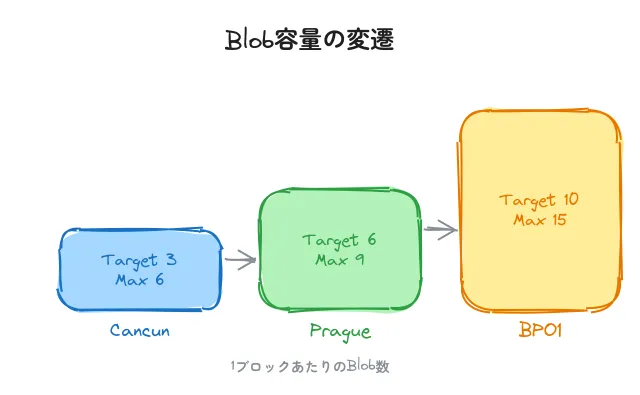
BPO1 further increases blob capacity, following the incremental expansions in Cancun and Prague.
| Upgrade | Blob Target | Blob Max | Base Fee Update Fraction |
|---|---|---|---|
| Cancun | 3 | 6 | 3,338,477 |
| Prague | 6 | 9 | 5,007,716 |
| BPO1 | 10 | 15 | 8,346,193 |
When Cancun introduced blobs, the target was 3 and the maximum was 6. Prague increased those values to 6 and 9, respectively. BPO1 further increases them to 10 and 15.
The maximum blob count per block is now 2.5 times the Cancun value, significantly increasing the amount of data L2 networks can post to Ethereum.
Data Source
The BPO1 parameter values and activation timestamp are derived from client genesis configurations.
"bpo1Time": 1765290071,
"blobSchedule": {
  "cancun": {
    "target": 3,
    "max": 6,
    "baseFeeUpdateFraction": 3338477
  },
  "prague": {
    "target": 6,
    "max": 9,
    "baseFeeUpdateFraction": 5007716
  },
  "bpo1": {
    "target": 10,
    "max": 15,
    "baseFeeUpdateFraction": 8346193
  }
}
This JSON is part of the blobSchedule object, which manages blob parameters across upgrades. The format may vary between client implementations, but the proposal reflects the canonical mainnet configuration values.
Additional Notes
Relationship to EIP-7892
Understanding EIP-8134 requires understanding its relationship to EIP-7892, which defines the BPO upgrade mechanism.
EIP-7892 specifies what a BPO upgrade is, including:
- Parameters that can change during a BPO upgrade (target, max, baseFeeUpdateFraction).
- How they are represented in client configuration files (the
blobScheduleobject). - Consistency requirements between the execution and consensus layers.
- Effects on P2P networking.
EIP-8134, by contrast, is a Meta EIP recording what actually changed in BPO1. EIP-7892 is analogous to a rulebook, whereas EIP-8134 is a record of a particular event.
Division of Responsibilities Between EIP-7892 and EIP-8134
EIP-7892 defines the overall BPO upgrade mechanism, including which parameters may change, client configuration, and activation methods.
EIP-8134 records the particular values and activation time of the first BPO upgrade (BPO1) performed under that framework. Similar Meta EIPs are expected to record subsequent BPO2 and BPO3 upgrades.
graph TD
    A[EIP-7892<br>BPOの仕組みを定義] --> B[BPO1<br>EIP-8134]
    A --> C[BPO2<br>将来のMeta EIP]
    A --> D[BPO3<br>将来のMeta EIP]
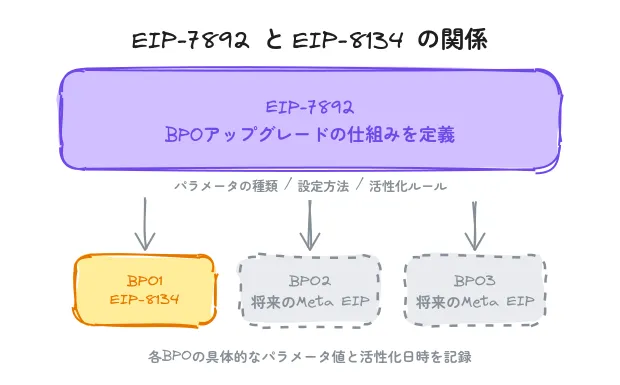
The original diagrams are retained; their labels may remain in Japanese.
Why Document BPO1 Separately?
BPO1 enables empirical evaluation on mainnet by expanding blob parameters in a controlled manner after Fusaka.
The change enables the collection of actual performance data across clients, validators, and proposers, allowing slot stability and overall system behavior to be assessed using evidence.
Because subsequent scaling decisions depend on this data, documenting BPO1 as a distinct parameter update is important for transparency and clarity of the upgrade process.
Security
BPO upgrades increase blob capacity and can affect network load characteristics. Increasing blob counts may increase processing requirements for validators and proposers and affect slot stability.
Careful monitoring, phased rollout, and coordination across the ecosystem are therefore required to maintain stability.
BPO1 is staged separately rather than occurring immediately at Fusaka activation to manage these risks. The approach collects real mainnet performance data before making further scaling decisions.
Citation
Conclusion
This article examined BPO1 (Blob Parameter Only upgrade).
BPO upgrades are important to Ethereum's strategy of scaling as a data availability layer because they allow blob capacity to increase incrementally without waiting for another major hard fork.
EIP-8134 is the official record of the first such upgrade, BPO1, and documents the progression of blob capacity from Cancun to Prague to BPO1.
I also publish articles on the following platforms.




