Introduction
Hi, I'm cardene, a software engineer and technical writer focused on blockchain and AI.
I've also authored Japanese technical books on specification-driven development with LLMs and decentralized application (DApp) development.

I also build and publish a variety of tools, libraries, and open-source projects.
Overview
When two transfers are verified in order, the computer verifying the second must first know whose balance changed in the first transfer. Knowing the locations read and written, together with their values after each operation, allows the data needed for verification to be prepared in advance.
Transaction ordering and parallel validation
A transaction is a unit of execution, such as a transfer or a contract call. For example, when someone receives money and then sends it to someone else, the second transfer must be checked using the balance after the first transfer. If different people send funds to unrelated recipients, the data to be read may be prepared concurrently. In either case, without knowing whose values will be used, the node must advance the preceding operation before starting preparation for the following transaction.
A computer that executes transactions and checks its results against other participants is called a node. A block is an ordered group of transactions processed by nodes. Parallelizing block validation does not change the requirement to verify results corresponding to the specified transaction order. Increasing the amount of reading and validation that can occur concurrently requires knowing which values existed at intermediate points in that order.
Access records and verification by the receiver
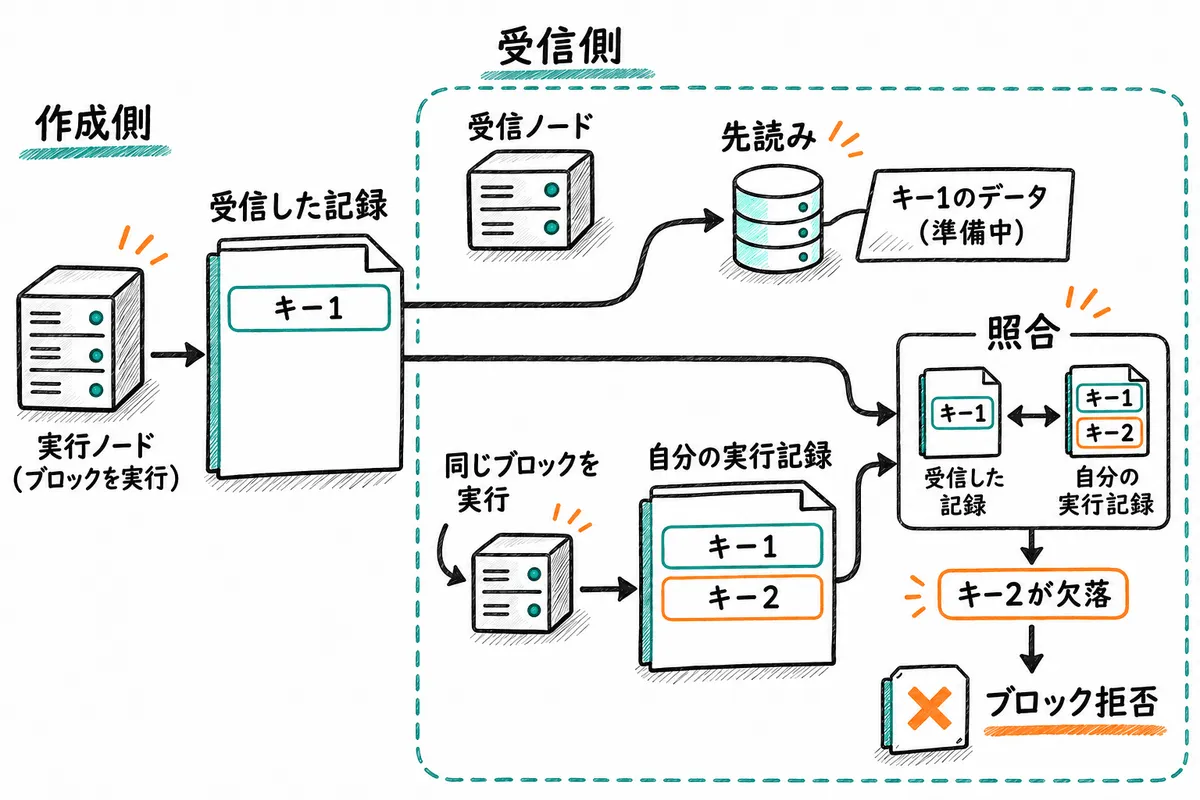
The node constructing the block records the accounts and contract storage locations accessed during execution.
It also records the values changed after each transaction, associating them with the index of the operation that caused the change.
This record is a block-level access list, and EIP7928 defines its format and validation conditions.
A receiving node can inspect the record and read the necessary data in advance. The collection of data at a given point, including account balances and storage values, is called the state. Even when a later transaction reads a value written by an earlier one, intermediate changes can be used to construct the state required for validation. However, the contents provided by the block producer are themselves subject to validation. The receiver compares them with the access record derived from its own execution and rejects the block if entries are missing, extraneous, or contain different changed values.
This record can also be used to update stored values during synchronization without executing transactions individually. However, being able to update values is different from confirming that the received transactions are correct. A node checking block validity verifies that actual execution matches the record.
The figures are reproduced from the original Japanese article; any Japanese labels are retained.
Motivation
When read locations are only discovered as processing proceeds, execution encounters waiting time. Providing the accessed locations and intermediate changes alongside the block lets the receiver advance preparation for validation.
Waiting when read locations are unknown
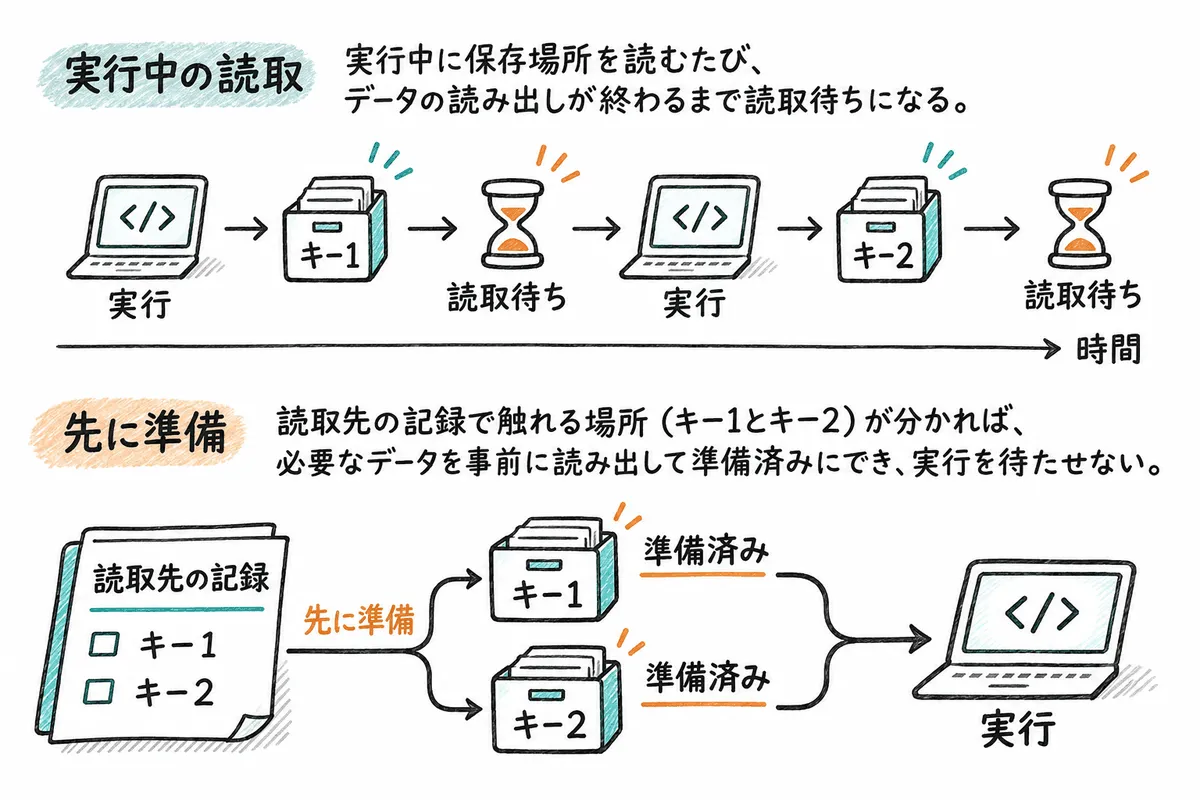
A transaction calling a contract may call another contract during execution or read different storage locations depending on conditions. The target address alone does not necessarily identify all the data the transaction will use. If a node queries storage every time execution advances, it must wait for each read before continuing computation.
Even when senders declare the locations they expect to use in a transaction, accesses to unlisted locations can occur. Treating that declaration as a complete list of planned reads would require obtaining additional data during execution. Collecting only locations with persistent changes would also omit accounts whose values were merely checked and reads from reverted calls. A record used by the receiver for preparation includes these actual accesses as well.
For example, if two transactions read distinct storage locations, a node can read both together.
If one location is excluded from the record simply because its value did not change, the receiver cannot identify that read before execution.
EIP7928 records actual accessed locations in addition to changed values to prevent such gaps in preparation.
Missing values left by preceding transactions
A list of locations alone is also insufficient when two transactions update the same storage location. If the first transaction changes a value from 7 to 9 and the second changes it from 9 to 11, providing only the final block value of 11 does not identify the intermediate value of 9. The node validating the later transaction needs to know which value existed after each operation.
The record therefore retains post-transaction changed values. A node can use the results of preceding transactions to prepare values read by later transactions. Validation information can be provided both for transactions accessing distinct locations and for those accessing the same location.
Unconditionally trusting the producer's values would allow incorrect balances or storage values to be adopted directly. The receiver checks execution results against the record and rejects blocks claiming different results. The specific scheduling of parallel execution and speed improvements depend on node implementation and transaction contents, but the record format and matching conditions are shared among participants.
Specification
After distinguishing where the record itself is stored from the value binding it to a block, examine the data structure and recording conditions. Read locations, changed values after each operation, and the receiver's comparison together form a validation target.
Association between blocks and access records
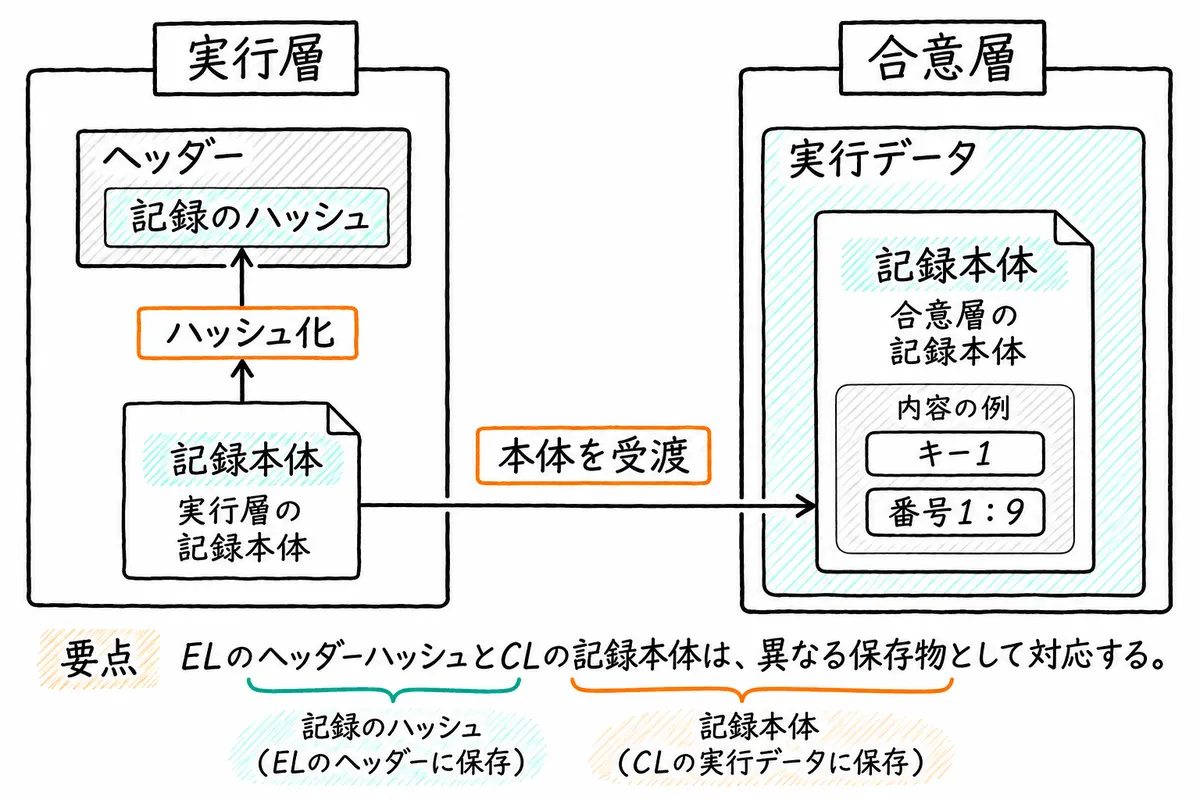
The execution layer stores access records separately from block bodies. The block header contains the hash of the entire record, fixing which record corresponds to the block.
Hash stored in the header
A computation that summarizes arbitrary-length data into a fixed-length value is called a hash.
The record is encoded using RLP, a format that arranges length-prefixed byte sequences and nested lists according to specified rules.
The execution layer computes the Keccak-256 hash of those bytes and stores it in the header, which contains fields used to identify and validate the block.
The header field added by the proposal is block_access_list_hash.
class Header:
    # Existing fields
    ...

    block_access_list_hash: Hash32 = keccak256(rlp.encode(block_access_list))
The input is the encoded access record, and the stored value is a 32-byte hash.
The header contains this commitment, while the record itself is stored separately.
The encoded byte sequence for an empty list is 0xc0, whose hash is shown below.
keccak256(rlp.encode([]))
    # 0x1dcc4de8dec75d7aab85b567b6ccd41ad312451b948a7413f0a142fd40d49347
This hash is computed over the bytes of the record. Changing the representation, such as encoding the same integer with a different length, changes the hash being compared, so the encoding rules must match as well.
Records held by the execution and consensus layers
The execution layer executes transactions and verifies state, while the consensus layer handles block proposals and consensus. They exchange execution data and validation results over an interface.
The interface connecting them is the Engine API.
The execution data exchanged is called ExecutionPayload, and its blockAccessList field contains the RLP bytes of the record.
The consensus layer uses SSZ, which deterministically encodes data and commits to its fields through a tree of hashes.
The record is also stored as a field of the SSZ execution payload.
For long-term storage, the record itself may be replaced with the field's hash_tree_root, but retaining the commitment in the tree does not imply that all original bytes can be retrieved.
There are two kinds of commitments here.
The execution-layer header contains the Keccak-256 of the record's RLP bytes, while the consensus layer commits to the record within the tree of the execution payload.
Do not treat their values or computation methods as identical.
This interface authenticates using a shared secret, and HTTP requests include an authentication token.
The token format is JWT.
This interface is separate from query endpoints exposed to ordinary applications; even records from authenticated peers must be checked against execution results.
Access record data structure
A location where a contract stores a value is called a storage slot.
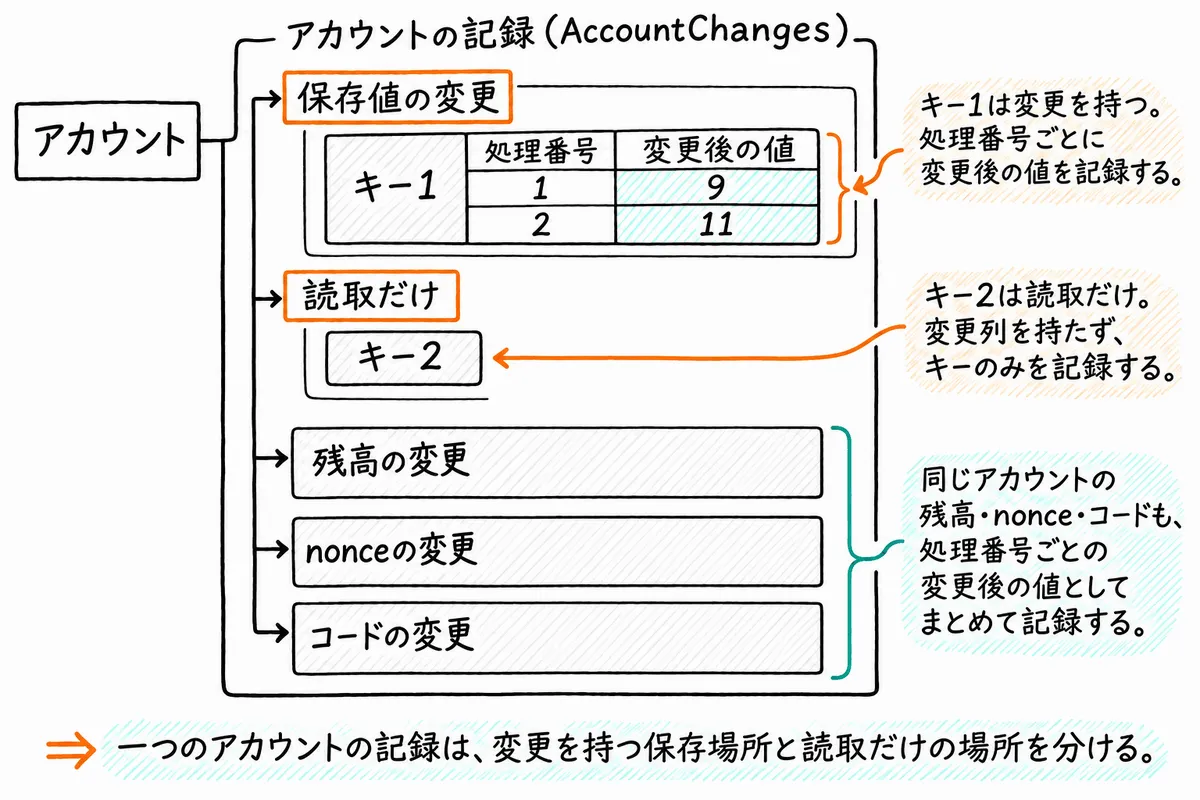
The record distinguishes slot changes from reads for each account.
Balances, nonce counters incremented by sending or creation, and executable code are stored in separate change lists.
BlockAccessList
AccountChanges is the record grouping the read storage locations and post-operation changes for one account.
The list of these per-account records is called BlockAccessList.
The producer creates the list from execution, and the receiver reproduces the same contents from its own execution.
BlockAccessList = List[AccountChanges]The types used in the record correspond as follows.
uint32, uint64, and uint256 are nonnegative integers fitting within 32, 64, and 256 bits respectively.
These types specify value ranges, not fixed encoded byte lengths.
| Type name | Official type | Recorded data |
|---|---|---|
Address |
bytes20 |
20-byte address identifying the account |
StorageKey |
uint256 |
Key of a storage location within the account |
StorageValue |
uint256 |
Value after a storage location changes |
Bytecode |
bytes |
Variable-length executable code after creation or modification |
BlockAccessIndex |
uint32 |
Index identifying the operation after which a change was finalized |
Balance |
uint256 |
Post-operation balance, in wei |
Nonce |
uint64 |
Post-operation nonce |
BlockAccessIndex distinguishes preprocessing results, the result of a numbered transaction, and postprocessing results.
Even for the same storage location, differing operation indexes can record values at different points in time.
Conversely, data outside the integer ranges or address length constraints is not accepted as an alternative representation conforming to this format.
AccountChanges
    # Order of the six fields
AccountChanges = [
    address,
    storage_changes,
    storage_reads,
    balance_changes,
    nonce_changes,
    code_changes,
]
Each account record contains six fields in this order. The execution layer gathers changes by value type into one record for the same address.
- Fields
| Field | Meaning |
|---|---|
address |
Account covered by the record |
storage_changes |
Operation indexes and changed values for each storage location |
storage_reads |
Keys of accessed storage locations without a change list |
balance_changes |
Finalized balance at each operation index |
nonce_changes |
Finalized nonce at each operation index |
code_changes |
Finalized code at each operation index |
For an account whose balance was only checked, the address remains and all five lists may be empty. If a storage location was read, its key is recorded. If the same key also appears in the change list, remove it from the read list rather than recording it in both.
SlotChanges
StorageChange = [BlockAccessIndex, StorageValue]
SlotChanges = [StorageKey, List[StorageChange]]
One finalized storage change is represented by a pair containing the operation index and new value.
This pair is StorageChange, and SlotChanges groups changes for the same storage location.
- Fields
| Object | Field | Meaning |
|---|---|---|
SlotChanges |
slot |
Storage location key |
SlotChanges |
changes |
Changes to that location, ordered by operation index |
StorageChange |
block_access_index |
Operation index at which the change was finalized |
StorageChange |
new_value |
Storage value after that operation completes |
For example, if transaction 1 changes the value at key 1 from 7 to 9 and transaction 2 changes it from 9 to 11, the result has the following form.
[1, [[1, 9], [2, 11]]]The first 1 is the storage location key, while the inner 1 and 2 are operation indexes corresponding to transactions.
No matter how many times one transaction writes the value during execution, its record is consolidated into the value after the indexed operation completes.
Splitting one key across multiple SlotChanges or creating an empty changes list without changes is prohibited.
BalanceChange
BalanceChange = [BlockAccessIndex, Balance]A balance record pairs the operation index with the balance after that operation. It stores the balance itself after transfers and gas settlement have completed.
- Fields
| Field | Meaning |
|---|---|
block_access_index |
Operation index at which the balance was finalized |
post_balance |
Balance after the operation completes |
The sender's record reflects the transfer amount and final gas charges, while the recipient's record reflects the amount received. Record relevant balance changes from internal calls, contract creation, transfers caused by destruction instructions, fee recipients, and consensus-layer withdrawals as well. If gas is refunded, use the final balance reflecting the refund.
If an account receives money and sends the same amount during the operation, leaving its ending balance equal to its starting balance, do not add a balance change entry. The address itself remains in the record because the account was actually accessed.
NonceChange
NonceChange = [BlockAccessIndex, Nonce]Pair the operation index with the nonce finalized after that operation.
In addition to transaction senders, this includes contracts that successfully create another contract, newly created contracts, and accounts that authorize delegation.
- Fields
| Field | Meaning |
|---|---|
block_access_index |
Operation index at which the counter change was finalized |
new_nonce |
Post-operation nonce |
Even if a call fails, the transaction sender's counter is finalized separately. When reverting changes inside a call, distinguish which entity's update occurred at which stage.
CodeChange
CodeChange = [BlockAccessIndex, Bytecode]A code record contains the operation index and the code bytes finalized after that operation. In addition to runtime code after contract creation, this includes delegation designations that allow an account to use other code.
- Fields
| Field | Meaning |
|---|---|
block_access_index |
Operation index at which the code change was finalized |
new_code |
Bytes of the actual code or delegation designation after the operation |
Clearing delegation and returning from an existing delegation designation to empty code is also a code change.
In this case, new_code is the empty byte sequence b"".
Becoming empty is included among recorded code changes.
By contrast, a contract created and deleted within the same transaction has no code remaining at the end. The treatment of this temporary code depends on the creation and deletion conditions discussed later.
Encoding integers and lists
Integers are encoded in RLP using the shortest big-endian representation without leading zero bytes.
For example, integer 1 is represented by 0x01, not padded to 32 bytes before encoding.
Unlike integers, addresses retain their 20-byte length.
| Original value | Encoded bytes | Distinction |
|---|---|---|
| Integer 0 | 0x80 |
Integer encoded as an empty byte sequence |
| Integer 1 | 0x01 |
Minimal integer representation |
| Empty list | 0xc0 |
List with no elements |
Even a uint256 key does not necessarily occupy 32 bytes when encoded.
Although the receiver may recover the same numeric value, bytes that do not follow the prescribed encoding change the hash committed to by the header.
The meaning of the value, type range, and actual encoding must all agree.
Access recording rules
An entry is added to the record based on whether the account or storage location was actually accessed. Distinguish stopping at a gas check before access from failing after access.
Gas checks and actual accesses
A node tracks addresses and storage locations already accessed within a transaction and charges different fees for initial and subsequent accesses.
EIP2929 defines this warm/cold distinction.
The node checks whether the target is already warm to determine the gas required for access.
For EIP2929, see the following article.
Understanding the proposal to increase gas costs for specific opcodes (EIP2929)
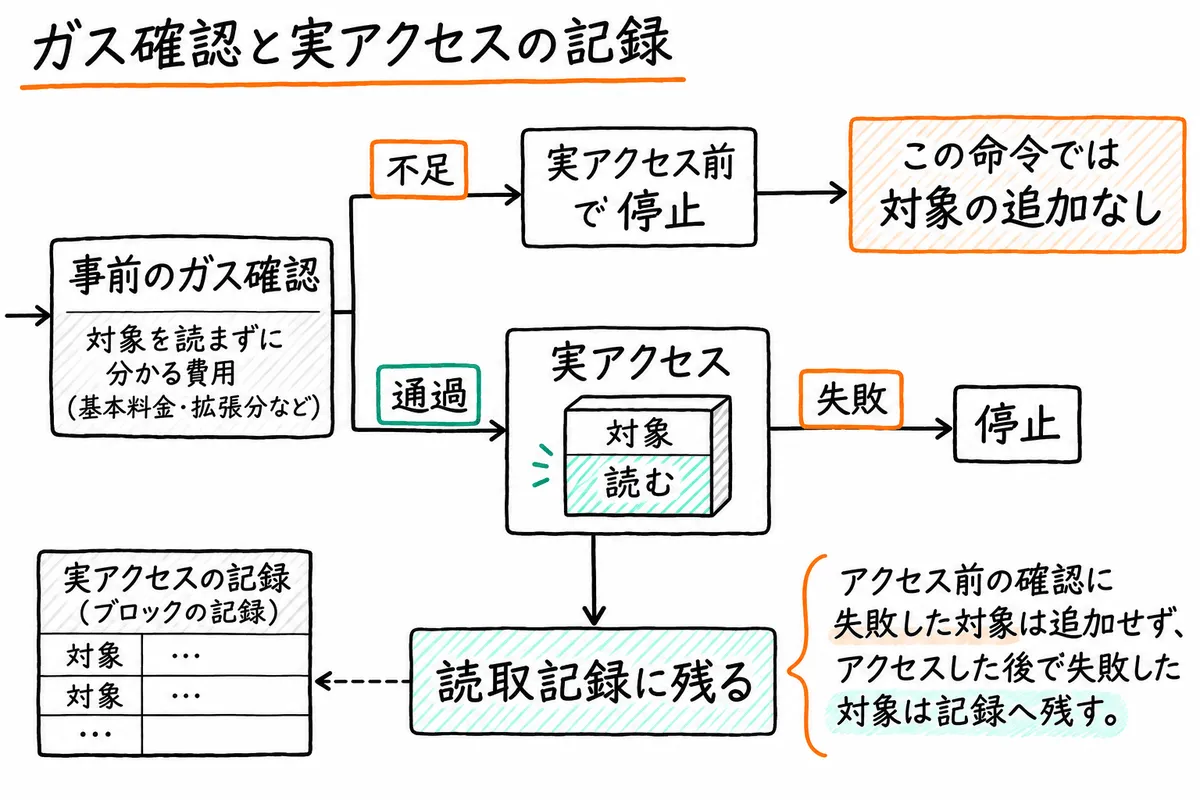
Gas is a unit for metering execution resources. Before access, check the opcode's base cost, memory expansion cost, and costs that can be determined without reading the target state. If these checks fail, the target is not read and is not added to the record on account of that instruction.
Once the checks pass, access the target and then calculate additional costs that depend on whether the account exists. Even if gas runs out or a call fails from this point onward, the access that already occurred remains in the record. The order of cost calculations after reading the target is implementation-defined.
The warm/cold set used for gas calculations differs from the block-wide record of actual accesses. The warm/cold set is restored to its previous state when a call reverts, whereas locations actually read remain in the block record. Reusing the gas-accounting set directly would omit these reads.
Pre-access conditions by opcode
Each opcode must satisfy the following conditions in addition to its base cost before accessing the target.
access_cost depends on whether the target is warm or cold, while memory_expansion is the cost of expanding memory for input or output.
| Opcode | Additional costs or conditions checked before access |
|---|---|
BALANCE |
access_cost |
SELFBALANCE |
None; the current contract is always warm |
EXTCODESIZE |
access_cost |
EXTCODEHASH |
access_cost |
EXTCODECOPY |
access_cost + memory_expansion + GAS_COPY |
CALL |
access_cost + memory_expansion, plus GAS_CALL_VALUE when transferring value |
CALLCODE |
access_cost + memory_expansion, plus GAS_CALL_VALUE when transferring value |
DELEGATECALL |
access_cost + memory_expansion |
STATICCALL |
access_cost + memory_expansion |
CREATE |
memory_expansion + INITCODE_WORD_COST + GAS_CREATE |
CREATE2 |
memory_expansion + INITCODE_WORD_COST + GAS_KECCAK256_WORD + GAS_CREATE |
SLOAD |
access_cost |
SSTORE |
Cover access_cost and ensure remaining gas is strictly greater than GAS_CALL_STIPEND |
SELFDESTRUCT |
GAS_SELF_DESTRUCT + access_cost |
For instructions reading accounts, access_cost is COLD_ACCOUNT_ACCESS_COST for cold targets and WARM_STORAGE_READ_COST for warm targets.
However, SELFDESTRUCT has zero access cost when the beneficiary is warm.
For SLOAD and SSTORE, which read storage locations, use COLD_SLOAD_COST when cold and WARM_STORAGE_READ_COST when warm.
SSTORE implicitly reads the current value to determine the write cost.
Before this read, check both that the access cost can be covered and that remaining gas is strictly greater than GAS_CALL_STIPEND.
If either condition fails, do not add the storage location to storage_reads or storage_changes.
In contrast, the additional cost of sending value to an empty account, which is determined after reading the target, is checked after the read. Even if this check fails, the already-accessed target remains recorded. This distinction makes the recorded locations consistent even when both cases end in an out-of-gas failure.
Delegating accounts and delegation targets
A mechanism allows an account's code to designate another address and execute using that address's code.
EIP7702 defines this designation.
The node reads the delegation target address from the original call target's code and separately checks the gas cost of reading the delegation target.
For EIP7702, see the following article.
Understanding how EOAs can use contract-account functionality (EIP7702)
The initial account has already been accessed to determine whether it delegates. If the gas check for the delegation target fails, retain the original account in the record and do not add the delegation target, which has not yet been read. If both accounts have been read before a sender balance or call depth check fails, retain both addresses. An account containing a delegation designation is not an empty account, so this resolution process does not incur the empty-account creation charge.
Also distinguish the stage at which authorization sets, updates, or clears delegation from the stage at which the delegation target's code executes.
When authorization succeeds, record the authorizing account's finalized nonce and code.
When clearing delegation removes existing delegation code, record the change to an empty byte sequence.
Clearing delegation alone does not constitute access to the old delegation target or zero address.
Even if authorization fails, include the authorizing account with empty change lists if it has already been loaded. Do not add an authorizing account on account of an authorization that failed before it was loaded. Successful authorizations are not reverted if subsequent transaction execution fails, so retain them separately from the rollback of changes inside a call.
Creation and deletion
CREATE and CREATE2 calculate the creation address before actually accessing that account.
Calculating the address alone does not meet the condition for adding it to the record.
If insufficient sender balance, the nonce limit, or call depth stops execution before access, do not add the creation address.
Record the address if gas runs out after accessing it, if creation collides with an existing account, or if the new account's nonce is incremented during creation preparation.
A creation transaction with an empty to field unconditionally accesses the creation address during transaction preparation, so include that address.
For destruction instructions, also check when the contract was created.
SELFDESTRUCT on an existing contract transfers its balance, but also deletes data if executed within the same transaction as creation.
EIP6780 defines this distinction; the node can use the creation time to distinguish deleted accounts from those whose balances alone are transferred.
An account created and deleted in the same transaction remains as an accessed address.
However, do not record finalized nonce or code changes; record the storage locations read or written in storage_reads.
If it had a positive balance before the transaction, also record the change to a zero balance.
Code and storage values that exist only during the transaction must not be retained as post-transaction state.
Read-only accounts
Accounts whose balances or code were merely checked are also included in the record.
For example, targets of BALANCE, EXTCODESIZE, and EXTCODEHASH remain as addresses with empty change lists if there are no changes.
A call target actually accessed is likewise retained even if the call reverts.
Precompiles providing built-in functionality are included when called or when their state is accessed. Record a balance change if receiving value changes the balance, or use empty change lists if no change occurs. Retain the recipient address of a zero-value transfer if it was accessed.
The SYSTEM_ADDRESS initiating system calls is not added solely because of its role as the sender.
Add it when the state of that address itself is accessed.
The fee recipient COINBASE is likewise included when actually accessed, including during fee settlement, and is not added solely because the reward is zero.
Transaction senders and recipients also follow the actual-access condition. If a transaction runs out of gas before loading its recipient, do not automatically add that recipient. If the same address is accessed by another operation, include it for that reason.
Changed values and operation ordering
Associate each changed value with the stage where it was finalized: preprocessing, an individual transaction, or postprocessing. Record what changed between immediately before the operation index started and after it completed, rather than how many times a location was used.
Assigning operation indexes
BlockAccessIndex values attached to changes are assigned within a block as follows.
| Operation | Index | Point at which values are finalized |
|---|---|---|
| Preprocessing system calls | 0 |
Before ordinary transactions begin |
Ordinary transactions |
1 through n |
After each transaction completes |
| Withdrawals and postprocessing | n + 1 |
After all ordinary transactions complete |
For two transactions, preprocessing has index 0, the transactions have indexes 1 and 2, and postprocessing has index 3.
For multiple system operations sharing an index, consolidate the change from the beginning of that index to the end of its final operation.
Duplicate indexes in the same change list and indexes greater than n + 1 are invalid.
Read-only keys have no operation index.
They identify keys used somewhere in the block, but storage_reads alone cannot reconstruct which transaction read them.
Storage changes and writes of the same value
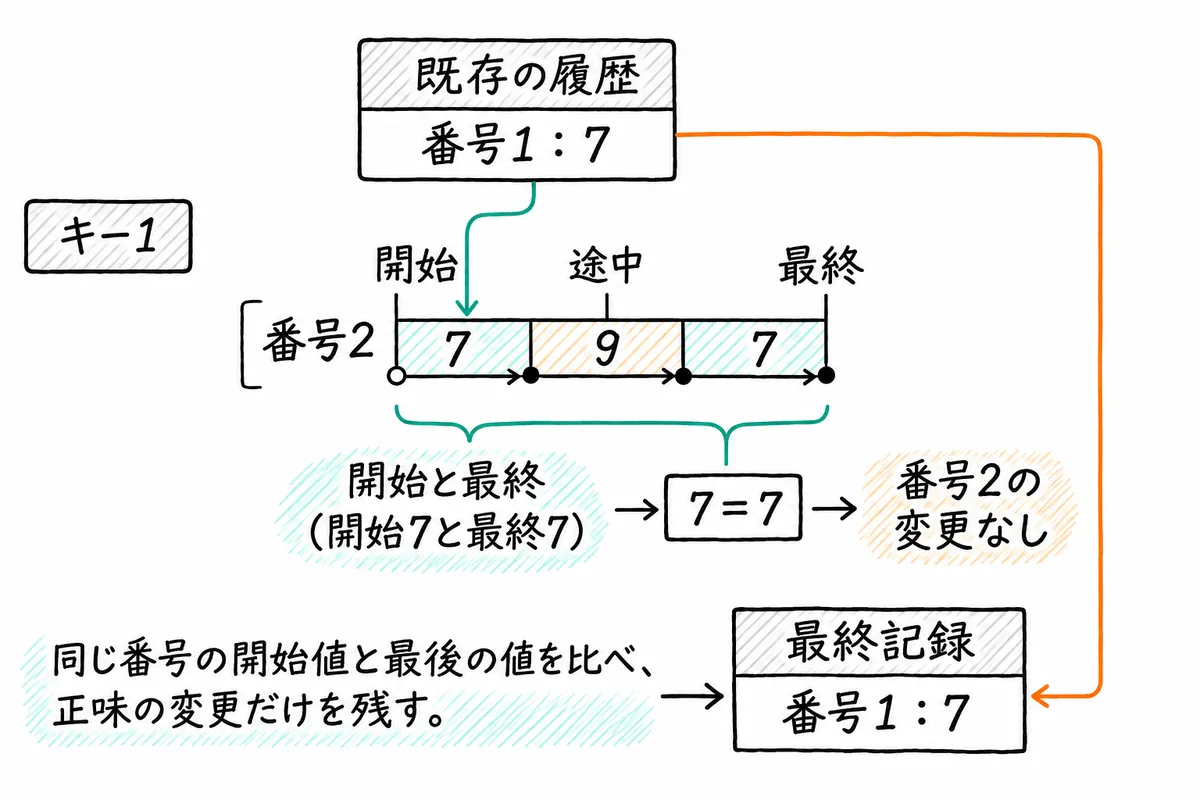
Determine whether a write produced a change by comparing it with the value immediately before the current operation index started.
The comparison value incorporates changes from preceding indexes.
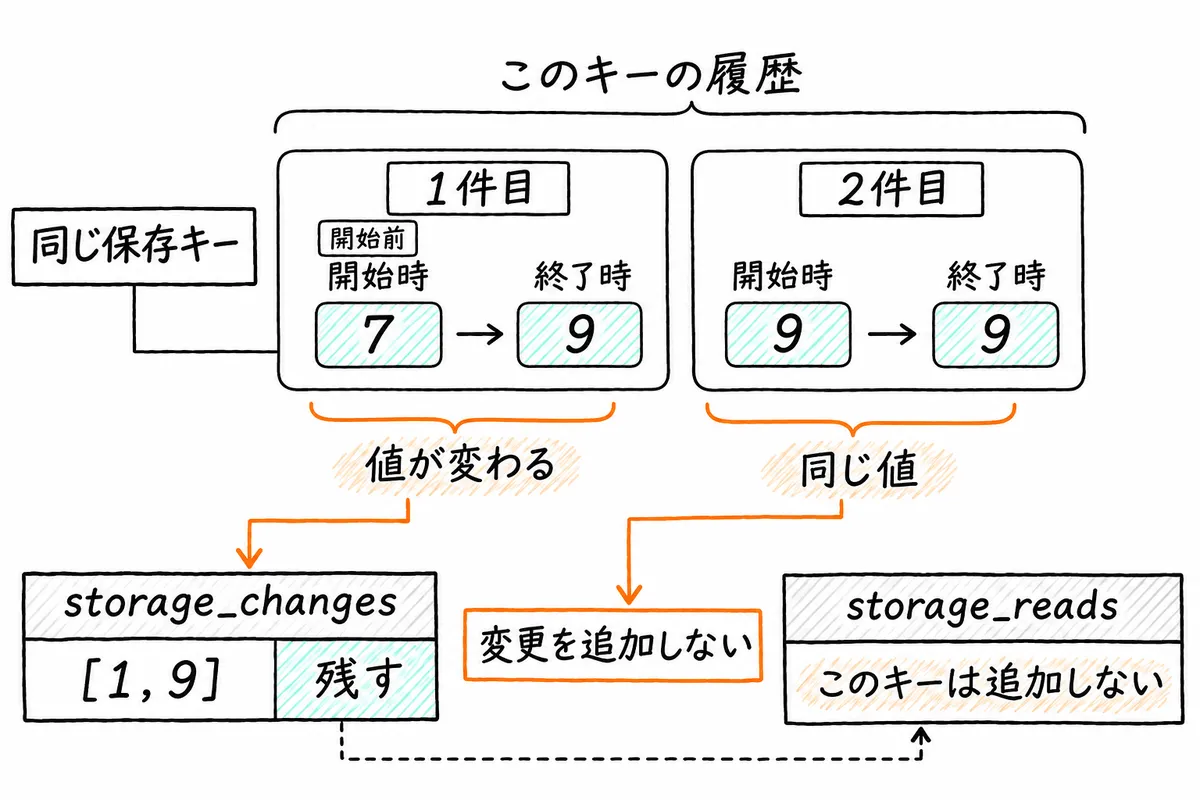
If the value changes, record it in storage_changes, including changes from a positive value to zero.
Writing back the same value, however, does not produce a storage change.
If no changes to that storage location remain in the block, record only its key in storage_reads.
A location read and then changed can be represented by its change list, so do not duplicate it in the read list.
For example, consider transaction 1 changing 7 to 9 and transaction 2 writing 9 again. The value immediately before transaction 2 is already 9, so transaction 2 produces no new change. The change from transaction 1 nevertheless remains, and the same key must not be duplicated in the final read list. Removing changes from earlier indexes when detecting same-value writes would lose the history needed for later validation.
Reverts and final balances
When the results of a call are reverted, remove its storage changes from the finalized change lists. However, retain addresses and storage locations that were actually read. If no changes to a storage location remain, represent its key as a read.
Again, distinguish changes made by a call from transaction settlement.
Record the sender's finalized nonce, balance reflecting gas refunds, and the fee recipient's balance.
This is necessary because transactions with failed internal calls can still be included in a valid block.
Delegation authorizations are also finalized at a different stage from changes inside a call.
Do not roll back a successfully completed authorization setting, update, or clearing, or its nonce update, when subsequent execution fails.
Interpreting the entire operation as nothing remains because it failed would omit changes that were already finalized.
Withdrawals and system operations
The execution layer receives withdrawal recipient addresses and amounts from the consensus layer and increases recipients' balances after ordinary transactions.
EIP4895 defines these withdrawals.
Identify the update targets from the recipients and amounts, and record the final balances using the postprocessing index.
Include the recipient address even when the withdrawal amount is zero.
For EIP4895, see the following article.
Understanding the proposal for validator withdrawals from the beacon chain to the EVM (EIP4895)
Preprocessing includes storing the parent block hash in a dedicated contract.
The node uses the parent hash and storage destination to identify the single slot updated this time.
EIP2935 defines this storage operation, which updates an entry in a ring buffer that overwrites older locations in order, recording the difference at index 0.
In EIP4788, which stores the parent beacon block root, the node derives two storage locations from the timestamp.
One stores the timestamp and the other stores its root; both changes are recorded as preprocessing.
Treating this as an operation that stores only one root would omit the location storing the timestamp.
During postprocessing, withdrawal requests to be processed are dequeued from the queue storing validator withdrawal requests.
EIP7002 defines this mechanism. The node reads the queue head and tail to select the requests to dequeue.
The differences in management slots 0–3 can be recorded separately from reads of request contents in slots 4 and above.
For EIP7002, see the following article.
Understanding the new mechanism for submitting staked ETH withdrawal requests (EIP7002)
EIP7251, which handles validator consolidation requests, also has a queue from which requests are dequeued.
The node selects the consolidation requests to process and records changes in management slots 0–3 and reads of request contents.
Because up to four slots are read for each request, the number of locations recorded differs from that of the withdrawal request queue.
For EIP7251, see the following article.
Understanding the mechanism for raising the staking limit to 2048 ETH (EIP7251)
| Operation | Locations and values recorded | Operation index |
|---|---|---|
| Store parent block hash | Change in one ring-buffer slot | 0 |
| Store parent beacon block root | Changes in two slots holding the timestamp and root | 0 |
| Dequeue withdrawal requests | Changes in management slots 0–3Reads of up to 3 × MAX_WITHDRAWAL_REQUESTS_PER_BLOCK request data slots |
n + 1 |
| Dequeue consolidation requests | Changes in management slots 0–3Reads of up to 4 × MAX_CONSOLIDATION_REQUESTS_PER_BLOCK request data slots |
n + 1 |
| Withdrawals from the consensus layer | Final recipient balance | n + 1 |
Dequeuing requests and increasing balances through consensus-layer withdrawals are separate operations. The former alone does not imply that a withdrawal recipient's balance is increased. These system operations do not consume the block gas used by ordinary transactions, so they are also accounted for in record limits and early rejection checks.
Ordering and uniqueness constraints
To obtain the same byte sequence from records representing the same execution, each list has an ordering rule. Addresses are sorted lexicographically, storage keys by ascending integer value, and changed values by ascending operation index.
| Object | Uniqueness condition |
|---|---|
| Address | Appears only once in a BlockAccessList |
| Storage changes | Do not split the same key of the same account across multiple SlotChanges |
| Storage reads | Include the same key of the same account only once |
| Read and change lists | Do not include the same key in both |
| Operation indexes in each change list | Each index appears at most once; for storage changes, check separately for each key |
SlotChanges change list |
Contains at least one change |
Per-transaction balance and code change lists are also sorted by index.
This prevents semantically identical records from having different byte representations due to reordering or duplication.
An account with empty change lists is valid, but an empty SlotChanges is not permitted.
Maximum item count
Transactions that predeclare and warm access targets are subject to an additional charge for the declaration data.
EIP7981 defines this charge.
Nodes count the data based on the number of declared addresses and keys, so using a declaration to increase the number of recorded items also incurs a cost.
EIP7928 defines bal_items as the sum of the number of unique addresses and the number of unique storage keys for each account.
This total is limited by an item count derived from the block gas limit.
ITEM_COST = 2000
bal_items = addresses + storage_keys
bal_items <= block_gas_limit // ITEM_COST
For example, a gas limit of 60,000,000 allows at most 30,000 recorded items. The count is not the number of changes to the same storage location or the compressed size of the record in bytes.
The reference cold SLOAD cost is 2100; the item-count calculation uses the smaller value of 2000.
The difference provides approximately block_gas_limit / 42000 extra items to accommodate records from system operations and withdrawals that do not pay ordinary block gas.
This limit constrains record growth but does not guarantee a constant transfer size.
Transfer and validation
The inter-layer interface distinguishes retrieving a constructed execution payload from requesting validation of received data. It also supports retrieving historical records; a response indicating unavailable data must not be interpreted as a valid empty record.
ExecutionPayloadV4
ExecutionPayloadV4 extends the existing ExecutionPayloadV3 with the bytes of the access record.
The record is carried in the blockAccessList field, separately from transactions and withdrawals.
| Field | Relationship to the record |
|---|---|
transactions |
List of transactions to execute |
withdrawals |
List of withdrawals applied after ordinary transactions |
blockAccessList |
RLP-encoded access record; represented as DATA on the wire |
blockHash |
Block hash corresponding to the header containing the record hash |
The wire type DATA represents bytes as a hexadecimal string prefixed with 0x.
A valid empty list can be transmitted as "0xc0".
Unlike null, which denotes a missing record in historical retrieval, the record field cannot be omitted from an execution payload submitted for validation.
The Amsterdam interface specification also contains slotNumber, which relates to a separate proposal.
Not every change associated with the V4 version number is attributable to the access record.
Validation of individual transaction fields and other proposals is retained as part of the existing execution payload requirements.
engine_newPayloadV5
engine_newPayloadV5(
  executionPayload,
  expectedBlobVersionedHashes,
  parentBeaconBlockRoot,
  executionRequests
)
This method submits the execution payload of a received block from the consensus layer to the execution layer for validation. The call notation above shows the order of arguments transmitted over the interface. The access record is contained within the first argument.
-
Check the execution payload version and format
Check the applicable fork timestamp and required fields. Distinguish a missing record from invalid record bytes.
-
Execute transactions and construct the record
Collect actual accesses and finalized changes, then compare them with the received record. Perform the existing block validation checks as well.
-
Return the validation status
Distinguish a result whose validity has been established from one whose validation is still incomplete.
- Arguments
| Argument | Contents |
|---|---|
executionPayload |
ExecutionPayloadV4 containing the record |
expectedBlobVersionedHashes |
List of expected versioned hashes for blob transactions in the block |
parentBeaconBlockRoot |
Root of the parent beacon block |
executionRequests |
List of requests generated by the execution layer |
executionRequests is sorted in ascending order by the leading byte identifying the request type.
The inherited argument requirements reject the following inputs.
- Requests with empty data portions
- Requests with duplicate types
null
A correct access record does not permit invalid values in other arguments.
- Return value
The execution layer returns PayloadStatus, which summarizes the validation status.
Reading its status field distinguishes whether validation has completed or the receiver is still waiting for required data.
status |
Execution layer state | Consensus layer interpretation |
|---|---|---|
VALID |
Completed the required validation and determined the payload is valid | Treat as a validated result |
INVALID |
Determined that the execution payload is invalid | Do not accept the block |
SYNCING |
Missing data required for acceptance or validation | Do not establish validity; wait for the required data |
ACCEPTED |
Received the data but has not completed full validation | Do not treat as a validated, valid result |
- Execution conditions
| Object checked | Result if not satisfied |
|---|---|
| Execution payload timestamp | -38005 Unsupported fork if outside the Amsterdam applicability period |
| Presence of record field | -32602 Invalid params if blockAccessList is missing |
| Record encoding | status: INVALID and latestValidHash: null for invalid RLP |
| Agreement with execution results | Block is invalid if the record differs from actual accesses or changed values |
latestValidHash is a separate field used according to the validation result.
Do not generalize the rule of returning null for malformed RLP to every INVALID response.
The specified timeout is six seconds. The consensus layer is advised to wait for this period, abort the call, and retry if required for progress. Failure to complete communication within the timeout is distinct from determining that a block is invalid.
engine_getPayloadV6
engine_getPayloadV6(payloadId)This method lets the consensus layer retrieve the execution payload constructed by the execution layer.
It uses the payloadId identifying the payload under construction and returns a result containing the access record.
-
Specify the payload under construction
The consensus layer passes the eight-byte
payloadId. -
Return the construction result containing the record
The execution layer encodes the accesses collected during preprocessing, each transaction, and postprocessing as
RLP, includes them in the execution payload, and returns it.
- Arguments
| Argument | Contents |
|---|---|
payloadId |
Eight-byte DATA identifying the construction process |
- Return value
| Field | Meaning |
|---|---|
executionPayload |
ExecutionPayloadV4 containing blockAccessList |
blockValue |
Expected amount received by the fee recipient, in wei |
blobsBundle |
Data corresponding to blob transactions in the block |
shouldOverrideBuilder |
Execution layer recommendation to use this constructed result instead of one built externally |
executionRequests |
List of requests generated by execution |
The access record is inside executionPayload, while the other return values are inherited from the preceding version.
The change in blob proof format comes from a separate proposal and is distinct from the access record data structure.
- Execution conditions
| Object checked | Result if not satisfied |
|---|---|
| Existence of construction process | -38001 Unknown payload if the specified process does not exist |
| Execution payload timestamp | -38005 if outside the applicable fork |
This operation has no method-specific timeout. The common specification expects immediate availability, and the caller may abort at its own discretion. Unlike the validation request operation, this operation retrieves data constructed by the execution layer.
engine_getPayloadBodiesByHashV2
engine_getPayloadBodiesByHashV2(blockHashes)This method retrieves historical data containing transactions, withdrawals, and access records by specifying execution block hashes. Provide execution block hashes, not consensus-layer block roots.
-
Specify blocks to retrieve
Pass an array of hashes, and the execution layer looks up the corresponding block bodies.
-
Return historical data in the requested order
Put
nullat the position of each unavailable block, preserving the order of the input hashes.
- Arguments
| Argument | Contents |
|---|---|
blockHashes |
DATA array containing 32-byte block hashes |
- Return value
Each element is an ExecutionPayloadBodyV2, or null if the block itself cannot be retrieved.
| Body field | Meaning |
|---|---|
transactions |
Transactions in the block |
withdrawals |
Withdrawal list; null for blocks predating withdrawals |
blockAccessList |
Record bytes; null before introduction or after pruning |
Distinguish a null array element from a returned body whose record field is null.
The latter occurs for pre-Amsterdam blocks or blocks whose records have already been pruned.
Do not replace it with the valid empty list "0xc0".
- Execution conditions
| Object checked | Condition and response |
|---|---|
| Number requested | Support at least 32 hashes; return -38004 if the implementation's supported count is exceeded |
| Block body availability | If a body cannot be provided, including during synchronization, the array element is null |
| Response waiting | Timeout of ten seconds; retry is recommended if required for progress |
During synchronization, even a block previously submitted to the execution layer may be unavailable.
Do not interpret a null array element as proof that only the record was pruned.
engine_getPayloadBodiesByRangeV2
engine_getPayloadBodiesByRangeV2(start, count)This method retrieves history from the currently selected chain by specifying a starting block number and count. It returns the same body format as the hash-based method, ordered by block number.
-
Provide the starting block number and count
Specify the number of the execution block containing transactions. Do not pass a consensus-layer slot number directly.
-
Return bodies in chain order
Follow the latest fork choice, representing unavailable intermediate blocks as
null. Omit trailingnullentries beyond the latest known block.
- Arguments
| Argument | Contents |
|---|---|
start |
Starting execution block number; 64-bit QUANTITY |
count |
Number of bodies requested; 64-bit QUANTITY |
QUANTITY is a hexadecimal integer prefixed with 0x, without unnecessary leading zeros.
Both the starting number and count must be at least 1.
- Return value
The return value is an array of bodies or null entries.
The distinction between an unavailable block itself and blockAccessList: null within a body is the same as for the hash-based method.
If the entire requested range is beyond the latest known block, the result is an empty array.
- Execution conditions
| Object checked | Condition and response |
|---|---|
| Starting number and count | -32602 if either is less than 1 |
| Number requested | Support at least 32 entries; -38004 for an excessive request |
| Response waiting | Timeout of ten seconds; retry is recommended if required for progress |
| Unfinalized chain | Account for reorganization races by using hash-based retrieval or checking received hashes |
The execution layer makes access records available through both historical retrieval methods for at least HISTORY_PRUNE_EPOCHS, or 14,299 epochs.
An epoch is a unit of time used by the consensus layer.
Retrieval of the complete bytes after this retention period is not guaranteed. Even if the consensus layer retains a tree commitment, the record itself may no longer be available.
Validation code and examples
The proposal includes Python pseudocode that compares a received record with execution results.
It illustrates collecting and ordering records from the inputs, but omits implementations of the helper functions it calls.
validate_block
In this example, execute_and_collect_accesses handles execution and record collection.
The following code compares its return value with the received record.
def validate_block(execution_payload, block_header):
    # 1. Compute hash from received BAL and set in header
    block_header.block_access_list_hash = keccak256(execution_payload.blockAccessList)

    # 2. Execute block and collect actual accesses
    actual_bal = execute_and_collect_accesses(execution_payload)

    # 3. Verify actual execution matches provided BAL
    # If this fails, the block is invalid (the hash in the header would be wrong)
    assert rlp.encode(actual_bal) == execution_payload.blockAccessList
This function binds the received record to the header and checks whether it matches the record collected during execution. Its inputs are an execution payload and header; on success, both represent the same reads and writes.
-
Set the hash of the received record
Compute the hash of the
blockAccessListbytes and place it in the corresponding header field. -
Construct the actual record from execution
Use
execute_and_collect_accessesto collect actual accesses and changed values within the block. -
Verify byte-for-byte agreement
Encode the actual record with
RLPand compare it with the received bytes. If they do not match, the block is invalid.
An implementation may alternatively construct a virtual record during execution and compare its hash with the header. Either approach compares against the node's own execution results rather than completing validation solely by inspecting the received hash.
execute_and_collect_accesses
The function uses track_state_changes to add each transaction's changes to a temporary dictionary and build_bal to convert that dictionary into the formal list.
It passes transaction ordering and collected data to these two functions.
def execute_and_collect_accesses(block):
    """Execute block and collect all state accesses into BAL format"""
    accesses = {}

    # Pre-execution system contracts (block_access_index = 0)
    track_system_contracts_pre(block, accesses, block_access_index=0)

    # Execute transactions (block_access_index = 1..n)
    for i, tx in enumerate(block.transactions):
        execute_transaction(tx)
        track_state_changes(tx, accesses, block_access_index=i+1)

    # Withdrawals and post-execution (block_access_index = len(txs) + 1)
    post_index = len(block.transactions) + 1
    for withdrawal in block.withdrawals:
        apply_withdrawal(withdrawal)
        track_balance_change(withdrawal.address, accesses, post_index)
    track_system_contracts_post(block, accesses, post_index)

    # Convert to BAL format and sort
    return build_bal(accesses)
This function executes preprocessing, each transaction, withdrawals, and postprocessing while collecting reads and writes.
Its input is a block. It records accesses in a temporary dictionary named accesses and finally returns the formal list.
It passes index 0 to preprocessing and assigns i + 1 to each transaction.
After ordinary transactions finish, it switches to len(block.transactions) + 1 and records withdrawals and postprocessing.
The final build_bal function assembles and sorts the temporary dictionary into a list.
However, this pseudocode as written omits the read/write deduplication described later.
Helper functions including track_system_contracts_pre and execute_transaction are not implemented in this example.
This sequential example also does not prescribe which validation operations a real node executes in parallel.
Implementations must preserve the ability to reproduce the complete record, and may reject early when they discover accesses exceeding the declared record.
track_state_changes
def track_state_changes(tx, accesses, block_access_index):
    """Track all state changes from a transaction"""
    for addr in get_touched_addresses(tx):
        if addr not in accesses:
            accesses[addr] = {
                'storage_writes': {},  # slot -> [(index, value)]
                'storage_reads': set(),
                'balance_changes': [],
                'nonce_changes': [],
                'code_changes': []
            }

        # Track storage changes
        for slot, value in get_storage_writes(addr).items():
            if slot not in accesses[addr]['storage_writes']:
                accesses[addr]['storage_writes'][slot] = []
            accesses[addr]['storage_writes'][slot].append((block_access_index, value))

        # Track reads (slots accessed but not written)
        for slot in get_storage_reads(addr):
            if slot not in accesses[addr]['storage_writes']:
                accesses[addr]['storage_reads'].add(slot)

        # Track balance, nonce, code changes
        if balance_changed(addr):
            accesses[addr]['balance_changes'].append((block_access_index, get_balance(addr)))
        if nonce_changed(addr):
            accesses[addr]['nonce_changes'].append((block_access_index, get_nonce(addr)))
        if code_changed(addr):
            accesses[addr]['code_changes'].append((block_access_index, get_code(addr)))
This function adds storage changes and changes to balances, counters, and code to a temporary dictionary for each address touched by a transaction. Its inputs are the transaction, temporary dictionary, and operation index. For an address encountered for the first time, it creates storage areas for each category.
Storage writes are grouped by key, with the index and value appended.
Read-only keys are placed in a set, while balances, nonce, and code retain the post-operation value when a change occurred.
The name storage_writes here is internal to collection, identifying the storage area used before constructing storage_changes in the final format.
However, retrieval functions including get_touched_addresses are undefined.
Reads retained after a revert, targets excluded before gas checks, same-value writes, and preservation of earlier-index history must be implemented according to the normative rules described above.
Executing this pseudocode requires implementing the omitted retrieval functions and normative exception handling.
build_bal
def build_bal(accesses):
    """Convert collected accesses to BAL format"""
    bal = []
    for addr in sorted(accesses.keys()):  # Sort addresses lexicographically
        data = accesses[addr]

        # Format storage changes: [slot, [[index, value], ...]]
        storage_changes = [[slot, sorted(changes)]
                          for slot, changes in sorted(data['storage_writes'].items())]

        # Account entry: [address, storage_changes, reads, balance_changes, nonce_changes, code_changes]
        bal.append([
            addr,
            storage_changes,
            sorted(list(data['storage_reads'])),
            sorted(data['balance_changes']),
            sorted(data['nonce_changes']),
            sorted(data['code_changes'])
        ])

    return bal
This function sorts the collected temporary dictionary into lists by address and field.
It sorts addresses and storage locations from the input accesses, constructs each account entry from six fields, and returns the result.
The first sort orders addresses, while the storage change lists are ordered by key and index.
Read keys and changes to balances, nonce, and code are also arranged in the prescribed order.
This official pseudocode does not deduplicate a key that is read first and written later.
For example, if transaction 1 reads key 1 and transaction 2 changes its value to 9, key 1 remains in both storage_reads and storage_changes.
This violates the normative rule that a key must not appear in both lists.
Implementations exclude keys in the change list from the read list during final assembly.
The final assembly process in the official reference implementation described later performs this exclusion.
Sorting alone does not correct incorrectly collected data. Missing or extraneous reads are checked by validating against actual accesses.
Example with two transactions and a withdrawal
The official example is a block containing two transactions and pre- and postprocessing.
Preprocessing stores the parent block hash. In transaction 1, Alice sends Bob 1 ETH and checks another account's balance.
In transaction 2, Charlie calls a factory contract to create a new contract.
Finally, 100 ETH is withdrawn to Eve.
| Operation | Observable changes | Index |
|---|---|---|
| Preprocessing | Update to the slot storing the parent hash | 0 |
| Alice's transaction | Sender balance and nonceBob's balanceAccess to an address whose balance was only checked |
1 |
| Charlie's transaction | Sender balance and nonceCreated account's code and nonceFactory contract's storage value and nonce |
2 |
| Withdrawal to Eve | Final recipient balance | 3 |
Assuming Bob and Eve initially have zero balances, their balances after receipt are 1 ETH and 100 ETH respectively.
The record stores these values converted to wei.
The balance changes derived from this assumption take the following form.
    # Bob: balance_changes
[[1, 10**18]]

    # Eve: balance_changes
[[3, 100 * 10**18]]
Indexes 1 and 3 identify which operation each balance follows. The other account whose balance was only checked is represented by its address and empty change lists. The fee recipient retains its balances after settlement of transactions 1 and 2 respectively.
The final account order follows addresses, not the chronology of events. The indexes within each entry associate the changes with preprocessing, individual transactions, and postprocessing. Because the official example omits some balances and code, it should not be treated as a complete block execution test.
Additional notes
Providing the locations actually used and their intermediate values enables parallel preparation for reads and validation. Distinguish this record from sender-provided declarations and the amount of additional data.
Prior declarations and actual accesses
There is a transaction format in which the sender attaches addresses and storage locations they expect to use.
EIP2930 defines this optional access list.
Nodes read the declared locations for access cost calculations and advance preparation, but accesses outside the declaration are still possible.
For EIP2930, see the following article.
Understanding the proposal to introduce a new transaction type with an access list (EIP2930)
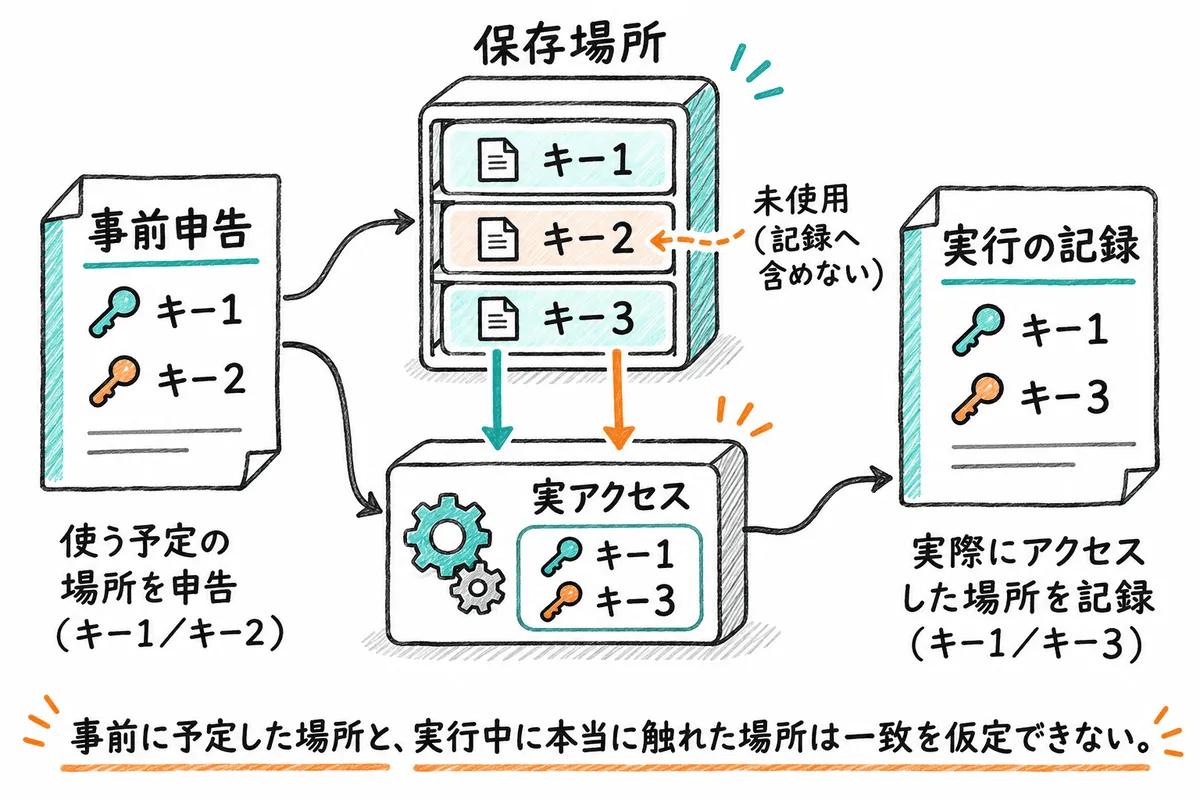
The block record retains locations used during execution. Addresses or keys that were declared but never used are not automatically included. The sender's planned accesses and the record produced from execution differ both in who creates them and how their contents are verified.
| Comparison | Transaction access declaration | Actual block access record |
|---|---|---|
| Created by | Transaction sender | Node executing the block |
| Basis for contents | Locations expected to be used | Locations actually accessed |
| Access outside the list | Possible | Included in the record if it occurred |
| Values after changes | Not stored | Stored by operation index |
| Unused entries | May be declared | Not added without actual access |
The warm/cold set used for gas accounting serves a different purpose as well. Even when the warm/cold state of a reverted call is restored, locations actually read remain in the block record. Preserving this distinction prevents omissions in the data prepared by the receiver.
Changed values and parallel validation
Knowing which locations to read makes it possible to read multiple pieces of data in parallel. With the values after each transaction, even transactions using the same location can be validated by constructing the state at the appropriate point in time. This information can also be used to compute a hash representing the entire post-operation state and to update state during synchronization.
The proposal describes 60–80% of transactions as having mutually independent storage locations, and states that the remainder can also be parallelized using changed values. The proposal cites this proportion as analysis supporting its design rationale; it does not guarantee the same proportion for every block. Actual processing time depends on storage performance, implementation strategy, and transaction contents.
Also distinguish synchronization that updates state using the record from validation of the legitimacy of proposed transactions. The latter does not trust recorded changed values directly, but compares them against the results of the node's own execution. Increasing the information available for parallelization is not the same as reducing validation requirements.
Observed record sizes
The official size analysis examines records from 1,000 blocks in October 2026 under a gas limit of 60,000,000.
The encoding is RLP and the compression method is Snappy.
The average total record size was 136.6 KiB uncompressed and 92.1KiB after compression.
| Record component | Average compressed size |
|---|---|
| Storage value changes | 36.1 KiB |
| Storage reads | 25.8 KiB |
| Balance changes | 9.2 KiB |
nonce changes |
1.9 KiB |
| Code changes | 1.4 KiB |
| Addresses of accounts with changes | 12.5 KiB |
| Access-only addresses | 3.3 KiB |
| Encoding overhead | 1.8 KiB |
| Total | 92.1KiB |
These observations depend on the sampled blocks and compression method.
They neither represent the item-count limit nor guarantee that every record fits within approximately 90 KiB.
Compare the additional data transfer volume and the waiting time reduced by parallelization as separate costs.
Compatibility
Participating nodes require updates because the record hash is added to the header and the record body is included in inter-layer communication. Transaction declarations created by senders and block records created by nodes continue to be handled separately.
Updating the block format and API
Nodes supporting the new format implement the validation conditions involving the header's record hash and the received record. Because the changes to block structure and interface specifications are incompatible with previous versions, they require a hard fork in which the network switches under common conditions. Both the consensus and execution layers must support the applicable version.
The interface uses the execution payload timestamp to determine the version to use.
It rejects the new version for timestamps outside its applicability and rejects post-activation data submitted using an old version.
Version suffixes are managed separately for each method and structure, so validation V5 and construction-result retrieval V6 can handle the same execution payload.
The Last Call status recorded in the specification indicates that final review is in progress.
Expiration of the deadline alone does not establish finalization or production activation.
The existence of an official implementation is likewise distinct from evidence that every production node has activated it.
Existing transactions and historical retrieval
The block record is generated by nodes from execution. It is not a new argument that senders attach to transactions and does not replace existing access declarations. The distinction between planned accesses specified in a transaction and actual accesses remains.
Readers of historical data must handle both older blocks that never had a record and blocks whose records were pruned after the retention period.
If blockAccessList in the body is null, the record itself has not been retrieved.
This differs in meaning from a valid empty record, so it cannot be treated as validated by interpreting it as an empty list.
Reference implementation
EELS, the official execution specification, contains a Python implementation that collects accesses and converts them into a record.
Value collection, consolidation of changes at the same operation index, sorting, and hash verification can be examined separately.
The standard specifies the result format and validation conditions; the internal dictionaries and division into helper functions are implementation choices.
Collection data and operation indexes
block_access_lists.py separates the data types representing the final record from those collecting information during execution.
The final-format types are assembled from individual changes, to lists of changes at the same storage location, to records for individual accounts.
| Type | Contents | Use after creation |
|---|---|---|
StorageChange |
block_access_indexnew_value |
Added to the storage location's change list |
BalanceChange |
block_access_indexpost_balance |
Added to the account's balance change list |
NonceChange |
block_access_indexnew_nonce |
Added to the account's counter change list |
CodeChange |
block_access_indexnew_code |
Added to the account's code change list |
SlotChanges |
slotchanges |
Groups changes to the same storage location |
AccountChanges |
Address and five lists | Final format for one account |
BlockAccessList |
List of per-account records | Passed to encoding and hashing |
During collection, AccountData holds storage changes in a dictionary, reads in a set, and balance, nonce, and code changes in lists.
BlockAccessListBuilder maintains accounts, which maps addresses to this collection area, and the current block_access_index.
It also records values as of the beginning of operations sharing the same index.
index_start_accounts: Dict[
    Tuple[BlockAccessIndex, Address], Optional[Account]
] = field(default_factory=dict)

index_start_storage: Dict[
    Tuple[BlockAccessIndex, Address, Bytes32], U256
] = field(default_factory=dict)
index_start_accounts uses the index and address as its key, while index_start_storage uses the index, address, and storage location.
These stores allow the initial and final values to be compared even for multiple system calls sharing one index.
Declaring them alone does not validate the inputs; the collection and formatting processes read and write them.
The ensure_account function creates empty AccountData if the address is absent from the collection dictionary.
If it already exists, the function does nothing, so there is only one collection area even when the same address is processed multiple times.
The add_touched_account function also uses this operation to retain addresses whose values did not change.
Class definitions using dataclass and collection using Dict and Set are implementation-specific.
Other languages and data structures can collect the same accesses and produce the same final format.
Consolidating changes at the same index
Even if the same location is updated multiple times within one index, only the final value is placed in the record. The collection functions update an existing entry with the same index or append a new entry if none exists.
| Function | Operation performed on input | Destination |
|---|---|---|
add_storage_write |
Replace the storage value at the same index or append a new entry | storage_changes[slot] |
add_balance_change |
Replace the post-operation balance at the same index or append a new entry | balance_changes |
add_nonce_change |
Retain only a value larger than the existing one for the same index | nonce_changes |
add_code_change |
Replace code at the same index with the final value | code_changes |
The fact that add_nonce_change retains the maximum value for the same index is an implementation detail of this helper.
The normative requirement remains to record the nonce finalized after the operation.
Do not generalize from this function alone that the specification replaces every counter change with a maximum value.
Even if a value changes during an operation, there is no net change if it returns to its starting value at the end of the same index.
The following code shows the main processing in update_builder_from_tx, which makes that determination.
def update_builder_from_tx(
    builder: BlockAccessListBuilder,
    tx_state: TransactionState,
) -> None:
    """
    Update the BAL builder with changes from a single transaction.

    Compare the transaction's writes against the state at the start of the
    current block access index to extract balance, nonce, code, and storage
    changes. A write that leaves a value where the index found it records
    no change, and drops one recorded earlier at the same index by another
    transaction sharing it, such as a second system call.

    Must be called **before** the transaction's writes are merged into
    the block state.
    """
    block_state = tx_state.parent
    idx = builder.block_access_index

    for address, post_account in tx_state.account_writes.items():
        pre_account = _index_start_account(builder, block_state, address)

        pre_balance = pre_account.balance if pre_account else U256(0)
        post_balance = post_account.balance if post_account else U256(0)
        if pre_balance != post_balance:
            add_balance_change(builder, address, idx, post_balance)
        else:
            remove_balance_change(builder, address, idx)

        pre_nonce = pre_account.nonce if pre_account else Uint(0)
        post_nonce = post_account.nonce if post_account else Uint(0)
        if pre_nonce != post_nonce:
            add_nonce_change(builder, address, idx, U64(post_nonce))
        else:
            remove_nonce_change(builder, address, idx)

        pre_code_hash = (
            pre_account.code_hash if pre_account else EMPTY_CODE_HASH
        )
        post_code_hash = (
            post_account.code_hash if post_account else EMPTY_CODE_HASH
        )
        if pre_code_hash != post_code_hash:
            post_code = get_code(tx_state, post_code_hash)
            add_code_change(builder, address, idx, post_code)
        else:
            remove_code_change(builder, address, idx)

    for address, slots in tx_state.storage_writes.items():
        for key, post_value in slots.items():
            pre_value = _index_start_storage(
                builder, block_state, address, key
            )
            # Convert slot from internal Bytes32 format to U256 for BAL.
            # EIP7928 uses U256 as it's more space-efficient in RLP.
            u256_slot = U256.from_be_bytes(key)
            if pre_value != post_value:
                add_storage_write(builder, address, u256_slot, idx, post_value)
            else:
                remove_storage_write(builder, address, u256_slot, idx)
This function is called before the transaction's writes are merged into block state.
It compares account balance, nonce, and code with their initial values, adding a change if different and removing the change for that index if equal.
It makes the same comparison for storage values. Even when using 32-byte keys internally, it converts them to U256 when constructing the record.
The starting values used in the comparison are obtained by the following functions.
| Function | Read order and result |
|---|---|
_get_pre_tx_account |
Prefer cumulative account writes; otherwise read pre-block state. Return None if nonexistent |
_get_pre_tx_storage |
Prefer cumulative storage values; return 0 if deleted, or the pre-block value if neither applies |
_index_start_account |
Retrieve and retain the initial value for the current index and address only on the first access |
_index_start_storage |
Retrieve and retain the initial value for the current index, address, and key only on the first access |
Consequently, a later transaction compares against values reflecting preceding transactions' changes.
A second system operation sharing an index compares against the value at the start of that index, not the value after the first operation.
Code changes are checked using EMPTY_CODE_HASH as well; if changed, the actual code is retrieved with get_code and stored.
The removal operations used when there is no net change also target only the current index.
| Function | Removed data | Retained data |
|---|---|---|
remove_storage_write |
Change at the current index for that key; remove the key if the list becomes empty | Changes at earlier indexes |
remove_balance_change |
Balance change at the current index | Balance changes at other indexes |
remove_nonce_change |
Counter change at the current index | Changes at other indexes |
remove_code_change |
Code change at the current index | Changes at other indexes |
If the address or relevant key is not registered, the removal function returns without doing anything. This structure neither deletes earlier history because of a same-value write nor leaves empty storage change lists. These functions manipulate collected data and do not independently establish block validity.
Integrating and sorting reads
After executing transactions and system operations, build_block_access_list incorporates accumulated reads.
It passes storage reads to add_storage_read and account reads to add_touched_account, then formats the final representation with _build_from_builder.
def build_block_access_list(
    builder: BlockAccessListBuilder,
    block_state: BlockState,
) -> BlockAccessList:
    """
    Build a [`BlockAccessList`] from the builder and block state.

    Feed accumulated reads from the block state into the builder, then produce
    the final sorted and encoded block access list.

    [`BlockAccessList`]: ref:ethereum.forks.amsterdam.block_access_lists.BlockAccessList
    """  # noqa: E501
    # Add storage reads (convert Bytes32 to U256 for BAL encoding)
    for address, slot in block_state.storage_reads:
        add_storage_read(builder, address, U256.from_be_bytes(slot))

    # Add touched addresses
    for address in block_state.account_reads:
        add_touched_account(builder, address)

    return _build_from_builder(builder)
Read keys are converted from their internal 32-byte representation to integers.
add_storage_read adds keys to a set, so multiple reads of the same location count as one entry.
At this stage, reads are collected even if they duplicate change-list entries; duplicates are removed when producing the final format.
_build_from_builder sorts each storage location's changes by index and excludes keys in change lists from the read list.
It also sorts balance, nonce, and code changes by index and orders storage locations and addresses before returning the result.
The deduplication of reads and changes omitted from the official pseudocode above occurs during this final assembly.
Although collection uses dictionaries and sets, the final format has a defined order, so identical contents encode to identical bytes.
Rejection based on the hash and item limit
Once the record is assembled, hash_block_access_list computes its hash.
Its input is the final-format record; the result of rlp.encode is passed to keccak256.
def hash_block_access_list(
    block_access_list: BlockAccessList,
) -> Hash32:
    """
    Compute the hash of a Block Access List.
    """
    return keccak256(rlp.encode(block_access_list))
validate_block_access_list_gas_limit checks the item-count limit.
It counts accounts individually, puts storage keys into a set to eliminate duplicates, and compares the total with the gas-derived limit.
def validate_block_access_list_gas_limit(
    block_access_list: BlockAccessList,
    block_gas_limit: Uint,
) -> None:
    """
    Validate that the block access list does not exceed the gas limit.

    The total number of items (addresses + unique storage keys) must not
    exceed ``block_gas_limit // GAS_BLOCK_ACCESS_LIST_ITEM``.
    """
    from .vm.gas import GasCosts

    bal_items = Uint(0)
    for account in block_access_list:
        # Count each address as one item
        bal_items += Uint(1)

        # Collect unique storage keys across both
        # reads and writes
        unique_slots: Set[U256] = set()
        for slot_change in account.storage_changes:
            unique_slots.add(slot_change.slot)
        for slot in account.storage_reads:
            unique_slots.add(slot)

        # Count each unique storage key as one item
        bal_items += ulen(unique_slots)

    if bal_items > block_gas_limit // GasCosts.BLOCK_ACCESS_LIST_ITEM:
        raise BlockAccessListGasLimitExceededError(
            f"Block access list exceeds gas limit, {bal_items} items "
            f"exceeds limit of "
            f"{block_gas_limit // GasCosts.BLOCK_ACCESS_LIST_ITEM}."
        )
Exceeding the limit raises BlockAccessListGasLimitExceededError.
The count covers addresses and unique keys, not the number of changes or the encoded byte length.
fork.py integrates these functions into block execution.
| Function | Processing order related to the record |
|---|---|
apply_body |
Executes preprocessing, ordinary transactions, and postprocessing, then constructs the record and checks the item limit |
process_transaction |
Sets the index and passes the state after execution, gas settlement, and deletion to record collection |
process_withdrawals |
Adds withdrawals to recipient balances and merges them as one transaction state |
execute_block |
Computes execution results and compares the record hash with the header |
process_transaction passes values to incorporate_tx_into_block after gas settlement and deletion, not immediately after the call.
For withdrawals, amounts are converted from Gwei to wei and consolidated into final recipient balances under the postprocessing index.
The caller sets the preprocessing index 0, ordinary transaction indexes, and postprocessing index.
Finally, execute_block compares the hash of the record it constructed with the header.
if computed_block_access_list_hash != block.header.block_access_list_hash:
    raise InvalidBlock("Invalid block access list hash")
If they differ, it raises InvalidBlock and does not reach the successful BlockDiff return.
BlockDiff groups changes obtained through execution; this function does not itself persist them.
The same function validates other block conditions, including the overall state root and receipts, so matching the record hash alone does not suffice to accept the entire block.
Boundaries covered by the official tests
The official test list covers the following boundaries.
- Same-value writes
- Retention of history across indexes
- Reads after a revert
- Out-of-gas conditions
- Delegation
- System operations
Missing records, extraneous entries, and behavior at fork boundaries are also tested. These cases help identify where records change.
However, this list retains older descriptions using N for preprocessing and len(txs) for postprocessing.
Some lines also conflate dequeuing withdrawal requests with increasing withdrawal recipient balances.
Expected values should be derived from the current specification and execution code, using 0 for preprocessing and n + 1 for postprocessing.
Consult the test list to identify cases to examine, rather than importing outdated expected values into the specification. Also distinguish dequeuing withdrawal requests from crediting withdrawal balances. The code explanations here are not a report of tests executed against a real client.
Security
The record supplied by the producer is both information used for preparation and an object of validation. Consider separately the risk of accepting false changed values and the risk of excessive reads or transfer volume putting pressure on processing.
Invalid changed values and record discrepancies
If a block producer records incorrect balances or storage values and the receiver applies them directly, the receiver will adopt an incorrect state.
The receiver compares the record collected from its own execution with the received contents.
Even if the record is bound to block_access_list_hash, agreement with execution results has not yet been established if the value is only a claim by the producer.
Validation rejects not only different values but also missing addresses or keys, extraneous entries, incorrect ordering, and out-of-range indexes. A discrepancy invalidates the block. Consequently, even when using intermediate values supplied by the producer to validate subsequent transactions, the correctness of those values is ultimately checked through execution.
Other block validation requirements remain even after verifying record agreement. The block is accepted only after satisfying existing conditions concerning the overall state root, transactions, and receipts. Do not extend the ability to update values from records during synchronization into a guarantee that unknown blocks can be validated unconditionally.
Excess I/O caused by unused reads
If an attacker adds keys for storage locations that are never used to storage_reads, the receiver performs unnecessary reads during prefetching.
Because this read list has no operation indexes, a key cannot be declared unnecessary simply because one transaction did not use it.
Determining whether later transactions use the key may require executing all transactions before the record can conclusively be rejected.
The bal_items limit constrains the number of additional items but does not eliminate prefetch costs.
Nodes are encouraged to consider mechanisms that detect impossible reads during execution and reject invalid blocks early.
However, such mechanisms must not reject valid blocks.
In particular, reads resulting from system calls do not consume the block gas used by ordinary transactions. Concluding solely from remaining gas that no further reads are possible would also reject legitimate system operations. Attack mitigations must preserve both the completeness of actual accesses and the conditions for accepting valid blocks.
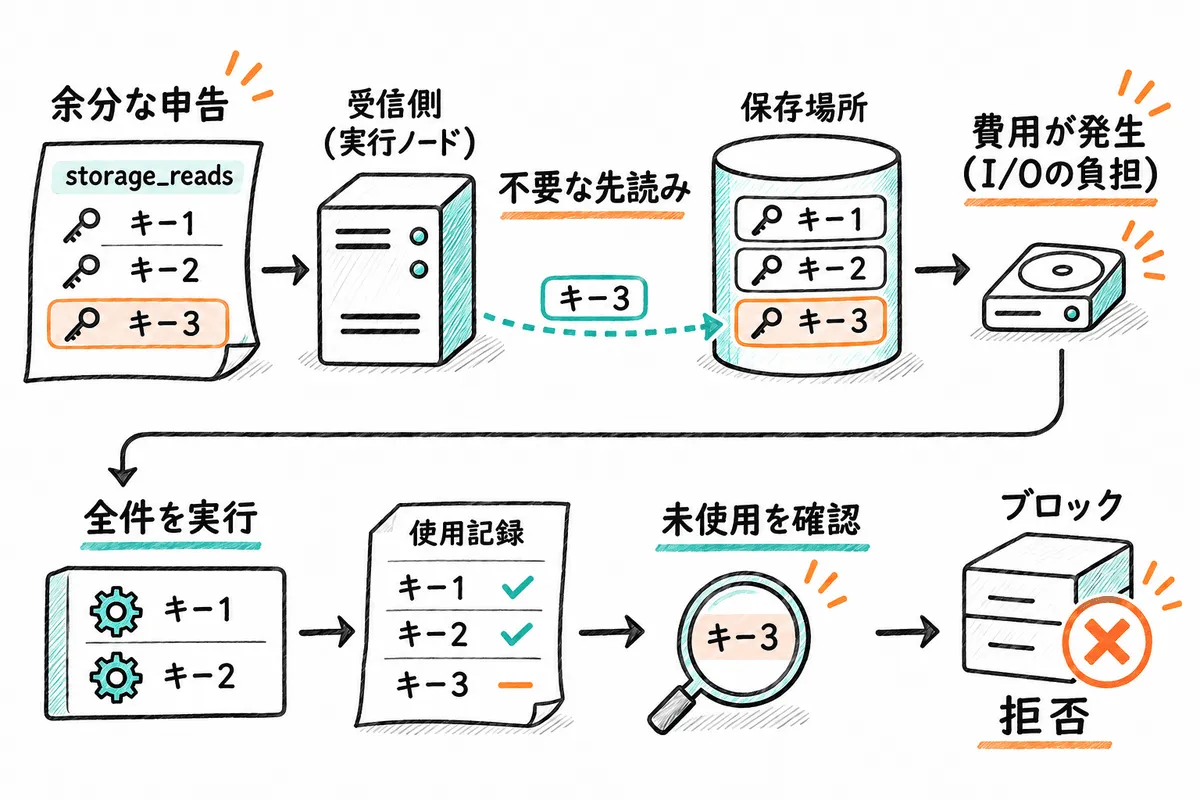
Transfer volume and validation overhead
Adding records increases the data transferred between nodes and the processing required for encoding and hash verification.
The official analysis's compressed average of 92.1KiB is an observation for a particular set of blocks.
It is neither a maximum size nor a guarantee of constant overhead across implementations.
bal_items links the item count to the gas limit; it is not a fixed byte-length cap.
Nodes must maintain completeness and agreement checks while performing additional transfers and comparisons.
Rejecting a valid record merely because it exceeds the average size, or skipping agreement checks for speed, would violate the normative requirements.
Storage overhead also remains while historical records are served. When assessing parallelization benefits, account for resources used to transfer, retain, and validate records as well as waiting time for reads. These costs and the specific processing strategies vary by node implementation and operating environment.
Conclusion
EIP7928 records actual accesses within a block and changed values after each operation, allowing receivers to compare the record against their own execution results.
Nodes can prepare reads and validation in advance, while missing entries, extraneous entries, and differing values provide grounds for rejecting a block.
It enables both parallelization using intermediate state and validation of that intermediate state itself.
The record format and validation requirements are specified in the proposal.

The inter-layer interface specifications and execution code are available in their respective official repositories.
