Introduction
Hi, I'm cardene, a software engineer and technical writer focused on blockchain and AI.
I've also authored Japanese technical books on specification-driven development with LLMs and decentralized application (DApp) development.

I also build and publish a variety of tools, libraries, and open-source projects.
Overview
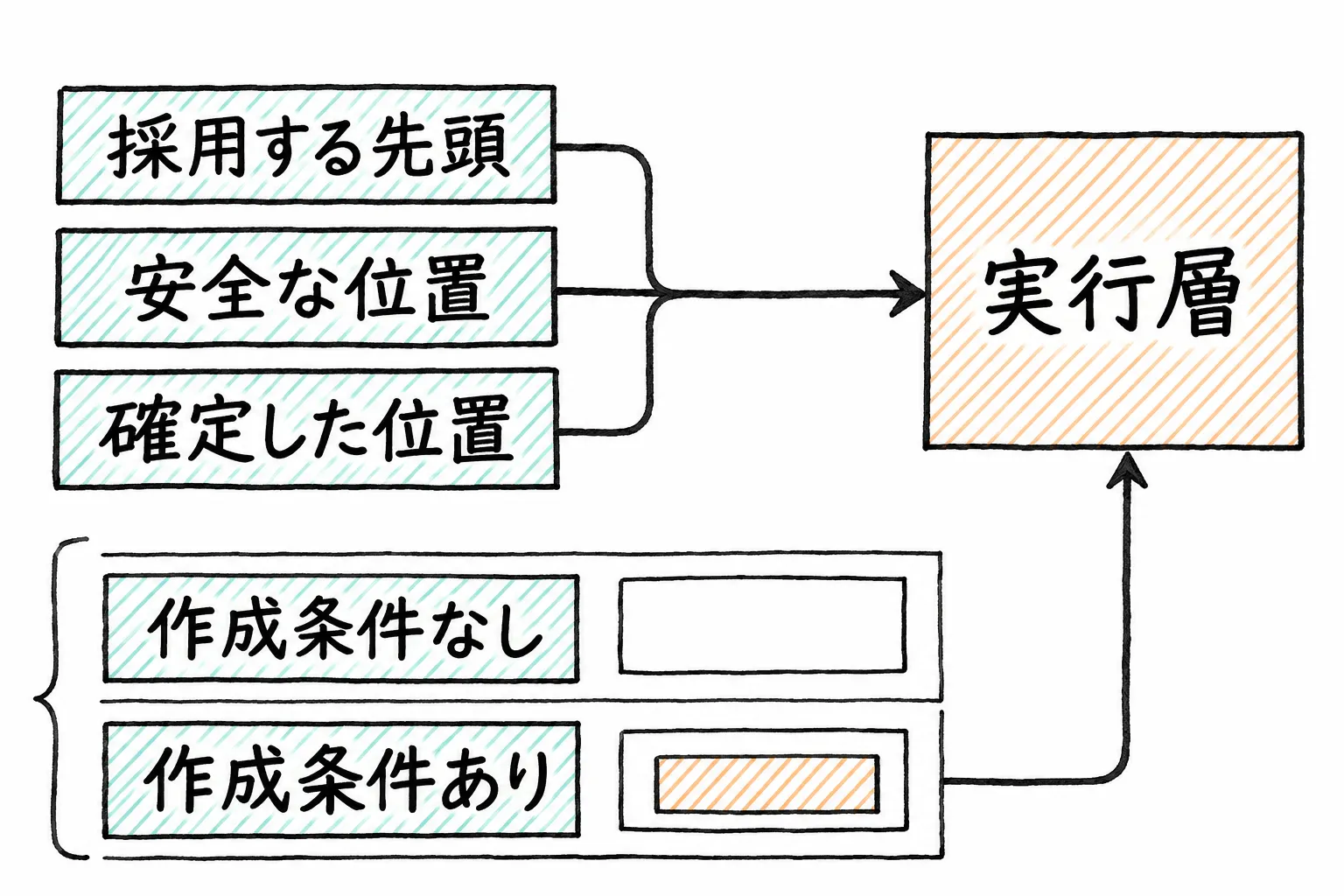
When a node receives a new block, the software responsible for selecting the canonical block passes its contents to the software that executes transactions.
If the data is converted to text for transfer and parsed again on receipt, the conversion adds time before validation can begin.
EIP8178 proposes an additional transport that eliminates this text conversion.
The figures are reproduced from the original Japanese article; any Japanese labels are retained.
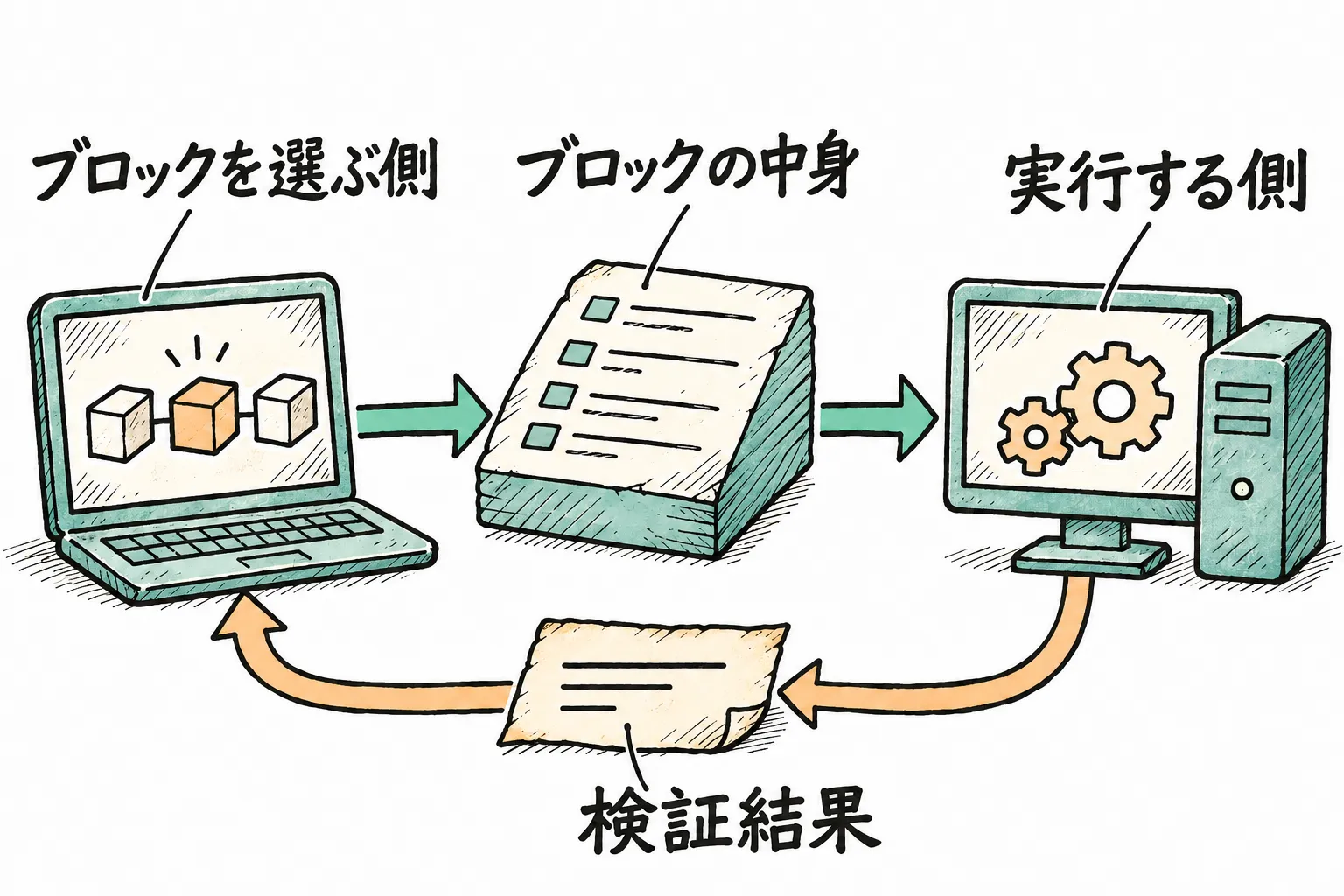
Passing blocks between two processes
Receiving a block does not by itself tell a node whether the recorded execution result is correct. The node executes transactions in order and compares the resulting updates, including balances, with the results recorded in the block. Because separate pieces of software handle block selection and execution and validation, data must be transferred even when both run on the same machine.
The consensus layer selects the block to adopt, while the execution layer executes transactions and verifies the results. The consensus layer sends the execution contents of the received block, and the execution layer returns the result of validating them. The round trip also includes the time required to convert values into a format the receiver can read.
For example, if the execution layer has not yet obtained the candidate's parent block, it may be unable to execute the candidate against the parent's state. In that case, block validation is not complete even though the consensus layer has finished sending the data. The consensus layer reads the response to distinguish successful transmission from completed validation.
Changing the transport without changing validation responsibilities
The new transport in EIP8178 delivers the values held by the consensus layer to the execution layer in a prescribed order.
The execution layer reads the values from that sequence and validates the block in its existing role.
The consensus layer continues to decide which block to adopt based on the execution layer's response.
When building a new block, the consensus layer specifies the parent block and the conditions for building it. When the execution layer starts building, it returns an identifier for that process, allowing the consensus layer to request the candidate later by specifying the identifier. The roles of requesting validation, starting construction, and retrieving the constructed payload remain the same, while the work of converting values to text between the layers is reduced. The existing transport remains available, so connections to peers that do not support the new transport can continue.
Motivation
Converting hashes and transactions to hexadecimal text requires two characters for each byte of information.
Generating strings on the sender and parsing them on the receiver also happens before a block reaches validation.
EIP8178 reduces transfer size and conversion work by sending byte sequences directly.
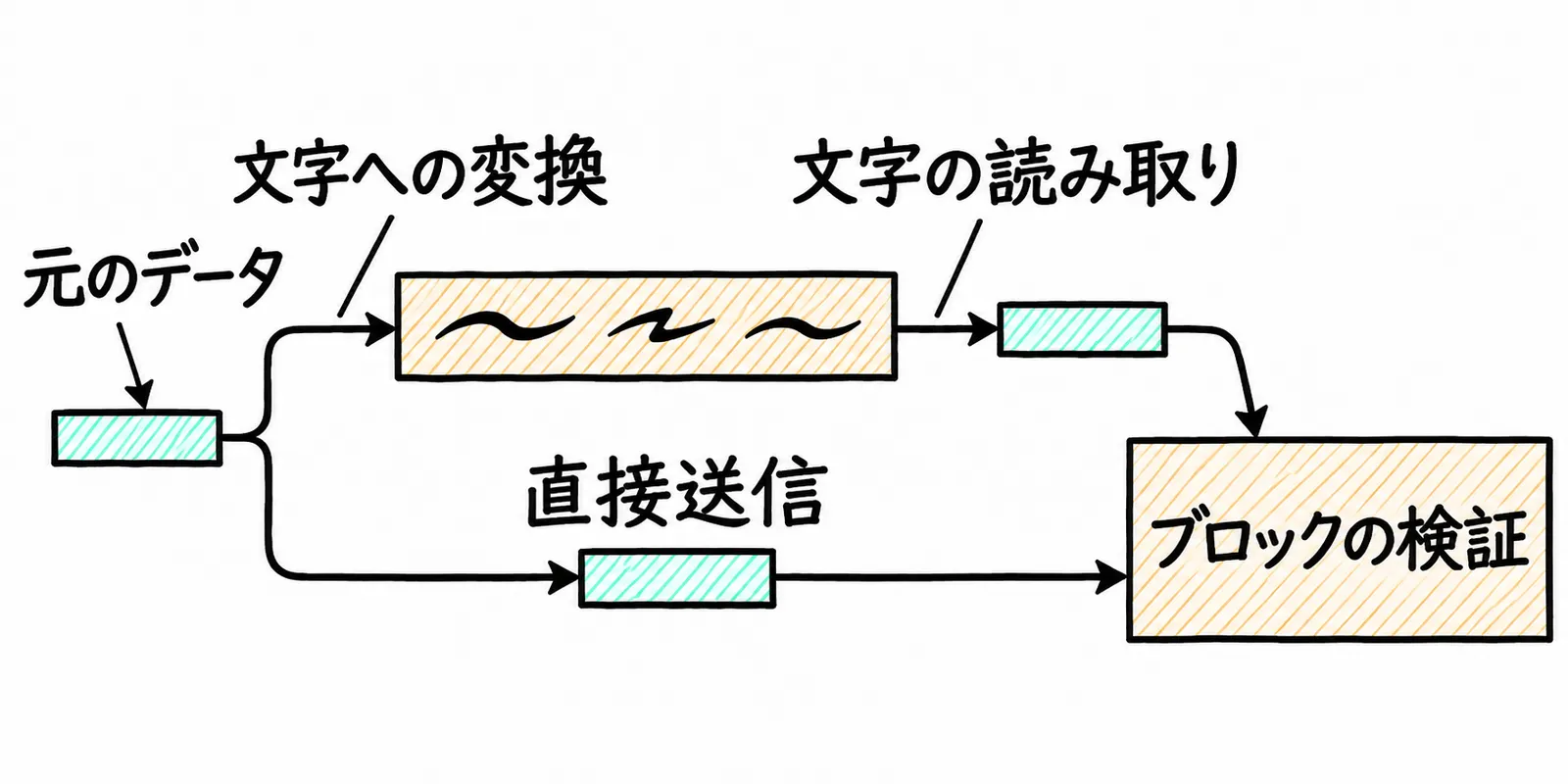
The cost of text conversion and parsing
Block hashes and recipient addresses are fixed-length byte sequences. When transactions or large auxiliary block data are converted to hexadecimal for transmission, each original byte is represented by two characters. The transfer therefore requires additional space to represent the value as text.
Beyond transfer size, the sender must construct strings from the values, and the receiver must parse them back into internal values. Even if the consensus layer already uses a suitable data format, converting it to a separate text format for the connection introduces conversions before it reaches the execution layer. As transaction counts and auxiliary data grow, more characters must be processed to represent the same contents.
Nodes propagate blocks to other nodes and validate their contents within a limited time.
EIP8178 therefore lets the consensus layer send the format it already uses and the execution layer decode it directly into values.
The aim is to remove conversion work from the connection between the layers and reduce the overhead of delivering the same block for validation.
Reduced transfer size and remaining validation time
The proposal states that the transferred data is approximately 50% smaller than with the existing transport. This claim follows from sending large byte sequences without representing each byte as two characters. However, the proposal does not provide a table of measurements or identify the clients and block compositions used for benchmarking.
For example, eliminating text conversion does not eliminate the execution layer's work of executing transactions. If information about the parent block is missing, the execution layer may also need to wait for it. The percentage reduction in transfer size therefore cannot be treated as an equivalent percentage reduction in total block validation time.
If both layers share a directly readable format, generating and parsing strings no longer needs to be a mandatory step in their connection. To assess the effect, measure the bytes transferred, computation time spent converting data, and time until validation completes separately. Distinguishing changes in how identical data is transported from validation of that data's contents identifies which overhead the proposal reduces.
Specification
The consensus layer asks the execution layer to validate received blocks or build new ones. When building a block, it provides the chosen parent and payload attributes, then retrieves the candidate using the identifier returned by the execution layer. The following sections connect the transport format, data types, request structures, and endpoints for each operation.
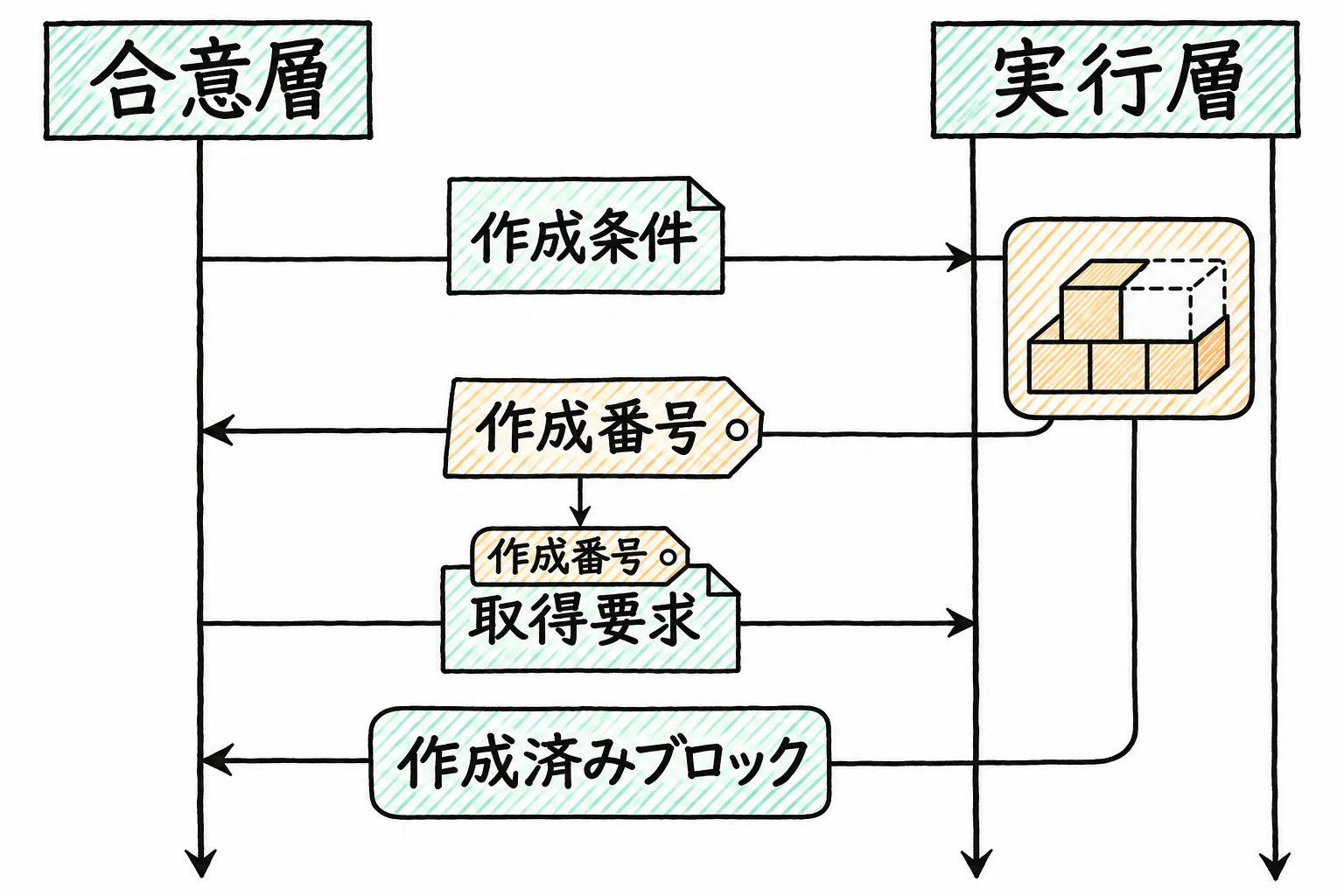
Transport format
The execution layer's response contains the transport-level result of processing the request and, where applicable, the result of validating the submitted block. When requested data does not exist, the response may have no body, or it may represent missing values within its body. Consistent endpoints and body formats let the receiver distinguish these cases.
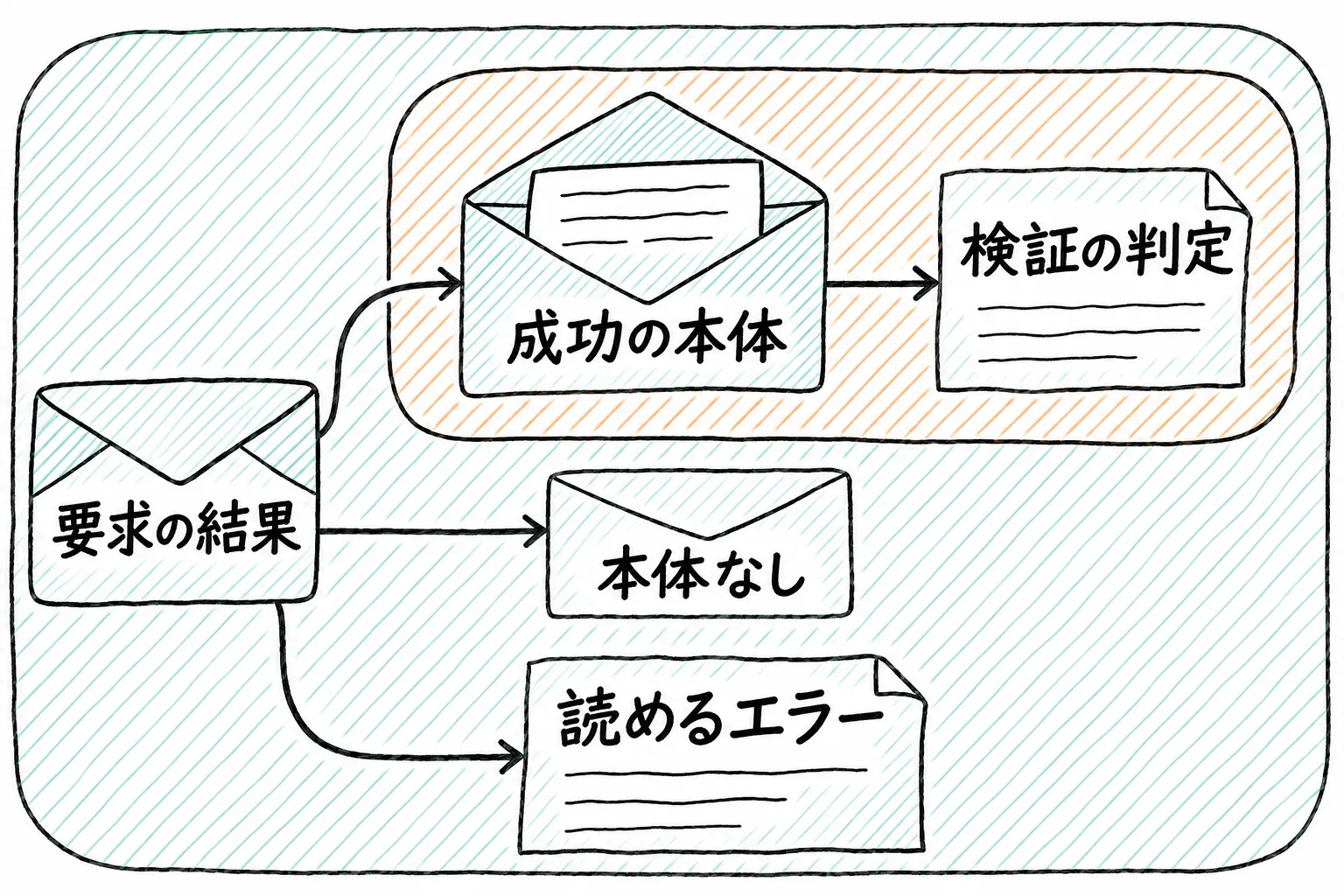
Endpoints and request format
This connection lets the consensus layer request validation or construction from the execution layer and receive its response.
The interface for these inter-layer calls is the Engine API.
The existing transport uses a text body with named fields containing the name of the operation to invoke and its arguments.
This is JSON-RPC, in which the execution layer selects the operation using the method name in the body.
The new transport uses HTTP to send requests and responses as messages with methods and headers.
It follows a REST format, distinguishing resources by URL paths and operations by methods such as submission or retrieval.
The default endpoint is http://localhost:8551/engine, using the existing port 8551 that connects the two layers.
The public JSON-RPC endpoint and the authenticated Engine API endpoint are separate.
The body arranges values into a byte sequence according to their types and order, and the receiver decodes them using those same types.
This format is SSZ (Simple Serialize).
The process of recovering typed values from a byte sequence is called deserialization.
The Content-Type header identifies the format of the body being sent, while Accept specifies the response format accepted by the consensus layer.
The value application/octet-stream indicates a raw binary body.
SSZ request bodies and successful response bodies use this Content-Type.
Requests also use this value for Accept; including it is recommended even for GET requests without a body.
The request includes an authentication token generated using a key shared with the execution layer.
This token is a JWT, and the execution layer authenticates the request by checking the signature and issuance time.
The token is passed in the Authorization header, and every request includes Authorization: Bearer <JWT token>.
The authentication requirements are inherited from the existing Engine API.
The consensus layer reads the validation status and payload identifier from the response to decide whether to proceed with validation or retrieve the constructed result. Endpoint paths include a version for each operation, and a new versioned path is added when the corresponding method changes. Older versions can be deprecated, but keeping them available for compatibility is recommended.
The Beacon API exposes consensus-layer data through HTTP paths and supports SSZ responses. This proposal draws on its conventions for resource-specific paths and version numbers.
This reference does not make the Engine API the same service as the Beacon API.
Successful and unsuccessful responses
The consensus layer first checks the HTTP status code to determine how to read the body.
A 200 response contains an SSZ result, while a 204 response has no body and corresponds to a null result.
For a block validation request, it then checks the validation status inside the 200 response body.
HTTP status |
Condition checked by the receiver | Returned content |
|---|---|---|
200 |
The request was processed | SSZ result |
204 |
The result is null, for example during synchronization |
Empty body |
400 |
Invalid SSZ encoding |
Human-readable error message |
401 |
Missing or invalid JWT |
Human-readable error message |
404 |
Payload identifier not found | Human-readable error message |
409 |
Invalid forkchoice state | Human-readable error message |
413 |
Maximum element count exceeded | Human-readable error message |
422 |
Invalid payload attributes | Human-readable error message |
500 |
Unexpected server error | Human-readable error message |
The content type for returning human-readable failure reasons is text/plain.
For example, if auxiliary block data cannot be retrieved because the client is synchronizing and returns 204, there is no SSZ body to decode.
Conversely, a validation request can return 200 with an invalid validation result in the body.
This HTTP table is not a complete mapping of existing JSON-RPC errors.
The proposal does not provide a complete mapping to HTTP codes for unsupported forks, excessively deep reorganizations, invalid arguments, or nonexistent methods.
Nor does it define rules for returning 405, 406, or 415 for unsupported paths or versions, or mismatched Accept or Content-Type headers.
The published code does not determine automatic retry intervals for each error either.
Basic types and missing values
In SSZ, the receiver uses types to determine how many bytes to interpret as each value.
A Container groups multiple named values in a prescribed order.
Distinguishing fixed from variable lengths, and byte counts from element counts, helps interpret the structure of blocks and responses.
A variable-length sequence with an upper bound is written as List, a fixed-length byte sequence as ByteVector, and a bounded variable-length byte sequence as ByteList.
For example, a fixed 256-byte log lookup value and extra data of at most 32 bytes are both byte sequences, but have different length constraints.
Bytes20, Bytes32, Bytes8, Bytes48, and Bytes4 are also fixed-length byte sequences, containing 20, 32, 8, 48, and 4 bytes respectively.
Numeric types include the unsigned 64-bit integer uint64, 256-bit integer uint256, and 8-bit integer uint8.
A boolean uses 0 for false and 1 for true; other byte values are not interpreted as true.
A recipient address retains the same 20 bytes and is transmitted without conversion to hexadecimal text.
The mapping from the existing basic types is as follows.
| Existing basic type | SSZ type |
|---|---|
address (20 bytes) |
Bytes20 |
hash32 (32 bytes) |
Bytes32 |
bytes8 (8 bytes) |
Bytes8 |
bytes32 (32 bytes) |
Bytes32 |
bytes48 (48 bytes) |
Bytes48 |
bytes256 (256 bytes) |
ByteVector[256] |
uint64 |
uint64 |
uint256 |
uint256 |
BOOLEAN |
boolean |
bytes (variable length) |
ByteList[MAX_LENGTH] (limit depends on usage) |
bytesMax32 (0–32 bytes) |
ByteList[32] |
Array of T |
List[T, MAX_LENGTH] (limit depends on usage) |
T or null |
List[T, 1] |
The presence or absence of a value is represented by List[T, 1], a list containing at most one element.
An empty list represents null, and a single-element list indicates that the value is present.
For example, if no payload attributes are sent, the list is empty; otherwise, it contains one set of attributes.
Some types represent absence using an all-zero hash or payload identifier, or an empty byte sequence for error messages. This general rule does not apply to every field.
An SSZ receiver uses field types and order to distinguish fixed and variable sections.
Integers use little-endian byte order, starting with the least significant byte, while offsets indicate the start of variable sections.
A body consisting of JSON-RPC integer strings cannot simply be read as SSZ.
SSZ is a value representation format; it does not encrypt or compress the transmitted contents.
A separate draft concerning the redesign of the execution API also uses types that express absence as Optional.
The current official SSZ implementation and the earlier consensus-specs v1.6.1 description also differ in how types are written and what they cover.
These differences do not justify replacing fields or missing-value representations defined by EIP8178.
Size and element count limits
Type lengths specify fixed byte counts, maximum byte counts, or maximum element counts. Even if a list respects its element count limit, a large individual element can make the body large, so count and size must be checked separately.
A Blob is a large fixed-length data object referenced in association with a block.
A commitment is a short value corresponding to its contents, and the receiver checks the relationship to those contents using the corresponding proof.
The receiver identifies the requested object using the versioned hash in the block contents and verifies the retrieved data and corresponding proof.
EIP4844 defines this basic relationship, and the constant table in EIP8178 derives the 131,072-byte size of a Blob from that definition.
For EIP4844, see the following article.
Understanding Shard Blob Transactions (EIP4844)
When reading proofs for individual parts of a Blob, the receiver uses the set of cell proofs corresponding to that Blob.
EIP7594 treats parts derived from a Blob as cells and verifies the contents using proofs for each part.
The types in EIP8178 represent proofs as a list with a maximum element count, so passing the type limit does not establish that the required number of corresponding proofs is present.
The underlying API associates 128 cell proofs with each Blob.
For EIP7594, see the following article.
Checking data availability without holding an entire Blob (EIP7594)
Requests arising from execution blocks are passed from the execution layer to the consensus layer as a list of byte sequences representing their types and contents.
The receiver reads each execution request's byte sequence and checks whether its contents can be passed to the subsequent processing for its type.
EIP7685 defines the format of these requests.
EIP8178 carries the list as part of its types and does not redefine the semantics of execution requests.
For EIP7685, see the following article.
The constants represent fixed lengths or limits for the respective types.
| Constant | Value | Source | Object constrained or fixed |
|---|---|---|---|
MAX_BYTES_PER_TRANSACTION |
2**30 (1,073,741,824) |
EIP4844 |
Maximum bytes per transaction |
MAX_TRANSACTIONS_PER_PAYLOAD |
2**20 (1,048,576) |
Bellatrix |
Maximum transaction count in a block |
MAX_WITHDRAWALS_PER_PAYLOAD |
2**4 (16) |
Capella |
Maximum withdrawal count |
BYTES_PER_LOGS_BLOOM |
256 |
Bellatrix |
Fixed byte length of the log bloom filter |
MAX_EXTRA_DATA_BYTES |
2**5 (32) |
Bellatrix |
Maximum extra data bytes |
MAX_BLOB_COMMITMENTS_PER_BLOCK |
2**12 (4,096) |
Deneb |
Type-level maximum count of Blob commitments or bodies |
FIELD_ELEMENTS_PER_BLOB |
4096 |
EIP4844 |
Number of field elements in one Blob |
BYTES_PER_FIELD_ELEMENT |
32 |
EIP4844 |
Bytes per field element |
CELLS_PER_EXT_BLOB |
128 |
EIP7594 |
Number of cell proofs corresponding to one Blob |
MAX_PAYLOAD_BODIES_REQUEST |
2**5 (32) |
Shanghai |
Maximum count of entries in a payload body retrieval response |
MAX_BLOB_HASHES_REQUEST |
128 |
Osaka |
Maximum count of hashes in a Blob retrieval request |
MAX_EXECUTION_REQUESTS |
2**8 (256) |
EIP7685 |
Maximum count of execution requests |
MAX_ERROR_MESSAGE_LENGTH |
1024 |
This proposal | Maximum bytes of a validation error description |
MAX_CLIENT_CODE_LENGTH |
2 |
This proposal | Maximum bytes of a client identifier code |
MAX_CLIENT_NAME_LENGTH |
64 |
This proposal | Maximum bytes of a client name |
MAX_CLIENT_VERSION_LENGTH |
64 |
This proposal | Maximum bytes of a client version |
MAX_CLIENT_VERSIONS |
4 |
This proposal | Maximum count of client version entries |
BLOB_SIZE |
FIELD_ELEMENTS_PER_BLOB * BYTES_PER_FIELD_ELEMENT (131,072) |
Derived from element count and length | Fixed bytes per Blob body |
The 131,072-byte length of a Blob consists of 4,096 field elements of 32 bytes each.
This length and the 128 cell proofs corresponding to each Blob measure different things.
Likewise, the maximum bytes per transaction and the maximum number of transactions per block are separate constraints.
These are SSZ type limits; they do not directly represent the actual block sizes or element counts accepted in a particular fork.
For example, the 128-entry limit for Blob retrieval is a fixed list maximum in this proposal, which differs from the existing Engine API requirement to support at least 128 entries.
The execution layer rejects inputs exceeding the defined maximum size before full deserialization.
Blocks and associated data
A block submitted for validation includes values for checking the state before and after execution, along with its transactions. Later versions add withdrawals and Blob gas values.
When returning a constructed payload, the response includes the execution payload as well as the expected value for the fee recipient and Blob bundles. The outer response and the inner data therefore have separate versions.
WithdrawalV1
This data groups the sequential index, validator, destination, and amount of a single withdrawal from a validator participating in consensus. It is used when the consensus layer includes withdrawals in payload attributes and when the execution layer builds or validates a block containing withdrawals. The execution layer reads each destination and amount in the list and verifies the withdrawals to be applied to the block.
class WithdrawalV1(Container):
    index: uint64
    validator_index: uint64
    address: Bytes20
amount: uint64| Field | Type | Meaning for the receiver |
|---|---|---|
index |
uint64 |
Sequential withdrawal index |
validator_index |
uint64 |
Index of the withdrawing validator |
address |
Bytes20 |
Withdrawal destination address |
amount |
uint64 |
Withdrawal amount |
amount is denominated in Gwei, the same unit used by the existing Engine API.
For example, if the payload attributes include one withdrawal for validator index 12, the execution layer uses its destination and amount to build the candidate.
SSZ reads uint64 as a binary integer; this field does not carry hexadecimal characters or a formatted amount.
ExecutionPayloadV1
This data groups the execution block's header information and transactions in the basic Paris format.
It is used when the consensus layer submits a received candidate for validation and when the execution layer returns a candidate it has built.
The execution layer identifies the parent block, executes the transactions, and computes the state and receipts recording execution results.
It compares the roots summarizing these results with the candidate's values to verify that execution matches.
class ExecutionPayloadV1(Container):
    parent_hash: Bytes32
    fee_recipient: Bytes20
    state_root: Bytes32
    receipts_root: Bytes32
    logs_bloom: ByteVector[BYTES_PER_LOGS_BLOOM]
    prev_randao: Bytes32
    block_number: uint64
    gas_limit: uint64
    gas_used: uint64
    timestamp: uint64
    extra_data: ByteList[MAX_EXTRA_DATA_BYTES]
    base_fee_per_gas: uint256
    block_hash: Bytes32
transactions: List[ByteList[MAX_BYTES_PER_TRANSACTION], MAX_TRANSACTIONS_PER_PAYLOAD]| Field | Type | Meaning for the receiver |
|---|---|---|
parent_hash |
Bytes32 |
Hash identifying the parent execution block |
fee_recipient |
Bytes20 |
Fee recipient address |
state_root |
Bytes32 |
Root for verifying the post-execution state |
receipts_root |
Bytes32 |
Root for verifying transaction receipts |
logs_bloom |
ByteVector[BYTES_PER_LOGS_BLOOM] |
Fixed-length bit sequence for log lookup |
prev_randao |
Bytes32 |
Randomness information supplied by the consensus layer |
block_number |
uint64 |
Execution block number |
gas_limit |
uint64 |
Block gas limit |
gas_used |
uint64 |
Gas actually used in the block |
timestamp |
uint64 |
Block timestamp |
extra_data |
ByteList[MAX_EXTRA_DATA_BYTES] |
Up to 32 bytes of extra data |
base_fee_per_gas |
uint256 |
Base fee per unit of gas |
block_hash |
Bytes32 |
Block hash for verifying the execution contents |
transactions |
List[ByteList[MAX_BYTES_PER_TRANSACTION], MAX_TRANSACTIONS_PER_PAYLOAD] |
Ordered list of transaction byte sequences to execute |
Each transactions element is the byte sequence of one transaction, and transactions are executed in list order.
For example, if a candidate contains two transfers, the execution layer applies them in order and checks the resulting state against state_root.
Correctly reading the SSZ lengths and structure does not guarantee that the execution results match.
ExecutionPayloadV2
The execution payload corresponding to Shanghai appends a withdrawal list to the basic format.
The same type containing withdrawals is used both when the execution layer constructs a candidate and when the consensus layer submits it for validation.
The results of applying withdrawals must be verified in addition to transaction execution results.
class ExecutionPayloadV2(Container):
    parent_hash: Bytes32
    fee_recipient: Bytes20
    state_root: Bytes32
    receipts_root: Bytes32
    logs_bloom: ByteVector[BYTES_PER_LOGS_BLOOM]
    prev_randao: Bytes32
    block_number: uint64
    gas_limit: uint64
    gas_used: uint64
    timestamp: uint64
    extra_data: ByteList[MAX_EXTRA_DATA_BYTES]
    base_fee_per_gas: uint256
    block_hash: Bytes32
    transactions: List[ByteList[MAX_BYTES_PER_TRANSACTION], MAX_TRANSACTIONS_PER_PAYLOAD]
withdrawals: List[WithdrawalV1, MAX_WITHDRAWALS_PER_PAYLOAD]| Field | Type | Meaning for the receiver |
|---|---|---|
parent_hash |
Bytes32 |
Hash identifying the parent execution block |
fee_recipient |
Bytes20 |
Fee recipient address |
state_root |
Bytes32 |
Root for verifying the post-execution state |
receipts_root |
Bytes32 |
Root for verifying transaction receipts |
logs_bloom |
ByteVector[BYTES_PER_LOGS_BLOOM] |
Fixed-length bit sequence for log lookup |
prev_randao |
Bytes32 |
Randomness information supplied by the consensus layer |
block_number |
uint64 |
Execution block number |
gas_limit |
uint64 |
Block gas limit |
gas_used |
uint64 |
Gas actually used in the block |
timestamp |
uint64 |
Block timestamp |
extra_data |
ByteList[MAX_EXTRA_DATA_BYTES] |
Up to 32 bytes of extra data |
base_fee_per_gas |
uint256 |
Base fee per unit of gas |
block_hash |
Bytes32 |
Block hash for verifying the execution contents |
transactions |
List[ByteList[MAX_BYTES_PER_TRANSACTION], MAX_TRANSACTIONS_PER_PAYLOAD] |
Ordered list of transaction byte sequences to execute |
withdrawals |
List[WithdrawalV1, MAX_WITHDRAWALS_PER_PAYLOAD] |
List of withdrawals to apply to the block |
Each withdrawals element has the single-withdrawal structure shown earlier.
For a candidate containing one withdrawal, the execution layer validates the execution result including its destination and amount.
This type does not omit V1 fields; it adds a list to all the original fields.
ExecutionPayloadV3
The execution payload from Cancun onward adds Blob gas used and excess Blob gas to the format containing withdrawals.
The execution layer constructs candidates containing these values, and the consensus layer uses the same type for candidates submitted for validation.
Even when the outer requests and responses are updated in Prague or Osaka, the execution payload type shown here remains V3.
class ExecutionPayloadV3(Container):
    parent_hash: Bytes32
    fee_recipient: Bytes20
    state_root: Bytes32
    receipts_root: Bytes32
    logs_bloom: ByteVector[BYTES_PER_LOGS_BLOOM]
    prev_randao: Bytes32
    block_number: uint64
    gas_limit: uint64
    gas_used: uint64
    timestamp: uint64
    extra_data: ByteList[MAX_EXTRA_DATA_BYTES]
    base_fee_per_gas: uint256
    block_hash: Bytes32
    transactions: List[ByteList[MAX_BYTES_PER_TRANSACTION], MAX_TRANSACTIONS_PER_PAYLOAD]
    withdrawals: List[WithdrawalV1, MAX_WITHDRAWALS_PER_PAYLOAD]
    blob_gas_used: uint64
excess_blob_gas: uint64| Field | Type | Meaning for the receiver |
|---|---|---|
parent_hash |
Bytes32 |
Hash identifying the parent execution block |
fee_recipient |
Bytes20 |
Fee recipient address |
state_root |
Bytes32 |
Root for verifying the post-execution state |
receipts_root |
Bytes32 |
Root for verifying transaction receipts |
logs_bloom |
ByteVector[BYTES_PER_LOGS_BLOOM] |
Fixed-length bit sequence for log lookup |
prev_randao |
Bytes32 |
Randomness information supplied by the consensus layer |
block_number |
uint64 |
Execution block number |
gas_limit |
uint64 |
Block gas limit |
gas_used |
uint64 |
Gas actually used in the block |
timestamp |
uint64 |
Block timestamp |
extra_data |
ByteList[MAX_EXTRA_DATA_BYTES] |
Up to 32 bytes of extra data |
base_fee_per_gas |
uint256 |
Base fee per unit of gas |
block_hash |
Bytes32 |
Block hash for verifying the execution contents |
transactions |
List[ByteList[MAX_BYTES_PER_TRANSACTION], MAX_TRANSACTIONS_PER_PAYLOAD] |
Ordered list of transaction byte sequences to execute |
withdrawals |
List[WithdrawalV1, MAX_WITHDRAWALS_PER_PAYLOAD] |
List of withdrawals to apply to the block |
blob_gas_used |
uint64 |
Gas used for Blob data |
excess_blob_gas |
uint64 |
Excess used to calculate the Blob gas price |
The additions are blob_gas_used and excess_blob_gas; the Blob bodies and proofs are not included in this structure.
For example, when retrieving a constructed payload in Osaka, the consensus layer reads this execution payload and a separate bundle of Blobs with cell proofs.
Do not assume the inner type has the same version number as the outer response.
PayloadStatusV1
The execution layer tells the consensus layer whether it has confirmed the submitted block as valid, is still obtaining the necessary information, or has determined that the block is invalid. This data groups the validation result. It is used in responses to block validation and forkchoice update requests, allowing the consensus layer to distinguish validated results from incomplete ones.
class PayloadStatusV1(Container):
    status: uint8
    latest_valid_hash: Bytes32
validation_error: ByteList[MAX_ERROR_MESSAGE_LENGTH]| Field | Type | Meaning for the receiver |
|---|---|---|
status |
uint8 |
Extent to which the execution layer has validated the submitted block |
latest_valid_hash |
Bytes32 |
Hash of the latest block confirmed valid; all zeroes when absent |
validation_error |
ByteList[MAX_ERROR_MESSAGE_LENGTH] |
Validation error description; empty when absent |
The one-byte status represents the type of validation result.
Independently of HTTP success, the receiver interprets the extent of validation indicated by each value.
| Value | Execution layer validation status | Consensus layer interpretation |
|---|---|---|
0 / VALID |
Confirmed valid | Validity has been established |
1 / INVALID |
Execution or checks found the block invalid | Do not adopt it as a valid candidate |
2 / SYNCING |
Obtaining data needed for validation | Do not treat the response as completed validation |
3 / ACCEPTED |
Accepted but not fully validated | Do not treat the candidate as confirmed valid |
4 / INVALID_BLOCK_HASH |
Block hash verification failed | Do not treat the candidate with that hash as valid |
For example, if the parent data is missing and SYNCING is returned, validity is not confirmed even if the HTTP response is 200.
ACCEPTED does not indicate completion of full validation either.
The underlying Paris specification returns this status when the transaction lengths and hash can be checked and known ancestors are correctly connected, but the candidate does not extend the canonical chain and full validation has not been completed.
The permitted status values also differ by operation and fork.
Forkchoice updates are limited to VALID, INVALID, and SYNCING; Shanghai validation also groups invalid block hashes under INVALID.
Receiving VALID from a validation request alone does not update the canonical chain head.
An absent latest_valid_hash is represented by 32 zero bytes; an absent validation_error is an empty byte sequence.
However, even for the same INVALID result, the underlying Paris specification distinguishes null when the latest valid hash is unknown from all zeroes indicating cases such as failure to satisfy terminal block conditions.
The all-zero value in EIP8178 alone cannot reconstruct that distinction.
Being able to represent absence is not the same as being able to convert all existing information without loss.
ForkchoiceStateV1
This data conveys the selected head, the position considered safe, and the finalized position from the consensus layer to the execution layer using three hashes. The execution layer checks the validity of the specified head and whether the other references belong to the same chain, then updates its forkchoice. These are references with three distinct roles, not a requirement to point to three different blocks.
class ForkchoiceStateV1(Container):
    head_block_hash: Bytes32
    safe_block_hash: Bytes32
finalized_block_hash: Bytes32| Field | Type | Meaning for the receiver |
|---|---|---|
head_block_hash |
Bytes32 |
Hash of the selected head block |
safe_block_hash |
Bytes32 |
Hash of the block considered safe |
finalized_block_hash |
Bytes32 |
Hash of the finalized block |
The safe block is either the head itself or an ancestor of it. If the head and safe positions are identical, both fields can specify the same hash. Before the transition block is finalized, all-zero values are permitted for the safe and finalized positions, but this is not a general representation of absence applicable to every hash.
For example, if the safe or finalized position does not belong to the chain of a valid head, the inconsistent forkchoice state is subject to a 409 response.
An unknown head instead returns SYNCING in the validation status of a 200 response, and an invalid head returns INVALID; not every failure to update forkchoice maps to 409.
PayloadAttributesV1
This data passes the timestamp, randomness information, and preferred fee recipient for a new block from the consensus layer to the execution layer. The execution layer applies a valid forkchoice state, checks these attributes, and, if they pass, starts building on that parent.
class PayloadAttributesV1(Container):
    timestamp: uint64
    prev_randao: Bytes32
suggested_fee_recipient: Bytes20| Field | Type | Meaning for the receiver |
|---|---|---|
timestamp |
uint64 |
Block timestamp |
prev_randao |
Bytes32 |
Randomness information supplied by the consensus layer |
suggested_fee_recipient |
Bytes20 |
Fee recipient preferred by the consensus layer when building |
For example, the candidate is built after verifying that the specified timestamp is later than the parent block's timestamp.
suggested_fee_recipient is the recipient preferred by the consensus layer; the underlying Engine API permits the actual candidate to have a different recipient.
The response distinguishes successfully transmitting the attributes from their acceptance and the start of block construction.
PayloadAttributesV2
The Shanghai payload attributes add a withdrawal list to the timestamp and preferred fee recipient.
When the consensus layer sends one set of payload attributes, the execution layer reads each withdrawal in the list to construct a candidate containing them.
class PayloadAttributesV2(Container):
    timestamp: uint64
    prev_randao: Bytes32
    suggested_fee_recipient: Bytes20
withdrawals: List[WithdrawalV1, MAX_WITHDRAWALS_PER_PAYLOAD]| Field | Type | Meaning for the receiver |
|---|---|---|
timestamp |
uint64 |
Block timestamp |
prev_randao |
Bytes32 |
Randomness information supplied by the consensus layer |
suggested_fee_recipient |
Bytes20 |
Fee recipient preferred by the consensus layer when building |
withdrawals |
List[WithdrawalV1, MAX_WITHDRAWALS_PER_PAYLOAD] |
List of withdrawals to apply to the block |
For example, if two withdrawals are specified, the execution layer builds a candidate reflecting both. An empty withdrawal list differs from not sending payload attributes at all. The former is a set of attributes with no withdrawals; the latter is distinguished by the optional payload attributes field in the outer request.
PayloadAttributesV3
The Cancun payload attributes add the parent beacon block root.
A beacon block is a block on the consensus-layer side; the root summarizing its contents associates the execution candidate with the parent consensus-layer block.
The consensus layer passes this value, the withdrawal list, and other attributes for the execution layer to use when building the payload.
class PayloadAttributesV3(Container):
    timestamp: uint64
    prev_randao: Bytes32
    suggested_fee_recipient: Bytes20
    withdrawals: List[WithdrawalV1, MAX_WITHDRAWALS_PER_PAYLOAD]
parent_beacon_block_root: Bytes32| Field | Type | Meaning for the receiver |
|---|---|---|
timestamp |
uint64 |
Block timestamp |
prev_randao |
Bytes32 |
Randomness information supplied by the consensus layer |
suggested_fee_recipient |
Bytes20 |
Fee recipient preferred by the consensus layer when building |
withdrawals |
List[WithdrawalV1, MAX_WITHDRAWALS_PER_PAYLOAD] |
List of withdrawals to apply to the block |
parent_beacon_block_root |
Bytes32 |
Root associating the payload with the parent beacon block |
After sending the payload attributes, the consensus layer retrieves the candidate using the payload identifier returned by the execution layer. The parent root is part of the payload attributes and is not a substitute for the identifier used to retrieve the constructed payload.
ForkchoiceUpdatedResponseV1
This data conveys the execution layer's result of checking forkchoice and, if construction has started, the payload identifier to the consensus layer. Every version of the forkchoice update operation uses the same response type. The consensus layer checks the validation result and then determines whether a payload identifier was returned.
class ForkchoiceUpdatedResponseV1(Container):
    payload_status: PayloadStatusV1
payload_id: Bytes8| Field | Type | Meaning for the receiver |
|---|---|---|
payload_status |
PayloadStatusV1 |
Validation result in the context of a forkchoice update |
payload_id |
Bytes8 |
Eight-byte identifier for retrieving the constructed payload; all zeroes if construction has not started |
If construction has not started, payload_id consists of eight zero bytes.
For example, if a request updates valid forkchoice without supplying payload attributes, the payload identifier is all zeroes even when the validation result is VALID.
Successful validation does not establish that a new payload construction process has started.
payload_id is an opaque Bytes8 value passed between the layers without interpreting its meaning.
When displaying it in hexadecimal in the retrieval path, preserve its byte order rather than reversing it as a result of converting it to uint64.
ExecutionPayloadBodyV1
This data extracts only the transaction and withdrawal lists from blocks stored by the execution layer. It is returned when the consensus layer requests historical payload bodies by hash or block number range, and differs from the execution payload type containing header information.
class ExecutionPayloadBodyV1(Container):
    transactions: List[ByteList[MAX_BYTES_PER_TRANSACTION], MAX_TRANSACTIONS_PER_PAYLOAD]
withdrawals: List[WithdrawalV1, MAX_WITHDRAWALS_PER_PAYLOAD]| Field | Type | Meaning for the receiver |
|---|---|---|
transactions |
List[ByteList[MAX_BYTES_PER_TRANSACTION], MAX_TRANSACTIONS_PER_PAYLOAD] |
Ordered list of transaction byte sequences to execute |
withdrawals |
List[WithdrawalV1, MAX_WITHDRAWALS_PER_PAYLOAD] |
List of withdrawals to apply to the block |
For a known block preceding Shanghai, withdrawals is empty.
In this case, the block body exists but contains no withdrawals.
If the body itself cannot be retrieved, the outer response indicates its absence, distinguishing an empty withdrawal list from an unknown block.
BlobsBundleV1
This data returns the Blobs associated with a candidate constructed by the execution layer, along with commitments corresponding to their contents and whole-Blob proofs.
The consensus layer associates them with Blob transactions in the candidate and verifies the bodies and proofs.
class BlobsBundleV1(Container):
    commitments: List[Bytes48, MAX_BLOB_COMMITMENTS_PER_BLOCK]
    proofs: List[Bytes48, MAX_BLOB_COMMITMENTS_PER_BLOCK]
blobs: List[ByteVector[BLOB_SIZE], MAX_BLOB_COMMITMENTS_PER_BLOCK]| Field | Type | Meaning for the receiver |
|---|---|---|
commitments |
List[Bytes48, MAX_BLOB_COMMITMENTS_PER_BLOCK] |
List of commitments corresponding to the Blob contents |
proofs |
List[Bytes48, MAX_BLOB_COMMITMENTS_PER_BLOCK] |
List of proofs for verifying whole Blob contents |
blobs |
List[ByteVector[BLOB_SIZE], MAX_BLOB_COMMITMENTS_PER_BLOCK] |
List of fixed-length 131,072-byte Blob bodies |
The entries at the same positions in blobs, commitments, and proofs correspond to each other.
The underlying Cancun specification requires the three lists to have equal lengths, with one commitment and one proof per Blob.
If a candidate contains no Blob transactions, all three lists are empty.
The type-level limit of 4,096 entries in each list must be distinguished from the actual number of Blobs permitted in a block under a particular fork.
BlobsBundleV2
The Osaka construction response replaces whole-Blob proofs with 128 cell proofs for each Blob.
The execution layer collects the Blobs and their corresponding proofs, and the consensus layer uses this data to check the correspondence among bodies, commitments, and cell proofs.
class BlobsBundleV2(Container):
    commitments: List[Bytes48, MAX_BLOB_COMMITMENTS_PER_BLOCK]
    proofs: List[Bytes48, MAX_BLOB_COMMITMENTS_PER_BLOCK * CELLS_PER_EXT_BLOB]
blobs: List[ByteVector[BLOB_SIZE], MAX_BLOB_COMMITMENTS_PER_BLOCK]| Field | Type | Meaning for the receiver |
|---|---|---|
commitments |
List[Bytes48, MAX_BLOB_COMMITMENTS_PER_BLOCK] |
List of commitments corresponding to the Blob contents |
proofs |
List[Bytes48, MAX_BLOB_COMMITMENTS_PER_BLOCK * CELLS_PER_EXT_BLOB] |
List of proofs for verifying the contents of each Blob cell |
blobs |
List[ByteVector[BLOB_SIZE], MAX_BLOB_COMMITMENTS_PER_BLOCK] |
List of fixed-length 131,072-byte Blob bodies |
blobs and commitments must have the same length, and the length of proofs must be 128 times the number of Blobs.
For example, two Blobs require two commitments and 256 cell proofs.
Even if each list respects its type-level maximum, the correspondence between their counts is not necessarily correct.
Interpreting the proofs as one proof per Blob, as in V1, would omit the proofs needed to verify each cell.
BlobAndProofV1
This data returns one Blob body and one proof from the execution layer to the consensus layer during Blob retrieval.
The execution layer retrieves the body and whole-Blob proof corresponding to the requested hash from its Blob pool, a temporary storage area for the Blobs it holds.
class BlobAndProofV1(Container):
    blob: ByteVector[BLOB_SIZE]
proof: Bytes48| Field | Type | Meaning for the receiver |
|---|---|---|
blob |
ByteVector[BLOB_SIZE] |
One fixed-length Blob body |
proof |
Bytes48 |
Proof corresponding to one Blob |
blob is a fixed 131,072 bytes, and proof is 48 bytes.
This pair represents an existing Blob; the outer retrieval response determines how an absent entry is represented.
A single whole-Blob proof cannot simply be interpreted as a list of cell proofs.
BlobAndProofV2
This data accompanies one Blob retrieved from the execution layer with a list of proofs for individual cells.
After obtaining the body, the consensus layer checks that exactly 128 proofs correspond to that Blob.
class BlobAndProofV2(Container):
    blob: ByteVector[BLOB_SIZE]
proofs: List[Bytes48, CELLS_PER_EXT_BLOB]| Field | Type | Meaning for the receiver |
|---|---|---|
blob |
ByteVector[BLOB_SIZE] |
One fixed-length Blob body |
proofs |
List[Bytes48, CELLS_PER_EXT_BLOB] |
List of proofs for verifying the contents of each Blob cell |
The SSZ proofs field is a list of up to 128 elements.
For example, 127 proofs fit within the list limit but are insufficient as the set of proofs for one Blob required by the underlying Osaka specification.
Rather than changing the type into a fixed-length Vector, check the type limit separately from the conditions for valid contents.
The returned body is the entire Blob, not a list of 128 body fragments.
TransitionConfigurationV1
This data groups the terminal total difficulty, target block hash, and block number so that the consensus and execution layers can compare the conditions for the execution transition.
The underlying Engine API includes an operation for exchanging this configuration, but EIP8178 only lists the type.
class TransitionConfigurationV1(Container):
    terminal_total_difficulty: uint256
    terminal_block_hash: Bytes32
terminal_block_number: uint64| Field | Type | Meaning for the receiver |
|---|---|---|
terminal_total_difficulty |
uint256 |
Total difficulty at the transition |
terminal_block_hash |
Bytes32 |
Hash of the terminal block |
terminal_block_number |
uint64 |
Number of the terminal block |
The proposal marks this type as deprecated in Cancun.
Although a definition exists for representing its values in SSZ, no REST endpoint is defined for exchanging it.
The type name alone does not justify inventing a new exchange path.
GetPayloadResponseV2
This data returns the candidate being constructed by the execution layer and the expected value for its fee recipient to the consensus layer.
Whereas the first retrieval version returns the execution payload directly, V2 puts the candidate and expected value in separate fields.
The consensus layer reads the execution contents in execution_payload and block_value in wei, distinguishing the candidate from its expected value.
class GetPayloadResponseV2(Container):
    execution_payload: ExecutionPayloadV2
block_value: uint256| Field | Type | Meaning for the receiver |
|---|---|---|
execution_payload |
ExecutionPayloadV2 |
Execution payload of the block being validated or retrieved |
block_value |
uint256 |
Expected value for the fee recipient, in wei, not a settled balance |
block_value is the amount expected to be received by the fee recipient, expressed in wei, the smallest unit of ETH.
The underlying API recommends using the sum of priority fees or another calculation method; it does not mandate a single method.
For example, an expected value of 1,000 wei does not represent a balance already transferred to the recipient.
When representing a pre-Shanghai candidate in this response, the inner withdrawals list is empty.
How an older candidate is represented in a V2 validation request is a separate issue from this response-specific note.
GetPayloadResponseV3
The Cancun construction response includes the associated Blob bundle and a recommendation to prefer the execution layer's own candidate, in addition to the candidate and expected value.
The execution layer produces these values, and the consensus layer reads the candidate contents and information relevant to its selection decision.
class GetPayloadResponseV3(Container):
    execution_payload: ExecutionPayloadV3
    block_value: uint256
    blobs_bundle: BlobsBundleV1
should_override_builder: boolean| Field | Type | Meaning for the receiver |
|---|---|---|
execution_payload |
ExecutionPayloadV3 |
Execution payload of the block being validated or retrieved |
block_value |
uint256 |
Expected value for the fee recipient, in wei, not a settled balance |
blobs_bundle |
BlobsBundleV1 |
Bundle of Blob data and proofs accompanying the block |
should_override_builder |
boolean |
Execution layer recommendation to prefer the returned candidate over an external candidate; not a mandatory instruction or a completed replacement |
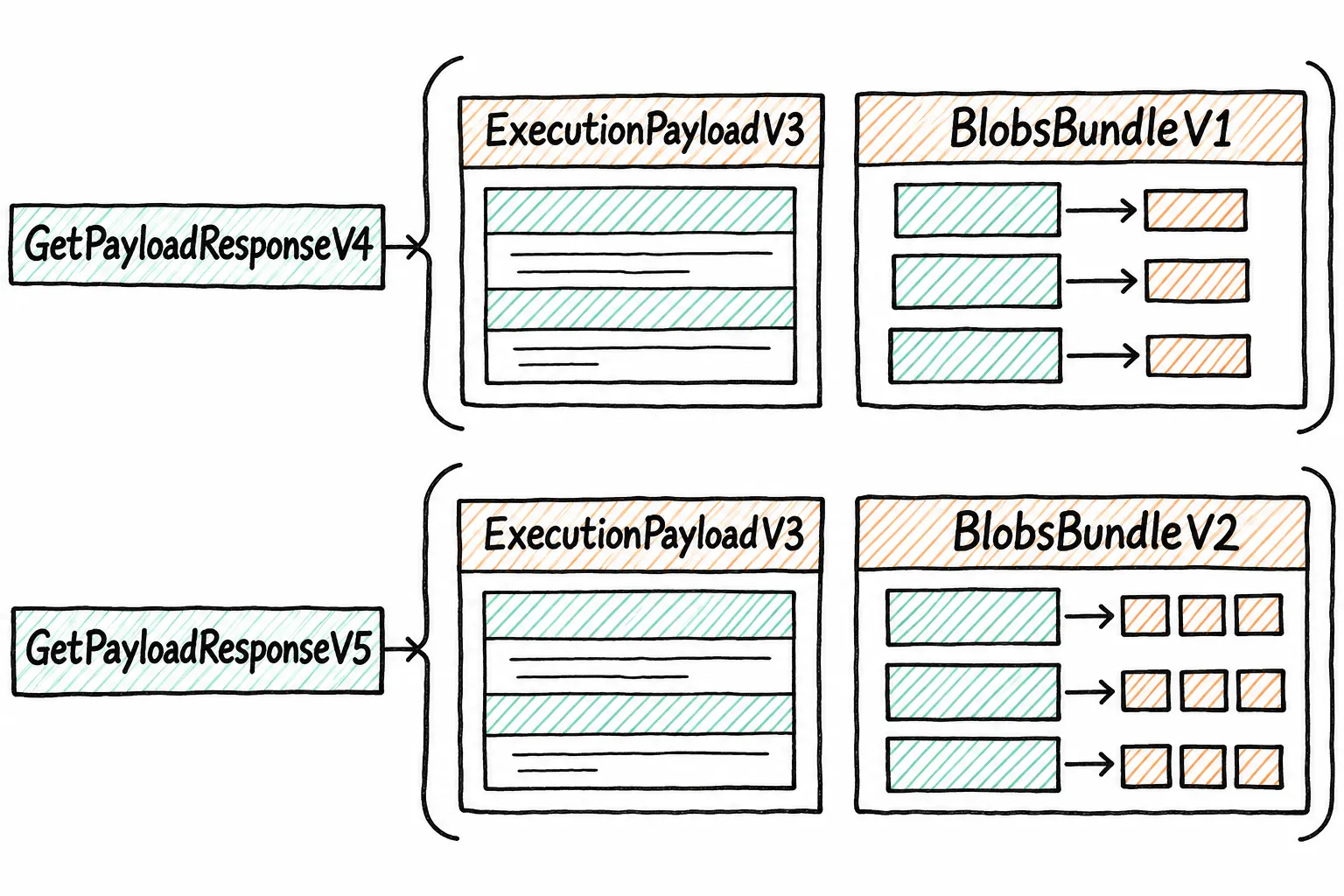
The execution payload is ExecutionPayloadV3, and the Blob bundle is BlobsBundleV1.
A V3 outer response does not imply that every inner type is V3.
block_value remains the same expected value as in V2, not a settled balance.
An external provider of block candidates is called a builder.
If should_override_builder is true, the execution layer recommends that the consensus layer prefer the returned candidate over an external builder's candidate.
false means no such recommendation is made; it is not an instruction to always adopt the external candidate.
The method for determining this value varies by implementation, and false is recommended if no decision procedure is available.
Receiving this recommendation does not indicate that an external candidate has already been replaced or that validation of the candidate succeeded. Assess candidate evaluation, validation status, and actual adoption separately.
GetPayloadResponseV4
The Prague construction response also returns a list of execution requests arising from the candidate to the consensus layer.
The execution layer attaches execution requests to the candidate, expected value, Blob bundle, and preference recommendation. The consensus layer passes their contents to processing appropriate to each request type.
class GetPayloadResponseV4(Container):
    execution_payload: ExecutionPayloadV3
    block_value: uint256
    blobs_bundle: BlobsBundleV1
    should_override_builder: boolean
execution_requests: List[ByteList[MAX_BYTES_PER_TRANSACTION], MAX_EXECUTION_REQUESTS]| Field | Type | Meaning for the receiver |
|---|---|---|
execution_payload |
ExecutionPayloadV3 |
Execution payload of the block being validated or retrieved |
block_value |
uint256 |
Expected value for the fee recipient, in wei, not a settled balance |
blobs_bundle |
BlobsBundleV1 |
Bundle of Blob data and proofs accompanying the block |
should_override_builder |
boolean |
Execution layer recommendation to prefer the returned candidate over an external candidate; not a mandatory instruction or a completed replacement |
execution_requests |
List[ByteList[MAX_BYTES_PER_TRANSACTION], MAX_EXECUTION_REQUESTS] |
List of execution requests containing types and contents, sorted by ascending type without duplicates, each at least two bytes |
Apart from execution_requests, the V3 response types remain unchanged, and the inner execution payload is still ExecutionPayloadV3.
The expected value is not a settled balance, and should_override_builder remains a recommendation to prefer the candidate.
Each execution request consists of request_type, a first byte identifying the type, and request_data, the remaining contents.
The list is ordered by ascending type without duplicate types.
Entries with empty contents are omitted, so each element is at least two bytes long.
If there are no requests, the list is empty rather than null.
For example, returning contents for type 1 followed by type 2 lets the consensus layer dispatch each to its corresponding processing.
A list with type 2 followed by type 1, or with two type 1 entries, violates these conditions even if it fits within the SSZ maximum length.
These conditions are checked both for the list returned in construction results and the list submitted for validation.
GetPayloadResponseV5
The Osaka response changes the Blob bundle accompanying the candidate to the cell-proof format.
The execution layer constructs this response, and the consensus layer reads the V3 execution payload together with the V2 Blob bundle.
class GetPayloadResponseV5(Container):
    execution_payload: ExecutionPayloadV3
    block_value: uint256
    blobs_bundle: BlobsBundleV2
    should_override_builder: boolean
execution_requests: List[ByteList[MAX_BYTES_PER_TRANSACTION], MAX_EXECUTION_REQUESTS]| Field | Type | Meaning for the receiver |
|---|---|---|
execution_payload |
ExecutionPayloadV3 |
Execution payload of the block being validated or retrieved |
block_value |
uint256 |
Expected value for the fee recipient, in wei, not a settled balance |
blobs_bundle |
BlobsBundleV2 |
Bundle of Blob data and proofs accompanying the block |
should_override_builder |
boolean |
Execution layer recommendation to prefer the returned candidate over an external candidate; not a mandatory instruction or a completed replacement |
execution_requests |
List[ByteList[MAX_BYTES_PER_TRANSACTION], MAX_EXECUTION_REQUESTS] |
List of execution requests containing types and contents, sorted by ascending type without duplicates, each at least two bytes |
The type change from V4 is that blobs_bundle becomes BlobsBundleV2.
For example, for two Blobs the consensus layer checks that 256 cell proofs correspond to the two bodies and commitments.
This count requirement remains separate from compliance with the maximum counts specified by the type.
block_value is the expected value for the fee recipient, and should_override_builder recommends prioritizing the execution layer's candidate.
As in V4, execution requests must be sorted by ascending type without duplicates and contain at least two bytes per element.
Changing the outer retrieval version to V5 does not turn the expected value into a settled balance or the recommendation into a mandatory instruction.
PayloadBodiesV1Response
This data returns existing and unknown payload bodies requested from the execution layer by hash list or block number range. The consensus layer reads the inner list at each response position, treating an empty list as unknown and a single-element list as a retrieved body.
class PayloadBodiesV1Response(Container):
payload_bodies: List[List[ExecutionPayloadBodyV1, 1], MAX_PAYLOAD_BODIES_REQUEST]| Field | Type | Meaning for the receiver |
|---|---|---|
payload_bodies |
List[List[ExecutionPayloadBodyV1, 1], MAX_PAYLOAD_BODIES_REQUEST] |
List of block bodies distinguishing known and unknown entries |
The outer payload_bodies list contains up to 32 entries, and each entry is itself a list of at most one element.
For example, a known pre-Shanghai block has one body in the inner list, and that body's withdrawals list is empty.
If the body cannot be retrieved, the inner list itself is empty. Both representations are empty lists, but they indicate different missing data.
GetBlobsV1Response
This V1 retrieval response returns a list of Blobs and their whole-Blob proofs from the execution layer.
The consensus layer reads the contents of each pair, but this list type has no inner list to represent missing entries.
class GetBlobsV1Response(Container):
blobs_and_proofs: List[BlobAndProofV1, MAX_BLOB_HASHES_REQUEST]| Field | Type | Meaning for the receiver |
|---|---|---|
blobs_and_proofs |
List[BlobAndProofV1, MAX_BLOB_HASHES_REQUEST] |
List of existing Blob and proof pairs |
An inconsistency with the existing API remains here.
For example, if Blob entries A, B, and C are requested and only B is absent, the underlying Cancun specification returns [A, null, C], preserving the positions relative to the request.
In contrast, every element of this SSZ list type is a Blob-and-proof pair, so it cannot represent the null in the middle.
Removing the missing B to produce [A, C] would change the positional correspondence, and the proposal does not establish that as a fallback behavior.
GetBlobsV2Response
In V2 retrieval, the execution layer returns a list containing each Blob with its cell proofs.
The consensus layer reads the existing Blobs and their 128 proofs, but conditions governing an absent response as a whole remain unspecified.
class GetBlobsV2Response(Container):
blobs_and_proofs: List[BlobAndProofV2, MAX_BLOB_HASHES_REQUEST]| Field | Type | Meaning for the receiver |
|---|---|---|
blobs_and_proofs |
List[BlobAndProofV2, MAX_BLOB_HASHES_REQUEST] |
List of existing Blob and proof pairs |
In the underlying Osaka specification, V2 returns null for the entire response if even one requested Blob is missing or if a Blob uses an older proof format.
For example, if A and B are requested and B is missing, the entire response is null, not a list containing only A.
EIP8178 specifies 204 during synchronization but does not state which HTTP code represents a null response as a whole due to missing data or an older version.
No rule can be inferred for extending 204 during synchronization to other conditions or changing the response to a list of only existing Blobs.
GetBlobsV3Response
V3 retrieval represents the presence or absence of a Blob and cell proofs at each requested position with an empty or single-element inner list.
The execution layer constructs the list, and the consensus layer reads which entries are present and absent while preserving the positions corresponding to the request.
class GetBlobsV3Response(Container):
blobs_and_proofs: List[List[BlobAndProofV2, 1], MAX_BLOB_HASHES_REQUEST]| Field | Type | Meaning for the receiver |
|---|---|---|
blobs_and_proofs |
List[List[BlobAndProofV2, 1], MAX_BLOB_HASHES_REQUEST] |
List indicating the presence or absence of Blob data and proofs at each position |
For example, if A, B, and C are requested and only B is missing, the response contains a single-element list for A, an empty list, and a single-element list for C.
Even if all entries are missing, the underlying V3 returns a list of missing entries with the same length as the request.
Distinguish missing entries in the 200 response body from a 204 response without a body during synchronization.
The underlying V3 also includes conditions other than synchronization where the entire response is null because Blob data cannot generally be served.
EIP8178 explicitly identifies synchronization as the condition for 204, but does not fully map the other unavailability conditions to HTTP.
ClientVersionV1
This data lets the consensus and execution layers identify their implementations to each other. Each client provides a short identifier code, name, version, and implementation commit information, allowing the peer to identify the connected implementation.
class ClientVersionV1(Container):
    code: ByteList[MAX_CLIENT_CODE_LENGTH]
    name: ByteList[MAX_CLIENT_NAME_LENGTH]
    version: ByteList[MAX_CLIENT_VERSION_LENGTH]
commit: Bytes4| Field | Type | Meaning for the receiver |
|---|---|---|
code |
ByteList[MAX_CLIENT_CODE_LENGTH] |
Short client identifier code |
name |
ByteList[MAX_CLIENT_NAME_LENGTH] |
Client name |
version |
ByteList[MAX_CLIENT_VERSION_LENGTH] |
Client version |
commit |
Bytes4 |
Four-byte value identifying the implementation commit |
code is at most two bytes; name and version are each at most 64 bytes.
commit is a fixed four bytes; in the underlying API it corresponds to the first four bytes of the build's latest commit hash.
The character counts of names and versions need not equal the byte counts constrained by the SSZ types.
Encodings such as UTF-8 represent human-readable text as byte sequences, but the proposal does not specify a character encoding for these fields.
It also does not specify how to handle invalid strings, including validation_error.
The type-level length limit alone does not guarantee the number of displayable characters or that the contents are valid text.
GetClientVersionV1Response
This data returns a list of execution-layer client information to the consensus layer. The consensus layer reads each entry's name, version, and commit to identify the implementations behind the connection.
class GetClientVersionV1Response(Container):
versions: List[ClientVersionV1, MAX_CLIENT_VERSIONS]| Field | Type | Meaning for the receiver |
|---|---|---|
versions |
List[ClientVersionV1, MAX_CLIENT_VERSIONS] |
List of up to four client information entries |
versions has a maximum of four entries.
For example, a setup that mediates connections to multiple execution clients may return multiple entries for one request.
The list identifies the connected implementations; it is neither a determination that a block is valid nor a declaration that every operation is supported.
Request data
The consensus layer creates request data according to the block to validate, the head to adopt, or the object to retrieve. A forkchoice update optionally includes payload attributes. An empty list requests only an update; a single element requests construction as well.
NewPayloadV1Request
This data sends the execution payload of a received Paris candidate from the consensus layer for validation.
The execution layer reads the enclosed candidate, validates the execution result, and returns PayloadStatusV1.
class NewPayloadV1Request(Container):
execution_payload: ExecutionPayloadV1| Field | Type | Meaning for the receiver |
|---|---|---|
execution_payload |
ExecutionPayloadV1 |
Execution payload of the block being validated or retrieved |
The body contains one ExecutionPayloadV1 candidate.
For example, after submitting a candidate containing two transfers, the consensus layer checks the returned status to distinguish valid, invalid, and incomplete validation.
Successfully transmitting the SSZ body alone does not establish the validity of the block.
NewPayloadV2Request
This data submits a Shanghai execution payload containing withdrawals for validation.
The consensus layer places ExecutionPayloadV2 in the body, and the execution layer validates the candidate including withdrawals.
class NewPayloadV2Request(Container):
execution_payload: ExecutionPayloadV2| Field | Type | Meaning for the receiver |
|---|---|---|
execution_payload |
ExecutionPayloadV2 |
Execution payload of the block being validated or retrieved |
This type fixes the inner payload to V2.
In contrast, the underlying Shanghai specification's V2 validation accepts V1 if the candidate timestamp precedes Shanghai and V2 thereafter.
The proposal does not specify how to represent a pre-fork V1 candidate accepted by the same V2 operation using this SSZ type.
The type definition alone does not establish normalization by adding empty withdrawals or automatic fallback to the V1 endpoint.
NewPayloadV3Request
To validate a Cancun candidate, the consensus layer uses this data to attach a list of expected Blob hashes and the parent beacon block root to the execution payload.
The execution layer uses these two fields in validation in addition to the inner candidate.
class NewPayloadV3Request(Container):
    execution_payload: ExecutionPayloadV3
    expected_blob_versioned_hashes: List[Bytes32, MAX_BLOB_COMMITMENTS_PER_BLOCK]
parent_beacon_block_root: Bytes32| Field | Type | Meaning for the receiver |
|---|---|---|
execution_payload |
ExecutionPayloadV3 |
Execution payload of the block being validated or retrieved |
expected_blob_versioned_hashes |
List[Bytes32, MAX_BLOB_COMMITMENTS_PER_BLOCK] |
Expected versioned hashes of the Blob data included in the block |
parent_beacon_block_root |
Bytes32 |
Root associating the payload with the parent beacon block |
The underlying API extracts Blob hashes from transactions in execution order and checks them against expected_blob_versioned_hashes.
If there are no Blob transactions, the expected list is also empty.
If the lists of hashes differ, the candidate fails validation even if the data satisfies the SSZ length and type constraints.
NewPayloadV4Request
The Prague validation request adds a list of execution requests to the execution payload and expected Blob hashes.
The consensus layer sends the candidate and list, and the execution layer also uses the commitment derived from the list to verify the block hash.
class NewPayloadV4Request(Container):
    execution_payload: ExecutionPayloadV3
    expected_blob_versioned_hashes: List[Bytes32, MAX_BLOB_COMMITMENTS_PER_BLOCK]
    parent_beacon_block_root: Bytes32
execution_requests: List[ByteList[MAX_BYTES_PER_TRANSACTION], MAX_EXECUTION_REQUESTS]| Field | Type | Meaning for the receiver |
|---|---|---|
execution_payload |
ExecutionPayloadV3 |
Execution payload of the block being validated or retrieved |
expected_blob_versioned_hashes |
List[Bytes32, MAX_BLOB_COMMITMENTS_PER_BLOCK] |
Expected versioned hashes of the Blob data included in the block |
parent_beacon_block_root |
Bytes32 |
Root associating the payload with the parent beacon block |
execution_requests |
List[ByteList[MAX_BYTES_PER_TRANSACTION], MAX_EXECUTION_REQUESTS] |
List of execution requests containing types and contents, sorted by ascending type without duplicates, each at least two bytes |
The inner execution payload remains V3; the added execution requests occupy a separate outer field.
The execution layer checks the ordering of request types, duplicate types, and the lengths of their contents.
Duplicate types, reversed ordering, elements of one byte or less, or a null list constitute invalid arguments under the underlying Prague specification.
EIP8178 does not specify which HTTP code represents this input error.
Conversely, if the commitment calculated from a correctly formed list does not match the candidate's header, the underlying API marks the candidate's validation result as INVALID.
Distinguish request format requirements from validation results based on the contents.
GetPayloadBodiesByHashRequest
This data lets the consensus layer specify the payload bodies to retrieve by a list of execution block hashes.
The execution layer looks up the bodies for the specified hashes and returns known or unknown entries in PayloadBodiesV1Response.
class GetPayloadBodiesByHashRequest(Container):
block_hashes: List[Bytes32, MAX_PAYLOAD_BODIES_REQUEST]| Field | Type | Meaning for the receiver |
|---|---|---|
block_hashes |
List[Bytes32, MAX_PAYLOAD_BODIES_REQUEST] |
List of hashes of the blocks to retrieve |
The list contains at most 32 hashes. For example, when two hashes are sent, the result at each position can be distinguished using an empty or single-element list. The specified hashes identify execution blocks; do not confuse them with consensus-layer beacon block roots.
GetPayloadBodiesByRangeRequest
This data specifies the starting block number and count so the consensus layer can retrieve consecutive payload bodies. The execution layer looks up the requested range on the currently selected chain and returns the list of bodies.
class GetPayloadBodiesByRangeRequest(Container):
    start: uint64
count: uint64| Field | Type | Meaning for the receiver |
|---|---|---|
start |
uint64 |
Starting block number for retrieval |
count |
uint64 |
Number of consecutive payload bodies to retrieve |
For example, start of 100 and count of 2 requests two entries beginning at block number 100.
The underlying API requires both to be at least 1, so zero, although representable as uint64, is not necessarily valid input.
Check these values against the response type's 32-entry maximum as well, and do not confuse the starting block number with a consensus-layer slot number.
ForkchoiceUpdatedV1Request
This data sends the three forkchoice references and optional Paris payload attributes from the consensus layer to the execution layer.
The execution layer checks and applies forkchoice before checking payload attributes, if any were supplied.
class ForkchoiceUpdatedV1Request(Container):
    forkchoice_state: ForkchoiceStateV1
payload_attributes: List[PayloadAttributesV1, 1]| Field | Type | Meaning for the receiver |
|---|---|---|
forkchoice_state |
ForkchoiceStateV1 |
Head, safe, and finalized positions selected by the consensus layer |
payload_attributes |
List[PayloadAttributesV1, 1] |
Attributes for starting construction; an empty list means no construction request |
If payload_attributes is empty, no new construction is requested.
If it contains one element, construction is requested using those attributes.
For example, when only valid forkchoice is updated, the payload identifier is all zeroes even if the response validation status is VALID.
Check the results of the update and construction separately, even though both are covered by one request.
ForkchoiceUpdatedV2Request
This Shanghai request attaches optional payload attributes containing withdrawals to the consensus layer's forkchoice references.
The execution layer processes forkchoice and, if attributes are present, interprets them as a request to construct a candidate containing withdrawals.
class ForkchoiceUpdatedV2Request(Container):
    forkchoice_state: ForkchoiceStateV1
payload_attributes: List[PayloadAttributesV2, 1]| Field | Type | Meaning for the receiver |
|---|---|---|
forkchoice_state |
ForkchoiceStateV1 |
Head, safe, and finalized positions selected by the consensus layer |
payload_attributes |
List[PayloadAttributesV2, 1] |
Attributes for starting construction; an empty list means no construction request |
When payload attributes are specified, this SSZ type contains one PayloadAttributesV2 entry.
The underlying V2 forkchoice update accepts pre-Shanghai V1 attributes or subsequent V2 attributes depending on the timestamp of the payload to construct.
There is no rule for mapping this older fork input to the same SSZ request.
An empty list means no construction is requested, so it cannot substitute for V1 attributes either.
ForkchoiceUpdatedV3Request
This data sends forkchoice references and optional payload attributes containing the parent beacon block root from the consensus layer. After applying forkchoice, the execution layer checks the timestamp and other attributes if present and starts construction.
class ForkchoiceUpdatedV3Request(Container):
    forkchoice_state: ForkchoiceStateV1
payload_attributes: List[PayloadAttributesV3, 1]| Field | Type | Meaning for the receiver |
|---|---|---|
forkchoice_state |
ForkchoiceStateV1 |
Head, safe, and finalized positions selected by the consensus layer |
payload_attributes |
List[PayloadAttributesV3, 1] |
Attributes for starting construction; an empty list means no construction request |
For example, if the head is valid but the payload attributes have an invalid timestamp, 422 is returned as an attributes error.
The underlying API specifies that an already-applied forkchoice update is not rolled back at that point.
A failed HTTP request does not establish that all updates have been reverted.
GetBlobsRequest
This data specifies the objects that the consensus layer wants to retrieve from the execution layer's Blob pool using versioned hashes.
It is shared by V1, V2, and V3 Blob retrieval; the execution layer looks up the objects and returns them in the format appropriate to the operation version.
class GetBlobsRequest(Container):
blob_versioned_hashes: List[Bytes32, MAX_BLOB_HASHES_REQUEST]| Field | Type | Meaning for the receiver |
|---|---|---|
blob_versioned_hashes |
List[Bytes32, MAX_BLOB_HASHES_REQUEST] |
Versioned hashes identifying the Blob data to retrieve |
blob_versioned_hashes contains at most 128 entries.
Even with the same hash, V1 returns a whole-Blob proof, while V2 and V3 return cell proofs and handle missing entries differently.
Sharing a request type does not mean that responses can be decoded using the same type.
GetClientVersionV1Request
This data sends one entry of the consensus layer's own client information to the execution layer. The execution layer reads the sender's implementation information and returns a list of its own client information.
class GetClientVersionV1Request(Container):
client_version: ClientVersionV1| Field | Type | Meaning for the receiver |
|---|---|---|
client_version |
ClientVersionV1 |
Client version information of the sending consensus layer |
The request contains one client_version entry, whereas the response's versions list contains up to four.
For example, if the consensus layer sends its own version A, the execution layer returns information such as its own version B.
The party providing the information and the number of entries differ between the request and response.
Operations and transmission examples
Even for the same data type, the endpoint and response differ depending on the invoked operation and version. The following sections map the 18 endpoints with detailed definitions and listings to seven operation categories, then examine the three transmission examples published in the proposal.
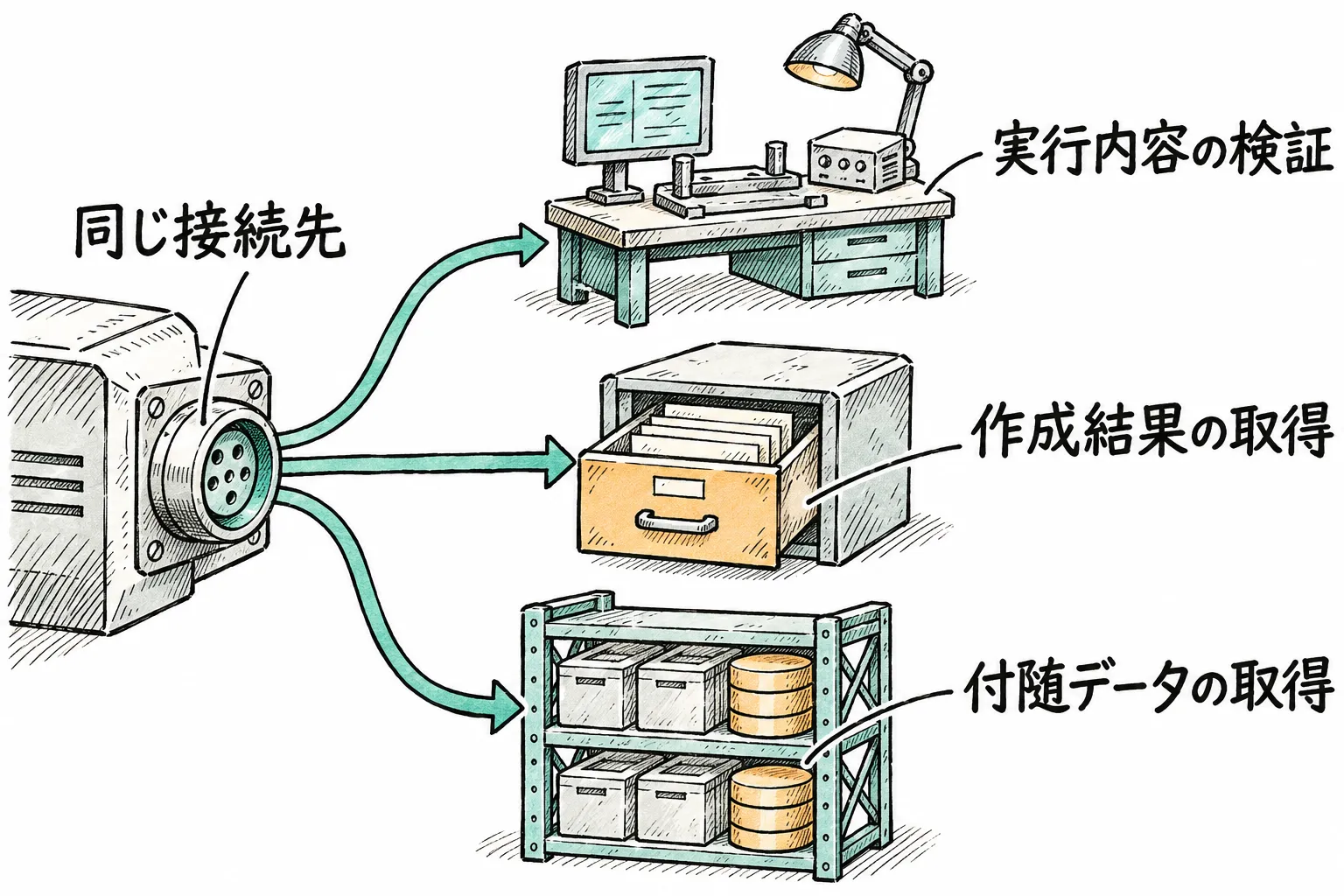
Validating an execution payload
The consensus layer submits a received candidate's execution payload with the necessary auxiliary information for validation.
After processing the request, the execution layer returns the validation result with 200, so the consensus layer then reads PayloadStatusV1.
A candidate for which SYNCING or ACCEPTED was returned must not be treated as fully validated.
| Endpoint | Fork | Request | 200 response | Corresponding existing operation |
|---|---|---|---|---|
POST /engine/v1/payloads |
Paris |
NewPayloadV1Request |
PayloadStatusV1 |
engine_newPayloadV1 |
POST /engine/v2/payloads |
Shanghai |
NewPayloadV2Request |
PayloadStatusV1 |
engine_newPayloadV2 |
POST /engine/v3/payloads |
Cancun |
NewPayloadV3Request |
PayloadStatusV1 |
engine_newPayloadV3 |
POST /engine/v4/payloads |
Prague |
NewPayloadV4Request |
PayloadStatusV1 |
engine_newPayloadV4 |
The body sent to each endpoint is the SSZ-encoded value of the request type in the table.
Include a valid JWT and use application/octet-stream for Content-Type and Accept.
Check not only the type version but also the fork-specific validation conditions corresponding to the candidate timestamp against the underlying API.
Retrieving a constructed payload
Specify the eight-byte identifier returned when construction started in the path to retrieve a candidate from that construction process.
The request has no body; include a valid JWT and an Accept header requesting an SSZ response.
The execution layer returns the corresponding candidate with 200, or 404 for an unknown identifier.
| Endpoint | Fork | Request | 200 response | Corresponding existing operation |
|---|---|---|---|---|
GET /engine/v1/payloads/{payload_id} |
Paris |
No body | ExecutionPayloadV1 |
engine_getPayloadV1 |
GET /engine/v2/payloads/{payload_id} |
Shanghai |
No body | GetPayloadResponseV2 |
engine_getPayloadV2 |
GET /engine/v3/payloads/{payload_id} |
Cancun |
No body | GetPayloadResponseV3 |
engine_getPayloadV3 |
GET /engine/v4/payloads/{payload_id} |
Prague |
No body | GetPayloadResponseV4 |
engine_getPayloadV4 |
GET /engine/v5/payloads/{payload_id} |
Osaka |
No body | GetPayloadResponseV5 |
engine_getPayloadV5 |
payload_id is displayed in hexadecimal while preserving its Bytes8 byte order.
This is not an operation that reconstructs a little-endian integer representation.
V1 returns the execution payload itself, while V2 and later return a response type including value and other data; decode using the type matching the path.
The identifier refers to the construction process, not a single fixed byte sequence.
The underlying Paris specification returns the latest candidate immediately at the time of the retrieval request and permits construction to stop after the response.
It does not guarantee that repeated requests with the same identifier return the same candidate or that it is stored indefinitely.
Do not assume an all-zero identifier indicating that construction has not started refers to a retrievable candidate.
Retrieving payload bodies by hash
The consensus layer sends a list of execution block hashes, and the execution layer returns the corresponding stored bodies.
Include a valid JWT and put up to 32 hashes in the SSZ body of the request type.
On success, decode the 200 body as PayloadBodiesV1Response.
| Endpoint | Fork | Request | 200 response | Corresponding existing operation |
|---|---|---|---|---|
POST /engine/v1/payloads/bodies/by-hash |
Shanghai |
GetPayloadBodiesByHashRequest |
PayloadBodiesV1Response |
engine_getPayloadBodiesByHashV1 |
The underlying API returns results in the same order as the requested hashes and represents unknown positions as null.
In the SSZ response, such a position is an empty inner list, while a known body is represented by one element.
A known body with an empty withdrawal list differs from an unknown block.
A synchronizing execution layer may be unable to provide even the body of a previously submitted candidate.
Retrieving payload bodies by block number range
The consensus layer sends a starting block number and count, and the execution layer returns bodies along the currently selected chain.
Include a valid JWT and send the SSZ-encoded request type; for a 200 response, decode the payload body retrieval response type.
This retrieves historical bodies and does not start construction of a new block.
| Endpoint | Fork | Request | 200 response | Corresponding existing operation |
|---|---|---|---|---|
POST /engine/v1/payloads/bodies/by-range |
Shanghai |
GetPayloadBodiesByRangeRequest |
PayloadBodiesV1Response |
engine_getPayloadBodiesByRangeV1 |
The underlying Shanghai specification requires both start and count to be at least 1.
Unknown positions before the latest block are returned as missing entries, but trailing missing positions beyond the end of the chain are truncated.
For example, when requesting four entries from block number 100 and the latest block is 101, the result stops at 101 instead of padding 102 and 103 with missing entries.
Because chain reorganizations can occur during retrieval of unfinalized blocks, the underlying API advises care when retrieving by hash or verifying received hashes.
Do not infer a different ordering or fallback behavior for missing bodies from the SSZ list type alone.
Updating forkchoice and starting construction
The consensus layer sends the selected head, safe position, and finalized position, optionally requesting construction of a new candidate as well.
The execution layer verifies the head's validity and the relationship between the references, then processes the payload attributes after successfully applying forkchoice.
Every version returns ForkchoiceUpdatedResponseV1, in which the receiver distinguishes the validation status from the payload identifier.
| Endpoint | Fork | Request | 200 response | Corresponding existing operation |
|---|---|---|---|---|
POST /engine/v1/forkchoice |
Paris |
ForkchoiceUpdatedV1Request |
ForkchoiceUpdatedResponseV1 |
engine_forkchoiceUpdatedV1 |
POST /engine/v2/forkchoice |
Shanghai |
ForkchoiceUpdatedV2Request |
ForkchoiceUpdatedResponseV1 |
engine_forkchoiceUpdatedV2 |
POST /engine/v3/forkchoice |
Cancun |
ForkchoiceUpdatedV3Request |
ForkchoiceUpdatedResponseV1 |
engine_forkchoiceUpdatedV3 |
Include a valid JWT and encode the request type for the selected version as the SSZ body.
The underlying API ordering requirements remain: the consensus layer sends forkchoice update events in order, and the execution layer processes them in the order received.
If the head is unknown or the data needed for validation is missing, the execution layer returns SYNCING within a 200 response.
An invalid head is also read as INVALID within a 200 response, whereas inconsistencies such as safe or finalized positions not belonging to the chain of a valid head produce 409.
Invalid payload attributes produce 422, but the underlying API does not roll back the forkchoice state that has already been applied.
There is no rule for translating errors without an HTTP mapping, such as excessively deep chain reorganizations, into custom codes.
Retrieving Blobs
The consensus layer sends up to 128 versioned hashes, and the execution layer returns contents from its Blob pool.
Use a valid JWT and the shared SSZ request type. Decode a 200 response using the response type corresponding to the path version, or treat a 204 during synchronization as having no body.
| Endpoint | Fork | Request | 200 response | Corresponding existing operation |
|---|---|---|---|---|
POST /engine/v1/blobs |
Cancun |
GetBlobsRequest |
GetBlobsV1Response |
engine_getBlobsV1 |
POST /engine/v2/blobs |
Osaka |
GetBlobsRequest |
GetBlobsV2Response |
engine_getBlobsV2 |
POST /engine/v3/blobs |
Osaka |
GetBlobsRequest |
GetBlobsV3Response |
engine_getBlobsV3 |
V1 returns whole-Blob proofs, while V2 and V3 return cell proofs.
V3 can also represent missing entries at each position, but the representation of missing V1 entries and additional conditions for absent V2 or V3 responses as a whole remain partially unspecified.
Do not fill these gaps by returning only existing entries or always using 204.
A 204 retrieval response is a transport result indicating that no body is present.
SYNCING in response to a candidate validation request is a separate result indicating incomplete candidate validation.
A Blob can also be removed from the storage pool, so knowing its hash does not guarantee that its body can be retrieved.
Exchanging client information
The consensus layer sends one entry of its own client information, and the execution layer returns a list of its own information.
Include a valid JWT, send the SSZ request, and read up to four information entries from the 200 body.
| Endpoint | Fork | Request | 200 response | Corresponding existing operation |
|---|---|---|---|---|
POST /engine/v1/client/version |
All | GetClientVersionV1Request |
GetClientVersionV1Response |
engine_getClientVersionV1 |
The response identifies the implementation name and version of the connected peer.
However, successful exchange does not constitute a capability negotiation indicating support for every SSZ version or operation.
Example of submitting a block for validation
This example assumes that the NewPayloadV4Request submitted for Prague validation has already been encoded into new_payload_request.ssz.
The consensus layer prepares a valid authentication token and sends this file to the validation endpoint.
curl -X POST http://localhost:8551/engine/v4/payloads \
  -H "Authorization: Bearer $JWT_TOKEN" \
  -H "Content-Type: application/octet-stream" \
  -H "Accept: application/octet-stream" \
  --data-binary @new_payload_request.ssz \
  -o payload_status.ssz
--data-binary sends the file's bytes directly as the body, and -o saves the response to payload_status.ssz.
Content-Type identifies the request body format, while Accept identifies the desired response format.
However, this command also writes HTTP error bodies to the same destination, so successfully saving the file alone does not establish success.
The caller checks the HTTP result and response Content-Type, then decodes a 200 SSZ body as PayloadStatusV1.
Only after checking the validation status, such as VALID, does the caller know the result of processing the block.
The command shown here is a transmission example from the proposal, not a measurement obtained by running it against a real client.
Example of retrieving a constructed payload
This example retrieves a candidate under construction using the payload identifier returned by the execution layer.
0x1234567890abcdef is the eight-byte example value in the proposal; when making an actual call, specify the identifier returned by the connected execution layer.
curl -X GET http://localhost:8551/engine/v4/payloads/0x1234567890abcdef \
  -H "Authorization: Bearer $JWT_TOKEN" \
  -H "Accept: application/octet-stream" \
  -o get_payload_response.ssz
There is no request body; the identifier in the path identifies the construction process.
Decode the 200 body as the V4 retrieval response GetPayloadResponseV4 and extract the execution payload, Blob bundle, and execution requests.
An unknown identifier produces 404, so do not decode the saved error text as SSZ.
Here too, check the existence of the saved file separately from the success of the HTTP request.
Example of submitting a forkchoice update
This example encodes forkchoice and optional payload attributes as ForkchoiceUpdatedV3Request and prepares them in forkchoice_request.ssz.
The consensus layer sends this file and a valid JWT to the execution layer.
curl -X POST http://localhost:8551/engine/v3/forkchoice \
  -H "Authorization: Bearer $JWT_TOKEN" \
  -H "Content-Type: application/octet-stream" \
  --data-binary @forkchoice_request.ssz \
  -o forkchoice_response.ssz
Before reading forkchoice_response.ssz, check the HTTP result and decode a successful body as ForkchoiceUpdatedResponseV1.
Check the validation status and presence of a payload identifier separately.
For example, if payload attributes are omitted, the payload identifier is all zeroes even when the forkchoice update is valid.
The three commands demonstrate sending prepared SSZ files and saving responses.
The proposal does not include a complete program that generates the input files, actual SSZ byte sequences, or test vectors with expected outputs.
These commands alone do not generate input files or authentication tokens, so testing the connection requires a compatible implementation and separately prepared inputs.
Additional notes
The new transport uses existing HTTP infrastructure and coexists with the existing JSON-RPC transport on the same port.
It returns SSZ values on success and human-readable reasons that can be logged on failure.
The transport is designed to avoid additional connection settings.
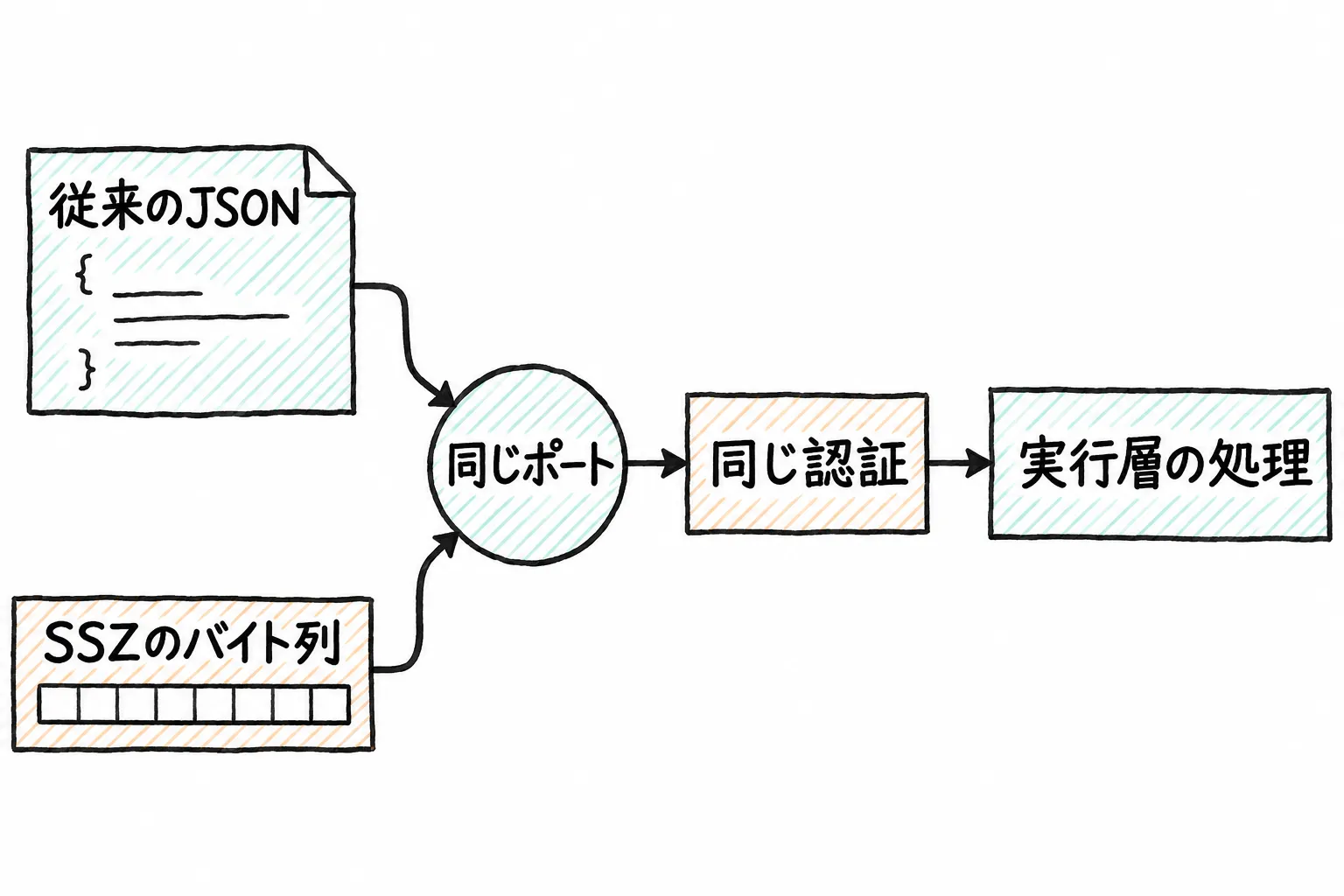
Two transports sharing the same endpoint
Existing JSON-RPC sends an application/json body to POST /, while the new transport sends SSZ bodies to paths under /engine.
Even on the same port, processing can be distinguished by path and body format.
Operators can therefore run both transports without additional ports, firewall rules, or separate shared JWT keys.
Sharing a port does not eliminate the need to authenticate the sender and check the network reachability of the service. Apply the existing authentication and connection restrictions to the new paths as well.
Existing transport infrastructure and readable errors
Using HTTP allows requests and responses to be observed through existing proxies and monitoring infrastructure.
In contrast, defining custom message framing over lower-level TCP communication requires additional implementation work on both layers.
Because the connection normally links processes on the same machine, the proposal chooses REST, finding no clear benefit to increasing that complexity.
The body format is application/octet-stream, a general-purpose binary content type.
Small, infrequent errors use text/plain so that people can read the reasons during debugging.
However, the proposal does not define error strings as stable error identifiers or fixed machine-readable structures.
The strength of mandatory and recommended behavior follows the normative terms in RFC2119 and RFC8174.
For example, providing a valid JWT and enforcing size limits before full deserialization are mandatory; including Accept in bodyless GET requests and retaining older versions are recommended.
This distinction separates required processing from behavior recommended for compatibility and operation.
Transfer-size claims and performance measurement
The proposal's claim of approximately 50% smaller transfer size compares hexadecimal text encoding with direct SSZ transport.
It does not mean that every HTTP header or the textual representation of payload identifiers remaining in URLs is also halved.
No benchmark table of implementations, block compositions, or execution times is provided either.
When evaluating an implementation, separate bytes transferred, encoding and deserialization time, and total block validation time. The design's ability to reduce conversion work does not establish real-client adoption or the speed of the entire propagation and execution process.
Compatibility
EIP8178 keeps the existing JSON-RPC transport available alongside the new one.
It adds a transport at the client level without changing consensus rules or execution results, but the draft leaves some type and version mappings incomplete.
Keeping the existing transport available is separate from being able to map every existing operation to the new transport.
Existing connections and gradual adoption
Consensus or execution layers without support can continue to use the existing JSON-RPC transport.
The proposal requires the existing API to remain functional and always available.
The addition can be made through regular client releases and does not change consensus rules, state transitions, or opcodes, so adding this transport itself does not require a hard fork.
However, no procedure is defined for discovering or negotiating peer SSZ support or for automatically falling back to the existing transport on failure.
The existence of both transports alone does not establish automatic switching between connected clients.
Version mismatches and undefined operations
The examples in the draft's versioning explanation do not match its detailed definitions.
The examples show paths corresponding to engine_newPayloadV5, engine_getPayloadV6, and engine_forkchoiceUpdatedV4, but the detailed request and response types and listings only extend to V4, V5, and V3 respectively.
There is no rule for constructing higher-version types appearing only in the examples by incrementing existing type numbers.
For example, the detailed block validation operation engine_newPayloadV4 has NewPayloadV4Request.
By contrast, no request type is published for the example engine_newPayloadV5.
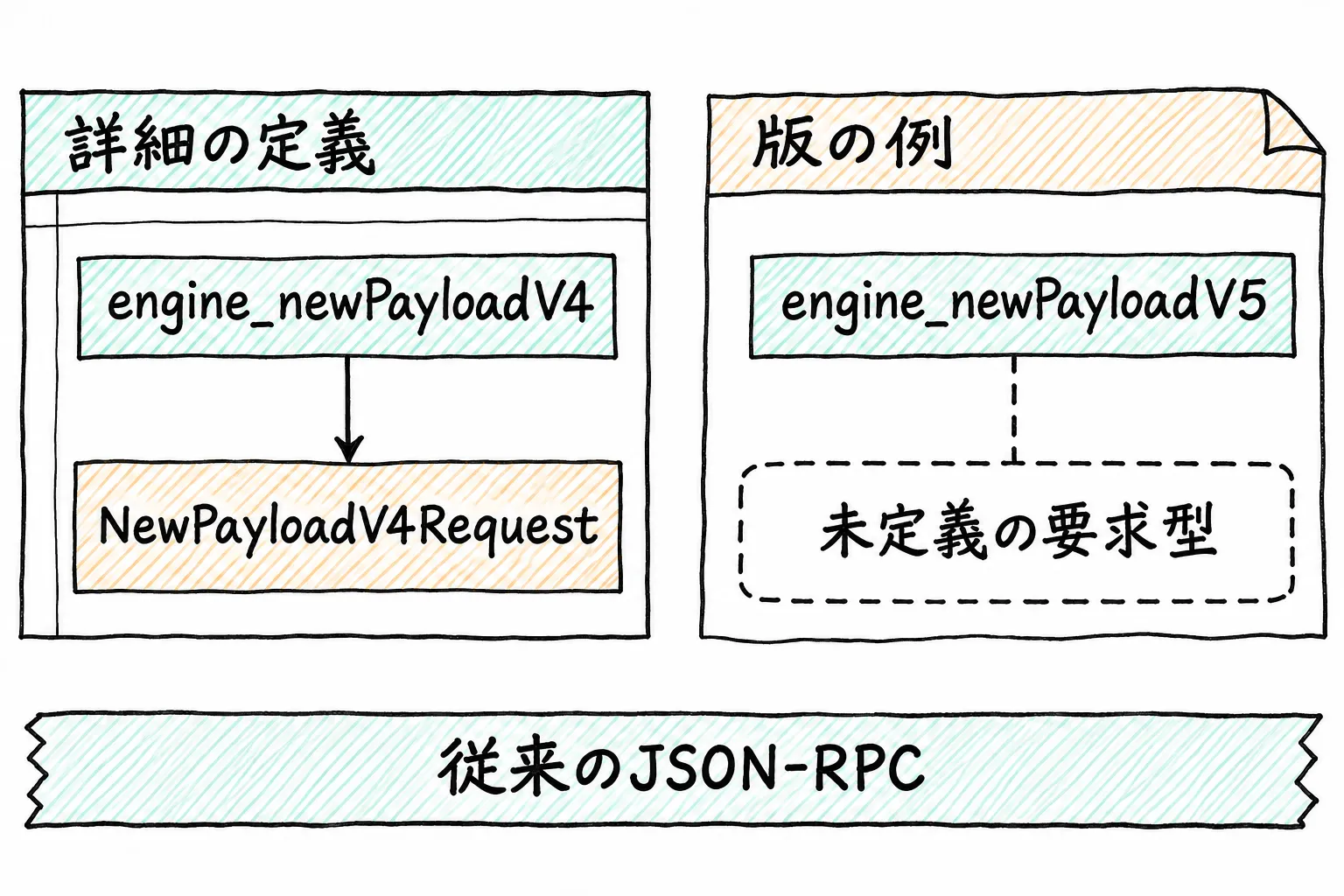
Similarly, the transition configuration type is listed but no exchange path is provided.
There is also no rule for converting capability negotiation through engine_exchangeCapabilities or the eth methods available on the authenticated connection to SSZ.
Although the proposal states that it covers structures and methods across all forks, only the 18 endpoints listed earlier have complete detailed definitions.
Missing-value representations also differ.
Blob retrieval V1 cannot represent the existing API's positional null entries, and the HTTP mappings for conditions producing an entirely null response in V2 and V3 are incomplete.
Representing a missing validation result hash as all zeroes also prevents distinguishing the original null from an all-zero value using the value alone.
The underlying Shanghai requirement that the same V2 operation accept an older fork's type also remains.
V2 validation accepts ExecutionPayloadV1 or V2 according to the timestamp, and V2 forkchoice updates accept PayloadAttributesV1 or V2.
In contrast, both SSZ V2 request types are fixed to their inner V2 types, and the draft does not specify how to represent the older types.
Do not fill this gap with automatic fallback to V1 paths, conversion to empty withdrawals, or the addition of alternative types.
Incorporating Optional or other constructs from a separate execution API redesign does not resolve this draft's unspecified behavior.
Connected implementations should compare the paths, request and response types, and handling of missing values and errors against the same specification version.
Security
Authenticate the sender for every request, and for requests containing an SSZ body, check the maximum size before decoding all the data into values.
A separate request for retrieving a constructed payload checks the format of the payload identifier in the URL before processing.
Body limits and identifiers in paths are distinct validation targets.
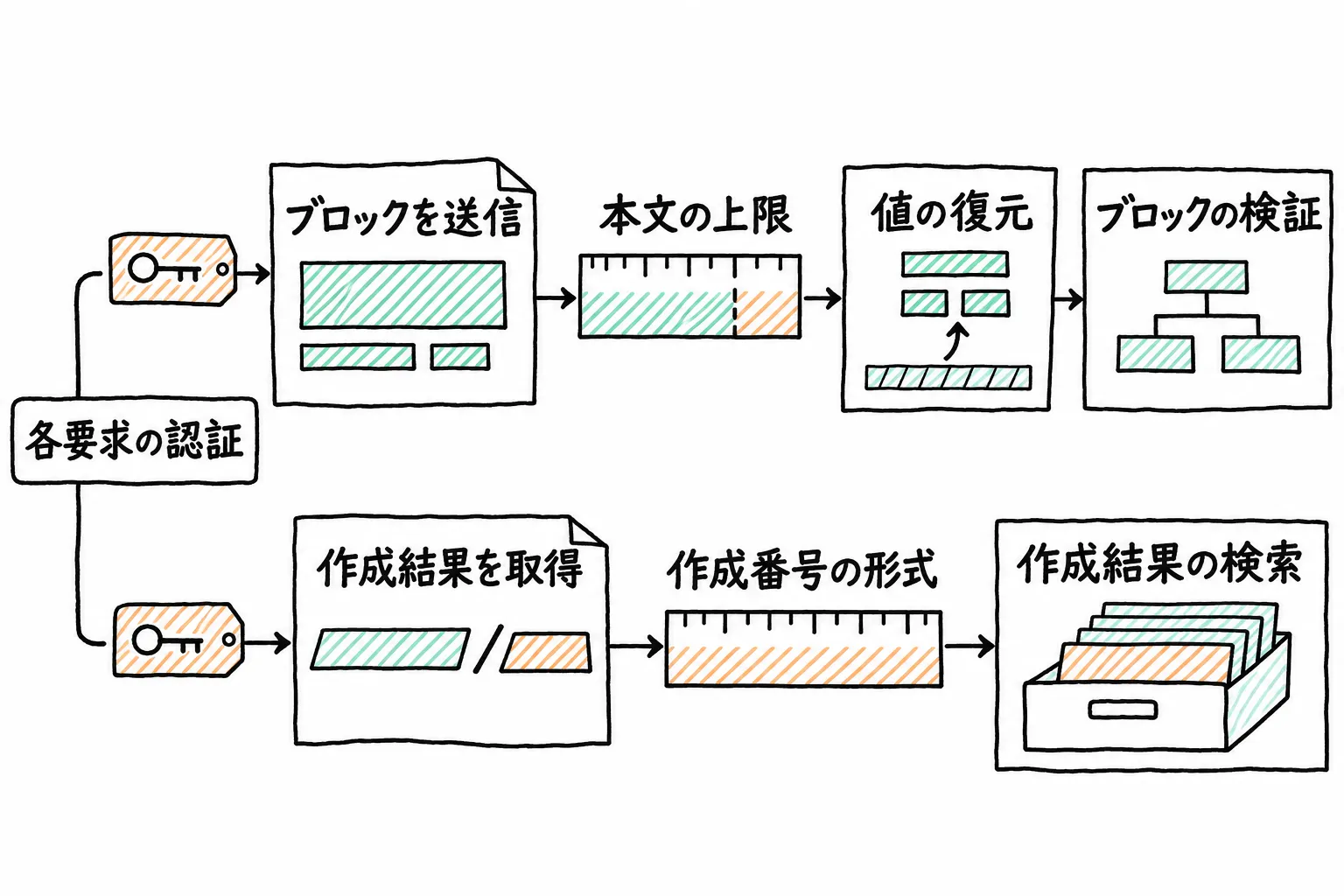
Existing authentication and restrictions on connection sources
The execution layer accepts only requests with a valid JWT on the new paths as well.
A missing Authorization header or invalid token produces 401.
Changing the transport to binary does not make block submission or forkchoice updates available to arbitrary callers.
The underlying authentication mechanism requires support for HS256 to verify token signatures using a shared secret and rejects unsigned tokens.
iat, the issuance timestamp, is required, and the execution layer is advised to accept tokens with timestamps within 60 seconds of its own clock in either direction.
The trust boundary for senders who know the secret is also shared with the existing Engine API.
JWT authenticates requests; it does not encrypt the communication.
The underlying specification is not intended to provide confidentiality against an observer of the communication or prevent replay attacks by that observer.
SSZ types alone cannot prevent shared-secret leakage or compromise of a trusted machine, so operators must apply key protection and connection-source restrictions to the new paths too.
Checking limits before decoding data
The execution layer rejects inputs exceeding the defined maximum size before fully deserializing the received body.
The same size limits applied to JSON parsing must also be applied to SSZ.
Even requests from authenticated peers can exhaust execution-layer resources if memory is allocated according to large element counts or sizes without enforcing limits.
Excess element counts are subject to 413, and invalid SSZ encoding to 400.
The proposal recommends using well-tested SSZ libraries and fuzz-testing parsers with numerous malformed inputs.
Execution payload validation remains after decoding the values, so successful type checks must not be substituted for a determination that the block is valid.
The draft does not define a concrete total HTTP body byte limit, limits for streaming reads, or rejection behavior when using Content-Length or compression.
The maximum capacity representable by a type cannot simply be treated as an operationally safe total capacity.
The receiver must separately check the mechanism for rejecting inputs before full decoding and the resource limits.
Payload identifier format and unretrieved data
When retrieving a constructed payload, the execution layer checks that payload_id in the URL is an eight-byte value represented in hexadecimal before processing.
This requirement prevents values with invalid lengths or characters from being passed directly to internal lookup.
A correctly formatted identifier does not guarantee that a result exists; an unknown payload identifier produces 404.
Check the identifier format and the existence of the construction process separately.
A 204 Blob retrieval response has no body, so it does not establish that validated contents were retrieved.
Read missing individual entries represented by empty inner lists and an all-zero payload identifier indicating that construction has not started according to their respective types.
Separate the transport result, missing-value representation, and block validation result to avoid proceeding as if necessary data had been retrieved when it has not.
Conclusion
EIP8178 proposes sending requests and responses between the consensus and execution layers using SSZ to reduce text conversion.
It retains authentication, block validation, and the existing JSON-RPC transport, but adoption requires checking versions, types, and unspecified behavior for missing values and errors separately.
All definitions and operations in the proposal can be found in the official EIP8178.

The official Engine API specification contains the underlying validation rules and fork-specific operations.
The official SSZ specification describes its types and how to read and write byte sequences.
