Introduction
Hi, I'm cardene, a software engineer and technical writer focused on blockchain and AI.
I've also authored Japanese technical books on specification-driven development with LLMs and decentralized application (DApp) development.

I also build and publish a variety of tools, libraries, and open-source projects.
ENS overview
ENS (Ethereum Name Service) provides a way to retrieve addresses and public profiles using human-readable names.
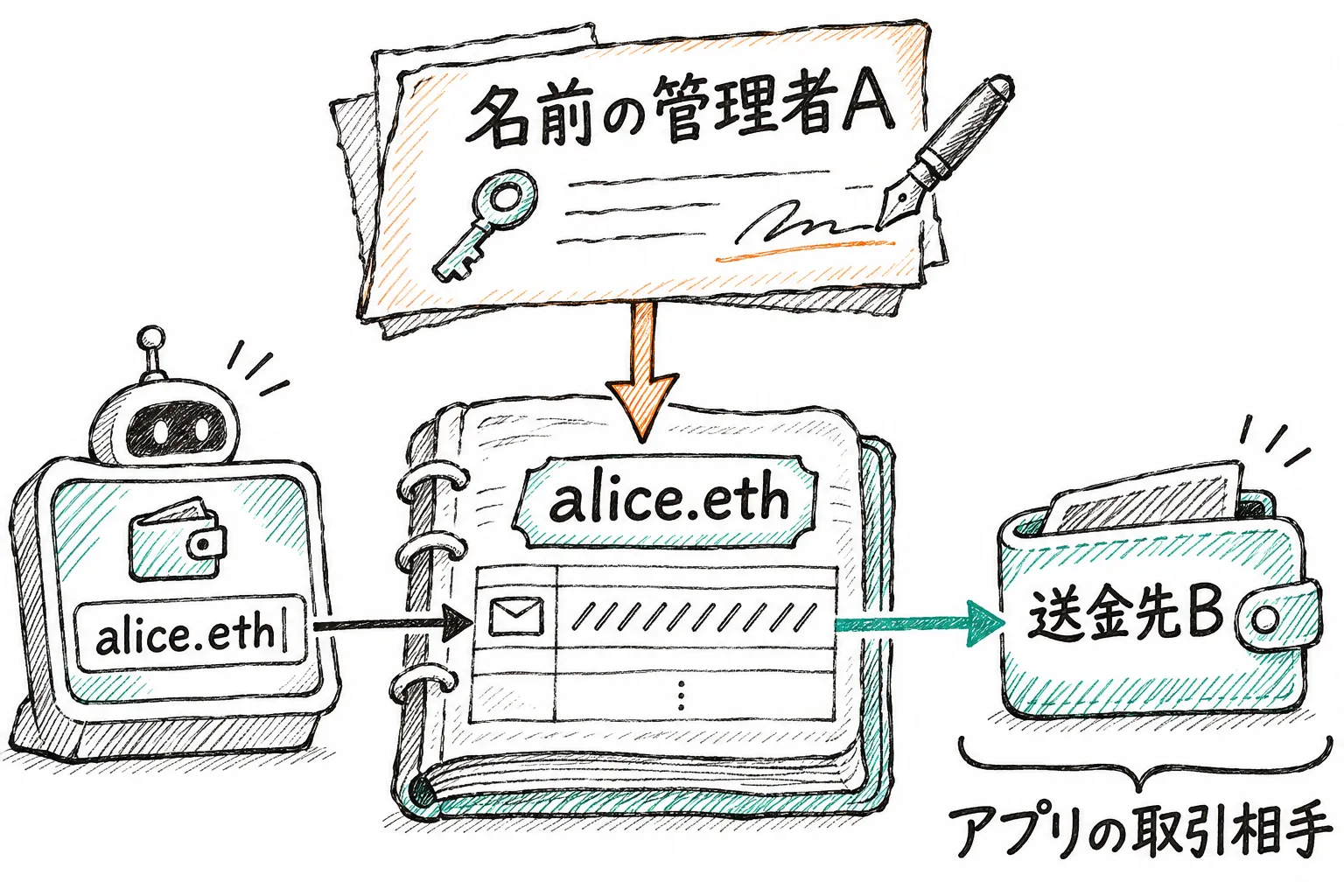
When someone enters alice.eth into a wallet, the application follows the name's management information and reads the address configured as the recipient.
The person managing the name can change that recipient, so the mapping between a name and an address is not fixed.
For example, even if account A owns alice.eth, its owner can configure account B as the recipient.
Looking up a name's owner and looking up its payment address involve reading different information.
Retrieving a requested value from a name is called name resolution; resolving a name to an address is called forward resolution.
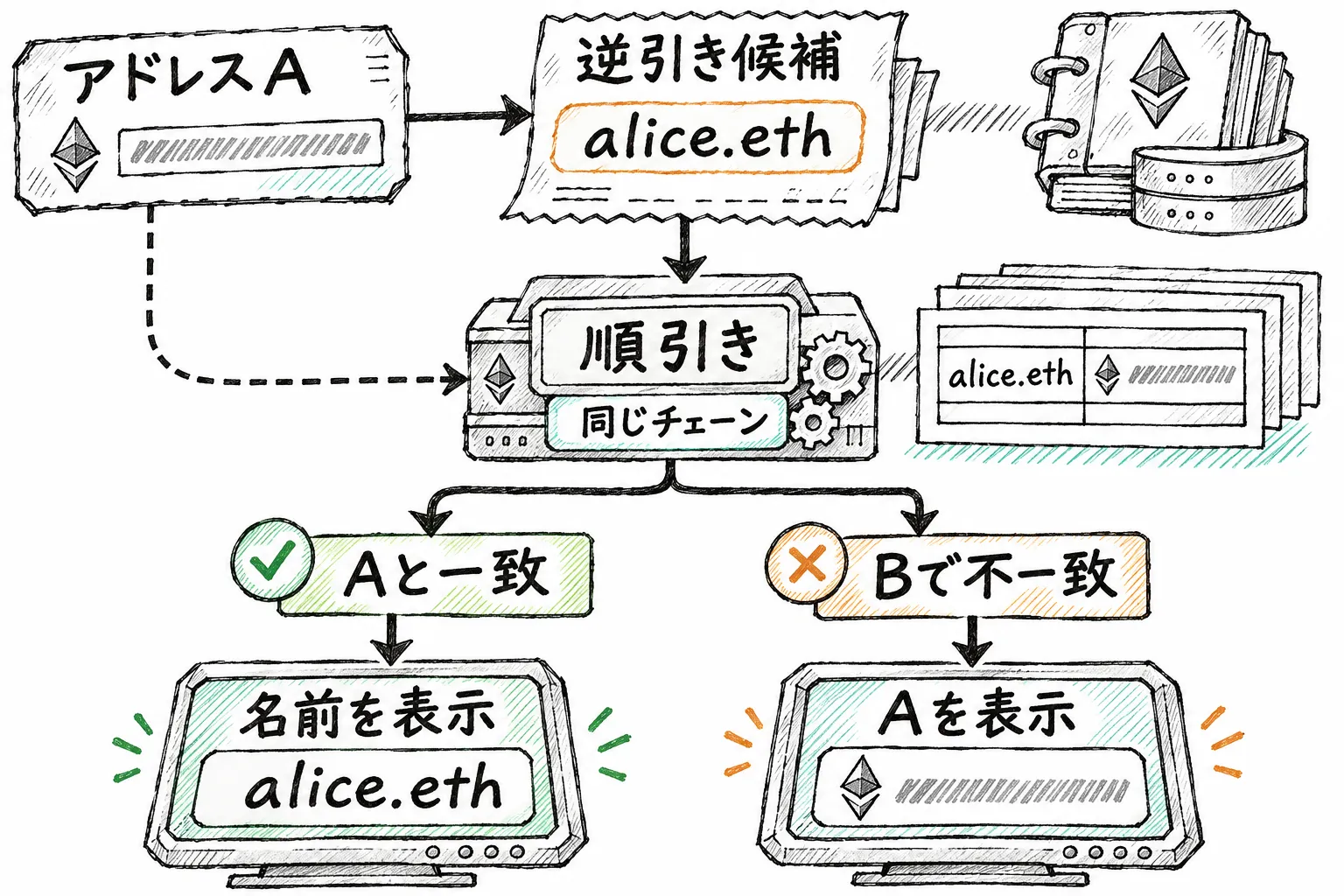
Conversely, applications use reverse resolution when they want to display a name for a connected address. However, reading the name configured by an address does not establish that the name points back to that address. Reverse resolution includes a forward lookup to verify the name before adopting it as the display name.
ENSv2 launched on Ethereum mainnet on October 27, 2026.
As of November 12, 2026, the mechanism for traversing the name hierarchy coexists with support for reading unmigrated ENSv1 names.
Even if newly registered names and existing names use different storage locations, applications can read them through the same name resolution operation using the appropriate resolution contract.
Names and their resolution targets
An application looking up a name may, for example, want the Ethereum address associated with alice.eth.
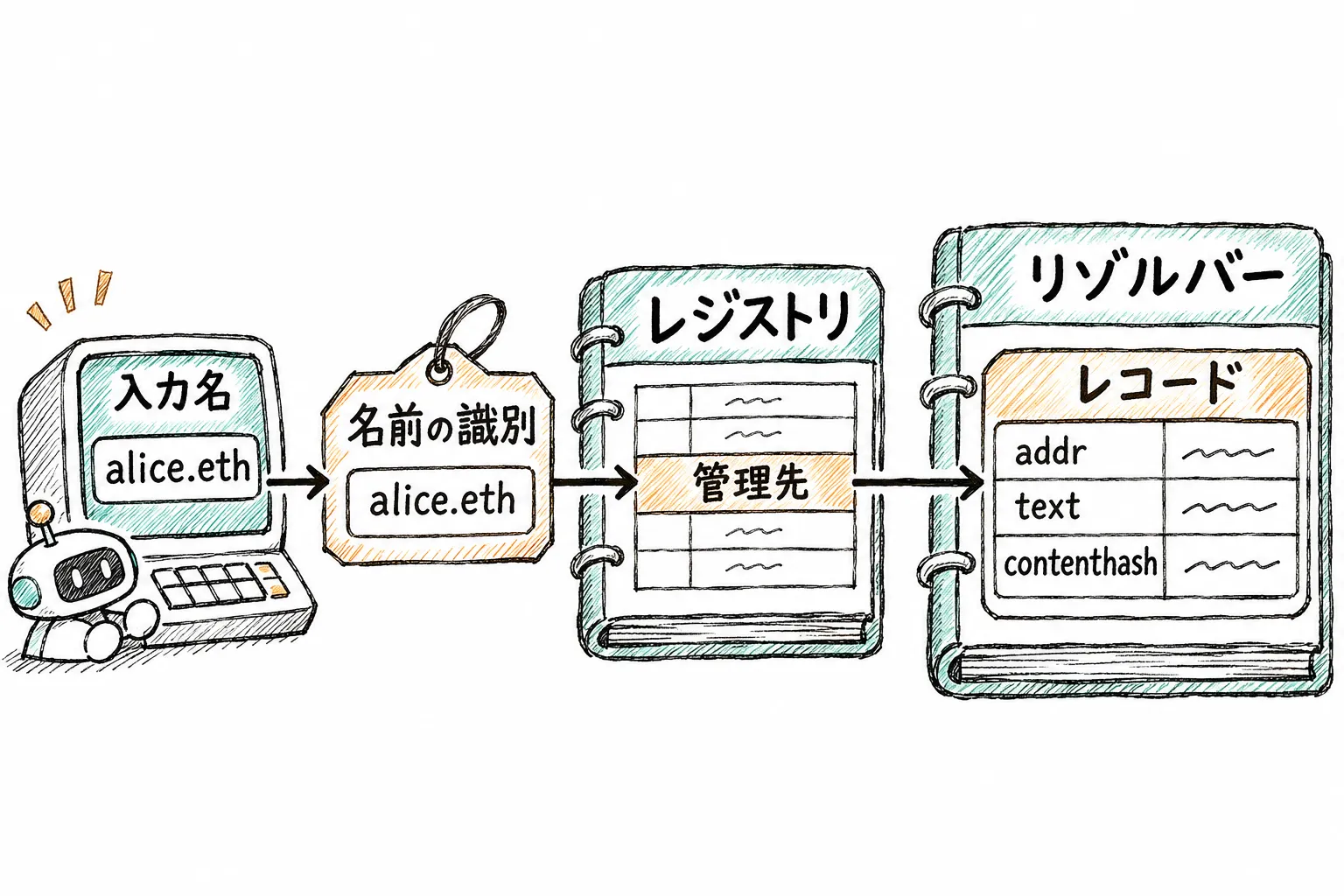
The name's management information contains a reference to a contract that returns its records. The actual address is obtained by querying that contract.
A contract that manages name registrations is called a registry, while a contract that returns records such as addresses and profiles is called a resolver.
A request for a name specifies which name and which type of record to read.
For the same alice.eth name, an application can separately request an Ethereum address, a profile description, or a content reference.
Separating name identification from retrieval of the requested value allows the name to remain usable even if its storage location changes.
Normalization and name identifiers
Hashing an input string directly can produce different identifiers for inputs that should represent the same name.
Before hashing or querying a name, normalization applies consistent rules to its characters and rejects invalid combinations.
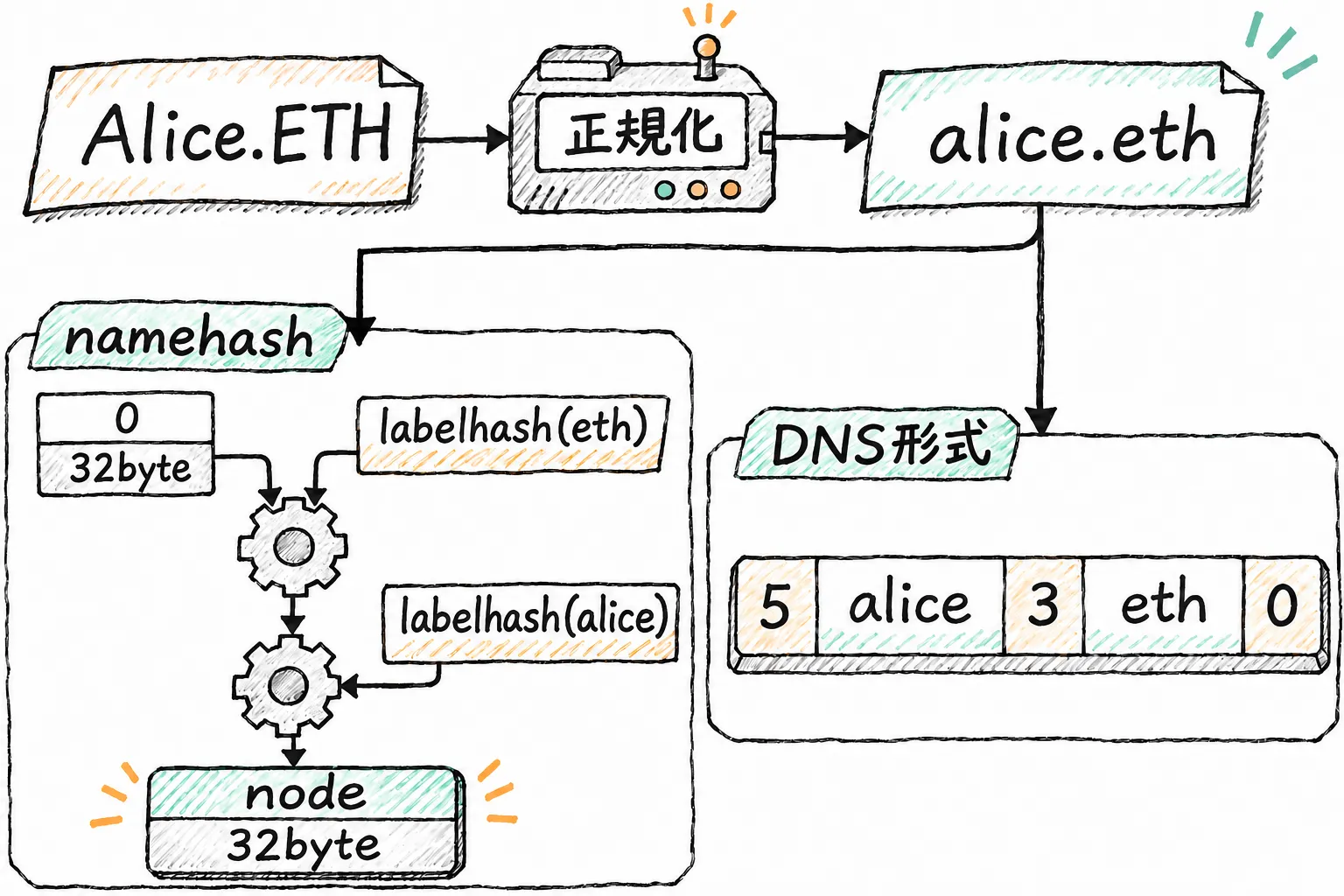
ENS uses the normalization rules specified by ENSIP-15. For example, Alice.ETH is normalized to alice.eth.
Normalization is more than converting uppercase English letters to lowercase.
It also validates permitted characters and character combinations. Substituting a custom toLowerCase() implementation may therefore accept inputs that are not valid names.
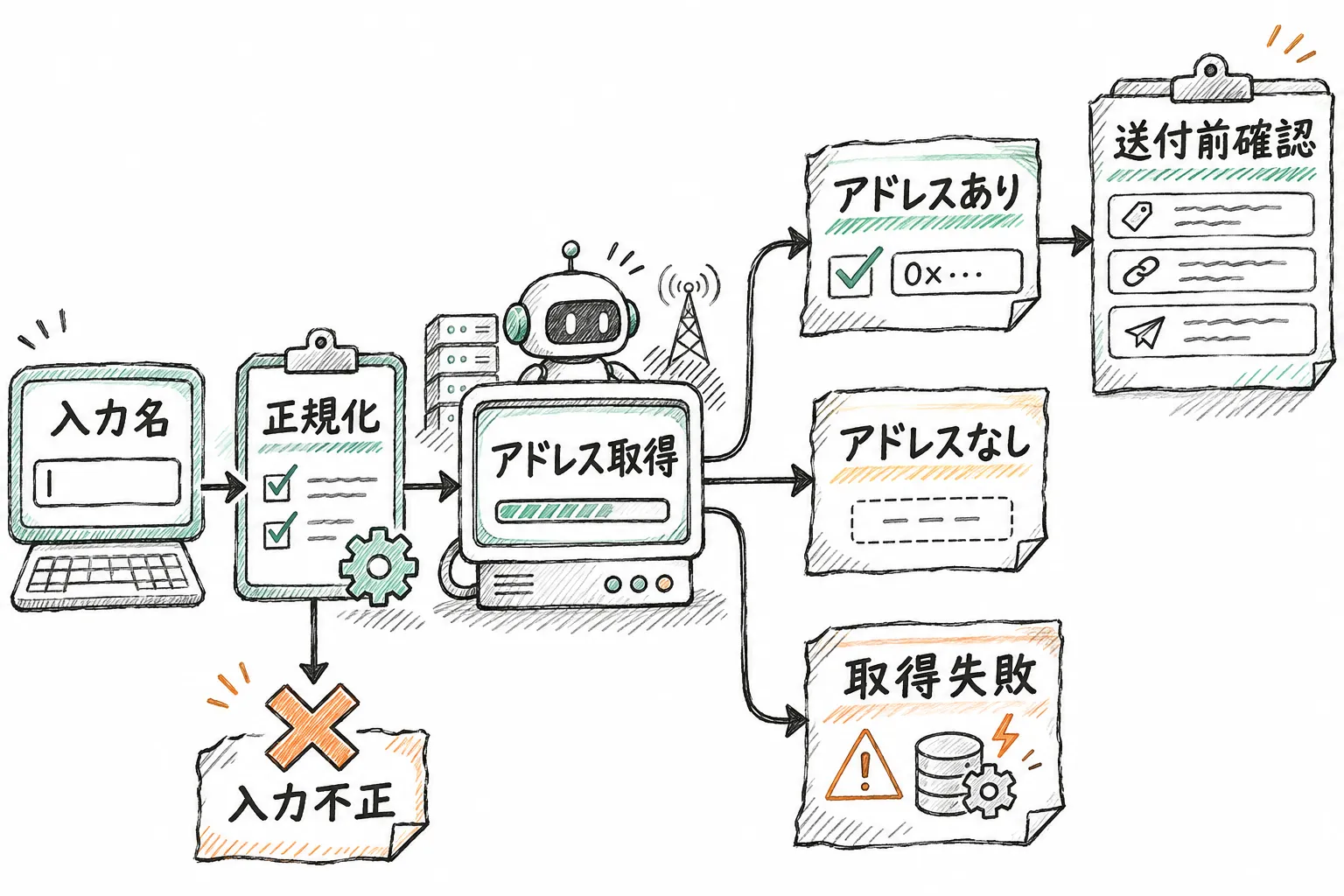
When normalization rejects an input, the application returns the error to the user immediately rather than proceeding to address resolution.
Normalized names are represented in different formats depending on their purpose.
In alice.eth, the dot-separated components alice and eth are labels.
The formats differ in whether they retain the string, identify a single label, or identify the entire name.
| Format | Component of alice.eth |
Purpose |
|---|---|---|
labelhash |
alice or eth |
Identifies a single label within the hierarchy |
namehash |
The entire alice.eth name |
Identifies the name associated with a record using 32 bytes |
DNS wire format |
A sequence of length-prefixed labels | Passes the name's labels to a resolution contract |
labelhash is the result of applying keccak256 to the normalized label string.
namehash combines the parent identifier with the child's labelhash, processing labels from right to left.
Starting with 32 zero bytes as the identifier of the empty name, the calculation first derives the identifier of eth and then that of alice.eth.
In the following calculations, || denotes concatenation of two byte sequences in order.
The first equation concatenates the empty name identifier and the labelhash of eth to produce a 32-byte value representing eth.
Concatenating that value with the labelhash of alice and hashing the result produces the identifier for the entire name.
This 32-byte identifier is called a node.
A complete name can be represented by 32 bytes regardless of its length.
However, the original labels cannot be recovered from the hash.
Operations that work with the name hierarchy or wildcard resolution also receive a format that retains the labels.
DNS wire format prefixes each label with its byte length and appends a terminating zero.
For alice.eth, the sequence consists of the five-byte label alice, the three-byte label eth, and the terminator. Its hexadecimal representation is 0x05616c6963650365746800.
Unlike namehash, which hashes labels recursively from right to left, this format retains the labels from the left side of the name.
Converting the name to this format does not itself trigger a query to a conventional DNS server.
Registries and resolvers
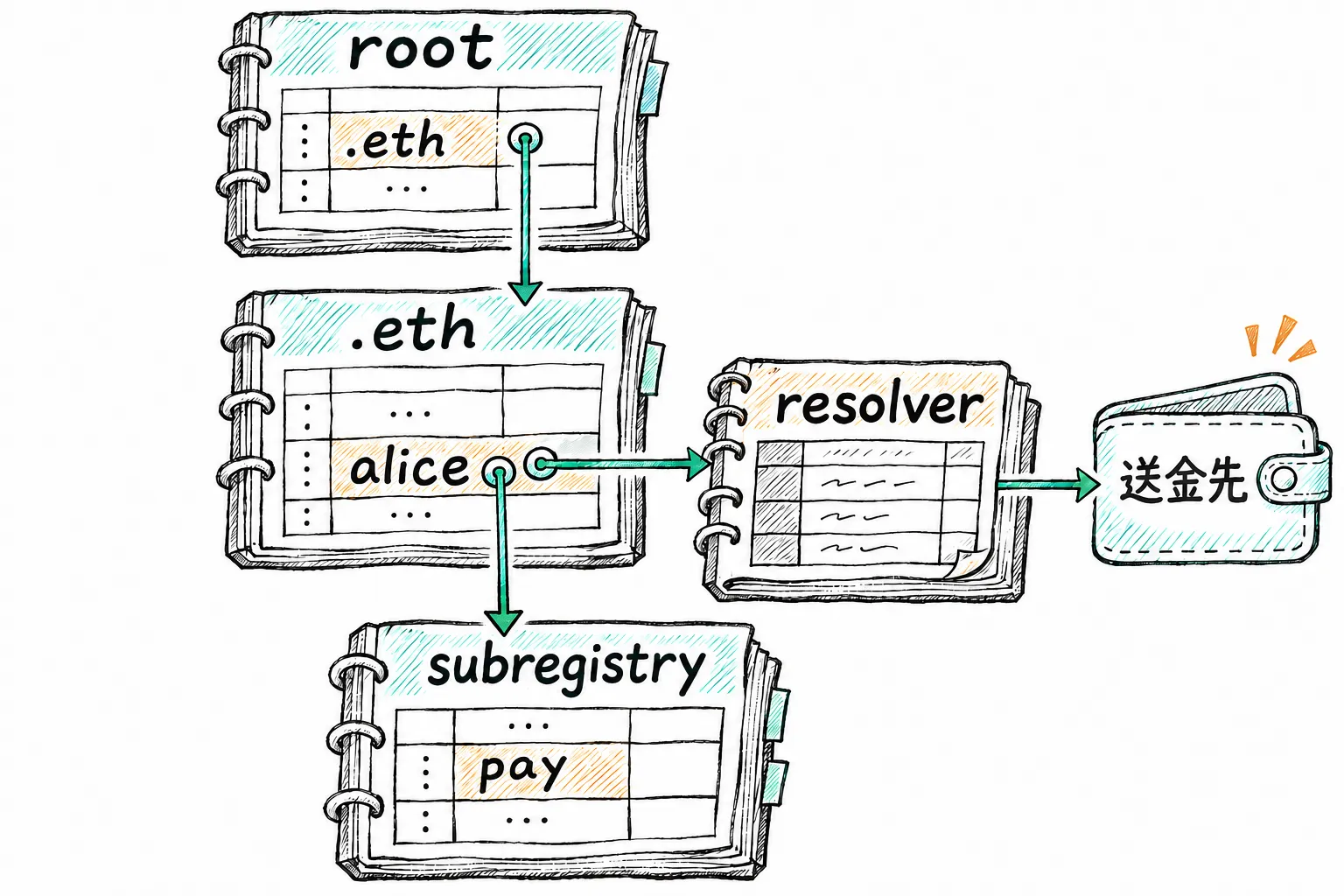
ENSv2 registries are connected according to the name hierarchy.
To look up pay.alice.eth, for example, resolution proceeds from the root registry to the eth registry, then looks for pay in the subregistry configured for alice.
A parent's registration contains a reference to the registry responsible for its children.
A registration can separately specify the resolver for that name and a subregistry that manages names below it.
The resolver returning the address of alice.eth and the registry managing the registration of pay.alice.eth serve different purposes.
An application resolving a child name cannot reach it merely by reading the parent's address record.
The ENSv1 registry primarily used the entire name's node as a key to retrieve the owner, resolver, and TTL used as a caching guideline.
The old structure remains available for reading unmigrated names, but looking up every new name solely through resolver(node) on the old registry cannot traverse the ENSv2 hierarchy.
Applications use a resolution contract called the Universal Resolver, which supports both structures.
Resolvers return different types of information, including addresses through addr, strings through text, content references through contenthash, and reverse names through name.
For example, a text request for description retrieves the description configured by the name's manager.
However, an organization name or contact information in a public profile does not itself prove the identity of a real person or company.
Resolving a name to a record
The Universal Resolver locates the resolver for a name and coordinates retrieval of the requested record.
The calling application supplies the normalized name and the request for the record it wants to retrieve.
Internally, the contract traverses the name hierarchy, selects the appropriate resolver, and obtains the value from its response.
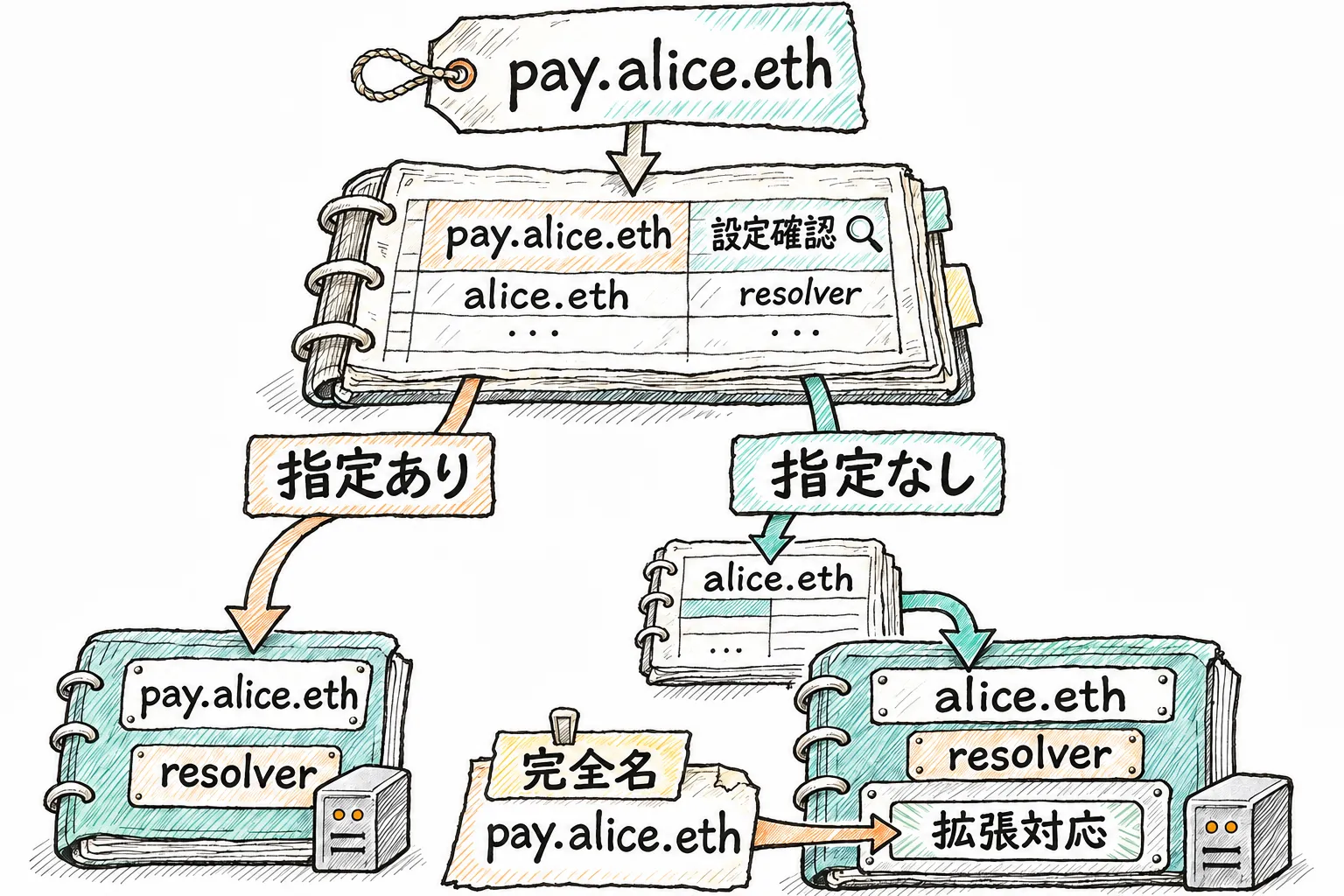
When an application requests the address of pay.alice.eth, the resolution process remembers resolvers encountered during traversal and replaces the candidate whenever it finds a resolver for a more specific name.
For example, if both alice.eth and pay.alice.eth have configured resolvers, the latter takes precedence.
If a parent's resolver is used to resolve a child name, the process also checks whether that resolver can handle requests for names below the parent.
PermissionedResolver, the standard resolver in ENSv2, uses resolve(name, data) for reads, receiving both the name and the record request.
The name argument is the name in DNS wire format, while data is the requested record encoded as function calldata.
For an address lookup, for example, data contains the addr request.
With this resolver, the addr selector representing a request is distinct from a directly callable read function.
Applications should not directly call addr(node) on the standard PermissionedResolver as they might with a legacy resolver.
Instead, resolve calculates the node from the supplied name and processes the requested record type.
Using a compatible library avoids having to assemble these calls for every name.
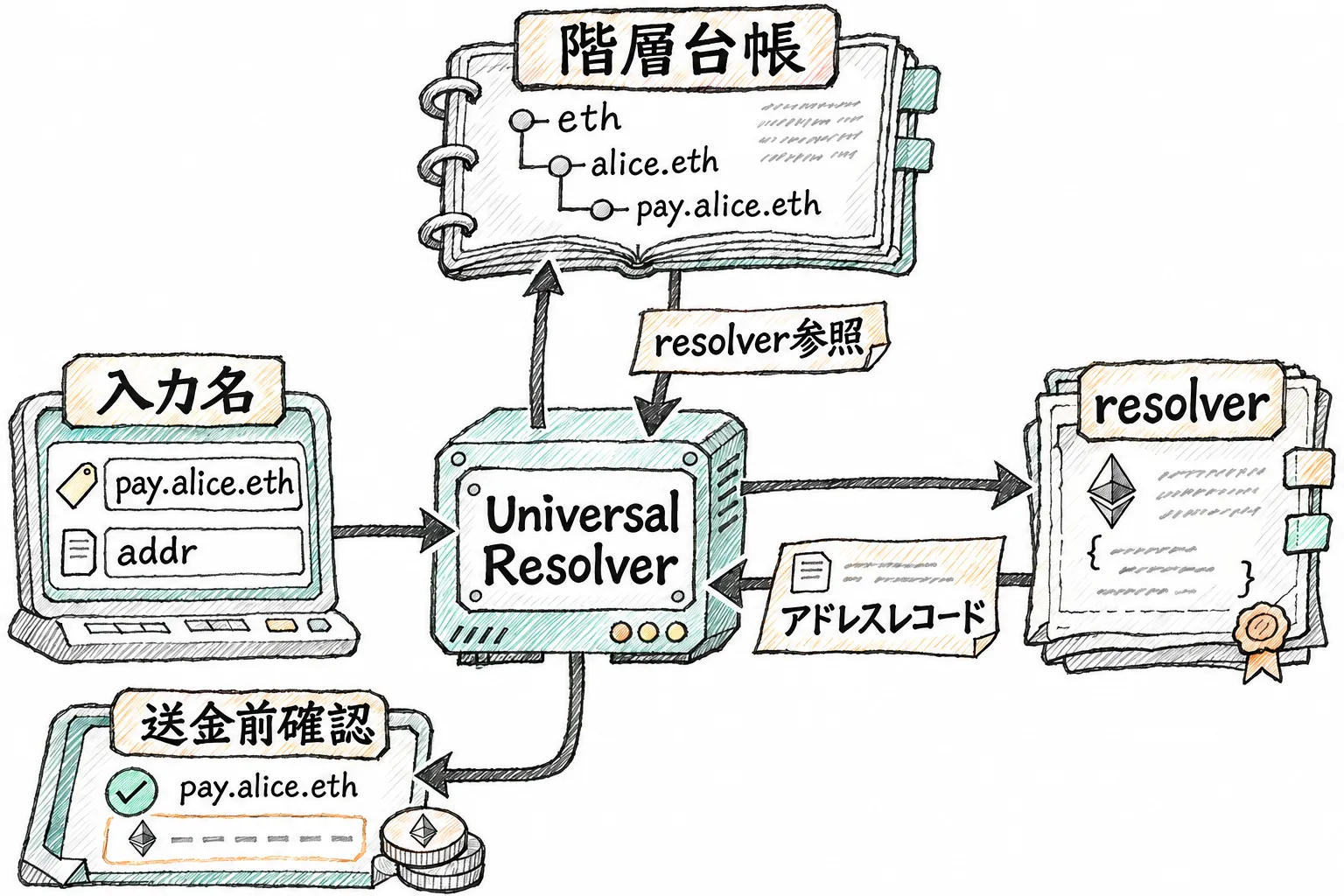
Successful resolution is distinct from the requested value actually being configured. A missing resolver, an unsupported request format, and an unset address require investigating different parts of the system. If communication failures are also treated as unset records, an application may incorrectly tell users that a name has no value when one is actually configured.
Chain-specific addresses
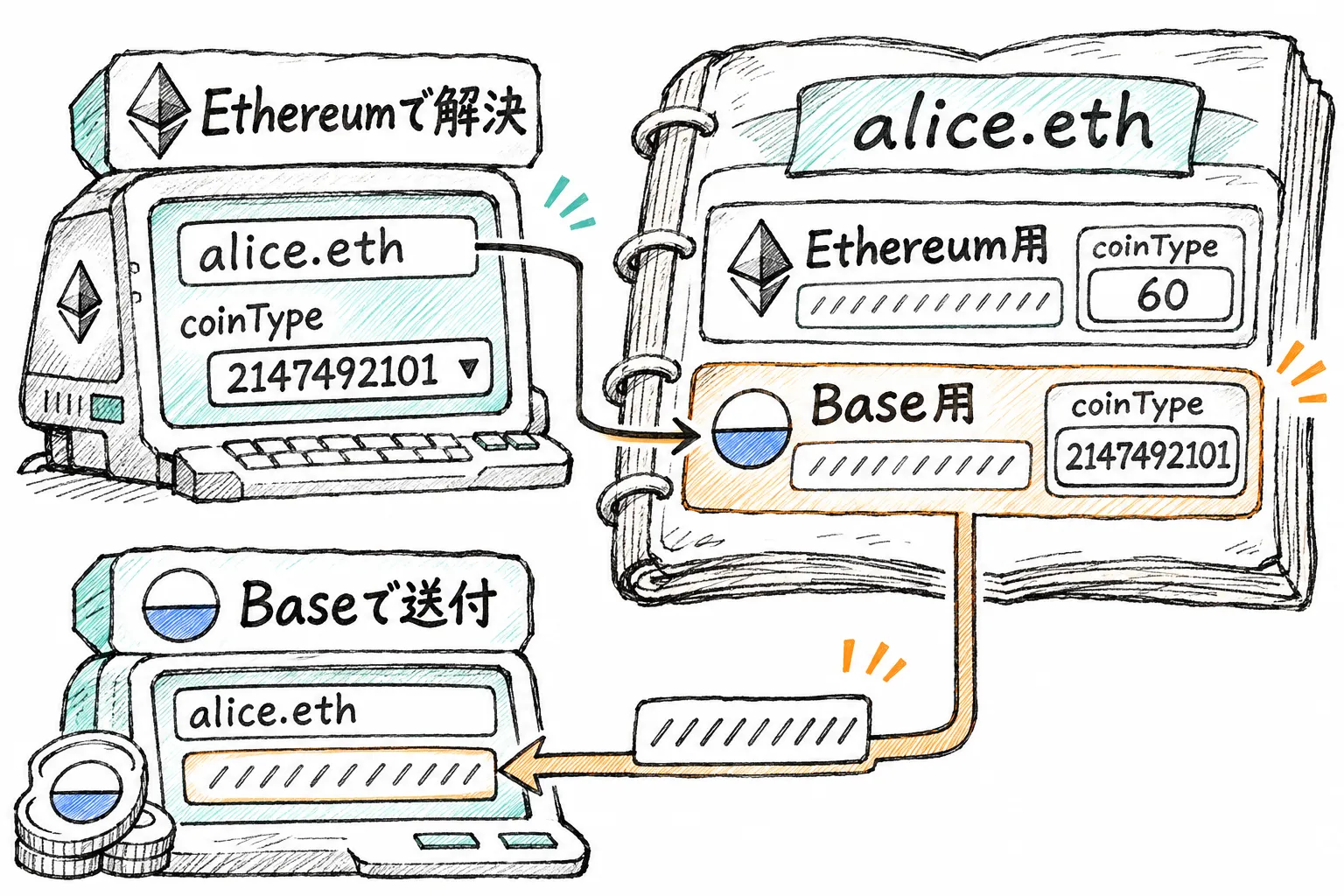
When retrieving an address from alice.eth, an application determines which chain the address will be used on.
A single name can specify different recipients for Ethereum and Base.
An address record is requested using an identifier called coinType, which identifies the relevant address system.
Ethereum uses coinType 60.
Identifiers for EVM chains are derived from the target chainId according to ENSIP-11.
Because Base has a chainId of 8453, its coinType is 2147492101.
| Target chain | coinType for address resolution |
Purpose |
|---|---|---|
Ethereum |
60 |
Retrieves the recipient for Ethereum |
Base |
2147492101 |
Retrieves the recipient for use on Base |
A transfer screen for Base does not imply that the name resolution query should also be sent to Base.
Name resolution begins on Ethereum mainnet, with the coinType for Base specifying the type of record to retrieve.
The chain managing the name and the chain on which funds will be sent to the returned address are treated separately.
Depending on the resolver's implementation and configuration, it may return a default EVM address when no dedicated chain-specific record exists.
A returned value therefore does not establish that a record was explicitly configured for that particular chain.
Applications use the result of resolution for the target chain and display the name, chain, and final address together to the user.
For non-EVM addresses, the returned bytes are converted into the chain's native display format.
Interpreting every record as a 20-byte Ethereum address would prevent applications from handling addresses with different lengths or encodings.
Subnames and wildcards
Subnames such as pay.alice.eth and shop.alice.eth can be created below alice.eth.
By creating a registration for each name, the owner can assign a different resolver to each one.
This allows recipients to be separated by purpose without changing the parent name itself.
For a service that distributes subnames to many users, however, registering every name individually increases management overhead.
Wildcard resolution provides an alternative: a resolver configured for a parent handles queries for names beneath it.
For example, even if customer123.shop.alice.eth has no individual registration, the resolver for shop.alice.eth can receive the original name and return the address associated with that customer.
In this case, the name passed to the resolver must not be shortened to shop.alice.eth.
By receiving the original customer123.shop.alice.eth, the parent's resolver can distinguish which customer's record was requested.
Wildcard resolution requires the parent's resolver to support this request format.
The fact that a name can be resolved does not establish that an individual token representing ownership of that name has been issued. A setup where the parent manager determines the returned values differs from one where users receive management rights over their child names, including what information users can change. Services issuing subnames should explain who can change an address and what happens when the parent changes its configuration.
Off-chain and L2 records
Records referenced by resolvers are not necessarily stored directly in Ethereum mainnet storage.
A resolver may instead use values stored in an external database or on an L2 and return them through the name resolution interface.
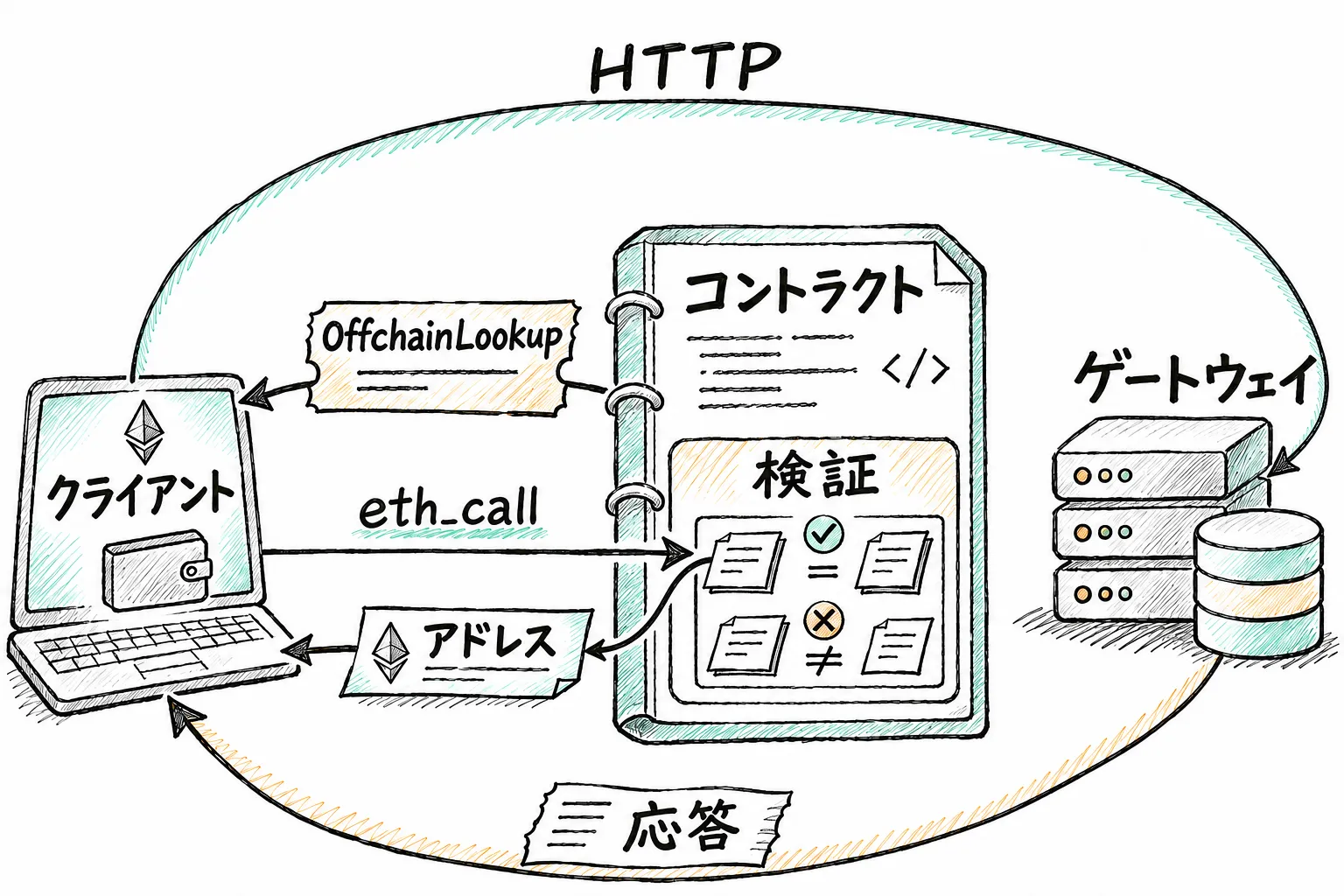
CCIP Read provides the mechanism for coordinating these reads.
During an ordinary read, a contract can inform the application where to retrieve external data and which function will verify that data afterward.
It communicates this information using a special error called OffchainLookup.
The call reverts, but a compatible client interprets the error as an instruction to proceed with external data retrieval.
For example, when the records for customer123.shop.alice.eth are managed externally, the process works as follows.
- Specify where to retrieve data
The resolver returns the retrieval
URL, request data, and verification callback throughOffchainLookup. - Retrieve external data
The client checks the source of the notification and sends an
HTTPrequest to the gateway responsible for providing the external data. - Pass the response for verification The client passes the retrieved response and the original auxiliary data to the callback.
- Verify the record The contract checks a signature or state proof and returns the accepted record.
The client performing name resolution connects to the gateway.
The smart contract itself does not make external HTTP requests.
For ordinary reads, the callback is also executed through eth_call, without requiring a user signature or gas payment.
Using CCIP Read does not automatically prove the correctness of external data.
A resolver that verifies signatures from a designated key assumes that the key's controller signs correct values.
A resolver that verifies L2 state depends on which states and proofs it accepts.
The trust assumptions are determined by the verification that the resolver actually performs.
Even if a design can verify correct responses, it may be unable to retrieve a value while its gateway is unavailable. Response correctness and external service availability must be treated separately. Silently returning an old recipient after a failed lookup can mislead users into thinking that the updated value has been verified.
Reverse resolution from an address to a display name
To display alice.eth for a connected wallet address, an application looks up a name from that address.
In conventional Ethereum reverse resolution, the address is converted to lowercase hexadecimal, its 0x prefix is removed, and .addr.reverse is appended. The configured candidate name is then retrieved from that reverse name.
Obtaining alice.eth as a candidate for address A does not, by itself, justify using that display name.
If the controller of an address can set an arbitrary reverse name, they could use someone else's name as their own display name.
The application therefore forward-resolves the returned alice.eth and verifies that the resulting address matches the original address A.
If alice.eth points to address B, it is not treated as the display name for A.
- Retrieve the candidate name Retrieve the reverse name candidate for the address A that the application wants to display.
- Forward-resolve the candidate name Resolve the candidate to an address for the target chain.
- Compare it with the original address Adopt the name as the display name for A only if the result matches A.
The comparison uses the address resolved for the target chain. Comparing a value for another chain can incorrectly reject a valid display name for the intended chain or give the impression that an unrelated mapping has been verified. If no candidate exists or the mapping does not match, the application displays the address instead of a name.
At the launch of ENSv2, reverse resolution continues to use the existing ENSv1 mechanism.
A mirror allows the new hierarchy to reference legacy reverse resolution, so not every component of name resolution moved to new storage simultaneously.
The existing chain-specific reverse resolution functionality should also be distinguished from future native ENSv2 registration mechanisms for L2 networks.
When using a compatible library's reverse resolution function, verify that it retrieves the candidate and performs the forward-resolution check.
viem's getEnsName includes this verification.
Applications distinguish the absence of an acceptable name from an error that prevents verification due to a communication failure.
Name registration and management
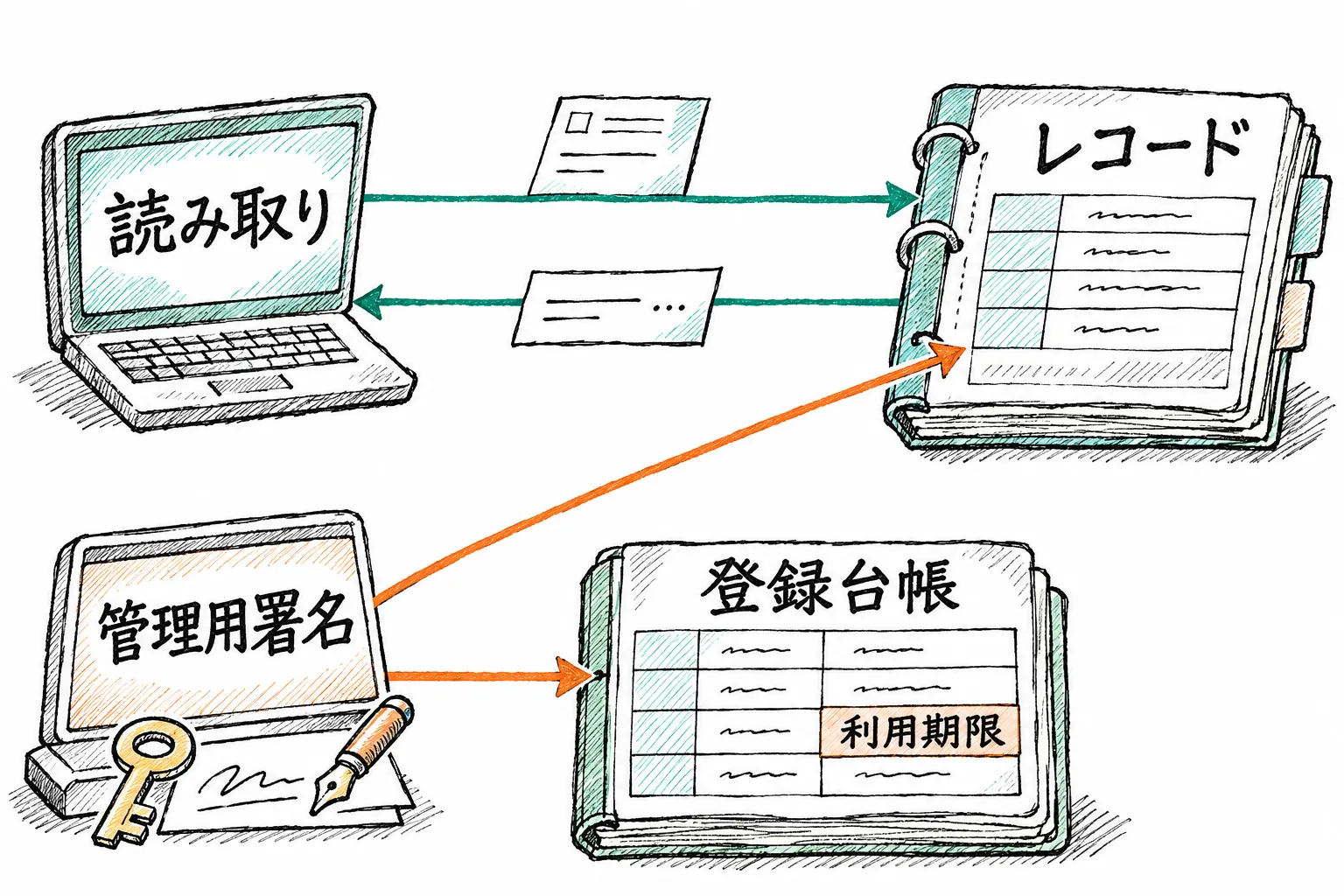
Applications that only read names normally do not need signatures from the parties managing those names. Acquiring a name, configuring its resolver, and changing its recipient, on the other hand, require the respective management permissions. When investigating why a read result has changed, check the name's expiration and changes to its references in addition to the record value.
The name owner, the person authorized to write records, and the account configured as the recipient may be different. An organization can own a name, have a manager update its profile, and receive payments through a separate accounting account. Determine the payment recipient by resolving the intended address record, not by substituting the result of an ownership lookup.
Registration and record updates
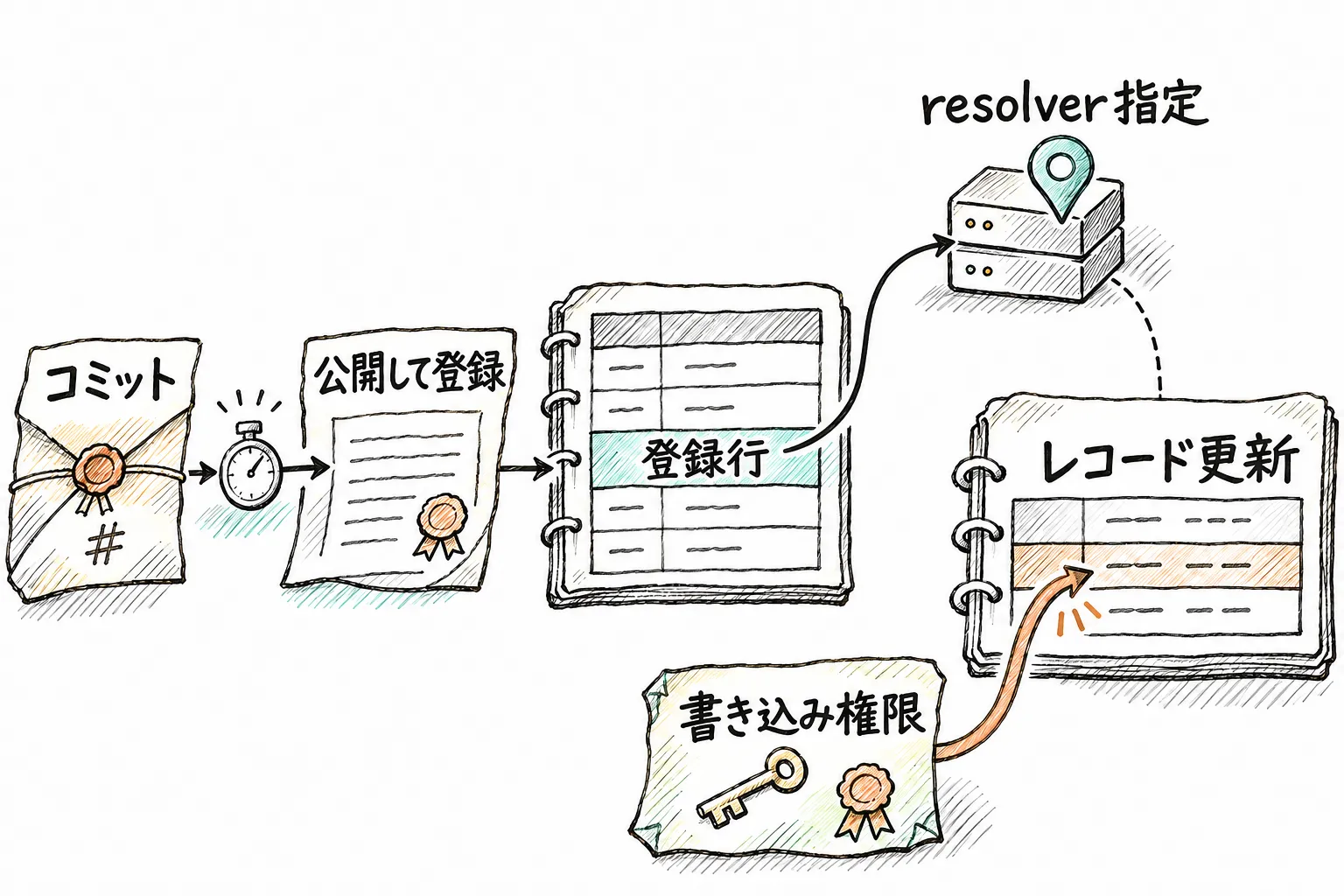
ETHRegistrar in ENSv2 handles the acquisition of new .eth names.
If a prospective registrant discloses all registration details immediately, a third party observing the transaction has an opportunity to front-run the registration of the same name.
To prevent this, the registrar uses a commit-reveal process: first recording a hash that conceals the registration details, then revealing the original details after a waiting period.
The commitment includes the label and owner, as well as a secret and the registration terms. At reveal time, the registrant supplies the same details used when making the commitment, and they are checked against the previously recorded hash. This prevents someone who sees the revealed name and secret from substituting a different owner in the registration.
ETHRegistrar defines a minimum waiting period after committing and a maximum period during which the commitment can be used to register.
According to the official documentation, the minimum is 60 seconds and the maximum is typically 24 hours.
Registration after the waiting period checks the commitment's conditions, name availability, and payment requirements.
ENSv2 registration fees are paid using supported ERC20 tokens.
Prior payment approval serves a different purpose from the ETH needed for transaction gas.
The legacy ENSv1 ETHRegistrarController and BaseRegistrar are therefore not the contracts to call for new registrations.
Name registration and record configuration are also separate operations. Successfully registering a name and configuring its resolver does not necessarily set all addresses and profile values automatically. Determine which resolver supports the intended record and which account is authorized to write it, then save the value using the write interface of that implementation.
The standard PermissionedResolver manages permissions in per-account instances.
Ownership of a name alone does not establish permission to perform every operation on its resolver.
In particular, when a parent's resolver resolves a subname, the child user's ability to change records depends on the resolver's permission configuration.
Expiration and continuity for existing names
Names have an expiration date. A registration can remain in storage without being resolvable as a valid name.
Because ENSv2 traverses connections to parent subregistries, expiration of a parent or changes to its references can make an earlier child registration unreachable.
Even if the child's ownership token remains, a payment application is not guaranteed to reach the same resolver.
However, even if traversal cannot reach a child's registration, an ancestor's resolver encountered along the way may still resolve the name through wildcard resolution. It is therefore also incorrect to assume that expiration of a parent necessarily causes every query for its descendants to fail in the same way. Check which registrations were reachable and which resolver processed the original name.
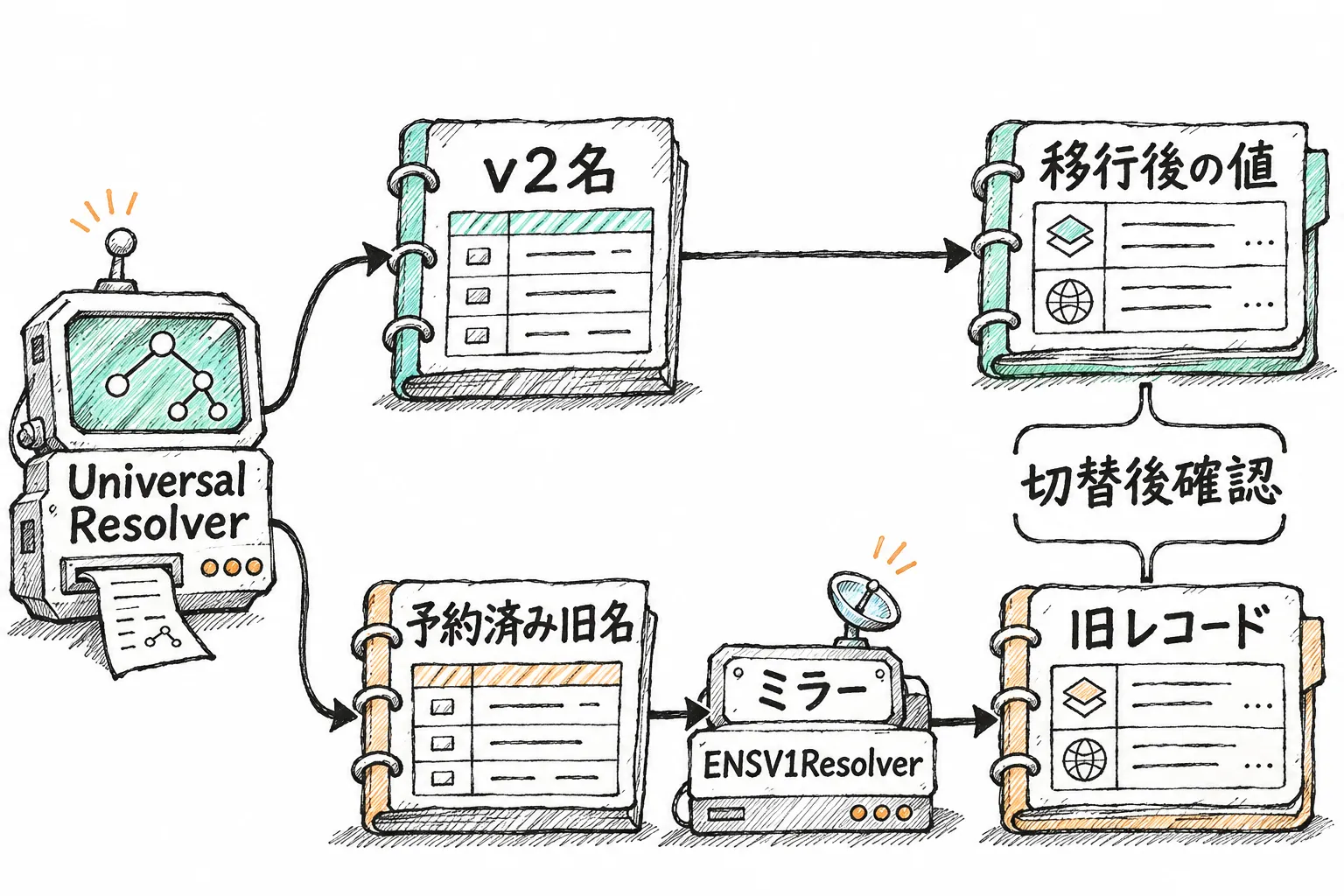
Existing .eth names from before the launch of ENSv2 are reserved in the new architecture for their previous owners, and their legacy records remain readable even before migration.
ENSV1Resolver in the new architecture acts as a mirror that references the legacy resolver, so record updates made in the legacy system are also reflected in reads.
Owners do not have to repurchase the same names before migrating them.
Although reads can use a common interface, management operations target different locations depending on whether the name has migrated.
Records for unmigrated names are updated through the old resolver, while renewals use ETHRenewerV1.
For migrated names, records are updated through the new resolver and renewals use the ENSv2 ETHRegistrar.
| Management operation | Unmigrated legacy name | Migrated name |
|---|---|---|
| Update records | Legacy resolver | Resolver configured after migration |
| Renew registration | ETHRenewerV1 |
ETHRegistrar |
The standard renewal grace period in ENSv2 is 28 days, but reservations for legacy names account for the grace period in the old architecture.
This does not mean that the previous 90-day grace period for legacy names is uniformly shortened to 28 days from the launch date.
Being able to renew a name during its grace period and being able to resolve an expired name as a valid registration are also distinct conditions.
When changing resolvers during migration, do not assume that all previous addresses and profile records will automatically be copied to the new storage location. Prepare the records to migrate and, after switching, check whether ordinary name resolution returns the expected values. Completing the ownership migration alone does not establish continuity of the payment address.
Application integration
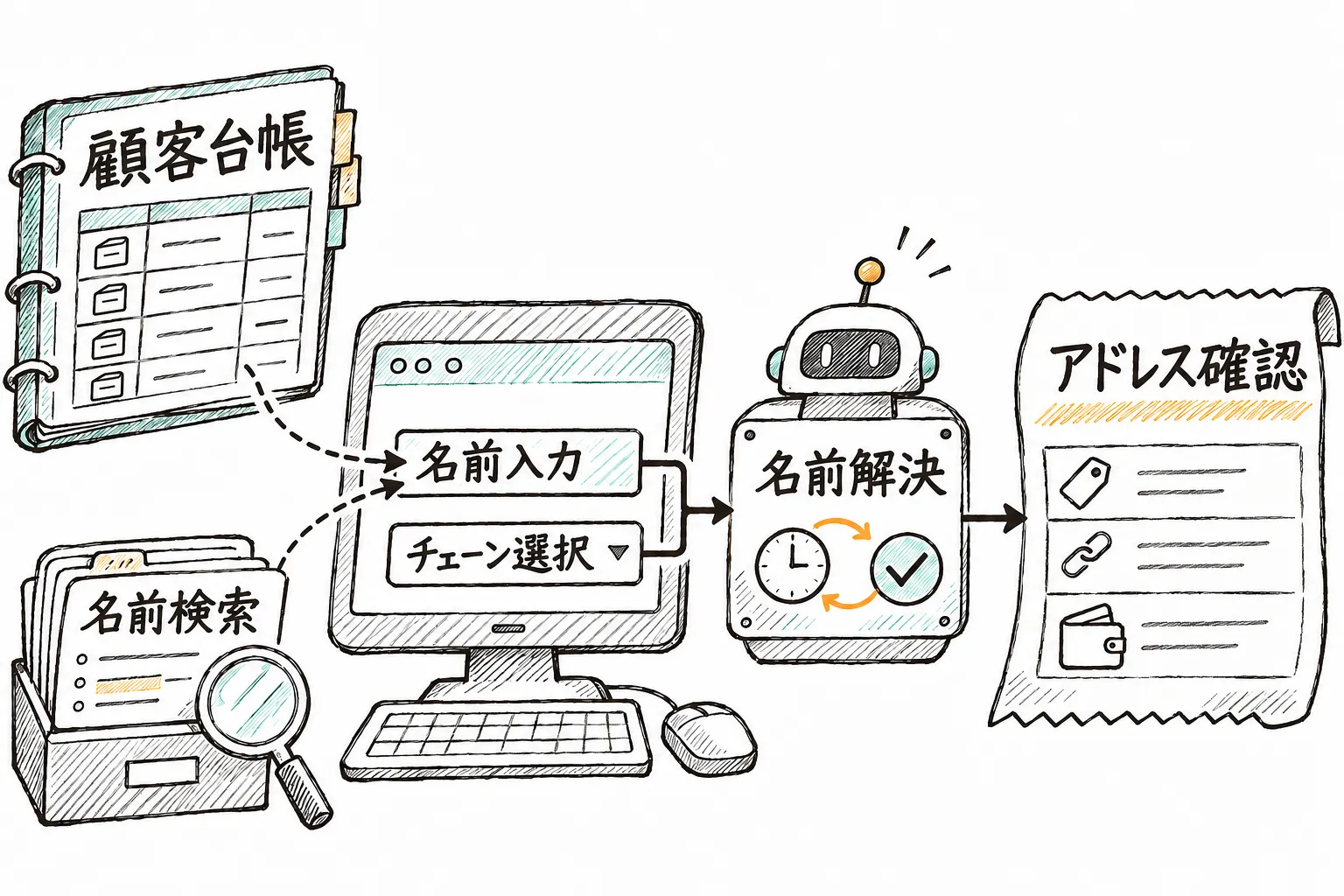
A payment screen receives the name entered by the user and the destination chain. The application normalizes the input, resolves the address for the target chain, and displays the final recipient to the user. Name search results and historical display data should not be reused directly as the final value for a payment.
A value returned by ENS is one piece of information an application uses to verify a counterparty.
Name resolution does not automatically determine the counterparty in a customer database, the recipient of an invoice, or the conditions for authorizing payment.
The application manages mappings between names and customers and verifies the resolved address when sending funds.
Reading records through a library
A compatible library provides reads through the Universal Resolver and handles CCIP Read.
As of November 12, 2026, the official compatibility table lists viem versions 2.35.0 and later.
An older library's ability to resolve some legacy names is not sufficient evidence that it supports ENSv2 names.
The following example reads an Ethereum address from an input name.
Configure RPC_URL with an Ethereum mainnet RPC endpoint and create a public client that does not sign transactions or transfer funds.
import {
  BaseError,
  ContractFunctionRevertedError,
  createPublicClient,
  http,
} from 'viem'
import { mainnet } from 'viem/chains'
import { normalize } from 'viem/ens'

const client = createPublicClient({
  chain: mainnet,
  transport: http(process.env.RPC_URL),
})

async function resolveRecipient(input: string) {
  let name: string
  try {
    name = normalize(input)
  } catch {
    return { status: 'invalid-name' as const }
  }

  try {
    const address = await client.getEnsAddress({
      name,
      coinType: 60n,
      strict: true,
    })
    if (address === null) {
      return { status: 'no-address' as const, name }
    }
    return { status: 'resolved' as const, name, address }
  } catch (error) {
    if (error instanceof BaseError) {
      const cause = error.walk(
        (entry) => entry instanceof ContractFunctionRevertedError,
      )
      if (
        cause instanceof ContractFunctionRevertedError &&
        cause.data?.errorName === 'ResolverNotFound'
      ) {
        return { status: 'no-address' as const, name }
      }
    }
    return { status: 'lookup-failed' as const, name, error }
  }
}
If normalize rejects the input, the function returns invalid-name.
If the read completes successfully but no address is set, the library's null result is classified as no-address.
The ResolverNotFound error indicating that no resolver was found is also identified from the cause of the typed exception and classified as no-address.
strict: true prevents the library from collapsing certain lookup errors into null.
The code follows the cause of BaseError and reads the error name from ContractFunctionRevertedError, which indicates that contract execution reverted.
Other exceptions remain classified as lookup-failed, rather than treating every communication failure or resolver execution error as an unset record.
When retrieving a Base address, keep the client's chain set to mainnet and change the requested coinType to 2147492101n.
The trailing n is the syntax for passing the integer as a bigint; the address system's identifier itself is 2147492101.
Display the resolved name, selected chain, and address together on the same confirmation screen.
This example demonstrates a read operation and does not actually send funds to the returned address.
Restricting accepted names to those ending in .eth would exclude DNS names imported into ENS.
At the same time, the presence of a dot alone does not establish that an input is a valid name.
Accept input for supported name types and determine how to handle it from the results of normalization and resolution.
Hardcoding individual resolver addresses in an application causes it to keep reading from the old resolver even after the owner changes the reference. Use a compatible library that calls the designated resolution contract instead of hardcoding the storage location for each name in the application. For reverse resolution, also use functionality that includes forward verification instead of implementing a shortcut that accepts the candidate name without checking it.
Caching and listing names
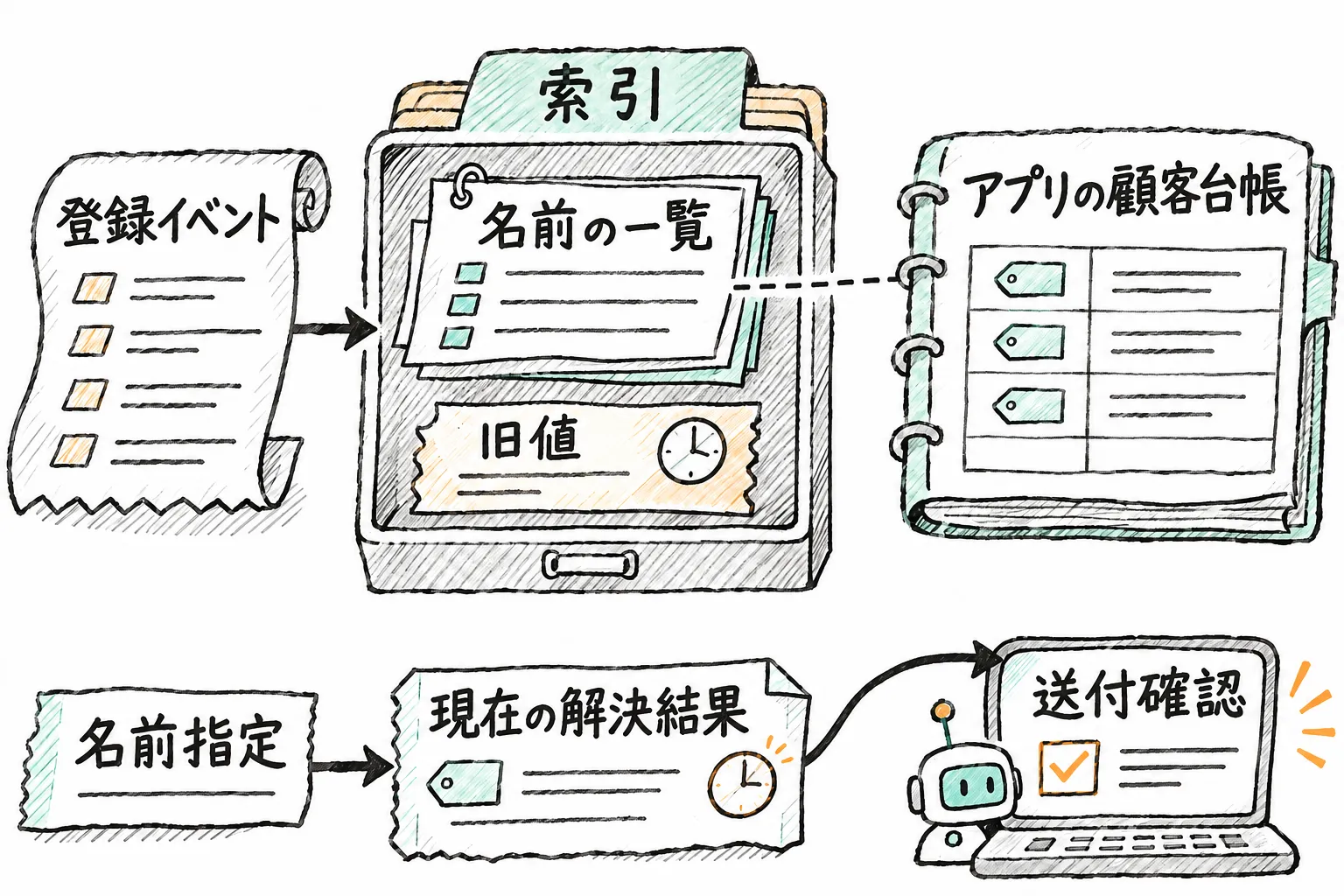
Resolving a value from a name and listing the names owned by an address retrieve different kinds of information. An indexer that processes registration and transfer events can be used to list names. When determining a payment recipient, however, resolve the record for the specific name at that point in time.
As of November 12, 2026, the official Subgraph documentation limits its coverage to ENSv1.
Names registered in ENSv2 may not appear, and ownership information for migrated names may be stale. This list therefore cannot serve as a comprehensive registry of current names.
Even if a name does not appear in the list, check its existence and resolvability separately.
Subnames returned through wildcard or off-chain resolution may also lack individual on-chain registrations. It may not be possible to enumerate all such names from a list based only on registration events. Separating search result display from resolution of names entered by users avoids incorrectly excluding names that are absent from the index.
Caching also depends on the use case.
The legacy registry's TTL provides a caching guideline, but it should not be interpreted as a guarantee that every ENSv2 record remains unchanged for the same duration.
Because a name's references and addresses can be updated, using historical lookup results indefinitely prevents changes to recipients from being reflected.
For example, caching names displayed in a contact list and retrieving an address when confirming a payment have different freshness requirements. Applications track when values were obtained and determine when to retrieve values for payment confirmation. If a lookup fails and a historical value is displayed instead, inform the user that the value could not be confirmed as current.
Conclusion
ENS name resolution normalizes input, selects a resolver from the name hierarchy, and retrieves a value appropriate for the target chain and record type.
Display names obtained through reverse resolution require forward verification. Name ownership, record update permissions, and the address returned as the recipient are treated as distinct concepts.
Regardless of whether storage is on-chain or external, or whether a name has migrated from the legacy architecture, applications associate the name, chain, and verified final address.
For details on registry storage, permission checks, and the contracts responsible for migration, see Exploring ENS through its contract implementation.
The official ENS documentation covers normalization, name resolution, registration, migration, and compatibility for application developers.