Introduction
Hi, I'm cardene, a software engineer and technical writer focused on blockchain and AI.
I've also authored Japanese technical books on specification-driven development with LLMs and decentralized application (DApp) development.

I also build and publish a variety of tools, libraries, and open-source projects.
This article explores ERC8257, the Agent Tool Registry for discovering and verifying AI agent tools onchain.
ERC8257 proposes an onchain registry for AI agent tools that makes their manifests, access requirements, pricing hints, and execution environment verification information discoverable. The registry neither executes tools nor processes payments. It defines the minimal infrastructure for finding tools, verifying their manifests, and checking whether they can be used.
This article walks through the proposal linked below.

Overview
ERC8257 defines an onchain registry for tools that AI agents can use.
Registrations are stored as ToolConfig, while the full tool description resides in a manifest retrievable over HTTPS.
The registry stores the registering address, the manifest location, its keccak256 hash, and the external contract responsible for access decisions.
Input and output schemas, pricing, access requirements, and execution environment details reside in the manifest. Its integrity is checked against the onchain manifestHash.
The following diagram illustrates the division of responsibilities in ERC8257. Existing diagrams may retain Japanese labels.
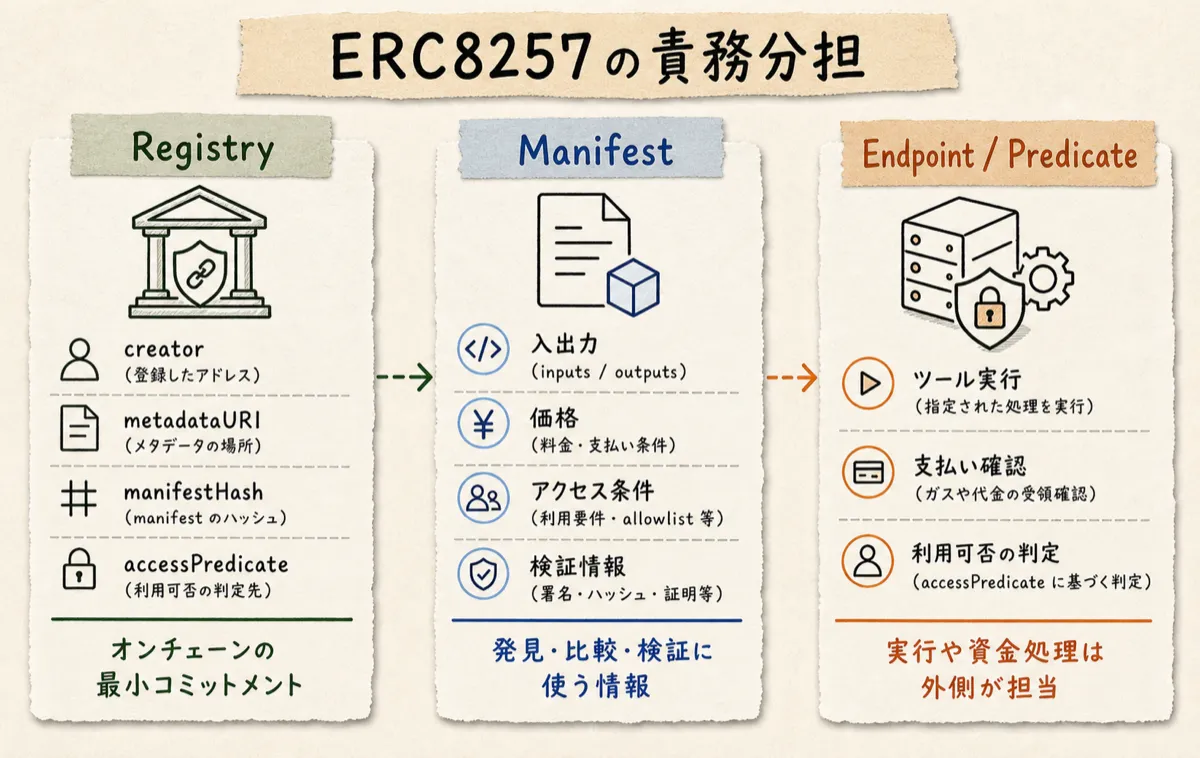
Tool providers publish a manifest under their own domain and register its URI and hash with ToolRegistry.
Agents and wallets read onchain configuration with getToolConfig, retrieve the manifest, verify its hash and creator, and use hasAccess if an access check is needed.
The registry does not process payments in this architecture. Pricing is published as a hint in the manifest; the tool endpoint or payment protocol handles actual payment verification. This leaves the registry focused on discovery and verification.
Motivation
AI agent tools tend to be scattered across service-specific and platform-specific catalogs. To select tools autonomously, an agent needs machine-readable information about their locations, inputs, outputs, pricing, access conditions, and execution environments.
A web catalog alone makes it difficult to establish which tool information is authentic and associate it with an onchain entity. ERC8257 addresses this by recording the manifest hash onchain so consumers can detect tampering.
Why access control is delegated to an external contract
Access requirements vary across tools: NFT holdings, subscriptions, allowlists, DAO votes, reputation scores, and more. Enumerating all of these rules in the registry would require modifying the registry whenever a new condition was introduced.
ERC8257 delegates access decisions to a single address called accessPredicate.
If accessPredicate is address(0), anyone can use the tool. Otherwise, the registry uses staticcall on the configured external contract to determine access.
Delegating decisions to an external contract follows a design similar to ERC4337 paymasters, Uniswap v4 hooks, and Seaport zones.
For more on ERC4337, see the following article.
[ERC4337] Implementing account abstraction without changing the protocol
Why pricing belongs in the manifest
An agent comparing tools for the same task needs to know their prices before execution.
ERC8257 stores pricing information in the manifest's pricing array.
The registry itself, however, never handles funds.
pricing provides discovery information about how much to pay, in which asset, to whom, and through which protocol. The endpoint or payment protocol enforces payment.
Specification
ToolConfig
ToolConfig is the onchain configuration of a registered tool.
struct ToolConfig {
    address creator;
    string metadataURI;
    bytes32 manifestHash;
    address accessPredicate;
}
Each field serves the following purpose.
| Field | Purpose |
|---|---|
creator |
Address that registered the tool. It remains unchanged after registration. |
metadataURI |
URI from which the Tool Manifest JSON can be retrieved. |
manifestHash |
keccak256 of the JCS-canonicalized manifest bytes. |
accessPredicate |
Contract responsible for access decisions. address(0) denotes a public tool. |
metadataURI must be a nonempty string no longer than 2,048 bytes.
manifestHash must not be bytes32(0).
A keccak256 hash of actual content is not expected to be zero, so the zero hash is rejected as a meaningless commitment.
IToolRegistry
IToolRegistry provides an interface for registration, updates, deregistration, queries, and access checks.
interface IToolRegistry {
    event ToolRegistered(
        uint256 indexed toolId,
        address indexed creator,
        address indexed accessPredicate,
        string metadataURI,
        bytes32 manifestHash
    );

    event ToolMetadataUpdated(
        uint256 indexed toolId,
        string newURI,
        bytes32 newHash
    );

    event AccessPredicateUpdated(
        uint256 indexed toolId,
        address indexed newPredicate
    );

    event ToolDeregistered(uint256 indexed toolId);

    error ToolNotFound(uint256 toolId);
    error NotToolCreator(uint256 toolId, address caller);
    error InvalidMetadataURI();
    error InvalidManifestHash();
    error InvalidAccessPredicate(address predicate);
    error ToolIsDeregistered(uint256 toolId);

    function registerTool(
        string calldata metadataURI,
        bytes32 manifestHash,
        address accessPredicate
    ) external returns (uint256 toolId);

    function deregisterTool(uint256 toolId) external;

    function updateToolMetadata(
        uint256 toolId,
        string calldata newURI,
        bytes32 newHash
    ) external;

    function setAccessPredicate(
        uint256 toolId,
        address newPredicate
    ) external;

    function getToolConfig(
        uint256 toolId
    ) external view returns (ToolConfig memory);

    function hasAccess(
        uint256 toolId,
        address account,
        bytes calldata data
    ) external view returns (bool);

    function tryHasAccess(
        uint256 toolId,
        address account,
        bytes calldata data
    ) external view returns (bool ok, bool granted);

    function toolCount() external view returns (uint256);
    function name() external view returns (string memory);
    function version() external view returns (string memory);
}
registerTool
function registerTool(
    string calldata metadataURI,
    bytes32 manifestHash,
    address accessPredicate
) external returns (uint256 toolId);
Registers a new tool.
The caller is recorded as the creator and assigned a sequential toolId.
- Parameters
| Parameter | Type | Description |
|---|---|---|
metadataURI |
string |
URI from which the Tool Manifest JSON can be retrieved. |
manifestHash |
bytes32 |
keccak256 of the JCS-canonicalized manifest bytes. |
accessPredicate |
address |
Access predicate contract. address(0) for a public tool. |
- Return value
| Return value | Type | Description |
|---|---|---|
toolId |
uint256 |
ID of the registered tool. |
Registration checks the constraints on metadataURI and manifestHash and validates accessPredicate.
If accessPredicate supports ERC165, it must also support IAccessPredicate.
Contracts that do not support ERC165 and addresses without deployed code are accepted on a best-effort basis, but a failed access check at runtime is treated as a denial.
deregisterTool
function deregisterTool(uint256 toolId) external;Permanently deregisters a tool.
Only the creator can call this function.
A deregistered toolId is never reused.
Subsequent calls to getToolConfig, hasAccess, tryHasAccess, updateToolMetadata, setAccessPredicate, or deregisterTool revert with ToolIsDeregistered.
To suspend a tool temporarily, the creator can use setAccessPredicate to switch to a predicate that always denies access instead of deregistering it.
Deregistration is irreversible.
updateToolMetadata
function updateToolMetadata(
    uint256 toolId,
    string calldata newURI,
    bytes32 newHash
) external;
Updates the manifest URI and hash together.
Only the creator can call this function.
- Parameters
| Parameter | Type | Description |
|---|---|---|
toolId |
uint256 |
ID of the tool to update. |
newURI |
string |
New manifest URI. |
newHash |
bytes32 |
Hash of the new manifest after JCS canonicalization. |
When input or output schemas, pricing, access hints, or verification information change, the provider publishes a new manifest and records its JCS-canonicalized hash onchain.
A ToolMetadataUpdated event is emitted if either the URI or the hash changes.
setAccessPredicate
function setAccessPredicate(
    uint256 toolId,
    address newPredicate
) external;
Updates the access predicate contract.
Only the creator can call this function.
- Parameters
| Parameter | Type | Description |
|---|---|---|
toolId |
uint256 |
ID of the tool to update. |
newPredicate |
address |
New access predicate contract. address(0) for a public tool. |
Changing to a new predicate follows the same validation rules as registration. Setting the existing predicate does not change state, so an implementation may skip validation and event emission.
getToolConfig
function getToolConfig(
    uint256 toolId
) external view returns (ToolConfig memory);
A view function that returns the configuration of a registered tool.
- Parameters
| Parameter | Type | Description |
|---|---|---|
toolId |
uint256 |
ID of the tool to query. |
- Return value
| Return value | Type | Description |
|---|---|---|
ToolConfig |
ToolConfig |
Onchain configuration of the registered tool. |
It reverts with ToolNotFound for an unregistered ID or ToolIsDeregistered for a deregistered ID.
Unregistered, deregistered, and inaccessible tools are treated as distinct states.
hasAccess
function hasAccess(
    uint256 toolId,
    address account,
    bytes calldata data
) external view returns (bool);
A view function that returns whether a given account can access a tool.
- Parameters
| Parameter | Type | Description |
|---|---|---|
toolId |
uint256 |
ID of the tool to check. |
account |
address |
Account whose access is being checked. |
data |
bytes |
Contextual data passed to the predicate. |
- Return value
| Return value | Type | Description |
|---|---|---|
bool |
bool |
true if access is granted. |
If accessPredicate is address(0), the function returns true without calling a predicate.
Otherwise, it calls the predicate with staticcall and grants access only for a correctly ABI-encoded true.
A predicate revert, insufficient gas, incorrect return data length, a boolean value other than 0 or 1, or a predicate without code all result in false.
This fail-closed design prevents a broken predicate from granting access.
tryHasAccess
function tryHasAccess(
    uint256 toolId,
    address account,
    bytes calldata data
) external view returns (bool ok, bool granted);
A view function that returns both the access decision and whether the predicate call could be interpreted successfully.
- Parameters
| Parameter | Type | Description |
|---|---|---|
toolId |
uint256 |
ID of the tool to check. |
account |
address |
Account whose access is being checked. |
data |
bytes |
Contextual data passed to the predicate. |
- Return values
| Return value | Type | Description |
|---|---|---|
ok |
bool |
Whether the predicate call could be interpreted correctly. |
granted |
bool |
Whether access was granted. |
The return values have the following meanings.
| Return value | Meaning |
|---|---|
(true, true) |
Public tool, or the predicate returned a valid true. |
(true, false) |
The predicate returned a valid false. |
(false, false) |
The predicate call failed or its return value could not be interpreted. |
(false, true) must be treated as an invalid combination.
Wallets and agents can use tryHasAccess to distinguish unmet conditions from a broken predicate in their interfaces.
The following diagram shows the access check flow.
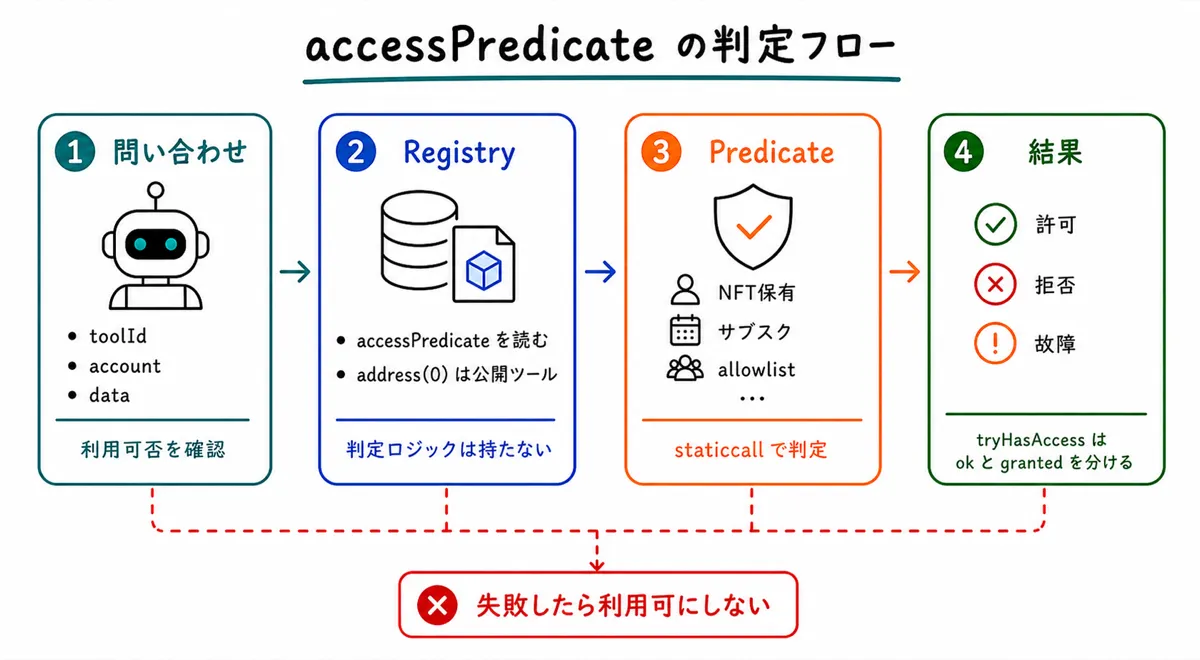
hasAccess offers a straightforward boolean result.
tryHasAccess separates a valid predicate response from the access decision, allowing UIs and agents to explain the reason more clearly.
toolCount
function toolCount() external view returns (uint256);A view function that returns the highest allocated tool ID.
- Return value
| Return value | Type | Description |
|---|---|---|
uint256 |
uint256 |
Highest toolId allocated so far. |
toolId is a sequential identifier starting at 1.
Because deregistered IDs are never reused, toolCount() represents the upper bound of allocated IDs, not the number of currently available tools.
name() / version()
function name() external view returns (string memory);
function version() external view returns (string memory);
View functions for identifying a registry implementation.
Both must return nonempty strings.
In the reference implementation, name() returns "ToolRegistry", and version() returns a string such as "0.1" or "1.0".
These values do not follow strict semantic versioning; they serve as coarse identifiers for a deployed registry.
IAccessPredicate
IAccessPredicate is the interface for externalizing access decisions.
struct AccessRequirement {
    bytes4 kind;
    bytes data;
    string label;
}

enum RequirementLogic {
    AND,
    OR
}

interface IAccessPredicate {
    function hasAccess(
        uint256 toolId,
        address account,
        bytes calldata data
    ) external view returns (bool);

    function name() external view returns (string memory);

    function getRequirements(
        uint256 toolId
    )
        external
        view
        returns (
            AccessRequirement[] memory requirements,
            RequirementLogic logic
        );
}
hasAccess
function hasAccess(
    uint256 toolId,
    address account,
    bytes calldata data
) external view returns (bool);
The predicate returns whether the specified account can use the tool identified by toolId.
- Parameters
| Parameter | Type | Description |
|---|---|---|
toolId |
uint256 |
ID of the tool to check. |
account |
address |
Account whose access is being checked. |
data |
bytes |
Contextual data passed to the predicate implementation. |
- Return value
| Return value | Type | Description |
|---|---|---|
bool |
bool |
true if the account can use the tool. |
ToolRegistry calls this function through staticcall.
The return value must be interpretable as a valid boolean.
A failure to interpret it is treated as an access denial.
name
function name() external view returns (string memory);Returns the display name of the predicate implementation.
- Return value
| Return value | Type | Description |
|---|---|---|
string |
string |
Display name of the predicate implementation. |
Wallets and agents can use this value to explain access requirements.
getRequirements
function getRequirements(
    uint256 toolId
)
    external
    view
    returns (
        AccessRequirement[] memory requirements,
        RequirementLogic logic
    );
Returns machine-readable hints so agents can determine the prerequisites in advance.
- Parameters
| Parameter | Type | Description |
|---|---|---|
toolId |
uint256 |
ID of the tool whose requirements are being queried. |
- Return values
| Return value | Type | Description |
|---|---|---|
requirements |
AccessRequirement[] |
List of prerequisites. |
logic |
RequirementLogic |
Whether the requirements are combined using AND or OR. |
AccessRequirement.kind is a four-byte identifier in the style of ERC165.
Known requirement types are listed below.
| Type | kind |
data |
|---|---|---|
IERC721Holding |
0xbdf8c428 |
abi.encode(address collection) |
IERC1155Holding |
0xcb429230 |
abi.encode(address collection, uint256 tokenId) |
ISubscription |
0x44387cc2 |
abi.encode(address collection, uint8 minTier) |
ERC165 is a standard for determining whether a contract supports a particular interface.
ERC8257 also fixes the interface IDs of IToolRegistry and IAccessPredicate.
For more on ERC165, see the following article.
[ERC165] Checking whether a contract supports a particular interface
| Interface | Interface ID |
|---|---|
IToolRegistry |
0xf1dc8075 |
IAccessPredicate |
0xbdf9dc18 |
getRequirements provides hints for discovery and preparation.
The final access decision is checked using hasAccess or tryHasAccess.
Changes to predicate configuration can cause the manifest's access hints to diverge from the onchain predicate state.
Scope of tool IDs
toolId is not a globally unique identifier on its own.
The same toolId can identify different tools on different chains or registries.
A tool reference therefore combines chainId, registryAddress, and toolId.
The recommended string representation is as follows.
eip155:<chainId>/erc8257:<registryAddress>/<toolId>At the time of the proposal, the erc8257 CAIP namespace had not yet been registered with CAIP.
Nevertheless, this string format is recommended for interoperability in anticipation of future registration.
Tool Manifest
The manifest referenced by metadataURI is a JSON document.
It contains the tool name, description, endpoint, input and output schemas, creator address, pricing, access hints, and execution environment verification information.
The following diagram shows the discovery information included in a manifest.
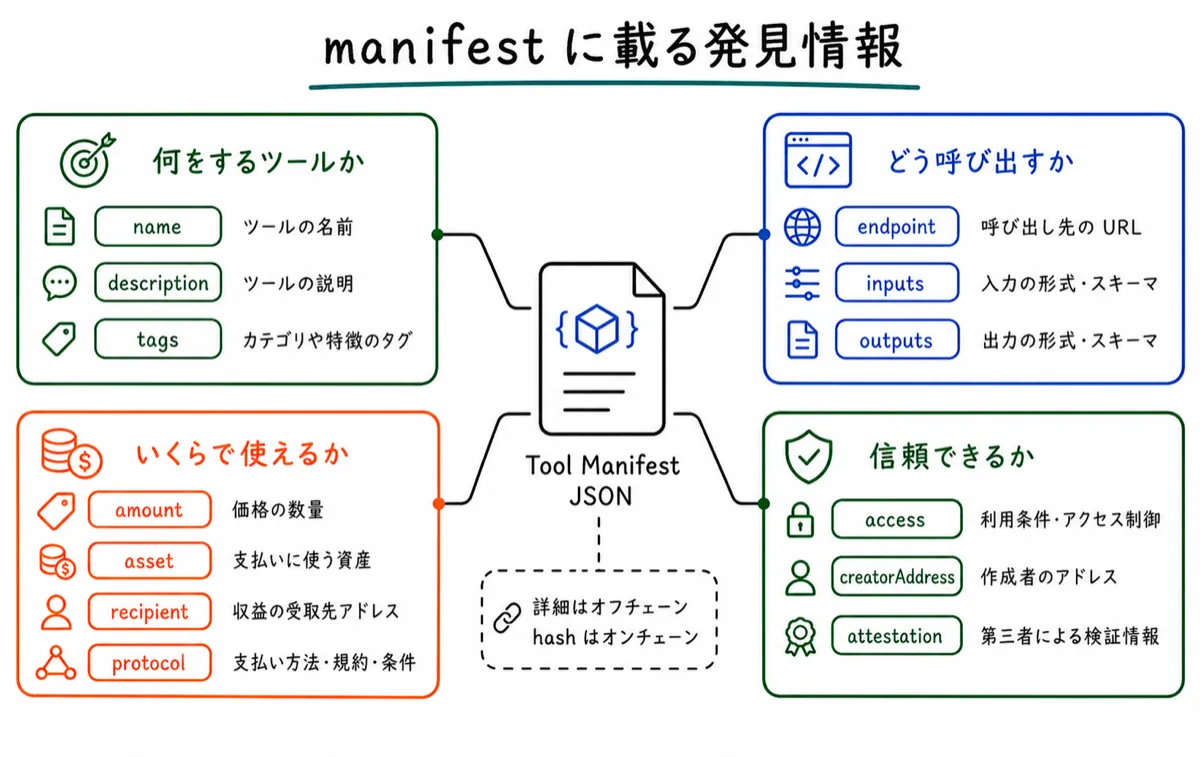
By reading a manifest, an agent can understand a tool's purpose, how to invoke it, pricing, access requirements, and information relevant to trust decisions before execution. Rather than storing these details directly onchain, the registry stores a hash of the manifest to detect tampering.
Canonicalized manifest bytes
manifestHash is not a hash of the raw JSON.
It is the keccak256 hash of bytes canonicalized using the JSON Canonicalization Scheme (JCS) defined in RFC8785.
JCS standardizes object key ordering, whitespace, numeric representations, and string escaping. In addition, ERC8257 imposes the following rules before JCS is applied.
| Rule | Requirement |
|---|---|
| Unicode | All JSON strings must be in NFC. |
| BOM | The bytes must not contain a UTF-8 BOM. |
| hex | Hex strings in the manifest must be lowercase. |
A manifest that fails any of these rules fails verification. Consumers must reject the manifest rather than silently normalize it to NFC, strip the BOM, or lowercase hex strings. Silent corrections would verify bytes other than those committed onchain.
Required fields
The main required manifest fields are listed below.
| Field | Type | Description |
|---|---|---|
type |
string |
schema version identifier |
name |
string |
Tool name, 1 to 128 Unicode code points. |
description |
string |
Tool description, 1 to 500 Unicode code points. |
endpoint |
string |
HTTPS URL hosting the tool. |
inputs |
object |
JSON Schema for input parameters. |
outputs |
object |
JSON Schema for output parameters. |
creatorAddress |
string |
Onchain address authorized to register this manifest. |
endpoint must be a URL beginning with https://.
creatorAddress must be a lowercase hex address matching ^0x[0-9a-f]{40}$ and must match the onchain creator.
Optional fields
The main optional manifest fields are listed below.
| Field | Purpose |
|---|---|
version |
Semantic version of the tool. |
image |
Tool icon URL. |
tags |
Discovery tags. |
pricing |
Available payment options. |
access |
Access requirements for preliminary checks. |
verifiability |
Self-reported claims and verification information about execution and data retention. |
Undefined top-level fields are ignored. Reverse DNS namespaces are recommended for extension fields to support future extensions.
Pricing
pricing is an array that lets agents discover a tool's price before execution.
The registry neither processes nor verifies payments.
Each element of pricing has the following fields.
| Field | Required | Description |
|---|---|---|
amount |
Yes | Amount in the smallest unit, encoded as a decimal string. |
asset |
Yes | CAIP-19 asset identifier. |
recipient |
Yes | CAIP-10 recipient identifier. |
protocol |
Yes | Payment protocol identifier. |
asset and recipient must refer to the same chain.
If pricing is present, it must be a nonempty array.
null is rejected.
Array order represents the creator's preference. The agent chooses the first protocol it supports.
When amount is "0", wallets treat the tool as free for spending-control purposes.
This differs slightly from a free tool without pricing, because it can indicate that the endpoint expects negotiation through a particular protocol.
Access requirements
The manifest's access field provides hints about predicate requirements in advance.
It serves a similar role to the onchain IAccessPredicate.getRequirements function, but the final decision belongs to the predicate's hasAccess.
The main fields of access are listed below.
| Field | Description |
|---|---|
logic |
"AND" or "OR" |
requirements |
Array of requirement objects. |
Each requirement object contains the following fields.
| Field | Description |
|---|---|
kind |
Four-byte selector in lowercase hex. |
data |
ABI-encoded payload in lowercase hex. |
label |
Short description for display. |
links |
Map of related URLs; values must be HTTPS URLs. |
Because access is part of the manifest, manifestHash commits it onchain.
However, the onchain predicate configuration can change without a manifest update.
access is therefore a preparation hint; consumers check hasAccess or tryHasAccess immediately before use.
Verifiability
verifiability helps agents assess trust in advance by describing how the tool executes and handles data.
It is also stored in the manifest, rather than the onchain ToolConfig.
Its main fields are listed below.
| Field | Purpose |
|---|---|
tier |
Summary of the trust tier. |
execution |
Execution environment. |
description |
Description. |
dataRetention |
Data retention policy. |
sourceVisibility |
Source code visibility. |
attestation |
Verification information for TEE or E2EE execution. |
reproducibleBuild |
Reproducible build information. |
The possible values of tier are as follows.
| Value | Meaning |
|---|---|
self-attested |
Entirely self-reported; no hardware isolation or reproducible builds. |
hardware-attested |
TEE attestation can be verified. |
verifiable |
Verification can combine TEE attestation with a reproducible build. |
The possible values of execution are as follows.
| Value | Meaning |
|---|---|
standard |
Conventional server-side execution. |
tee |
Execution in a Trusted Execution Environment. |
e2ee |
Input is encrypted on the client and decrypted inside a verified TEE. |
tier is a self-reported claim.
Agents should not assign high trust based on tier alone; they should check whether the structures of attestation and reproducibleBuild support the claim.
For example, a manifest whose tier is verifiable but that lacks attestation or reproducibleBuild is inconsistent.
Indexers and discovery layers are advised to flag inconsistent manifests and treat them as belonging to a lower, demonstrable trust tier.
Origin binding
The manifest must be retrievable from a well-known path on the same origin as the tool's endpoint.
<origin>/.well-known/ai-tool/<slug>.jsonslug must match the following pattern.
[a-z0-9]([a-z0-9-]*[a-z0-9])?Its length is 1 to 64 characters.
metadataURI must be a URI without a query string or fragment.
endpoint can include a path or query, but origin comparison uses only the scheme, host, and port.
This rule ensures that only the entity controlling the endpoint's origin can publish the corresponding manifest. An attacker who registers another party's API endpoint without permission fails verification because they cannot publish the manifest at the well-known path on that origin.
Creator binding
Origin Binding establishes that the manifest comes from the endpoint's origin.
However, registerTool is permissionless, so another address could still copy a valid manifest URL and register itself as the creator.
The manifest therefore includes creatorAddress.
Consumers check that the manifest's creatorAddress matches the onchain ToolConfig.creator.
{
  "creatorAddress": "0xabcdefabcdef1234567890abcdefabcdef123456"
}
creatorAddress must be a nonzero, lowercase hex address of 20 bytes.
The zero address cannot be msg.sender, so it cannot match a legitimate registrant.
Consumer verification
Agents, wallets, and indexers verify tools in the following order when resolving a registration.
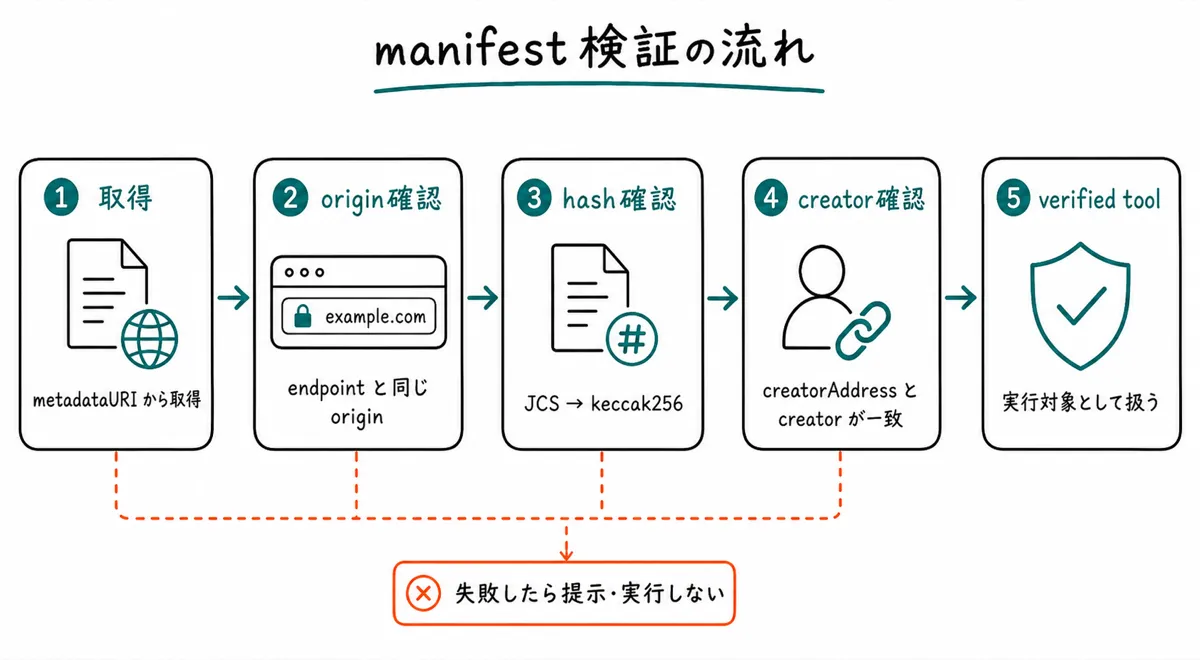
- Retrieve the manifest from
metadataURIFetch the manifest using the onchainToolConfig.metadataURI. Do not follow HTTP redirects; treat 3xx responses as verification failures. - Check that
metadataURIis at the well-known path on the same origin asendpointNormalize the URLs and check the scheme, host, port, path, and slug.metadataURImust not contain a query or fragment. - Canonicalize using JCS and check that
keccak256matchesmanifestHashThe bytes must have no UTF-8 BOM, all strings must be NFC, and hex must be lowercase. If the hash does not match, rereadgetToolConfigonce to account for a possible race with an update transaction. - Check that
creatorAddressmatches the onchaincreatorIf they differ, reject the registration as a manifest from the correct origin that was registered by another address.
Only tools that pass all four checks are treated as canonical registrations. Agents must present only canonical registrations to users and consider only those tools for execution.
Additional considerations
Hash commitments
manifestHash is an onchain commitment to the content referenced by a mutable metadataURI.
If the manifest changes, updateToolMetadata registers the new URI and hash and emits a ToolMetadataUpdated event.
Indexers can track events to detect manifest changes.
Consumers that pin a particular manifestHash can continue to use the previous commitment until they explicitly approve the new manifest.
Predicate validation
IToolRegistry.hasAccess(uint256,address,bytes) and IAccessPredicate.hasAccess(uint256,address,bytes) have the same selector.
Accidentally configuring a different contract with a function of the same name and parameters as the predicate can therefore produce unintended access decisions.
ERC8257 checks whether predicates that support ERC165 also support IAccessPredicate.
If a contract for which supportsInterface(type(IERC165).interfaceId) returns true does not support IAccessPredicate, registration or updates revert with InvalidAccessPredicate.
Contracts without ERC165 support are accepted on a best-effort basis.
The final line of defense is staticcall with strict boolean decoding.
A predicate unable to return a valid true is treated as denying access.
AccessProof using EIP712
The account parameter is the address for which the caller requests an access check.
The registry does not bind account to msg.sender.
Even when hasAccess returns true, the party making the current request may not actually control account.
To address this issue, the proposal describes an AccessProof pattern based on EIP712 typed data.
A message containing toolId, account, and deadline is signed, and the predicate or endpoint verifies the signer.
For more on EIP712, see the following article.
[EIP712] Hashing and signing typed structured data
deadline limits the period during which a proof can be reused, while including chainId and verifyingContract in the domain prevents reuse across chains or predicates.
Backward compatibility
ERC8257 introduces IToolRegistry and IAccessPredicate without modifying existing ERCs.
It uses ERC165 for interface detection without requiring changes to ERC165 itself.
Predicates are independent contracts.
Existing contracts can serve as predicates if their function signatures and behavior conform to IAccessPredicate.
Reference implementation
A Foundry-based reference implementation is maintained in the same repository as the proposal.
It includes ToolRegistry, IToolRegistry, and IAccessPredicate, with tests covering ERC165 interface IDs, manifest URI length limits, predicate integration, strict return value decoding, and predicates without code.
Implementers must avoid changing the function set of IToolRegistry in a way that changes its interface ID.
A changed function set should be treated as a different interface with its own identifier.
Security considerations
Predicate gas and failure handling
The registry calls predicates through staticcall.
If a predicate reverts, runs out of gas, or returns invalid data, hasAccess returns false and tryHasAccess returns (false, false).
The proposal does not fix a maximum gas allowance for predicate calls.
Costs for operations such as SLOAD and signature verification vary with hard forks and chain-specific gas schedules.
Contracts integrating hasAccess onchain are advised to set an explicit budget, such as staticcall{gas: budget}, to limit the worst-case cost of calling an external predicate.
Upgradeable predicates
If accessPredicate is an ERC1967 or UUPS proxy, the predicate administrator can change its access logic without calling setAccessPredicate.
Tracking changes to access requirements therefore requires monitoring not only AccessPredicateUpdated events but also the predicate's own state and events.
Consumers and indexers are advised to check predicate addresses for proxy patterns and treat proxies as higher risk.
Monitoring ERC1967 Upgraded(address) events and surfacing predicate implementation changes to users is also important.
Registry deployment
If the registry itself is deployed behind a proxy, its administrator can replace the implementation and change the behavior of hasAccess, getToolConfig, and toolCount.
For addresses treated as canonical registries, pinning the bytecode hash or deployment transaction is recommended.
By publishing the bytecode hash alongside the registry address, a discovery layer lets downstream wallets and agents verify that they are looking at the same implementation.
Read-only reentrancy
Predicate calls use staticcall, so the predicate cannot modify state.
It can, however, read the state of other contracts.
If hasAccess is called while an external protocol's state is only partially updated, the predicate may observe an inconsistent state.
Contracts that use hasAccess results to control state changes must account for read-only reentrancy when making external view calls.
If the same (toolId, account) check is used multiple times in a transaction, the first result can be cached in EIP1153 transient storage.
This is an integration-side cost optimization, not a change to registry behavior.
Do not include secrets in data
The data passed to hasAccess and tryHasAccess is forwarded directly to the predicate.
As input to an onchain view call, it may be visible in RPC traces, node logs, and monitoring infrastructure.
data must contain only contextual information that is safe to make public.
Private keys, API tokens, passwords, session cookies, bearer tokens, and other secrets must be handled securely elsewhere, not in data.
Appropriate uses include Merkle proofs, token IDs, EIP712 signatures, and signatures over public challenges, all of which can be disclosed.
Access mechanisms that require secrets should verify them at the HTTPS endpoint rather than passing them to an onchain predicate.
Predicates without deployed code
Registration and updates accept predicate addresses that do not yet have deployed code. This accommodates designs that deploy the predicate later using CREATE2.
At runtime, however, a staticcall to an address without code must still yield a return value interpretable as a valid boolean.
If decoding fails, access is denied.
Creators using counterfactual deployment are advised to verify that the CREATE2 salt and init-code hash correspond to the intended deployment and to deploy the predicate before making the tool available to users.
References
https://raw.githubusercontent.com/ethereum/ERCs/master/ERCS/erc-8257.md
Conclusion
This article covered ERC8257, the Agent Tool Registry for discovering and verifying AI agent tools onchain.
ERC8257 proposes registering AI agent tools onchain, describing them in offchain manifests, and verifying them through their hash, origin, and creator. By keeping the registry minimal, delegating access requirements to predicates, and putting pricing and execution environment details in the manifest, the design makes it easier to add new tools and payment mechanisms.
I also write articles elsewhere; feel free to explore the links below.




