Introduction
Hi, I'm cardene, a software engineer and technical writer focused on blockchain and AI.
I've also authored Japanese technical books on specification-driven development with LLMs and decentralized application (DApp) development.

I also build and publish a variety of tools, libraries, and open-source projects.
This article examines ERC8063, a proposal that interprets ERC20 token holdings as membership levels and enables threshold-based, tiered access control.
The explanation below follows the original proposal.

I also cover a variety of EIPs, BIPs, SLIPs, CAIPs, ENSIPs, RFCs, and ACPs.

Overview
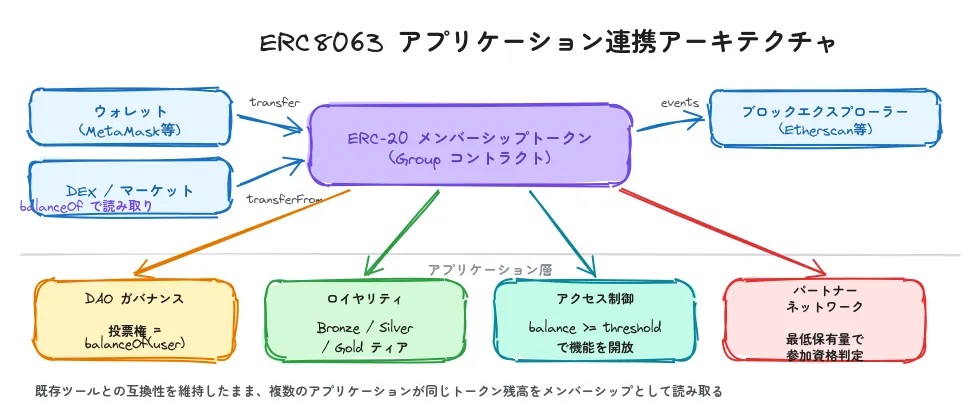
ERC8063 proposes interpreting ERC20 token balances directly as group membership levels.
For an introduction to ERC20, see the following article.
[ERC20] Understanding ERC20 from the Ground Up
The core idea is straightforward. An account holding a particular ERC20 token is considered a member of the group. If its holdings meet a specified threshold, it qualifies for a higher membership tier.
For example, if balanceOf(account) is 0, the account is not a member. A balance of at least 100 could qualify for bronze membership, 500 for silver, and 1000 for gold.
Importantly, the proposal does not introduce a new token standard. Instead, it standardizes the interpretation of an existing ERC20 token balance as a membership level. This makes it possible to introduce group membership without sacrificing compatibility with existing wallets, block explorers, or DEXs.
The following diagram illustrates the ERC8063 application integration architecture. Multiple applications interpret the balance of a single ERC20 token as membership for their respective purposes. The existing diagrams retain their original Japanese labels.
Motivation
Many applications need to group accounts and control access according to membership. Conventional approaches, however, require custom contracts or data structures to manage membership. This proposal addresses that problem using mechanisms already provided by ERC20 tokens.
DAOs and governance
Decentralized autonomous organizations (DAOs) commonly use models in which voting power is proportional to token holdings. Since the number of tokens held directly determines voting weight, these models fit naturally with the proposal's threshold-based approach.
For example, a DAO could grant proposal rights only to members holding a minimum number of tokens and give additional privileges to members with larger holdings, without adding a separate membership implementation.
Loyalty programs
Tiered loyalty programs that assign bronze, silver, or gold status based on customer activity are commonplace. With ERC8063, the token balance itself determines the tier, so points balances and membership ranks do not have to be managed in separate systems. Distributing tokens automatically updates membership levels.
Access control and partner networks
Access to particular features or services can also be opened progressively according to token balances. For example, a partner network could require participating companies to hold a specified quantity of tokens. Token holdings serve as proof of eligibility, removing the need to maintain participant lists and manually update access control lists.
What the proposal provides
The benefits of ERC8063 for these use cases can be grouped into four areas.
| Feature | Description |
|---|---|
| Zero token implementation cost | An existing ERC20 token can serve directly as a group. No new contract or additional function is required for balance-based interpretation. |
| Compatibility with existing tools | Wallets, block explorers, and DEXs continue to work as before. |
| Tiered membership | Balance thresholds naturally represent multiple membership tiers. |
| Transferable membership | Membership can be transferred or delegated using the ERC20 transfer function. |
Specification
A group contract conforming to this proposal must implement ERC20 and ERC165. The proposal also defines an optional interface that simplifies membership checks.
For an explanation of ERC165, see the following article.
[ERC165] Detecting Whether a Contract Supports a Particular Interface
Interfaces
IERC8063
This convenience interface allows membership to be checked onchain. Implementing it is optional, but it simplifies membership checks for applications.
// SPDX-License-Identifier: CC0-1.0
pragma solidity ^0.8.20;

/// @title IERC8063 — Optional membership introspection for ERC-20 tokens
interface IERC8063 {
    /// @notice Returns true if `account` holds at least `threshold` tokens
    /// @param account The address to check
    /// @param threshold Minimum balance required for membership at this tier
    function isMember(address account, uint256 threshold) external view returns (bool);
}
isMember
Checks whether the specified account holds at least the specified threshold of tokens.
- Parameters
| Parameter | Type | Description |
|---|---|---|
account |
address |
The address whose membership is being checked. It can be either an EOA or a contract. |
threshold |
uint256 |
The minimum balance required for the tier. For a silver tier, for example, this could be 500 * 10**18. |
- Return value
bool — returns true if the account's balanceOf is at least the threshold, and false otherwise.
If this function is implemented, isMember(account, threshold) must return the same result as balanceOf(account) >= threshold. Passing 0 as the threshold returns true for every account, because a threshold of 0 means that everyone qualifies as a member.
ERC165 interface IDs
Interface detection through ERC165 is also supported.
| Interface ID | Interface | Expected return value |
|---|---|---|
0x36372b07 |
ERC20 | Should return true |
Interface ID of IERC8063 |
isMember function |
true if the optional interface is implemented |
Applications can call supportsInterface to determine whether a contract provides the membership-checking interface. Even if IERC8063 is not supported, applications can check membership by calling balanceOf directly.
Membership semantics
Under ERC8063, token balances directly represent membership levels.
| Condition | Membership status |
|---|---|
balanceOf(account) == 0 |
Non-member |
balanceOf(account) > 0 |
Member |
balanceOf(account) >= threshold |
Member of the tier associated with that threshold |
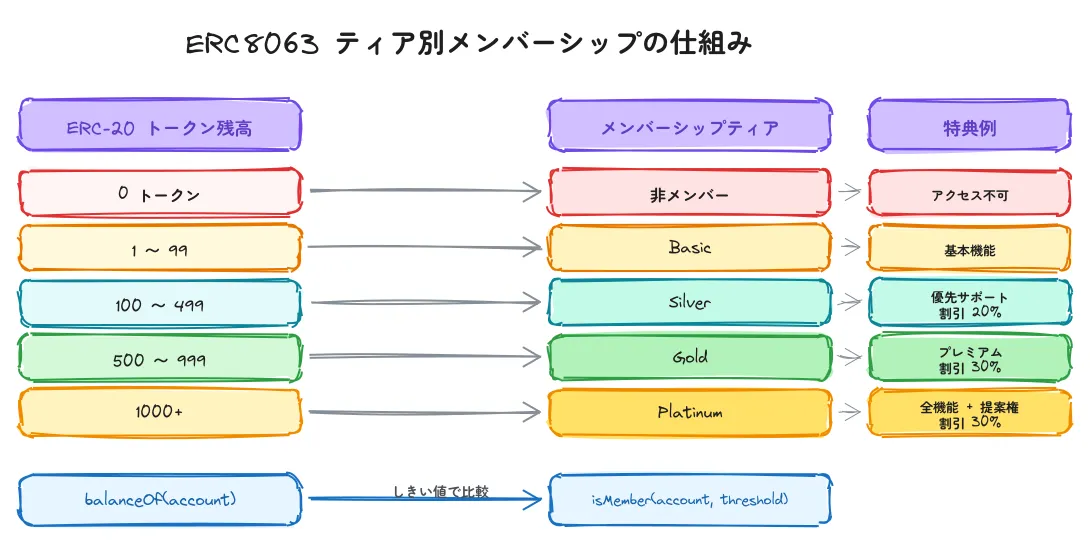
Applications are free to define their own thresholds. For example, tiers could be structured as follows.
| Tier | Required balance | Example benefits |
|---|---|---|
| Basic | >= 1 |
Access to basic group features |
| Silver | >= 100 * 10**decimals |
Priority support and additional features |
| Gold | >= 500 * 10**decimals |
Premium features and greater voting power |
| Platinum | >= 1000 * 10**decimals |
Highest privileges and proposal rights |
The key design decision is that thresholds are defined by applications rather than hardcoded into the contract. For the same token, one application could define silver membership as 100 tokens while another sets its silver threshold at 200.
The following diagram shows how membership tiers and benefits are determined from token balances.
The following flowchart illustrates how an account's balance determines its membership tier.
flowchart TD
    A["balanceOf(account) を確認"] --> B{"残高 == 0?"}
    B -- "はい" --> C["非メンバー"]
    B -- "いいえ" --> D{"残高 >= Platinum?"}
    D -- "はい" --> E["Platinum メンバー"]
    D -- "いいえ" --> F{"残高 >= Gold?"}
    F -- "はい" --> G["Gold メンバー"]
    F -- "いいえ" --> H{"残高 >= Silver?"}
    H -- "はい" --> I["Silver メンバー"]
    H -- "いいえ" --> J["Basic メンバー"]
As shown in the flowchart, the application checks balance thresholds starting with the highest tier to identify the tier the account belongs to. Threshold checks are simple numeric comparisons, which are also efficient in terms of gas costs.
Deployment model
As with ERC20, each group is deployed as a separate contract.
| Item | Description |
|---|---|
| Group identity | Uniquely identified by the contract address |
| Deployment | Deploy any ERC20 token. The token itself serves as the group. |
| Group discovery | Monitor Transfer events, consult a registry, or specify an address directly. |
| Name and symbol | The standard ERC20 name() and symbol() serve as the group name and symbol. |
The design defines a group not as a new primitive, but as a way to interpret an existing ERC20 token. In other words, even an already-deployed ERC20 token can function as a group if an application interprets its balances as membership.
Minting and burning
The proposal does not prescribe how tokens are minted (issued) or burned (destroyed). Implementers can choose mechanisms appropriate to their use cases.
| Minting mechanism | Description |
|---|---|
Standard mint(address, uint256) |
The owner issues tokens to a specified address. |
ERC5679-compliant mint(address, uint256, bytes) |
Minting with additional data |
| Fixed supply | No minting after initial issuance; membership is distributed only at launch. |
| Governance-controlled | Minting is approved through a governance process such as voting. |
| Open minting | Anyone can mint tokens and join the group. |
Leaving minting mechanisms unspecified accommodates a wide range of use cases. For instance, an invitation-only group can restrict minting to administrators, while an open community can allow anyone to mint.
Burning is likewise implementation-defined. The appropriate design depends on the nature of the group, including whether members may leave voluntarily or administrators may remove them.
Additional considerations
Rationale for the design decisions
The proposal makes several important design decisions.
First, it defines a group as a plain ERC20 token to avoid introducing another token standard. Simply assigning membership semantics to ERC20 tokens provides immediate compatibility with the existing ecosystem of wallets, DEXs, and explorers.
Second, the proposal leaves minting and burning mechanisms unspecified because the most suitable minting policy varies considerably by use case. Invitation-only private groups and open communities admit new members in fundamentally different ways. Mandating a minting mechanism would favor particular use cases at the expense of general applicability.
Threshold-based membership, rather than binary membership (member or non-member), was chosen because it naturally represents tiered access, loyalty programs, and proportional voting power. If binary membership is required, balances can simply be restricted to at most 1, making the threshold-based design more flexible.
The isMember function is optional because calling balanceOf directly provides an equivalent check. It is a convenience interface; comparing balanceOf(account) >= threshold directly in an application is equally valid.
Example of tiered membership
The proposal introduces a PartnerBenefits contract as an example of an application that uses threshold-based membership. The contract returns a discount rate based on the balance of a membership token.
contract PartnerBenefits {
    IERC20 public membershipToken;

    uint256 public constant BRONZE = 100 * 10**18;
    uint256 public constant SILVER = 500 * 10**18;
    uint256 public constant GOLD = 1000 * 10**18;

    function getDiscount(address user) external view returns (uint256) {
        uint256 balance = membershipToken.balanceOf(user);
        if (balance >= GOLD) return 30;
        if (balance >= SILVER) return 20;
        if (balance >= BRONZE) return 10;
        return 0;
    }

    function isMember(address user) external view returns (bool) {
        return membershipToken.balanceOf(user) > 0;
    }
}
In this contract, getDiscount returns a percentage discount according to the account's balance. Gold members (at least 1000 tokens) receive a 30% discount, silver members (at least 500 tokens) receive 20%, and bronze members (at least 100 tokens) receive 10%. Accounts holding no tokens receive no discount.
| Tier | Required balance | Discount |
|---|---|---|
| Gold | At least 1000 tokens | 30% |
| Silver | At least 500 tokens | 20% |
| Bronze | At least 100 tokens | 10% |
| Non-member | 0 tokens | 0% |
Notably, the PartnerBenefits contract does not manage the membership token itself. It reads balanceOf from an external ERC20 token to determine membership and grant benefits. Responsibilities are clearly separated: the token contract manages membership, while a separate contract implements benefit logic.
The isMember function performs a simple member/non-member check based on whether the balance is greater than 0. When no tier needs to be determined, this function alone is sufficient to check membership.
Optional extensions
Ownership management with ERC173 and ERC8023
If a group needs a single owner, it can incorporate standardized ownership patterns from ERC173 (Ownable) or ERC8023. For example, restricting minting and burning to the owner allows an administrator alone to grant and revoke membership.
Binary membership
For use cases that require only a yes-or-no membership check rather than multiple tiers, an implementation can restrict every account's balance to at most 1. A balance of 1 then means membership, while 0 means non-membership. This restriction can be enforced by ensuring that transfer never raises a balance above 1.
Compatibility
ERC8063 is fully backward-compatible with ERC20. It does not change token behavior; it only defines the semantic interpretation of an existing ERC20 balance as membership.
| Standard or tool | Compatibility | Notes |
|---|---|---|
| ERC20 | ✅ Fully compatible | Group contracts implement ERC20. Existing ERC20 tokens can also serve directly as groups. |
| ERC165 | ✅ Fully compatible | Supports interface detection via supportsInterface. |
| Existing wallets | ✅ Work unchanged | Wallets such as MetaMask can display balances and send or receive tokens. |
| Existing DEXs | ✅ Work unchanged | Membership tokens can be traded like ordinary tokens. |
| Block explorers | ✅ Work unchanged | Explorers such as Etherscan can display token holders and Transfer events. |
The most important compatibility feature is that already-deployed ERC20 tokens can be used as groups simply by having applications interpret their balances as membership. Membership functionality can therefore be added without modifying an existing token.
Security considerations
Token economics and membership
Because membership is directly tied to token balances, market prices and liquidity affect the cost of acquiring membership. For example, a sharp increase in token price raises the cost for new members to acquire enough tokens to reach a threshold. Conversely, a price collapse makes membership easier to obtain and may trigger an unintended surge in participation. Application designers should account for the effect of token price fluctuations on the composition and quality of membership.
Threshold manipulation
If thresholds are stored onchain and can be changed through governance, unauthorized or malicious changes can manipulate membership criteria. For example, a malicious proposal could raise a threshold dramatically and forcibly downgrade existing members. Timelocks or multisignature approvals are recommended for threshold changes.
Membership changes through token transfers
Transferring tokens with the standard ERC20 transfer function lowers the sender's membership level and raises the recipient's level, where balances cross the relevant thresholds. This is intentional, but it may be undesirable in some use cases. If a loyalty program does not want memberships to be bought and sold, for instance, it may need to override transfer to restrict token transfers.
Approval risks and decimal handling
The risks associated with the standard ERC20 approve function still apply. Calling approve for another address allows that address to transfer membership tokens, potentially causing the approving account to lose membership.
It is also important to account for the token's decimals when setting thresholds. For a token with decimals of 18, a threshold of 100 tokens corresponds to 100 * 10**18 in raw units. An incorrect conversion prevents tier checks from functioning as intended.
Security of minting permissions
Contracts that permit minting must strictly control who can mint. Without appropriate access control, unauthorized parties can grant membership. Depending on the use case, minting may be restricted to administrators, require multisignature approval, or be subject to a governance vote.
Reference implementation
IERC8063.sol
Interface definition for membership checks.
// SPDX-License-Identifier: CC0-1.0
pragma solidity ^0.8.20;

/// @title IERC8063 — Optional membership introspection for ERC-20 tokens
/// @notice A Group is an ERC-20 token where balance represents membership level
interface IERC8063 {
    /// @notice Returns true if `account` holds at least `threshold` tokens
    /// @param account The address to check
    /// @param threshold Minimum balance required for membership at this tier
    /// @dev Equivalent to: balanceOf(account) >= threshold
    function isMember(address account, uint256 threshold) external view returns (bool);
}
IERC8063 is a simple interface defining only the isMember function. Because the function is equivalent to balanceOf(account) >= threshold, an implementation can simply call balanceOf internally and compare the result with the threshold.
ERC8063.sol
The reference implementation provides the basic ERC20 functionality and implements IERC8063 and ERC165.
// SPDX-License-Identifier: CC0-1.0
pragma solidity ^0.8.20;

import "./IERC8063.sol";

contract ERC8063 is IERC8063 {
    string private _name;
    string private _symbol;
    uint8 private immutable _decimals;
    address private _owner;
    uint256 private _totalSupply;

    mapping(address => uint256) private _balances;
    mapping(address => mapping(address => uint256)) private _allowances;

    event Transfer(address indexed from, address indexed to, uint256 value);
    event Approval(address indexed owner, address indexed spender, uint256 value);

    modifier onlyOwner() {
        require(msg.sender == _owner, "Not owner");
        _;
    }

    constructor(
        string memory groupName,
        string memory groupSymbol,
        uint8 tokenDecimals,
        uint256 initialSupply
    ) {
        _name = groupName;
        _symbol = groupSymbol;
        _decimals = tokenDecimals;
        _owner = msg.sender;

        if (initialSupply > 0) {
            _balances[msg.sender] = initialSupply;
            _totalSupply = initialSupply;
            emit Transfer(address(0), msg.sender, initialSupply);
        }
    }

    // ============ ERC-165 ============

    function supportsInterface(bytes4 interfaceId) external pure returns (bool) {
        return
            interfaceId == type(IERC8063).interfaceId ||
            interfaceId == 0x36372b07 || // ERC-20
            interfaceId == 0x01ffc9a7;   // ERC-165
    }

    // ============ ERC-20 ============

    function name() public view returns (string memory) { return _name; }
    function symbol() public view returns (string memory) { return _symbol; }
    function decimals() public view returns (uint8) { return _decimals; }
    function totalSupply() public view returns (uint256) { return _totalSupply; }

    function balanceOf(address account) public view returns (uint256) {
        return _balances[account];
    }

    function transfer(address to, uint256 amount) public returns (bool) {
        _transfer(msg.sender, to, amount);
        return true;
    }

    function allowance(address owner, address spender) public view returns (uint256) {
        return _allowances[owner][spender];
    }

    function approve(address spender, uint256 amount) public returns (bool) {
        require(spender != address(0), "Zero address");
        _allowances[msg.sender][spender] = amount;
        emit Approval(msg.sender, spender, amount);
        return true;
    }

    function transferFrom(address from, address to, uint256 amount) public returns (bool) {
        uint256 currentAllowance = _allowances[from][msg.sender];
        require(currentAllowance >= amount, "Insufficient allowance");
        unchecked {
            _allowances[from][msg.sender] = currentAllowance - amount;
        }
        _transfer(from, to, amount);
        return true;
    }

    function _transfer(address from, address to, uint256 amount) internal {
        require(from != address(0), "Transfer from zero");
        require(to != address(0), "Transfer to zero");
        require(_balances[from] >= amount, "Insufficient balance");
        unchecked {
            _balances[from] -= amount;
        }
        _balances[to] += amount;
        emit Transfer(from, to, amount);
    }

    // ============ Minting/Burning ============

    function mint(address to, uint256 amount) external onlyOwner {
        require(to != address(0), "Mint to zero");
        _balances[to] += amount;
        _totalSupply += amount;
        emit Transfer(address(0), to, amount);
    }

    function burn(address from, uint256 amount) external {
        require(msg.sender == _owner || msg.sender == from, "Not authorized");
        require(_balances[from] >= amount, "Insufficient balance");
        unchecked {
            _balances[from] -= amount;
            _totalSupply -= amount;
        }
        emit Transfer(from, address(0), amount);
    }

    // ============ IERC8063 ============

    function isMember(address account, uint256 threshold) public view override returns (bool) {
        return _balances[account] >= threshold;
    }

    // ============ Ownership ============

    function owner() public view returns (address) { return _owner; }

    function transferOwnership(address newOwner) external onlyOwner {
        require(newOwner != address(0), "Zero address");
        _owner = newOwner;
    }
}
The following sections explain the key parts of the reference implementation.
Constructor
The constructor accepts the group name (name), symbol (symbol), number of decimal places (decimals), and initial supply (initialSupply). If the initial supply is greater than 0, the entire amount is allocated to the deployer. The deployer can then distribute tokens to other members using transfer to grant group membership.
supportsInterface
The ERC165 supportsInterface function returns true for the IERC8063 interface ID, the ERC20 interface ID (0x36372b07), and the ERC165 interface ID itself (0x01ffc9a7). This allows external applications to dynamically discover the interfaces supported by the contract.
isMember
The isMember implementation is straightforward: it directly returns the result of _balances[account] >= threshold. Accessing the internal _balances mapping directly saves a small amount of gas compared with calling balanceOf.
Minting and burning
In this reference implementation, only the owner can call mint, while burn can be called by either the owner or the token holder. This is one possible implementation and can be adapted to the use case.
References
Conclusion
This article covered group membership using ERC20 tokens under ERC8063.
The defining feature of the proposal is its simple but powerful approach: assigning membership level semantics to existing ERC20 token balances without creating a new token standard. Existing infrastructure can be reused as-is, making adoption relatively easy.
If you are interested, you can also find my other articles and work at the links below.



